Home Blog

How to Learn Video Editing in Nepal 2026: 10 Powerful Tips

0
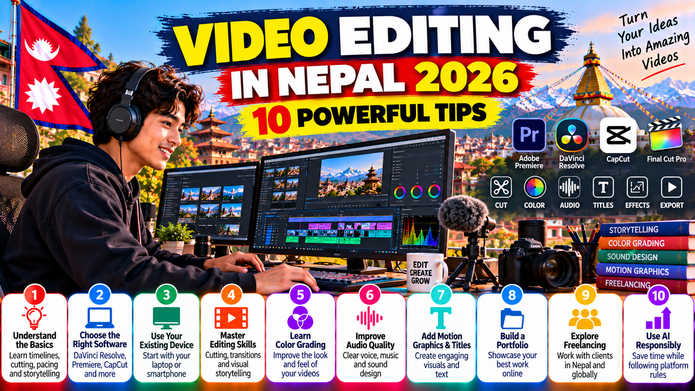
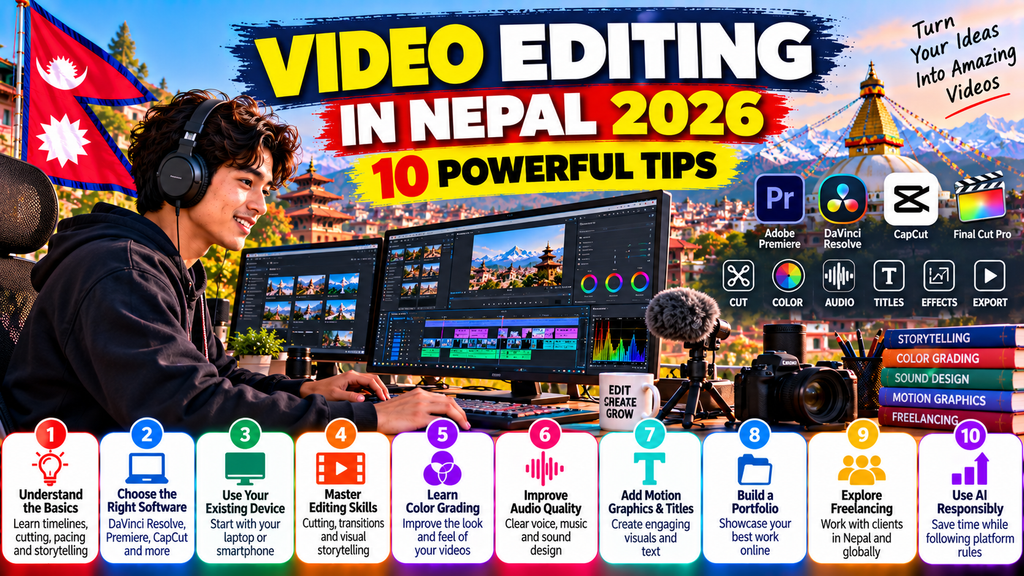
Video editing in Nepal 2026 showing a Nepali student editing videos on a computer with a timeline, camera and 10 powerful learning tips

By Eleven Nepal Editorial Team | Updated: 20 October 2026 | Category: Technology & Digital Skills
Learning video editing in Nepal can be a valuable way to develop creative skills, produce digital content and explore professional opportunities in media, marketing, filmmaking and online services.

Whether you want to edit YouTube videos, create Instagram Reels, produce travel documentaries, work with businesses or become a freelance video editor, understanding the fundamentals of editing is an important first step.

The good news is that beginners do not necessarily need an expensive computer, professional camera or paid editing subscription.

You can begin learning with a smartphone or a suitable computer, free editing software and original practice footage.

However, professional video editing involves much more than adding transitions, background music and visual effects.

A skilled editor understands storytelling, pacing, audio, colour, continuity, organisation and the needs of the intended audience.

In 2026, creators can explore established tools such as DaVinci Resolve and Adobe Premiere, alongside mobile editing applications. Artificial intelligence is also becoming part of some editing workflows, although editors still need to evaluate the accuracy and quality of automated results.

For Nepalese students and aspiring freelancers, developing practical editing skills may help build a portfolio and prepare for legitimate employment or client projects.

But how should beginners start?

Which software should they choose? Can video editing be learned for free? What computer specifications matter? How long does it take to become competent? And how can someone demonstrate their skills to potential clients?

This guide explains 10 powerful tips for learning video editing in Nepal in 2026, including software selection, essential techniques, colour correction, audio editing, portfolios, freelancing and responsible AI use.

It also provides a practical 30-day learning plan, hypothetical equipment budgets, beginner project ideas and 25 frequently asked questions.

Important: This article provides educational guidance, not guaranteed employment, income or career outcomes. Software features, subscriptions and platform policies can change. Always confirm current information with official providers.

Why Learn Video Editing in Nepal in 2026?

Video is used across many forms of communication, including education, entertainment, advertising, journalism and business promotion.

Editing transforms recorded footage into a coherent finished production.

Opportunities for Content Creators

YouTube creators, podcasters and social media publishers may need editing skills to prepare videos for their audiences.

A creator producing cooking tutorials, for example, might combine preparation footage, close-up shots, voiceovers and captions.

Opportunities for Businesses

Businesses may use video to explain products, demonstrate services, introduce staff or communicate with customers.

An editor could help prepare suitable promotional material.

However, business demand varies and should not be assumed without market research.

Opportunities in Filmmaking

Film and documentary production involves organising footage, developing narrative structure and collaborating with other creative professionals.

Editing is an important part of this process.

Opportunities for Freelancers

Independent editors may provide services to clients locally or internationally.

However, obtaining clients depends on practical ability, communication, competition, contracts and payment arrangements.

Developing Transferable Skills

Video editing can improve attention to detail, organisation, storytelling, problem-solving and technical confidence.

These skills can also support broader digital careers.

For additional background, read Eleven Nepal’s Nepal Tech Revolution 2026, which discusses technology skills and digital opportunities.

1. Understand the Fundamentals of Video Editing

Before choosing software, beginners should understand what editing actually involves.

What Is Video Editing?

Video editing is the process of selecting, arranging, trimming and modifying recorded footage to communicate a story or message.

It may also involve sound, titles, graphics, visual effects and colour adjustments.

Understand the Timeline

Most editing applications use a timeline.

The timeline shows how video and audio clips are arranged over time.

Editors use it to control the order, duration and relationship between different elements.

Learn Cutting and Trimming

Cutting divides footage into sections.

Trimming adjusts the beginning or end of a clip.

These basic operations are among the most important editing skills.

Understand Continuity

Continuity helps a sequence feel visually and logically connected.

For example, a cooking demonstration should show preparation steps in an understandable order.

Learn About Pacing

Pacing refers to how quickly or slowly information is presented.

A fast-paced promotional video may use shorter shots than an educational documentary.

Neither approach is automatically better.

The appropriate pace depends on the subject and audience.

Understand B-Roll

B-roll is supporting footage used to illustrate the main content.

A tourism video might use landscape shots, transport scenes and details of local activities.

Learn Basic Storytelling

Good editing helps viewers understand what is happening and why it matters.

A simple structure includes an introduction, development and conclusion.

Beginner Practice Exercise

Record five short clips showing how to prepare a cup of tea.

Arrange them in a logical sequence.

Remove unnecessary pauses.

Add a clear opening title and export the result.

Key lesson: Learn storytelling, cutting and pacing before focusing on complicated effects.

2. Choose the Right Video Editing Software

Choosing suitable software is one of the most important decisions for beginners learning video editing in Nepal.

Different applications offer different workflows, hardware requirements and licensing arrangements.

DaVinci Resolve

DaVinci Resolve is a professional editing application developed by Blackmagic Design.

It combines editing, colour correction, visual effects, motion graphics and audio post-production tools.

Blackmagic provides a free version alongside its paid Studio edition.

Why Consider DaVinci Resolve?

The free version provides a substantial environment for learning professional editing concepts.

Blackmagic also publishes official tutorials, training books and practice files.

Its Beginner’s Guide to DaVinci Resolve 20 covers media management, timeline editing, colour, audio and visual effects.

Adobe Premiere

Adobe Premiere is another established professional editing application.

Adobe provides official learning materials covering beginner editing, sequences, transitions, audio, graphics and other techniques.

Premiere generally uses a subscription-based commercial licensing model.

Check current plans and device requirements before subscribing.

CapCut and Mobile Editors

Mobile editing applications may be suitable for short-form videos, basic titles and social media content.

However, features, availability and commercial-use conditions may vary.

Free Versus Paid Software

A free application can be sufficient for many beginner projects.

Paid software may offer additional features, integrations or specialised capabilities.

Purchasing expensive software does not automatically make someone a better editor.

Software Comparison

SoftwareCommon useBeginner consideration
DaVinci ResolveEditing, colour, audio and effectsFree edition and official training
Adobe PremiereProfessional video editingOfficial tutorials; commercial subscription
CapCutMobile and social video workflowsCheck current features and licensing
iMovieBasic editing on compatible Apple devicesAccessible introduction to timeline editing
KdenliveDesktop editingOpen-source alternative
ShotcutDesktop editingOpen-source alternative

Which Software Should You Learn First?

If your computer can run it reliably, DaVinci Resolve is a strong option for developing broad editing skills.

If you already use Adobe software or need Premiere for a specific course or workplace, learning Premiere may be more appropriate.

If you only have a smartphone, start with a compatible mobile editor.

Avoid Switching Applications Constantly

Learning one programme thoroughly is usually more productive than repeatedly changing tools.

Official learning resources:

https://www.blackmagicdesign.com/products/davinciresolve/training
https://www.adobe.com/learn/premiere-pro

Key lesson: Choose software that matches your device, learning goals and budget.

3. Learn Video Editing With Your Existing Computer or Smartphone

Beginners often believe that professional editing requires an expensive laptop.

Hardware matters, but the correct starting point depends on the footage and software.

Can You Edit on a Smartphone?

Yes.

Mobile devices can support basic editing, captions, transitions and short-form video production.

Performance depends on the device and application.

Can You Edit on an Older Laptop?

Possibly.

A computer may handle simple projects but struggle with high-resolution footage or complex effects.

Check the editing software’s current minimum and recommended system requirements.

Understand RAM

RAM helps applications manage active tasks.

Insufficient memory may contribute to slow performance.

However, increasing RAM does not solve every editing problem.

Understand the GPU

Graphics processors can accelerate certain editing, colour and effects operations.

The importance of GPU performance depends on the application and workflow.

Understand Storage

Video files can occupy substantial storage space.

Solid-state drives may improve responsiveness compared with slower storage devices.

However, actual performance depends on the hardware and project.

Use Proxy Media

Proxy media consists of lower-demand versions of original video files.

Editors can use proxies during editing and return to the original footage for final delivery.

This can improve the editing experience on less powerful systems.

Reduce Preview Quality

Many applications allow lower-resolution playback previews.

This can reduce processing demands without permanently changing the source footage.

Organise Your Storage

Keep sufficient free space for media, cache files and exports.

Protect Your Projects

Maintain backups of original footage and project files.

Avoid relying on a single storage device.

Illustrative Equipment Budget

The following figures are hypothetical budgeting allowances, not verified Nepalese market prices.

ItemIllustrative additional cost
Existing computer or smartphoneNPR 0
External storageNPR 5,000
Basic headphonesNPR 2,000
Optional accessoriesNPR 1,000
Illustrative totalNPR 8,000

Actual prices and requirements vary.

Key lesson: Test your existing equipment and optimise your workflow before making major purchases.

4. Master Cutting, Transitions and Storytelling

Cutting is one of the most important abilities an editor can develop.

An effective edit should guide the viewer without drawing unnecessary attention to itself.

Learn the Basic Cut

A standard cut moves directly from one shot to another.

It is often more useful than an elaborate transition.

Understand Jump Cuts

Jump cuts remove sections of continuous footage.

They are frequently used to shorten talking-head videos.

However, excessive jump cuts may become distracting.

Learn J-Cuts and L-Cuts

A J-cut introduces audio from the next scene before the picture changes.

An L-cut allows audio from the previous scene to continue after the picture changes.

These techniques can make transitions feel more natural.

Understand Match Cuts

A match cut connects shots through similar movement, shape or visual composition.

It can help create a smooth visual relationship.

Avoid Overusing Transitions

Wipes, zooms and animated transitions may be useful in particular contexts.

But applying them between every clip can distract from the message.

Use B-Roll Purposefully

Supporting footage should illustrate the subject.

For example, a café documentary could show coffee preparation while the owner discusses operations.

Remove Unnecessary Pauses

Careful trimming can improve clarity and pacing.

However, leaving some natural pauses may be important in interviews or emotional storytelling.

Think About the Viewer

Ask whether every shot contributes useful information, context or atmosphere.

Practice Project

Create a 60-second video about a local place using ten original clips.

Arrange the shots to establish location, introduce an activity and conclude with a clear final image.

Key lesson: Strong storytelling and thoughtful cuts matter more than flashy effects.

5. Learn Colour Correction and Colour Grading

Colour can influence how viewers perceive a video.

However, colour correction and colour grading are not identical.

What Is Colour Correction?

Colour correction involves improving technical consistency.

It may include adjusting exposure, white balance, contrast and colour balance.

What Is Colour Grading?

Colour grading involves developing a particular visual style or mood.

For example, a documentary may use restrained colours, while a travel montage may emphasise warmth and saturation.

Start With Exposure

Ensure important subjects are visible without unnecessary loss of highlight or shadow detail.

Understand White Balance

Incorrect white balance can make neutral objects appear too warm or too cool.

Match Different Shots

Footage recorded under different lighting conditions may look inconsistent.

Matching shots can help maintain visual continuity.

Learn Scopes

Waveforms, histograms and vectorscopes provide technical information about image levels and colour.

They can support more consistent adjustments.

Avoid Excessive Saturation

Highly saturated colours may appear unnatural or distracting.

Understand LUTs

A lookup table, commonly called a LUT, can transform image values.

LUTs can be useful in colour workflows, but they are not automatic solutions for every shot.

Learn Colour Management

Colour management helps maintain more predictable results across footage, displays and output formats.

Beginners should understand basic concepts before experimenting with advanced workflows.

Practice Exercise

Record the same subject under two different lighting conditions.

Correct exposure and white balance.

Then try to make both shots appear visually consistent.

Key lesson: Learn accurate colour correction before developing dramatic cinematic looks.

6. Improve Audio Editing and Sound Design

Audio is an essential part of professional video production.

Even attractive footage may be difficult to enjoy when speech is unclear.

Understand Dialogue Editing

Dialogue editing involves improving spoken recordings.

Tasks may include trimming unwanted sections, reducing distractions and adjusting levels.

Monitor With Headphones

Headphones can help identify clicks, background noise and other issues.

Understand Audio Levels

Audio that is too quiet may be difficult to hear.

Audio that is too loud may distort.

Learn Equalisation

Equalisation adjusts the balance of different frequency ranges.

It can help improve clarity when applied appropriately.

Understand Compression

Audio compression reduces dynamic-range differences.

It may help make speech levels more consistent.

However, excessive compression can make recordings sound unnatural.

Use Noise Reduction Carefully

Noise-reduction tools can reduce some background sounds.

Aggressive processing may introduce audible artefacts.

Add Music Responsibly

Background music should support the video rather than overpower dialogue.

Understand Sound Effects

Sound effects can improve atmosphere and communication.

Use them intentionally.

Respect Copyright

Music and sound recordings may be protected by copyright.

Finding a track online does not automatically provide permission for commercial use.

YouTube explains that creators need appropriate rights to use third-party audio and visual material.

Learn Fairlight or Other Audio Tools

DaVinci Resolve includes Fairlight audio tools.

Blackmagic provides an official Fairlight training guide.

Practice Exercise

Record a short spoken introduction.

Edit out unnecessary noise, balance the level and add appropriately licensed background music.

Key lesson: Clear, balanced audio can significantly improve the viewing experience.

7. Learn Motion Graphics, Titles and Visual Effects

Once you understand basic editing, you can begin exploring motion graphics.

What Are Motion Graphics?

Motion graphics are animated visual elements used to communicate information.

Examples include moving titles, diagrams and lower-thirds.

Learn Basic Titles

Start with readable titles that identify the topic or speaker.

Understand Keyframes

Keyframes define how a property changes over time.

They can control movement, scale, opacity and other settings.

Create Lower-Third Graphics

Lower-thirds are often used to identify speakers in interviews.

Understand Masking

Masking allows editors to isolate or control parts of an image.

Learn Basic Compositing

Compositing combines multiple visual elements into one scene.

Explore Fusion

DaVinci Resolve includes Fusion for visual effects and motion graphics.

Blackmagic provides official training resources for beginners.

Avoid Unnecessary Complexity

A complicated animation may take considerable time without improving the viewer’s understanding.

Maintain Consistent Branding

Use consistent typography, spacing and visual styles across related projects.

Consider Accessibility

Ensure text is readable and remains on screen long enough to understand.

Practice Exercise

Create a short educational video featuring an animated title, speaker identification and a simple visual explanation.

Key lesson: Motion graphics should make information clearer, not simply make the video look more complicated.

8. Build a Professional Video Editing Portfolio

A portfolio provides evidence of what you can create.

For beginners learning video editing in Nepal, completed projects can be more useful than simply listing software knowledge.

What Is a Video Editing Portfolio?

A portfolio is a collection of selected work that demonstrates your editing skills.

Start With Original Practice Projects

You do not need a paying client to begin building a portfolio.

Create projects using your own footage or material that you are authorised to use.

Include Different Editing Styles

You might prepare:

  • A short promotional video.
  • An educational tutorial.
  • A travel montage.
  • A talking-head video.
  • A podcast highlight.
  • A short documentary.
  • A social media advertisement concept.

Show Your Contribution

Explain whether you handled editing, filming, audio, colour or graphics.

Create Before-and-After Examples

Where appropriate, show how editing improved the original footage.

Ensure you have permission to display the material.

Use Clear Project Descriptions

Explain the objective, editing process and final output.

Avoid Misrepresenting Client Work

Do not claim that a fictional practice project was commissioned by a real company.

Keep the Portfolio Focused

A small selection of strong projects may be more useful than a large collection of unfinished work.

Choose a Suitable Platform

You can present your portfolio through a personal website or compatible video-sharing service.

Check privacy and licensing settings.

Update Your Work

Replace older examples as your abilities improve.

For advice on presenting skills to employers, see Eleven Nepal’s How to Make a Professional CV in Nepal.

Key lesson: A portfolio should demonstrate genuine ability, originality and professional judgement.

9. Explore Freelance Video Editing Opportunities in Nepal

Once you have developed practical skills, you may consider offering editing services.

However, freelancing is a business activity as well as a creative profession.

Identify Potential Clients

Possible clients may include content creators, businesses, educational organisations and media producers.

These are potential customer groups, not verified current vacancies.

Choose a Service

You might specialise in YouTube editing, short-form videos, podcast editing or promotional content.

Understand Client Requirements

Ask about the intended audience, final video length, delivery format, deadline and number of revisions.

Agree on the Scope

A written agreement can clarify expectations.

Consider Project Complexity

A simple short-form edit may require different work from a documentary involving extensive footage and sound design.

Avoid Promising Unrealistic Turnaround Times

Estimate the work required before agreeing to a deadline.

Build Professional Communication Skills

Respond clearly, confirm instructions and explain when information is missing.

Protect Your Files

Use suitable backup and transfer procedures.

Avoid sharing confidential client footage without authorisation.

Understand Payments

Freelancers should investigate available payment methods, fees, contracts and potential scams.

Do not assume that every international platform supports every Nepalese payment arrangement.

Avoid Guaranteed-Income Claims

There is no universal salary or freelance rate for video editors in Nepal.

Income depends on skill, project scope, experience, client demand and negotiated terms.

Illustrative Freelance Revenue Example

Suppose a fictional beginner completes three editing projects in one month.

Assume a hypothetical fee of NPR 4,000 per project.

The illustrative gross revenue would be:

3 × NPR 4,000 = NPR 12,000.

This is not a verified Nepalese market rate, typical beginner income or earnings forecast.

Actual revenue could be lower, higher or zero.

Expenses and taxes may also affect the amount retained.

Learn Related Digital Skills

Video editing can complement graphic design, marketing, writing and content strategy.

For related guidance, read Eleven Nepal’s AI Skills in Nepal 2026.

Key lesson: Freelance success depends on reliable delivery, communication and business judgement as well as technical editing skills.

10. Use AI Tools Responsibly in Video Editing

Artificial intelligence is increasingly integrated into creative software.

Some tools can assist with transcription, captions, audio repair, object selection and other production tasks.

AI-Assisted Transcription

Automatic transcription can convert speech into editable text.

However, transcripts may contain mistakes, particularly with names, accents and multilingual dialogue.

AI-Assisted Captions

Captions can improve accessibility.

Always review automatically generated text before publishing.

AI Audio Repair

Some tools can reduce background noise or improve speech clarity.

The results should be checked carefully.

AI-Assisted Object Selection

Certain editing applications provide automated masking or object-selection features.

These can save time in suitable workflows.

AI-Generated Visuals

AI-generated images and footage may be useful for some creative projects.

However, they can also misrepresent people, locations and events.

YouTube Disclosure Requirements

YouTube requires creators to disclose certain realistic AI-generated or meaningfully altered content.

Examples include realistic fabricated events or making a real person appear to say something they did not say.

Ordinary colour correction, caption generation and other routine production assistance do not automatically require the same disclosure.

Respect Consent

Do not use synthetic voices or manipulated likenesses to impersonate real people deceptively.

Verify AI-Generated Information

AI systems may generate inaccurate subtitles, factual claims or visual details.

Human review remains important.

Understand Monetization Policies

YouTube clarified its inauthentic-content policy on 15 July 2025, explicitly addressing repetitive or mass-produced material.

Using AI tools does not automatically prevent monetization, but originality and policy compliance remain important.

Combine AI With Human Skills

Editors should understand the underlying techniques instead of depending entirely on automated tools.

Key lesson: AI can assist editing, but creativity, accuracy and professional responsibility remain essential.

Best Free Resources to Learn Video Editing in Nepal

Beginners can access learning materials from established software providers.

Blackmagic Design Training

Blackmagic publishes DaVinci Resolve training videos, books and lesson files.

Its official materials cover editing, colour, audio and visual effects.

Website: https://www.blackmagicdesign.com/products/davinciresolve/training

Adobe Learn

Adobe provides Premiere tutorials for beginners and experienced users.

Topics include sequences, transitions, graphics, colour and audio.

Website: https://www.adobe.com/learn/premiere-pro

Kdenlive Documentation

Kdenlive provides documentation for its open-source video editing software.

Website: https://docs.kdenlive.org/

Shotcut Tutorials

Shotcut provides information and tutorials for its editing application.

Website: https://www.shotcut.org/tutorials/

Apple iMovie Support

Apple provides instructions for using iMovie on compatible devices.

Website: https://support.apple.com/imovie

Learning From Practice

Official tutorials are useful, but watching them is not the same as developing practical competence.

Complete projects using your own footage.

Are Certificates Necessary?

A certificate may document completion of training.

However, employers and clients may also evaluate portfolios, experience and practical performance.

No particular certificate guarantees employment.

A Practical 30-Day Video Editing Learning Plan

The following plan is a suggested beginner schedule.

It is not a promise that every learner will become professionally competent within 30 days.

Week 1: Learn the Basics

Day 1: Choose suitable editing software.

Day 2: Install the software and explore its interface.

Day 3: Learn how to import and organise footage.

Day 4: Practise placing clips on the timeline.

Day 5: Learn cutting and trimming.

Day 6: Practise basic transitions.

Day 7: Export a short practice video.

Week 2: Improve Storytelling and Audio

Day 8: Study pacing and continuity.

Day 9: Practise editing a talking-head video.

Day 10: Add useful B-roll.

Day 11: Learn basic audio-level adjustments.

Day 12: Practise noise reduction.

Day 13: Add titles and captions.

Day 14: Complete a one-minute educational video.

Week 3: Learn Colour and Graphics

Day 15: Understand exposure and white balance.

Day 16: Practise basic colour correction.

Day 17: Match footage from different scenes.

Day 18: Learn keyframe animation.

Day 19: Create a lower-third title.

Day 20: Experiment with simple motion graphics.

Day 21: Complete a short promotional video.

Week 4: Build a Portfolio

Day 22: Choose a portfolio project.

Day 23: Plan the story and collect footage.

Day 24: Create the first edit.

Day 25: Improve the audio.

Day 26: Correct colour and add graphics.

Day 27: Review the final video.

Day 28: Export and present the project.

Day 29: Write a project description.

Day 30: Evaluate your progress and plan the next month.

What Should You Expect After 30 Days?

You may develop familiarity with essential tools and complete several beginner projects.

Professional competence usually requires additional practice, feedback and experience.

Seven Beginner Video Editing Projects to Practise

1. Nepal Travel Montage

Use original footage to create a short visual story about a location.

Practise pacing and music selection.

2. Cooking Tutorial

Record food preparation and organise the steps into a clear instructional video.

Practise continuity and close-up editing.

3. Talking-Head Educational Video

Record someone explaining a subject.

Practise dialogue editing and captions.

4. Small-Business Promotional Concept

Create a fictional advertisement using footage you own or are licensed to use.

Clearly identify it as a practice project.

5. Podcast Highlight

Edit a short section from a recording you have permission to use.

Practise speaker framing and subtitles.

6. Before-and-After Colour Project

Correct exposure and colour in several clips.

Explain the adjustments.

7. Mini Documentary

Create a short documentary about a place, craft or activity.

Practise research, storytelling and sound design.

How Much Does It Cost to Learn Video Editing in Nepal?

Learning costs depend on your device, software and preferred training method.

Some beginners may use free software and existing equipment.

Others may choose paid courses, additional storage or upgraded hardware.

Illustrative Learning Budgets

The following are hypothetical scenarios, not verified Nepalese prices.

Learning setupIllustrative additional budget
Existing smartphone and free editorNPR 0
Existing computer and free editorNPR 0
Basic accessories and storageNPR 8,000
Expanded training and equipment allowanceNPR 30,000

Illustrative Monthly Learning Expenses

ExpenseHypothetical allowance
Additional internet/dataNPR 1,500
Learning materialsNPR 1,000
Storage or accessoriesNPR 1,500
Illustrative totalNPR 4,000

Actual expenses depend on the learner’s circumstances.

Should You Pay for a Course?

A structured course may help learners who benefit from instructor feedback and a planned curriculum.

However, free official training materials may be sufficient to begin.

Questions to Ask Before Enrolling

Check the course syllabus, instructor experience, software requirements, practical projects, assessment method and refund conditions.

Avoid programmes promising guaranteed employment or unusually high earnings without credible evidence.

Common Video Editing Mistakes Beginners Should Avoid

Using Too Many Transitions

Excessive effects can distract from the content.

Ignoring Audio

Poor dialogue quality can undermine otherwise strong footage.

Overusing Colour Filters

Unnecessary colour changes may make videos look inconsistent.

Failing to Organise Files

Poor file management can cause missing media and project delays.

Editing Without a Story

Technical effects cannot replace clear communication.

Copying Other Creators’ Work

Originality matters for both professional reputation and platform policies.

Ignoring Copyright

Music and footage may require permission or appropriate licensing.

Exporting Without Checking

Always review the final file for missing audio, incorrect framing and other errors.

Relying Entirely on AI

Automated tools can make mistakes and do not replace editorial judgement.

Expecting Immediate Freelance Income

A completed course or portfolio does not guarantee clients.

Frequently Asked Questions About Video Editing in Nepal

1. Can I learn video editing in Nepal for free?

Yes. Beginners can use free editing applications and official training resources, although internet and equipment expenses may still apply.

2. Which software is best for beginners?

The best choice depends on your device and goals. DaVinci Resolve, iMovie and suitable mobile editors are possible starting points.

3. Is DaVinci Resolve free?

Blackmagic Design provides a free version of DaVinci Resolve alongside its paid Studio edition.

4. Is Adobe Premiere free?

Adobe Premiere is generally offered through paid licensing arrangements. Check Adobe’s current plans and trial conditions.

5. Can I learn video editing on my phone?

Yes. Mobile applications can support many basic editing tasks.

6. Do I need an expensive laptop?

Not necessarily. Hardware requirements depend on the software, footage and complexity of the project.

7. Can an older laptop run video editing software?

Possibly. Check the software’s requirements and consider lower-resolution footage or proxy workflows.

8. What is the first editing skill I should learn?

Start with importing footage, cutting clips, arranging a timeline and exporting a finished video.

9. What is the difference between colour correction and colour grading?

Colour correction improves technical consistency, while colour grading develops a visual style.

10. What is B-roll?

B-roll is supporting footage that illustrates or complements the main content.

11. What are proxy files?

Proxy files are less demanding versions of original media used to make editing easier.

12. Is video editing difficult to learn?

The basics can be approachable, but advanced editing requires sustained practice and technical understanding.

13. How long does it take to learn video editing?

There is no universal timeline. Progress depends on practice, prior experience, software and project complexity.

14. Can I become a freelance video editor in Nepal?

Yes, you may explore freelance services, but securing clients and income is not guaranteed.

15. How much do video editors earn in Nepal?

There is no single verified rate applicable to every editor. Earnings depend on employment arrangements, skills, experience and project requirements.

16. Do I need a video editing certificate?

Not universally. Some employers may value certificates, while others focus on practical work and portfolios.

17. How do I build a portfolio without clients?

Create original practice projects and clearly identify them as personal work.

18. Can I use copyrighted music in edited videos?

You need appropriate rights or another lawful basis for using protected material.

19. Can I use AI for video editing?

Yes. AI tools can assist with some tasks, but results should be reviewed and platform rules followed.

20. Does YouTube require disclosure of AI-edited videos?

YouTube requires disclosure for certain realistic AI-generated or significantly altered content, not every ordinary editing adjustment.

21. Can I edit YouTube Shorts?

Yes. Suitable editing software can be used to create short-form videos.

22. Is DaVinci Resolve suitable for professional work?

Yes. It provides professional editing, colour, audio and visual-effects workflows, subject to edition-specific features and system requirements.

23. What should I practise every day?

Practise a specific technique and apply it to a small finished project.

24. Can video editing help with digital marketing?

Yes. Editing skills can support the production of educational, promotional and social media content.

25. What is the most important tip for learning video editing?

Focus on storytelling, complete original projects and improve through consistent practice and feedback.

Conclusion: Start Learning Video Editing in Nepal Today

Learning video editing in Nepal in 2026 can provide a practical way to develop creative, technical and communication skills.

You do not necessarily need expensive equipment or paid software to begin.

A suitable smartphone or computer, free editing tools and a structured learning plan can provide a useful starting point.

The ten essential areas covered in this guide are understanding editing fundamentals, selecting software, working with available hardware, mastering storytelling, learning colour, improving audio, exploring graphics, building a portfolio, understanding freelance work and using AI responsibly.

Beginners should focus on completing original projects rather than simply watching tutorials.

As your abilities improve, you can explore more complex productions, specialised workflows and professional opportunities.

Blackmagic Design and Adobe provide official training resources that can support structured learning.

However, neither software knowledge nor course completion guarantees employment or freelance income.

Long-term progress depends on practical ability, creativity, professional communication and continued learning.

Your first edited video does not need to be perfect. It needs to be completed, reviewed and used as an opportunity to improve.

Start with a simple project, learn from your mistakes and gradually build a portfolio that demonstrates your genuine skills.

Eleven Nepal — Empowering Youth Through Knowledge, Skills and Opportunities.


References and Official Sources

1. Blackmagic Design (accessed 20 October 2026). DaVinci Resolve Official Training.

https://www.blackmagicdesign.com/products/davinciresolve/training

2. Blackmagic Design (DaVinci Resolve 20 edition). The Beginner’s Guide to DaVinci Resolve 20.

https://documents.blackmagicdesign.com/UserManuals/DaVinci-Resolve-20-Beginners-Guide.pdf

3. Blackmagic Design (accessed 20 October 2026). DaVinci Resolve Product Information.

https://www.blackmagicdesign.com/products/davinciresolve

4. Adobe (accessed 20 October 2026). Learn Adobe Premiere.

https://www.adobe.com/learn/premiere-pro

5. Adobe (updated 21 May 2026). Adobe Video Tutorials.

https://experienceleague.adobe.com/en/docs/creative-cloud-enterprise-learn/cce-learning-hub/videooverview/overview-dva

6. Kdenlive (accessed 20 October 2026). Official Documentation.

https://docs.kdenlive.org

7. Shotcut (accessed 20 October 2026). Official Tutorials.

https://www.shotcut.org/tutorials

8. Apple Support (accessed 20 October 2026). iMovie Support.

https://support.apple.com/imovie

9. YouTube Help (accessed 20 October 2026). Disclosing Use of Generative AI Content.

https://support.google.com/youtube/answer/14328491

10. YouTube Help (policy clarification dated 15 July 2025). YouTube Channel Monetization Policies.

https://support.google.com/youtube/answer/1311392

11. YouTube Help (accessed 20 October 2026). What Kind of Content Can I Monetize?

https://support.google.com/youtube/answer/2490020

12. YouTube Help (accessed 20 October 2026). Remove Copyright-Claimed Content From Videos.

https://support.google.com/youtube/answer/2902117

13. Eleven Nepal (14 October 2026). AI Skills in Nepal 2026: 7 Essential Skills for Students and Jobseekers.

14. Eleven Nepal (14 October 2026). Nepal Tech Revolution 2026: 5 Powerful Opportunities for Youth.

15. Eleven Nepal (October 2026). How to Make a Professional CV in Nepal: 7 Essential Steps.

Editorial note: This article uses official software and platform guidance reviewed in October 2026. Software capabilities, availability and licensing may change. All NPR budgets and freelance revenue calculations are hypothetical examples, not verified Nepalese retail prices, typical wages or earnings forecasts. This article does not guarantee employment, client acquisition or financial results.


How to Start a Podcast in Nepal 2026: 10 Powerful Tips

0
Featured image alt text Podcast in Nepal 2026 featuring Nepali creators recording with microphones, headphones and a laptop, with 10 powerful podcasting tips

By Eleven Nepal Editorial Team | Updated: 20 October 2026 | Category: Technology & Digital Skills

Starting a podcast in Nepal can be an exciting opportunity for students, entrepreneurs, journalists, educators and creative individuals who want to share their ideas with a wider audience.

Whether you want to discuss Nepalese culture, interview successful entrepreneurs, explain technology, share personal experiences or create educational content, podcasting offers a flexible way to communicate with listeners.

Unlike traditional broadcasting, podcasting does not necessarily require a professional studio or an expensive production team.

You can begin with a smartphone, a quiet recording space, a clear topic and suitable recording software.

However, creating a successful podcast involves more than buying a microphone and talking for an hour.

You need to identify your audience, choose relevant topics, prepare episodes, record understandable audio, edit carefully, distribute your content and develop a consistent publishing strategy.

Many beginners also have questions about podcast monetization.

Can you earn money from a podcast in Nepal? Is Spotify podcast hosting free? Should you publish on YouTube? How much equipment do you need? Are there copyright rules for using music?

These questions matter because online tutorials sometimes exaggerate earning opportunities or provide outdated information about platform eligibility.

In 2026, creators can explore audio podcasts, video podcasts and short clips that introduce longer conversations.

Services such as Spotify for Creators, Apple Podcasts and YouTube provide different publishing and discovery options, although features and eligibility vary.

This guide explains 10 powerful tips for starting a podcast in Nepal in 2026, including equipment, recording, editing, distribution, branding, promotion and possible income opportunities.

It also includes an illustrative startup budget, a practical 30-day launch plan, beginner-friendly podcast ideas and 25 frequently asked questions.

Important: Podcasting does not guarantee listeners, sponsorships, employment or income. Platform features, costs and commercial obligations may change. Always confirm important information through official sources.

What Is a Podcast?

A podcast is a programme distributed as a series of episodes, usually centred on a particular subject or theme.

Many podcasts are audio-only, although video podcasts have become an established format.

Episodes may feature a single presenter, interviews, group discussions, storytelling or educational explanations.

Listeners can access podcasts through compatible applications, websites and media platforms.

Audio Podcasts

Audio podcasts focus on spoken content.

They can be suitable for interviews, discussions, educational lessons and storytelling.

An audio-only programme may require less filming equipment than a video podcast.

However, clear sound and thoughtful editing remain important.

Video Podcasts

Video podcasts include visual recordings of presenters or guests.

They can be published on compatible video platforms, including YouTube.

Video can make conversations more engaging for viewers who prefer to watch speakers.

However, video production may require additional lighting, storage and editing time.

Solo Podcasts

A solo podcast features one main presenter.

This format can be useful for tutorials, commentary, personal experiences and educational explanations.

Interview Podcasts

Interview podcasts feature conversations with guests.

They may provide different perspectives and specialist knowledge.

Group Discussion Podcasts

Group discussions involve multiple speakers.

These require careful microphone placement and conversation management to prevent overlapping dialogue.

Which Format Is Best?

There is no universally best format.

The right choice depends on your audience, subject, resources and communication style.

Beginners should select a format they can produce consistently.

Why Start a Podcast in Nepal in 2026?

Podcasting can provide a platform for sharing information and developing creative skills.

Nepal offers many potential subjects, including culture, entrepreneurship, education, tourism, food, technology and personal development.

Share Nepalese Stories

Podcasts can document experiences that may receive limited attention through traditional media.

For example, a creator could interview local entrepreneurs, artists or skilled workers.

Support Education

Educational podcasts can explain complex topics in accessible language.

A student-focused programme might discuss examination preparation, career planning or digital skills.

Develop Communication Skills

Preparing and presenting episodes can help improve public speaking, interviewing, research and storytelling.

Build a Personal Brand

A consistent podcast can become part of a creator’s professional portfolio.

However, publishing episodes does not automatically establish credibility.

Accuracy, experience and responsible communication remain important.

Connect With Different Audiences

Creators can publish in Nepali, English or other languages.

Language selection should reflect the intended audience.

Explore Future Commercial Opportunities

Some established podcasts may attract sponsors or support related businesses.

These opportunities depend on audience trust, commercial demand and the creator’s circumstances.

They should not be treated as guaranteed outcomes.

For broader digital career opportunities, read Eleven Nepal’s AI Skills in Nepal 2026.

1. Choose the Right Podcast Niche in Nepal

The first step in starting a podcast in Nepal is deciding what your programme will discuss.

A niche is the main subject or audience focus of your content.

Why Your Niche Matters

A clearly defined subject helps listeners understand what to expect.

It also makes episode planning easier.

For example, a podcast about Nepalese entrepreneurship might feature business owners, startup lessons and practical management discussions.

Ten Podcast Niches to Consider

1. Entrepreneurship: Interviews with business owners and discussions about business development.

2. Education: Study techniques, career planning and academic experiences.

3. Technology: Digital tools, software, cybersecurity and technology trends.

4. Nepalese Culture: Language, traditions, food and cultural history.

5. Tourism: Travel experiences, responsible tourism and destination information.

6. Personal Development: Communication, time management and learning habits.

7. Food and Hospitality: Culinary careers, restaurant operations and traditional recipes.

8. Creative Careers: Filmmaking, photography, design and music production.

9. Agriculture: Farming experiences, food systems and rural entrepreneurship.

10. Community Stories: Conversations about local experiences and social issues.

These are editorial suggestions, not a verified ranking of Nepal’s most popular or profitable podcast categories.

Identify Your Target Listener

Ask yourself who will benefit from the programme.

A podcast for university students may use different language and examples from a programme for established business owners.

Evaluate Your Knowledge

Choose a subject you can discuss responsibly.

For specialised topics such as health, finance or law, distinguish personal experience from professional advice.

Research Existing Podcasts

Listen to programmes covering similar topics.

Notice their structure, episode length, presentation and audience questions.

Do not copy their branding or original content.

Create a Clear Podcast Promise

A podcast promise explains the value offered to listeners.

For example:

“Weekly conversations with Nepalese entrepreneurs about their experiences, decisions and lessons.”

This is clearer than a description that simply says, “We talk about everything.”

Key lesson: A focused subject and identifiable audience provide a stronger starting point than choosing a niche solely because it appears profitable.

2. Create a Memorable Podcast Name and Brand

Your podcast name is an important part of its identity.

It should communicate the programme’s purpose and be easy to recognise.

Choose a Clear Name

A good name should be memorable, relevant and suitable for the intended audience.

Avoid names that are unnecessarily complicated.

Check for Existing Names

Search major podcast directories, YouTube and the web for similar names.

Also consider whether the name could conflict with an existing brand or protected trademark.

Design Podcast Cover Artwork

Cover artwork represents your show in podcast applications.

Use clear typography, a recognisable visual identity and an appropriate image.

Understand Artwork Requirements

Different platforms may specify artwork dimensions, formats and other technical requirements.

Apple Podcasts publishes official artwork guidance.

Review the current specifications before exporting your final design.

Write a Podcast Description

A useful description explains the subject, audience and type of episodes.

For example:

“Welcome to Himalayan Conversations, a podcast exploring entrepreneurship, education and creative careers in Nepal through practical discussions and guest interviews.”

This is an illustrative description for a fictional podcast.

Create Consistent Branding

Use similar visual elements across episode artwork, social profiles and promotional clips.

Choose Introductory Music Carefully

If you use music, confirm that you have the appropriate rights.

Do not assume that a song is free to use because it is available online.

Establish a Professional Contact Method

Consider creating a dedicated email address for guest enquiries and business communication.

Key lesson: Good branding should help people understand and remember your podcast without misleading them about its purpose.

3. Start With Affordable Podcast Equipment

One common misconception is that podcasting requires expensive microphones, mixers and cameras.

Professional equipment can be useful, but beginners can test their concept with a much simpler setup.

Can You Record With a Smartphone?

Yes.

A smartphone can record spoken audio using a suitable application.

The quality depends on microphone placement, room acoustics, recording settings and background noise.

Why Audio Quality Matters

Listeners need to understand the speakers.

Echo, distortion, electrical interference and excessive background noise can make a conversation difficult to follow.

Basic Podcast Equipment

EquipmentMain purpose
Smartphone or computerRecording and editing
MicrophoneCapturing speech
HeadphonesMonitoring audio
Microphone standStable microphone positioning
Pop filter or windscreenReducing certain unwanted sounds
Recording softwareCapturing the conversation
Editing softwareImproving and organising audio

USB Microphones

USB microphones can connect directly to compatible computers.

They may be convenient for beginners recording in one location.

XLR Microphones

XLR microphones generally require a suitable audio interface, mixer or recorder.

They can offer flexibility for more complex setups.

Headphones

Headphones help presenters monitor recordings and detect unwanted noise.

Closed-back headphones may be useful when monitoring speech near microphones.

Room Acoustics

A quiet room with soft furnishings may reduce some unwanted reflections.

Avoid recording near loud appliances, busy roads or open windows when possible.

Microphone Placement

Position the microphone consistently and avoid unnecessary movement.

Test the sound before recording an entire episode.

Illustrative Beginner Podcast Budget

The following amounts are hypothetical planning allowances, not verified Nepalese retail prices.

ItemIllustrative cost
Existing smartphone or laptopNPR 0 additional purchase
Basic microphoneNPR 3,000
HeadphonesNPR 2,000
Microphone standNPR 1,500
Pop filter or windscreenNPR 500
Miscellaneous accessoriesNPR 1,000
Illustrative totalNPR 8,000

Actual prices vary by brand, retailer, availability and product specifications.

Should You Buy a Camera?

A camera is optional for audio-only podcasts.

If you plan to produce video, test your smartphone before purchasing a dedicated camera.

Key lesson: Improve your recording environment and microphone technique before spending heavily on equipment.

4. Plan Your Podcast Episodes Before Recording

A podcast becomes easier to produce when each episode has a clear purpose.

Planning does not mean every sentence must be scripted.

It means understanding what the episode should communicate.

Define the Episode Objective

Ask what listeners should learn or understand by the end.

Create a Basic Episode Structure

An interview episode might include:

  • A short introduction.
  • Guest background.
  • Main discussion topics.
  • Practical examples.
  • Key lessons.
  • Closing remarks.

Prepare Research Notes

If you discuss factual subjects, review credible sources before recording.

Write Interview Questions

Prepare open-ended questions that encourage useful explanations.

For example:

“What was the biggest challenge when you opened your first business?”

This may produce a more informative response than a simple yes-or-no question.

Avoid Overloading One Episode

Trying to cover too many unrelated subjects can make a conversation difficult to follow.

Choose a Suitable Episode Length

There is no universal ideal duration.

An educational explanation might be short, while an in-depth interview may take longer.

Choose a length appropriate to the content.

Prepare Follow-Up Questions

Listen carefully to your guest and ask for clarification where needed.

Fact-Check Important Claims

Guests may express opinions or recall events inaccurately.

Consider verifying important factual claims before publication.

Plan Your First Five Episodes

For a fictional Nepalese entrepreneurship podcast, a beginner plan could include:

  1. Why People Start Small Businesses in Nepal.
  2. Lessons From a First-Time Entrepreneur.
  3. How Business Owners Approach Customer Service.
  4. Common Challenges in Managing a Small Team.
  5. Developing Useful Skills Before Starting a Business.

These are content ideas, not verified market-demand findings.

Key lesson: Preparation creates a more useful conversation without removing spontaneity.

5. Learn Podcast Recording and Editing

Recording and editing are essential production skills.

A well-edited podcast should remain natural while removing avoidable distractions.

Choose Recording Software

Depending on your device, you may explore tools such as Audacity, GarageBand or other established recording applications.

Check current compatibility and licensing.

Test Before Recording

Record a short sample.

Listen for background noise, echo, clipping and differences in speaker volume.

Use Separate Audio Tracks Where Possible

Recording speakers on separate tracks can make editing easier.

This may require suitable equipment or recording software.

Record Remote Interviews Carefully

Remote conversations depend on internet stability, microphone quality and the recording service.

Explain the recording arrangement to guests beforehand.

Avoid Interruptions

Silence notifications and reduce avoidable distractions.

Learn Basic Editing

Begin with trimming unwanted sections, balancing levels and removing distracting noise where appropriate.

Do Not Overprocess Audio

Excessive noise reduction or compression can make speech sound unnatural.

Review the Full Episode

Listen to the finished programme before publication.

Check for missing sections, abrupt edits and accidental disclosure of private information.

Export Suitable Audio Files

Follow your podcast hosting platform’s current supported formats and technical requirements.

Save Backups

Keep original recordings and project files in a secure location.

A second backup can help protect against accidental loss.

Key lesson: Reliable recording and careful editing are more valuable than unnecessary sound effects.

6. Choose the Right Podcast Hosting Platform

Podcast hosting is different from recording.

A hosting service stores your podcast episodes and may provide an RSS feed used by compatible podcast directories.

What Is an RSS Feed?

An RSS feed contains information about your podcast and episodes.

This may include titles, descriptions, artwork and links to audio files.

Podcast applications can use the feed to discover new episodes.

Spotify for Creators

Spotify for Creators offers free podcast hosting and publishing tools.

It also provides analytics and other creator features.

However, monetization eligibility and feature availability vary.

Does Spotify Automatically Publish Everywhere?

No.

Spotify’s official guidance explains that a podcast hosted through Spotify for Creators is automatically available on Spotify.

To distribute through other platforms, creators may need to enable their RSS feed and submit it separately.

How to Find Your Spotify RSS Feed

Spotify explains that the feed becomes available after the first episode is published.

Creators can locate RSS distribution settings through their account.

Protect Your Email Address

Spotify warns that enabling RSS distribution can make the email address associated with the feed publicly visible.

Consider using an appropriate dedicated contact address.

Other Hosting Services

Other podcast hosting providers may offer different storage limits, distribution features and pricing arrangements.

Compare their current terms before selecting one.

Questions to Ask Before Choosing a Host

Consider whether the service supports your preferred format, provides an RSS feed, allows access to analytics and offers suitable export or migration options.

Free Hosting Versus Paid Services

A free hosting service may be sufficient for a beginner.

Paid plans may offer additional tools, but purchasing a subscription does not guarantee audience growth.

Official source: https://creators.spotify.com/features/podcast

Key lesson: Choose a host based on your publishing needs and current features, not unsupported monetization promises.

7. Publish Your Podcast on Spotify, Apple Podcasts and YouTube

Distribution makes episodes accessible to listeners.

However, each platform has its own requirements.

Publishing on Spotify

Creators using Spotify for Creators can follow its official hosting and publishing workflow.

After publishing, review the show’s details and availability.

Publishing on Apple Podcasts

Apple Podcasts allows creators to submit a qualifying RSS feed through Apple Podcasts Connect.

Apple states that shows must satisfy technical requirements and undergo review.

Basic Apple Podcasts Submission Process

Create or access an Apple Podcasts Connect account.

Choose the option to add a show using an RSS feed.

Enter the feed address.

Review show details, rights declarations and availability settings.

Submit the show according to Apple’s instructions.

Apple Podcasts Technical Requirements

Apple requires appropriate RSS information, at least one episode and suitable artwork.

Feeds must pass technical validation.

Publishing on YouTube

YouTube treats a podcast as a playlist containing podcast episodes in video form.

Creators can create and manage podcasts through YouTube Studio.

Can an Audio Podcast Appear on YouTube?

Yes.

YouTube supports audio-first podcast publishing through eligible workflows.

One approach is to create a video using suitable static artwork or other visuals.

YouTube RSS Import

YouTube also supports podcast RSS-feed ingestion in selected countries and regions.

This feature is not universally available.

Creators in Nepal should check their YouTube Studio account for current access.

Do Not Assume Automatic Cross-Platform Distribution

Spotify, Apple Podcasts and YouTube operate separate publishing systems.

An upload to one service does not necessarily publish the same episode everywhere.

Check Your Published Episodes

After distribution, verify the title, artwork, description, audio playback and episode order.

Official sources:

https://support.spotify.com/sn-en/creators/article/finding-and-enabling-your-rss-feed
https://podcasters.apple.com/support/897-submit-a-show
https://support.google.com/youtube/answer/13175969

Key lesson: Successful distribution requires correct metadata, suitable hosting and compliance with each platform’s requirements.

8. Promote Your Podcast and Build an Audience

Publishing an episode is only the beginning.

Listeners need a way to discover your programme.

Create a Simple Podcast Website

A website can provide episode descriptions, transcripts, resources and contact information.

Use Social Media Carefully

Share relevant episode highlights rather than repeatedly posting identical promotional messages.

Create Short Clips

A useful conversation segment can become a short promotional video.

Ensure the clip represents the original discussion accurately.

Write Clear Episode Titles

A title should explain the subject.

For example:

“Starting a Small Café in Nepal: Lessons From a Business Owner”

This is more informative than a vague title such as “Episode 5.”

Publish Show Notes

Show notes can summarise the episode and provide links to relevant resources.

Invite Suitable Guests

Guests may bring useful knowledge and different perspectives.

Choose them based on relevance and credibility.

Collaborate With Other Creators

Collaboration can help introduce a podcast to related audiences.

Engage With Listeners

Ask for thoughtful questions and respond respectfully where possible.

Maintain a Realistic Schedule

A predictable release schedule can help establish expectations.

However, quality and accuracy should take priority over publishing frequency.

Avoid Artificial Engagement

Buying fake followers or manipulating metrics does not build a genuine audience.

Key lesson: Sustainable audience development depends on useful episodes, clear presentation and authentic engagement.

9. Understand Podcast Monetization in Nepal

Podcasting can support commercial activity, but income is not automatic.

A programme may need time to develop an audience and demonstrate value.

Can Podcasts Earn Money in Nepal?

Creators may explore different income models depending on their audience, agreements and platform eligibility.

Sponsorships

A business may pay to sponsor an episode or series.

Commercial terms depend on the agreement.

Brand Partnerships

Creators may collaborate with relevant businesses.

Sponsored relationships should be disclosed appropriately.

Services and Consulting

A podcast may help a professional demonstrate expertise and attract legitimate enquiries.

However, professional services may require qualifications or other obligations.

Educational Products

Some creators may develop courses, workshops or learning materials related to their expertise.

Listener Support

Certain platforms provide subscription or support features in eligible locations.

Availability must be confirmed for the creator’s account and country.

Spotify Monetization

Spotify advertises monetization opportunities, including its Partner Program, but these are subject to specific eligibility and market restrictions.

Free Spotify hosting does not mean every Nepalese creator can immediately access Spotify’s monetization programmes.

YouTube Monetization

Podcast videos on YouTube may become eligible for monetization through the YouTube Partner Program.

YouTube’s standard programme is available in Nepal, subject to the relevant requirements and channel review.

Illustrative Sponsorship Calculation

Suppose a fictional podcast secures two sponsorship arrangements in one month.

Assume each hypothetical sponsor pays NPR 5,000.

The illustrative gross sponsorship revenue would be:

2 × NPR 5,000 = NPR 10,000.

This is not a verified Nepalese sponsorship rate, market average or earnings forecast.

Actual sponsorship income may be lower, higher or zero.

Understand Expenses

Commercial revenue is not the same as profit.

Recording equipment, travel, software, marketing and other expenses may reduce the amount retained.

Tax and Business Considerations

Podcast income may create tax, reporting or business obligations depending on the circumstances.

Do not assume that online earnings are automatically tax-free.

For related business guidance, see Eleven Nepal’s How to Register a Business in Nepal and PAN and VAT Registration in Nepal.

Key lesson: Build a trustworthy podcast before depending on potential sponsorship or platform income.

10. Protect Your Podcast With Copyright, Consent and Responsible Publishing

Podcast creators should understand the responsibilities involved in publishing recordings.

Respect Copyright

Music, recordings, written works and other creative materials may be protected by copyright.

Nepal has a Copyright Act, 2059 (2002), and related rules.

The Nepal Copyright Registrar’s Office provides access to relevant legislation.

Obtain Appropriate Music Rights

Do not assume that music can be used freely simply because it appears on YouTube or another website.

Understand Guest Consent

Explain to guests that the conversation will be recorded and published.

Agree on the intended format and any important conditions beforehand.

Protect Personal Information

Avoid publishing private contact details, addresses or sensitive information without an appropriate basis.

Be Careful With Allegations

Claims about individuals or organisations can create legal and reputational risks.

Verify important information and distinguish factual reporting from opinion.

Use AI Responsibly

AI tools may help with episode outlines, transcription and editing.

However, automatically generated transcripts can contain errors.

Do Not Fabricate Guest Statements

Never present an AI-generated voice or fabricated quotation as an authentic statement by a real person.

Check Platform Rules

Hosting and distribution services have their own content policies.

Keep Records

Maintain suitable records of permissions, licences and commercial agreements.

Seek Specialist Advice When Necessary

Complex legal or commercial questions should be reviewed by a qualified professional.

Official Nepalese copyright source:

https://www.nepalcopyright.gov.np/ne

Key lesson: Responsible publishing protects your guests, listeners and creative work.

How Much Does It Cost to Start a Podcast in Nepal?

Podcast startup costs vary significantly.

Some creators can begin with existing devices and free software.

Others may choose additional equipment or professional production services.

The following examples are hypothetical planning scenarios.

Illustrative Startup Budgets

SetupIllustrative additional budgetDescription
Minimal audio podcastNPR 0Existing phone and suitable free tools
Basic audio podcastNPR 8,000Entry-level microphone and accessories
Expanded audio setupNPR 25,000Additional recording and monitoring equipment
Video podcast setupNPR 60,000Hypothetical allowance for expanded video production

These are not verified retail quotations or typical Nepalese market prices.

Example Monthly Operating Budget

ExpenseHypothetical monthly allowance
Internet or additional dataNPR 1,500
Transport for guest interviewsNPR 2,000
Miscellaneous production expensesNPR 1,000
Illustrative totalNPR 4,500

Actual costs may be lower or higher.

Should Beginners Rent a Studio?

Studio rental may be useful for some productions.

However, beginners should compare the benefits with the cost and frequency of recording.

Is Free Podcast Hosting Enough?

Free hosting may be suitable initially.

Evaluate current storage, distribution and account terms before committing to a platform.

Avoid Unnecessary Debt

Do not assume that expensive equipment will generate commercial returns.

Test the concept and improve your skills before making major purchases.

A Practical 30-Day Podcast Launch Plan

The following plan provides an illustrative schedule for developing and publishing a first podcast episode.

It is not a guaranteed audience-growth programme.

Week 1: Research and Branding

Day 1: Choose your podcast subject.

Day 2: Identify your intended audience.

Day 3: Research existing podcasts.

Day 4: Choose a programme name.

Day 5: Write the podcast description.

Day 6: Design cover artwork.

Day 7: Plan the first three episode topics.

Week 2: Recording Preparation

Day 8: Choose a suitable recording space.

Day 9: Test your available microphone.

Day 10: Select recording software.

Day 11: Prepare your first episode outline.

Day 12: Practise speaking and recording.

Day 13: Invite a guest if needed.

Day 14: Confirm recording arrangements and permissions.

Week 3: Production

Day 15: Record your first episode.

Day 16: Review the raw audio.

Day 17: Edit the recording.

Day 18: Check sound quality.

Day 19: Prepare episode artwork.

Day 20: Write the title and description.

Day 21: Review the complete episode.

Week 4: Distribution and Promotion

Day 22: Choose a hosting platform.

Day 23: Create your hosting account.

Day 24: Upload the first episode.

Day 25: Review RSS distribution settings.

Day 26: Submit to additional compatible platforms.

Day 27: Publish a promotional clip.

Day 28: Share the episode with relevant audiences.

Day 29: Review initial feedback and analytics.

Day 30: Plan the next episode and improve your workflow.

What Should You Expect After 30 Days?

The primary objective is to publish a complete episode and establish a repeatable production process.

There is no guaranteed listener count.

Some podcasts may take considerable time to develop an audience.

How to Create an Effective Podcast Episode Structure

A consistent structure can help listeners follow the conversation.

Introduction

Introduce the programme, episode topic and guest where relevant.

Context

Explain why the topic matters.

Main Discussion

Explore the subject through prepared questions or organised explanations.

Practical Examples

Use relevant examples to clarify complex ideas.

Key Takeaways

Summarise the most useful lessons.

Conclusion

Thank listeners and explain where they can find related information.

Example Episode Outline

For a fictional 30-minute entrepreneurship podcast:

SegmentIllustrative duration
Introduction2 minutes
Guest background5 minutes
Main discussion15 minutes
Practical lessons6 minutes
Conclusion2 minutes
Total30 minutes

This is an editorial example, not an official recommended episode length.

How to Measure Podcast Performance

Analytics can help creators understand how their episodes perform.

However, different platforms may define and report metrics differently.

Plays and Downloads

Hosting platforms may report downloads or other listening activity.

Do not assume that every download represents a complete listen.

Audience Retention

Where available, retention information may help identify how long people continue listening.

Episode Comparisons

Compare topics and formats to identify which episodes generate useful engagement.

Audience Feedback

Listener questions and comments can reveal areas for improvement.

Traffic Sources

Some platforms provide information about how audiences discover content.

Avoid Misleading Comparisons

A small podcast should not assume that the performance of an established programme represents a realistic short-term target.

Review Trends Over Time

Look for consistent patterns rather than judging a programme based on one episode.

Improve One Element at a Time

You might improve microphone placement, shorten introductions or make episode titles clearer.

Key lesson: Use analytics to improve the listener experience rather than obsess over individual numbers.

Ten Podcast Ideas for Nepalese Beginners

If you are unsure what to create, consider these concepts.

1. Nepalese Entrepreneur Stories

Interview founders and small-business owners about their experiences.

2. Student Career Conversations

Discuss academic choices, career development and professional skills.

3. Nepalese Food and Culinary Culture

Explore regional dishes, cooking techniques and hospitality careers.

4. Technology Explained in Nepali

Discuss software, digital literacy and practical technology use.

5. Travel Experiences in Nepal

Share responsible travel stories and cultural experiences.

6. Creative Careers in Nepal

Interview filmmakers, designers, photographers and other creative professionals.

7. Agriculture and Rural Entrepreneurship

Explore farming experiences, food production and rural business challenges.

8. Language Learning Conversations

Help listeners practise communication skills.

9. Books and Learning

Discuss books, educational ideas and research.

10. Community Voices

Document local experiences through responsible interviews and storytelling.

These suggestions are not ranked by verified popularity or revenue potential.

Common Mistakes New Podcasters Should Avoid

Recording Without a Clear Topic

Unstructured conversations can become difficult to follow.

Ignoring Audio Quality

Poor sound may discourage listeners even when the topic is interesting.

Buying Expensive Equipment Too Early

High-end equipment does not guarantee engaging content.

Copying Another Podcast

Imitating another creator’s identity can undermine originality.

Publishing Without Permission

Guest recordings and third-party content may raise consent or rights concerns.

Using Copyrighted Music Carelessly

A short music clip is not automatically free to use.

Expecting Immediate Sponsorship

Commercial opportunities depend on many factors and are not guaranteed.

Ignoring Episode Titles

Vague titles make it harder for potential listeners to understand the content.

Publishing Inaccurate Information

Credibility depends on careful research and responsible corrections.

Giving Up Before Improving the Process

Evaluate production challenges and feedback before deciding whether to continue.

Frequently Asked Questions About Starting a Podcast in Nepal

1. Can I start a podcast in Nepal?

Yes. Individuals in Nepal can create and publish podcasts using suitable recording and distribution services, subject to applicable rules.

2. Is starting a podcast free?

It can be possible to begin with existing equipment and free tools, although internet and other expenses may still apply.

3. Can I record a podcast with my smartphone?

Yes. A suitable smartphone and recording application can be used for basic podcast production.

4. Do I need an expensive microphone?

No. Beginners can start with available equipment and upgrade when necessary.

5. Which language should I use for my podcast?

Choose a language appropriate for your intended audience, such as Nepali, English or another language.

6. Which podcast niche is best in Nepal?

The best choice depends on your knowledge, interests and target listeners. No niche guarantees success.

7. Is Spotify podcast hosting free?

Spotify for Creators advertises free podcast hosting, subject to its current service terms.

8. Does Spotify automatically publish my podcast on Apple Podcasts?

No. Spotify’s guidance explains that creators may need to enable and submit an RSS feed separately.

9. What is a podcast RSS feed?

An RSS feed contains information about the podcast and episodes that compatible applications use for distribution.

10. Can I publish my podcast on Apple Podcasts?

Yes, subject to Apple’s submission, technical and review requirements.

11. Can I upload podcasts to YouTube?

Yes. YouTube supports podcasts through its video-based podcast features.

12. Is YouTube RSS podcast import available in Nepal?

YouTube restricts RSS ingestion to selected countries or regions. Confirm current availability through YouTube Studio.

13. Do I need a camera for podcasting?

No. Audio-only podcasts do not require video equipment.

14. Can I record a podcast without guests?

Yes. Solo podcasts are a recognised format.

15. How long should a podcast episode be?

Choose a duration appropriate to the topic and audience. There is no universally required episode length.

16. How often should I publish episodes?

Choose a realistic schedule that allows sufficient preparation and quality control.

17. Can I earn money from a podcast in Nepal?

Potential commercial opportunities exist, but they depend on audience, agreements and eligibility. Income is not guaranteed.

18. Does Spotify pay every podcast creator?

No. Spotify monetization features have eligibility and market restrictions.

19. Can a podcast attract sponsors?

Potentially, although sponsorship depends on commercial interest and negotiated arrangements.

20. Can I use popular songs in my podcast?

Only where you have the necessary rights or another lawful basis for use.

21. Do I need permission to record guests?

You should clearly explain the recording and publication arrangements and obtain appropriate consent.

22. Can AI help edit my podcast?

Yes. AI tools may assist with transcription and editing, but outputs should be reviewed for errors.

23. How can I promote a new podcast?

Use accurate episode titles, useful clips, relevant communities, collaborations and consistent publishing.

24. Do I need to register a business for a podcast?

Requirements depend on the nature of the activity and applicable rules. Creating a podcast does not by itself establish that every creator must register a company.

25. What is the most important tip for starting a podcast?

Choose a clear subject, create useful original episodes, record understandable audio and improve consistently.

Conclusion: Start Your Podcast in Nepal With a Clear Plan

Starting a podcast in Nepal in 2026 can provide an opportunity to share knowledge, document experiences and build valuable creative skills.

You do not necessarily need an expensive studio, professional camera or large production team to begin.

A suitable recording device, quiet environment, clear topic and practical publishing plan may be enough to produce your first episode.

The most important early decisions involve choosing your audience, developing original content and establishing a repeatable recording process.

As your skills improve, you can explore better equipment, guest interviews, video production and wider distribution.

Spotify for Creators offers free hosting, while Apple Podcasts and YouTube provide additional publishing options subject to their requirements.

However, distribution does not automatically produce a large audience.

Listeners are more likely to value content that is informative, engaging, accurate and consistently produced.

Creators should also understand copyright, guest consent, privacy and platform policies before publishing.

Podcast monetization may become possible through commercial partnerships or eligible platform features, but no income level or timeline is guaranteed.

The best way to begin is to choose one meaningful topic, prepare one useful episode and learn from the experience.

Your first podcast does not need to be perfect.

It should be original, understandable and worth listening to.

Eleven Nepal — Empowering Youth Through Knowledge, Skills and Opportunities.


References and Official Sources

1. Spotify for Creators (accessed 20 October 2026). Podcast Hosting, Distribution and Creator Tools.

https://creators.spotify.com/features/podcast

2. Spotify Support (accessed 20 October 2026). Finding and Enabling Your RSS Feed.

https://support.spotify.com/sn-en/creators/article/finding-and-enabling-your-rss-feed

3. Apple Podcasts for Creators (accessed 20 October 2026). Submit a New Show.

https://podcasters.apple.com/support/897-submit-a-show

4. Apple Podcasts for Creators (accessed 20 October 2026). Podcast RSS Feed Requirements.

https://podcasters.apple.com/support/823-podcast-requirements

5. YouTube Help (accessed 20 October 2026). Distribute Podcasts on YouTube.

https://support.google.com/youtube/answer/13175969

6. YouTube Help (accessed 20 October 2026). Deliver Podcasts Using an RSS Feed.

https://support.google.com/youtube/answer/13525207

7. Nepal Copyright Registrar’s Office (accessed 20 October 2026). Copyright Legislation and Official Resources.

https://www.nepalcopyright.gov.np/ne

8. Eleven Nepal (14 October 2026). AI Skills in Nepal 2026: 7 Essential Skills for Students and Jobseekers.

9. Eleven Nepal. How to Register a Business in Nepal.

10. Eleven Nepal. PAN and VAT Registration in Nepal.

Editorial note: This article was prepared using publicly available information reviewed on 20 October 2026. Platform availability, technical requirements, pricing and monetization conditions may change. All NPR equipment costs, monthly budgets and sponsorship calculations are hypothetical examples, not verified market prices or income forecasts. The article does not provide legal, tax or financial advice.

How to Start a YouTube Channel in Nepal: 10 Powerful Tips

0
How to start a YouTube channel in Nepal in 2026 with a smartphone, camera, microphone, editing software and ten creator tips

By Eleven Nepal Editorial Team | Updated: 20 October 2026 | Category: Technology & Digital Skills

Starting a YouTube channel in Nepal can be an exciting way to share knowledge, develop creative skills, build a personal brand and potentially earn income. Whether you want to create travel videos, cooking tutorials, educational lessons, gaming content or technology reviews, YouTube provides a platform for reaching audiences in Nepal and around the world.

However, becoming a successful YouTube creator requires more than uploading videos and waiting for views.

You need to understand your audience, choose a suitable topic, produce original content, improve your editing skills and follow YouTube’s policies.

For beginners, one of the biggest challenges is knowing where to start.

Do you need an expensive camera? Can you start with a smartphone? How do you get your first subscribers? Can YouTube creators in Nepal earn advertising revenue? What are the monetization requirements in 2026?

These questions are particularly important because online advice often contains outdated information, exaggerated income claims or misleading promises about rapid growth.

Fortunately, starting a channel does not require purchasing professional equipment immediately.

A smartphone, reliable internet connection, clear content strategy and willingness to learn can provide a practical starting point.

In 2026, YouTube also offers several content formats, including traditional videos, Shorts and live streams. Each format has different strengths and production considerations.

Nepal is included in the countries where the standard YouTube Partner Program is available. However, joining the programme requires meeting eligibility conditions and passing YouTube’s review.

This guide explains 10 powerful tips for starting a YouTube channel in Nepal in 2026, including channel creation, niche selection, equipment, filming, editing, YouTube SEO, audience development, monetization and copyright protection.

You will also find a 30-day content plan, illustrative equipment budgets, practical video ideas and 25 frequently asked questions.

Important: This article provides educational guidance, not guaranteed earnings, subscriber growth or business results. Platform features and monetization policies can change, so creators should confirm current requirements through YouTube’s official Help Centre and YouTube Studio.

Why Start a YouTube Channel in Nepal in 2026?

YouTube allows individuals to publish videos without first securing a traditional television or media distribution agreement.

Creators can share educational content, demonstrate practical skills, document experiences or build communities around particular interests.

Opportunities for Nepalese Creators

Nepal offers many possible content subjects.

Its languages, food traditions, landscapes, cultural heritage and everyday experiences can provide inspiration for original videos.

For example, a creator might teach Nepali cooking techniques, explain technology in simple Nepali or document a trekking experience.

Another creator might publish educational videos for students or tutorials for small-business owners.

These are potential content directions, not verified rankings of Nepal’s most profitable YouTube niches.

Building Digital Skills

Creating videos can help develop communication, storytelling, photography, editing, research and marketing skills.

These abilities may also be useful in employment, freelancing and entrepreneurship.

Readers interested in related technology skills can explore Eleven Nepal’s AI Skills in Nepal 2026.

Potential Income Opportunities

Some creators eventually earn income through YouTube advertising, sponsorships, services or other commercial activities.

However, revenue depends on audience behaviour, eligibility, advertiser demand and individual business arrangements.

Many channels earn little or no income, especially during their early development.

A Long-Term Creative Project

A YouTube channel can also be valuable without immediate monetization.

It may serve as a portfolio, educational resource or record of personal development.

The most sustainable starting point is to create something useful for a clearly defined audience.

1. Choose the Right YouTube Niche in Nepal

A niche is the main subject or audience focus of a channel.

Choosing a niche helps viewers understand what they can expect from your videos.

Popular Types of YouTube Content to Explore

Possible channel categories include:

  • Education and examination preparation.
  • Cooking and food tutorials.
  • Travel and tourism.
  • Technology and smartphone guides.
  • Gaming and entertainment.
  • Fitness and lifestyle.
  • Agriculture and rural life.
  • Business and personal finance.
  • Language learning.
  • Documentary and cultural storytelling.

These categories are examples, not a verified popularity ranking.

Match the Niche to Your Skills

Consider what you know, enjoy and can explain accurately.

A culinary student might create cooking demonstrations.

A technology enthusiast might explain mobile applications or computer troubleshooting.

Someone with experience in agriculture could document farming practices.

Identify Your Target Audience

A channel aimed at SEE students requires a different approach from one targeting professional chefs.

Define the viewers you want to reach.

Consider their interests, language preferences, problems and expectations.

Research Existing Videos

Search YouTube for topics related to your niche.

Observe common questions, video formats and gaps in available explanations.

Avoid copying another creator’s content.

Create a Clear Channel Promise

A channel promise explains what viewers gain by subscribing.

For example:

“Simple cooking tutorials using ingredients available in Nepal.”

This is more specific than saying, “I upload different videos.”

Avoid Choosing Only Based on Earnings

A niche with high advertising value may still be unsuitable if you lack interest or expertise.

Choose a subject you can develop over time.

Key lesson: A focused channel with useful content is easier to understand than a channel without a clear purpose.

2. Create and Set Up Your YouTube Channel Properly

YouTube’s official Help Centre explains how to create a personal channel or a channel associated with a Brand Account.

Step 1: Sign In to YouTube

Visit https://www.youtube.com/ and sign in using your Google Account.

Step 2: Create a Channel

Open your account settings and locate the option to add or manage channels.

Follow the prompts to create a new channel.

The interface may change over time.

Step 3: Choose a Channel Name

Select a name that reflects your content.

A good name should be understandable, memorable and appropriate for your audience.

Check whether a similar name is already associated with another creator or business.

Step 4: Choose a Handle

A YouTube handle is a unique identifier associated with your channel.

Choose one that is easy to recognise and share.

Step 5: Add a Profile Picture

Use a clear personal photograph, original logo or suitable brand image.

Avoid using another organisation’s protected branding without permission.

Step 6: Create a Channel Banner

Your banner should communicate the channel’s theme.

Keep important text visible across different screen sizes.

Step 7: Write a Channel Description

Explain what viewers can expect.

For example:

“Welcome to our channel, where we share practical cooking tutorials, affordable recipes and useful kitchen techniques for home cooks in Nepal.”

Step 8: Customise Your Channel

Open YouTube Studio and explore the Customization section.

You can manage your channel’s branding, description, featured content and layout.

Step 9: Enable Account Security

Use a strong password and enable two-step verification.

Avoid sharing account credentials with editors or collaborators.

Step 10: Verify Your Phone Number

YouTube’s feature-access guidance explains that phone verification unlocks certain features, including custom thumbnails and longer video uploads, subject to account eligibility.

Official setup guide:

https://support.google.com/youtube/answer/1646861

Key lesson: Professional channel presentation begins with accurate information, consistent branding and account security.

3. Start With Affordable YouTube Equipment

One of the biggest misconceptions about starting a YouTube channel in Nepal is that expensive equipment is necessary.

Professional cameras and lighting systems can improve production flexibility, but beginners should first focus on clear communication and useful content.

Can You Start With a Smartphone?

Yes.

Many modern smartphones can record suitable video for online publishing.

The result depends on lighting, audio quality, camera settings and recording technique.

Prioritise Audio

Viewers may tolerate modest video quality, but unclear speech can make a tutorial difficult to follow.

Record in a quiet environment.

Position the microphone appropriately.

Use Natural Lighting

A window can provide useful light for indoor recording.

Avoid placing a bright window directly behind the subject unless the exposure is carefully managed.

Stabilise the Camera

A tripod or stable surface can reduce distracting movement.

Basic Beginner Equipment

A simple setup may include:

EquipmentPurpose
Existing smartphoneVideo recording
Basic tripod or stable standCamera stability
Suitable microphoneClearer speech
Window light or available lightingSubject visibility
HeadphonesAudio monitoring
Editing applicationVideo production

Illustrative Equipment Budget

The following figures are entirely hypothetical and are not verified Nepalese retail prices.

ItemIllustrative allowance
Existing smartphoneNPR 0 additional purchase
TripodNPR 1,500
MicrophoneNPR 2,500
Basic lightingNPR 3,000
AccessoriesNPR 1,000
Illustrative totalNPR 8,000

Actual equipment prices depend on the product, seller and market conditions.

When Should You Upgrade?

Upgrade equipment when a specific limitation affects your videos.

For example, a better microphone may be worthwhile if outdoor noise repeatedly makes dialogue difficult to understand.

Avoid borrowing heavily to purchase equipment before testing your content idea.

Key lesson: Start with the equipment you already have and improve your production process before investing in expensive gear.

4. Plan Your First 10 YouTube Videos

Many beginners create a channel but struggle to decide what to publish.

Planning a small group of videos can make the process more manageable.

Understand Audience Problems

Useful videos often answer questions or demonstrate skills.

For example, a technology channel might explain how to improve smartphone storage management.

A cooking channel might demonstrate a traditional recipe step by step.

Create Content Categories

Organise your niche into several related subjects.

A Nepalese cooking channel could cover traditional recipes, kitchen techniques and ingredient guides.

Example: First 10 Videos for a Cooking Channel

  1. How to Make Authentic Nepali Momo at Home.
  2. Easy Tomato and Sesame Momo Achar.
  3. Five Common Mistakes When Making Momo Dough.
  4. How to Prepare a Simple Nepali Breakfast.
  5. Beginner Knife Skills for Home Cooking.
  6. How to Store Vegetables Safely.
  7. Easy Dal Bhat Cooking Tutorial.
  8. How to Make Soft Roti.
  9. Basic Food Hygiene Tips for Home Kitchens.
  10. A Beginner’s Guide to Planning Weekly Meals.

These are editorial video ideas, not evidence of search demand.

Develop a Simple Video Outline

Before filming, write down the introduction, main teaching points, demonstration and conclusion.

Focus on Viewer Value

Ask what the viewer will learn or experience by the end of the video.

Avoid Unnecessary Introductions

A long introduction can delay the information viewers came to find.

Explain the topic clearly and begin delivering value.

Create a Repeatable Workflow

Use a planning template for each video.

Record the topic, audience, key message, filming requirements and publication status.

Key lesson: A small, realistic content plan is more useful than a long list of ideas you never produce.

5. Learn Basic Filming and Video Editing

Video editing helps organise footage into a clear story.

However, complicated effects are not necessary for every type of content.

Learn Basic Camera Framing

Position the subject clearly.

Check that important objects remain visible.

Record Clean Audio

Reduce background noise where possible.

Monitor recordings before completing the entire filming session.

Capture Supporting Footage

Supporting footage, often called B-roll, helps illustrate explanations.

A cooking video might include close-ups of ingredients, preparation and the finished dish.

Choose Suitable Editing Software

Beginners can explore editing applications that work with their devices.

Examples include DaVinci Resolve, CapCut and other established video editors.

Free versions may offer sufficient functionality for basic production.

Check current licensing and feature availability before choosing a programme.

Learn Essential Editing Skills

Start with trimming clips, arranging scenes, adjusting audio levels, adding captions and exporting videos.

Avoid Excessive Effects

Transitions and animations should support the content rather than distract from it.

Add Captions Where Appropriate

Captions can improve accessibility and help viewers understand speech in difficult listening environments.

Review automatically generated captions for errors.

Export in a Suitable Format

Choose settings supported by YouTube and appropriate for your source footage.

Do not assume that exporting low-resolution footage at a higher resolution automatically improves image quality.

Develop Your Own Style

Consistent editing, pacing and visual presentation can help establish a recognisable channel identity.

Key lesson: Clear storytelling and understandable audio are more important than unnecessary visual complexity.

6. Optimise Videos With YouTube SEO

YouTube SEO involves helping the platform and potential viewers understand what a video is about.

It does not guarantee higher rankings.

Research Search Intent

Think about what viewers are trying to find.

Someone searching for “momo dough recipe” probably wants practical measurements and preparation instructions.

Write Clear Titles

A title should accurately describe the video.

For example:

“How to Make Nepali Momo Dough | Beginner Recipe”

Avoid promising results that the video does not deliver.

Create Useful Thumbnails

A thumbnail should communicate the topic quickly.

Use clear images and readable text.

Avoid misleading expressions, unrelated photographs or exaggerated claims.

Write Informative Descriptions

Explain what the video covers.

Include relevant information, useful links and appropriate disclosures.

Use Chapters Where Helpful

Chapters can make longer tutorials easier to navigate.

Add Accurate Captions

Captions may help viewers and improve accessibility.

Organise Videos Into Playlists

Playlists can group related videos.

A cooking channel might create playlists for breakfast, traditional food and kitchen skills.

Avoid Keyword Stuffing

Repeating the same phrase excessively does not make content more useful.

Use YouTube Analytics

Review the search terms and traffic sources available in YouTube Studio.

These can help you understand how viewers discover your content.

Match the Video to the Title

A well-optimised title cannot compensate for a video that fails to answer the viewer’s question.

Key lesson: YouTube SEO works best when accurate titles, useful content and audience satisfaction support one another.

7. Use YouTube Shorts to Reach New Viewers

YouTube Shorts provide a format for publishing shorter vertical or square videos.

They can be useful for demonstrations, highlights and concise explanations.

What Changed With Shorts?

YouTube introduced support for Shorts of up to three minutes for eligible square or vertical uploads from 15 October 2024.

The current classification and monetization rules depend on YouTube’s official requirements.

Ideas for Nepalese Creators

A food creator might demonstrate a quick kitchen technique.

A technology creator could explain one smartphone feature.

An education channel could answer a common examination question.

Capture Attention Early

Start with the subject rather than a lengthy introduction.

Keep the Message Focused

One Short should usually communicate one clear idea.

Use Readable Captions

Text should remain visible on mobile screens.

Encourage Further Learning

A Short can introduce a subject that is explained in greater depth in a longer video.

Understand Shorts Watch Hours

Watch hours generated through the Shorts Feed do not count towards the standard 4,000 valid public watch-hour requirement for long-form advertising eligibility.

YouTube provides a separate eligible Shorts-view pathway.

Avoid Reposting Without Permission

Copying clips from other creators can create copyright and monetization problems.

Key lesson: Shorts can complement longer videos, but neither format guarantees subscribers or revenue.

8. Build a Loyal YouTube Audience

Audience growth is not simply about reaching the highest possible view count.

A sustainable channel should give viewers reasons to return.

Publish Consistently

Choose a schedule you can maintain.

A beginner may prefer one carefully produced video each week rather than an unrealistic daily schedule.

Respond to Genuine Questions

Comments can reveal what viewers want to learn.

Ask for Useful Feedback

Instead of repeatedly requesting subscriptions, ask whether the explanation was clear or what topic viewers would like covered next.

Create Related Videos

A series can help viewers explore a subject in greater depth.

Maintain Content Quality

Consistency should not mean publishing unfinished or misleading content.

Collaborate Carefully

Collaborations may introduce your work to another audience.

Choose partners whose content and values are compatible with yours.

Avoid Buying Subscribers

Purchased subscribers and artificial engagement can violate platform rules and provide misleading performance data.

Respect Your Audience

Avoid misleading thumbnails, false claims and unnecessary controversy.

Build Trust Over Time

Viewers may return when they find your explanations useful, accurate and enjoyable.

Key lesson: Genuine engagement and useful content are more valuable than artificially inflated metrics.

9. Understand YouTube Monetization in Nepal in 2026

One of the most common questions is whether creators can earn money from a YouTube channel in Nepal.

The answer is yes, subject to YouTube’s programme rules and eligibility conditions.

Is Nepal Eligible for the YouTube Partner Program?

Yes.

Nepal appears on YouTube’s official list of countries where the standard YouTube Partner Program is available.

Standard Advertising-Revenue Thresholds

Under YouTube’s published October 2026 requirements, creators can become eligible to apply through either of these pathways:

RequirementLong-form pathwayShorts pathway
Subscribers1,0001,000
Performance threshold4,000 valid public watch hours in the previous 12 months10 million valid public Shorts views in the previous 90 days

Meeting a numerical threshold does not guarantee acceptance.

YouTube reviews the channel and requires compliance with its policies.

Other Programme Requirements

YouTube also identifies requirements involving account security, channel standing, advanced features and an appropriate AdSense for YouTube account.

What About 500 Subscribers?

Some online tutorials explain an expanded YouTube Partner Program pathway beginning at 500 subscribers.

However, YouTube’s official list of countries where that expanded programme is available does not currently include Nepal.

Nepalese creators should therefore not assume that the 500-subscriber pathway is available to them.

How to Check Eligibility

Open YouTube Studio and select the Earn section.

Review the eligibility information shown for your channel.

How Do Creators Receive Payments?

Approved creators follow the relevant YouTube and AdSense for YouTube payment procedures.

Payment arrangements and verification requirements depend on the account and applicable rules.

How Much Does YouTube Pay in Nepal?

There is no fixed amount paid for every 1,000 views.

Earnings depend on factors including audience location, advertising demand, content category, monetized playback and platform revenue arrangements.

Do not rely on universal earnings claims without context.

Illustrative Revenue Calculation

Suppose a fictional channel receives 100,000 video views.

Assume, solely for demonstration, an effective creator revenue of NPR 80 per 1,000 views.

The hypothetical calculation would be:

100,000 ÷ 1,000 × NPR 80 = NPR 8,000.

This is not a verified Nepalese RPM, an actual YouTube rate or a forecast.

The real amount could be lower, higher or zero.

Other Potential Income Sources

Creators may also explore brand partnerships, freelance services, educational products or other legitimate commercial arrangements.

Availability and obligations depend on the activity.

Taxes and Business Responsibilities

Income from content creation may create tax or reporting obligations.

The applicable treatment depends on the creator’s circumstances and current rules.

Consult the relevant Nepalese authorities or a qualified professional instead of assuming that online income is automatically tax-free.

For related entrepreneurship guidance, read Eleven Nepal’s How to Register a Business in Nepal.

Key lesson: Treat monetization as a possible long-term outcome, not an immediate or guaranteed source of income.

10. Follow Copyright, Community and AI Content Rules

Creators are responsible for the content they publish.

Understanding YouTube’s policies can help protect both viewers and channel owners.

Use Original Content

Create your own videos, commentary, demonstrations and educational material wherever possible.

Understand Copyright

Music, film clips, photographs and other creative works may be protected.

Finding material online does not automatically grant permission to reuse it.

Do Not Assume Giving Credit Is Enough

Attribution does not necessarily replace the need for permission or another lawful basis for use.

Understand Reused Content

YouTube’s monetization policies distinguish original, transformative content from material that merely republishes another source.

A video may raise monetization concerns even where copyright issues are different.

Important 2025 Policy Clarification

On 15 July 2025, YouTube clarified that its policy concerning repetitive content includes mass-produced or inauthentic material.

It renamed the relevant policy category “inauthentic content.”

This does not mean that all AI-assisted content is automatically prohibited.

AI-Generated Content in 2026

YouTube requires disclosure when creators use AI to meaningfully generate or alter realistic content in specified circumstances.

For example, a realistic fabricated scene or altered depiction of a real event may require disclosure.

May 2026 Disclosure Update

YouTube announced more prominent placement of generative-AI disclosures beginning in May 2026.

The platform also explained that appropriate disclosure alone does not automatically remove monetization eligibility.

AI Assistance Versus Misleading Content

Using AI to brainstorm a script or improve an outline is different from presenting a fabricated event as real.

Creators should review all AI-generated information.

Protect Privacy

Avoid exposing private addresses, identification documents or personal information without an appropriate basis.

Respect Community Guidelines

Follow YouTube’s rules concerning harmful content, harassment, spam and other prohibited activities.

Key lesson: Originality, accuracy and responsible publishing support a more sustainable channel.

How Much Does It Cost to Start a YouTube Channel in Nepal?

Creating a YouTube channel does not itself require purchasing an expensive production package.

Costs depend on the equipment you already own and the type of content you intend to create.

Illustrative Beginner Scenarios

The following amounts are hypothetical budgeting examples, not verified market prices.

Budget scenarioIllustrative spendingSuitable approach
Existing-device setupNPR 0 additional equipmentUse a phone and available lighting
Basic creator setupNPR 8,000Add simple audio, lighting and support equipment
Expanded beginner setupNPR 25,000Consider additional production equipment after testing the concept

Other Possible Costs

Creators may incur internet, electricity, travel, storage, editing or location-related expenses.

Some software offers free features, while other services require subscriptions.

Do Not Overspend Before Publishing

Create several videos before making major equipment purchases.

This helps identify which upgrades would genuinely improve your work.

30-Day YouTube Channel Launch Plan

A simple launch plan can help beginners move from an idea to published content.

The following schedule is an editorial example, not a guarantee of audience growth.

Week 1: Research and Setup

Day 1: Choose your niche and intended audience.

Day 2: Research common viewer questions.

Day 3: Choose a channel name and handle.

Day 4: Create the channel and update its profile.

Day 5: Prepare a banner and channel description.

Day 6: Plan your first five video topics.

Day 7: Write an outline for your first video.

Week 2: Learn Production

Day 8: Test smartphone camera settings.

Day 9: Test microphone placement and audio.

Day 10: Practise filming in available light.

Day 11: Record your first video.

Day 12: Learn basic editing.

Day 13: Edit the first video.

Day 14: Review the finished video and correct problems.

Week 3: Publish and Learn

Day 15: Create an accurate title and thumbnail.

Day 16: Upload and publish your first video.

Day 17: Review the upload and viewer experience.

Day 18: Plan a related Short.

Day 19: Record and edit the Short.

Day 20: Publish the Short.

Day 21: Review comments and available analytics.

Week 4: Improve the Workflow

Day 22: Plan your second long-form video.

Day 23: Write the script or outline.

Day 24: Record the second video.

Day 25: Edit the footage.

Day 26: Prepare the title and thumbnail.

Day 27: Publish the second video.

Day 28: Review audience feedback.

Day 29: Identify one production skill to improve.

Day 30: Plan the next month of content.

What Should You Expect After 30 Days?

The main objective is to develop a repeatable publishing process.

Subscriber and view counts may vary widely.

A small audience does not necessarily mean that the project has failed.

How to Read YouTube Analytics as a Beginner

YouTube Studio provides information about how viewers interact with published content.

Impressions

Impressions can help show how often eligible thumbnail displays occur on YouTube.

Click-Through Rate

Click-through rate provides information about how frequently viewers select a video after an eligible impression.

Interpret it alongside traffic sources and other context.

Audience Retention

Audience-retention information can help identify where viewers continue watching or leave.

Watch Time

Watch time measures how much time viewers spend watching content.

Returning Viewers

Returning-viewer information can help creators understand whether audiences come back.

Avoid Obsessing Over One Metric

A video with a high click-through rate may still disappoint viewers if its content is misleading.

Consider several measures together.

Improve One Element at a Time

For example, experiment with clearer introductions before changing every aspect of your content strategy.

Best YouTube Channel Ideas for Nepalese Beginners

Here are ten possible concepts.

1. Nepali Cooking Tutorials

Explain recipes and kitchen techniques using accessible ingredients.

2. Educational Lessons

Teach subjects you understand accurately.

3. Technology Tutorials

Demonstrate useful software and smartphone features.

4. Travel and Cultural Videos

Document places and experiences responsibly.

5. Agriculture Education

Share practical knowledge and authentic experiences.

6. Fitness Education

Demonstrate general fitness concepts within your competence.

Avoid unsupported medical claims.

7. Language Learning

Create lessons in Nepali, English or other languages.

8. Personal Finance Education

Explain budgeting and financial concepts without promising investment returns.

9. Small-Business Learning

Discuss customer service, business planning and entrepreneurship.

10. Career and Digital Skills

Help students understand skills, CVs and professional development.

These are ideas for exploration rather than guaranteed profitable niches.

Common Mistakes New Nepalese YouTubers Should Avoid

Buying Expensive Equipment Immediately

Equipment cannot replace useful content.

Copying Successful Channels

Imitation without original value can create creative and policy problems.

Publishing Misleading Thumbnails

A misleading title may attract clicks but damage trust.

Ignoring Audio Quality

Poor audio can make otherwise useful videos difficult to follow.

Changing Topics Constantly

A channel without a clear focus may confuse viewers.

Purchasing Fake Engagement

Artificial subscribers and views are not a sustainable audience strategy.

Expecting Immediate Monetization

Building a channel takes time, and monetization is not guaranteed.

Ignoring Copyright

Unauthorised content use can create serious problems.

Using AI Without Verification

AI-generated claims, images or scripts may be inaccurate or misleading.

Giving Up Without Reviewing Feedback

Creators should assess what they can improve rather than judging success from a single upload.

Frequently Asked Questions About Starting a YouTube Channel in Nepal

1. Can I start a YouTube channel in Nepal?

Yes. People in Nepal can create YouTube channels subject to YouTube’s applicable account and platform requirements.

2. Is creating a YouTube channel free?

YouTube does not require a channel-creation purchase, although equipment, internet and production activities may involve expenses.

3. Can I start with only a smartphone?

Yes. A suitable smartphone can be used to record and edit beginner videos.

4. Which YouTube niche is best in Nepal?

The best choice depends on your knowledge, interests, intended audience and ability to create useful content.

5. Can Nepali YouTubers earn money?

Yes, subject to applicable monetization eligibility, platform policies and other relevant requirements.

6. Is Nepal eligible for the YouTube Partner Program?

Yes. Nepal is listed as an available country for the standard YouTube Partner Program.

7. How many subscribers are needed for YouTube advertising revenue?

YouTube’s published standard advertising-revenue threshold includes 1,000 subscribers together with an eligible watch-time or Shorts-view requirement.

8. Are 500 subscribers enough for monetization in Nepal?

The expanded 500-subscriber Partner Program is not currently listed as available in Nepal. Creators should check YouTube Studio for their account’s eligibility.

9. How many watch hours are needed?

The standard long-form pathway requires 4,000 valid public watch hours within the preceding 12 months, together with the other eligibility conditions.

10. How many Shorts views are needed?

The standard Shorts pathway requires 10 million valid public Shorts views within 90 days, together with the subscriber and other eligibility conditions.

11. Do Shorts Feed watch hours count towards 4,000 hours?

No. YouTube excludes watch hours generated through the Shorts Feed from that particular requirement.

12. How much does YouTube pay per 1,000 views in Nepal?

There is no universal fixed amount. Actual revenue depends on monetization and audience-related factors.

13. Can I make YouTube videos without showing my face?

Yes. Educational demonstrations, screen recordings and other original formats may not require appearing on camera.

14. Can AI-generated videos be monetized?

AI assistance is not automatically disqualifying, but content must meet YouTube’s originality, authenticity and other monetization policies.

15. Do I need to disclose AI-generated content?

YouTube requires disclosure for specified realistic AI-generated or meaningfully altered content.

16. Can I use copyrighted music?

You need an appropriate right or permission to use protected material unless another lawful basis applies.

17. How often should I upload videos?

Choose a realistic schedule that supports consistent quality. There is no universal upload frequency that guarantees growth.

18. Are YouTube Shorts useful for beginners?

Shorts can help creators experiment with concise formats and reach viewers, but results vary.

19. How long can a YouTube Short be?

YouTube supports eligible Shorts of up to three minutes, subject to its format and classification rules.

20. Which editing software should beginners use?

Choose software compatible with your device, skills and production requirements.

21. Do I need a professional camera?

No. Beginners can start with an existing smartphone and upgrade later if needed.

22. How can I get my first subscribers?

Publish useful original videos, communicate topics clearly and develop a consistent audience focus.

23. Can I create videos in Nepali?

Yes. Creators can publish videos in Nepali or other languages, subject to platform rules.

24. Do I need to register a business before creating a channel?

Creating a channel and operating a commercial business are different activities. Any registration or tax obligations depend on the circumstances and applicable rules.

25. How long does it take to become successful on YouTube?

There is no guaranteed timeline. Outcomes depend on content, audience response, consistency, competition and other factors.

Conclusion: Start Your YouTube Channel in Nepal With a Clear Strategy

Starting a YouTube channel in Nepal in 2026 can be a valuable opportunity to develop creative skills, share knowledge and connect with viewers.

However, long-term progress requires patience, originality and realistic expectations.

Begin by selecting a subject you understand and enjoy.

Create a channel with clear branding.

Use available equipment to produce your first videos.

Learn basic filming, editing and YouTube SEO.

Experiment with longer videos and Shorts where appropriate.

Review your analytics and improve based on genuine audience feedback.

As your channel develops, learn about monetization eligibility, copyright and platform policies.

Nepal’s inclusion in the standard YouTube Partner Program means eligible creators can apply for monetization, but reaching the numerical thresholds does not guarantee acceptance or income.

The most important early goal should not be earning money immediately.

Instead, focus on building useful content, improving your skills and developing a sustainable publishing routine.

You do not need the most expensive camera or the biggest budget to begin. You need a clear idea, a willingness to learn and the discipline to keep improving.

Eleven Nepal — Empowering Youth Through Knowledge, Skills and Opportunities.


References and Verified Sources

1. YouTube Help (accessed 20 October 2026). Create a YouTube Channel.

https://support.google.com/youtube/answer/1646861

2. YouTube Help (accessed 20 October 2026). Channel Customization.

https://support.google.com/youtube/answer/3027950

3. YouTube Help (accessed 20 October 2026). See and Unlock Features With Phone Verification.

https://support.google.com/youtube/answer/9722880

4. YouTube Help (accessed 20 October 2026). Add Custom Thumbnails on YouTube.

https://support.google.com/youtube/answer/72431

5. YouTube Help (accessed 20 October 2026). Understand Three-Minute YouTube Shorts.

https://support.google.com/youtube/answer/15424877

6. YouTube Help (accessed 20 October 2026). YouTube Partner Program Availability.

https://support.google.com/youtube/answer/7101720

7. YouTube Help (accessed 20 October 2026). YouTube Partner Program Overview and Eligibility.

https://support.google.com/youtube/answer/72851

8. YouTube Help (accessed 20 October 2026). Overview of the Expanded YouTube Partner Program.

https://support.google.com/youtube/answer/13429240

9. YouTube Help (updated 15 July 2025). YouTube Channel Monetization Policies.

https://support.google.com/youtube/answer/1311392

10. YouTube (May 2026). Updates to AI Content Disclosure and Labels.

https://support.google.com/youtube/blog/424874071/updates-to-ai-content-disclosure-and-labels

11. YouTube Help (accessed 20 October 2026). Disclosing Use of Generative AI Content.

https://support.google.com/youtube/answer/14328491

12. YouTube Help (accessed 20 October 2026). How to Earn Money on YouTube.

https://support.google.com/youtube/answer/72857

13. Eleven Nepal (14 October 2026). AI Skills in Nepal 2026: 7 Essential Skills for Students and Jobseekers.

14. Eleven Nepal (October 2026). How to Register a Business in Nepal.

Editorial note: This article reflects publicly available YouTube guidance reviewed on 20 October 2026. Platform features, eligibility conditions and monetization policies may change. All NPR equipment budgets and revenue calculations are illustrative, not verified market quotations, official revenue rates or earnings forecasts. No subscriber, view, monetization or financial result is guaranteed.

How to Prepare for IELTS in Nepal: 10 Powerful Tips (2026)

0
IELTS preparation in Nepal 2026 showing Nepalese students practising Listening, Reading, Writing and Speaking for the IELTS exam

By Eleven Nepal Editorial Team | Published: 20 October 2026 | Category: Education & Study Abroad

IELTS preparation in Nepal is an important step for students and professionals who want to demonstrate their English-language abilities for international education, employment or migration.

Every year, Nepalese candidates prepare for English-language examinations as part of their plans to study or work abroad. However, IELTS is not simply a test of memorised vocabulary or grammar rules. It assesses how effectively a person understands and communicates in English across four different skills.

These skills are Listening, Reading, Writing and Speaking.

A candidate who performs well in everyday conversations may still find academic reading challenging. Similarly, someone with strong grammar knowledge may struggle to complete writing tasks within the time limit.

Successful preparation therefore requires an understanding of the test format, realistic practice, useful feedback and consistent improvement.

In 2026, IELTS test delivery has also changed significantly.

On 5 March 2026, IELTS announced a transition away from traditional paper-based testing. IDP Nepal confirmed that conventional IELTS on Paper would no longer be offered in Nepal after 27 June 2026.

From 1 July 2026, eligible candidates in Nepal gained access to IELTS on Computer with Writing on Paper, allowing them to handwrite the Writing section while completing the Listening and Reading sections digitally.

This means that students preparing for IELTS in Nepal should understand the available computer-based options before booking.

Whether you are preparing for university admission, professional registration or another recognised purpose, choosing the correct IELTS test and developing a suitable study strategy are essential.

This guide explains 10 powerful tips for IELTS preparation in Nepal in 2026, including official test formats, band scores, study schedules, Listening and Reading strategies, Writing and Speaking practice, examination fees and reliable preparation resources.

You will also find a 30-day study plan, clearly labelled financial examples, common mistakes to avoid and 25 frequently asked questions.

Important: IELTS scores do not automatically guarantee university admission, employment, visa approval or migration eligibility. Always confirm the requirements of the organisation or immigration authority receiving your results.

What Is IELTS and Why Is It Important?

IELTS stands for the International English Language Testing System.

It is an English-language proficiency assessment used by educational institutions, employers, professional bodies and immigration authorities in different countries.

The test assesses four language skills rather than relying on one overall examination paper.

The Four IELTS Skills

Listening: Understanding spoken English in different situations.

Reading: Understanding written information, arguments and details.

Writing: Communicating information and ideas in an organised written form.

Speaking: Communicating verbally with an examiner.

Each component receives an individual band score.

The overall score is calculated using the four component scores.

Who May Need IELTS?

Some Nepalese students take IELTS when applying to universities abroad.

Other candidates may need an approved English-language test for professional registration, employment or immigration purposes.

However, IELTS is not compulsory for every university, occupation or visa route.

The receiving organisation determines which evidence it accepts.

IELTS Academic Versus General Training

IELTS Academic is commonly used for higher education and certain professional purposes.

IELTS General Training is commonly associated with migration, employment and some training or study pathways.

The Listening and Speaking components are the same in both versions.

The Reading and Writing components differ.

What About IELTS for UKVI?

IELTS for UK Visas and Immigration is designed for situations where a UK immigration application requires an approved secure English-language test.

Not every UK university applicant must take IELTS for UKVI.

The correct requirement depends on the institution, course and immigration circumstances.

Before booking, check the official requirements of the university or relevant authority.

IELTS Preparation in Nepal: Important 2026 Changes

Understanding the latest examination arrangements can prevent candidates from preparing for an unavailable test format.

Traditional Paper-Based IELTS Has Changed

On 5 March 2026, IELTS announced that traditional paper-based testing would be phased out from mid-2026, with implementation dates varying by market.

IDP Nepal confirmed that its conventional IELTS on Paper test would no longer be available after 27 June 2026.

Candidates should therefore not assume that older advertisements offering a fully paper-based IELTS examination remain current.

IELTS on Computer

IELTS on Computer allows candidates to complete Listening, Reading and Writing using a computer at an authorised test centre.

Speaking remains an assessment with an IELTS examiner.

Depending on the centre, Speaking may be conducted in person or through an approved video-call arrangement.

IELTS on Computer With Writing on Paper

This option became available through IDP Nepal from 1 July 2026.

Listening and Reading are completed on a computer.

Writing questions appear on the screen, but answers are handwritten on the provided answer sheets.

Speaking follows the normal examiner-led assessment process.

Does the New Format Change the Difficulty?

IELTS states that the transition does not change the underlying language skills assessed, test content or scoring interpretation.

Candidates should choose the available format that best suits their abilities and the requirements of the receiving organisation.

Faster Results

IELTS states that computer-delivered test results are generally available within one to five days.

British Council Nepal reports that its computer-based results are typically available within one to three days.

Actual release times can vary.

Official sources:

https://ielts.org/news-and-insights/updates-to-ielts-test-delivery
https://ielts.idp.com/nepal/about/which-test-do-i-take/ielts-writing-on-paper

1. Understand the IELTS Test Format Before Studying

The first step in IELTS preparation in Nepal is learning exactly what each component assesses.

Many beginners start practising random questions without understanding the examination structure.

This makes it difficult to identify the skills they need to improve.

IELTS Test Overview

ComponentOfficial durationMain assessment
ListeningApproximately 30 minutesUnderstanding spoken English
Reading60 minutesUnderstanding written texts
Writing60 minutesWritten communication
Speaking11–14 minutesSpoken communication

The Listening test contains 40 questions.

The Reading test also contains 40 questions.

Writing consists of two tasks, while Speaking contains three parts.

Academic Reading

IELTS Academic Reading contains three sections with 40 questions in total.

Candidates may encounter different types of written material, including descriptive and argumentative texts.

General Training Reading

General Training Reading focuses on texts relevant to everyday life, employment and broader reading contexts.

The scoring scale is the same, but the relationship between raw marks and band scores differs from Academic Reading.

Writing Tasks

Academic Writing Task 1 involves describing visual information such as a graph, chart, table or process.

General Training Writing Task 1 involves writing a letter.

Writing Task 2 requires an essay-style response in both versions.

Speaking Parts

Part 1 involves familiar questions about personal experiences and everyday topics.

Part 2 requires the candidate to speak about a topic after preparation time.

Part 3 develops a more detailed discussion related to the topic.

Practical Advice

Download the official test format and sample questions before beginning serious preparation.

Avoid relying on old examination descriptions that may not reflect 2026 delivery arrangements.

2. Set a Realistic IELTS Band Score Goal

Candidates should identify the score required by the organisation they are applying to.

Different universities, programmes and professional bodies may have different English-language requirements.

Understand the IELTS Band Scale

IELTS reports performance using a nine-band scale.

Scores are awarded for Listening, Reading, Writing and Speaking.

An overall band score is calculated from the four components.

How Is the Overall Band Calculated?

Suppose a candidate receives the following hypothetical scores:

SkillIllustrative band
Listening7.0
Reading6.5
Writing6.0
Speaking6.5

The average is:

(7.0 + 6.5 + 6.0 + 6.5) ÷ 4 = 6.5.

The overall band is therefore 6.5.

This example demonstrates the calculation. It does not represent a predicted result.

Overall Score Versus Individual Requirements

A university may specify an overall score and minimum scores in individual components.

Meeting the overall requirement does not necessarily mean that every component requirement has been satisfied.

Take a Diagnostic Test

Before selecting a study schedule, complete a suitable practice assessment.

Use the result to identify which skills require additional attention.

Set Measurable Goals

Instead of writing only “I want Band 7,” establish specific learning targets.

For example, a candidate may aim to improve paragraph organisation, reduce spelling errors or answer reading questions more accurately.

These are preparation goals rather than guaranteed score outcomes.

Key lesson: Prepare for the score and component requirements relevant to your actual application.

3. Create a Structured IELTS Study Plan

A realistic timetable helps candidates prepare consistently.

However, there is no universal number of study hours that guarantees a particular IELTS band.

Preparation time depends on current English proficiency, learning needs and available time.

Illustrative Two-Hour Daily Timetable

ActivitySuggested duration
Listening practice25 minutes
Reading practice25 minutes
Writing practice30 minutes
Speaking practice20 minutes
Vocabulary and error review20 minutes
Total120 minutes

This is an illustrative schedule, not an official IELTS requirement.

Adapt the Schedule

A student attending college may prefer shorter sessions throughout the day.

Someone working full-time may prepare in the evening or during free days.

Prioritise Weak Skills

Candidates should not spend equal time on every component if one skill requires significantly more improvement.

For example, a candidate with stronger Listening skills but weaker Writing skills may need additional writing feedback.

Include Weekly Reviews

At the end of each week, assess completed tasks, recurring mistakes and areas requiring more practice.

Avoid Excessive Study Hours

Long study sessions are not automatically effective.

Rest, consistency and feedback are important parts of sustainable learning.

Key lesson: A study plan should respond to your actual weaknesses rather than copy another student’s routine.

4. Improve IELTS Listening Through Active Practice

Listening assesses the ability to understand spoken English.

Candidates must identify relevant information while following audio recordings.

Understand the Listening Format

The test contains four parts and 40 questions.

Audio is played once.

Candidates may encounter conversations and monologues in different contexts.

Practise Different Accents

IELTS materials may include different varieties of English.

Listening to a range of authentic English speakers can help candidates become familiar with different pronunciations.

Read Questions Carefully

Before each recording, use the available preparation time to understand the questions.

Identify the type of information required.

For example, a question may require a name, number, date or short phrase.

Predict the Answer Type

If a question asks for a price, expect numerical information.

If it asks for a location, listen for place names or directions.

Prediction helps direct attention, but candidates should remain open to unexpected wording.

Avoid Losing Concentration

A common difficulty occurs when candidates miss one answer and continue thinking about it.

Instead, move on and focus on the next question.

Practise Spelling

Incorrect spelling may cause otherwise understood answers to be marked wrong.

Review names, common vocabulary and number formats.

Use Transcripts for Feedback

After completing a practice recording, review the transcript.

Identify the words or phrases that caused difficulty.

Useful Listening Activities

Candidates can practise with official IELTS audio materials, educational programmes and appropriate English-language recordings.

However, general listening activities should complement, not replace, IELTS-format practice.

Key lesson: Listening improvement requires active attention, review and familiarity with spoken English.

5. Develop Strong IELTS Reading Strategies

Reading can be challenging because candidates must process information accurately within a fixed time.

The Reading test lasts 60 minutes.

Understand the Question Types

Depending on the test, candidates may encounter multiple-choice questions, matching information, sentence completion and other tasks.

Learn Skimming

Skimming means reading quickly to understand the overall topic and structure.

It can help candidates locate the relevant section of a passage.

Learn Scanning

Scanning means searching for particular details, names, dates or terms.

It is useful when a question requires specific information.

Understand Paraphrasing

IELTS questions may express ideas differently from the original passage.

Candidates should learn to recognise meaning rather than search only for identical words.

Practise True, False and Not Given

These questions require careful attention to the relationship between the statement and the passage.

Candidates should not rely on general knowledge.

Improve Vocabulary in Context

Instead of memorising isolated words, study how words function within sentences.

Pay attention to synonyms and related expressions.

Manage Time

Avoid spending too long on one difficult question.

Develop a strategy for returning to unanswered questions when time permits.

Review Mistakes

After practice, identify whether an incorrect answer resulted from misunderstanding the passage, misreading instructions or running out of time.

Academic and General Training Differences

Academic and General Training Reading are assessed on the same band scale, but raw-score conversion differs.

Candidates should use practice materials matching their booked test.

Key lesson: Reading success depends on comprehension, accuracy and effective time management.

6. Master IELTS Writing Task 1 and Task 2

Writing is often a challenging component because candidates must communicate ideas clearly within a limited time.

The official Writing test lasts 60 minutes.

Academic Writing Task 1

Candidates describe visual information, which may include a chart, graph, table or diagram.

The minimum response length is 150 words.

IELTS recommends spending approximately 20 minutes on this task.

General Training Writing Task 1

Candidates write a letter based on a given situation.

The required style depends on the task.

Writing Task 2

Task 2 requires a response of at least 250 words.

IELTS recommends allocating approximately 40 minutes.

Task 2 contributes twice as much as Task 1 to the Writing score.

Understand the Assessment Criteria

IELTS Writing is assessed using four main criteria:

  • Task achievement or task response.
  • Coherence and cohesion.
  • Lexical resource.
  • Grammatical range and accuracy.

Plan Before Writing

Read the question carefully.

Identify the required response.

Organise the main ideas before writing full paragraphs.

Develop Relevant Arguments

Avoid including memorised information that does not answer the question.

Use explanations and examples that support the main argument.

Improve Paragraph Structure

Each paragraph should have a clear purpose.

Ideas should follow a logical sequence.

Avoid Memorised Essays

Memorising complete essays can lead to irrelevant responses and unnatural language.

IELTS also warns against plagiarism.

Practise Computer Typing

Candidates choosing standard IELTS on Computer should practise typing accurately and comfortably.

Candidates selecting Writing on Paper should practise legible handwriting under timed conditions.

Seek Constructive Feedback

A qualified teacher or reliable feedback resource may help identify recurring problems.

Simply writing many essays without reviewing them may not produce meaningful improvement.

Key lesson: Clear ideas, relevant responses and accurate language are more important than unnecessarily complicated vocabulary.

7. Improve IELTS Speaking Confidence and Fluency

Speaking assesses a candidate’s ability to communicate in English with an examiner.

The official Speaking test lasts approximately 11–14 minutes.

Understand the Three Parts

Part 1 involves familiar questions.

Part 2 requires a longer individual response based on a topic.

Part 3 involves more detailed discussion and explanation.

Practise Speaking Every Day

Short, regular speaking sessions may help candidates become more comfortable expressing ideas.

Record Yourself

Recording practice answers can help identify hesitation, unclear pronunciation and repeated grammatical errors.

Focus on Communication

Speaking quickly does not automatically produce a higher score.

Candidates should aim to communicate clearly and naturally.

Expand Answers Appropriately

Very short answers may limit opportunities to demonstrate language ability.

However, candidates should avoid giving long responses unrelated to the question.

Practise Pronunciation

Pronunciation involves intelligibility, stress, rhythm and other features of spoken communication.

Candidates do not need to imitate a particular nationality’s accent.

Develop Ideas

Practise explaining opinions and supporting them with reasons.

For example, if asked about public transport, explain both your preference and the reasons behind it.

Avoid Memorised Responses

Over-rehearsed answers may sound unnatural and may not match the question.

Practise With a Partner

A study partner can help simulate conversational conditions.

However, feedback should focus on identifiable language issues rather than personal impressions alone.

Key lesson: Speaking preparation should build genuine communication ability, not rehearsed performances.

8. Build Useful Vocabulary and Grammar Skills

Vocabulary and grammar influence performance across multiple IELTS components.

However, learning advanced words without understanding their meaning can create mistakes.

Learn Vocabulary by Topic

Useful topics may include education, technology, environment, employment, transport and everyday life.

Study Word Families

For example, candidates can explore how a word changes between noun, verb and adjective forms.

Practise Collocations

Collocations are words commonly used together.

Understanding natural word combinations can improve accuracy.

Use New Words in Sentences

Writing your own examples helps reinforce meaning.

Review Grammar Patterns

Focus on sentence structure, verb forms, articles, agreement and punctuation.

Avoid Unnecessary Complexity

A grammatically accurate sentence is often more effective than a complicated sentence containing several errors.

Use an Error Notebook

Record repeated mistakes and corrected examples.

Review them regularly.

Read Authentic English

Books, reputable news articles and educational materials can expose learners to vocabulary used in context.

Use AI Carefully

AI tools can help generate practice questions and explain grammar.

However, AI-generated explanations or IELTS band estimates may be inaccurate.

Use official assessment criteria and reliable feedback when evaluating performance.

Eleven Nepal’s AI Skills in Nepal 2026 provides additional guidance on responsible use of AI tools.

Key lesson: Vocabulary and grammar improvement should support accurate communication rather than memorisation alone.

9. Practise Official Mock Tests and Analyse Your Results

Mock tests help candidates become familiar with examination timing and task requirements.

They also provide a way to measure progress.

Start With Official Practice Materials

IELTS, British Council and IDP provide preparation resources.

These are preferable to relying entirely on unofficial question collections.

Simulate Test Conditions

Complete practice sections within the relevant time limits.

Avoid pausing audio or consulting dictionaries during timed simulations.

Review Listening and Reading Answers

Identify the reason for each incorrect answer.

Review Writing Carefully

Writing performance cannot be reliably evaluated using only an answer key.

Use official assessment criteria and appropriate feedback.

Review Speaking Recordings

Listen for clarity, hesitation, grammar and vocabulary use.

Track Progress

A simple practice record can help identify trends.

Practice sessionIllustrative Listening result
Session 122/40
Session 225/40
Session 328/40
Session 430/40

These are hypothetical practice scores, not verified average candidate results.

Do Not Overinterpret One Mock Test

Performance may vary between practice sessions.

Look for consistent patterns rather than assuming one result predicts the official examination score.

Avoid Fake Predictions

No unofficial website can guarantee the questions that will appear in your actual IELTS test.

Key lesson: Mock tests are most valuable when followed by careful analysis and targeted practice.

10. Book the Correct IELTS Test and Prepare for Test Day

The final preparation step is choosing the correct test, confirming the booking and understanding test-day requirements.

Choose the Correct IELTS Type

Confirm whether you need Academic, General Training, IELTS for UKVI or another accepted English-language assessment.

Use Official Booking Providers

Nepalese candidates can consult British Council Nepal and IDP IELTS Nepal for authorised test information.

Verify the Available Format

In October 2026, candidates should check current computer-delivered options, including Writing on Paper where offered.

Confirm the Test Location

Official centres operate in different Nepalese cities, but availability depends on the provider, test type and date.

Check Identification Requirements

Follow the identification instructions shown during booking.

Do not assume that every document is accepted.

Prepare for Computer Delivery

Practise navigating on-screen questions and entering answers.

Candidates choosing handwriting for Writing should practise the appropriate format.

Understand Speaking Arrangements

The Speaking component may be scheduled separately from the other sections.

Follow the confirmation provided by your test centre.

Arrive on Time

Review arrival instructions, identification requirements and prohibited items before test day.

Avoid Last-Minute Changes

Do not attempt to learn large amounts of new material immediately before the examination.

Focus on familiar strategies and adequate rest.

Key lesson: Good preparation includes both language skills and correct examination arrangements.

IELTS Exam Fees in Nepal in 2026

Test fees are an important part of preparation planning.

The British Council Nepal’s official booking page currently lists the following amounts.

Test typePublished fee
IELTS on Computer — Academic or General TrainingNPR 36,000
IELTS for UKVI on Computer — Academic or General TrainingNPR 36,400

These are provider-published amounts reviewed in October 2026, not illustrative estimates.

Fees and availability can change.

Candidates should confirm the exact charge before payment.

Official Booking Websites

British Council Nepal:

https://www.britishcouncil.org.np/exam/ielts/book-test

IDP IELTS Nepal:

https://ielts.idp.com/nepal/about/ielts-test-dates-fees-locations

Do Not Confuse Different Test Types

IELTS for UKVI Life Skills is a different assessment from the standard four-skill IELTS Academic or General Training test.

Candidates should not select it unless it meets the relevant requirement.

Illustrative IELTS Preparation Budget in Nepal

Preparation expenses vary depending on study methods, materials, travel and optional coaching.

The following example is hypothetical and does not represent a verified survey of Nepalese coaching prices.

ExpenseAmount
Official standard IELTS on Computer feeNPR 36,000
Hypothetical study-material allowanceNPR 1,500
Hypothetical internet/data allowanceNPR 800
Hypothetical local travel allowanceNPR 1,200
Hypothetical miscellaneous reserveNPR 1,000
Illustrative totalNPR 40,500

Only the IELTS test fee is an officially published provider charge.

The remaining figures are fictional budgeting assumptions.

Optional Coaching

Suppose a student adds a hypothetical NPR 10,000 preparation course.

The revised illustrative total becomes NPR 50,500.

This is not a verified course quotation.

Is Coaching Necessary?

Coaching is not universally required.

Some students prepare independently using official materials and structured practice.

Others benefit from professional feedback, particularly for Writing and Speaking.

Before purchasing a course, compare its content, teaching arrangements and refund terms.

Best Free IELTS Preparation Resources in Nepal

Students do not necessarily need expensive materials to begin preparing.

British Council IELTS Preparation

British Council Nepal provides free preparation materials, online lessons, videos and practice resources.

Website:

https://www.britishcouncil.org.np/exam/ielts/prepare

IELTS Ready

IELTS Ready offers preparation resources.

British Council Nepal states that IELTS Ready Premium is available to eligible candidates who book through the British Council.

Website:

https://www.britishcouncil.org.np/ielts-ready-premium-gets-you-ready-ielts

Official IELTS Website

The official IELTS website explains test formats, scoring and preparation.

Website:

https://ielts.org/take-a-test

IDP IELTS Nepal

IDP provides booking information, preparation guidance and test-format explanations.

Website:

https://ielts.idp.com/nepal

How to Choose Reliable Resources

Prioritise materials that match the current examination format.

Check publication dates.

Avoid websites promising guaranteed questions or guaranteed band scores.

Use unofficial resources as supplements rather than replacements for official information.

A Practical 30-Day IELTS Preparation Plan

The following schedule is an illustrative learning plan.

It is not an official IELTS programme and cannot guarantee a specific band score.

Candidates may require more than 30 days depending on their starting proficiency and target.

Week 1: Understand the Examination

Day 1: Review Academic and General Training differences. Confirm your required test.

Day 2: Complete a Listening diagnostic exercise.

Day 3: Complete a Reading diagnostic exercise.

Day 4: Write a timed Task 1 response.

Day 5: Write a timed Task 2 response.

Day 6: Record a Speaking practice session.

Day 7: Review results and identify the three most important weaknesses.

Week 2: Build Core Skills

Day 8: Practise Listening question types.

Day 9: Review Listening errors using transcripts.

Day 10: Practise Reading skimming and scanning.

Day 11: Complete a timed Reading exercise.

Day 12: Practise Writing Task 1 organisation.

Day 13: Practise Writing Task 2 argument development.

Day 14: Review vocabulary, grammar and common mistakes.

Week 3: Increase Accuracy

Day 15: Complete a timed Listening section.

Day 16: Practise difficult Reading questions.

Day 17: Write a full Task 2 essay and review feedback.

Day 18: Practise Speaking Part 1.

Day 19: Practise Speaking Part 2.

Day 20: Practise Speaking Part 3.

Day 21: Complete a combined practice assessment.

Week 4: Simulate Examination Conditions

Day 22: Review the weakest skill.

Day 23: Complete a full Listening practice test.

Day 24: Complete a full Reading practice test.

Day 25: Complete both Writing tasks within 60 minutes.

Day 26: Complete a simulated Speaking interview.

Day 27: Review all mistakes and prepare a final revision list.

Day 28: Complete another timed practice assessment.

Day 29: Review examination arrangements and identification instructions.

Day 30: Complete light revision and evaluate readiness.

What If You Are Not Ready After 30 Days?

Continue preparation.

There is no requirement to book an examination immediately after completing a short study schedule.

A realistic test date should reflect your current ability and application deadlines.

Common IELTS Preparation Mistakes Nepalese Students Should Avoid

Memorising Entire Essays

Memorised writing may not address the actual question.

Ignoring the Test Format

Candidates may waste time preparing for the wrong task type.

Practising Only Strong Skills

Weak components can affect overall eligibility where minimum component scores apply.

Using Unverified Band Predictions

Unofficial scoring tools may not reflect examiner assessment.

Learning Difficult Words Without Context

Incorrect vocabulary use can reduce clarity.

Speaking Too Quickly

Speed alone is not a measure of effective communication.

Avoiding Timed Practice

Candidates may struggle with time management despite understanding the material.

Ignoring Feedback

Repeating the same mistakes can limit improvement.

Booking the Wrong Test

Academic, General Training and UKVI requirements are not interchangeable in every situation.

Depending on Guaranteed-Score Claims

No legitimate preparation provider can guarantee a particular IELTS result for every candidate.

IELTS One Skill Retake in Nepal

IELTS One Skill Retake may allow eligible candidates to repeat one component rather than retake the complete examination.

Which Skills Can Be Retaken?

Eligible candidates may retake Listening, Reading, Writing or Speaking.

What Is the Time Limit?

IELTS states that eligible candidates must complete One Skill Retake within 60 days of the original full test.

Only one One Skill Retake is permitted per original test.

Is It Automatically Accepted Everywhere?

No.

The receiving university, employer or immigration authority must accept the result.

Candidates should confirm acceptance before booking.

Is It Free?

No universal free-retake entitlement is stated.

Prices vary by provider and location.

Check the official booking system for the applicable charge.

Should Everyone Use It?

Not necessarily.

Candidates should compare their results against the requirements of the receiving organisation.

Sometimes no retake is needed.

How Long Are IELTS Results Valid?

IELTS recommends that results generally be considered valid for two years after the test date.

However, receiving organisations may have their own acceptance policies.

Students should confirm the requirements of their intended institution or authority.

Plan Your Examination Date Carefully

Taking IELTS too early may create problems if results become too old for a future application.

Taking it too late may leave insufficient time for university deadlines or other procedures.

University Admission and Immigration Are Separate

An institution may accept particular English-language evidence for admission.

Immigration authorities may impose different conditions.

Do not assume that admission automatically confirms compliance with immigration requirements.

For students considering the UK, Eleven Nepal’s broader education and careers coverage can help with financial and academic planning.

IELTS Preparation for Students Planning to Study Abroad

English-language preparation should form part of a larger education plan.

Research Universities

Identify suitable programmes and verify admission requirements.

Compare Language Requirements

Different courses may require different IELTS scores or alternative evidence.

Review Tuition and Living Costs

English proficiency is only one aspect of international education.

Students should also consider financial affordability.

Understand Application Deadlines

Language-test results may be required at particular stages of an application.

Prepare Supporting Documents

Requirements depend on the university and destination.

Avoid Unverified Education Agents

Confirm important claims directly with the university or relevant authority.

Develop Independent Learning Skills

International study often requires research, academic writing and time management.

IELTS preparation can help students develop some of these abilities.

Frequently Asked Questions About IELTS Preparation in Nepal

1. How can I start IELTS preparation in Nepal?

Begin by identifying the correct test type, reviewing the official format and completing a diagnostic assessment.

2. Is IELTS difficult for Nepalese students?

Difficulty depends on individual English proficiency, familiarity with the test and preparation quality.

3. How long does IELTS preparation take?

There is no universal duration. Some candidates need more time than others.

4. Can I prepare for IELTS at home?

Yes. Official preparation materials and structured self-study can support independent learning.

5. Is IELTS coaching compulsory in Nepal?

No. Coaching is optional, although some candidates benefit from structured feedback.

6. What is the IELTS exam fee in Nepal in October 2026?

British Council Nepal lists NPR 36,000 for standard IELTS on Computer and NPR 36,400 for IELTS for UKVI on Computer.

7. Is traditional paper-based IELTS still available in Nepal?

IDP Nepal states that its conventional IELTS on Paper ended after 27 June 2026. Candidates should check current options with their chosen provider.

8. What is IELTS Writing on Paper?

It is a computer-delivered IELTS option in which candidates handwrite the Writing component.

9. Is IELTS on Computer harder than paper-based IELTS?

IELTS states that the underlying test content and scoring interpretation remain unchanged.

10. Which IELTS test is best for studying abroad?

The correct test depends on the university, programme and destination requirements.

11. Do I need IELTS for UKVI to study in the UK?

Not necessarily. The appropriate English-language evidence depends on the course, institution and immigration circumstances.

12. How many sections are in IELTS?

There are four assessed skills: Listening, Reading, Writing and Speaking.

13. How long is the IELTS examination?

The combined assessment time is commonly described as approximately two hours and 45 minutes, including the Speaking component.

14. How is the IELTS overall band calculated?

It is based on the average of the four component band scores, rounded according to IELTS scoring rules.

15. Can I achieve Band 7 in one month?

A particular score cannot be guaranteed within a fixed preparation period. Outcomes depend on starting proficiency and performance.

16. How can I improve IELTS Listening?

Practise official recordings, review transcripts and work on comprehension, concentration and spelling.

17. How can I improve IELTS Reading?

Develop comprehension, skimming, scanning, paraphrase recognition and time management.

18. How can I improve IELTS Writing?

Practise relevant tasks, understand assessment criteria and obtain reliable feedback.

19. How can I improve IELTS Speaking?

Practise natural communication, record responses and work on fluency, pronunciation and grammatical accuracy.

20. Are free IELTS practice tests available?

Yes. Official IELTS providers offer free preparation resources and sample materials.

21. How quickly are computer-based IELTS results available?

IELTS states that computer-based results are generally available within one to five days, depending on the provider and circumstances.

22. Can I retake only one IELTS component?

Eligible candidates may use IELTS One Skill Retake, subject to availability, conditions and acceptance by the receiving organisation.

23. How long are IELTS results valid?

IELTS generally recommends a two-year validity period, although receiving organisations determine their own acceptance policies.

24. Can AI tools help with IELTS preparation?

AI tools can support practice and explanations, but their feedback and estimated scores should not be treated as official examiner assessments.

25. What is the most important IELTS preparation tip?

Understand the official test requirements, practise consistently and use feedback to improve specific weaknesses.

Conclusion: Start Your IELTS Preparation in Nepal With a Clear Plan

IELTS preparation in Nepal becomes more manageable when candidates understand the examination, identify their weaknesses and practise consistently.

The most effective approach is not simply memorising difficult vocabulary or completing large numbers of random questions.

Candidates should learn the official test format, set a relevant score target, develop realistic study habits and improve their Listening, Reading, Writing and Speaking skills.

The 2026 transition towards computer-delivered IELTS also makes familiarity with digital test formats particularly important.

Students should confirm whether standard IELTS on Computer or the Writing on Paper option is appropriate for their needs.

Official preparation resources from IELTS, British Council and IDP can help candidates understand current assessment requirements.

Mock tests, writing feedback, speaking practice and careful error analysis are useful parts of preparation.

However, no preparation method guarantees a particular band score, university offer or visa outcome.

Candidates should avoid unrealistic promises, confirm official test fees and choose examination dates that fit their academic or professional plans.

The strongest IELTS preparation strategy is simple: understand the test, practise with purpose, learn from mistakes and improve consistently.

For Nepalese students planning international education, developing genuine English-language skills can provide benefits that extend beyond the examination itself.

Eleven Nepal — Empowering Youth Through Knowledge, Skills and Opportunities.


References and Official Sources

1. IELTS (5 March 2026). Updates to IELTS Test Delivery.

https://ielts.org/news-and-insights/updates-to-ielts-test-delivery

2. IDP IELTS Nepal (2026). IELTS on Paper: Important Nepal Test Delivery Notice.

https://ielts.idp.com/nepal/about/which-test-do-i-take/paper-based-ielts

3. IDP IELTS Nepal (2026). IELTS Writing on Paper.

https://ielts.idp.com/nepal/about/which-test-do-i-take/ielts-writing-on-paper

4. IELTS (accessed 20 October 2026). Ways to Take IELTS.

https://ielts.org/take-a-test/why-choose-ielts/ways-to-take-ielts

5. IELTS (accessed 20 October 2026). IELTS Scoring in Detail.

https://www.ielts.org/take-a-test/your-results/ielts-scoring-in-detail

6. IELTS (accessed 20 October 2026). IELTS Academic Writing Test Format.

https://ielts.org/take-a-test/test-types/ielts-academic-test/ielts-academic-format-writing

7. IELTS (accessed 20 October 2026). IELTS Academic Reading Test Format.

https://ielts.org/take-a-test/test-types/ielts-academic-test/ielts-academic-format-reading

8. IELTS (accessed 20 October 2026). IELTS Academic Speaking Test Format.

https://www.ielts.org/take-a-test/test-types/ielts-academic-test/ielts-academic-format-speaking

9. IELTS (accessed 20 October 2026). IELTS General Training.

https://ielts.org/take-a-test/test-types/ielts-general-training-test

10. British Council Nepal (accessed 20 October 2026). Book Your IELTS Test: Fees and Registration.

https://www.britishcouncil.org.np/exam/ielts/book-test

11. British Council Nepal (accessed 20 October 2026). IELTS Preparation Materials.

https://www.britishcouncil.org.np/exam/ielts/prepare

12. British Council Nepal (accessed 20 October 2026). IELTS Ready Preparation Resources.

https://www.britishcouncil.org.np/ielts-ready-premium-gets-you-ready-ielts

13. IELTS (accessed 20 October 2026). IELTS One Skill Retake.

https://ielts.org/take-a-test/booking-your-test/one-skill-retake

14. British Council Nepal (accessed 20 October 2026). IELTS for UK Visas and Immigration.

https://www.britishcouncil.org.np/exam/ielts/uk-visas-immigration

15. Eleven Nepal (14 October 2026). AI Skills in Nepal 2026: 7 Essential Skills for Students and Jobseekers.

Editorial note: This article reflects information reviewed on 20 October 2026. Test delivery, fees and available dates may change. Financial allowances, practice results and study schedules labelled illustrative are hypothetical. No score, admission or immigration outcome is guaranteed. Candidates should confirm requirements directly with official IELTS providers and receiving organisations.

How to Prepare for Lok Sewa in Nepal: 10 Powerful Tips (2026)

0
Lok Sewa preparation in Nepal 2026 with students studying PSC examination books, practice questions and a study timetable

By Eleven Nepal Editorial Team | Published: 20 October 2026 | Category: Education & Careers

Lok Sewa preparation in Nepal requires more than memorising general knowledge questions or reading examination guidebooks. Candidates need to understand the official Public Service Commission syllabus, select an appropriate position, develop a realistic study timetable and practise answering questions under examination conditions.

For thousands of Nepalese students and graduates, Lok Sewa represents a possible pathway into public service. Positions in administration, accounting, engineering, health and other government services attract candidates with different educational backgrounds.

However, competitive examinations require careful preparation. A candidate who studies for many hours without understanding the syllabus may struggle to make progress, while someone who uses a structured approach can identify weaknesses and improve systematically.

In 2026, Nepal’s Public Service Commission, commonly known as Lok Sewa Aayog (लोक सेवा आयोग), continues to publish recruitment notices, examination programmes, syllabuses, results and official announcements through its website.

The commission has also published its recruitment calendar for fiscal year 2083/84, making official planning information available to prospective applicants.

For beginners, the biggest challenge is often knowing where to start.

Should you prepare for Kharidar, Nayab Subba or Section Officer? Which books should you read? How many hours should you study? Are coaching classes necessary? How can you prepare while attending college or working?

This comprehensive guide explains 10 powerful tips for Lok Sewa preparation in Nepal in 2026, including official resources, syllabus analysis, time management, mock examinations, current affairs, written-answer practice and interview preparation.

It also provides illustrative study plans, a sample preparation budget, common mistakes to avoid and 25 frequently asked questions.

Important: This is an independent educational guide, not an official Public Service Commission publication. Eligibility conditions, examination formats, marks, fees and deadlines depend on the relevant advertisement and syllabus. Always follow the latest instructions issued by the appropriate commission.

What Is Lok Sewa in Nepal?

Lok Sewa refers to the competitive public-service recruitment system associated with Nepal’s Public Service Commission.

The Public Service Commission, or PSC, is known in Nepali as लोक सेवा आयोग.

It is a constitutional institution involved in public-service recruitment and related examination processes.

What Does the Public Service Commission Do?

The commission publishes recruitment advertisements and administers relevant selection procedures within its jurisdiction.

Depending on the position, the process may include written examinations, practical or skills assessments, interviews and other specified stages.

Not every position follows the same assessment structure.

Candidates should consult the official notice for their particular recruitment process.

Is Lok Sewa Only for Administrative Jobs?

No.

Public-service recruitment includes various occupational and professional areas.

Examples may include administrative services, accounting-related roles, engineering services and health-related positions.

The available positions and required qualifications vary.

Federal and Provincial Recruitment

Candidates should distinguish between the federal Public Service Commission and provincial public service commissions.

Different commissions may publish separate advertisements, syllabuses, examination schedules and application instructions.

Preparing for one examination does not automatically establish eligibility for another.

Official Public Service Commission Website

The federal commission’s official website is:

https://psc.gov.np

Candidates should use official sources rather than relying exclusively on social media posts, coaching advertisements or unofficial vacancy summaries.

Lok Sewa Preparation in Nepal: Important 2026 Updates

The year 2026 corresponds partly to Bikram Sambat 2082 and partly to 2083.

Government recruitment announcements commonly use the Nepali calendar.

Recruitment Calendar for Fiscal Year 2083/84

The Public Service Commission published its annual recruitment calendar for fiscal year 2083/84 on 2083-04-01 BS.

The calendar is available through the commission’s annual-calendar section.

Official source:

https://psc.gov.np/category/yearly_calendar

The calendar helps candidates anticipate recruitment activities.

However, it should not be treated as a substitute for individual vacancy notices.

Official Syllabuses Continue to Be Published

The commission maintains a syllabus section containing position-specific materials.

The available entries include different services, groups, levels and posts.

Candidates should download the syllabus matching their intended examination.

Official source:

https://www.psc.gov.np/category/course

Examination Notices Can Change

A PSC notice issued in 2083 BS concerning the non-technical Nayab Subba or equivalent examination illustrates the importance of consulting the official examination programme.

Candidates should check for revised examination centres, schedules and other notices.

Avoid Outdated Information

A book published several years ago may still contain useful foundational material.

However, older editions may not reflect changes to legislation, government structures, current affairs or examination requirements.

Always compare study materials against the latest official syllabus.

1. Choose the Right Lok Sewa Position Before Starting

One of the most important steps in Lok Sewa preparation in Nepal is choosing a specific examination target.

Preparing without a clear target can lead to wasted time and unnecessary confusion.

Understand Different Positions

Candidates commonly discuss positions such as Kharidar, Nayab Subba and Section Officer.

However, these are not interchangeable examinations.

Their eligibility criteria, syllabus content and selection arrangements may differ.

Consider Your Educational Background

Review your completed qualifications and the eligibility conditions published in the relevant vacancy announcement.

Do not assume that a particular degree automatically qualifies you for every administrative or technical post.

Check Age and Other Requirements

Age limits, citizenship requirements, professional registration and other eligibility conditions may apply.

These must be checked in the current official advertisement.

This article does not provide a universal age limit because the applicable conditions can differ.

Match Your Interests and Strengths

Someone who enjoys public administration may prefer a different pathway from a candidate with technical qualifications.

Your target should reflect your interests, educational eligibility and realistic preparation capacity.

Practical Exercise

Create a simple career-planning document containing:

  • Target position and service.
  • Relevant commission.
  • Required educational qualification.
  • Official syllabus link.
  • Current or expected recruitment notice.
  • Examination stages.
  • Personal strengths and weaknesses.

This document becomes the foundation of your preparation.

Key lesson: Choose the examination first, then build the study plan around its official requirements.

2. Download and Understand the Official Lok Sewa Syllabus

The syllabus is the most important planning document for serious candidates.

It explains what knowledge and skills the examination is designed to assess.

Why the Syllabus Matters

Many beginners start by buying several books without checking whether the material matches the examination.

This can result in spending too much time on topics that are not relevant.

Where to Find the Syllabus

Visit the official PSC syllabus section:

https://www.psc.gov.np/category/course

Search for the correct service, group, level and position.

Download the relevant official document.

Analyse Every Section

Read the syllabus carefully and identify its main subject areas.

Depending on the examination, these may include general awareness, language, reasoning, public administration, technical knowledge or other subjects.

Do not assume every Lok Sewa examination contains the same sections.

Understand the Examination Format

Review the official assessment structure.

Determine whether the relevant examination includes objective questions, descriptive answers, practical assessments or interviews.

Check any officially specified marking and assessment instructions.

Create a Syllabus Tracker

A simple tracker can contain four columns:

TopicStudiedPractisedRevised
Topic AYesYesYes
Topic BYesNoNo
Topic CNoNoNo
Topic DNoNoNo

These are placeholder topics, not an official syllabus.

Replace them with the actual topics from your chosen examination.

Prioritise Weak Areas

Mark each syllabus topic as strong, moderate or weak.

Allocate more study time to difficult areas while continuing to revise familiar subjects.

Key lesson: The official syllabus should determine what you study, not the popularity of a particular guidebook.

3. Create a Realistic Daily and Weekly Study Plan

A timetable helps candidates study consistently.

However, the best schedule is one that can be followed alongside education, employment and personal responsibilities.

How Many Hours Should You Study?

There is no single official number of daily study hours that guarantees Lok Sewa success.

A full-time candidate may have more available time than someone working or attending college.

The quality of concentration, revision and practice matters alongside the number of hours studied.

Illustrative Four-Hour Daily Plan

The following timetable is an optional example, not a PSC requirement.

Study activityIllustrative time
Review previous material30 minutes
Study a major syllabus topic90 minutes
Practise relevant questions60 minutes
Review current affairs30 minutes
Analyse mistakes and plan tomorrow30 minutes
Total4 hours

Candidates can adapt the schedule according to their circumstances.

Weekly Planning

A useful weekly approach is to combine new learning, revision and practice.

For example, a candidate might dedicate several days to syllabus topics and reserve another session for a timed mock test.

Include Breaks

Long periods of uninterrupted study can reduce concentration.

Short breaks, sleep and regular physical activity may support sustainable preparation.

Avoid Unrealistic Timetables

A schedule requiring twelve hours of study every day may be difficult to maintain.

A realistic plan followed consistently is usually more useful than an ambitious plan abandoned after a few days.

Review Progress Weekly

At the end of each week, ask:

Which topics have I completed?

Which questions did I answer incorrectly?

What should I revise next?

What changes would make my timetable more effective?

Key lesson: Consistency and feedback matter more than creating an impressive-looking timetable.

4. Build Strong General Knowledge and Current Affairs Awareness

General knowledge and current affairs may form part of the syllabus for certain Lok Sewa examinations.

Candidates must confirm whether these areas are assessed in their particular examination.

Study Relevant National Information

Where included in the syllabus, useful areas may involve Nepal’s geography, history, constitutional framework, institutions, economy and public administration.

Understand International Developments

Some examinations may assess knowledge of international organisations or global developments.

The scope depends on the official syllabus.

Use Reliable Sources

For government policies, official reports and institutional decisions, consult the relevant authority.

News reports can help identify developments, but important facts should be checked against primary sources where possible.

Separate Facts From Opinions

Competitive examination answers should distinguish factual information from personal interpretation.

For example, a government announcement is not necessarily evidence that a proposed policy has already been implemented.

Create a Current Affairs Notebook

Organise notes by subject rather than simply collecting headlines.

Possible categories include government and administration, economy, environment, science and technology, and international relations.

Record Dates Carefully

Because Nepal uses the Bikram Sambat calendar for many official activities, candidates should pay attention to the calendar system used in their sources.

Avoid mixing dates without checking them.

Revise Rather Than Collect

Saving hundreds of articles does not mean you have learned their content.

Write short summaries, test your recall and revisit important facts.

Key lesson: Accurate understanding is more valuable than memorising unverified social media posts.

5. Practise Previous Questions and Timed Mock Tests

Practice questions help candidates understand how examination knowledge is applied.

They also reveal weaknesses that may not be obvious during reading.

Start With Relevant Questions

Use previous questions from the correct examination where authentic materials are available.

Do not assume questions from unrelated positions reflect your target syllabus.

Why Timed Practice Matters

A candidate may understand a topic but struggle to answer efficiently under time pressure.

Timed practice helps develop familiarity with examination conditions.

Create Realistic Mock Tests

Use the structure and time limit specified for your examination.

If an official format is unavailable for a particular practice exercise, clearly label the mock test as unofficial.

Analyse Incorrect Answers

After every practice session, identify whether mistakes resulted from:

  • Missing knowledge.
  • Misreading the question.
  • Calculation errors.
  • Weak reasoning.
  • Time pressure.
  • Uncertainty between similar answers.

Different causes require different solutions.

Track Your Progress

Keep a record of practice results.

For example:

Practice testIllustrative score
Test 142%
Test 251%
Test 358%
Test 465%

These figures are hypothetical examples showing how a candidate might monitor progress.

They are not official pass marks, cut-off scores or typical candidate results.

Avoid Memorising Answer Keys

Understanding why an answer is correct helps candidates respond to unfamiliar questions.

Check Marking Instructions

If negative marking or other rules apply, they should be confirmed from the relevant official examination instructions.

Do not rely on a universal assumption about marking.

Key lesson: Mock tests are most valuable when candidates learn from the results.

6. Improve Writing, Language and Analytical Skills

Some Lok Sewa examinations assess descriptive writing, language ability or analytical responses.

The relevant syllabus determines the exact requirements.

Understand the Question

Before writing, identify what the question is asking.

A question requesting an explanation requires a different response from one requesting comparison or evaluation.

Organise Answers Clearly

A useful structure for many descriptive responses is:

Introduction: Define the issue or explain its context.

Main discussion: Present relevant facts, arguments or explanations.

Conclusion: Summarise the response directly.

This is a general writing method, not an official PSC marking template.

Use Relevant Examples

Examples can clarify complex ideas.

However, factual claims should be accurate.

Practise Under Time Limits

Candidates may find it helpful to practise writing answers within an appropriate time allowance.

The actual examination duration should come from the official syllabus or examination notice.

Improve Nepali and English Where Relevant

Language requirements vary by examination.

Candidates should practise the language skills actually assessed in their target position.

Seek Feedback

A qualified teacher, mentor or experienced candidate may help identify unclear explanations or weak organisation.

Avoid Overly Complicated Language

Clear, accurate writing is generally preferable to unnecessarily elaborate sentences.

Key lesson: Strong answers demonstrate understanding, relevance and organisation.

7. Use Quality Books, Digital Resources and Study Materials

Preparation resources can support learning, but their usefulness depends on accuracy and relevance.

Start With the Official Syllabus

Choose resources only after identifying the required subjects.

Compare Book Editions

Check publication dates and whether the content reflects the current syllabus.

Use Official Documents for Legal and Administrative Topics

Where the syllabus includes laws, regulations or government procedures, consult authoritative sources.

A simplified guidebook may be useful for learning, but it should not replace the current official text.

Use Digital Learning Carefully

Videos, online classes and practice applications can help explain difficult subjects.

However, online popularity does not prove accuracy.

Create a Small Resource Library

Rather than purchasing every available book, select a manageable collection that covers the relevant topics.

AI Tools for Lok Sewa Preparation

AI tools may help generate flashcards, explain concepts and organise study schedules.

However, AI systems can produce inaccurate answers, outdated information and fabricated references.

Never rely on AI-generated legal provisions, constitutional articles or examination dates without verification.

For more information on responsible digital learning, read Eleven Nepal’s AI Skills in Nepal 2026.

Protect Your Personal Information

Avoid uploading citizenship documents, application credentials or sensitive personal information to unfamiliar study platforms.

Key lesson: Reliable, syllabus-aligned resources are more useful than collecting excessive study materials.

8. Use Active Recall and Regular Revision

Reading the same chapter repeatedly may create a feeling of familiarity without ensuring that information can be recalled during an examination.

Active learning methods can help candidates identify what they genuinely remember.

What Is Active Recall?

Active recall means attempting to retrieve information from memory without immediately looking at the answer.

For example, after studying a topic, close the book and write down its key points.

Use Flashcards

Flashcards can be useful for definitions, terminology and factual information.

Keep questions specific and answers concise.

Practise Spaced Revision

Instead of revising a topic only once, return to it at different intervals.

Illustrative Revision Schedule

A candidate could revisit a topic:

  • On the day it is first studied.
  • The following day.
  • Several days later.
  • Approximately one week later.
  • During a later mock-test session.

This is a suggested learning strategy, not a PSC-prescribed schedule.

Mix Different Topics

Alternating between related subject areas may help candidates practise selecting the appropriate knowledge for different questions.

Explain Topics Aloud

Try teaching a concept to another person or explaining it without notes.

Difficulty explaining the topic may reveal gaps in understanding.

Maintain an Error Notebook

Record frequently missed questions and the reasons for mistakes.

Review this notebook before future practice sessions.

Key lesson: Revision should test memory and understanding rather than simply repeat reading.

9. Prepare for Interviews and Other Selection Stages

Candidates should understand every stage of the selection process applicable to their chosen position.

Some recruitment procedures include interviews, practical examinations or skills assessments.

Check the Official Assessment Structure

Do not assume that every examination has an identical interview process.

Review the relevant official advertisement and selection information.

Develop Clear Communication

Practise answering questions directly.

Avoid speaking for several minutes without addressing the question.

Understand the Role

Learn about the responsibilities of the position for which you are applying.

Prepare to Discuss Your Background

Be ready to explain your education, experience and reasons for applying.

Practise Ethical Judgement

Public-service roles may involve responsibilities related to fairness, accountability and professional conduct.

Candidates should understand relevant public-service principles.

Avoid Memorised Personal Claims

Do not invent achievements or experience to impress interviewers.

Mock Interviews

Practising with a mentor or study group can improve confidence.

However, coaching cannot guarantee selection.

Professional Presentation

Follow any instructions about documentation and attendance.

Dress appropriately and arrive with sufficient time to complete required procedures.

Key lesson: Interview preparation should focus on knowledge, clarity, integrity and familiarity with the position.

10. Stay Consistent, Manage Stress and Follow Official Notices

Lok Sewa preparation can be demanding, particularly for candidates balancing study with work or family responsibilities.

A sustainable approach is important.

Set Achievable Weekly Goals

Break large subjects into manageable tasks.

Avoid Comparing Yourself Constantly

Different candidates have different educational backgrounds and preparation time.

Focus on measurable personal progress.

Maintain Healthy Routines

Regular sleep, physical activity and adequate nutrition can support concentration.

Use Study Groups Productively

A small study group can provide accountability and opportunities to discuss difficult topics.

However, groups should not become a source of constant distraction.

Check Official Notices

The PSC website publishes important information including advertisements, examination centres, results and recommendations.

Keep Documents Organised

Maintain copies of relevant educational records and other documents required by the specific application.

Protect Your Account

Use strong passwords and avoid sharing application credentials.

Prepare for More Than One Outcome

Competitive examinations are uncertain.

Candidates may benefit from developing transferable skills while preparing.

Maintain Alternative Career Pathways

A candidate can prepare for public service while also exploring suitable private-sector employment, technical training or further education.

Eleven Nepal’s Nepal Tech Revolution 2026 discusses alternative skill-development opportunities.

Key lesson: Consistent preparation is valuable, but candidates should avoid treating one examination as their only possible future.

How to Apply for Lok Sewa in Nepal in 2026

Application procedures depend on the recruiting commission and specific advertisement.

The following is a general preparation checklist, not a substitute for official application instructions.

Step 1: Find the Official Advertisement

Visit the relevant commission’s official website.

Identify the position and read the complete notice.

Step 2: Confirm Eligibility

Check educational qualifications, age conditions and any other requirements stated in the advertisement.

Step 3: Read Application Instructions

Determine the required application method, documents, deadlines and payment instructions.

Step 4: Prepare Accurate Documents

Use genuine, complete and legible records.

Step 5: Submit Through the Official System

Follow the current instructions provided by the recruiting authority.

The federal PSC has historically provided online application guidance, but candidates should use the current system and instructions rather than relying on older screenshots.

Step 6: Confirm Submission

Keep the official confirmation or receipt where provided.

Step 7: Monitor Notices

Check for approved candidate lists, examination centres and any revised schedules.

Step 8: Follow Examination-Day Instructions

Bring the documents specified in the official notice and comply with the relevant examination rules.

Important: This article intentionally does not state a fixed application fee, universal age limit or guaranteed examination date. These details must be checked in the current advertisement.

Lok Sewa Preparation in Nepal: A 90-Day Study Plan

A structured 90-day plan may help candidates organise their preparation.

However, completing a syllabus in 90 days is not guaranteed.

The time required depends on the examination, subject complexity and individual preparation level.

Days 1–15: Understand the Examination

Download the official syllabus.

Identify the examination format.

Collect suitable resources.

Complete an initial diagnostic practice test.

Record weak areas.

Days 16–30: Build Foundational Knowledge

Study major syllabus topics.

Create short notes.

Begin active recall.

Practise questions after each topic.

Days 31–45: Strengthen Difficult Subjects

Spend additional time on weak areas.

Review relevant official documents.

Practise analytical or technical questions as required.

Days 46–60: Increase Practice

Complete timed exercises.

Review previous questions.

Update the error notebook.

Identify recurring mistakes.

Days 61–75: Intensive Revision

Revisit completed topics.

Practise full-length assessments where appropriate.

Improve time management.

Days 76–90: Final Review

Focus on weak topics.

Complete realistic practice examinations.

Review important notes.

Check official announcements.

Maintain adequate rest.

Illustrative Weekly Timetable

DaySuggested activity
MondayMajor syllabus topic
TuesdaySecond syllabus topic
WednesdayPractice questions and review
ThursdayWeak-topic improvement
FridayWriting or technical practice
SaturdayTimed mock examination
SundayError analysis and weekly planning

This schedule is illustrative and should be adapted to the candidate’s actual syllabus.

How Much Does Lok Sewa Preparation Cost in Nepal?

Preparation expenses vary depending on whether a candidate studies independently, purchases books, attends classes or travels to an examination centre.

There is no single preparation cost applicable to every candidate.

Possible Expenses

Candidates may need to budget for books, stationery, internet access, optional coaching, travel and official application charges.

The official application charge depends on the relevant notice.

Illustrative Self-Study Budget

The following is a hypothetical budgeting exercise, not a verified 2026 market-price survey.

ExpenseIllustrative amount
Books and reference materialsNPR 2,000
Stationery and printingNPR 600
Additional internet/data allowanceNPR 900
Travel reserveNPR 1,500
Miscellaneous preparation reserveNPR 500
Total illustrative budgetNPR 5,500

The example excludes any official application fee and optional coaching.

It also assumes that the candidate already has access to a suitable study environment.

Illustrative Coaching Scenario

Suppose a candidate chooses an optional preparation course costing a hypothetical NPR 8,000.

Adding this to the example above would produce a total of NPR 13,500.

This is not a verified coaching quotation.

Is Coaching Necessary?

No single preparation method is suitable for everyone.

Some candidates benefit from structured instruction.

Others may study effectively using official syllabuses, books, practice questions and independent revision.

Before paying for a course, check the instructor’s qualifications, teaching content, refund conditions and relevance to the current syllabus.

Best Books and Resources for Lok Sewa Preparation

Instead of recommending unverified commercial titles or editions, candidates should select resources by category.

Official Syllabus

This should be the primary reference for examination coverage.

Relevant Laws and Government Documents

Use current authoritative texts where legal or administrative subjects are included.

Subject Textbooks

Choose books that explain the required concepts clearly.

Authentic Previous Questions

Use genuine past papers where available and relevant.

Practice Question Collections

These can help with revision, but check their accuracy.

Current Affairs Sources

Use reliable reporting supported by official documents.

Study Notes

Create concise summaries using your own words.

Digital Tools

Use flashcards, spreadsheets and study timers where helpful.

Avoid depending entirely on unofficial answer databases.

Common Mistakes During Lok Sewa Preparation

Candidates can lose valuable preparation time through avoidable habits.

Studying Without the Official Syllabus

This may lead to irrelevant reading.

Changing Targets Repeatedly

Constantly switching between examinations can make focused preparation difficult.

Buying Too Many Books

More resources do not necessarily mean better understanding.

Ignoring Previous Questions

Practice is important for applying knowledge.

Avoiding Weak Topics

Repeatedly studying familiar subjects can create an inaccurate sense of progress.

Memorising Without Understanding

Unfamiliar questions may require reasoning rather than repetition.

Believing Unverified Vacancy News

Unofficial announcements can contain incorrect dates or conditions.

Neglecting Writing Practice

Candidates preparing for descriptive examinations should practise the relevant response format.

Ignoring Examination Instructions

Failure to follow official requirements can create avoidable problems.

Studying Without Rest

Unsustainable routines may reduce concentration and motivation.

Lok Sewa Preparation for Working Students

Candidates with employment responsibilities may have less available study time.

A focused schedule can still help.

Use Short Study Sessions

A working candidate might divide preparation into shorter sessions before or after work.

Prioritise High-Value Tasks

Focus on the official syllabus, weak areas and practice questions.

Use Commuting Time Carefully

Audio revision may be useful when it is safe and appropriate.

Protect Sleep

Avoid sacrificing essential rest for an unrealistic timetable.

Plan Around Work Commitments

A predictable weekly schedule can help maintain consistency.

Review Progress Monthly

If the plan is not working, adjust it rather than abandoning preparation entirely.

Lok Sewa Versus Private-Sector Careers

Public-service preparation is one possible career path.

Private employment, technical occupations and entrepreneurship may also offer suitable opportunities.

Public-Service Pathway

Candidates may value the structured recruitment process and the opportunity to contribute to public administration.

However, selection is competitive and vacancies are limited.

Private-Sector Pathway

Private employers may offer different roles, training opportunities and working conditions.

Employment terms vary by organisation.

Combining Preparation With Skill Development

Candidates can improve communication, digital literacy, writing and organisational skills while preparing for Lok Sewa.

These abilities may remain useful in other career paths.

Preparing a CV

Although PSC applications have their own requirements, a professional CV may be useful when applying for internships or alternative jobs.

Read Eleven Nepal’s How to Make a Professional CV in Nepal for practical guidance.

Frequently Asked Questions About Lok Sewa Preparation in Nepal

1. What is Lok Sewa in Nepal?

Lok Sewa commonly refers to Nepal’s public-service competitive recruitment system, including examinations administered by the Public Service Commission.

2. How can beginners start Lok Sewa preparation?

Begin by selecting a target position, checking eligibility, downloading the official syllabus and creating a realistic study plan.

3. Where can I find the official Lok Sewa syllabus?

The federal Public Service Commission publishes syllabuses at https://www.psc.gov.np/category/course.

4. Is the Lok Sewa calendar available for 2083/84?

Yes. The PSC published the fiscal year 2083/84 annual recruitment calendar on its official website.

5. How many hours should I study every day?

There is no universal requirement. Study time should depend on the examination, available time and individual learning needs.

6. Can I prepare for Lok Sewa at home?

Yes. Independent preparation may be suitable for candidates who can access reliable resources and maintain a structured routine.

7. Is coaching compulsory for Lok Sewa?

No universal coaching requirement applies. Candidates should assess whether additional instruction would be useful.

8. Which book is best for Lok Sewa preparation?

The most suitable resources depend on the target examination and its current syllabus.

9. Can I prepare for Lok Sewa after Grade 12?

Eligibility depends on the specific position. Check the official advertisement before assuming you qualify.

10. Can bachelor’s degree students apply?

Some positions may require completed qualifications or other conditions. The relevant notice determines eligibility.

11. What is the age limit for Lok Sewa in 2026?

The applicable age conditions depend on the recruitment category and advertisement. Check the current official notice.

12. How much is the Lok Sewa application fee?

Fees depend on the relevant advertisement and application arrangements. This article does not provide an unverified universal fee.

13. Is the Lok Sewa examination held every year?

Recruitment activities are planned through official calendars, but specific advertisements and examination arrangements can vary.

14. Is the Lok Sewa examination difficult?

Competitive examinations can be demanding because candidates must meet the required standards and compete for available positions.

15. Are previous questions useful?

Yes. Relevant previous questions can help candidates understand question styles and identify weak areas.

16. Are mock tests necessary?

Mock tests are not universally compulsory, but they can support time management and self-assessment.

17. Can I prepare while working full-time?

Yes, although candidates may need a longer preparation period and a carefully managed timetable.

18. Is general knowledge important?

It is important where included in the relevant examination syllabus.

19. Is English compulsory for Lok Sewa?

Language requirements depend on the examination and syllabus.

20. Do all Lok Sewa positions have interviews?

Selection stages vary. Candidates should review the official process for their chosen position.

21. Can I use AI tools for preparation?

AI tools can assist with explanations and revision, but all important factual and legal information should be verified.

22. How can I avoid fake Lok Sewa notices?

Check the official commission website and verify advertisement details before taking action.

23. Is Lok Sewa the same as the Teacher Service Commission?

No. Different recruitment authorities administer different selection processes. Candidates should consult the relevant institution.

24. How long does Lok Sewa preparation take?

Preparation time varies by examination complexity, educational background, study consistency and prior knowledge.

25. What is the most important tip for Lok Sewa success?

Begin with the official syllabus, study consistently, practise relevant questions and improve based on feedback.

Conclusion: How to Succeed With Lok Sewa Preparation in Nepal

Lok Sewa preparation in Nepal requires a clear target, accurate information, consistent study and regular practice.

Candidates should begin by understanding the position they want to pursue and confirming the relevant eligibility conditions.

The official Public Service Commission syllabus should guide their preparation.

A realistic timetable can help candidates balance learning, revision and practice examinations.

Current affairs, writing skills, analytical thinking and interview preparation may also be important, depending on the examination.

In 2026, candidates can use the PSC’s published fiscal year 2083/84 recruitment calendar and official syllabus pages to support their planning.

However, no study method guarantees selection.

Success depends on the examination requirements, individual performance and the competitive recruitment process.

Candidates should also maintain their wellbeing and continue developing skills that remain useful beyond one examination.

The most effective preparation is not about studying the greatest number of hours. It is about understanding what matters, practising consistently and improving with every study session.

For Nepalese students and graduates, a disciplined approach can make public-service preparation more organised, informed and sustainable.

Eleven Nepal — Empowering Youth Through Knowledge, Skills and Opportunities.


References and Official Sources

1. Public Service Commission, Nepal (2083-04-01 BS / 2026). Annual Recruitment Calendar for Fiscal Year 2083/84.

https://psc.gov.np/category/yearly_calendar

2. Public Service Commission, Nepal (accessed 20 October 2026). Official Syllabuses and Course Materials.

https://www.psc.gov.np/category/course

3. Public Service Commission, Nepal (accessed 20 October 2026). Official Website: Advertisements, Examination Notices and Results.

https://psc.gov.np

4. Public Service Commission, Nepal (2083 BS / 2026). Non-Technical Nayab Subba or Equivalent Examination Programme.

https://psc.gov.np/site_uploads/files/नायब_सुब्बा_परीक्षा_कार्यक्रम_अप्राविधिक_2083-1-2.pdf

5. Public Service Commission, Nepal. Acts, Regulations and Examination Procedures.

https://psc.gov.np

6. Public Service Commission, Nepal. Official Examination Schedule and Examination Centre Notices.

https://psc.gov.np/file/examschudle

7. Eleven Nepal (14 October 2026). AI Skills in Nepal 2026: 7 Essential Skills for Students and Jobseekers.

8. Eleven Nepal (14 October 2026). Nepal Tech Revolution 2026: 5 Powerful Opportunities for Youth.

9. Eleven Nepal (October 2026). How to Make a Professional CV in Nepal: 7 Essential Steps.

Editorial note: This guide reflects information reviewed on 20 October 2026. The preparation methods, study timetables, practice scores and NPR budgets are illustrative educational examples, not official PSC requirements or verified commercial quotations. Applicants must confirm current eligibility, fees, deadlines, examination stages and assessment rules from the relevant recruiting authority before applying.

Best Career Options in Nepal 2026: 10 Promising Careers

0
Explore 10 promising career options in Nepal in 2026, including IT, healthcare, engineering, finance and tourism. Discover skills, qualifications and career tips.

By Eleven Nepal Editorial Team | Published: 20 October 2026 | Category: Careers & Education

Career options in Nepal are becoming increasingly diverse as technology, healthcare, tourism, financial services, infrastructure and entrepreneurship create different professional pathways for young people.

For students completing SEE, Grade 12 or university, choosing a career can be one of the most important decisions they make.

Some students want a stable government position. Others are interested in technology, healthcare, business, engineering or creative work. Many young Nepalese also consider overseas employment because they are uncertain about opportunities within Nepal.

However, choosing a career should not depend only on salary expectations or social pressure.

A suitable career should reflect a person’s interests, abilities, educational background, financial circumstances and long-term goals.

Nepal’s labour market continues to face significant challenges. The World Bank’s October 2026 Nepal Development Update reported that economic growth moderated to 3.9% in FY2025/26. Industrial growth accelerated to 5.7%, supported partly by increased electricity generation, but the report also identified risks associated with infrastructure damage and financial-sector conditions.

Meanwhile, a February 2026 UNDP study examining Nepal’s economy and labour market highlighted the country’s continuing difficulties in creating sufficient productive employment.

These developments make career planning particularly important.

Students need to understand which industries offer possible opportunities, what qualifications employers may require and how to develop skills that remain useful as the economy changes.

In this guide, Eleven Nepal explores 10 promising career options in Nepal in 2026, including software development, healthcare, engineering, finance, hospitality, digital marketing, agriculture, education, skilled technical trades and entrepreneurship.

We also explain educational pathways, essential skills, job-search strategies, career risks and practical ways to prepare for employment.

The careers are not ranked by salary or confirmed vacancy numbers. They have been selected because they represent different potential pathways supported by Nepal’s economic structure, institutional training systems and emerging professional opportunities.

Why Career Planning Matters in Nepal in 2026

Choosing a career involves more than selecting a university degree.

Students should understand the relationship between education, practical skills and employment opportunities.

Nepal’s Changing Economic Structure

Nepal has traditionally depended heavily on agriculture, but services, trade, tourism, technology and other activities also play important roles.

According to the UNDP’s February 2026 report, agriculture, forestry and fishing account for approximately one-quarter of Nepal’s economic output, while a substantially larger proportion of workers are engaged in agriculture-related activities.

This difference highlights the importance of productivity, skills development and access to higher-value work.

The same report describes a growing services sector but notes that the expansion of productive employment has remained insufficient.

Economic Growth Does Not Guarantee Jobs

A growing industry does not automatically provide employment for every graduate.

Businesses may require specialised skills, relevant experience or qualifications that are not available to all applicants.

Employment opportunities also differ between Kathmandu, Pokhara, provincial cities and rural areas.

Technical Education Is Becoming Important

Nepal’s Council for Technical Education and Vocational Training, commonly known as CTEVT, supports technical and vocational education.

Its programmes include different occupational and practical training pathways.

In March 2026, CTEVT highlighted the importance of connecting technical education more closely with employment outcomes.

Digital Skills Are Relevant Across Industries

Digital literacy is useful beyond software companies.

Hotels, hospitals, banks, educational institutions and small businesses increasingly use digital systems.

Students interested in technology can also explore Eleven Nepal’s AI Skills in Nepal 2026, which discusses practical skills for students and jobseekers.

1. Software Development and Information Technology

Software development is one of the most widely discussed technology-related career options in Nepal.

Software developers create and maintain computer programmes, websites, mobile applications and digital systems.

Potential Career Roles

Students interested in information technology may explore positions such as:

  • Software developer.
  • Web developer.
  • Mobile application developer.
  • Quality assurance tester.
  • Database developer.
  • Cloud support professional.
  • Cybersecurity analyst.
  • IT support technician.

These roles require different levels of technical knowledge.

Educational Pathways

Students may study computer science, information technology, software engineering or related subjects.

Some individuals also develop practical skills through vocational programmes and independent learning.

However, employers may have specific degree or qualification requirements.

Essential Skills

Useful skills include programming fundamentals, problem-solving, version control, databases and software testing.

Communication and teamwork are also important.

Practical Career Preparation

A beginner could create a simple portfolio website.

A more experienced student might develop a small inventory-management application or contribute to an authorised open-source project.

These projects can demonstrate practical ability.

Career Challenges

Technology changes rapidly.

Some entry-level tasks are becoming easier to automate, while more advanced work requires deeper technical knowledge.

A short programming course does not guarantee employment.

Career Outlook

Technology-related employment offers possible opportunities in domestic companies, international service delivery and remote work.

However, applicants should evaluate current vacancies and employer expectations rather than relying on unsupported claims about guaranteed salaries.

Best suited for: Students who enjoy technology, logical reasoning and continuous learning.

2. Healthcare and Medical Professions

Healthcare is an essential sector involving clinical services, patient care, diagnostics, rehabilitation and public health.

Career pathways include both highly specialised professions and technical support roles.

Potential Career Roles

Examples include doctors, nurses, laboratory professionals, physiotherapists, radiography professionals and public-health practitioners.

These are distinct professions with different educational and regulatory requirements.

Educational Requirements

Medical professionals must complete appropriate recognised education and meet applicable professional registration requirements.

Nepal Medical Council regulates the registration of qualified doctors.

Nepal Nursing Council manages registration arrangements for nursing professionals.

Nepal Health Professional Council regulates specified allied health professions.

Students should verify the correct regulatory body for their chosen qualification.

Why Healthcare Skills Matter

Healthcare services require trained professionals who can provide safe, ethical and competent care.

The sector includes hospitals, clinics, diagnostic facilities and community health services.

Essential Skills

Healthcare professionals need scientific knowledge, communication, attention to detail, ethical judgement and patient-safety awareness.

Different occupations also require specialised clinical competencies.

Career Challenges

Professional education can be demanding.

Certain courses involve competitive admission, clinical placements and significant training commitments.

A qualification does not automatically guarantee employment.

Career Preparation

Students should research accredited educational institutions, recognised qualifications and the current licensing process.

They should avoid enrolling in programmes without verifying their professional recognition.

Best suited for: Students interested in science, healthcare and working directly with people.

3. Engineering and Renewable Energy

Engineering remains an important career field because Nepal requires infrastructure, buildings, transport systems, electricity networks and technical services.

Different engineering disciplines support different industries.

Potential Engineering Careers

Examples include civil, electrical, mechanical, computer and environmental engineering.

Renewable energy projects may involve several engineering specialisations.

Why Engineering Matters in 2026

The World Bank’s October 2026 Nepal Development Update reported stronger industrial growth during FY2025/26, supported partly by electricity generation.

However, the report also identified damage to energy and transport infrastructure and the need for recovery and resilience.

These findings illustrate the importance of infrastructure skills.

They do not establish how many new engineering positions will be available.

Educational Requirements

Engineering careers generally require appropriate recognised qualifications.

Nepal Engineering Council regulates professional engineering registration.

Its official registration portal provides information about recognised qualifications and the applicable process.

Essential Skills

Engineers need mathematics, technical analysis, design, safety awareness and problem-solving abilities.

Knowledge of relevant software may also be useful.

Practical Experience

Internships, supervised project work and laboratory experience can help students understand engineering applications.

Challenges

Projects depend on financing, government decisions, private investment and implementation.

Graduates may face competition for available positions.

Best suited for: Students interested in mathematics, science, infrastructure and technical design.

4. Banking, Accounting and Financial Services

Banks, cooperatives, insurance companies and businesses require professionals who understand financial information and financial operations.

Accounting and financial skills are relevant across many industries.

Potential Career Roles

Students may explore accounting, auditing, financial analysis, banking operations, credit administration and financial technology.

Specific roles may require professional qualifications or experience.

Educational Pathways

Common academic backgrounds include management, accounting, economics, finance and business administration.

Professional accounting qualifications may also be relevant for certain careers.

Important Skills

Employers may value spreadsheet proficiency, financial reporting, numerical accuracy, communication and ethical judgement.

Financial analysis increasingly involves digital systems and data.

Understanding the Financial Sector

The World Bank’s October 2026 report noted financial-sector vulnerabilities, including a gross non-performing loan ratio of 5.7% by mid-July 2026.

This indicates that students should understand both opportunities and risks within the sector.

It should not be interpreted as evidence of expanding financial-sector recruitment.

Practical Preparation

Students can practise preparing budgets, analysing sample financial statements and using spreadsheet tools.

They should also learn about financial confidentiality and responsible handling of information.

Challenges

Some positions are competitive.

Professional qualifications can require substantial study.

Financial-sector conditions may affect hiring and business expansion.

Best suited for: Students interested in numbers, business, economics and analytical work.

5. Hospitality, Tourism and Culinary Arts

Tourism and hospitality provide career pathways in hotels, restaurants, travel services, accommodation and food businesses.

Nepal’s natural landscapes and cultural heritage create opportunities for different tourism-related services.

Potential Career Roles

Examples include hotel operations, front-office services, culinary arts, food and beverage management, housekeeping supervision, travel operations and tourism marketing.

Educational Pathways

Students may study hotel management, hospitality management, culinary arts or tourism.

Vocational training and supervised workplace experience can also be relevant.

Practical Skills

Hospitality workers benefit from communication, customer service, teamwork, food safety, time management and problem-solving.

Culinary careers additionally require food preparation, hygiene, costing and kitchen organisation.

Official Sector Evidence

Nepal’s Ministry of Culture, Tourism and Civil Aviation publishes tourism employment information.

CTEVT also identifies hospitality and tourism among sectors relevant to technical skills development.

These sources support the sector’s importance, although they do not guarantee vacancies.

Career Progression

A person may begin in an entry-level operational role and develop towards supervisory or management responsibilities.

Progression depends on performance, experience and employer opportunities.

Challenges

Hospitality work may involve weekends, evenings and seasonal demand.

Tourism activity can also be affected by weather, transport disruption and international travel conditions.

Entrepreneurship Opportunities

Experienced hospitality professionals may eventually consider cafés, restaurants, catering or accommodation businesses.

Eleven Nepal’s How to Open a Café in Pokhara discusses practical business planning considerations.

Best suited for: Students interested in food, travel, customer service and operational management.

6. Digital Marketing and Content Creation

Digital marketing involves promoting products, services and organisations through digital channels.

It combines communication, creative work, technology and business analysis.

Potential Career Roles

Students may explore search engine optimisation, content writing, social media management, digital advertising, email marketing and marketing analytics.

Educational Requirements

Relevant educational backgrounds may include marketing, business, communications, media or information technology.

Some roles also place significant emphasis on practical portfolios.

Essential Skills

Useful skills include writing, audience research, data interpretation, design awareness and campaign planning.

Understanding website analytics and customer behaviour can also help.

How to Build a Portfolio

A student could create a sample marketing plan for a fictional café.

They might design a content calendar, explain the intended audience and identify suitable performance measures.

The project should clearly distinguish assumptions from real results.

AI and Marketing

AI tools may support brainstorming, editing and analysis.

However, marketers must verify factual claims and respect copyright, privacy and advertising rules.

Career Challenges

Digital marketing is competitive.

Social media followers alone do not establish professional competence.

Employers may expect evidence of measurable work and strong communication skills.

Long-Term Opportunities

Professionals may work in-house, join agencies or provide independent services.

Success depends on customer demand and demonstrated results.

Best suited for: Creative students interested in business, communication and technology.

7. Agriculture, Agribusiness and Food Technology

Agriculture remains central to Nepal’s economy and employment.

However, agricultural careers are not limited to traditional farming.

They can include production management, processing, quality assurance, supply chains and agricultural technology.

Potential Career Roles

Examples include agricultural technician, agronomist, food technologist, production supervisor, agribusiness manager and agricultural extension worker.

Why Agribusiness Matters

The UNDP’s February 2026 labour-market study highlighted the difference between agriculture’s share of employment and its contribution to economic output.

This indicates the importance of improving productivity and creating higher-value activities.

Educational Pathways

Students may study agriculture, food technology, agricultural engineering or related subjects.

CTEVT also supports relevant technical and vocational training.

Potential Areas of Work

Commercial vegetable production, food processing, quality control, agricultural logistics and irrigation services represent possible activities.

However, the financial viability of any business depends on local demand, production costs and market access.

Essential Skills

Agribusiness professionals need production knowledge, financial planning, quality control and supply-chain understanding.

Digital recordkeeping and market research may also be useful.

Challenges

Agriculture is exposed to weather, disease, price fluctuations and transport difficulties.

A technically successful crop does not necessarily guarantee profitable sales.

Career Preparation

Students should gain practical experience and understand the economics of production.

Business plans should use verified local quotations rather than generic online estimates.

Best suited for: Students interested in science, food systems, agriculture and rural entrepreneurship.

8. Education, Teaching and Training

Education provides career opportunities in schools, colleges, technical institutions and professional training organisations.

Teachers and trainers help students develop knowledge, skills and confidence.

Potential Career Roles

Examples include school teacher, subject instructor, vocational trainer, education coordinator and learning-content developer.

Educational Requirements

Qualifications and licensing requirements depend on the position and institution.

Students interested in school teaching should consult Nepal’s Teacher Service Commission and applicable education authorities.

Vocational instructors may need relevant technical expertise and training qualifications.

Essential Skills

Teachers require subject knowledge, communication, lesson planning, assessment skills and patience.

Digital teaching skills can also be valuable.

Opportunities Beyond Traditional Classrooms

Educational work may include curriculum development, training materials, educational technology and professional workshops.

However, these activities require appropriate competence and may not provide stable employment automatically.

Challenges

Teaching positions can be competitive.

Working conditions and pay vary between institutions.

Professional development is necessary as curricula and educational technology evolve.

Practical Preparation

Students can explore supervised teaching experience, tutoring practice and lesson design.

They should understand safeguarding and professional responsibilities.

Best suited for: Students who enjoy explaining concepts and supporting other people’s learning.

9. Skilled Technical Trades and Vocational Careers

A successful career does not always require a traditional university degree.

Technical and vocational occupations can provide practical pathways into employment.

Potential Career Roles

Examples include electrician, refrigeration and air-conditioning technician, automotive technician, welder, plumber and industrial maintenance technician.

Why Technical Skills Matter

Buildings, equipment, vehicles and industrial systems require installation, maintenance and repair.

CTEVT’s technical and vocational education programmes support the development of occupational skills.

Training Pathways

Students should look for recognised vocational programmes, apprenticeships and relevant competency assessments.

Training requirements vary by occupation.

Essential Skills

Technical workers need practical competence, safety awareness, problem-solving and customer communication.

They may also need to understand equipment manuals and technical drawings.

Employment and Self-Employment

Some technicians work for established organisations.

Others may eventually operate independent service businesses.

Self-employment requires additional abilities such as pricing, recordkeeping and customer management.

Challenges

Poor training or unsafe practices can create serious risks.

Students should prioritise practical competence and appropriate supervision.

Career Preparation

Compare training providers, facilities, qualifications and opportunities for practical experience.

Avoid assuming that every short course provides the same occupational recognition.

Best suited for: Students who enjoy practical work, machinery and solving real-world technical problems.

10. Entrepreneurship and Small Business Management

Entrepreneurship offers a different career pathway.

Instead of applying for a conventional job, an entrepreneur develops a product or service and attempts to build a sustainable business.

Potential Business Areas

Possible areas include food services, retail, digital services, agricultural processing, tourism services and local maintenance businesses.

Why Entrepreneurship Appeals to Young People

Entrepreneurship may provide opportunities to apply skills, solve customer problems and create independent income.

However, starting a business also creates financial and operational risks.

Essential Skills

Entrepreneurs need market research, budgeting, customer service, pricing, recordkeeping and problem-solving.

They should understand the difference between sales revenue and profit.

Start With a Small Test

A prospective business owner can begin by investigating customer needs and testing a product or service on a manageable scale.

A positive response from friends is not sufficient proof of sustainable demand.

Understand Registration and Compliance

Business registration, taxation and other obligations depend on the business structure and activity.

Students should consult official authorities before operating.

Eleven Nepal’s How to Register a Business in Nepal provides an introduction to the process.

Financial Risks

Businesses may lose money, particularly during the early stages.

Entrepreneurs should avoid investing money they cannot afford to lose without a realistic plan.

Long-Term Career Development

Business ownership can develop management, negotiation and leadership skills.

However, success depends on execution, customer demand and financial discipline.

Best suited for: Students interested in problem-solving, business ownership and independent decision-making.

Comparison of the 10 Best Career Options in Nepal

Career fieldCommon preparationImportant skillsMain consideration
Software and ITComputing education or relevant practical trainingProgramming, problem-solvingRapid technical change
HealthcareRecognised professional qualificationClinical competence, ethicsRegistration and training requirements
EngineeringRecognised engineering educationMathematics, design, safetyProfessional registration
FinanceBusiness, accounting or finance educationAnalysis, spreadsheetsCompetitive recruitment
HospitalityHospitality education and practical experienceService, operations, teamworkIrregular hours and seasonal demand
Digital marketingMarketing knowledge and portfolioWriting, analytics, creativityDemonstrating results
AgribusinessAgricultural education or technical trainingProduction, costing, qualityWeather and market risks
EducationRelevant teaching qualificationsCommunication, subject expertiseRole-specific eligibility
Technical tradesVocational training and practiceTechnical competence, safetyTraining quality
EntrepreneurshipBusiness knowledge and experienceResearch, finance, leadershipFinancial uncertainty

This table compares career characteristics. It does not represent an official salary or vacancy ranking.

Which Career Options in Nepal Offer the Highest Salaries?

Salary is an important consideration, but reliable comparisons require comparable data.

A senior software engineer may earn more than a beginner in the same profession.

A business owner may generate substantial revenue but also face significant costs.

A healthcare specialist may require many years of education before reaching an advanced professional role.

Why Salary Figures Differ

Income depends on qualifications, experience, employer size, location, working hours and responsibilities.

Employment contracts may also include allowances or other benefits.

Avoid Unsupported Salary Rankings

Articles claiming that a particular profession pays a fixed monthly amount often omit the source, experience level and reporting period.

Without a verified dataset, those figures should not be presented as national averages.

Compare Total Compensation

Students should consider salary, benefits, professional development, working conditions and career progression.

A higher advertised salary may not always mean a better long-term opportunity.

Illustrative Financial Example: Comparing Two Career Paths

The following figures are entirely hypothetical.

They do not represent verified Nepalese salary averages, actual job offers or guaranteed earnings.

Suppose a student compares two possible entry-level roles.

Financial measureIllustrative Role AIllustrative Role B
Monthly gross salaryNPR 30,000NPR 40,000
Monthly commuting expenseNPR 3,000NPR 6,000
Monthly work-related food expenseNPR 2,000NPR 4,000
Amount remaining before taxes and other expensesNPR 25,000NPR 30,000

Role B has a higher assumed gross salary, but also higher assumed work-related expenses.

This simplified example excludes taxes, insurance, household costs and other deductions.

It demonstrates why students should compare more than the advertised salary.

Best Career Options in Nepal After SEE

Students completing SEE may not yet need to select a lifelong profession.

Instead, they can explore subjects and training pathways.

Academic Education

Students may continue with higher-secondary education in subjects aligned with their interests.

Technical and Vocational Education

Recognised technical programmes can provide practical occupational skills.

Career Exploration

Students can learn about professions through school guidance, approved training providers and conversations with qualified professionals.

Avoid Premature Decisions

Choosing a field solely because friends have selected it can lead to dissatisfaction.

Students should evaluate their own strengths and goals.

Best Career Options in Nepal After Grade 12

Grade 12 students often face decisions about university, technical training or employment.

Science Background

Possible areas include healthcare, engineering, computing, agriculture and scientific disciplines.

Eligibility depends on the institution and programme.

Management Background

Students may explore business, accounting, finance, hospitality, marketing and related fields.

Humanities and Social Sciences

Possible pathways include education, communication, public administration, social research and other disciplines.

Technical Skills

Students from different academic backgrounds may also explore suitable vocational and digital skills programmes.

Research Before Enrolling

Check accreditation, course structure, total costs, professional recognition and graduate outcomes where reliable evidence is available.

Government Jobs Versus Private-Sector Jobs in Nepal

Both public and private employment offer potential advantages and disadvantages.

Government Employment

Some students value the structured recruitment and service conditions associated with public employment.

However, government vacancies are competitive and eligibility depends on the specific announcement.

The Public Service Commission publishes official notices and examination information.

Private-Sector Employment

Private employers may offer different working environments, responsibilities and career progression.

Conditions vary substantially between organisations.

Which Is Better?

There is no universal answer.

Students should compare the actual position, contract, working conditions and long-term career goals.

How to Find Genuine Job Opportunities in Nepal

Finding reliable vacancies is an important part of career development.

Government Employment Services

Nepal’s Shram Sansar employment platform provides information about employment opportunities, employers and training.

The platform’s October 2026 information includes job-search and regional filtering functions.

Vacancy availability changes, so applicants should check current listings.

Employer Websites

Many organisations publish vacancies on their official websites.

Applicants should confirm deadlines and eligibility directly.

Professional Networks

Teachers, alumni, internship supervisors and professional associations may provide information about opportunities.

Networking should complement, not replace, formal recruitment procedures.

Avoid Recruitment Scams

Be cautious about offers that guarantee employment in exchange for unexpected payments.

Verify the employer independently.

Do not share sensitive documents with unverified recruiters.

Skills That Can Improve Career Prospects in Nepal

Different professions require different technical abilities, but some skills are useful across industries.

Communication

Clear writing, speaking and listening help employees work with colleagues and customers.

Digital Literacy

Spreadsheets, email, online research and secure digital practices are useful in many workplaces.

Problem-Solving

Employers need people who can identify problems and evaluate solutions.

Teamwork

Most professional environments require collaboration.

Financial Literacy

Understanding budgets and expenses can support both personal and professional decisions.

Professional Ethics

Honesty, confidentiality and responsible behaviour are essential in many occupations.

Adaptability

New technologies and changing business needs may require continuous learning.

How to Prepare a Professional CV in Nepal

A CV should clearly explain qualifications, relevant skills and experience.

Include Accurate Information

Use correct contact details, education and employment history.

Highlight Relevant Experience

Internships, projects, volunteering and practical training can demonstrate skills.

Tailor the CV

Different vacancies may require different emphasis.

Avoid Exaggeration

Do not invent qualifications, experience or achievements.

Proofread Carefully

Spelling and formatting mistakes can reduce clarity.

For detailed guidance, read Eleven Nepal’s How to Make a Professional CV in Nepal: 7 Essential Steps.

A 90-Day Career Preparation Plan for Nepalese Students

Career preparation becomes easier when divided into manageable stages.

Days 1–30: Explore Career Interests

Identify three fields that interest you.

Research typical responsibilities, educational requirements and working conditions.

Review genuine job advertisements to understand employer expectations.

Speak with teachers or professionals where possible.

Days 31–60: Develop Practical Skills

Choose one skill relevant to your preferred career.

Complete a suitable course, project or supervised activity.

Document your learning.

Avoid collecting certificates without developing practical competence.

Days 61–90: Prepare for Opportunities

Create or update your CV.

Develop a small portfolio if appropriate.

Research internships, apprenticeships or entry-level vacancies.

Practise interview questions.

Review the results and refine your career plan.

Common Career Mistakes Young Nepalese Should Avoid

Career planning can be affected by unrealistic expectations.

Choosing Only Based on Salary

High advertised income does not necessarily indicate a suitable profession.

Ignoring Personal Interests

A career that conflicts strongly with personal strengths may be difficult to sustain.

Depending Only on Academic Certificates

Practical skills and experience can be important.

Following Friends Without Research

Different students have different goals and abilities.

Believing Guaranteed Job Claims

No training provider can responsibly guarantee every learner a job without clear, verifiable conditions.

Neglecting Communication Skills

Technical competence is important, but communication also matters.

Avoiding Internships

Suitable practical experience can help students understand workplace expectations.

Ignoring Professional Registration

Regulated careers may require recognised qualifications and registration.

Failing to Research Employers

Students should verify job offers and understand employment conditions.

Refusing to Learn New Skills

Continuous development can help professionals respond to changing work requirements.

Frequently Asked Questions About Career Options in Nepal

1. What are the best career options in Nepal in 2026?

Potential options include software development, healthcare, engineering, finance, hospitality, digital marketing, agribusiness, education, technical trades and entrepreneurship.

2. Which career has the highest salary in Nepal?

There is no single reliable answer without comparable salary data. Earnings vary by experience, employer, specialisation and location.

3. Is IT a good career in Nepal?

IT may be suitable for students interested in technology and problem-solving. Employment depends on skills and market demand.

4. Is engineering a good career in Nepal?

Engineering offers different professional pathways, but graduates must consider recognised qualifications, registration and employment conditions.

5. Are healthcare careers promising in Nepal?

Healthcare is an essential field with several professional pathways. Training and registration requirements differ by occupation.

6. Which career is best after SEE?

Students should consider their interests, academic strengths and available education or vocational pathways.

7. Which career is best after Grade 12 science?

Possible options include healthcare, engineering, computing, agriculture and other scientific fields, subject to admission requirements.

8. Which career is best after Grade 12 management?

Students may explore accounting, finance, business, hospitality, marketing and related disciplines.

9. Can students find jobs without a university degree?

Some occupations offer vocational and skills-based pathways. Requirements depend on the job.

10. Are government jobs better than private jobs?

Each offers different conditions. The better option depends on the actual position and individual priorities.

11. Is digital marketing a good career?

Digital marketing can be a possible career for people with communication, analytical and practical marketing skills.

12. Can students work remotely from Nepal?

Some roles may allow remote work. Eligibility, payment arrangements, contracts and applicable requirements must be checked.

13. Is freelancing a reliable career?

Freelancing can generate income, but clients and earnings are not guaranteed.

14. What skills are useful for future jobs?

Communication, digital literacy, problem-solving, technical competence and adaptability can support different careers.

15. Is hospitality a good career in Nepal?

Hospitality offers operational and management pathways, although working hours and tourism demand can vary.

16. Are vocational courses valuable?

Recognised vocational training can help students develop practical occupational skills.

17. Can agriculture provide professional careers?

Yes. Agriculture-related pathways include technical services, food processing, production management and agribusiness.

18. Should I study abroad for a better career?

The decision depends on course quality, finances, immigration rules and personal goals. Overseas education does not guarantee employment.

19. How can I find internships in Nepal?

Check employer websites, institutional career services, professional networks and legitimate recruitment platforms.

20. How can I prepare for a job interview?

Research the employer, understand the role and practise explaining relevant skills and experiences.

21. Does AI threaten jobs in Nepal?

AI may change some tasks and create new skill requirements. Its effect varies by occupation and should not be reduced to a single prediction.

22. Can I start a business immediately after Grade 12?

Some business activities may be possible, but legal, financial and operational requirements must be understood.

23. How important is English for careers in Nepal?

English can be useful in certain sectors, particularly international services, tourism and professional communication. Requirements vary.

24. Where can I find official employment information?

Relevant resources include Shram Sansar, government recruitment notices, CTEVT and official employer websites.

25. How do I choose the right career?

Compare interests, abilities, educational requirements, employment evidence, financial circumstances and long-term goals.

Conclusion: Choosing the Best Career Options in Nepal

Exploring career options in Nepal is an important step for students and young professionals preparing for the future.

The country offers different pathways in technology, healthcare, engineering, finance, tourism, agriculture, education, skilled trades and entrepreneurship.

However, no profession guarantees high earnings or permanent employment.

Nepal’s economic challenges make realistic career planning particularly important.

Students should investigate genuine labour-market information, understand professional requirements and develop practical skills.

A recognised qualification can provide a foundation, but experience, communication, adaptability and professional behaviour also matter.

For students who are uncertain about their future, the most useful first step is to explore several suitable options rather than committing immediately to one profession.

Speak with experienced professionals.

Review genuine vacancies.

Compare educational pathways.

Develop practical skills.

Prepare a professional CV.

Most importantly, choose a direction that reflects both personal interests and realistic opportunities.

The best career is not necessarily the one with the most impressive title. It is the one that allows you to develop valuable skills, contribute meaningfully and build a sustainable professional future.

Eleven Nepal — Empowering Youth Through Knowledge, Skills and Opportunities.


References and Verified Sources

1. World Bank (6 October 2026). Nepal Development Update, October 2026.

https://www.worldbank.org/en/country/nepal/publication/nepaldevelopmentupdate

2. United Nations Development Programme (February 2026). Understanding the Nepalese Economy and Labour Market.

https://www.undp.org/sites/g/files/zskgke326/files/2026-02/final_web_version_infs_9_feb_2026_0.pdf

3. Council for Technical Education and Vocational Training (2026). Official Website and Technical Education Information.

https://www.ctevt.org.np

4. CTEVT (accessed 20 October 2026). SAKCHYAMTA: Technical and Vocational Education Development.

https://www.ctevt.org.np/sakchyamta

5. Ministry of Culture, Tourism and Civil Aviation (2025). Tourism Employment Survey.

https://tourism.gov.np/content/67/tourism-employment-survey

6. Nepal Medical Council (accessed 20 October 2026). Professional Registration and Medical Regulation.

https://www.nmc.org.np

7. Nepal Nursing Council (accessed 20 October 2026). Registration Application Information.

https://application.nnc.org.np/Registration/Instruction

8. Nepal Health Professional Council (accessed 20 October 2026). Professional Registration and Licensing Information.

https://nhpc.gov.np

9. Nepal Engineering Council (accessed 20 October 2026). Engineering Registration and Professional Regulation.

https://www.nec.gov.np

10. Government of Nepal, Shram Sansar (accessed 20 October 2026). Employment and Training Platform.

https://shramsansar.gov.np

11. Ministry of Labour, Employment and Social Security (accessed 20 October 2026). Official Employment Information.

https://www.moless.gov.np

12. Eleven Nepal (14 October 2026). AI Skills in Nepal 2026: 7 Essential Skills for Students and Jobseekers.

13. Eleven Nepal (14 October 2026). Nepal Tech Revolution 2026: 5 Powerful Opportunities for Youth.

14. Eleven Nepal (13 October 2026). How to Make a Professional CV in Nepal: 7 Essential Steps.

15. Eleven Nepal (October 2026). How to Register a Business in Nepal.

16. Eleven Nepal (October 2026). How to Open a Café in Pokhara.

Editorial note: This article was prepared using credible information available as of 20 October 2026. The ten career fields are editorial selections, not an official employment ranking. No unverified national salary averages, job vacancy forecasts or guaranteed income claims are presented. All NPR amounts in the financial comparison are hypothetical. Professional registration and educational eligibility should be checked directly with the appropriate authorities.

Cost of Studying in the UK from Nepal 2026: 10 Essential Expenses

0
Cost of studying in UK from Nepal in 2026, showing Nepalese students, university tuition, visa fees and living expenses

By Eleven Nepal Editorial Team | Published: 20 October 2026 | Category: Education & Personal Finance

Cost of studying in UK from Nepal is one of the most important financial considerations for Nepalese students planning higher education abroad in 2026. From university tuition fees and Student visa charges to accommodation, food, transport and healthcare costs, studying in the United Kingdom requires careful financial planning.

In this comprehensive guide, Eleven Nepal explains 10 essential expenses, official UK visa financial requirements, practical budgeting strategies and illustrative examples to help Nepalese students and families prepare for studying in the UK.Studying in the United Kingdom is an important ambition for many Nepalese students. British universities offer a wide range of undergraduate and postgraduate programmes, including business management, engineering, nursing, hospitality, information technology and other specialist subjects.

However, international education requires careful financial preparation.

Tuition fees are only one part of the total expense. Students must also consider visa charges, the Immigration Health Surcharge, accommodation, food, transport, English-language assessments and other costs.

For families researching the cost of studying in UK from Nepal, understanding these expenses before applying can help prevent financial difficulties.

The amount required varies significantly depending on the university, programme, location and individual circumstances.

A student living in London may face different accommodation and transport costs from someone studying in Birmingham, Cardiff or another city.

Course duration also matters. A one-year postgraduate programme may have a different total cost from a three-year undergraduate degree.

In October 2026, the standard UK Student visa application fee is £558 for applications made outside the UK. The student Immigration Health Surcharge rate is £776 per year, although the total payment depends on visa duration.

The UK government also specifies minimum financial requirements for Student visa applications.

As of 20 October 2026, the maintenance requirement is £1,529 per month for study in London and £1,171 per month outside London, for up to nine months.

These figures are official visa financial requirements, not estimates of what every student will actually spend.

Importantly, higher maintenance requirements are scheduled to take effect on 30 November 2026.

This article explains ten essential expenses Nepalese students should consider, compares London with other UK locations, provides clearly labelled illustrative budgets and answers frequently asked questions.

Why Is Studying in the UK Expensive for Nepalese Students?

International study involves expenses in two countries.

Before departure, students may need to pay for applications, assessments, travel documents and immigration-related processes.

After arrival, they must manage tuition payments, accommodation, food and everyday living costs.

International Tuition Fees

Nepalese students ordinarily apply as international students unless they qualify for another fee status.

International tuition fees are set by the institution and can differ substantially between courses.

Students should check their exact fee classification rather than assuming all Nepalese applicants pay the same amount.

Differences Between UK Cities

Accommodation is often one of the largest ongoing expenses.

A room in central London may cost more than a comparable room in some other locations.

However, prices vary within every city.

University location alone does not determine a student’s total spending.

Exchange Rate Changes

Tuition fees and living costs are normally paid in pounds sterling.

Nepalese families often budget in Nepalese rupees.

Changes in the GBP/NPR exchange rate can therefore affect the amount required in Nepalese currency.

Course Duration

A three-year degree involves more years of tuition and living expenses than a one-year course, assuming comparable annual costs.

Students should calculate the entire programme budget rather than looking only at the first year.

1. University Tuition Fees

Tuition is usually the largest single educational expense.

The exact amount depends on the university, qualification and course.

Undergraduate Tuition Fees

Undergraduate courses may run for several academic years.

A student considering a bachelor’s degree should check the tuition payable for every year of study.

They should also ask whether fees may increase in later years.

Postgraduate Tuition Fees

Many taught master’s programmes in the UK are designed to be completed in one year.

However, some programmes are longer.

Students should confirm the official duration and any additional course requirements.

Specialist Courses

Courses involving laboratories, clinical training, specialist equipment or extensive practical facilities may have different fees from classroom-based programmes.

Illustrative Tuition Examples

The following figures are hypothetical planning scenarios, not verified 2026 university fee quotations.

Course scenarioIllustrative tuition
One-year postgraduate programme£15,000
One-year postgraduate programme at a different institution£20,000
Undergraduate programme, annual fee£16,000
Three years at £16,000 per year£48,000

Actual fees may be lower or higher.

Tuition Deposits

Some universities require a tuition deposit before issuing a Confirmation of Acceptance for Studies, commonly called a CAS.

The amount and refund conditions depend on the institution.

Students should pay only through verified university payment channels.

Scholarships and Discounts

Some universities offer international scholarships, bursaries or tuition discounts.

Eligibility, availability and amounts vary.

A scholarship should only be included in the final budget after the institution has confirmed the award and applicable conditions.

Practical advice: Obtain an official written fee quotation and understand the full payment schedule before accepting an offer.

2. UK Student Visa Application Fee

Most Nepalese students intending to study an eligible longer course in the UK will need an appropriate immigration route.

The Student visa is a common route for eligible further and higher education courses.

Official Student Visa Fee in October 2026

The Home Office fee schedule effective 8 October 2026 lists the standard Student visa application fee for an applicant outside the UK as £558.

This is an official charge, not an illustrative estimate.

Does the Fee Include Healthcare?

No.

The Immigration Health Surcharge is normally a separate payment.

Students may also have other application-related expenses depending on their circumstances.

Is the Visa Fee Refundable?

Refund eligibility depends on the stage of the application and applicable Home Office rules.

Students should review the official refund guidance rather than assume that cancelling an application guarantees repayment.

Are Faster Decisions Available?

Priority services may be offered for some applications.

Availability and fees can vary.

Students should check the official application system and avoid paying unverified agents who promise guaranteed visa approval.

How Long Does a Decision Take?

The UK government’s Student visa guidance describes a usual decision period of approximately three weeks for applications made outside the UK.

Actual processing can take longer.

Students should not book expensive non-refundable travel solely on the assumption that a decision will arrive by a particular date.

Official source: https://www.gov.uk/student-visa

3. Immigration Health Surcharge (IHS)

The Immigration Health Surcharge is an important upfront cost for many international students.

It is paid as part of the immigration application process.

Official Student IHS Rate

The UK government specifies a reduced IHS rate of £776 per year for students.

However, the total charge depends on the length of immigration permission.

Why the Total Can Be Higher Than One Year’s Rate

A student may receive additional immigration permission before or after the course.

The surcharge calculation takes the relevant visa period into account.

Home Office guidance explains that the IHS is generally calculated in six-month increments where applicable.

Illustrative IHS Calculation

Suppose a student’s immigration permission covers 18 months.

Using the verified annual student rate:

£776 × 1.5 = £1,164.

This is an illustrative calculation for an assumed 18-month chargeable period.

It does not mean every one-year master’s student pays exactly £1,164.

The actual IHS is calculated through the immigration application.

Does IHS Cover Every Medical Expense?

No.

Paying the surcharge generally provides access to relevant NHS services under applicable rules.

Certain services and charges may still apply, including some prescriptions, dental care and other treatments.

Do Students Still Need Private Insurance?

Private insurance is not automatically a substitute for the IHS.

Students should consider their individual needs, university guidance and travel insurance arrangements.

Official source: https://www.gov.uk/healthcare-immigration-application

4. Proof of Funds and UK Living-Cost Requirements

Financial evidence is one of the most important parts of Student visa preparation.

Students must distinguish between the money required to demonstrate eligibility and the money they expect to spend.

Official Requirements on 20 October 2026

The UK government currently specifies:

  • London: £1,529 per month.
  • Outside London: £1,171 per month.

The calculation covers the relevant course period up to a maximum of nine months.

Nine-Month Calculation

For London:

£1,529 × 9 = £13,761.

For locations outside London:

£1,171 × 9 = £10,539.

These are official maintenance calculations for a nine-month requirement under the rules applicable on 20 October 2026.

Important Change From 30 November 2026

The UK government published changes increasing the monthly figures to:

  • London: £1,570.
  • Outside London: £1,203.

For nine months, these would equal:

London: £1,570 × 9 = £14,130.

Outside London: £1,203 × 9 = £10,827.

Students submitting applications around the implementation date should check the applicable rules carefully.

The 28-Day Financial Evidence Rule

Where applicants must demonstrate personal funds, the required amount generally needs to be held for at least 28 consecutive days.

The end of that period must fall within 31 days of the application date.

Official student loans and financial sponsorship can be subject to different evidence arrangements.

Tuition and Maintenance Are Separate

The financial requirement normally includes outstanding tuition fees shown on the CAS and the applicable living-cost amount.

Certain qualifying tuition payments or accommodation payments may be taken into account under the rules.

Illustrative Example

Assume a student’s CAS shows £15,000 outstanding tuition.

If the nine-month outside-London maintenance requirement is £10,539:

£15,000 + £10,539 = £25,539.

This is an illustrative combination of assumed tuition and the official October 2026 maintenance figure.

It is not an additional government fee.

Why Financial Planning Must Go Beyond Nine Months

The maintenance calculation may cover up to nine months, but many students need to budget for a full twelve-month living period.

Actual expenses may also exceed the minimum immigration requirement.

Official source: https://www.gov.uk/student-visa/money

5. Accommodation and Housing Expenses

Accommodation is a major part of the cost of studying in UK from Nepal.

Students may choose university halls, private student accommodation, shared houses or other suitable housing.

University Accommodation

University-managed accommodation may offer convenient access to campus and a structured contract.

However, availability is limited at some institutions.

Private Student Accommodation

Purpose-built student accommodation may include certain utilities or shared facilities.

Students should confirm exactly what is included.

Shared Houses

A room in a shared property may be suitable for students who prefer independent living.

However, students should understand the tenancy agreement, bills and household responsibilities.

Illustrative Monthly Accommodation Budgets

These are fictional budgeting assumptions, not verified average rents.

Location scenarioIllustrative monthly housing
Shared room or house outside London£500
Different outside-London arrangement£650
London shared accommodation£850
Higher-cost London accommodation£1,100

Actual prices can vary considerably.

Deposits and Advance Rent

Students may need to pay a deposit or rent in advance.

The rules and protections applicable to deposits depend on the tenancy and jurisdiction.

England, Scotland, Wales and Northern Ireland have different housing frameworks.

Check What Bills Are Included

Ask whether the rent covers electricity, heating, water and internet.

A cheaper advertised room may be more expensive overall if essential bills are excluded.

Avoid Accommodation Scams

Verify the landlord or accommodation provider.

Review the contract before transferring money.

Do not assume that photographs or social media advertisements prove a property is genuine.

6. Food and Grocery Expenses

Food is an essential recurring expense.

Students can spend different amounts depending on dietary preferences, cooking habits and shopping choices.

Cooking at Home

Preparing meals at home may help students control portions and spending.

Shared accommodation with suitable cooking facilities can make meal preparation more convenient.

Eating Out

Restaurants, takeaways and delivery services can increase monthly expenses.

Students should include occasional social meals in their budgets rather than assuming they will never eat outside.

Nepalese Food and Ingredients

Students who prefer Nepalese meals may purchase rice, lentils, vegetables, spices and other ingredients from supermarkets or specialist shops.

Prices and availability vary.

Illustrative Food Budget

Assume a student sets aside:

  • Groceries: £160 per month.
  • Occasional meals outside: £40 per month.

Total: £200 per month.

Over twelve months:

£200 × 12 = £2,400.

This is a hypothetical spending plan, not a verified national student food average.

Practical Food-Saving Habits

Prepare a shopping list.

Compare unit prices.

Cook larger batches when food can be stored safely.

Avoid purchasing more perishable food than needed.

Monitor food waste.

Students should not reduce food spending to a level that compromises adequate nutrition.

7. Transport and Daily Travel

Transport costs depend on how far students live from campus and how frequently they travel.

Walking and Cycling

Living close to campus may reduce travel expenses.

However, housing near universities may be more expensive.

Local Buses

Bus fares and student discounts vary by location and operator.

Students should check current local transport arrangements.

Rail Travel

Rail journeys may be useful for visiting other cities or travelling home during holidays.

Eligible students may benefit from suitable railcards or discounted tickets.

Discounts, exclusions and eligibility conditions should be checked before purchase.

London Transport

Students in London may use buses, Underground services and other public transport.

Costs depend on travel zones, frequency and eligibility for discounts.

Illustrative Transport Budget

Assume a student spends £65 per month on local transport.

Annual cost:

£65 × 12 = £780.

A student who walks to campus may spend less.

Someone commuting longer distances may spend more.

Airport Transfers

Students should also budget for travel from the arrival airport to their accommodation.

This is separate from regular commuting.

8. English-Language Tests and Academic Assessments

English-language requirements vary by university, course and visa circumstances.

Some applicants need to provide evidence through an accepted test.

IELTS and Other Tests

Universities may accept different English-language qualifications.

The appropriate test depends on institutional requirements and the immigration route.

Students should confirm whether a particular test version is required before booking.

Do Not Assume One Fixed Test Fee

Test charges vary by provider, location and test type.

Because no current provider quotation is included in this article, no specific 2026 Nepal test fee is presented as verified.

Retaking an Examination

Students should budget for the possibility of retaking a test if they do not achieve the required score.

However, retaking is not inevitable.

Academic Technology Approval Scheme

Certain postgraduate courses and research areas may require an Academic Technology Approval Scheme certificate.

Students should check whether ATAS applies to their course.

Document Preparation

Applicants may need to obtain appropriate translations or other documentation.

Costs depend on individual requirements.

Practical Advice

Use the university’s official admissions instructions to identify acceptable evidence.

Do not book unnecessary tests simply because an education agent recommends them.

9. Tuberculosis Testing and Medical Documentation

Some applicants need tuberculosis screening before applying for a UK visa.

The requirement depends on factors including residence history and intended length of stay.

When a TB Test May Be Required

UK government guidance states that applicants generally need a TB test if they are coming for six months or more and meet the relevant residence conditions for a listed country.

Nepal is included in the relevant country guidance.

Use an Approved Clinic

The UK government states that certificates must come from approved clinics.

A certificate from an unapproved provider may not be accepted.

Verified Nepal TB Test Fees

The official Nepal clinic list, updated 2 November 2025, publishes these fees:

Approved providerPublished adult test fee
IOM approved clinics listed in NepalUS$60, payable in NPR at the clinic’s exchange rate
Norvic International Hospital, KathmanduNPR 7,800

These are published provider charges, not hypothetical examples.

The official list also provides separate charges for younger applicants and certain additional services.

Students should confirm current fees directly with the clinic before booking.

Certificate Validity

UK guidance states that a negative TB certificate is valid for six months from the date of the chest X-ray.

Other Medical Expenses

Individual applicants may incur additional expenses depending on their medical circumstances.

Do not assume that every applicant requires identical assessments.

Official source: https://www.gov.uk/government/publications/tuberculosis-test-for-a-uk-visa-clinics-in-nepal/tuberculosis-testing-in-nepal

10. Flights, Initial Settlement and Emergency Funds

Travel and arrival costs are sometimes overlooked.

Even students who have prepared for tuition and rent may need extra money during their first weeks in the UK.

Flights From Nepal to the UK

Airfares vary according to airline, route, season, booking conditions and baggage allowance.

No single flight price is reliable for every departure date.

Students should compare actual quotations before booking.

Baggage Charges

Some fares include less checked baggage than others.

Students should check baggage allowances and additional charges.

Initial Household Purchases

Students may need bedding, kitchen equipment, toiletries or other essential items.

University accommodation may include some furnishings.

Mobile Phone and Internet

Students should compare suitable mobile plans.

Do not automatically purchase an expensive long-term contract before understanding the terms.

Winter Clothing

Students arriving from Nepal may need appropriate clothing for colder weather.

The amount required depends on what they already own and where they will live.

Emergency Savings

An emergency reserve may help cover unexpected travel, equipment repairs or temporary income interruptions.

Illustrative Initial Settlement Budget

ExpenseHypothetical amount
Flight allowance£650
Airport transfer£50
Initial household essentials£150
Winter clothing allowance£120
Emergency reserve£500
Total£1,470

These are illustrative assumptions, not verified travel quotations or compulsory charges.

Total Cost of Studying in the UK from Nepal: Two Illustrative Budgets

To understand the combined impact of these expenses, consider two fictional student scenarios.

These examples assume a one-year academic programme, twelve months of living expenses and an 18-month IHS charging period.

They are planning exercises, not estimates of average costs.

Scenario A: Student Studying Outside London

ExpenseIllustrative amount
Tuition fees£15,000
Student visa fee — official October 2026£558
IHS for assumed 18 months£1,164
Accommodation: £550 × 12£6,600
Food: £200 × 12£2,400
Transport: £60 × 12£720
Phone and miscellaneous: £80 × 12£960
English test and document allowance£250
TB test and related allowance£70
Flight and initial settlement allowance£1,200
Illustrative total£28,922

The £70 TB-related allowance is hypothetical and is not presented as an official clinic fee.

The total assumes the listed tuition is the entire fee for the example course.

Scenario B: Student Studying in London

ExpenseIllustrative amount
Tuition fees£20,000
Student visa fee — official October 2026£558
IHS for assumed 18 months£1,164
Accommodation: £950 × 12£11,400
Food: £250 × 12£3,000
Transport: £120 × 12£1,440
Phone and miscellaneous: £100 × 12£1,200
English test and document allowance£250
TB test and related allowance£70
Flight and initial settlement allowance£1,500
Illustrative total£40,582

These examples show how tuition and accommodation assumptions can influence overall costs.

They should not be used as a substitute for official university quotations and a personal budget.

What About a Three-Year Degree?

Suppose an undergraduate student pays an illustrative £16,000 annually for three years.

Tuition alone would total:

£16,000 × 3 = £48,000.

Living expenses, immigration charges and other costs would be additional.

Future tuition increases and changes to living costs should also be considered.

Converting UK Study Costs Into Nepalese Rupees

Many families prefer to calculate education costs in NPR.

However, the GBP/NPR exchange rate changes.

The rate used by a bank or payment provider may also differ from an indicative market rate.

Illustrative Exchange Rate Example

Assume, purely for calculation, that:

£1 = NPR 190.

This is not a verified live exchange rate.

Using the outside-London example:

£28,922 × NPR 190 = NPR 5,495,180.

Using the London example:

£40,582 × NPR 190 = NPR 7,710,580.

These conversions are hypothetical.

Actual NPR costs depend on the rate and charges applied when money is exchanged or transferred.

Why Exchange Rate Planning Matters

A change in the exchange rate can affect the NPR amount required even when tuition in GBP stays the same.

Families should consider a reasonable contingency for currency movements.

Check Official Exchange Information

Nepal Rastra Bank publishes foreign exchange information.

Students should also confirm the actual rate and charges with the bank processing their payment.

Official source: https://www.nrb.org.np/forex/

Can Nepalese Students Work Part-Time in the UK?

Part-time employment may help with some living expenses, but it should not be treated as guaranteed income.

Work Rights Depend on Visa Conditions

Under the UK Student route, eligible students studying full-time degree-level courses with appropriate sponsors may be permitted to work up to 20 hours per week during term time.

Different limits or restrictions can apply to other courses and circumstances.

Students must check the conditions attached to their own immigration permission.

Term Time and Holidays

Some eligible students may work full-time outside term time.

However, the definition of term time depends on the course and institution.

A postgraduate dissertation period may still be treated as term time.

Do Not Assume Employment Is Guaranteed

Jobs depend on local demand, experience, availability and employer requirements.

A student may take time to find suitable employment.

Illustrative Part-Time Earnings

Assume a student is legally permitted to work 15 hours per week and receives a hypothetical hourly rate of £12.

Weekly gross earnings:

15 × £12 = £180.

Over four weeks:

£180 × 4 = £720.

This is a mathematical illustration, not a verified wage offer or guaranteed monthly income.

Actual take-home pay may differ because of taxes, working hours and other circumstances.

Avoid Funding Your Entire Plan Through Expected Wages

Tuition and essential living expenses should be planned using reliable financial resources.

Potential employment income should be treated cautiously.

For students preparing employment applications, Eleven Nepal also publishes How to Make a Professional CV in Nepal.

How to Reduce the Cost of Studying in the UK

Financial planning can help students make more sustainable choices.

Compare Universities Carefully

Do not compare universities using tuition alone.

Consider the course, location, accommodation options and total programme duration.

Investigate Scholarships

Review official university scholarship pages.

Check eligibility, award amounts and application deadlines.

Consider Location

Living outside London may reduce some costs, but the actual benefit depends on rent, transport and lifestyle.

Choose Accommodation Strategically

Compare total monthly housing expenses, including bills and commuting.

Prepare a Monthly Budget

Track recurring expenses and irregular payments.

Include annual or term-based costs that do not occur every month.

Use Student Discounts

Check verified discounts offered by transport providers, retailers and student organisations.

Cook More Frequently

Home cooking may help manage food expenses.

Students should still maintain adequate nutrition.

Avoid Unnecessary Subscriptions

Review software, entertainment and other recurring payments.

Plan Currency Transfers

Compare legitimate transfer methods and applicable fees.

Keep an Emergency Reserve

Unexpected costs can occur even with careful planning.

Common Financial Mistakes Nepalese Students Should Avoid

Several mistakes can create unnecessary pressure.

Looking Only at First-Year Tuition

A degree lasting multiple years involves additional tuition and living expenses.

Confusing Visa Maintenance With Actual Living Costs

The official maintenance requirement is an immigration calculation.

It is not a personalised cost-of-living forecast.

Ignoring the Immigration Health Surcharge

The IHS can create a substantial upfront expense.

Assuming Part-Time Work Will Cover Tuition

Employment is not guaranteed and may be restricted by visa conditions.

Paying Unverified Agents

Students should verify institutions, services and payment instructions independently.

Ignoring Exchange Rates

GBP costs may become more expensive in NPR when exchange rates move.

Underestimating Accommodation Costs

Rent, deposits and utilities should all be considered.

Forgetting Course-Related Expenses

Some courses require specialist materials, equipment or travel.

Borrowing Without a Repayment Plan

Education loans create repayment obligations regardless of employment outcomes.

Making Decisions Based on Unverified Promises

Claims about guaranteed jobs, visa approval or future earnings should be treated with caution.

Is Studying in the UK Worth the Cost for Nepalese Students?

The value of international education depends on academic, professional and financial circumstances.

Educational Benefits

Students may gain access to specialised courses, research facilities and different teaching methods.

International Experience

Living abroad can provide opportunities to develop independence, communication and cultural understanding.

Career Development

A qualification may support certain career goals.

However, graduation does not guarantee employment.

Financial Return

Students should compare total education costs with realistic career pathways.

Expected earnings depend on occupation, skills, employer demand and immigration eligibility.

Post-Study Immigration Rules

The UK Graduate route has eligibility requirements and does not automatically provide permanent residence.

The government has published a change under which eligible non-doctoral Graduate visa applications made on or before 31 December 2026 can receive two years, while applications from 1 January 2027 are subject to an 18-month period.

Doctoral graduates have different duration rules.

Students planning future work should review the current Graduate visa guidance rather than relying on older information.

Official source: https://www.gov.uk/graduate-visa

A Practical Financial Planning Timeline

Students can organise preparation around key decisions.

Six to Twelve Months Before the Course

Research universities.

Compare tuition fees.

Review scholarship options.

Estimate total programme costs.

Three to Six Months Before Departure

Confirm the course offer.

Review financial evidence requirements.

Plan for tuition deposits and applicable tests.

Before Submitting the Visa Application

Confirm the CAS details.

Check current visa fees and maintenance rules.

Prepare appropriate financial evidence.

Complete required medical checks.

After Visa Approval

Arrange suitable accommodation.

Review travel options.

Prepare an initial settlement budget.

During the First Month in the UK

Track actual spending.

Compare it with the planned budget.

Adjust nonessential expenses if necessary.

Frequently Asked Questions About the Cost of Studying in the UK from Nepal

1. How much does it cost to study in the UK from Nepal in 2026?

There is no single total. Tuition, living costs, course duration and personal circumstances vary. The illustrative one-year scenarios in this article total £28,922 outside London and £40,582 in London, but these are not market averages.

2. What is the UK Student visa fee in October 2026?

The standard fee for applying from outside the UK is £558 under the Home Office schedule effective 8 October 2026.

3. How much is the student Immigration Health Surcharge?

The official student rate is £776 per year. The actual total depends on the relevant visa duration.

4. How much money must students show for London?

As of 20 October 2026, the maintenance requirement is £1,529 per month for up to nine months, subject to applicable exemptions and adjustments.

5. How much money must students show outside London?

As of 20 October 2026, the requirement is £1,171 per month for up to nine months.

6. Will the maintenance requirements change in November 2026?

Yes. Published immigration changes provide for £1,570 per month in London and £1,203 outside London from 30 November 2026.

7. Do students need to show funds for twelve months?

The standard maintenance calculation generally covers the course period up to nine months, but actual budgeting may need to cover a full year or longer.

8. What is the 28-day bank statement rule?

Where personal funds must be evidenced, the required amount generally needs to be held for at least 28 consecutive days, with the relevant end date within 31 days of the application.

9. Can tuition already paid be deducted?

Qualifying tuition payments may be taken into account under the relevant financial rules, provided the required evidence is available.

10. Is studying outside London always cheaper?

Not necessarily. Some expenses may be lower, but actual costs depend on accommodation, transport, university fees and lifestyle.

11. Can Nepalese students work while studying?

Eligible students may be permitted to work, subject to their visa conditions and course circumstances.

12. Can students work 20 hours per week?

Some eligible full-time degree-level students can work up to 20 hours per week during term time. This does not apply universally.

13. Can part-time work cover tuition fees?

It is not reliable to assume that part-time work will cover tuition. Employment is uncertain and immigration restrictions apply.

14. Is IELTS compulsory for every student?

No single test requirement applies to every applicant. Universities and immigration rules specify acceptable evidence according to the circumstances.

15. Is a tuberculosis test required for Nepalese students?

It is required where the applicant meets the relevant UK TB screening conditions. The official rules should be checked.

16. How much does a TB test cost in Nepal?

The official UK clinic list updated in November 2025 shows US$60 at listed IOM clinics and NPR 7,800 at Norvic for applicants aged 11 or older, subject to the listed conditions.

17. Are scholarships available to Nepalese students?

Some universities and organisations offer scholarships. Eligibility, value and deadlines vary.

18. How much is accommodation in the UK?

There is no universal price. Students should compare actual housing listings and university accommodation quotations.

19. How much should students budget for food?

The required amount depends on personal circumstances. The £200 monthly food budget in this article is illustrative.

20. Should students take an education loan?

A loan may be appropriate in some circumstances, but students should evaluate interest, repayment terms, currency risk and future affordability.

21. Does the IHS cover dental treatment?

Certain NHS services and charges, including some dental services, may require additional payment.

22. Can students bring dependants?

Eligibility is restricted and depends on the course and immigration rules. Applicants should check the current Student dependant requirements.

23. Is a one-year master’s cheaper than a three-year bachelor’s degree?

A shorter course may have lower total living expenses, but tuition and other costs vary. Students should compare complete programme budgets.

24. Is the Graduate visa guaranteed after completing a degree?

No. Applicants must meet the applicable eligibility and immigration requirements.

25. What is the best way to calculate total UK study costs?

Add verified tuition and immigration charges to a realistic personal budget for accommodation, food, transport, travel, course materials and emergencies.

Conclusion: Plan the Full Cost Before Studying in the UK

Understanding the cost of studying in UK from Nepal is an essential step before accepting an international university offer.

Tuition fees may represent the largest expense, but students must also prepare for immigration charges, accommodation, food, transport, academic assessments and initial settlement costs.

In October 2026, the standard Student visa application fee is £558.

The student Immigration Health Surcharge is £776 per year, with the total determined by visa duration.

The official maintenance requirement is £1,529 per month in London and £1,171 outside London, for up to nine months.

Higher maintenance figures are scheduled to apply from 30 November 2026.

These official requirements should be distinguished from actual living expenses.

Students should obtain university fee quotations, compare accommodation options and prepare a full programme budget.

Families should also consider currency changes, emergency expenses and the possibility that part-time work may not be available immediately.

Studying abroad can provide valuable educational experiences, but it involves significant financial commitments.

The best decision is one based on verified costs, realistic financial resources, academic goals and a sustainable long-term plan.


References and Official Sources

1. UK Home Office (8 October 2026). Home Office Immigration and Nationality Fees.

https://www.gov.uk/government/publications/visa-regulations-revised-table/home-office-immigration-and-nationality-fees-8-october-2026

2. UK Government (accessed 20 October 2026). Student Visa: Money You Need.

https://www.gov.uk/student-visa/money

3. UK Home Office (3 September 2026). Statement of Changes to the Immigration Rules: HC 584.

https://www.gov.uk/government/publications/statement-of-changes-to-the-immigration-rules-hc-584-3-september-2026

4. UK Government. Pay for UK Healthcare as Part of Your Immigration Application.

https://www.gov.uk/healthcare-immigration-application

5. UK Home Office. Immigration Health Surcharge: Caseworker Guidance.

https://www.gov.uk/government/publications/immigration-health-surcharge-caseworker-guidance

6. UK Government. Financial Evidence for Student and Child Student Visa Applicants.

https://www.gov.uk/guidance/financial-evidence-for-student-and-child-student-route-applicants

7. UK Government (updated 2 November 2025). Tuberculosis Testing in Nepal.

https://www.gov.uk/government/publications/tuberculosis-test-for-a-uk-visa-clinics-in-nepal/tuberculosis-testing-in-nepal

8. UK Government. Immigration Rules: Appendix Student.

https://www.gov.uk/guidance/immigration-rules/immigration-rules-appendix-student

9. UK Government. Graduate Visa.

https://www.gov.uk/graduate-visa

10. Nepal Rastra Bank. Foreign Exchange Rates.

11. Eleven Nepal (October 2026). How to Make a Professional CV in Nepal.

Editorial note: This article reflects official guidance reviewed on 20 October 2026. University tuition, rent, food, travel and financial scenarios are illustrative unless specifically identified as verified government or provider charges. Immigration rules and fees may change. Readers should check the current UK government guidance and their university’s official information before applying or making payments.

AI Tools for Students in Nepal 2026: 10 Powerful Tools

0
AI tools for students in Nepal 2026 featuring ChatGPT, Gemini, NotebookLM, Canva, Grammarly and digital learning

By Eleven Nepal Editorial Team | Published: 20 October 2026 | Category: Technology & Education

Artificial intelligence is changing how students research, study, write, prepare presentations and develop professional skills. From understanding difficult mathematics questions to organising research papers, AI-powered platforms can support many everyday learning activities.

For students in Nepal, these technologies offer opportunities to access educational assistance beyond traditional classroom hours.

A student in Kathmandu might use an AI tutor to understand a difficult accounting concept. Someone studying in Pokhara could use an AI design platform to prepare a university presentation. A student in a rural district with reliable internet access might use research tools to explore academic literature.

However, artificial intelligence is not a replacement for teachers, textbooks, independent research or critical thinking.

AI systems can produce inaccurate explanations, invent references and misunderstand questions. Some features also require paid subscriptions or may not be available to every user.

That is why choosing the right platform matters.

This guide explores 10 powerful AI tools for students in Nepal in 2026, including ChatGPT, Google Gemini, NotebookLM, Perplexity, Grammarly, QuillBot, Canva, Elicit, Consensus and Gamma.

We explain their features, potential educational benefits, free and paid access, limitations and practical examples.

We also discuss responsible academic use, privacy, internet accessibility and ways to develop valuable digital skills.

Whether you are studying for SEE, preparing for Grade 12 examinations, completing a bachelor’s degree or working on a university dissertation, this article will help you understand how AI can support your learning.

Why AI Tools for Students in Nepal Matter in 2026

Artificial intelligence can support students by making certain educational activities more accessible and interactive.

Traditional learning resources remain essential, but AI provides additional ways to explore concepts and practise skills.

Personalised Learning Support

Students learn at different speeds.

Some understand a concept after reading a textbook, while others benefit from examples and repeated explanations.

AI tools can generate alternative explanations, practice questions and revision activities.

For example, a student learning economics might ask for the concept of inflation to be explained first in simple English and then with examples relevant to Nepal.

However, the student must verify important information using reliable educational materials.

Support for English-Language Learning

Many Nepalese students complete academic work in English while using Nepali or another language at home.

AI writing tools can help identify grammar mistakes, improve sentence clarity and explain unfamiliar vocabulary.

Students should use these features to strengthen their writing rather than submit material they do not understand.

Research and Academic Reading

University students often need to locate research papers and evaluate evidence.

AI-assisted research platforms can help identify relevant literature and summarise findings.

Nevertheless, summaries are not substitutes for reading the original studies.

Presentation and Design Skills

Students frequently prepare group presentations, posters, business proposals and reports.

AI-assisted design platforms can help create initial layouts and organise information.

Students remain responsible for factual accuracy and originality.

Digital Career Preparation

Learning to use AI responsibly may also help students develop skills relevant to future employment.

Eleven Nepal’s AI Skills in Nepal 2026: 7 Essential Skills for Students and Jobseekers explains how prompt writing, data analysis and responsible AI use can complement professional abilities.

1. ChatGPT: AI Tutor for Learning, Writing and Exam Preparation

Official website: https://chatgpt.com/

ChatGPT is an AI assistant developed by OpenAI.

Students can use it to explore academic concepts, practise questions, improve writing and organise study activities.

Key Features for Students

ChatGPT can explain concepts, create practice questions, provide feedback on writing and help organise revision schedules.

It can also assist with programming explanations and structured problem-solving.

Availability of uploads, models and other features depends on the account and plan.

ChatGPT Study Mode in 2026

OpenAI’s official guidance describes Study Mode as an interactive learning experience.

Instead of immediately providing a complete answer, it can ask questions, explain ideas step by step and check a student’s understanding.

Study Mode is available across ChatGPT plans globally, subject to applicable limits.

How Nepalese Students Can Use ChatGPT

A Grade 12 student studying economics could ask:

“Explain the difference between inflation and deflation using simple examples from everyday life in Nepal. Then ask me five questions to test my understanding.”

A university student could request:

“Explain the difference between qualitative and quantitative research methods. Give examples and ask me questions to check whether I understand.”

Advantages

ChatGPT can provide flexible explanations and interactive practice.

It may help students identify gaps in their understanding.

Limitations

ChatGPT can make factual and mathematical mistakes.

It may generate nonexistent academic references.

It should not be treated as an authoritative source without verification.

Free or Paid?

ChatGPT offers a free access option, while additional plans provide different capabilities and usage limits.

Students should check the official website for current features and subscription terms.

Best for: General studying, exam practice, concept explanations, writing feedback and learning plans.

2. Google Gemini: AI Learning Assistant and Study Notebooks

Official website: https://gemini.google.com/

Google Gemini is an AI assistant developed by Google.

It can support learning, brainstorming, summarisation and question answering.

New Student Features in 2026

In June 2026, Google announced study notebooks in the Gemini application.

These notebooks are designed to support interactive learning through diagnostic quizzes, personalised lessons and progress tracking.

Google explained that students can provide learning goals or study materials and receive lessons focused on identified knowledge gaps.

Feature availability may depend on rollout, account type and location.

How Students Can Use Gemini

Suppose a student is preparing for a biology examination.

The student could ask Gemini to explain photosynthesis, create practice questions and identify areas requiring further revision.

A business student could use Gemini to compare basic marketing concepts before consulting course textbooks.

Integration With Google’s Learning Tools

Google has also developed connections between Gemini, NotebookLM and educational products.

In April 2026, Google announced personal NotebookLM class notebooks for eligible higher-education students using Google Classroom.

These features depend on institutional and account arrangements.

Advantages

Gemini can help students explore topics and structure revision.

Its educational features are particularly relevant to learners who already use Google’s ecosystem.

Limitations

AI-generated explanations may contain errors.

Students should verify facts, formulas and citations.

Some educational integrations are not available to every personal account.

Free or Paid?

Google provides free access to certain Gemini features, alongside paid and institution-managed options.

Premium access and educational offers depend on eligibility and current terms.

Best for: Interactive study, revision, explanations and students using Google services.

3. Google NotebookLM: Study Assistant Based on Your Own Sources

Official website: https://notebooklm.google.com/

NotebookLM is an AI-assisted research and study tool developed by Google.

Its distinctive approach is to work with materials supplied or selected by the user.

How NotebookLM Works

Students can organise eligible documents and learning resources into notebooks.

The tool can then help answer questions about those sources and create study materials.

Depending on available features, it can generate summaries, study guides, audio overviews and other learning aids.

Why Source-Based Learning Matters

General AI chatbots may respond using broad learned information.

NotebookLM is designed to ground its responses in the sources included in a notebook.

This can help students identify where information came from.

However, source-grounded answers can still misinterpret material or omit important context.

Example for a Nepalese University Student

Suppose a student is studying hospitality management.

They have lecture notes about food safety, stock control and customer service.

The student could add permitted course materials to NotebookLM and ask:

“Create a revision guide comparing HACCP, stock rotation and food waste management using only these documents.”

The student can then review the output against the original lecture notes.

2026 Educational Developments

Google’s 2026 announcements expanded connections between NotebookLM and Gemini study notebooks.

These developments provide additional ways to organise learning around educational materials.

Advantages

NotebookLM is useful for reviewing lengthy notes and identifying important themes.

It can support revision from specific sources.

Limitations

The quality of the output depends partly on the quality and completeness of the uploaded material.

Students should not upload confidential university documents, personal records or copyrighted materials without appropriate permission.

Free or Paid?

NotebookLM offers free access with usage limits, alongside enhanced access through certain Google subscriptions and institutional arrangements.

Best for: Lecture notes, academic readings, source-based revision and long-document study.

4. Perplexity: AI-Assisted Search and Research

Official website: https://www.perplexity.ai/

Perplexity combines AI-generated responses with web search and source links.

It can help students explore topics and locate information for further reading.

How Perplexity Helps Students

A student researching renewable energy could ask:

“What are the major opportunities and challenges for hydropower development in Nepal?”

Perplexity may provide a summary with links to relevant sources.

The student should then open those sources and verify the information.

Learning Features in 2026

Perplexity introduced a step-by-step learning experience available through its interface.

Its 2026 documentation also describes an Education Pro subscription for eligible students and educators.

Why Source Links Are Useful

Source links allow students to investigate where claims originated.

However, a cited source may not always support every statement in an AI-generated answer.

Students must read the linked material.

Advantages

Perplexity can support early-stage research, topic exploration and source discovery.

It is particularly useful when a student needs to identify potentially relevant online information.

Limitations

Search results may contain unreliable or outdated websites.

AI summaries can oversimplify complex issues.

Perplexity should not replace academic databases or primary sources.

Free or Paid?

As documented in September 2026, Perplexity offers a free Standard plan and paid options.

Its Education Pro plan is offered to verified eligible students and educators.

Eligibility and subscription terms should be checked before purchasing.

Best for: Research discovery, current information and source exploration.

5. Grammarly: AI Writing and Grammar Assistance

Official website: https://www.grammarly.com/

Grammarly provides tools designed to support writing quality and communication.

It can be useful for students who want to improve English grammar, clarity and sentence structure.

Key Features

Grammarly offers spelling and grammar assistance, writing suggestions and additional tools depending on the plan.

Its student-focused resources also discuss responsible AI use and writing transparency.

How Nepalese Students Can Use Grammarly

A student preparing a scholarship application could write the initial draft independently.

They could then use Grammarly to identify grammar errors and improve clarity.

A university student might use it to review a report before submission.

Learning From Corrections

Students should examine why a correction is suggested.

Simply accepting every recommendation may change the intended meaning.

For example, a technical term used correctly in an academic discipline should not automatically be replaced with a simpler but inaccurate expression.

Academic Integrity

Grammarly’s official student guidance discusses citations, plagiarism awareness and responsible AI use.

Some institutions distinguish between grammar correction and AI-generated rewriting.

Students should follow the specific policy applying to their assessment.

Advantages

Grammarly can help improve written communication.

It may be especially useful for students developing academic English skills.

Limitations

Not every suggestion is correct.

Advanced features may require payment.

Grammar correction does not establish that the underlying argument is accurate.

Free or Paid?

Grammarly offers free functionality and paid features.

Student discounts may be available to eligible users, but promotional terms can change.

Best for: Grammar, clarity, formal communication and English-language writing practice.

6. QuillBot: Paraphrasing and Grammar Checking

Official website: https://quillbot.com/

QuillBot provides AI-assisted writing tools, including paraphrasing and grammar checking.

It can help students understand alternative ways of expressing an idea.

Main Features

QuillBot offers a paraphrasing tool, grammar checker and other writing-related services.

In June 2026, its official documentation confirmed that free paraphrasing was limited to 125 words at a time.

The free version includes Standard and Fluency modes, while additional options require Premium.

How Students Can Use QuillBot Responsibly

A student may write a paragraph and use QuillBot to examine whether the wording can be clearer.

They should compare the suggested text with their original meaning.

Paraphrasing Is Not the Same as Avoiding Plagiarism

Changing words does not make another person’s ideas your own.

If a paragraph relies on someone else’s research, the original source still needs appropriate acknowledgement.

Students should not use paraphrasing tools to disguise copied work.

Example

Suppose a student writes:

“Technology has made communication faster, but people still face difficulties accessing reliable internet in some areas.”

They could use QuillBot to review clarity while preserving the intended meaning.

They must verify any factual claims separately.

Advantages

QuillBot can support sentence-level editing and writing practice.

Its basic features may be accessible to students who cannot afford a subscription.

Limitations

Paraphrasing can distort technical meaning.

Repeated automated rewriting may produce unnatural writing.

Free or Paid?

QuillBot offers free basic tools and a Premium subscription.

Its official June 2026 documentation provides details about the free paraphrasing limit.

Best for: Sentence improvement, grammar practice and responsible paraphrasing.

7. Canva: AI-Assisted Presentations and Visual Design

Official website: https://www.canva.com/

Canva is a design platform that includes AI-powered features.

Students can use it to create presentations, posters, infographics and visual learning materials.

Canva Magic Studio

Canva introduced Magic Studio as a collection of AI-assisted design features.

Its tools can help generate initial design ideas and layouts.

Presentation Design

Canva’s official guidance describes AI-assisted presentation creation from a written idea or outline.

However, its current help information identifies Canva AI for Presentations as a premium AI feature, with access depending on the user’s plan.

This distinction is important for students comparing free tools.

How Nepalese Students Can Use Canva

A student preparing a group presentation about sustainable tourism could use Canva to design slides with clear headings, photographs and charts.

A science student could create a poster explaining a laboratory process.

Good Presentation Practices

AI-generated slides should be reviewed carefully.

Students should check statistics, spelling, image accuracy and source attribution.

A visually impressive slide is not necessarily academically accurate.

Advantages

Canva provides accessible visual design tools.

It can help students develop communication and presentation skills.

Limitations

Some AI features are restricted to paid plans.

Generated images and designs may contain mistakes or unsuitable details.

Free or Paid?

Canva provides free design features, while advanced AI capabilities may require paid or eligible educational access.

Do not assume every Canva AI feature is free.

Best for: Presentations, posters, infographics and visual communication.

8. Elicit: AI Research Assistant for Academic Papers

Official website: https://elicit.com/

Elicit is designed to support research and evidence discovery.

It can help students search academic literature and examine information from research papers.

Academic Research Features

Elicit provides AI-assisted paper search and research workflows.

Its official documentation describes searching scholarly literature and supporting tasks such as evidence synthesis.

Why It Can Be Useful for University Students

Students writing research proposals or dissertations need to identify relevant academic studies.

Elicit may help locate papers associated with a research question.

Practical Example

A student researching food waste in restaurants might ask:

“What does academic research say about kitchen practices that reduce food waste in restaurants?”

The student can review the papers identified by the tool and evaluate their relevance.

Important 2026 Update

Elicit’s October 2026 help documentation describes changes to its research workflows.

Older Find Papers, Extract Data and Chat with Papers sessions created before 30 September 2026 are described as legacy sessions.

Students following older tutorials should check the current interface.

Advantages

Elicit can support structured literature searching.

It may reduce the time spent identifying potentially relevant studies.

Limitations

AI-generated summaries may omit methodological details.

The tool does not determine whether a paper is academically suitable for every assignment.

Students must evaluate study design, publication quality and limitations.

Free or Paid?

Elicit offers a free entry point, while advanced research workflows and export features depend on the subscription.

Best for: Literature reviews, research proposals and academic paper discovery.

9. Consensus: AI Search for Scientific Research

Official website: https://consensus.app/

Consensus is an AI-powered academic search platform.

It is designed to help users find and understand scientific literature.

How Consensus Works

According to its September 2026 documentation, Consensus searches research literature and uses AI to help interpret relevant papers.

It supports research questions, keyword searches and more detailed academic queries.

Example for a Student

A student might ask:

“Does regular physical activity improve sleep quality among university students?”

Consensus can help locate relevant research.

The student should then read the original papers and examine whether their methods support the conclusions.

Why Research Quality Matters

Different studies may reach different conclusions.

A single paper may not provide enough evidence to answer a broad question.

Students should consider sample size, research design, population and limitations.

Advantages

Consensus focuses on research literature rather than general web content.

It can be useful for finding evidence-based starting points.

Limitations

A research summary can still miss important context.

Not every research question has a clear scientific consensus.

Free or Paid?

Consensus offers access options with different research capabilities.

Students should consult its current plan details before subscribing.

Best for: Evidence-based academic questions, scientific literature and research exploration.

10. Gamma: AI Presentation and Document Creation

Official website: https://gamma.app/

Gamma is an AI-assisted platform for creating presentations, documents and other visual content.

It may be useful for students who need to organise information into a professional-looking format.

How Gamma Works

Students can provide a topic, outline or existing material.

Gamma can help generate an initial presentation structure.

The student can then edit the content and layout.

2026 Free Plan Features

Gamma’s official pricing information describes a free plan with initial AI credits and the ability to create presentations.

Its documentation states that free users can generate up to ten slides in a single prompt, subject to current plan conditions.

Free-plan AI credits do not automatically refresh according to its help guidance.

Example for Nepalese Students

A business student preparing a startup pitch could use Gamma to create an initial presentation structure covering the problem, customer, solution, costs and financial assumptions.

The student would still need to supply reliable evidence and realistic calculations.

Advantages

Gamma can speed up initial presentation organisation.

It may help students who struggle with slide design.

Limitations

Generated presentations may contain unsupported statements or generic content.

Free usage is limited.

Free or Paid?

Gamma offers a free plan and paid subscriptions with expanded capabilities.

Students should verify the current limits before relying on the platform for an important project.

Best for: Presentation drafts, business pitches and visual reports.

Comparison of the 10 Best AI Tools for Students in Nepal

AI toolMain educational purposeFree accessImportant limitation
ChatGPTTutoring and revisionYesAnswers may be inaccurate
Google GeminiInteractive learningYes, selected featuresFeatures vary by account
NotebookLMSource-based studyYes, with limitsDepends on source quality
PerplexityWeb researchYesCitations require verification
GrammarlyWriting improvementYes, basic featuresAdvanced features may cost
QuillBotParaphrasing and grammarYes, limitedCan change intended meaning
CanvaDesign and presentationsYes, basic designAI features may be premium
ElicitAcademic paper researchYes, limitedDoes not replace critical appraisal
ConsensusScientific literatureAccess tiers availableResearch interpretation needs checking
GammaPresentations and documentsYes, limited creditsAI credits and features are restricted

Important: Free access does not mean unlimited use. Plans, eligibility, availability and feature limits can change.

Which AI Tool Should Students in Nepal Choose?

The best tool depends on the task.

For SEE and Grade 12 Students

ChatGPT and Gemini may help with concept explanations and revision questions.

Students should continue using prescribed textbooks, teacher guidance and official syllabuses.

For University Assignments

NotebookLM can help review permitted course materials.

Grammarly and QuillBot can support writing improvement.

Academic integrity rules must be followed.

For Research Projects and Dissertations

Elicit and Consensus may help identify research papers.

Perplexity can assist with preliminary topic exploration.

Original papers and reliable databases remain essential.

For Presentations

Canva and Gamma can help with slide design.

Students should create and verify the underlying content themselves.

For English-Language Development

Grammarly, QuillBot and interactive AI tutors may support practice.

Students should pay attention to explanations rather than accept every suggested change.

How to Use AI Tools Without Cheating in Assignments

Responsible academic use is one of the most important considerations for students.

Universities, colleges and schools may have different rules concerning AI assistance.

Understand Your Institution’s Policy

Some institutions allow AI for brainstorming, grammar checking or revision.

Others restrict AI use for specific assessments.

A tool being publicly available does not mean it is permitted for every assignment.

Use AI to Understand, Not Replace, Learning

A productive approach is to ask for explanations, examples and feedback.

Students should remain capable of explaining their own submitted work.

Never Invent References

AI systems may generate citations that appear genuine but do not exist.

Every reference should be checked against the original publication.

Acknowledge AI Assistance When Required

If your institution requires disclosure of AI use, follow its instructions.

Do not assume that paraphrasing AI-generated text makes the use undiscoverable or academically acceptable.

Protect Confidential Information

Do not upload private student records, unpublished research, passwords or confidential documents without appropriate authorisation.

Evaluate Every Output

Check facts, calculations, quotations and conclusions.

Human review is necessary even when a tool includes source links.

10 Useful AI Prompts for Nepalese Students

A well-written prompt can make AI assistance more relevant.

The following examples focus on learning rather than generating work for dishonest submission.

Prompt 1: Explain a Difficult Concept

“Explain opportunity cost in simple English using examples from everyday life in Nepal. Then ask me three questions.”

Prompt 2: Create a Revision Plan

“Help me create a seven-day revision timetable for mathematics, English and economics. Ask about my available study hours first.”

Prompt 3: Practise English Writing

“Review this paragraph for grammar and clarity. Explain each important correction without changing my meaning.”

Prompt 4: Prepare for an Examination

“Ask me ten practice questions about human digestion, one at a time. Give feedback after each answer.”

Prompt 5: Understand Research Methods

“Explain qualitative and quantitative research methods with examples suitable for an undergraduate student.”

Prompt 6: Evaluate a Research Paper

“Help me identify the research question, methodology, findings and limitations of this paper. Use only the information provided.”

Prompt 7: Improve Presentation Structure

“Suggest a clear eight-slide outline for a presentation about sustainable tourism in Nepal. Do not invent statistics.”

Prompt 8: Learn Basic Programming

“Teach me Python loops step by step. Give me a small exercise and check my answer before moving forward.”

Prompt 9: Compare Business Ideas

“Help me compare a bakery, a café and a cloud kitchen using startup costs, customer demand and operational risks. Label all assumptions.”

Prompt 10: Test Understanding

“I have studied supply and demand. Ask me five progressively harder questions and explain any mistakes.”

Students can modify these prompts for their own subjects and learning levels.

Can Students in Nepal Use AI Tools for Free?

Many AI services provide some form of free access.

However, free accounts commonly have restrictions.

These may include message limits, smaller upload allowances, restricted research functions or limited AI generation credits.

Free Does Not Always Mean Unlimited

A platform may provide free basic functionality while reserving advanced models or features for paying users.

Students should check the provider’s current terms.

Student Discounts

Some providers offer educational discounts or institutional subscriptions.

Eligibility may require verification.

An offer advertised in another country may not be available in Nepal.

Avoid Unofficial Premium Accounts

Students should be cautious about people selling unusually cheap access to premium AI accounts.

Shared or unauthorised accounts may create privacy, payment and security risks.

Use official subscription channels.

Illustrative Financial Example: Budgeting for AI Tools

The following example is entirely hypothetical.

It is not a quotation of actual 2026 AI subscription prices in Nepal.

Suppose a student decides to set aside NPR 1,500 per month for digital learning tools.

Budget categoryIllustrative monthly NPR
Internet and connectivity allowance600
Optional AI subscription allowance500
Other learning resources400
Total1,500

Over twelve months:

NPR 1,500 × 12 = NPR 18,000.

This is a planning illustration, not a recommended minimum or actual cost estimate.

A student using only free tools may not need an AI subscription budget at all.

The most appropriate decision depends on affordability, educational requirements and whether paid features provide genuine value.

Can AI Tools Help Students Develop Career Skills?

AI tools can support skill development, but they do not guarantee employment.

Students can practise writing, programming, research, data analysis and visual communication.

Build Practical Projects

A student interested in digital marketing could prepare a sample content strategy for a local business.

Someone learning programming could build a small application.

A student interested in design could create a portfolio of original posters.

Learn to Verify AI Outputs

Employers may value people who can evaluate information and correct mistakes.

AI-generated work still requires human judgment.

Combine AI With Subject Knowledge

A hospitality student should understand food costing before using AI to review a recipe budget.

A finance student should understand accounting principles before relying on automated analysis.

Develop Communication Skills

AI can help students practise professional writing and interviews.

However, real communication skills require continued independent practice.

For a broader discussion of technology-related opportunities, read Eleven Nepal’s Nepal Tech Revolution 2026: 5 Powerful Opportunities for Youth.

Challenges of Using AI Tools in Nepal

Although AI tools offer potential benefits, students may encounter practical barriers.

Internet Access

Cloud-based AI platforms generally require internet connectivity.

Slow or unstable connections can affect usability.

Subscription Affordability

Paid subscriptions may be difficult to justify for students with limited budgets.

Free tools should be evaluated before purchasing upgrades.

Language Limitations

Some tools can respond in Nepali, but language quality may vary.

Technical terminology, translation and cultural context require careful review.

Inaccurate Information

AI systems can produce convincing but incorrect answers.

Students should check academic claims against reliable sources.

Privacy Concerns

Uploading sensitive information to online services can create privacy risks.

Read the platform’s data-handling information before sharing documents.

Unequal Digital Skills

Not every student has experience evaluating online information or using advanced software.

Digital literacy training remains important.

A Practical 30-Day AI Learning Plan for Students

Students can develop AI literacy gradually without subscribing to every platform.

Week 1: Understand AI Basics

Learn what generative AI is.

Practise writing clear prompts.

Use an AI tutor to explain familiar subjects.

Compare responses with textbooks.

Week 2: Improve Research Skills

Explore source-based study with NotebookLM.

Use an academic search tool to identify papers.

Practise checking references.

Learn to distinguish primary and secondary sources.

Week 3: Develop Writing and Presentation Skills

Draft a short piece of writing independently.

Review grammar suggestions.

Create a presentation outline.

Check every factual statement.

Week 4: Complete a Small Project

Choose a project related to your interests.

Examples include a revision guide, research summary, presentation or simple programming exercise.

Document which tools were used and what you learned.

Evaluate the finished work independently.

Frequently Asked Questions About AI Tools for Students in Nepal

1. What are the best AI tools for students in Nepal in 2026?

Ten useful options are ChatGPT, Gemini, NotebookLM, Perplexity, Grammarly, QuillBot, Canva, Elicit, Consensus and Gamma. The best choice depends on the learning task.

2. Is ChatGPT free for students in Nepal?

ChatGPT provides free access, subject to its current usage limits and account requirements.

3. Can Nepalese students use Google Gemini?

Gemini is available in many countries and languages. Students should check current account eligibility and regional availability.

4. Which AI tool is best for exam preparation?

ChatGPT and Gemini can support explanations and practice questions. NotebookLM may help students revise from their own study materials.

5. Which AI tool is best for university research?

Elicit and Consensus focus on academic literature. NotebookLM can help review selected source materials.

6. Can AI write my university assignment?

AI can generate text, but whether such use is permitted depends on institutional rules. Students should produce their own work and follow academic integrity requirements.

7. Is using Grammarly considered cheating?

It depends on the assessment rules and how the tool is used. Basic proofreading and substantial AI rewriting may be treated differently.

8. Is QuillBot completely free?

QuillBot provides free basic features, but Premium functionality requires payment.

9. Can AI generate fake references?

Yes. AI-generated references may be inaccurate or nonexistent. Always verify them.

10. Which AI tool is best for presentations?

Canva and Gamma offer presentation features. Availability of AI generation depends on the relevant plan.

11. Is NotebookLM useful for lecture notes?

Yes. It can help organise and review supported learning materials, but its output should be checked against the originals.

12. Can AI explain subjects in Nepali?

Some AI assistants can respond in Nepali. Accuracy and fluency may vary.

13. Do I need a laptop to use AI tools?

Not always. Some services offer mobile access, although particular features may work better on a computer.

14. Can students use AI without programming knowledge?

Yes. Many AI productivity and learning tools do not require coding.

15. Are AI tools safe for personal information?

Privacy protections vary. Students should avoid sharing sensitive information unnecessarily and review service policies.

16. Can AI help with SEE preparation?

AI can provide practice questions and explanations, but students should use official syllabuses and prescribed learning materials.

17. Can AI help with IELTS preparation?

AI tools may help practise vocabulary, writing and speaking prompts. They should not be treated as official exam assessors.

18. Which AI tool helps improve English grammar?

Grammarly and QuillBot provide writing assistance. General AI tutors can also explain grammar rules.

19. Can AI tools help students find scholarships?

They can help identify possible opportunities, but eligibility and deadlines must be confirmed through official scholarship providers.

20. Can AI tools help students earn money online?

AI skills may support legitimate work, but earnings are not guaranteed. Professional quality, customer demand and relevant skills remain essential.

21. Is Perplexity better than ChatGPT for research?

They serve overlapping but different purposes. Perplexity emphasises search and source discovery, while ChatGPT provides broader interactive assistance. Neither removes the need for verification.

22. Does Canva provide free AI presentations?

Canva offers free design functionality, but its official guidance identifies AI presentation generation as a premium feature subject to plan limits.

23. Can I use AI for dissertation research?

AI may support research discovery and organisation where permitted. Students must independently evaluate evidence and comply with university policies.

24. Should students buy several AI subscriptions?

Not necessarily. Students should first identify their actual needs and evaluate available free features.

25. What is the most important AI skill for beginners?

Learning to ask clear questions, evaluate responses and verify information is a strong starting point.

Conclusion: Choosing the Right AI Tools for Students in Nepal

The growing availability of AI tools for students in Nepal creates new possibilities for learning, research, writing and digital skill development.

ChatGPT and Gemini can support interactive explanations and revision.

NotebookLM can help students study from selected source materials.

Perplexity, Elicit and Consensus can assist with research discovery.

Grammarly and QuillBot provide writing support.

Canva and Gamma can help organise visual presentations.

However, these platforms are not interchangeable, and none should be trusted without appropriate verification.

Students should also remember that free access may involve restrictions, while premium subscriptions do not automatically produce better learning outcomes.

The most effective approach is to begin with a clear educational goal.

Choose a tool that supports that goal.

Understand its limitations.

Check its output against reliable information.

Follow school or university rules.

Above all, continue developing independent reasoning, creativity and communication skills.

Artificial intelligence should help students become better learners, not replace the process of learning.

For Nepalese students preparing for higher education and future employment, responsible AI literacy can become a useful addition to traditional academic knowledge and practical skills.


References and Official Sources

1. OpenAI Help Center (accessed 20 October 2026). Using Study Mode in ChatGPT.

https://help.openai.com/en/articles/11780217-study-mode

2. Google for Education (25 June 2026). Supporting Students With Connected AI Tools for More Personalised Learning.

https://blog.google/products-and-platforms/products/education/iste-students-2026

3. Google (25 June 2026). Five Ways to Learn With Study Notebooks in the Gemini App.

https://blog.google/innovation-and-ai/products/gemini-app/gemini-study-notebooks

4. Google Workspace Updates (27 April 2026). Students Can Now Create Personal Class Notebooks With NotebookLM in Google Classroom.

https://workspaceupdates.googleblog.com/2026/04/students-can-now-create-personal-class-notebooks-with-NotebookLM-in-Google-Classroom.html

5. Perplexity Help Center (16 July 2026). What Is Education Pro?

https://www.perplexity.ai/help-center/en/articles/12590157-what-is-education-pro

6. Perplexity Help Center (2 September 2026). Which Perplexity Subscription Plan Is Right for You?

https://www.perplexity.ai/help-center/en/articles/11187416-which-perplexity-subscription-plan-is-right-for-you

7. Grammarly. AI for Students: Responsible Learning and Writing.

https://www.grammarly.com/ai/ai-for-students

8. QuillBot Help Center (10 June 2026). Difference Between Free and Premium Paraphrasing.

https://help.quillbot.com/hc/en-us/articles/35855733045143-What-is-the-difference-between-free-and-Premium-in-the-Quillbot-Paraphraser

9. Canva Help Centre. Create a Presentation With Canva AI.

https://www.canva.com/en_gb/help/using-magic-presentations

10. Elicit. AI Search for Academic Research.

https://elicit.com/solutions/search

11. Elicit Help Center (October 2026). Export Your Data From Elicit.

https://support.elicit.com/en/articles/14758189-export-your-data-from-elicit

12. Consensus Help Center (10 September 2026). How Consensus Works.

https://help.consensus.app/en/articles/9922673-how-consensus-works

13. Gamma. Official Plans and Pricing.

https://gamma.app/pricing

14. Gamma Help Center (accessed October 2026). How Can I Upgrade My Gamma Subscription?

https://help.gamma.app/en/articles/8077107-how-can-i-upgrade-my-gamma-subscription

15. Eleven Nepal (14 October 2026). AI Skills in Nepal 2026: 7 Essential Skills for Students and Jobseekers.

16. Eleven Nepal (14 October 2026). Nepal Tech Revolution 2026: 5 Powerful Opportunities for Youth.

Editorial note: This article was prepared using provider information available as of 20 October 2026. AI features, subscription limits, educational discounts and regional eligibility may change. The NPR budgeting example is hypothetical and does not represent actual subscription prices or verified student expenses. Readers should confirm current details with official providers and follow their educational institution’s AI-use policies.

Cybersecurity in Nepal 2026: 10 Essential Online Safety Tips

0
Cybersecurity in Nepal 2026 showing online fraud prevention, phishing protection, password security and safe digital payments

By Eleven Nepal Editorial Team | 20 October 2026 | Technology

The internet has become an important part of everyday life in Nepal. People use smartphones to communicate with family, apply for jobs, attend online classes, operate businesses, shop and manage digital payments.

These services offer convenience, but they also create opportunities for online fraud, identity theft, phishing and account hacking.

A message claiming that your bank account has been suspended might be fraudulent. A social media advertisement promising an unusually profitable investment could be designed to steal money. Even a familiar-looking message from a friend’s account may have been sent by someone who gained unauthorised access.

Understanding cybersecurity in Nepal is therefore increasingly important for students, families, employees, entrepreneurs and anyone who uses digital services.

The issue is particularly relevant in October 2026.

On 16 October 2026, Nepal Rastra Bank’s Financial Intelligence Unit published a special advisory concerning online scams and fraud. Nepal’s National Cyber Security Center has also published guidance on ransomware and other cybersecurity risks.

These developments demonstrate that online safety remains an active concern for public authorities.

However, readers should be cautious about dramatic statistics claiming that a particular number of Nepalese people are hacked or lose money every day. Without an identified official dataset and reporting period, such figures should not be treated as verified facts.

The good news is that many common online risks can be reduced through practical security habits.

This guide explains ten essential cybersecurity tips, common scams affecting Nepalese internet users, how to protect digital payments and what to do when an online incident occurs.

What Is Cybersecurity and Why Does It Matter in Nepal?

Cybersecurity refers to the practices, technologies and processes used to protect digital devices, accounts, networks and information against unauthorised access, damage and misuse.

For an individual, cybersecurity might involve protecting a banking password or preventing someone from taking control of a Facebook account.

For a business, it could involve protecting customer records, securing a website and maintaining access to important files.

Cybersecurity Versus Online Privacy

Cybersecurity and privacy are related but different.

Cybersecurity focuses on protecting information and systems against threats.

Privacy concerns how personal information is collected, used, shared and controlled.

A website might have strong technical security but still collect more personal information than necessary.

Good digital practices should consider both.

Why Cybersecurity in Nepal Matters in 2026

Digital services are becoming part of education, commerce, employment and public administration.

Nepal’s National Cyber Security Policy, 2080, establishes a national policy framework for improving cybersecurity.

The National Cyber Security Center also provides cybersecurity information and guidance.

Meanwhile, Nepal Police’s Cyber Bureau accepts complaints concerning online financial fraud, hacked accounts and other cyber incidents.

These institutions address different aspects of cybersecurity.

A national policy does not guarantee that every digital service is secure. Individual users and organisations must still take reasonable precautions.

Who Needs Cybersecurity Awareness?

Cybersecurity is relevant to almost everyone using the internet.

Students need to protect educational accounts and personal information.

Workers need to recognise fraudulent job offers and suspicious attachments.

Families need to understand online shopping and financial scams.

Business owners need to protect customer records and payment accounts.

Older adults and first-time internet users may benefit from straightforward guidance about identifying suspicious requests.

The most useful cybersecurity advice is practical, understandable and regularly applied.

1. Use Strong, Unique Passwords for Every Important Account

Passwords remain an important part of account security.

A weak or reused password can create problems when criminals obtain login credentials through phishing or data breaches.

Why Reusing Passwords Is Dangerous

Imagine using the same password for your email, social media and online shopping accounts.

If one service suffers a data breach and the password is exposed, an attacker may try the same credentials elsewhere.

This is commonly called credential stuffing.

The attacker does not necessarily need to guess your password if it has already been exposed.

How to Create a Strong Password

The US Cybersecurity and Infrastructure Security Agency (CISA) recommends long, random and unique passwords.

Its public guidance recommends passwords of at least 16 characters.

A password should not be based on easily discovered personal information such as a birthday, phone number or familiar name.

Consider Using a Password Manager

A reputable password manager can generate and store unique passwords.

This reduces the need to remember dozens of complex combinations.

However, the password manager itself should be protected with a strong master password and multifactor authentication where available.

Which Accounts Should Be Prioritised?

Start with your primary email account.

Email is particularly important because it is often used to reset passwords for other services.

Then secure banking, digital wallets, social media, cloud storage and business accounts.

Practical Action

Review whether you reuse passwords.

Replace reused passwords on important accounts with unique alternatives.

If a password may have been exposed, change it through the service’s official website or application.

Key lesson: A unique password helps prevent one compromised account from becoming a problem across several services.

2. Enable Two-Factor or Multifactor Authentication

A strong password is valuable, but it should not be the only protection for an important account.

Multifactor authentication, or MFA, adds another verification step.

What Is Two-Factor Authentication?

Two-factor authentication is a form of MFA.

After entering a password, the user may need to provide additional proof of identity.

Depending on the service, this might involve an authenticator application, a passkey, a security key or a one-time verification code.

Why MFA Matters

If an attacker obtains a password, an additional authentication requirement can make unauthorised access more difficult.

CISA recommends enabling MFA wherever it is available.

Which MFA Method Is Best?

Where supported, phishing-resistant methods such as passkeys or hardware security keys offer important advantages.

Authenticator applications are another useful option.

SMS verification can still provide additional protection, but it may be vulnerable to certain attacks, including SIM-related fraud and social engineering.

The available methods depend on the service.

Never Share Verification Codes

A one-time password, commonly called an OTP, should not be disclosed to someone who contacts you unexpectedly.

A fraudster may pretend to be a bank employee, delivery agent or technical support worker.

The caller might claim that a verification code is necessary to resolve a problem.

Do not provide the code.

Protect Recovery Options

Keep account recovery information up to date.

Store recovery codes securely and separately from the account where practical.

Otherwise, losing a phone could make it difficult to regain access.

Key lesson: Enable MFA on email, banking, digital wallets and social media accounts whenever the service supports it.

3. Learn to Recognise Phishing Messages and Fake Websites

Phishing is a technique used to deceive people into revealing information, opening malicious files or visiting fraudulent websites.

Phishing attempts may arrive through email, SMS, social media or messaging applications.

How Phishing Works

A criminal creates a message that appears to come from a trusted organisation.

The message may claim that your account has been blocked or that you must urgently verify your identity.

It might include a link to a fake login page.

If you enter your password, the attacker may capture it.

Common Warning Signs

Suspicious messages may create urgency, threaten consequences or promise an unrealistic reward.

However, professional-looking messages can also be fraudulent.

Correct spelling, logos and branding do not prove authenticity.

Check the Actual Website Address

A fraudulent website may use a domain that resembles the real organisation’s name.

For example, a fake page might add extra words or characters to a familiar brand.

Do not assume that a website is genuine simply because it displays a padlock icon.

HTTPS indicates an encrypted connection, not that the operator is trustworthy.

Avoid Unexpected Links

If you receive a suspicious message claiming to come from your bank, open the bank’s official application or enter its known website address independently.

Do not rely on the link in the message.

Be Careful With Attachments

Unexpected attachments may contain harmful files.

Verify the sender and context before opening documents or downloading software.

Practical Example

Suppose you receive a text message saying:

“Your mobile banking account will be permanently disabled unless you verify it immediately.”

The message includes a link.

Instead of clicking, open your banking application directly or contact the bank using its published contact details.

Key lesson: Treat unexpected requests for passwords, OTPs or urgent payments as warning signs.

4. Protect Mobile Banking, Digital Wallets and QR Payments

Digital financial services can make everyday transactions more convenient.

However, financial accounts are attractive targets for fraud because they can provide access to money.

Nepal Rastra Bank’s Financial Intelligence Unit published a special online scams and fraud advisory on 16 October 2026.

Users should review current information from their banks and payment providers.

Protect Your Banking Credentials

Never disclose banking passwords, transaction PINs or verification codes to strangers.

Avoid storing sensitive credentials in unsecured notes or sending them through chat messages.

Verify QR Payment Details

Before confirming a QR payment, check the displayed recipient information and amount.

A QR code is simply a way to encode information. Its appearance alone does not prove that the intended merchant will receive the money.

Beware of Fake Payment Screenshots

A screenshot claiming that someone has paid you is not reliable proof of receipt.

Sellers should verify the transaction through their own bank or payment provider.

Do not release goods solely because a buyer displays an image of a successful payment.

Check Payment Requests

Some scams involve sending a payment request while claiming the recipient is about to receive money.

Read the transaction confirmation carefully.

Make sure you understand whether you are sending or receiving funds.

Avoid Remote-Access Requests

Fraudsters may ask users to install screen-sharing or remote-access software under the pretence of helping with a transaction.

Such access can expose sensitive information and allow unauthorised activity.

Do not install remote-access tools at the request of an unverified caller.

Enable Transaction Alerts

Where available, transaction notifications can help identify suspicious activity.

Review your statements regularly.

What If You Transfer Money to a Scammer?

Contact your bank or payment provider immediately through its official channels.

Ask whether the transaction can be stopped, recalled or investigated.

Do not assume recovery is guaranteed.

Preserve transaction details and report the incident to police.

Key lesson: Always verify the recipient, amount and purpose before approving a digital payment.

5. Keep Your Phone, Computer and Applications Updated

Software updates are not only about adding features.

They may also fix security vulnerabilities that attackers could exploit.

Why Updates Matter

A security vulnerability is a weakness in software or a system.

When a manufacturer identifies a vulnerability, it may release an update to address the problem.

Devices that remain unpatched can be exposed to known threats.

Update Your Operating System

Keep Android, iOS, Windows, macOS and other operating systems updated through their official mechanisms.

Where practical, enable automatic security updates.

Update Applications

Banking apps, browsers, messaging applications and other frequently used software should also be maintained.

Install updates from trusted sources.

Avoid Unofficial Modified Applications

Modified or pirated applications may contain unwanted software or harmful code.

Even if an application appears to work normally, it may request unnecessary permissions or collect sensitive information.

Review Application Permissions

A simple application may not need access to your contacts, microphone or location.

Review permissions and disable access that is unnecessary.

Replace Unsupported Devices Where Possible

Older devices may stop receiving security updates.

If replacement is not immediately affordable, reduce risky activity, remove unnecessary applications and avoid using unsupported devices for highly sensitive transactions where possible.

Practical Action

Set aside time each month to check whether your devices and important applications are up to date.

Key lesson: Regular updates reduce exposure to vulnerabilities that have already been identified and fixed.

6. Secure Social Media Accounts and Protect Personal Information

Social media platforms are important communication tools for many Nepalese users.

However, account compromise, impersonation and fraudulent messages can create serious problems.

How Social Media Accounts Get Compromised

Attackers may obtain credentials through phishing, password reuse or malicious applications.

Some victims are persuaded to provide login codes directly.

Protect Your Account

Use a unique password and enable MFA.

Review active sessions and remove unfamiliar devices.

Check which third-party applications have account access.

Be Careful With Personal Information

Avoid publicly sharing unnecessary personal details such as identity documents, private contact information or travel plans.

Information posted online can be copied or reused.

Fake Profiles and Impersonation

A fraudster may create a profile using another person’s photograph and name.

The fake account might contact friends and request money.

If you receive an unusual request from someone you know, verify it through a separate communication channel.

Protect Your Photographs

Privacy settings can reduce unwanted access, but they do not guarantee that content cannot be copied.

Think carefully before sharing sensitive images or documents.

What If Your Account Is Hacked?

Use the platform’s official recovery process.

Secure the associated email account.

Change compromised passwords and review account recovery settings.

Notify contacts if the attacker has sent fraudulent messages.

Preserve evidence before removing suspicious content where possible.

Nepal Police’s Cyber Bureau provides a complaint category for fake or hacked social media accounts.

Key lesson: Social media security protects both your identity and the people who trust your account.

7. Avoid Online Shopping, Job and Investment Scams

Fraudsters often exploit situations where people are excited, worried or looking for opportunities.

Online shopping, employment and investment offers can all be used to deceive potential victims.

Online Shopping Scams

A fraudulent seller may advertise products at unusually low prices.

The seller might demand advance payment and then fail to deliver.

Before ordering, check the seller’s identity, contact information, refund terms and independent reputation.

A professional-looking page does not guarantee legitimacy.

Fake Job Offers

Fraudulent recruiters may promise employment in exchange for payments or personal information.

Some scams involve fake remote-work tasks that require users to deposit money before receiving supposed earnings.

Verify the employer independently.

Be particularly cautious when a recruiter pressures you to pay immediately.

Investment Scams

Fraudulent investment schemes may promise high returns with little or no risk.

Claims of guaranteed profits should be treated sceptically.

Do not assume that a social media personality’s endorsement proves legitimacy.

Cryptocurrency and Digital Asset Claims

Offers involving virtual assets can carry financial, legal and fraud risks.

Nepalese users should consult current Nepal Rastra Bank guidance and applicable laws before engaging in such activities.

Fake Parcel and Delivery Messages

Scammers may claim that a parcel is waiting and that a small fee must be paid.

The linked page may collect payment details.

Verify deliveries through the original seller or courier’s official channels.

Practical Action

Before sending money to an unfamiliar business or individual, ask whether you can independently verify who they are and what you will receive.

Key lesson: A convincing advertisement is not evidence that a business or opportunity is genuine.

8. Use Public Wi-Fi and Shared Devices Carefully

Public Wi-Fi can be useful in cafés, hotels, educational institutions and other shared spaces.

However, users should understand the limitations of networks they do not control.

Risks of Public Networks

An attacker may create a wireless network with a name resembling that of a legitimate business.

Users who connect to the wrong network may be exposed to phishing or other attacks.

Unencrypted connections can also create risks.

Confirm the Correct Network

Ask the venue for the correct Wi-Fi network name.

Avoid connecting automatically to unfamiliar networks.

Use Encrypted Websites and Applications

Modern HTTPS connections help protect information in transit.

However, HTTPS does not establish that a website is legitimate.

Avoid Sensitive Transactions on Untrusted Devices

Public computers may contain malicious software or retain account information.

Avoid logging into banking or other sensitive accounts from devices you do not control.

Consider a Trusted VPN When Appropriate

A reputable VPN can provide additional protection for some network traffic.

However, it does not prevent phishing, malicious downloads or every form of surveillance.

A VPN is not a substitute for strong passwords and MFA.

Log Out of Shared Devices

If you must use a shared computer, avoid saving passwords.

Sign out when finished and review active sessions from a trusted device.

Key lesson: The security of the device and website matters as much as the Wi-Fi connection.

9. Back Up Important Data and Protect Against Ransomware

Losing access to important files can be stressful and expensive.

Students may lose coursework.

Businesses may lose customer records, invoices or operational documents.

Families may lose photographs and personal files.

What Is Ransomware?

Ransomware is malicious software that can encrypt files or disrupt access to systems.

Attackers may demand payment in exchange for restoring access.

Some attacks also involve threats to disclose stolen information.

Nepal’s 2026 Ransomware Guidance

The National Cyber Security Center published a ransomware-related cybersecurity advisory in 2083 BS, corresponding to 2026.

Its publication demonstrates the relevance of ransomware preparedness for organisations and users.

Why Backups Matter

A backup is an additional copy of important information.

If a device fails or files are damaged, a reliable backup may allow recovery.

Use More Than One Backup Location

Consider keeping copies in separate locations.

For example, important files might be stored on a computer and in a reputable cloud backup service.

An additional offline backup can provide protection against certain attacks.

Test Your Backups

A backup is useful only if the data can be restored.

Periodically confirm that important files are accessible.

Be Careful With Unknown Downloads

Ransomware can spread through malicious files, compromised software and other attack methods.

Avoid suspicious attachments and untrusted downloads.

Should You Pay a Ransom?

Payment does not guarantee recovery and may create further risks.

Victims should seek appropriate professional and law-enforcement guidance rather than assuming payment is a reliable solution.

Key lesson: Reliable backups can reduce the damage caused by device failure, accidental deletion and some cyberattacks.

10. Learn How to Report Cybercrime in Nepal

Knowing how to respond after an incident is an essential part of cybersecurity awareness.

Quick action may help limit further damage and preserve useful evidence.

Nepal Police Cyber Bureau

Nepal Police operates a Cyber Bureau in Bhotahity, Kathmandu.

Its official website provides complaint forms for different types of incidents.

These include online financial fraud, fake or hacked social media accounts and other computer-related offences.

Where to Report

The official Nepal Police FAQ explains that people in Kathmandu Valley can approach the Cyber Bureau.

Outside Kathmandu Valley, complaints may be submitted through a convenient police office or district police office.

Official Contact Information

Nepal Police Cyber Bureau

Location: Bhotahity, Kathmandu

Telephone: 01-5319044

Email: cyberbureau@nepalpolice.gov.np

Official complaint page:

https://cyberbureau.nepalpolice.gov.np/report-cyber-crime

The Cyber Bureau also publishes contact information for enquiries and complaint follow-up.

What Evidence Should You Preserve?

Depending on the incident, useful records may include:

  • Screenshots of suspicious messages.
  • Relevant website addresses.
  • Social media account links.
  • Transaction receipts.
  • Bank or wallet transaction identifiers.
  • Chat history.
  • Relevant emails.
  • Dates and times of events.

Avoid editing original evidence unnecessarily.

Can You Submit a Complaint by Email?

The Cyber Bureau’s official complaint guidance states that applicants who cannot attend in person may send the relevant information to its published email address.

Follow the current form and documentation instructions.

What Should You Do Immediately After a Financial Scam?

Contact the bank or payment provider first.

Secure affected accounts.

Preserve evidence.

Report the incident to police.

Do not wait for an online scammer to voluntarily return the money.

What If Someone Threatens You With Private Images?

Preserve the messages and account details.

Avoid sending additional money or sensitive material.

Report the account through the relevant platform and seek assistance from police.

If there is an immediate threat to personal safety, contact emergency services.

Key lesson: Reporting cybercrime through official channels is safer than relying on unverified individuals who promise to recover money or accounts.

Common Cybersecurity Threats in Nepal in 2026

Different online threats require different responses.

ThreatTypical warning signProtective action
PhishingUnexpected login or verification linkOpen the official service independently
OTP fraudSomeone asks for a verification codeNever share the code
Account hackingUnknown logins or password changesSecure email, reset credentials and enable MFA
Online shopping fraudPressure to prepay an unfamiliar sellerVerify seller and payment details
Fake job offerPayment demanded before employmentVerify employer and recruitment terms
Investment scamGuaranteed high returnsIndependently verify claims and applicable rules
RansomwareFiles become inaccessible with a payment demandDisconnect affected systems and seek assistance
ImpersonationA familiar contact unexpectedly requests moneyVerify through another channel
Fake QR paymentPayment recipient does not match expectationCheck details before confirming
Data theftUnauthorised access or suspicious data requestsRestrict access, secure accounts and report

These examples describe known forms of cyber risk. The table does not rank their prevalence in Nepal or claim that one is statistically the most common.

Cybersecurity Tips for Students in Nepal

Students use online accounts for learning, communication, applications and personal activities.

These accounts may contain important academic and identity information.

Protect Educational Accounts

Use unique passwords for student email and learning platforms.

Enable MFA where available.

Avoid Fake Scholarship and Admission Messages

Verify opportunities through the institution’s official website.

Do not send identity documents or money solely because a social media advertisement appears credible.

Protect Assignment Files

Back up coursework regularly.

Avoid installing untrusted software or browser extensions.

Be Careful With Public Computers

Shared computers in libraries and other facilities may retain account information.

Sign out and avoid saving passwords.

Learn Basic Cybersecurity Skills

Cybersecurity awareness can also lead to educational and career interests.

Students interested in technology can explore Eleven Nepal’s Nepal Tech Revolution 2026: 5 Powerful Opportunities for Youth, which discusses cybersecurity, cloud computing and digital careers.

Cybersecurity for Small Businesses in Nepal

Small businesses increasingly depend on websites, email, online payments and digital records.

A cyber incident can interrupt sales, expose information and create financial losses.

Protect Business Email

Business email accounts may be used to send invoices, manage customers and reset other account passwords.

Use strong passwords and MFA.

Limit Administrator Access

Not every employee needs full access to a website, payment account or business system.

Provide access according to job responsibilities.

Remove access when it is no longer needed.

Secure WordPress Websites

Businesses operating WordPress websites should maintain core software, themes and plugins.

Remove unnecessary extensions.

Use reputable hosting and suitable backup arrangements.

Protect administrator accounts with strong authentication.

Train Employees

Employees should know how to identify suspicious messages and verify unusual payment requests.

A fraudulent invoice may appear to come from a legitimate supplier.

Independent confirmation of changed bank details can reduce the risk of misdirected payments.

Maintain an Incident Response Plan

A basic plan should identify who to contact if an account is compromised, a payment appears fraudulent or business data becomes inaccessible.

Review Third-Party Services

Businesses should understand which providers can access customer information or business systems.

A trusted supplier relationship does not remove the need for appropriate security controls.

Protect Customer Trust

Collect only information reasonably needed for business purposes.

Store it appropriately and restrict access.

For related business planning, read Eleven Nepal’s How to Register a Business in Nepal.

Cybersecurity Laws and Government Initiatives in Nepal

Cybersecurity is not only an individual responsibility.

It also involves government policy, law enforcement and institutional preparedness.

National Cyber Security Policy, 2080

Nepal’s Ministry of Communication and Information Technology published the National Cyber Security Policy, 2080.

The policy provides a framework for national cybersecurity development.

The National Cyber Security Center also makes an English translation available.

Electronic Transactions Act, 2063

Nepal’s Electronic Transactions Act, 2063, includes provisions concerning computer-related offences.

The Nepal Police Cyber Bureau refers to this law in its complaint guidance.

The application of a particular legal provision depends on the facts and relevant legal interpretation.

National Cyber Security Center

The National Cyber Security Center publishes policies, notices and advisories.

Its resources include cybersecurity hygiene guidance and a ransomware advisory.

Nepal Rastra Bank and Financial Fraud

Nepal Rastra Bank oversees relevant aspects of the financial system.

Its Financial Intelligence Unit publishes material relating to financial crime risks, including its October 2026 online scams advisory.

What These Institutions Do Not Guarantee

The existence of policies and complaint systems does not mean that every incident can be prevented or that stolen money will always be recovered.

Users should continue to apply basic security practices and seek timely assistance when necessary.

What to Do If Your Account Has Been Hacked

If you suspect that an attacker has accessed an account, act systematically.

First: Use a Trusted Device

If you suspect your current device is infected, use another trusted device to secure important accounts where possible.

Second: Secure Your Email

Your primary email account may control password recovery for other services.

Change its password if necessary and review MFA and recovery settings.

Third: Review Account Sessions

Sign out unfamiliar devices and revoke suspicious third-party access.

Fourth: Secure Financial Accounts

Contact your bank or payment provider immediately if financial information may be affected.

Fifth: Preserve Evidence

Save relevant notifications, suspicious messages and transaction records.

Sixth: Notify Affected Contacts

If someone has used your account to send fraudulent requests, warn the people who may have received them.

Seventh: Report the Incident

Use the platform’s official reporting process and contact Nepal Police where appropriate.

Avoid paying unknown individuals who claim they can recover an account for a fee.

Illustrative Financial Example: The Cost of an Online Scam

The following example is hypothetical and is not a reported Nepalese cybercrime case.

Suppose a person receives a fake shopping advertisement and transfers NPR 8,000 to a fraudulent seller.

The seller then requests another NPR 2,000 as a supposed delivery charge.

If the buyer sends both amounts, the total potential financial loss is:

NPR 8,000 + NPR 2,000 = NPR 10,000.

The buyer may also spend time contacting the payment provider and reporting the incident.

This example demonstrates why additional payment requests should be independently verified.

It does not represent average cybercrime losses in Nepal.

Why Small Losses Still Matter

Even a relatively small financial loss can affect a household budget.

The impact depends on the person’s circumstances.

Fraud prevention is therefore important regardless of the amount involved.

A Seven-Day Personal Cybersecurity Improvement Plan

Improving online safety does not require completing every task in one day.

A short plan can help people build better habits.

Day 1: Review Passwords

Identify accounts using weak or reused passwords.

Prioritise email, banking and social media.

Day 2: Enable MFA

Activate MFA on important accounts.

Review recovery options.

Day 3: Update Devices

Install legitimate security updates.

Remove unnecessary applications.

Day 4: Review Financial Security

Check transaction alerts and payment settings.

Learn how to contact your bank or wallet provider.

Day 5: Review Privacy Settings

Check social media visibility and app permissions.

Remove unfamiliar active sessions.

Day 6: Back Up Important Files

Create backups of essential documents and photographs.

Verify that they can be restored.

Day 7: Learn Reporting Procedures

Save the official Nepal Police Cyber Bureau complaint page.

Discuss common scams with family members.

Repeat important checks periodically as your accounts and devices change.

Frequently Asked Questions About Cybersecurity in Nepal

1. What is cybersecurity in Nepal?

Cybersecurity in Nepal refers to protecting digital devices, accounts, networks and information against cyber threats within the country’s digital environment.

2. Why is cybersecurity important in 2026?

Online communication, financial transactions, education and business services create opportunities for both legitimate activity and cybercrime.

3. What are common online scams?

Examples include phishing, fake shopping offers, account impersonation, fraudulent job advertisements and investment scams.

4. How can I protect my Facebook account?

Use a unique password, enable MFA, review active sessions and avoid suspicious login links.

5. How can I protect my mobile banking account?

Keep credentials private, enable available security features, verify transactions and contact the bank through official channels if suspicious activity occurs.

6. Should I share an OTP with bank staff?

Do not share a one-time verification code with someone who unexpectedly requests it. Use the bank’s official support channels to verify any unusual request.

7. What is phishing?

Phishing is an attempt to trick someone into disclosing information, opening malicious files or visiting fraudulent websites.

8. Is public Wi-Fi safe?

Public Wi-Fi can be used more safely with appropriate precautions, but unfamiliar networks and shared devices create additional risks.

9. Does a VPN prevent hacking?

No. A VPN may protect certain network traffic but does not prevent all cyberattacks or scams.

10. What is ransomware?

Ransomware is malicious software that can block access to systems or files and may be used to demand payment.

11. How can I report cybercrime in Nepal?

Use Nepal Police’s official Cyber Bureau complaint process or contact an appropriate police office.

12. Where is the Nepal Police Cyber Bureau?

The Cyber Bureau is located in Bhotahity, Kathmandu.

13. What is the Cyber Bureau contact number?

The official published office number is 01-5319044. Consult the Cyber Bureau’s website for current contact and follow-up details.

14. Can I report a hacked social media account?

Yes. The Cyber Bureau provides a complaint category for fake or hacked accounts.

15. Can stolen money be recovered?

Recovery depends on the circumstances and actions available to the financial institution and authorities. It is not guaranteed.

16. Is two-factor authentication necessary?

It is strongly recommended wherever available, especially for important accounts.

17. Are password managers useful?

A reputable password manager can help generate and store unique passwords securely.

18. How often should I change passwords?

Change a password when there is evidence or reasonable suspicion of compromise. Strong, unique passwords do not necessarily need arbitrary frequent changes unless required by a specific policy.

19. Can a QR code be fraudulent?

Yes. A QR code may direct users to an unexpected website or payment recipient. Verify its destination and transaction details.

20. How can I recognise a fake online store?

Check the seller’s identity, contact details, independent reputation, return terms and payment arrangements.

21. What should I do after clicking a suspicious link?

Avoid entering credentials. If you submitted information, secure the affected account. If a file was downloaded or installed, investigate the device and seek technical assistance if necessary.

22. Can students learn cybersecurity for free?

Yes. Reputable organisations publish free introductory security guidance. Practical learning should use authorised training environments.

23. Does Nepal have a national cybersecurity policy?

Yes. Nepal published the National Cyber Security Policy, 2080.

24. Can small businesses be affected by cybercrime?

Yes. Businesses may face account compromise, payment fraud, data loss and operational disruption.

25. What is the most important online safety habit?

No single measure prevents every threat. Strong unique passwords, MFA, updates, phishing awareness and secure backups work best together.

Conclusion: Building Better Cybersecurity Habits in Nepal

Understanding cybersecurity in Nepal is essential for people who use digital technology in everyday life.

Online banking, social media, digital shopping and internet-based work provide convenience, but they also create risks.

Phishing messages, fake websites, fraudulent payment requests and compromised accounts can affect individuals and businesses.

Nepal’s National Cyber Security Policy, National Cyber Security Center and Police Cyber Bureau provide important institutional resources.

The Financial Intelligence Unit’s October 2026 advisory also reinforces the relevance of online fraud awareness.

However, cybersecurity does not begin and end with government action.

Every internet user can take practical steps to reduce exposure to common threats.

Use strong, unique passwords.

Enable multifactor authentication.

Verify unexpected requests.

Keep devices updated.

Protect financial information.

Maintain reliable backups.

Learn how to report suspicious activity.

For families, discussing online safety can help people recognise scams before money or information is lost.

For businesses, security should be included in everyday operations rather than addressed only after an incident.

The most effective approach is to build consistent digital safety habits, remain alert to suspicious requests and use official reporting channels when something goes wrong.


References and Verified Sources

1. Nepal Rastra Bank, Financial Intelligence Unit (16 October 2026). Special Advisory on Online Scams/Fraud.

2. Ministry of Communication and Information Technology (2080 BS / 2023). National Cyber Security Policy, 2080.

https://moic.gov.np/content/7119/7119-national-cyber-security-policy

3. National Cyber Security Center (2082 BS / 2025). English Translation of National Cyber Security Policy, 2080.

https://ncsc.gov.np/content/10889/national-cyber-security-policy-english

4. National Cyber Security Center (2083 BS / 2026). Cybersecurity Advisory on Protection Against Ransomware.

https://ncsc.gov.np/category/10

5. Nepal Police Cyber Bureau (accessed 20 October 2026). Report Cyber Crime: Complaint Forms and Submission Instructions.

https://cyberbureau.nepalpolice.gov.np/report-cyber-crime

6. Nepal Police Cyber Bureau (accessed 20 October 2026). Contact Information.

https://cyberbureau.nepalpolice.gov.np/about-us/contact-us

7. Nepal Police (accessed 20 October 2026). Frequently Asked Questions: Reporting Cybercrime.

https://www.nepalpolice.gov.np/faq

8. Cybersecurity and Infrastructure Security Agency. Secure Our World: Online Safety Guidance.

https://www.cisa.gov/secure-our-world

9. Cybersecurity and Infrastructure Security Agency. Four Easy Ways to Stay Safe Online.

https://www.cisa.gov/sites/default/files/2024-09/Secure-Our-World-4-Easy-Ways-Stay-Safe-Online-Tip-Sheet.pdf

10. Eleven Nepal (14 October 2026). Nepal Tech Revolution 2026: 5 Powerful Opportunities for Youth.

11. Eleven Nepal (16 October 2026). How to Register a Business in Nepal: 10 Essential Steps.

Editorial note: This article was prepared using information reviewed as of 20 October 2026. It does not invent national cybercrime statistics, financial loss figures or legal penalties. The financial example is hypothetical. Reporting procedures and official contact information should be reconfirmed when needed.

Food Business Ideas in Nepal 2026: 10 Smart Opportunities

0
Food business ideas in Nepal showing cafés, momo shops, bakeries, cloud kitchens, catering and Nepalese food entrepreneurs

Published: 20 October 2026 | Eleven Nepal | Business & Entrepreneurship

Food is an essential part of everyday life, making the food industry an interesting area for entrepreneurs who want to build a business in Nepal. From traditional momo restaurants and neighbourhood cafés to bakeries, cloud kitchens and packaged food products, there are several business models worth exploring.

However, a successful food business requires more than good cooking skills.

Entrepreneurs must understand customer demand, food safety, ingredient costs, pricing, staffing, competition and cash flow. A restaurant may serve hundreds of customers yet struggle financially if its operating expenses are too high.

For aspiring entrepreneurs searching for food business ideas in Nepal, the best opportunity is not necessarily the most expensive or fashionable concept. It is a business that matches their skills, available capital, target customers and ability to manage daily operations.

Nepal’s food sector also operates within an established regulatory framework. The Department of Food Technology and Quality Control (DFTQC) publishes the Food Hygiene and Quality Act, 2081, while its food-industry licensing system supports applicable approval procedures.

In August 2026, DFTQC also published updated mandatory quality standards for food and feed products. This highlights the importance of checking current food safety requirements before beginning commercial production.

Meanwhile, Nepal’s tourism industry creates another potential customer segment for certain food businesses. Nepal Tourism Board publishes monthly tourism statistics, including reports during 2026.

However, tourism demand varies significantly by location and season. A café in Pokhara may face different market conditions from a neighbourhood takeaway in Kathmandu or a bakery in Butwal.

This article explores ten food business opportunities in Nepal for 2026, with practical planning advice, illustrative startup budgets, recipe costing, break-even calculations and frequently asked questions.

All financial examples are hypothetical educational scenarios, not verified supplier quotations or guaranteed earnings.

Why Consider Starting a Food Business in Nepal in 2026?

Food businesses serve different customer needs, including convenience, affordability, social experiences, celebrations and everyday meals.

Entrepreneurs can choose between dine-in restaurants, takeaway outlets, production kitchens and packaged-food operations.

Each model has different financial and operational requirements.

Opportunities in Local Communities

A food business can serve students, office workers, families and local residents.

For example, a small breakfast outlet may focus on commuters, while a neighbourhood bakery may depend on repeat purchases from nearby households.

The important question is whether enough customers want the product at a price that covers its costs.

Tourism and Hospitality

Restaurants and cafés in tourism-oriented locations may serve domestic and international visitors.

Nepal Tourism Board publishes official monthly tourism statistics that entrepreneurs can use when researching visitor activity.

However, national arrival figures should not be treated as a forecast of customers for an individual restaurant.

Local competition, accessibility and seasonality remain important.

Online Ordering Opportunities

Food businesses may use websites, messaging services and suitable online platforms to receive orders.

Online ordering can provide an additional sales channel, but it also introduces packaging, delivery and customer-service costs.

Demand for Convenient Meals

Busy customers may value convenient breakfast, lunch and takeaway options.

However, this is a business hypothesis that must be tested in each target location.

Entrepreneurs should not assume that every area has sufficient demand for ready-made meals.

Food Safety and Consumer Trust

Customers expect food to be safe, accurately described and consistently prepared.

Poor hygiene can harm customers and create serious legal and commercial consequences.

Food safety should therefore be treated as a fundamental operating requirement rather than a marketing feature.

1. Momo Restaurant or Takeaway Business

A momo restaurant is one of the most recognisable Nepalese food business concepts.

Momo can be prepared using different fillings, cooking methods and accompaniments.

A business might focus on steamed momo, jhol momo, fried momo or a limited combination of products.

Why Consider a Momo Business?

Momo offers opportunities for menu specialisation.

Instead of operating a large restaurant with many unrelated dishes, a business can focus on a small product range.

This may simplify purchasing, staff training and recipe control.

However, demand and profitability must still be established through local research.

Target Customers

Potential customers include students, office workers, families and takeaway buyers.

The target market influences portion sizes, pricing, opening hours and location.

Essential Equipment

Depending on the scale, equipment may include preparation tables, refrigeration, cooking equipment, momo steamers, utensils and appropriate food storage facilities.

The business should also plan for cleaning, ventilation and safe handling of raw ingredients.

Illustrative Momo Costing

Assume one portion contains ten momo pieces.

Cost componentHypothetical NPR
Filling and dough65
Achar and accompaniments15
Packaging10
Other variable costs10
Total variable cost100

Suppose the portion sells for NPR 180.

Contribution per portion:

NPR 180 − NPR 100 = NPR 80.

This amount must contribute toward rent, wages, utilities and other fixed costs.

It is not final profit.

All prices and costs in this example are illustrative, not verified Nepalese market rates.

Main Risks

A momo business may face inconsistent quality, food safety problems, ingredient waste and intense local competition.

Practical Recommendation

Develop standard recipes for dough, fillings and achar.

Use consistent portion sizes and monitor ingredient costs.

Test a small menu before expanding.

2. Coffee Shop and Breakfast Café

A coffee shop can offer beverages, breakfast items, sandwiches, pastries and light meals.

The concept may appeal to entrepreneurs with hospitality experience.

Choosing a Café Concept

Not every café needs to target premium coffee customers.

Possible concepts include a neighbourhood tea and coffee shop, a student café or a breakfast-focused business.

The best choice depends on the local market.

Importance of Location

Location influences customer access, visibility and rent.

A café near offices may experience demand during morning and lunch periods.

A café near a university may have different purchasing patterns.

Menu Planning

A manageable menu can help control ingredient waste and preparation time.

For example, a café might begin with tea, coffee, a few breakfast dishes and selected bakery items.

Illustrative Monthly Sales

Assume:

  • Average customer spending: NPR 350.
  • Customers per day: 35.
  • Operating days per month: 26.

Monthly sales:

35 × NPR 350 × 26 = NPR 318,500.

If variable costs represent an assumed 35% of sales, contribution after variable costs would be NPR 207,025.

If fixed operating costs total NPR 130,000, the illustrative operating surplus would be NPR 77,025 before tax, financing, depreciation and any excluded owner remuneration.

These are hypothetical assumptions.

Main Risks

High rent, equipment maintenance, inconsistent service and low customer traffic can affect performance.

Further Reading

For a more detailed example, read Eleven Nepal’s How to Open a Café in Pokhara: Complete Business Guide 2026.

The guide includes an illustrative café startup budget, registration considerations and a break-even example.

3. Bakery and Pastry Business

A bakery can produce bread, cakes, cookies, pastries and other baked products.

The business may operate through a retail outlet, a production kitchen or a combination of both.

Choosing a Bakery Specialisation

A beginner might focus on celebration cakes, cookies, bread or a small selection of pastries.

Specialisation can simplify equipment purchasing and production planning.

Bakery Equipment

Possible equipment includes an oven, mixer, refrigerator, worktables, baking trays, weighing scales and suitable storage facilities.

The equipment needed depends on the product range and production volume.

Recipe Standardisation

Bakery products require accurate measurements.

Ingredient quantities, baking temperatures, portion sizes and preparation methods should be documented.

Standard recipes help maintain consistency and calculate costs.

Illustrative Cookie Business Example

Suppose a bakery produces 100 packs of cookies.

Assume the total variable production and packaging cost is NPR 12,000.

Variable cost per pack:

NPR 12,000 ÷ 100 = NPR 120.

If each pack sells for NPR 200, contribution per pack is NPR 80.

Selling all 100 packs would generate NPR 8,000 in contribution before fixed costs.

This is a hypothetical calculation.

Food Safety Considerations

Bakeries must manage ingredient storage, sanitation, product shelf life and relevant allergen risks.

Packaged products may be subject to additional regulatory and labelling requirements.

Main Risks

Unsold products, short shelf life, equipment failure and inconsistent product quality can reduce profitability.

Practical Recommendation

Begin with products that can be produced consistently.

Monitor demand and avoid preparing excessive quantities without reliable sales information.

4. Cloud Kitchen and Online Food Delivery Business

A cloud kitchen is a food production operation focused on delivery or takeaway rather than conventional dine-in service.

It may offer a smaller customer-facing space than a traditional restaurant.

How a Cloud Kitchen Works

Customers place orders through suitable digital channels.

The kitchen prepares meals and arranges collection or delivery.

The operator manages food production, packaging, order accuracy and customer support.

Potential Advantages

A delivery-focused business may avoid some dining-room expenses.

However, it still requires suitable food preparation premises, equipment, staff and compliance.

Delivery charges and packaging can also reduce margins.

Choosing the Menu

Products should be selected partly on how well they travel.

Some foods lose quality quickly during delivery.

Packaging should protect food quality and support safe transport.

Illustrative Delivery Meal Costing

Assume a meal sells for NPR 400.

Cost componentHypothetical NPR
Ingredients145
Packaging25
Delivery-related cost borne by seller45
Payment and other variable costs15
Total variable cost230

Contribution per order:

NPR 400 − NPR 230 = NPR 170.

If the business completes 300 comparable orders in a month, total contribution would be NPR 51,000.

Rent, wages, utilities and other fixed costs must still be deducted.

Main Risks

Delivery delays, platform dependence, packaging expenses and poor customer reviews can affect performance.

Practical Recommendation

Test the delivery process before accepting a large number of orders.

Track the actual contribution from each menu item.

5. Home-Based Catering and Event Food Business

Catering involves preparing food for events, meetings, celebrations and other occasions.

The business may serve small private gatherings or larger commercial customers.

Potential Catering Services

Possible services include birthday catering, office lunches, family celebrations and specialised menus.

The appropriate scale depends on equipment, staff and operational capacity.

Why Catering Requires Planning

Catering often involves preparing a specific quantity of food for a fixed delivery time.

A mistake in portion forecasting can lead to shortages or waste.

Pricing a Catering Order

A catering quotation should account for ingredients, labour, equipment, transport, setup, service and other expenses.

The business should also consider whether deposits or advance payments are appropriate under its contract.

Illustrative Catering Example

Suppose a catering business agrees to provide 100 meals at NPR 500 each.

Total revenue:

100 × NPR 500 = NPR 50,000.

Assume:

  • Ingredients and consumables: NPR 19,000.
  • Labour: NPR 9,000.
  • Transport: NPR 4,000.
  • Equipment and miscellaneous direct costs: NPR 3,000.

Total assumed direct costs: NPR 35,000.

Illustrative contribution from the event: NPR 15,000.

This excludes fixed overheads, tax and any additional costs.

Food Safety Challenges

Catering requires careful control of preparation, transport, holding and service conditions.

The operator must assess food safety requirements relevant to the menu and event.

Main Risks

Last-minute cancellations, transport delays, equipment shortages and incorrect guest counts can affect profitability.

Practical Recommendation

Use written quotations and event specifications.

Confirm guest numbers, service arrangements and payment terms before purchasing large quantities of ingredients.

6. Healthy Meal Preparation and High-Protein Food Business

A meal preparation business provides planned meals to customers who want convenience or specific dietary preferences.

Examples may include balanced lunch boxes, portion-controlled meals and higher-protein menu options.

Identifying the Target Customer

Potential customers include office workers, gym-goers and people who prefer prepared meals.

However, entrepreneurs should validate demand rather than assuming that interest in fitness automatically translates into regular purchases.

Developing the Menu

A meal preparation business should focus on consistent recipes, safe food handling and accurate product information.

Menus may include rice, vegetables, legumes, chicken or other suitable ingredients.

Nutrition Information

If the business makes nutritional claims, those claims should be accurate and supported by appropriate calculations or testing.

Businesses should avoid promising medical or weight-loss outcomes.

Illustrative Meal Subscription Example

Suppose a customer orders 20 meals per month at NPR 450 per meal.

Monthly customer revenue would be:

20 × NPR 450 = NPR 9,000.

Assume the total variable cost is NPR 280 per meal.

Monthly contribution from that customer:

20 × NPR 170 = NPR 3,400.

This is before fixed operating expenses.

Main Risks

Ingredient cost changes, meal consistency, refrigeration, delivery and short shelf life can affect operations.

Practical Recommendation

Begin with a limited menu and small number of subscribers.

Monitor food quality and customer feedback before expanding.

7. Traditional Nepalese Snacks and Packaged Food Business

Traditional Nepalese foods can provide opportunities for entrepreneurs interested in local recipes and packaged products.

Possible concepts include selected snacks, spice blends, achar and other suitable food products.

Why Product Development Matters

A packaged product needs more than an appealing recipe.

It must be safe, consistently manufactured and suitable for its intended storage and distribution conditions.

Choosing a Product

Entrepreneurs should consider ingredient availability, production methods, packaging and expected shelf life.

The intended customer might be a local retailer, household buyer or another business.

Packaging and Labelling

Packaging should protect the product and meet applicable requirements.

Labelling obligations depend on the product and relevant food regulations.

Businesses should verify current rules rather than copying labels from competitors.

Shelf-Life Validation

Shelf life should be based on appropriate evidence and food safety assessment.

Do not assign an arbitrary expiry date to a product without understanding its microbiological, chemical and physical stability.

Illustrative Packaged Achar Example

Suppose a producer makes 200 jars of achar.

Assume total relevant variable production and packaging costs of NPR 30,000.

Cost per jar:

NPR 30,000 ÷ 200 = NPR 150.

If each jar sells for NPR 250, contribution per jar is NPR 100.

If all 200 jars are sold, the illustrative contribution is NPR 20,000 before fixed expenses.

Regulatory Considerations

Commercial packaged-food manufacturing may involve DFTQC requirements and applicable food-industry permissions.

The department’s NeFFILS platform provides an online process for relevant food and feed industry licensing.

Main Risks

Product spoilage, inconsistent recipes, poor packaging and inadequate quality controls can create significant problems.

Practical Recommendation

Obtain appropriate technical and regulatory advice before distributing shelf-stable or packaged food products commercially.

8. Street Food Stall or Food Truck Business

Street food businesses may offer a smaller menu than full-service restaurants.

Possible products include momo, grilled snacks, sandwiches and other prepared foods.

Choosing Between a Stall and Food Truck

A fixed stall and a mobile food truck have different operating requirements.

A food truck may need a suitable vehicle, equipment installation, safe utilities and permission to operate in particular locations.

A street stall may require suitable premises or a permitted trading location.

Location Research

Entrepreneurs should examine pedestrian traffic, accessibility, nearby competitors and local restrictions.

A busy public area is not automatically a legally permitted trading location.

Menu Engineering

Street food operations benefit from quick preparation, consistent portions and manageable inventory.

Products should be selected based on customer demand and operational capability.

Illustrative Daily Sales

Assume a street food outlet sells 80 portions per day at NPR 150 each.

Daily revenue:

80 × NPR 150 = NPR 12,000.

Suppose variable costs average NPR 70 per portion.

Daily contribution:

80 × NPR 80 = NPR 6,400.

At 24 trading days, monthly contribution would be NPR 153,600 before fixed expenses.

This is an illustrative scenario, not a realistic earnings guarantee.

Main Risks

Weather, location restrictions, equipment breakdown and inconsistent customer traffic can affect sales.

Practical Recommendation

Confirm location permissions and applicable food safety requirements before purchasing a vehicle or setting up a stall.

9. Juice, Smoothie and Beverage Shop

A beverage-focused business can offer fresh juices, smoothies, tea, coffee or other non-alcoholic drinks.

It may operate independently or alongside a limited food menu.

Target Customers

Potential customers include shoppers, students, office workers and people seeking convenient refreshments.

Demand may vary with location and season.

Equipment Requirements

Depending on the menu, equipment may include blenders, juicers, refrigeration, water treatment arrangements and appropriate storage facilities.

Ingredient Management

Fresh produce can spoil quickly.

Accurate purchasing and preparation forecasts help reduce waste.

Businesses must also manage washing, storage and cleaning procedures appropriately.

Illustrative Smoothie Costing

Suppose a smoothie sells for NPR 250.

Assume fruit, dairy or other ingredients cost NPR 85, packaging costs NPR 20 and other variable costs total NPR 15.

Total variable cost:

NPR 120.

Contribution per smoothie:

NPR 250 − NPR 120 = NPR 130.

This contribution must cover fixed costs.

Main Risks

Seasonal demand, fresh produce waste, equipment maintenance and inconsistent quality can affect results.

Practical Recommendation

Create standard recipes and measure ingredients rather than estimating portions during service.

10. Frozen Food and Ready-to-Cook Products

Frozen and ready-to-cook products offer another food manufacturing concept.

Examples may include frozen momo, prepared snacks and other products suitable for validated storage conditions.

How the Business Works

The producer prepares food, packages it and distributes it through appropriate sales channels.

Customers store and cook the product according to the supplied instructions.

Importance of Cold-Chain Management

Frozen food businesses need reliable temperature control.

Temperature abuse can create safety and quality problems.

Equipment, transport and storage systems must be appropriate for the product.

Product Development

Before commercial production, the business should evaluate recipe consistency, freezing performance, packaging and shelf life.

Illustrative Frozen Momo Example

Suppose a business produces 300 packs of frozen momo.

Assume each pack has a variable cost of NPR 180 and sells for NPR 300.

Contribution per pack:

NPR 120.

If all packs are sold, total contribution is NPR 36,000 before fixed operating costs.

These figures are hypothetical.

Regulatory Responsibilities

Food manufacturing and packaged-product distribution may require relevant DFTQC permissions, product standards and other approvals.

Businesses should verify the requirements for the specific product.

Main Risks

Cold-chain failure, packaging damage, inadequate shelf-life validation and inconsistent distribution can cause serious losses.

Practical Recommendation

Do not launch frozen products commercially without appropriate food safety controls and reliable refrigeration arrangements.

Comparing the 10 Food Business Ideas in Nepal

Different business models require different skills and resources.

Business ideaMain operating modelImportant skillMajor risk
Momo restaurantDine-in or takeawayProduction consistencyCompetition and waste
Coffee shopBeverage and light food serviceHospitality managementRent and customer traffic
BakeryProduction and retailBaking and costingUnsold products
Cloud kitchenDelivery-focusedLogistics and order managementDelivery expenses
CateringEvent-based productionPlanning and organisationEvent disruption
Healthy meal preparationPreordered mealsNutrition accuracy and productionShelf life and delivery
Packaged Nepalese snacksFood manufacturingProduct developmentSafety and shelf life
Street food or food truckQuick-serviceSpeed and portion controlLocation and permissions
Beverage shopDrink preparationRecipe consistencyIngredient spoilage
Frozen ready-to-cook foodsManufacturing and distributionCold-chain managementTemperature control

There is no verified evidence that one of these ten businesses is universally the most profitable in Nepal.

The best choice depends on demand, competition, skills and operating costs.

How Much Money Is Needed to Start a Food Business in Nepal?

Startup costs vary widely.

A small takeaway outlet may have different capital requirements from a full restaurant or packaged-food factory.

Entrepreneurs should calculate costs based on actual supplier quotations and premises requirements.

Common Startup Expenses

Potential expenses include equipment, renovation, rental deposits, inventory, packaging, branding, registration and working capital.

The required amount depends on the business model.

Illustrative Small Takeaway Startup Budget

ExpenseHypothetical NPR
Kitchen equipment200,000
Refrigeration and storage80,000
Premises deposit and initial rent90,000
Basic renovation100,000
Utensils and small equipment40,000
Initial ingredients and packaging30,000
Branding and marketing20,000
Administrative and professional allowance20,000
Working capital reserve120,000
Total700,000

This NPR 7 lakh example is a fictional planning model.

It is not a verified minimum cost for opening a takeaway in Nepal.

The administrative allowance is not an official licence-fee quotation.

Why Working Capital Matters

A food business must purchase ingredients and pay operating expenses even when sales are lower than expected.

A working capital reserve can help manage early trading periods.

Avoid Excessive Initial Spending

Expensive interiors and equipment do not guarantee customers.

Begin by identifying the equipment and facilities actually needed to deliver the planned menu safely.

How to Calculate Food Cost and Selling Price

Recipe costing is one of the most important skills for food entrepreneurs.

Without accurate costing, a business may sell popular products at unsustainable margins.

Step 1: Create a Standard Recipe

Record the ingredients and quantities used in one batch.

Include garnishes, sauces and other accompaniments.

Step 2: Calculate Ingredient Costs

Use actual supplier prices.

Account for preparation losses where relevant.

Step 3: Determine Portion Yield

Calculate how many saleable portions the recipe produces.

Step 4: Calculate Cost Per Portion

Divide the total batch cost by the number of portions.

Step 5: Include Other Variable Costs

Packaging, transaction charges and delivery expenses may also need to be included.

Step 6: Evaluate the Selling Price

The selling price must be considered alongside customer demand, competitor offerings and required contribution.

Illustrative Food Cost Percentage

Suppose a dish sells for NPR 400 and its ingredient cost is NPR 120.

Food cost percentage:

NPR 120 ÷ NPR 400 × 100 = 30%.

This does not mean the restaurant earns a 70% net profit.

Other variable and fixed costs still need to be deducted.

Break-Even Analysis for a Small Food Business

Break-even analysis helps estimate how much a business must sell to cover its costs.

Break-Even Formula

Break-even units = Monthly fixed costs ÷ Contribution per unit.

Illustrative Takeaway Example

Assume:

  • Average selling price per order: NPR 300.
  • Average variable cost per order: NPR 120.
  • Contribution per order: NPR 180.
  • Monthly fixed operating costs: NPR 180,000.

Break-even orders:

NPR 180,000 ÷ NPR 180 = 1,000 orders per month.

If the business operates 25 days per month:

1,000 ÷ 25 = 40 orders per day.

The business would need approximately 40 comparable orders daily to cover the assumed fixed costs.

What Happens at 30 Orders Per Day?

Monthly orders:

30 × 25 = 750.

Total contribution:

750 × NPR 180 = NPR 135,000.

After fixed costs of NPR 180,000, the illustrative operating result is a loss of NPR 45,000.

What Happens at 50 Orders Per Day?

Monthly orders:

50 × 25 = 1,250.

Total contribution:

1,250 × NPR 180 = NPR 225,000.

After fixed costs, the illustrative operating surplus is NPR 45,000 before tax, financing, depreciation and other excluded costs.

These calculations are simplified examples, not earnings forecasts.

Legal Requirements for Starting a Food Business in Nepal in 2026

Food businesses must consider business registration, tax obligations and applicable food safety requirements.

The exact process depends on the location and activity.

Business Registration

Entrepreneurs should choose an appropriate legal structure and register through the relevant authority.

Private limited companies are incorporated through the Office of the Company Registrar.

Other structures may involve different registration procedures.

Read Eleven Nepal’s How to Register a Business in Nepal: 10 Essential Steps.

PAN and VAT

The Inland Revenue Department administers taxpayer registration.

Business PAN and VAT registration are separate matters.

VAT requirements depend on applicable legislation, taxable activities and relevant conditions.

For a more detailed explanation, read PAN and VAT Registration in Nepal: Easy Step-by-Step Guide.

Food Hygiene and Quality Act, 2081

The Department of Food Technology and Quality Control publishes the Food Hygiene and Quality Act, 2081.

Food entrepreneurs should review the applicable requirements and consult the responsible authority.

Food Manufacturing and NeFFILS

DFTQC operates the Nepal Food and Feed Industry Licensing System, known as NeFFILS.

The system supports relevant food and feed industry licensing procedures.

However, a restaurant preparing meals for immediate consumption may face different requirements from a factory producing packaged foods for distribution.

Do not assume that the same licence applies to every food business.

Municipal Requirements

Local authorities may have requirements concerning business registration, premises, sanitation, waste management and other matters.

The applicable rules depend on the municipality and business activity.

Food Safety Operations

Businesses should implement appropriate controls for purchasing, receiving, storage, preparation, cooking, cooling, cleaning and service.

Employees should receive suitable food safety training.

Allergen Information

Food businesses should identify ingredients that may cause allergic reactions and communicate accurate information to customers.

Do not make unsupported claims that a food product is allergen-free.

Official Resources

Department of Food Technology and Quality Control: https://www.dftqc.gov.np/en/

NeFFILS: https://neffils.dftqc.gov.np/

Office of the Company Registrar: https://ocr.gov.np/

Inland Revenue Department: https://ird.gov.np/

National Statistics Office: https://www.nsonepal.gov.np/

How to Market a Food Business in Nepal

Marketing helps customers discover a business, but it cannot compensate for poor food quality or unreliable service.

Understand the Target Customer

A student-focused takeaway may need different pricing and operating hours from a premium restaurant.

Research customer needs before designing promotions.

Build a Clear Brand

Choose a recognisable business name and visual identity.

Menus should communicate products and prices clearly.

Use Digital Channels Responsibly

A website can display menus, opening hours, contact details and ordering information.

Social media may help businesses share updates and communicate with customers.

Encourage Genuine Customer Feedback

Authentic reviews can help entrepreneurs identify strengths and weaknesses.

Businesses should not purchase fake reviews or invent testimonials.

Monitor Marketing Costs

Track completed sales and customer acquisition costs rather than relying only on social media engagement.

Build Repeat Business

Consistent food quality, accurate orders and professional customer service can encourage repeat visits.

However, repeat business must be earned through actual customer experience.

How to Reduce Food Waste and Improve Profitability

Food waste creates financial and environmental costs.

Businesses should monitor waste without compromising food safety.

Use Standard Recipes

Consistent recipes support purchasing, costing and portion control.

Forecast Demand

Review sales records and prepare realistic production quantities.

Rotate Stock

Use appropriate stock rotation systems and follow product-specific storage requirements.

Monitor Preparation Waste

Record avoidable losses during trimming, preparation and production.

Review Unsold Food

Investigate why products remain unsold.

Do not sell food that is unsafe or beyond applicable limits.

Improve Staff Training

Employees should understand portioning, storage, cleaning and safe food handling.

A Practical 30-Day Food Business Planning Checklist

The following plan is a preparation framework, not a guarantee that all legal approvals can be completed within 30 days.

Week 1: Research

Choose a food business concept.

Identify target customers.

Study competitors.

Test product interest where lawful and appropriate.

Week 2: Costing and Budgeting

Develop standard recipes.

Obtain supplier quotations.

Calculate startup costs.

Prepare a cash-flow forecast and break-even analysis.

Week 3: Registration and Operations

Confirm the correct business structure.

Investigate applicable tax, municipal and food safety requirements.

Assess premises and equipment needs.

Prepare cleaning, storage and production procedures.

Week 4: Pilot Preparation

Finalise a limited menu.

Train staff where relevant.

Test production and service systems.

Launch only after the necessary permissions and operational safeguards are in place.

Common Mistakes to Avoid When Starting a Food Business

Entrepreneurs can reduce avoidable risks by recognising common mistakes.

Choosing an Expensive Location Without Research

High rent creates pressure to generate sales.

Offering Too Many Menu Items

A large menu can increase inventory and preparation complexity.

Ignoring Recipe Costing

Without accurate costing, owners may not understand margins.

Underestimating Payroll

Staffing needs should be considered when preparing operating budgets.

Poor Food Safety Practices

Unsafe food can harm customers and damage the business.

Weak Cash-Flow Management

Sales revenue does not always equal available cash.

Excessive Borrowing

Loan repayments can become difficult when demand is weak.

Ignoring Customer Feedback

Businesses that fail to address recurring complaints may lose customers.

Overestimating Demand

A popular product does not guarantee enough sales to cover costs.

Expanding Too Quickly

Expansion should be supported by actual demand, reliable operations and adequate capital.

For related entrepreneurship planning, read Business Ideas for Returnees in Nepal.

Frequently Asked Questions About Food Business Ideas in Nepal

1. What are the best food business ideas in Nepal in 2026?

Potential ideas include momo outlets, cafés, bakeries, cloud kitchens, catering, meal preparation, packaged snacks, street food, beverage shops and frozen-food production. The best option depends on local demand and resources.

2. Which food business is most profitable in Nepal?

There is no verified national ranking establishing one universally most profitable food business. Profitability depends on prices, costs, demand and management.

3. Can I start a food business with NPR 1 lakh?

Some very small-scale concepts may be worth investigating, but whether NPR 1 lakh is sufficient depends on actual equipment, premises, registration, food safety and working capital requirements.

4. How much does it cost to open a café in Nepal?

There is no single verified cost. Location, seating capacity, equipment and renovation requirements affect investment. Actual quotations are necessary.

5. Is a momo business a good idea?

A momo business may be viable where sufficient demand exists, but it requires recipe consistency, food safety and sound financial planning.

6. Can I operate a food business from home?

A home-based operation may be possible depending on the activity and applicable regulations. Entrepreneurs should confirm local and food safety requirements before selling.

7. What is a cloud kitchen?

A cloud kitchen focuses on preparing food for delivery or takeaway rather than conventional dine-in service.

8. Do food businesses need registration in Nepal?

Applicable business registration requirements depend on the legal structure and activity. Food-related approvals may also apply.

9. Is PAN registration required?

Business PAN obligations should be checked through the Inland Revenue Department and the relevant registration process.

10. Does every restaurant need VAT registration?

Not necessarily. VAT obligations depend on current law and the circumstances of the business.

11. What is NeFFILS?

NeFFILS is the Nepal Food and Feed Industry Licensing System operated for relevant food and feed industry approval processes.

12. Is packaged-food production different from restaurant service?

Yes. The activities can involve different operational risks and regulatory requirements.

13. How do I calculate food cost percentage?

Divide ingredient cost per portion by selling price and multiply by 100.

14. What is a good food cost percentage?

There is no universal percentage suitable for every product. The appropriate level depends on the menu, pricing, labour and other operating costs.

15. How can I reduce food waste?

Use standard recipes, accurate forecasting, appropriate stock rotation and staff training without compromising food safety.

16. Are frozen foods a good business opportunity?

Frozen foods may offer commercial opportunities, but they require suitable product development, cold-chain controls and compliance.

17. How do I attract customers to a new café?

Research the target market, communicate a clear offer, provide consistent quality and use appropriate marketing channels.

18. Can a food business sell through online platforms?

Potentially, yes, subject to applicable business, food safety, e-commerce and platform requirements.

19. What is the break-even point for a restaurant?

It is the sales level at which contribution covers fixed operating costs under the assumptions used in the calculation.

20. How long does it take to become profitable?

There is no guaranteed timeline. Some businesses take considerable time to become profitable, while others never achieve profitability.

21. Is catering better than opening a restaurant?

Neither is automatically better. Catering and restaurants have different customer patterns, equipment needs and operational risks.

22. Can students start a small food business?

Students may explore entrepreneurship, subject to applicable legal, registration and food safety requirements.

23. What equipment is needed for a bakery?

Equipment depends on the product range and scale. Possible items include ovens, mixers, refrigeration, worktables and measuring equipment.

24. How important is location for a food business?

Location can strongly influence customer access, rent and sales. Delivery-focused businesses may prioritise logistics differently from dine-in restaurants.

25. What should beginners do before investing?

Conduct market research, prepare a financial plan, calculate recipe costs and confirm applicable legal and food safety requirements.

Conclusion: Which Food Business Should You Start in Nepal in 2026?

Exploring food business ideas in Nepal can help aspiring entrepreneurs identify opportunities that match their interests and professional skills.

Momo restaurants, cafés, bakeries, cloud kitchens and catering businesses offer different ways to serve customers.

Packaged snacks, frozen products and ready-to-cook foods provide additional possibilities for entrepreneurs interested in food manufacturing.

However, no business concept is guaranteed to succeed.

A profitable food business requires more than an attractive menu.

Entrepreneurs must understand customer demand, calculate costs, manage employees, control waste and maintain food safety.

The regulatory environment also matters.

Nepal’s Food Hygiene and Quality Act, 2081, and DFTQC’s food-industry licensing systems provide important reference points for entrepreneurs.

For beginners, a sensible approach is to select one clear concept, validate demand and prepare a realistic operating budget.

Standard recipes, accurate pricing and cash-flow planning can support better decisions.

It is also important to avoid unnecessary expansion before the business has demonstrated reliable customer demand.

Ultimately, the best food business is not necessarily the one with the largest menu, most expensive equipment or most attractive interior.

It is the business that delivers safe, consistent food customers genuinely want while maintaining sustainable finances and responsible operations.


References and Credible Sources

1. Department of Food Technology and Quality Control. Food Hygiene and Quality Act, 2081. Official legislation listing.

https://www.dftqc.gov.np/en/acts-rules/3/7867689

2. Department of Food Technology and Quality Control (30 August 2026). Mandatory Quality Standards for Food and Feed Products, 2082.

https://www.dftqc.gov.np/en

3. Department of Food Technology and Quality Control. Nepal Food and Feed Industry Licensing System (NeFFILS).

https://neffils.dftqc.gov.np/register

4. Department of Food Technology and Quality Control. Departmental Responsibilities, Food Safety and Quality Control.

https://dftqc.gov.np/en/pages/2/70332091

5. National Statistics Office (2026). National Economic Census 2082.

https://ec.nsonepal.gov.np

6. Nepal Tourism Board (2026). Nepal Tourism Statistics and Monthly Tourism Insights.

https://trade.ntb.gov.np/downloads-cat/nepal-tourism-statistics

7. Inland Revenue Department. Taxpayer Service and Registration.

https://ird.gov.np/content/13668/taxpayer-service-and-registration

8. Office of the Company Registrar. Company Registration Information.

https://ocr.gov.np/pages/registration

9. Eleven Nepal (16 October 2026). How to Open a Café in Pokhara: Complete Business Guide.

10. Eleven Nepal (16 October 2026). How to Register a Business in Nepal: Essential Steps.

11. Eleven Nepal (17 October 2026). PAN and VAT Registration in Nepal: Easy Step-by-Step Guide.

Editorial note: This article reflects information available as of 20 October 2026. All financial examples are hypothetical and do not represent verified supplier quotations, official fees, market-average profits or guaranteed business results. Readers should confirm applicable legal, food safety, tax and municipal requirements with the relevant authorities before investing.