


Published: 20 October 2026 | Eleven Nepal | Business & Entrepreneurship
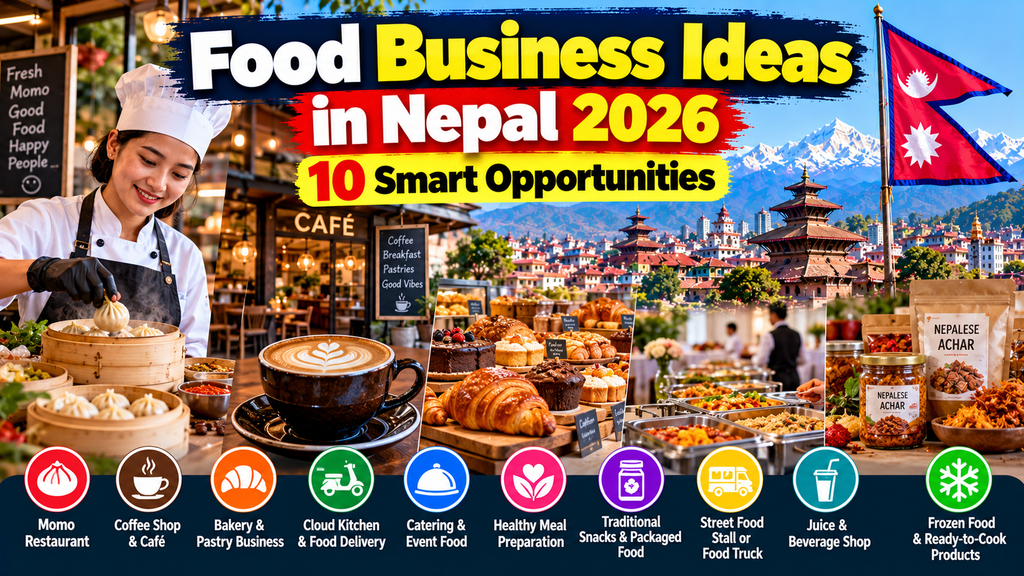
Food is an essential part of everyday life, making the food industry an interesting area for entrepreneurs who want to build a business in Nepal. From traditional momo restaurants and neighbourhood cafés to bakeries, cloud kitchens and packaged food products, there are several business models worth exploring.
However, a successful food business requires more than good cooking skills.
Entrepreneurs must understand customer demand, food safety, ingredient costs, pricing, staffing, competition and cash flow. A restaurant may serve hundreds of customers yet struggle financially if its operating expenses are too high.
For aspiring entrepreneurs searching for food business ideas in Nepal, the best opportunity is not necessarily the most expensive or fashionable concept. It is a business that matches their skills, available capital, target customers and ability to manage daily operations.
Nepal’s food sector also operates within an established regulatory framework. The Department of Food Technology and Quality Control (DFTQC) publishes the Food Hygiene and Quality Act, 2081, while its food-industry licensing system supports applicable approval procedures.
In August 2026, DFTQC also published updated mandatory quality standards for food and feed products. This highlights the importance of checking current food safety requirements before beginning commercial production.
Meanwhile, Nepal’s tourism industry creates another potential customer segment for certain food businesses. Nepal Tourism Board publishes monthly tourism statistics, including reports during 2026.
However, tourism demand varies significantly by location and season. A café in Pokhara may face different market conditions from a neighbourhood takeaway in Kathmandu or a bakery in Butwal.
This article explores ten food business opportunities in Nepal for 2026, with practical planning advice, illustrative startup budgets, recipe costing, break-even calculations and frequently asked questions.
All financial examples are hypothetical educational scenarios, not verified supplier quotations or guaranteed earnings.
Why Consider Starting a Food Business in Nepal in 2026?
Food businesses serve different customer needs, including convenience, affordability, social experiences, celebrations and everyday meals.
Entrepreneurs can choose between dine-in restaurants, takeaway outlets, production kitchens and packaged-food operations.
Each model has different financial and operational requirements.
Opportunities in Local Communities
A food business can serve students, office workers, families and local residents.
For example, a small breakfast outlet may focus on commuters, while a neighbourhood bakery may depend on repeat purchases from nearby households.
The important question is whether enough customers want the product at a price that covers its costs.
Tourism and Hospitality
Restaurants and cafés in tourism-oriented locations may serve domestic and international visitors.
Nepal Tourism Board publishes official monthly tourism statistics that entrepreneurs can use when researching visitor activity.
However, national arrival figures should not be treated as a forecast of customers for an individual restaurant.
Local competition, accessibility and seasonality remain important.
Online Ordering Opportunities
Food businesses may use websites, messaging services and suitable online platforms to receive orders.
Online ordering can provide an additional sales channel, but it also introduces packaging, delivery and customer-service costs.
Demand for Convenient Meals
Busy customers may value convenient breakfast, lunch and takeaway options.
However, this is a business hypothesis that must be tested in each target location.
Entrepreneurs should not assume that every area has sufficient demand for ready-made meals.
Food Safety and Consumer Trust
Customers expect food to be safe, accurately described and consistently prepared.
Poor hygiene can harm customers and create serious legal and commercial consequences.
Food safety should therefore be treated as a fundamental operating requirement rather than a marketing feature.
1. Momo Restaurant or Takeaway Business
A momo restaurant is one of the most recognisable Nepalese food business concepts.
Momo can be prepared using different fillings, cooking methods and accompaniments.
A business might focus on steamed momo, jhol momo, fried momo or a limited combination of products.
Why Consider a Momo Business?
Momo offers opportunities for menu specialisation.
Instead of operating a large restaurant with many unrelated dishes, a business can focus on a small product range.
This may simplify purchasing, staff training and recipe control.
However, demand and profitability must still be established through local research.
Target Customers
Potential customers include students, office workers, families and takeaway buyers.
The target market influences portion sizes, pricing, opening hours and location.
Essential Equipment
Depending on the scale, equipment may include preparation tables, refrigeration, cooking equipment, momo steamers, utensils and appropriate food storage facilities.
The business should also plan for cleaning, ventilation and safe handling of raw ingredients.
Illustrative Momo Costing
Assume one portion contains ten momo pieces.
| Cost component | Hypothetical NPR |
|---|---|
| Filling and dough | 65 |
| Achar and accompaniments | 15 |
| Packaging | 10 |
| Other variable costs | 10 |
| Total variable cost | 100 |
Suppose the portion sells for NPR 180.
Contribution per portion:
NPR 180 − NPR 100 = NPR 80.
This amount must contribute toward rent, wages, utilities and other fixed costs.
It is not final profit.
All prices and costs in this example are illustrative, not verified Nepalese market rates.
Main Risks
A momo business may face inconsistent quality, food safety problems, ingredient waste and intense local competition.
Practical Recommendation
Develop standard recipes for dough, fillings and achar.
Use consistent portion sizes and monitor ingredient costs.
Test a small menu before expanding.
2. Coffee Shop and Breakfast Café
A coffee shop can offer beverages, breakfast items, sandwiches, pastries and light meals.
The concept may appeal to entrepreneurs with hospitality experience.
Choosing a Café Concept
Not every café needs to target premium coffee customers.
Possible concepts include a neighbourhood tea and coffee shop, a student café or a breakfast-focused business.
The best choice depends on the local market.
Importance of Location
Location influences customer access, visibility and rent.
A café near offices may experience demand during morning and lunch periods.
A café near a university may have different purchasing patterns.
Menu Planning
A manageable menu can help control ingredient waste and preparation time.
For example, a café might begin with tea, coffee, a few breakfast dishes and selected bakery items.
Illustrative Monthly Sales
Assume:
- Average customer spending: NPR 350.
- Customers per day: 35.
- Operating days per month: 26.
Monthly sales:
35 × NPR 350 × 26 = NPR 318,500.
If variable costs represent an assumed 35% of sales, contribution after variable costs would be NPR 207,025.
If fixed operating costs total NPR 130,000, the illustrative operating surplus would be NPR 77,025 before tax, financing, depreciation and any excluded owner remuneration.
These are hypothetical assumptions.
Main Risks
High rent, equipment maintenance, inconsistent service and low customer traffic can affect performance.
Further Reading
For a more detailed example, read Eleven Nepal’s How to Open a Café in Pokhara: Complete Business Guide 2026.
The guide includes an illustrative café startup budget, registration considerations and a break-even example.
3. Bakery and Pastry Business
A bakery can produce bread, cakes, cookies, pastries and other baked products.
The business may operate through a retail outlet, a production kitchen or a combination of both.
Choosing a Bakery Specialisation
A beginner might focus on celebration cakes, cookies, bread or a small selection of pastries.
Specialisation can simplify equipment purchasing and production planning.
Bakery Equipment
Possible equipment includes an oven, mixer, refrigerator, worktables, baking trays, weighing scales and suitable storage facilities.
The equipment needed depends on the product range and production volume.
Recipe Standardisation
Bakery products require accurate measurements.
Ingredient quantities, baking temperatures, portion sizes and preparation methods should be documented.
Standard recipes help maintain consistency and calculate costs.
Illustrative Cookie Business Example
Suppose a bakery produces 100 packs of cookies.
Assume the total variable production and packaging cost is NPR 12,000.
Variable cost per pack:
NPR 12,000 ÷ 100 = NPR 120.
If each pack sells for NPR 200, contribution per pack is NPR 80.
Selling all 100 packs would generate NPR 8,000 in contribution before fixed costs.
This is a hypothetical calculation.
Food Safety Considerations
Bakeries must manage ingredient storage, sanitation, product shelf life and relevant allergen risks.
Packaged products may be subject to additional regulatory and labelling requirements.
Main Risks
Unsold products, short shelf life, equipment failure and inconsistent product quality can reduce profitability.
Practical Recommendation
Begin with products that can be produced consistently.
Monitor demand and avoid preparing excessive quantities without reliable sales information.
4. Cloud Kitchen and Online Food Delivery Business
A cloud kitchen is a food production operation focused on delivery or takeaway rather than conventional dine-in service.
It may offer a smaller customer-facing space than a traditional restaurant.
How a Cloud Kitchen Works
Customers place orders through suitable digital channels.
The kitchen prepares meals and arranges collection or delivery.
The operator manages food production, packaging, order accuracy and customer support.
Potential Advantages
A delivery-focused business may avoid some dining-room expenses.
However, it still requires suitable food preparation premises, equipment, staff and compliance.
Delivery charges and packaging can also reduce margins.
Choosing the Menu
Products should be selected partly on how well they travel.
Some foods lose quality quickly during delivery.
Packaging should protect food quality and support safe transport.
Illustrative Delivery Meal Costing
Assume a meal sells for NPR 400.
| Cost component | Hypothetical NPR |
|---|---|
| Ingredients | 145 |
| Packaging | 25 |
| Delivery-related cost borne by seller | 45 |
| Payment and other variable costs | 15 |
| Total variable cost | 230 |
Contribution per order:
NPR 400 − NPR 230 = NPR 170.
If the business completes 300 comparable orders in a month, total contribution would be NPR 51,000.
Rent, wages, utilities and other fixed costs must still be deducted.
Main Risks
Delivery delays, platform dependence, packaging expenses and poor customer reviews can affect performance.
Practical Recommendation
Test the delivery process before accepting a large number of orders.
Track the actual contribution from each menu item.
5. Home-Based Catering and Event Food Business
Catering involves preparing food for events, meetings, celebrations and other occasions.
The business may serve small private gatherings or larger commercial customers.
Potential Catering Services
Possible services include birthday catering, office lunches, family celebrations and specialised menus.
The appropriate scale depends on equipment, staff and operational capacity.
Why Catering Requires Planning
Catering often involves preparing a specific quantity of food for a fixed delivery time.
A mistake in portion forecasting can lead to shortages or waste.
Pricing a Catering Order
A catering quotation should account for ingredients, labour, equipment, transport, setup, service and other expenses.
The business should also consider whether deposits or advance payments are appropriate under its contract.
Illustrative Catering Example
Suppose a catering business agrees to provide 100 meals at NPR 500 each.
Total revenue:
100 × NPR 500 = NPR 50,000.
Assume:
- Ingredients and consumables: NPR 19,000.
- Labour: NPR 9,000.
- Transport: NPR 4,000.
- Equipment and miscellaneous direct costs: NPR 3,000.
Total assumed direct costs: NPR 35,000.
Illustrative contribution from the event: NPR 15,000.
This excludes fixed overheads, tax and any additional costs.
Food Safety Challenges
Catering requires careful control of preparation, transport, holding and service conditions.
The operator must assess food safety requirements relevant to the menu and event.
Main Risks
Last-minute cancellations, transport delays, equipment shortages and incorrect guest counts can affect profitability.
Practical Recommendation
Use written quotations and event specifications.
Confirm guest numbers, service arrangements and payment terms before purchasing large quantities of ingredients.
6. Healthy Meal Preparation and High-Protein Food Business
A meal preparation business provides planned meals to customers who want convenience or specific dietary preferences.
Examples may include balanced lunch boxes, portion-controlled meals and higher-protein menu options.
Identifying the Target Customer
Potential customers include office workers, gym-goers and people who prefer prepared meals.
However, entrepreneurs should validate demand rather than assuming that interest in fitness automatically translates into regular purchases.
Developing the Menu
A meal preparation business should focus on consistent recipes, safe food handling and accurate product information.
Menus may include rice, vegetables, legumes, chicken or other suitable ingredients.
Nutrition Information
If the business makes nutritional claims, those claims should be accurate and supported by appropriate calculations or testing.
Businesses should avoid promising medical or weight-loss outcomes.
Illustrative Meal Subscription Example
Suppose a customer orders 20 meals per month at NPR 450 per meal.
Monthly customer revenue would be:
20 × NPR 450 = NPR 9,000.
Assume the total variable cost is NPR 280 per meal.
Monthly contribution from that customer:
20 × NPR 170 = NPR 3,400.
This is before fixed operating expenses.
Main Risks
Ingredient cost changes, meal consistency, refrigeration, delivery and short shelf life can affect operations.
Practical Recommendation
Begin with a limited menu and small number of subscribers.
Monitor food quality and customer feedback before expanding.
7. Traditional Nepalese Snacks and Packaged Food Business
Traditional Nepalese foods can provide opportunities for entrepreneurs interested in local recipes and packaged products.
Possible concepts include selected snacks, spice blends, achar and other suitable food products.
Why Product Development Matters
A packaged product needs more than an appealing recipe.
It must be safe, consistently manufactured and suitable for its intended storage and distribution conditions.
Choosing a Product
Entrepreneurs should consider ingredient availability, production methods, packaging and expected shelf life.
The intended customer might be a local retailer, household buyer or another business.
Packaging and Labelling
Packaging should protect the product and meet applicable requirements.
Labelling obligations depend on the product and relevant food regulations.
Businesses should verify current rules rather than copying labels from competitors.
Shelf-Life Validation
Shelf life should be based on appropriate evidence and food safety assessment.
Do not assign an arbitrary expiry date to a product without understanding its microbiological, chemical and physical stability.
Illustrative Packaged Achar Example
Suppose a producer makes 200 jars of achar.
Assume total relevant variable production and packaging costs of NPR 30,000.
Cost per jar:
NPR 30,000 ÷ 200 = NPR 150.
If each jar sells for NPR 250, contribution per jar is NPR 100.
If all 200 jars are sold, the illustrative contribution is NPR 20,000 before fixed expenses.
Regulatory Considerations
Commercial packaged-food manufacturing may involve DFTQC requirements and applicable food-industry permissions.
The department’s NeFFILS platform provides an online process for relevant food and feed industry licensing.
Main Risks
Product spoilage, inconsistent recipes, poor packaging and inadequate quality controls can create significant problems.
Practical Recommendation
Obtain appropriate technical and regulatory advice before distributing shelf-stable or packaged food products commercially.
8. Street Food Stall or Food Truck Business
Street food businesses may offer a smaller menu than full-service restaurants.
Possible products include momo, grilled snacks, sandwiches and other prepared foods.
Choosing Between a Stall and Food Truck
A fixed stall and a mobile food truck have different operating requirements.
A food truck may need a suitable vehicle, equipment installation, safe utilities and permission to operate in particular locations.
A street stall may require suitable premises or a permitted trading location.
Location Research
Entrepreneurs should examine pedestrian traffic, accessibility, nearby competitors and local restrictions.
A busy public area is not automatically a legally permitted trading location.
Menu Engineering
Street food operations benefit from quick preparation, consistent portions and manageable inventory.
Products should be selected based on customer demand and operational capability.
Illustrative Daily Sales
Assume a street food outlet sells 80 portions per day at NPR 150 each.
Daily revenue:
80 × NPR 150 = NPR 12,000.
Suppose variable costs average NPR 70 per portion.
Daily contribution:
80 × NPR 80 = NPR 6,400.
At 24 trading days, monthly contribution would be NPR 153,600 before fixed expenses.
This is an illustrative scenario, not a realistic earnings guarantee.
Main Risks
Weather, location restrictions, equipment breakdown and inconsistent customer traffic can affect sales.
Practical Recommendation
Confirm location permissions and applicable food safety requirements before purchasing a vehicle or setting up a stall.
9. Juice, Smoothie and Beverage Shop
A beverage-focused business can offer fresh juices, smoothies, tea, coffee or other non-alcoholic drinks.
It may operate independently or alongside a limited food menu.
Target Customers
Potential customers include shoppers, students, office workers and people seeking convenient refreshments.
Demand may vary with location and season.
Equipment Requirements
Depending on the menu, equipment may include blenders, juicers, refrigeration, water treatment arrangements and appropriate storage facilities.
Ingredient Management
Fresh produce can spoil quickly.
Accurate purchasing and preparation forecasts help reduce waste.
Businesses must also manage washing, storage and cleaning procedures appropriately.
Illustrative Smoothie Costing
Suppose a smoothie sells for NPR 250.
Assume fruit, dairy or other ingredients cost NPR 85, packaging costs NPR 20 and other variable costs total NPR 15.
Total variable cost:
NPR 120.
Contribution per smoothie:
NPR 250 − NPR 120 = NPR 130.
This contribution must cover fixed costs.
Main Risks
Seasonal demand, fresh produce waste, equipment maintenance and inconsistent quality can affect results.
Practical Recommendation
Create standard recipes and measure ingredients rather than estimating portions during service.
10. Frozen Food and Ready-to-Cook Products
Frozen and ready-to-cook products offer another food manufacturing concept.
Examples may include frozen momo, prepared snacks and other products suitable for validated storage conditions.
How the Business Works
The producer prepares food, packages it and distributes it through appropriate sales channels.
Customers store and cook the product according to the supplied instructions.
Importance of Cold-Chain Management
Frozen food businesses need reliable temperature control.
Temperature abuse can create safety and quality problems.
Equipment, transport and storage systems must be appropriate for the product.
Product Development
Before commercial production, the business should evaluate recipe consistency, freezing performance, packaging and shelf life.
Illustrative Frozen Momo Example
Suppose a business produces 300 packs of frozen momo.
Assume each pack has a variable cost of NPR 180 and sells for NPR 300.
Contribution per pack:
NPR 120.
If all packs are sold, total contribution is NPR 36,000 before fixed operating costs.
These figures are hypothetical.
Regulatory Responsibilities
Food manufacturing and packaged-product distribution may require relevant DFTQC permissions, product standards and other approvals.
Businesses should verify the requirements for the specific product.
Main Risks
Cold-chain failure, packaging damage, inadequate shelf-life validation and inconsistent distribution can cause serious losses.
Practical Recommendation
Do not launch frozen products commercially without appropriate food safety controls and reliable refrigeration arrangements.
Comparing the 10 Food Business Ideas in Nepal
Different business models require different skills and resources.
| Business idea | Main operating model | Important skill | Major risk |
|---|---|---|---|
| Momo restaurant | Dine-in or takeaway | Production consistency | Competition and waste |
| Coffee shop | Beverage and light food service | Hospitality management | Rent and customer traffic |
| Bakery | Production and retail | Baking and costing | Unsold products |
| Cloud kitchen | Delivery-focused | Logistics and order management | Delivery expenses |
| Catering | Event-based production | Planning and organisation | Event disruption |
| Healthy meal preparation | Preordered meals | Nutrition accuracy and production | Shelf life and delivery |
| Packaged Nepalese snacks | Food manufacturing | Product development | Safety and shelf life |
| Street food or food truck | Quick-service | Speed and portion control | Location and permissions |
| Beverage shop | Drink preparation | Recipe consistency | Ingredient spoilage |
| Frozen ready-to-cook foods | Manufacturing and distribution | Cold-chain management | Temperature control |
There is no verified evidence that one of these ten businesses is universally the most profitable in Nepal.
The best choice depends on demand, competition, skills and operating costs.
How Much Money Is Needed to Start a Food Business in Nepal?
Startup costs vary widely.
A small takeaway outlet may have different capital requirements from a full restaurant or packaged-food factory.
Entrepreneurs should calculate costs based on actual supplier quotations and premises requirements.
Common Startup Expenses
Potential expenses include equipment, renovation, rental deposits, inventory, packaging, branding, registration and working capital.
The required amount depends on the business model.
Illustrative Small Takeaway Startup Budget
| Expense | Hypothetical NPR |
|---|---|
| Kitchen equipment | 200,000 |
| Refrigeration and storage | 80,000 |
| Premises deposit and initial rent | 90,000 |
| Basic renovation | 100,000 |
| Utensils and small equipment | 40,000 |
| Initial ingredients and packaging | 30,000 |
| Branding and marketing | 20,000 |
| Administrative and professional allowance | 20,000 |
| Working capital reserve | 120,000 |
| Total | 700,000 |
This NPR 7 lakh example is a fictional planning model.
It is not a verified minimum cost for opening a takeaway in Nepal.
The administrative allowance is not an official licence-fee quotation.
Why Working Capital Matters
A food business must purchase ingredients and pay operating expenses even when sales are lower than expected.
A working capital reserve can help manage early trading periods.
Avoid Excessive Initial Spending
Expensive interiors and equipment do not guarantee customers.
Begin by identifying the equipment and facilities actually needed to deliver the planned menu safely.
How to Calculate Food Cost and Selling Price
Recipe costing is one of the most important skills for food entrepreneurs.
Without accurate costing, a business may sell popular products at unsustainable margins.
Step 1: Create a Standard Recipe
Record the ingredients and quantities used in one batch.
Include garnishes, sauces and other accompaniments.
Step 2: Calculate Ingredient Costs
Use actual supplier prices.
Account for preparation losses where relevant.
Step 3: Determine Portion Yield
Calculate how many saleable portions the recipe produces.
Step 4: Calculate Cost Per Portion
Divide the total batch cost by the number of portions.
Step 5: Include Other Variable Costs
Packaging, transaction charges and delivery expenses may also need to be included.
Step 6: Evaluate the Selling Price
The selling price must be considered alongside customer demand, competitor offerings and required contribution.
Illustrative Food Cost Percentage
Suppose a dish sells for NPR 400 and its ingredient cost is NPR 120.
Food cost percentage:
NPR 120 ÷ NPR 400 × 100 = 30%.
This does not mean the restaurant earns a 70% net profit.
Other variable and fixed costs still need to be deducted.
Break-Even Analysis for a Small Food Business
Break-even analysis helps estimate how much a business must sell to cover its costs.
Break-Even Formula
Break-even units = Monthly fixed costs ÷ Contribution per unit.
Illustrative Takeaway Example
Assume:
- Average selling price per order: NPR 300.
- Average variable cost per order: NPR 120.
- Contribution per order: NPR 180.
- Monthly fixed operating costs: NPR 180,000.
Break-even orders:
NPR 180,000 ÷ NPR 180 = 1,000 orders per month.
If the business operates 25 days per month:
1,000 ÷ 25 = 40 orders per day.
The business would need approximately 40 comparable orders daily to cover the assumed fixed costs.
What Happens at 30 Orders Per Day?
Monthly orders:
30 × 25 = 750.
Total contribution:
750 × NPR 180 = NPR 135,000.
After fixed costs of NPR 180,000, the illustrative operating result is a loss of NPR 45,000.
What Happens at 50 Orders Per Day?
Monthly orders:
50 × 25 = 1,250.
Total contribution:
1,250 × NPR 180 = NPR 225,000.
After fixed costs, the illustrative operating surplus is NPR 45,000 before tax, financing, depreciation and other excluded costs.
These calculations are simplified examples, not earnings forecasts.
Legal Requirements for Starting a Food Business in Nepal in 2026
Food businesses must consider business registration, tax obligations and applicable food safety requirements.
The exact process depends on the location and activity.
Business Registration
Entrepreneurs should choose an appropriate legal structure and register through the relevant authority.
Private limited companies are incorporated through the Office of the Company Registrar.
Other structures may involve different registration procedures.
Read Eleven Nepal’s How to Register a Business in Nepal: 10 Essential Steps.
PAN and VAT
The Inland Revenue Department administers taxpayer registration.
Business PAN and VAT registration are separate matters.
VAT requirements depend on applicable legislation, taxable activities and relevant conditions.
For a more detailed explanation, read PAN and VAT Registration in Nepal: Easy Step-by-Step Guide.
Food Hygiene and Quality Act, 2081
The Department of Food Technology and Quality Control publishes the Food Hygiene and Quality Act, 2081.
Food entrepreneurs should review the applicable requirements and consult the responsible authority.
Food Manufacturing and NeFFILS
DFTQC operates the Nepal Food and Feed Industry Licensing System, known as NeFFILS.
The system supports relevant food and feed industry licensing procedures.
However, a restaurant preparing meals for immediate consumption may face different requirements from a factory producing packaged foods for distribution.
Do not assume that the same licence applies to every food business.
Municipal Requirements
Local authorities may have requirements concerning business registration, premises, sanitation, waste management and other matters.
The applicable rules depend on the municipality and business activity.
Food Safety Operations
Businesses should implement appropriate controls for purchasing, receiving, storage, preparation, cooking, cooling, cleaning and service.
Employees should receive suitable food safety training.
Allergen Information
Food businesses should identify ingredients that may cause allergic reactions and communicate accurate information to customers.
Do not make unsupported claims that a food product is allergen-free.
Official Resources
Department of Food Technology and Quality Control: https://www.dftqc.gov.np/en/
NeFFILS: https://neffils.dftqc.gov.np/
Office of the Company Registrar: https://ocr.gov.np/
Inland Revenue Department: https://ird.gov.np/
National Statistics Office: https://www.nsonepal.gov.np/
How to Market a Food Business in Nepal
Marketing helps customers discover a business, but it cannot compensate for poor food quality or unreliable service.
Understand the Target Customer
A student-focused takeaway may need different pricing and operating hours from a premium restaurant.
Research customer needs before designing promotions.
Build a Clear Brand
Choose a recognisable business name and visual identity.
Menus should communicate products and prices clearly.
Use Digital Channels Responsibly
A website can display menus, opening hours, contact details and ordering information.
Social media may help businesses share updates and communicate with customers.
Encourage Genuine Customer Feedback
Authentic reviews can help entrepreneurs identify strengths and weaknesses.
Businesses should not purchase fake reviews or invent testimonials.
Monitor Marketing Costs
Track completed sales and customer acquisition costs rather than relying only on social media engagement.
Build Repeat Business
Consistent food quality, accurate orders and professional customer service can encourage repeat visits.
However, repeat business must be earned through actual customer experience.
How to Reduce Food Waste and Improve Profitability
Food waste creates financial and environmental costs.
Businesses should monitor waste without compromising food safety.
Use Standard Recipes
Consistent recipes support purchasing, costing and portion control.
Forecast Demand
Review sales records and prepare realistic production quantities.
Rotate Stock
Use appropriate stock rotation systems and follow product-specific storage requirements.
Monitor Preparation Waste
Record avoidable losses during trimming, preparation and production.
Review Unsold Food
Investigate why products remain unsold.
Do not sell food that is unsafe or beyond applicable limits.
Improve Staff Training
Employees should understand portioning, storage, cleaning and safe food handling.
A Practical 30-Day Food Business Planning Checklist
The following plan is a preparation framework, not a guarantee that all legal approvals can be completed within 30 days.
Week 1: Research
Choose a food business concept.
Identify target customers.
Study competitors.
Test product interest where lawful and appropriate.
Week 2: Costing and Budgeting
Develop standard recipes.
Obtain supplier quotations.
Calculate startup costs.
Prepare a cash-flow forecast and break-even analysis.
Week 3: Registration and Operations
Confirm the correct business structure.
Investigate applicable tax, municipal and food safety requirements.
Assess premises and equipment needs.
Prepare cleaning, storage and production procedures.
Week 4: Pilot Preparation
Finalise a limited menu.
Train staff where relevant.
Test production and service systems.
Launch only after the necessary permissions and operational safeguards are in place.
Common Mistakes to Avoid When Starting a Food Business
Entrepreneurs can reduce avoidable risks by recognising common mistakes.
Choosing an Expensive Location Without Research
High rent creates pressure to generate sales.
Offering Too Many Menu Items
A large menu can increase inventory and preparation complexity.
Ignoring Recipe Costing
Without accurate costing, owners may not understand margins.
Underestimating Payroll
Staffing needs should be considered when preparing operating budgets.
Poor Food Safety Practices
Unsafe food can harm customers and damage the business.
Weak Cash-Flow Management
Sales revenue does not always equal available cash.
Excessive Borrowing
Loan repayments can become difficult when demand is weak.
Ignoring Customer Feedback
Businesses that fail to address recurring complaints may lose customers.
Overestimating Demand
A popular product does not guarantee enough sales to cover costs.
Expanding Too Quickly
Expansion should be supported by actual demand, reliable operations and adequate capital.
For related entrepreneurship planning, read Business Ideas for Returnees in Nepal.
Frequently Asked Questions About Food Business Ideas in Nepal
1. What are the best food business ideas in Nepal in 2026?
Potential ideas include momo outlets, cafés, bakeries, cloud kitchens, catering, meal preparation, packaged snacks, street food, beverage shops and frozen-food production. The best option depends on local demand and resources.
2. Which food business is most profitable in Nepal?
There is no verified national ranking establishing one universally most profitable food business. Profitability depends on prices, costs, demand and management.
3. Can I start a food business with NPR 1 lakh?
Some very small-scale concepts may be worth investigating, but whether NPR 1 lakh is sufficient depends on actual equipment, premises, registration, food safety and working capital requirements.
4. How much does it cost to open a café in Nepal?
There is no single verified cost. Location, seating capacity, equipment and renovation requirements affect investment. Actual quotations are necessary.
5. Is a momo business a good idea?
A momo business may be viable where sufficient demand exists, but it requires recipe consistency, food safety and sound financial planning.
6. Can I operate a food business from home?
A home-based operation may be possible depending on the activity and applicable regulations. Entrepreneurs should confirm local and food safety requirements before selling.
7. What is a cloud kitchen?
A cloud kitchen focuses on preparing food for delivery or takeaway rather than conventional dine-in service.
8. Do food businesses need registration in Nepal?
Applicable business registration requirements depend on the legal structure and activity. Food-related approvals may also apply.
9. Is PAN registration required?
Business PAN obligations should be checked through the Inland Revenue Department and the relevant registration process.
10. Does every restaurant need VAT registration?
Not necessarily. VAT obligations depend on current law and the circumstances of the business.
11. What is NeFFILS?
NeFFILS is the Nepal Food and Feed Industry Licensing System operated for relevant food and feed industry approval processes.
12. Is packaged-food production different from restaurant service?
Yes. The activities can involve different operational risks and regulatory requirements.
13. How do I calculate food cost percentage?
Divide ingredient cost per portion by selling price and multiply by 100.
14. What is a good food cost percentage?
There is no universal percentage suitable for every product. The appropriate level depends on the menu, pricing, labour and other operating costs.
15. How can I reduce food waste?
Use standard recipes, accurate forecasting, appropriate stock rotation and staff training without compromising food safety.
16. Are frozen foods a good business opportunity?
Frozen foods may offer commercial opportunities, but they require suitable product development, cold-chain controls and compliance.
17. How do I attract customers to a new café?
Research the target market, communicate a clear offer, provide consistent quality and use appropriate marketing channels.
18. Can a food business sell through online platforms?
Potentially, yes, subject to applicable business, food safety, e-commerce and platform requirements.
19. What is the break-even point for a restaurant?
It is the sales level at which contribution covers fixed operating costs under the assumptions used in the calculation.
20. How long does it take to become profitable?
There is no guaranteed timeline. Some businesses take considerable time to become profitable, while others never achieve profitability.
21. Is catering better than opening a restaurant?
Neither is automatically better. Catering and restaurants have different customer patterns, equipment needs and operational risks.
22. Can students start a small food business?
Students may explore entrepreneurship, subject to applicable legal, registration and food safety requirements.
23. What equipment is needed for a bakery?
Equipment depends on the product range and scale. Possible items include ovens, mixers, refrigeration, worktables and measuring equipment.
24. How important is location for a food business?
Location can strongly influence customer access, rent and sales. Delivery-focused businesses may prioritise logistics differently from dine-in restaurants.
25. What should beginners do before investing?
Conduct market research, prepare a financial plan, calculate recipe costs and confirm applicable legal and food safety requirements.
Conclusion: Which Food Business Should You Start in Nepal in 2026?
Exploring food business ideas in Nepal can help aspiring entrepreneurs identify opportunities that match their interests and professional skills.
Momo restaurants, cafés, bakeries, cloud kitchens and catering businesses offer different ways to serve customers.
Packaged snacks, frozen products and ready-to-cook foods provide additional possibilities for entrepreneurs interested in food manufacturing.
However, no business concept is guaranteed to succeed.
A profitable food business requires more than an attractive menu.
Entrepreneurs must understand customer demand, calculate costs, manage employees, control waste and maintain food safety.
The regulatory environment also matters.
Nepal’s Food Hygiene and Quality Act, 2081, and DFTQC’s food-industry licensing systems provide important reference points for entrepreneurs.
For beginners, a sensible approach is to select one clear concept, validate demand and prepare a realistic operating budget.
Standard recipes, accurate pricing and cash-flow planning can support better decisions.
It is also important to avoid unnecessary expansion before the business has demonstrated reliable customer demand.
Ultimately, the best food business is not necessarily the one with the largest menu, most expensive equipment or most attractive interior.
It is the business that delivers safe, consistent food customers genuinely want while maintaining sustainable finances and responsible operations.
References and Credible Sources
1. Department of Food Technology and Quality Control. Food Hygiene and Quality Act, 2081. Official legislation listing.
2. Department of Food Technology and Quality Control (30 August 2026). Mandatory Quality Standards for Food and Feed Products, 2082.
3. Department of Food Technology and Quality Control. Nepal Food and Feed Industry Licensing System (NeFFILS).
4. Department of Food Technology and Quality Control. Departmental Responsibilities, Food Safety and Quality Control.
5. National Statistics Office (2026). National Economic Census 2082.
6. Nepal Tourism Board (2026). Nepal Tourism Statistics and Monthly Tourism Insights.
7. Inland Revenue Department. Taxpayer Service and Registration.
8. Office of the Company Registrar. Company Registration Information.
9. Eleven Nepal (16 October 2026). How to Open a Café in Pokhara: Complete Business Guide.
10. Eleven Nepal (16 October 2026). How to Register a Business in Nepal: Essential Steps.
11. Eleven Nepal (17 October 2026). PAN and VAT Registration in Nepal: Easy Step-by-Step Guide.
Editorial note: This article reflects information available as of 20 October 2026. All financial examples are hypothetical and do not represent verified supplier quotations, official fees, market-average profits or guaranteed business results. Readers should confirm applicable legal, food safety, tax and municipal requirements with the relevant authorities before investing.

