

By Eleven Nepal Editorial Team | Published: 20 October 2026 | Category: Education & Study Abroad
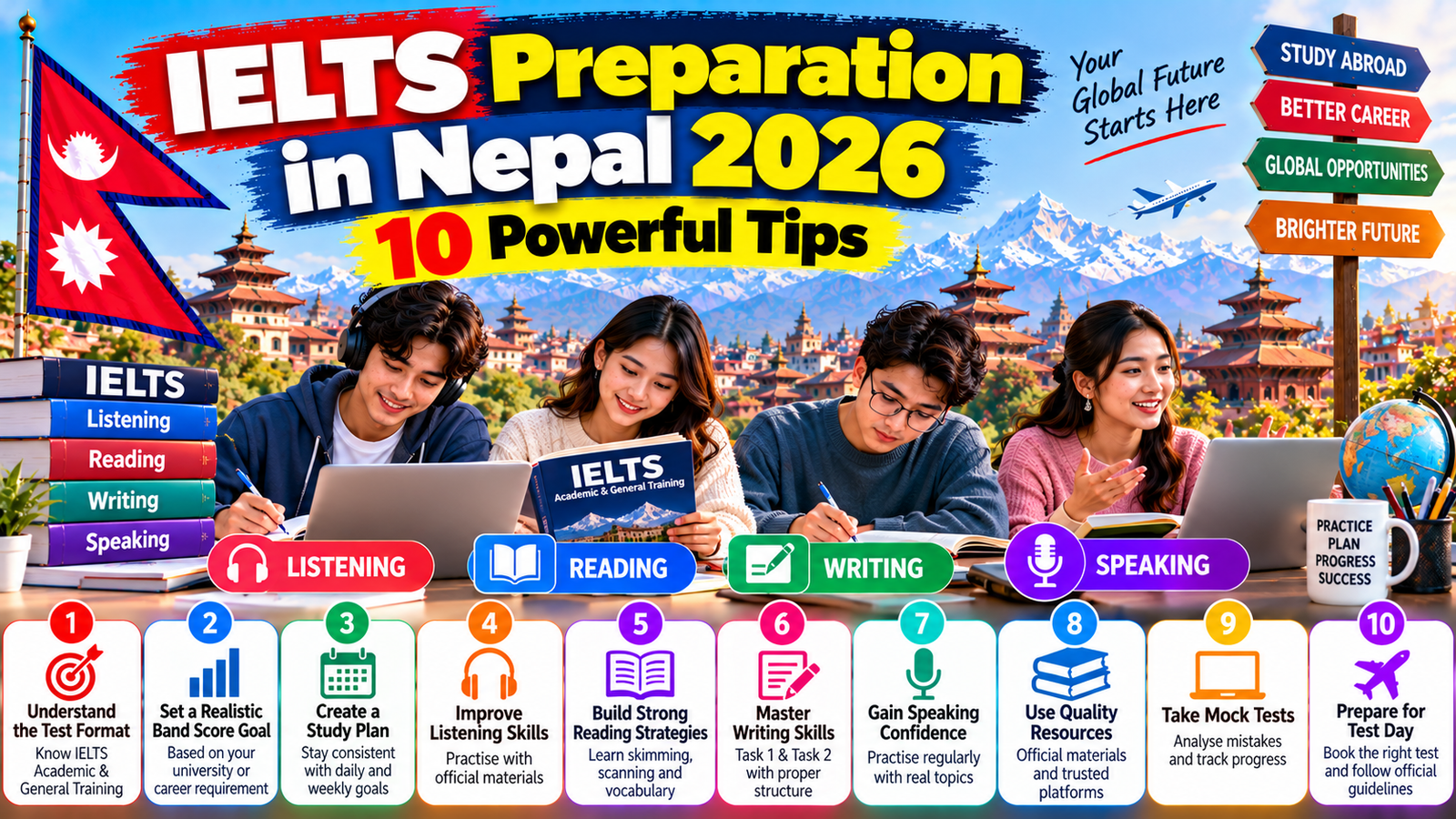
IELTS preparation in Nepal is an important step for students and professionals who want to demonstrate their English-language abilities for international education, employment or migration.
Every year, Nepalese candidates prepare for English-language examinations as part of their plans to study or work abroad. However, IELTS is not simply a test of memorised vocabulary or grammar rules. It assesses how effectively a person understands and communicates in English across four different skills.
These skills are Listening, Reading, Writing and Speaking.
A candidate who performs well in everyday conversations may still find academic reading challenging. Similarly, someone with strong grammar knowledge may struggle to complete writing tasks within the time limit.
Successful preparation therefore requires an understanding of the test format, realistic practice, useful feedback and consistent improvement.
In 2026, IELTS test delivery has also changed significantly.
On 5 March 2026, IELTS announced a transition away from traditional paper-based testing. IDP Nepal confirmed that conventional IELTS on Paper would no longer be offered in Nepal after 27 June 2026.
From 1 July 2026, eligible candidates in Nepal gained access to IELTS on Computer with Writing on Paper, allowing them to handwrite the Writing section while completing the Listening and Reading sections digitally.
This means that students preparing for IELTS in Nepal should understand the available computer-based options before booking.
Whether you are preparing for university admission, professional registration or another recognised purpose, choosing the correct IELTS test and developing a suitable study strategy are essential.
This guide explains 10 powerful tips for IELTS preparation in Nepal in 2026, including official test formats, band scores, study schedules, Listening and Reading strategies, Writing and Speaking practice, examination fees and reliable preparation resources.
You will also find a 30-day study plan, clearly labelled financial examples, common mistakes to avoid and 25 frequently asked questions.
Important: IELTS scores do not automatically guarantee university admission, employment, visa approval or migration eligibility. Always confirm the requirements of the organisation or immigration authority receiving your results.
What Is IELTS and Why Is It Important?
IELTS stands for the International English Language Testing System.
It is an English-language proficiency assessment used by educational institutions, employers, professional bodies and immigration authorities in different countries.
The test assesses four language skills rather than relying on one overall examination paper.
The Four IELTS Skills
Listening: Understanding spoken English in different situations.
Reading: Understanding written information, arguments and details.
Writing: Communicating information and ideas in an organised written form.
Speaking: Communicating verbally with an examiner.
Each component receives an individual band score.
The overall score is calculated using the four component scores.
Who May Need IELTS?
Some Nepalese students take IELTS when applying to universities abroad.
Other candidates may need an approved English-language test for professional registration, employment or immigration purposes.
However, IELTS is not compulsory for every university, occupation or visa route.
The receiving organisation determines which evidence it accepts.
IELTS Academic Versus General Training
IELTS Academic is commonly used for higher education and certain professional purposes.
IELTS General Training is commonly associated with migration, employment and some training or study pathways.
The Listening and Speaking components are the same in both versions.
The Reading and Writing components differ.
What About IELTS for UKVI?
IELTS for UK Visas and Immigration is designed for situations where a UK immigration application requires an approved secure English-language test.
Not every UK university applicant must take IELTS for UKVI.
The correct requirement depends on the institution, course and immigration circumstances.
Before booking, check the official requirements of the university or relevant authority.
IELTS Preparation in Nepal: Important 2026 Changes
Understanding the latest examination arrangements can prevent candidates from preparing for an unavailable test format.
Traditional Paper-Based IELTS Has Changed
On 5 March 2026, IELTS announced that traditional paper-based testing would be phased out from mid-2026, with implementation dates varying by market.
IDP Nepal confirmed that its conventional IELTS on Paper test would no longer be available after 27 June 2026.
Candidates should therefore not assume that older advertisements offering a fully paper-based IELTS examination remain current.
IELTS on Computer
IELTS on Computer allows candidates to complete Listening, Reading and Writing using a computer at an authorised test centre.
Speaking remains an assessment with an IELTS examiner.
Depending on the centre, Speaking may be conducted in person or through an approved video-call arrangement.
IELTS on Computer With Writing on Paper
This option became available through IDP Nepal from 1 July 2026.
Listening and Reading are completed on a computer.
Writing questions appear on the screen, but answers are handwritten on the provided answer sheets.
Speaking follows the normal examiner-led assessment process.
Does the New Format Change the Difficulty?
IELTS states that the transition does not change the underlying language skills assessed, test content or scoring interpretation.
Candidates should choose the available format that best suits their abilities and the requirements of the receiving organisation.
Faster Results
IELTS states that computer-delivered test results are generally available within one to five days.
British Council Nepal reports that its computer-based results are typically available within one to three days.
Actual release times can vary.
Official sources:
1. Understand the IELTS Test Format Before Studying
The first step in IELTS preparation in Nepal is learning exactly what each component assesses.
Many beginners start practising random questions without understanding the examination structure.
This makes it difficult to identify the skills they need to improve.
IELTS Test Overview
| Component | Official duration | Main assessment |
|---|---|---|
| Listening | Approximately 30 minutes | Understanding spoken English |
| Reading | 60 minutes | Understanding written texts |
| Writing | 60 minutes | Written communication |
| Speaking | 11–14 minutes | Spoken communication |
The Listening test contains 40 questions.
The Reading test also contains 40 questions.
Writing consists of two tasks, while Speaking contains three parts.
Academic Reading
IELTS Academic Reading contains three sections with 40 questions in total.
Candidates may encounter different types of written material, including descriptive and argumentative texts.
General Training Reading
General Training Reading focuses on texts relevant to everyday life, employment and broader reading contexts.
The scoring scale is the same, but the relationship between raw marks and band scores differs from Academic Reading.
Writing Tasks
Academic Writing Task 1 involves describing visual information such as a graph, chart, table or process.
General Training Writing Task 1 involves writing a letter.
Writing Task 2 requires an essay-style response in both versions.
Speaking Parts
Part 1 involves familiar questions about personal experiences and everyday topics.
Part 2 requires the candidate to speak about a topic after preparation time.
Part 3 develops a more detailed discussion related to the topic.
Practical Advice
Download the official test format and sample questions before beginning serious preparation.
Avoid relying on old examination descriptions that may not reflect 2026 delivery arrangements.
2. Set a Realistic IELTS Band Score Goal
Candidates should identify the score required by the organisation they are applying to.
Different universities, programmes and professional bodies may have different English-language requirements.
Understand the IELTS Band Scale
IELTS reports performance using a nine-band scale.
Scores are awarded for Listening, Reading, Writing and Speaking.
An overall band score is calculated from the four components.
How Is the Overall Band Calculated?
Suppose a candidate receives the following hypothetical scores:
| Skill | Illustrative band |
|---|---|
| Listening | 7.0 |
| Reading | 6.5 |
| Writing | 6.0 |
| Speaking | 6.5 |
The average is:
(7.0 + 6.5 + 6.0 + 6.5) ÷ 4 = 6.5.
The overall band is therefore 6.5.
This example demonstrates the calculation. It does not represent a predicted result.
Overall Score Versus Individual Requirements
A university may specify an overall score and minimum scores in individual components.
Meeting the overall requirement does not necessarily mean that every component requirement has been satisfied.
Take a Diagnostic Test
Before selecting a study schedule, complete a suitable practice assessment.
Use the result to identify which skills require additional attention.
Set Measurable Goals
Instead of writing only “I want Band 7,” establish specific learning targets.
For example, a candidate may aim to improve paragraph organisation, reduce spelling errors or answer reading questions more accurately.
These are preparation goals rather than guaranteed score outcomes.
Key lesson: Prepare for the score and component requirements relevant to your actual application.
3. Create a Structured IELTS Study Plan
A realistic timetable helps candidates prepare consistently.
However, there is no universal number of study hours that guarantees a particular IELTS band.
Preparation time depends on current English proficiency, learning needs and available time.
Illustrative Two-Hour Daily Timetable
| Activity | Suggested duration |
|---|---|
| Listening practice | 25 minutes |
| Reading practice | 25 minutes |
| Writing practice | 30 minutes |
| Speaking practice | 20 minutes |
| Vocabulary and error review | 20 minutes |
| Total | 120 minutes |
This is an illustrative schedule, not an official IELTS requirement.
Adapt the Schedule
A student attending college may prefer shorter sessions throughout the day.
Someone working full-time may prepare in the evening or during free days.
Prioritise Weak Skills
Candidates should not spend equal time on every component if one skill requires significantly more improvement.
For example, a candidate with stronger Listening skills but weaker Writing skills may need additional writing feedback.
Include Weekly Reviews
At the end of each week, assess completed tasks, recurring mistakes and areas requiring more practice.
Avoid Excessive Study Hours
Long study sessions are not automatically effective.
Rest, consistency and feedback are important parts of sustainable learning.
Key lesson: A study plan should respond to your actual weaknesses rather than copy another student’s routine.
4. Improve IELTS Listening Through Active Practice
Listening assesses the ability to understand spoken English.
Candidates must identify relevant information while following audio recordings.
Understand the Listening Format
The test contains four parts and 40 questions.
Audio is played once.
Candidates may encounter conversations and monologues in different contexts.
Practise Different Accents
IELTS materials may include different varieties of English.
Listening to a range of authentic English speakers can help candidates become familiar with different pronunciations.
Read Questions Carefully
Before each recording, use the available preparation time to understand the questions.
Identify the type of information required.
For example, a question may require a name, number, date or short phrase.
Predict the Answer Type
If a question asks for a price, expect numerical information.
If it asks for a location, listen for place names or directions.
Prediction helps direct attention, but candidates should remain open to unexpected wording.
Avoid Losing Concentration
A common difficulty occurs when candidates miss one answer and continue thinking about it.
Instead, move on and focus on the next question.
Practise Spelling
Incorrect spelling may cause otherwise understood answers to be marked wrong.
Review names, common vocabulary and number formats.
Use Transcripts for Feedback
After completing a practice recording, review the transcript.
Identify the words or phrases that caused difficulty.
Useful Listening Activities
Candidates can practise with official IELTS audio materials, educational programmes and appropriate English-language recordings.
However, general listening activities should complement, not replace, IELTS-format practice.
Key lesson: Listening improvement requires active attention, review and familiarity with spoken English.
5. Develop Strong IELTS Reading Strategies
Reading can be challenging because candidates must process information accurately within a fixed time.
The Reading test lasts 60 minutes.
Understand the Question Types
Depending on the test, candidates may encounter multiple-choice questions, matching information, sentence completion and other tasks.
Learn Skimming
Skimming means reading quickly to understand the overall topic and structure.
It can help candidates locate the relevant section of a passage.
Learn Scanning
Scanning means searching for particular details, names, dates or terms.
It is useful when a question requires specific information.
Understand Paraphrasing
IELTS questions may express ideas differently from the original passage.
Candidates should learn to recognise meaning rather than search only for identical words.
Practise True, False and Not Given
These questions require careful attention to the relationship between the statement and the passage.
Candidates should not rely on general knowledge.
Improve Vocabulary in Context
Instead of memorising isolated words, study how words function within sentences.
Pay attention to synonyms and related expressions.
Manage Time
Avoid spending too long on one difficult question.
Develop a strategy for returning to unanswered questions when time permits.
Review Mistakes
After practice, identify whether an incorrect answer resulted from misunderstanding the passage, misreading instructions or running out of time.
Academic and General Training Differences
Academic and General Training Reading are assessed on the same band scale, but raw-score conversion differs.
Candidates should use practice materials matching their booked test.
Key lesson: Reading success depends on comprehension, accuracy and effective time management.
6. Master IELTS Writing Task 1 and Task 2
Writing is often a challenging component because candidates must communicate ideas clearly within a limited time.
The official Writing test lasts 60 minutes.
Academic Writing Task 1
Candidates describe visual information, which may include a chart, graph, table or diagram.
The minimum response length is 150 words.
IELTS recommends spending approximately 20 minutes on this task.
General Training Writing Task 1
Candidates write a letter based on a given situation.
The required style depends on the task.
Writing Task 2
Task 2 requires a response of at least 250 words.
IELTS recommends allocating approximately 40 minutes.
Task 2 contributes twice as much as Task 1 to the Writing score.
Understand the Assessment Criteria
IELTS Writing is assessed using four main criteria:
- Task achievement or task response.
- Coherence and cohesion.
- Lexical resource.
- Grammatical range and accuracy.
Plan Before Writing
Read the question carefully.
Identify the required response.
Organise the main ideas before writing full paragraphs.
Develop Relevant Arguments
Avoid including memorised information that does not answer the question.
Use explanations and examples that support the main argument.
Improve Paragraph Structure
Each paragraph should have a clear purpose.
Ideas should follow a logical sequence.
Avoid Memorised Essays
Memorising complete essays can lead to irrelevant responses and unnatural language.
IELTS also warns against plagiarism.
Practise Computer Typing
Candidates choosing standard IELTS on Computer should practise typing accurately and comfortably.
Candidates selecting Writing on Paper should practise legible handwriting under timed conditions.
Seek Constructive Feedback
A qualified teacher or reliable feedback resource may help identify recurring problems.
Simply writing many essays without reviewing them may not produce meaningful improvement.
Key lesson: Clear ideas, relevant responses and accurate language are more important than unnecessarily complicated vocabulary.
7. Improve IELTS Speaking Confidence and Fluency
Speaking assesses a candidate’s ability to communicate in English with an examiner.
The official Speaking test lasts approximately 11–14 minutes.
Understand the Three Parts
Part 1 involves familiar questions.
Part 2 requires a longer individual response based on a topic.
Part 3 involves more detailed discussion and explanation.
Practise Speaking Every Day
Short, regular speaking sessions may help candidates become more comfortable expressing ideas.
Record Yourself
Recording practice answers can help identify hesitation, unclear pronunciation and repeated grammatical errors.
Focus on Communication
Speaking quickly does not automatically produce a higher score.
Candidates should aim to communicate clearly and naturally.
Expand Answers Appropriately
Very short answers may limit opportunities to demonstrate language ability.
However, candidates should avoid giving long responses unrelated to the question.
Practise Pronunciation
Pronunciation involves intelligibility, stress, rhythm and other features of spoken communication.
Candidates do not need to imitate a particular nationality’s accent.
Develop Ideas
Practise explaining opinions and supporting them with reasons.
For example, if asked about public transport, explain both your preference and the reasons behind it.
Avoid Memorised Responses
Over-rehearsed answers may sound unnatural and may not match the question.
Practise With a Partner
A study partner can help simulate conversational conditions.
However, feedback should focus on identifiable language issues rather than personal impressions alone.
Key lesson: Speaking preparation should build genuine communication ability, not rehearsed performances.
8. Build Useful Vocabulary and Grammar Skills
Vocabulary and grammar influence performance across multiple IELTS components.
However, learning advanced words without understanding their meaning can create mistakes.
Learn Vocabulary by Topic
Useful topics may include education, technology, environment, employment, transport and everyday life.
Study Word Families
For example, candidates can explore how a word changes between noun, verb and adjective forms.
Practise Collocations
Collocations are words commonly used together.
Understanding natural word combinations can improve accuracy.
Use New Words in Sentences
Writing your own examples helps reinforce meaning.
Review Grammar Patterns
Focus on sentence structure, verb forms, articles, agreement and punctuation.
Avoid Unnecessary Complexity
A grammatically accurate sentence is often more effective than a complicated sentence containing several errors.
Use an Error Notebook
Record repeated mistakes and corrected examples.
Review them regularly.
Read Authentic English
Books, reputable news articles and educational materials can expose learners to vocabulary used in context.
Use AI Carefully
AI tools can help generate practice questions and explain grammar.
However, AI-generated explanations or IELTS band estimates may be inaccurate.
Use official assessment criteria and reliable feedback when evaluating performance.
Eleven Nepal’s AI Skills in Nepal 2026 provides additional guidance on responsible use of AI tools.
Key lesson: Vocabulary and grammar improvement should support accurate communication rather than memorisation alone.
9. Practise Official Mock Tests and Analyse Your Results
Mock tests help candidates become familiar with examination timing and task requirements.
They also provide a way to measure progress.
Start With Official Practice Materials
IELTS, British Council and IDP provide preparation resources.
These are preferable to relying entirely on unofficial question collections.
Simulate Test Conditions
Complete practice sections within the relevant time limits.
Avoid pausing audio or consulting dictionaries during timed simulations.
Review Listening and Reading Answers
Identify the reason for each incorrect answer.
Review Writing Carefully
Writing performance cannot be reliably evaluated using only an answer key.
Use official assessment criteria and appropriate feedback.
Review Speaking Recordings
Listen for clarity, hesitation, grammar and vocabulary use.
Track Progress
A simple practice record can help identify trends.
| Practice session | Illustrative Listening result |
|---|---|
| Session 1 | 22/40 |
| Session 2 | 25/40 |
| Session 3 | 28/40 |
| Session 4 | 30/40 |
These are hypothetical practice scores, not verified average candidate results.
Do Not Overinterpret One Mock Test
Performance may vary between practice sessions.
Look for consistent patterns rather than assuming one result predicts the official examination score.
Avoid Fake Predictions
No unofficial website can guarantee the questions that will appear in your actual IELTS test.
Key lesson: Mock tests are most valuable when followed by careful analysis and targeted practice.
10. Book the Correct IELTS Test and Prepare for Test Day
The final preparation step is choosing the correct test, confirming the booking and understanding test-day requirements.
Choose the Correct IELTS Type
Confirm whether you need Academic, General Training, IELTS for UKVI or another accepted English-language assessment.
Use Official Booking Providers
Nepalese candidates can consult British Council Nepal and IDP IELTS Nepal for authorised test information.
Verify the Available Format
In October 2026, candidates should check current computer-delivered options, including Writing on Paper where offered.
Confirm the Test Location
Official centres operate in different Nepalese cities, but availability depends on the provider, test type and date.
Check Identification Requirements
Follow the identification instructions shown during booking.
Do not assume that every document is accepted.
Prepare for Computer Delivery
Practise navigating on-screen questions and entering answers.
Candidates choosing handwriting for Writing should practise the appropriate format.
Understand Speaking Arrangements
The Speaking component may be scheduled separately from the other sections.
Follow the confirmation provided by your test centre.
Arrive on Time
Review arrival instructions, identification requirements and prohibited items before test day.
Avoid Last-Minute Changes
Do not attempt to learn large amounts of new material immediately before the examination.
Focus on familiar strategies and adequate rest.
Key lesson: Good preparation includes both language skills and correct examination arrangements.
IELTS Exam Fees in Nepal in 2026
Test fees are an important part of preparation planning.
The British Council Nepal’s official booking page currently lists the following amounts.
| Test type | Published fee |
|---|---|
| IELTS on Computer — Academic or General Training | NPR 36,000 |
| IELTS for UKVI on Computer — Academic or General Training | NPR 36,400 |
These are provider-published amounts reviewed in October 2026, not illustrative estimates.
Fees and availability can change.
Candidates should confirm the exact charge before payment.
Official Booking Websites
British Council Nepal:
IDP IELTS Nepal:
Do Not Confuse Different Test Types
IELTS for UKVI Life Skills is a different assessment from the standard four-skill IELTS Academic or General Training test.
Candidates should not select it unless it meets the relevant requirement.
Illustrative IELTS Preparation Budget in Nepal
Preparation expenses vary depending on study methods, materials, travel and optional coaching.
The following example is hypothetical and does not represent a verified survey of Nepalese coaching prices.
| Expense | Amount |
|---|---|
| Official standard IELTS on Computer fee | NPR 36,000 |
| Hypothetical study-material allowance | NPR 1,500 |
| Hypothetical internet/data allowance | NPR 800 |
| Hypothetical local travel allowance | NPR 1,200 |
| Hypothetical miscellaneous reserve | NPR 1,000 |
| Illustrative total | NPR 40,500 |
Only the IELTS test fee is an officially published provider charge.
The remaining figures are fictional budgeting assumptions.
Optional Coaching
Suppose a student adds a hypothetical NPR 10,000 preparation course.
The revised illustrative total becomes NPR 50,500.
This is not a verified course quotation.
Is Coaching Necessary?
Coaching is not universally required.
Some students prepare independently using official materials and structured practice.
Others benefit from professional feedback, particularly for Writing and Speaking.
Before purchasing a course, compare its content, teaching arrangements and refund terms.
Best Free IELTS Preparation Resources in Nepal
Students do not necessarily need expensive materials to begin preparing.
British Council IELTS Preparation
British Council Nepal provides free preparation materials, online lessons, videos and practice resources.
Website:
https://www.britishcouncil.org.np/exam/ielts/prepare
IELTS Ready
IELTS Ready offers preparation resources.
British Council Nepal states that IELTS Ready Premium is available to eligible candidates who book through the British Council.
Website:
https://www.britishcouncil.org.np/ielts-ready-premium-gets-you-ready-ielts
Official IELTS Website
The official IELTS website explains test formats, scoring and preparation.
Website:
IDP IELTS Nepal
IDP provides booking information, preparation guidance and test-format explanations.
Website:
How to Choose Reliable Resources
Prioritise materials that match the current examination format.
Check publication dates.
Avoid websites promising guaranteed questions or guaranteed band scores.
Use unofficial resources as supplements rather than replacements for official information.
A Practical 30-Day IELTS Preparation Plan
The following schedule is an illustrative learning plan.
It is not an official IELTS programme and cannot guarantee a specific band score.
Candidates may require more than 30 days depending on their starting proficiency and target.
Week 1: Understand the Examination
Day 1: Review Academic and General Training differences. Confirm your required test.
Day 2: Complete a Listening diagnostic exercise.
Day 3: Complete a Reading diagnostic exercise.
Day 4: Write a timed Task 1 response.
Day 5: Write a timed Task 2 response.
Day 6: Record a Speaking practice session.
Day 7: Review results and identify the three most important weaknesses.
Week 2: Build Core Skills
Day 8: Practise Listening question types.
Day 9: Review Listening errors using transcripts.
Day 10: Practise Reading skimming and scanning.
Day 11: Complete a timed Reading exercise.
Day 12: Practise Writing Task 1 organisation.
Day 13: Practise Writing Task 2 argument development.
Day 14: Review vocabulary, grammar and common mistakes.
Week 3: Increase Accuracy
Day 15: Complete a timed Listening section.
Day 16: Practise difficult Reading questions.
Day 17: Write a full Task 2 essay and review feedback.
Day 18: Practise Speaking Part 1.
Day 19: Practise Speaking Part 2.
Day 20: Practise Speaking Part 3.
Day 21: Complete a combined practice assessment.
Week 4: Simulate Examination Conditions
Day 22: Review the weakest skill.
Day 23: Complete a full Listening practice test.
Day 24: Complete a full Reading practice test.
Day 25: Complete both Writing tasks within 60 minutes.
Day 26: Complete a simulated Speaking interview.
Day 27: Review all mistakes and prepare a final revision list.
Day 28: Complete another timed practice assessment.
Day 29: Review examination arrangements and identification instructions.
Day 30: Complete light revision and evaluate readiness.
What If You Are Not Ready After 30 Days?
Continue preparation.
There is no requirement to book an examination immediately after completing a short study schedule.
A realistic test date should reflect your current ability and application deadlines.
Common IELTS Preparation Mistakes Nepalese Students Should Avoid
Memorising Entire Essays
Memorised writing may not address the actual question.
Ignoring the Test Format
Candidates may waste time preparing for the wrong task type.
Practising Only Strong Skills
Weak components can affect overall eligibility where minimum component scores apply.
Using Unverified Band Predictions
Unofficial scoring tools may not reflect examiner assessment.
Learning Difficult Words Without Context
Incorrect vocabulary use can reduce clarity.
Speaking Too Quickly
Speed alone is not a measure of effective communication.
Avoiding Timed Practice
Candidates may struggle with time management despite understanding the material.
Ignoring Feedback
Repeating the same mistakes can limit improvement.
Booking the Wrong Test
Academic, General Training and UKVI requirements are not interchangeable in every situation.
Depending on Guaranteed-Score Claims
No legitimate preparation provider can guarantee a particular IELTS result for every candidate.
IELTS One Skill Retake in Nepal
IELTS One Skill Retake may allow eligible candidates to repeat one component rather than retake the complete examination.
Which Skills Can Be Retaken?
Eligible candidates may retake Listening, Reading, Writing or Speaking.
What Is the Time Limit?
IELTS states that eligible candidates must complete One Skill Retake within 60 days of the original full test.
Only one One Skill Retake is permitted per original test.
Is It Automatically Accepted Everywhere?
No.
The receiving university, employer or immigration authority must accept the result.
Candidates should confirm acceptance before booking.
Is It Free?
No universal free-retake entitlement is stated.
Prices vary by provider and location.
Check the official booking system for the applicable charge.
Should Everyone Use It?
Not necessarily.
Candidates should compare their results against the requirements of the receiving organisation.
Sometimes no retake is needed.
How Long Are IELTS Results Valid?
IELTS recommends that results generally be considered valid for two years after the test date.
However, receiving organisations may have their own acceptance policies.
Students should confirm the requirements of their intended institution or authority.
Plan Your Examination Date Carefully
Taking IELTS too early may create problems if results become too old for a future application.
Taking it too late may leave insufficient time for university deadlines or other procedures.
University Admission and Immigration Are Separate
An institution may accept particular English-language evidence for admission.
Immigration authorities may impose different conditions.
Do not assume that admission automatically confirms compliance with immigration requirements.
For students considering the UK, Eleven Nepal’s broader education and careers coverage can help with financial and academic planning.
IELTS Preparation for Students Planning to Study Abroad
English-language preparation should form part of a larger education plan.
Research Universities
Identify suitable programmes and verify admission requirements.
Compare Language Requirements
Different courses may require different IELTS scores or alternative evidence.
Review Tuition and Living Costs
English proficiency is only one aspect of international education.
Students should also consider financial affordability.
Understand Application Deadlines
Language-test results may be required at particular stages of an application.
Prepare Supporting Documents
Requirements depend on the university and destination.
Avoid Unverified Education Agents
Confirm important claims directly with the university or relevant authority.
Develop Independent Learning Skills
International study often requires research, academic writing and time management.
IELTS preparation can help students develop some of these abilities.
Frequently Asked Questions About IELTS Preparation in Nepal
1. How can I start IELTS preparation in Nepal?
Begin by identifying the correct test type, reviewing the official format and completing a diagnostic assessment.
2. Is IELTS difficult for Nepalese students?
Difficulty depends on individual English proficiency, familiarity with the test and preparation quality.
3. How long does IELTS preparation take?
There is no universal duration. Some candidates need more time than others.
4. Can I prepare for IELTS at home?
Yes. Official preparation materials and structured self-study can support independent learning.
5. Is IELTS coaching compulsory in Nepal?
No. Coaching is optional, although some candidates benefit from structured feedback.
6. What is the IELTS exam fee in Nepal in October 2026?
British Council Nepal lists NPR 36,000 for standard IELTS on Computer and NPR 36,400 for IELTS for UKVI on Computer.
7. Is traditional paper-based IELTS still available in Nepal?
IDP Nepal states that its conventional IELTS on Paper ended after 27 June 2026. Candidates should check current options with their chosen provider.
8. What is IELTS Writing on Paper?
It is a computer-delivered IELTS option in which candidates handwrite the Writing component.
9. Is IELTS on Computer harder than paper-based IELTS?
IELTS states that the underlying test content and scoring interpretation remain unchanged.
10. Which IELTS test is best for studying abroad?
The correct test depends on the university, programme and destination requirements.
11. Do I need IELTS for UKVI to study in the UK?
Not necessarily. The appropriate English-language evidence depends on the course, institution and immigration circumstances.
12. How many sections are in IELTS?
There are four assessed skills: Listening, Reading, Writing and Speaking.
13. How long is the IELTS examination?
The combined assessment time is commonly described as approximately two hours and 45 minutes, including the Speaking component.
14. How is the IELTS overall band calculated?
It is based on the average of the four component band scores, rounded according to IELTS scoring rules.
15. Can I achieve Band 7 in one month?
A particular score cannot be guaranteed within a fixed preparation period. Outcomes depend on starting proficiency and performance.
16. How can I improve IELTS Listening?
Practise official recordings, review transcripts and work on comprehension, concentration and spelling.
17. How can I improve IELTS Reading?
Develop comprehension, skimming, scanning, paraphrase recognition and time management.
18. How can I improve IELTS Writing?
Practise relevant tasks, understand assessment criteria and obtain reliable feedback.
19. How can I improve IELTS Speaking?
Practise natural communication, record responses and work on fluency, pronunciation and grammatical accuracy.
20. Are free IELTS practice tests available?
Yes. Official IELTS providers offer free preparation resources and sample materials.
21. How quickly are computer-based IELTS results available?
IELTS states that computer-based results are generally available within one to five days, depending on the provider and circumstances.
22. Can I retake only one IELTS component?
Eligible candidates may use IELTS One Skill Retake, subject to availability, conditions and acceptance by the receiving organisation.
23. How long are IELTS results valid?
IELTS generally recommends a two-year validity period, although receiving organisations determine their own acceptance policies.
24. Can AI tools help with IELTS preparation?
AI tools can support practice and explanations, but their feedback and estimated scores should not be treated as official examiner assessments.
25. What is the most important IELTS preparation tip?
Understand the official test requirements, practise consistently and use feedback to improve specific weaknesses.
Conclusion: Start Your IELTS Preparation in Nepal With a Clear Plan
IELTS preparation in Nepal becomes more manageable when candidates understand the examination, identify their weaknesses and practise consistently.
The most effective approach is not simply memorising difficult vocabulary or completing large numbers of random questions.
Candidates should learn the official test format, set a relevant score target, develop realistic study habits and improve their Listening, Reading, Writing and Speaking skills.
The 2026 transition towards computer-delivered IELTS also makes familiarity with digital test formats particularly important.
Students should confirm whether standard IELTS on Computer or the Writing on Paper option is appropriate for their needs.
Official preparation resources from IELTS, British Council and IDP can help candidates understand current assessment requirements.
Mock tests, writing feedback, speaking practice and careful error analysis are useful parts of preparation.
However, no preparation method guarantees a particular band score, university offer or visa outcome.
Candidates should avoid unrealistic promises, confirm official test fees and choose examination dates that fit their academic or professional plans.
The strongest IELTS preparation strategy is simple: understand the test, practise with purpose, learn from mistakes and improve consistently.
For Nepalese students planning international education, developing genuine English-language skills can provide benefits that extend beyond the examination itself.
Eleven Nepal — Empowering Youth Through Knowledge, Skills and Opportunities.
References and Official Sources
1. IELTS (5 March 2026). Updates to IELTS Test Delivery.
https://ielts.org/news-and-insights/updates-to-ielts-test-delivery
2. IDP IELTS Nepal (2026). IELTS on Paper: Important Nepal Test Delivery Notice.
https://ielts.idp.com/nepal/about/which-test-do-i-take/paper-based-ielts
3. IDP IELTS Nepal (2026). IELTS Writing on Paper.
https://ielts.idp.com/nepal/about/which-test-do-i-take/ielts-writing-on-paper
4. IELTS (accessed 20 October 2026). Ways to Take IELTS.
https://ielts.org/take-a-test/why-choose-ielts/ways-to-take-ielts
5. IELTS (accessed 20 October 2026). IELTS Scoring in Detail.
https://www.ielts.org/take-a-test/your-results/ielts-scoring-in-detail
6. IELTS (accessed 20 October 2026). IELTS Academic Writing Test Format.
https://ielts.org/take-a-test/test-types/ielts-academic-test/ielts-academic-format-writing
7. IELTS (accessed 20 October 2026). IELTS Academic Reading Test Format.
https://ielts.org/take-a-test/test-types/ielts-academic-test/ielts-academic-format-reading
8. IELTS (accessed 20 October 2026). IELTS Academic Speaking Test Format.
https://www.ielts.org/take-a-test/test-types/ielts-academic-test/ielts-academic-format-speaking
9. IELTS (accessed 20 October 2026). IELTS General Training.
https://ielts.org/take-a-test/test-types/ielts-general-training-test
10. British Council Nepal (accessed 20 October 2026). Book Your IELTS Test: Fees and Registration.
11. British Council Nepal (accessed 20 October 2026). IELTS Preparation Materials.
https://www.britishcouncil.org.np/exam/ielts/prepare
12. British Council Nepal (accessed 20 October 2026). IELTS Ready Preparation Resources.
https://www.britishcouncil.org.np/ielts-ready-premium-gets-you-ready-ielts
13. IELTS (accessed 20 October 2026). IELTS One Skill Retake.
https://ielts.org/take-a-test/booking-your-test/one-skill-retake
14. British Council Nepal (accessed 20 October 2026). IELTS for UK Visas and Immigration.
https://www.britishcouncil.org.np/exam/ielts/uk-visas-immigration
15. Eleven Nepal (14 October 2026). AI Skills in Nepal 2026: 7 Essential Skills for Students and Jobseekers.
Editorial note: This article reflects information reviewed on 20 October 2026. Test delivery, fees and available dates may change. Financial allowances, practice results and study schedules labelled illustrative are hypothetical. No score, admission or immigration outcome is guaranteed. Candidates should confirm requirements directly with official IELTS providers and receiving organisations.

