

By Eleven Nepal Editorial Team | Published: 20 October 2026 | Category: Education & Careers
Lok Sewa preparation in Nepal requires more than memorising general knowledge questions or reading examination guidebooks. Candidates need to understand the official Public Service Commission syllabus, select an appropriate position, develop a realistic study timetable and practise answering questions under examination conditions.
For thousands of Nepalese students and graduates, Lok Sewa represents a possible pathway into public service. Positions in administration, accounting, engineering, health and other government services attract candidates with different educational backgrounds.
However, competitive examinations require careful preparation. A candidate who studies for many hours without understanding the syllabus may struggle to make progress, while someone who uses a structured approach can identify weaknesses and improve systematically.
In 2026, Nepal’s Public Service Commission, commonly known as Lok Sewa Aayog (लोक सेवा आयोग), continues to publish recruitment notices, examination programmes, syllabuses, results and official announcements through its website.
The commission has also published its recruitment calendar for fiscal year 2083/84, making official planning information available to prospective applicants.
For beginners, the biggest challenge is often knowing where to start.
Should you prepare for Kharidar, Nayab Subba or Section Officer? Which books should you read? How many hours should you study? Are coaching classes necessary? How can you prepare while attending college or working?
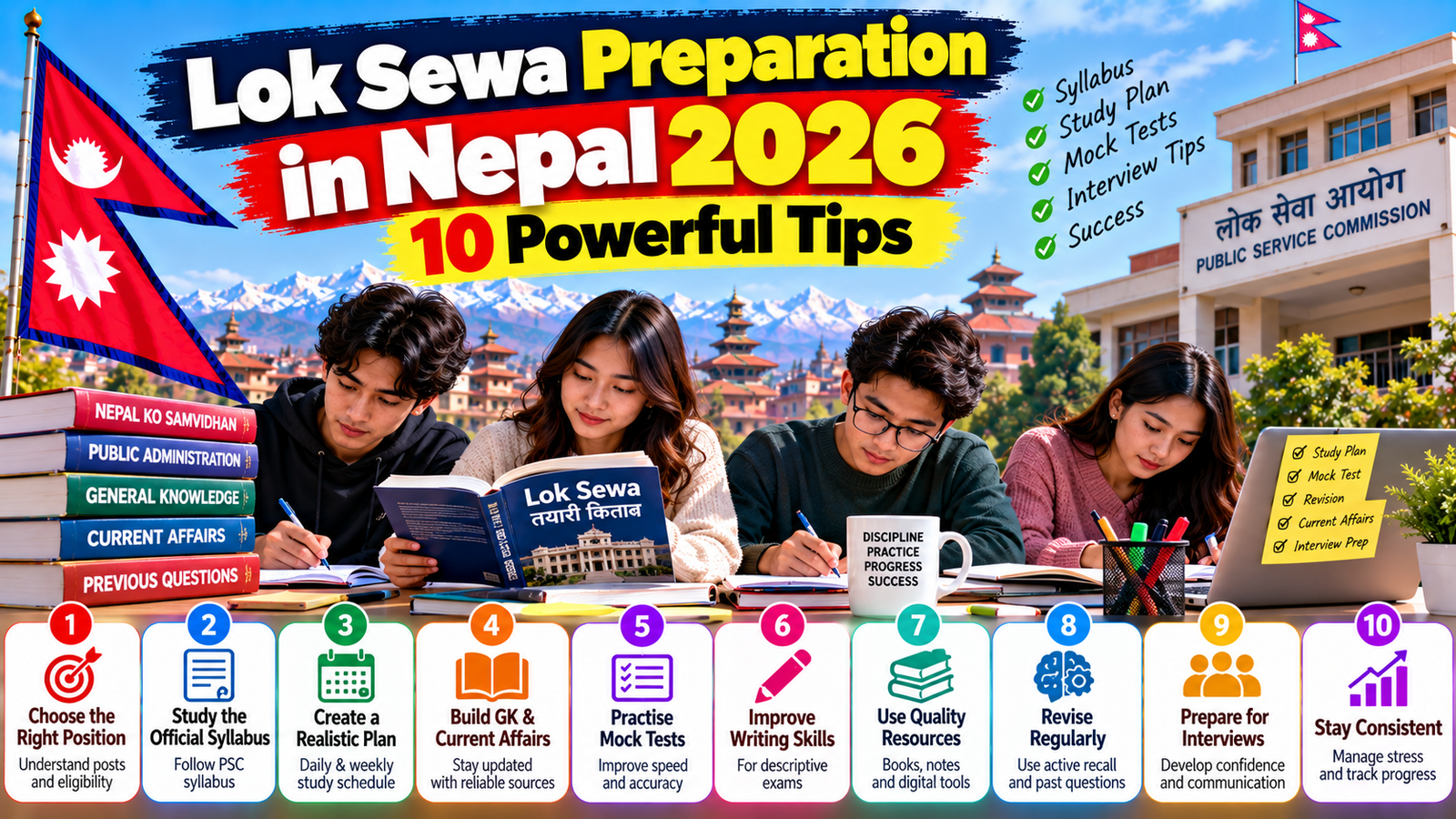
This comprehensive guide explains 10 powerful tips for Lok Sewa preparation in Nepal in 2026, including official resources, syllabus analysis, time management, mock examinations, current affairs, written-answer practice and interview preparation.
It also provides illustrative study plans, a sample preparation budget, common mistakes to avoid and 25 frequently asked questions.
Important: This is an independent educational guide, not an official Public Service Commission publication. Eligibility conditions, examination formats, marks, fees and deadlines depend on the relevant advertisement and syllabus. Always follow the latest instructions issued by the appropriate commission.
What Is Lok Sewa in Nepal?
Lok Sewa refers to the competitive public-service recruitment system associated with Nepal’s Public Service Commission.
The Public Service Commission, or PSC, is known in Nepali as लोक सेवा आयोग.
It is a constitutional institution involved in public-service recruitment and related examination processes.
What Does the Public Service Commission Do?
The commission publishes recruitment advertisements and administers relevant selection procedures within its jurisdiction.
Depending on the position, the process may include written examinations, practical or skills assessments, interviews and other specified stages.
Not every position follows the same assessment structure.
Candidates should consult the official notice for their particular recruitment process.
Is Lok Sewa Only for Administrative Jobs?
No.
Public-service recruitment includes various occupational and professional areas.
Examples may include administrative services, accounting-related roles, engineering services and health-related positions.
The available positions and required qualifications vary.
Federal and Provincial Recruitment
Candidates should distinguish between the federal Public Service Commission and provincial public service commissions.
Different commissions may publish separate advertisements, syllabuses, examination schedules and application instructions.
Preparing for one examination does not automatically establish eligibility for another.
Official Public Service Commission Website
The federal commission’s official website is:
Candidates should use official sources rather than relying exclusively on social media posts, coaching advertisements or unofficial vacancy summaries.
Lok Sewa Preparation in Nepal: Important 2026 Updates
The year 2026 corresponds partly to Bikram Sambat 2082 and partly to 2083.
Government recruitment announcements commonly use the Nepali calendar.
Recruitment Calendar for Fiscal Year 2083/84
The Public Service Commission published its annual recruitment calendar for fiscal year 2083/84 on 2083-04-01 BS.
The calendar is available through the commission’s annual-calendar section.
Official source:
https://psc.gov.np/category/yearly_calendar
The calendar helps candidates anticipate recruitment activities.
However, it should not be treated as a substitute for individual vacancy notices.
Official Syllabuses Continue to Be Published
The commission maintains a syllabus section containing position-specific materials.
The available entries include different services, groups, levels and posts.
Candidates should download the syllabus matching their intended examination.
Official source:
https://www.psc.gov.np/category/course
Examination Notices Can Change
A PSC notice issued in 2083 BS concerning the non-technical Nayab Subba or equivalent examination illustrates the importance of consulting the official examination programme.
Candidates should check for revised examination centres, schedules and other notices.
Avoid Outdated Information
A book published several years ago may still contain useful foundational material.
However, older editions may not reflect changes to legislation, government structures, current affairs or examination requirements.
Always compare study materials against the latest official syllabus.
1. Choose the Right Lok Sewa Position Before Starting
One of the most important steps in Lok Sewa preparation in Nepal is choosing a specific examination target.
Preparing without a clear target can lead to wasted time and unnecessary confusion.
Understand Different Positions
Candidates commonly discuss positions such as Kharidar, Nayab Subba and Section Officer.
However, these are not interchangeable examinations.
Their eligibility criteria, syllabus content and selection arrangements may differ.
Consider Your Educational Background
Review your completed qualifications and the eligibility conditions published in the relevant vacancy announcement.
Do not assume that a particular degree automatically qualifies you for every administrative or technical post.
Check Age and Other Requirements
Age limits, citizenship requirements, professional registration and other eligibility conditions may apply.
These must be checked in the current official advertisement.
This article does not provide a universal age limit because the applicable conditions can differ.
Match Your Interests and Strengths
Someone who enjoys public administration may prefer a different pathway from a candidate with technical qualifications.
Your target should reflect your interests, educational eligibility and realistic preparation capacity.
Practical Exercise
Create a simple career-planning document containing:
- Target position and service.
- Relevant commission.
- Required educational qualification.
- Official syllabus link.
- Current or expected recruitment notice.
- Examination stages.
- Personal strengths and weaknesses.
This document becomes the foundation of your preparation.
Key lesson: Choose the examination first, then build the study plan around its official requirements.
2. Download and Understand the Official Lok Sewa Syllabus
The syllabus is the most important planning document for serious candidates.
It explains what knowledge and skills the examination is designed to assess.
Why the Syllabus Matters
Many beginners start by buying several books without checking whether the material matches the examination.
This can result in spending too much time on topics that are not relevant.
Where to Find the Syllabus
Visit the official PSC syllabus section:
https://www.psc.gov.np/category/course
Search for the correct service, group, level and position.
Download the relevant official document.
Analyse Every Section
Read the syllabus carefully and identify its main subject areas.
Depending on the examination, these may include general awareness, language, reasoning, public administration, technical knowledge or other subjects.
Do not assume every Lok Sewa examination contains the same sections.
Understand the Examination Format
Review the official assessment structure.
Determine whether the relevant examination includes objective questions, descriptive answers, practical assessments or interviews.
Check any officially specified marking and assessment instructions.
Create a Syllabus Tracker
A simple tracker can contain four columns:
| Topic | Studied | Practised | Revised |
|---|---|---|---|
| Topic A | Yes | Yes | Yes |
| Topic B | Yes | No | No |
| Topic C | No | No | No |
| Topic D | No | No | No |
These are placeholder topics, not an official syllabus.
Replace them with the actual topics from your chosen examination.
Prioritise Weak Areas
Mark each syllabus topic as strong, moderate or weak.
Allocate more study time to difficult areas while continuing to revise familiar subjects.
Key lesson: The official syllabus should determine what you study, not the popularity of a particular guidebook.
3. Create a Realistic Daily and Weekly Study Plan
A timetable helps candidates study consistently.
However, the best schedule is one that can be followed alongside education, employment and personal responsibilities.
How Many Hours Should You Study?
There is no single official number of daily study hours that guarantees Lok Sewa success.
A full-time candidate may have more available time than someone working or attending college.
The quality of concentration, revision and practice matters alongside the number of hours studied.
Illustrative Four-Hour Daily Plan
The following timetable is an optional example, not a PSC requirement.
| Study activity | Illustrative time |
|---|---|
| Review previous material | 30 minutes |
| Study a major syllabus topic | 90 minutes |
| Practise relevant questions | 60 minutes |
| Review current affairs | 30 minutes |
| Analyse mistakes and plan tomorrow | 30 minutes |
| Total | 4 hours |
Candidates can adapt the schedule according to their circumstances.
Weekly Planning
A useful weekly approach is to combine new learning, revision and practice.
For example, a candidate might dedicate several days to syllabus topics and reserve another session for a timed mock test.
Include Breaks
Long periods of uninterrupted study can reduce concentration.
Short breaks, sleep and regular physical activity may support sustainable preparation.
Avoid Unrealistic Timetables
A schedule requiring twelve hours of study every day may be difficult to maintain.
A realistic plan followed consistently is usually more useful than an ambitious plan abandoned after a few days.
Review Progress Weekly
At the end of each week, ask:
Which topics have I completed?
Which questions did I answer incorrectly?
What should I revise next?
What changes would make my timetable more effective?
Key lesson: Consistency and feedback matter more than creating an impressive-looking timetable.
4. Build Strong General Knowledge and Current Affairs Awareness
General knowledge and current affairs may form part of the syllabus for certain Lok Sewa examinations.
Candidates must confirm whether these areas are assessed in their particular examination.
Study Relevant National Information
Where included in the syllabus, useful areas may involve Nepal’s geography, history, constitutional framework, institutions, economy and public administration.
Understand International Developments
Some examinations may assess knowledge of international organisations or global developments.
The scope depends on the official syllabus.
Use Reliable Sources
For government policies, official reports and institutional decisions, consult the relevant authority.
News reports can help identify developments, but important facts should be checked against primary sources where possible.
Separate Facts From Opinions
Competitive examination answers should distinguish factual information from personal interpretation.
For example, a government announcement is not necessarily evidence that a proposed policy has already been implemented.
Create a Current Affairs Notebook
Organise notes by subject rather than simply collecting headlines.
Possible categories include government and administration, economy, environment, science and technology, and international relations.
Record Dates Carefully
Because Nepal uses the Bikram Sambat calendar for many official activities, candidates should pay attention to the calendar system used in their sources.
Avoid mixing dates without checking them.
Revise Rather Than Collect
Saving hundreds of articles does not mean you have learned their content.
Write short summaries, test your recall and revisit important facts.
Key lesson: Accurate understanding is more valuable than memorising unverified social media posts.
5. Practise Previous Questions and Timed Mock Tests
Practice questions help candidates understand how examination knowledge is applied.
They also reveal weaknesses that may not be obvious during reading.
Start With Relevant Questions
Use previous questions from the correct examination where authentic materials are available.
Do not assume questions from unrelated positions reflect your target syllabus.
Why Timed Practice Matters
A candidate may understand a topic but struggle to answer efficiently under time pressure.
Timed practice helps develop familiarity with examination conditions.
Create Realistic Mock Tests
Use the structure and time limit specified for your examination.
If an official format is unavailable for a particular practice exercise, clearly label the mock test as unofficial.
Analyse Incorrect Answers
After every practice session, identify whether mistakes resulted from:
- Missing knowledge.
- Misreading the question.
- Calculation errors.
- Weak reasoning.
- Time pressure.
- Uncertainty between similar answers.
Different causes require different solutions.
Track Your Progress
Keep a record of practice results.
For example:
| Practice test | Illustrative score |
|---|---|
| Test 1 | 42% |
| Test 2 | 51% |
| Test 3 | 58% |
| Test 4 | 65% |
These figures are hypothetical examples showing how a candidate might monitor progress.
They are not official pass marks, cut-off scores or typical candidate results.
Avoid Memorising Answer Keys
Understanding why an answer is correct helps candidates respond to unfamiliar questions.
Check Marking Instructions
If negative marking or other rules apply, they should be confirmed from the relevant official examination instructions.
Do not rely on a universal assumption about marking.
Key lesson: Mock tests are most valuable when candidates learn from the results.
6. Improve Writing, Language and Analytical Skills
Some Lok Sewa examinations assess descriptive writing, language ability or analytical responses.
The relevant syllabus determines the exact requirements.
Understand the Question
Before writing, identify what the question is asking.
A question requesting an explanation requires a different response from one requesting comparison or evaluation.
Organise Answers Clearly
A useful structure for many descriptive responses is:
Introduction: Define the issue or explain its context.
Main discussion: Present relevant facts, arguments or explanations.
Conclusion: Summarise the response directly.
This is a general writing method, not an official PSC marking template.
Use Relevant Examples
Examples can clarify complex ideas.
However, factual claims should be accurate.
Practise Under Time Limits
Candidates may find it helpful to practise writing answers within an appropriate time allowance.
The actual examination duration should come from the official syllabus or examination notice.
Improve Nepali and English Where Relevant
Language requirements vary by examination.
Candidates should practise the language skills actually assessed in their target position.
Seek Feedback
A qualified teacher, mentor or experienced candidate may help identify unclear explanations or weak organisation.
Avoid Overly Complicated Language
Clear, accurate writing is generally preferable to unnecessarily elaborate sentences.
Key lesson: Strong answers demonstrate understanding, relevance and organisation.
7. Use Quality Books, Digital Resources and Study Materials
Preparation resources can support learning, but their usefulness depends on accuracy and relevance.
Start With the Official Syllabus
Choose resources only after identifying the required subjects.
Compare Book Editions
Check publication dates and whether the content reflects the current syllabus.
Use Official Documents for Legal and Administrative Topics
Where the syllabus includes laws, regulations or government procedures, consult authoritative sources.
A simplified guidebook may be useful for learning, but it should not replace the current official text.
Use Digital Learning Carefully
Videos, online classes and practice applications can help explain difficult subjects.
However, online popularity does not prove accuracy.
Create a Small Resource Library
Rather than purchasing every available book, select a manageable collection that covers the relevant topics.
AI Tools for Lok Sewa Preparation
AI tools may help generate flashcards, explain concepts and organise study schedules.
However, AI systems can produce inaccurate answers, outdated information and fabricated references.
Never rely on AI-generated legal provisions, constitutional articles or examination dates without verification.
For more information on responsible digital learning, read Eleven Nepal’s AI Skills in Nepal 2026.
Protect Your Personal Information
Avoid uploading citizenship documents, application credentials or sensitive personal information to unfamiliar study platforms.
Key lesson: Reliable, syllabus-aligned resources are more useful than collecting excessive study materials.
8. Use Active Recall and Regular Revision
Reading the same chapter repeatedly may create a feeling of familiarity without ensuring that information can be recalled during an examination.
Active learning methods can help candidates identify what they genuinely remember.
What Is Active Recall?
Active recall means attempting to retrieve information from memory without immediately looking at the answer.
For example, after studying a topic, close the book and write down its key points.
Use Flashcards
Flashcards can be useful for definitions, terminology and factual information.
Keep questions specific and answers concise.
Practise Spaced Revision
Instead of revising a topic only once, return to it at different intervals.
Illustrative Revision Schedule
A candidate could revisit a topic:
- On the day it is first studied.
- The following day.
- Several days later.
- Approximately one week later.
- During a later mock-test session.
This is a suggested learning strategy, not a PSC-prescribed schedule.
Mix Different Topics
Alternating between related subject areas may help candidates practise selecting the appropriate knowledge for different questions.
Explain Topics Aloud
Try teaching a concept to another person or explaining it without notes.
Difficulty explaining the topic may reveal gaps in understanding.
Maintain an Error Notebook
Record frequently missed questions and the reasons for mistakes.
Review this notebook before future practice sessions.
Key lesson: Revision should test memory and understanding rather than simply repeat reading.
9. Prepare for Interviews and Other Selection Stages
Candidates should understand every stage of the selection process applicable to their chosen position.
Some recruitment procedures include interviews, practical examinations or skills assessments.
Check the Official Assessment Structure
Do not assume that every examination has an identical interview process.
Review the relevant official advertisement and selection information.
Develop Clear Communication
Practise answering questions directly.
Avoid speaking for several minutes without addressing the question.
Understand the Role
Learn about the responsibilities of the position for which you are applying.
Prepare to Discuss Your Background
Be ready to explain your education, experience and reasons for applying.
Practise Ethical Judgement
Public-service roles may involve responsibilities related to fairness, accountability and professional conduct.
Candidates should understand relevant public-service principles.
Avoid Memorised Personal Claims
Do not invent achievements or experience to impress interviewers.
Mock Interviews
Practising with a mentor or study group can improve confidence.
However, coaching cannot guarantee selection.
Professional Presentation
Follow any instructions about documentation and attendance.
Dress appropriately and arrive with sufficient time to complete required procedures.
Key lesson: Interview preparation should focus on knowledge, clarity, integrity and familiarity with the position.
10. Stay Consistent, Manage Stress and Follow Official Notices
Lok Sewa preparation can be demanding, particularly for candidates balancing study with work or family responsibilities.
A sustainable approach is important.
Set Achievable Weekly Goals
Break large subjects into manageable tasks.
Avoid Comparing Yourself Constantly
Different candidates have different educational backgrounds and preparation time.
Focus on measurable personal progress.
Maintain Healthy Routines
Regular sleep, physical activity and adequate nutrition can support concentration.
Use Study Groups Productively
A small study group can provide accountability and opportunities to discuss difficult topics.
However, groups should not become a source of constant distraction.
Check Official Notices
The PSC website publishes important information including advertisements, examination centres, results and recommendations.
Keep Documents Organised
Maintain copies of relevant educational records and other documents required by the specific application.
Protect Your Account
Use strong passwords and avoid sharing application credentials.
Prepare for More Than One Outcome
Competitive examinations are uncertain.
Candidates may benefit from developing transferable skills while preparing.
Maintain Alternative Career Pathways
A candidate can prepare for public service while also exploring suitable private-sector employment, technical training or further education.
Eleven Nepal’s Nepal Tech Revolution 2026 discusses alternative skill-development opportunities.
Key lesson: Consistent preparation is valuable, but candidates should avoid treating one examination as their only possible future.
How to Apply for Lok Sewa in Nepal in 2026
Application procedures depend on the recruiting commission and specific advertisement.
The following is a general preparation checklist, not a substitute for official application instructions.
Step 1: Find the Official Advertisement
Visit the relevant commission’s official website.
Identify the position and read the complete notice.
Step 2: Confirm Eligibility
Check educational qualifications, age conditions and any other requirements stated in the advertisement.
Step 3: Read Application Instructions
Determine the required application method, documents, deadlines and payment instructions.
Step 4: Prepare Accurate Documents
Use genuine, complete and legible records.
Step 5: Submit Through the Official System
Follow the current instructions provided by the recruiting authority.
The federal PSC has historically provided online application guidance, but candidates should use the current system and instructions rather than relying on older screenshots.
Step 6: Confirm Submission
Keep the official confirmation or receipt where provided.
Step 7: Monitor Notices
Check for approved candidate lists, examination centres and any revised schedules.
Step 8: Follow Examination-Day Instructions
Bring the documents specified in the official notice and comply with the relevant examination rules.
Important: This article intentionally does not state a fixed application fee, universal age limit or guaranteed examination date. These details must be checked in the current advertisement.
Lok Sewa Preparation in Nepal: A 90-Day Study Plan
A structured 90-day plan may help candidates organise their preparation.
However, completing a syllabus in 90 days is not guaranteed.
The time required depends on the examination, subject complexity and individual preparation level.
Days 1–15: Understand the Examination
Download the official syllabus.
Identify the examination format.
Collect suitable resources.
Complete an initial diagnostic practice test.
Record weak areas.
Days 16–30: Build Foundational Knowledge
Study major syllabus topics.
Create short notes.
Begin active recall.
Practise questions after each topic.
Days 31–45: Strengthen Difficult Subjects
Spend additional time on weak areas.
Review relevant official documents.
Practise analytical or technical questions as required.
Days 46–60: Increase Practice
Complete timed exercises.
Review previous questions.
Update the error notebook.
Identify recurring mistakes.
Days 61–75: Intensive Revision
Revisit completed topics.
Practise full-length assessments where appropriate.
Improve time management.
Days 76–90: Final Review
Focus on weak topics.
Complete realistic practice examinations.
Review important notes.
Check official announcements.
Maintain adequate rest.
Illustrative Weekly Timetable
| Day | Suggested activity |
|---|---|
| Monday | Major syllabus topic |
| Tuesday | Second syllabus topic |
| Wednesday | Practice questions and review |
| Thursday | Weak-topic improvement |
| Friday | Writing or technical practice |
| Saturday | Timed mock examination |
| Sunday | Error analysis and weekly planning |
This schedule is illustrative and should be adapted to the candidate’s actual syllabus.
How Much Does Lok Sewa Preparation Cost in Nepal?
Preparation expenses vary depending on whether a candidate studies independently, purchases books, attends classes or travels to an examination centre.
There is no single preparation cost applicable to every candidate.
Possible Expenses
Candidates may need to budget for books, stationery, internet access, optional coaching, travel and official application charges.
The official application charge depends on the relevant notice.
Illustrative Self-Study Budget
The following is a hypothetical budgeting exercise, not a verified 2026 market-price survey.
| Expense | Illustrative amount |
|---|---|
| Books and reference materials | NPR 2,000 |
| Stationery and printing | NPR 600 |
| Additional internet/data allowance | NPR 900 |
| Travel reserve | NPR 1,500 |
| Miscellaneous preparation reserve | NPR 500 |
| Total illustrative budget | NPR 5,500 |
The example excludes any official application fee and optional coaching.
It also assumes that the candidate already has access to a suitable study environment.
Illustrative Coaching Scenario
Suppose a candidate chooses an optional preparation course costing a hypothetical NPR 8,000.
Adding this to the example above would produce a total of NPR 13,500.
This is not a verified coaching quotation.
Is Coaching Necessary?
No single preparation method is suitable for everyone.
Some candidates benefit from structured instruction.
Others may study effectively using official syllabuses, books, practice questions and independent revision.
Before paying for a course, check the instructor’s qualifications, teaching content, refund conditions and relevance to the current syllabus.
Best Books and Resources for Lok Sewa Preparation
Instead of recommending unverified commercial titles or editions, candidates should select resources by category.
Official Syllabus
This should be the primary reference for examination coverage.
Relevant Laws and Government Documents
Use current authoritative texts where legal or administrative subjects are included.
Subject Textbooks
Choose books that explain the required concepts clearly.
Authentic Previous Questions
Use genuine past papers where available and relevant.
Practice Question Collections
These can help with revision, but check their accuracy.
Current Affairs Sources
Use reliable reporting supported by official documents.
Study Notes
Create concise summaries using your own words.
Digital Tools
Use flashcards, spreadsheets and study timers where helpful.
Avoid depending entirely on unofficial answer databases.
Common Mistakes During Lok Sewa Preparation
Candidates can lose valuable preparation time through avoidable habits.
Studying Without the Official Syllabus
This may lead to irrelevant reading.
Changing Targets Repeatedly
Constantly switching between examinations can make focused preparation difficult.
Buying Too Many Books
More resources do not necessarily mean better understanding.
Ignoring Previous Questions
Practice is important for applying knowledge.
Avoiding Weak Topics
Repeatedly studying familiar subjects can create an inaccurate sense of progress.
Memorising Without Understanding
Unfamiliar questions may require reasoning rather than repetition.
Believing Unverified Vacancy News
Unofficial announcements can contain incorrect dates or conditions.
Neglecting Writing Practice
Candidates preparing for descriptive examinations should practise the relevant response format.
Ignoring Examination Instructions
Failure to follow official requirements can create avoidable problems.
Studying Without Rest
Unsustainable routines may reduce concentration and motivation.
Lok Sewa Preparation for Working Students
Candidates with employment responsibilities may have less available study time.
A focused schedule can still help.
Use Short Study Sessions
A working candidate might divide preparation into shorter sessions before or after work.
Prioritise High-Value Tasks
Focus on the official syllabus, weak areas and practice questions.
Use Commuting Time Carefully
Audio revision may be useful when it is safe and appropriate.
Protect Sleep
Avoid sacrificing essential rest for an unrealistic timetable.
Plan Around Work Commitments
A predictable weekly schedule can help maintain consistency.
Review Progress Monthly
If the plan is not working, adjust it rather than abandoning preparation entirely.
Lok Sewa Versus Private-Sector Careers
Public-service preparation is one possible career path.
Private employment, technical occupations and entrepreneurship may also offer suitable opportunities.
Public-Service Pathway
Candidates may value the structured recruitment process and the opportunity to contribute to public administration.
However, selection is competitive and vacancies are limited.
Private-Sector Pathway
Private employers may offer different roles, training opportunities and working conditions.
Employment terms vary by organisation.
Combining Preparation With Skill Development
Candidates can improve communication, digital literacy, writing and organisational skills while preparing for Lok Sewa.
These abilities may remain useful in other career paths.
Preparing a CV
Although PSC applications have their own requirements, a professional CV may be useful when applying for internships or alternative jobs.
Read Eleven Nepal’s How to Make a Professional CV in Nepal for practical guidance.
Frequently Asked Questions About Lok Sewa Preparation in Nepal
1. What is Lok Sewa in Nepal?
Lok Sewa commonly refers to Nepal’s public-service competitive recruitment system, including examinations administered by the Public Service Commission.
2. How can beginners start Lok Sewa preparation?
Begin by selecting a target position, checking eligibility, downloading the official syllabus and creating a realistic study plan.
3. Where can I find the official Lok Sewa syllabus?
The federal Public Service Commission publishes syllabuses at https://www.psc.gov.np/category/course.
4. Is the Lok Sewa calendar available for 2083/84?
Yes. The PSC published the fiscal year 2083/84 annual recruitment calendar on its official website.
5. How many hours should I study every day?
There is no universal requirement. Study time should depend on the examination, available time and individual learning needs.
6. Can I prepare for Lok Sewa at home?
Yes. Independent preparation may be suitable for candidates who can access reliable resources and maintain a structured routine.
7. Is coaching compulsory for Lok Sewa?
No universal coaching requirement applies. Candidates should assess whether additional instruction would be useful.
8. Which book is best for Lok Sewa preparation?
The most suitable resources depend on the target examination and its current syllabus.
9. Can I prepare for Lok Sewa after Grade 12?
Eligibility depends on the specific position. Check the official advertisement before assuming you qualify.
10. Can bachelor’s degree students apply?
Some positions may require completed qualifications or other conditions. The relevant notice determines eligibility.
11. What is the age limit for Lok Sewa in 2026?
The applicable age conditions depend on the recruitment category and advertisement. Check the current official notice.
12. How much is the Lok Sewa application fee?
Fees depend on the relevant advertisement and application arrangements. This article does not provide an unverified universal fee.
13. Is the Lok Sewa examination held every year?
Recruitment activities are planned through official calendars, but specific advertisements and examination arrangements can vary.
14. Is the Lok Sewa examination difficult?
Competitive examinations can be demanding because candidates must meet the required standards and compete for available positions.
15. Are previous questions useful?
Yes. Relevant previous questions can help candidates understand question styles and identify weak areas.
16. Are mock tests necessary?
Mock tests are not universally compulsory, but they can support time management and self-assessment.
17. Can I prepare while working full-time?
Yes, although candidates may need a longer preparation period and a carefully managed timetable.
18. Is general knowledge important?
It is important where included in the relevant examination syllabus.
19. Is English compulsory for Lok Sewa?
Language requirements depend on the examination and syllabus.
20. Do all Lok Sewa positions have interviews?
Selection stages vary. Candidates should review the official process for their chosen position.
21. Can I use AI tools for preparation?
AI tools can assist with explanations and revision, but all important factual and legal information should be verified.
22. How can I avoid fake Lok Sewa notices?
Check the official commission website and verify advertisement details before taking action.
23. Is Lok Sewa the same as the Teacher Service Commission?
No. Different recruitment authorities administer different selection processes. Candidates should consult the relevant institution.
24. How long does Lok Sewa preparation take?
Preparation time varies by examination complexity, educational background, study consistency and prior knowledge.
25. What is the most important tip for Lok Sewa success?
Begin with the official syllabus, study consistently, practise relevant questions and improve based on feedback.
Conclusion: How to Succeed With Lok Sewa Preparation in Nepal
Lok Sewa preparation in Nepal requires a clear target, accurate information, consistent study and regular practice.
Candidates should begin by understanding the position they want to pursue and confirming the relevant eligibility conditions.
The official Public Service Commission syllabus should guide their preparation.
A realistic timetable can help candidates balance learning, revision and practice examinations.
Current affairs, writing skills, analytical thinking and interview preparation may also be important, depending on the examination.
In 2026, candidates can use the PSC’s published fiscal year 2083/84 recruitment calendar and official syllabus pages to support their planning.
However, no study method guarantees selection.
Success depends on the examination requirements, individual performance and the competitive recruitment process.
Candidates should also maintain their wellbeing and continue developing skills that remain useful beyond one examination.
The most effective preparation is not about studying the greatest number of hours. It is about understanding what matters, practising consistently and improving with every study session.
For Nepalese students and graduates, a disciplined approach can make public-service preparation more organised, informed and sustainable.
Eleven Nepal — Empowering Youth Through Knowledge, Skills and Opportunities.
References and Official Sources
1. Public Service Commission, Nepal (2083-04-01 BS / 2026). Annual Recruitment Calendar for Fiscal Year 2083/84.
https://psc.gov.np/category/yearly_calendar
2. Public Service Commission, Nepal (accessed 20 October 2026). Official Syllabuses and Course Materials.
https://www.psc.gov.np/category/course
3. Public Service Commission, Nepal (accessed 20 October 2026). Official Website: Advertisements, Examination Notices and Results.
4. Public Service Commission, Nepal (2083 BS / 2026). Non-Technical Nayab Subba or Equivalent Examination Programme.
https://psc.gov.np/site_uploads/files/नायब_सुब्बा_परीक्षा_कार्यक्रम_अप्राविधिक_2083-1-2.pdf
5. Public Service Commission, Nepal. Acts, Regulations and Examination Procedures.
6. Public Service Commission, Nepal. Official Examination Schedule and Examination Centre Notices.
https://psc.gov.np/file/examschudle
7. Eleven Nepal (14 October 2026). AI Skills in Nepal 2026: 7 Essential Skills for Students and Jobseekers.
8. Eleven Nepal (14 October 2026). Nepal Tech Revolution 2026: 5 Powerful Opportunities for Youth.
9. Eleven Nepal (October 2026). How to Make a Professional CV in Nepal: 7 Essential Steps.
Editorial note: This guide reflects information reviewed on 20 October 2026. The preparation methods, study timetables, practice scores and NPR budgets are illustrative educational examples, not official PSC requirements or verified commercial quotations. Applicants must confirm current eligibility, fees, deadlines, examination stages and assessment rules from the relevant recruiting authority before applying.

