
By Eleven Nepal Editorial Team | Updated: 20 October 2026 | Category: Technology & Digital Skills
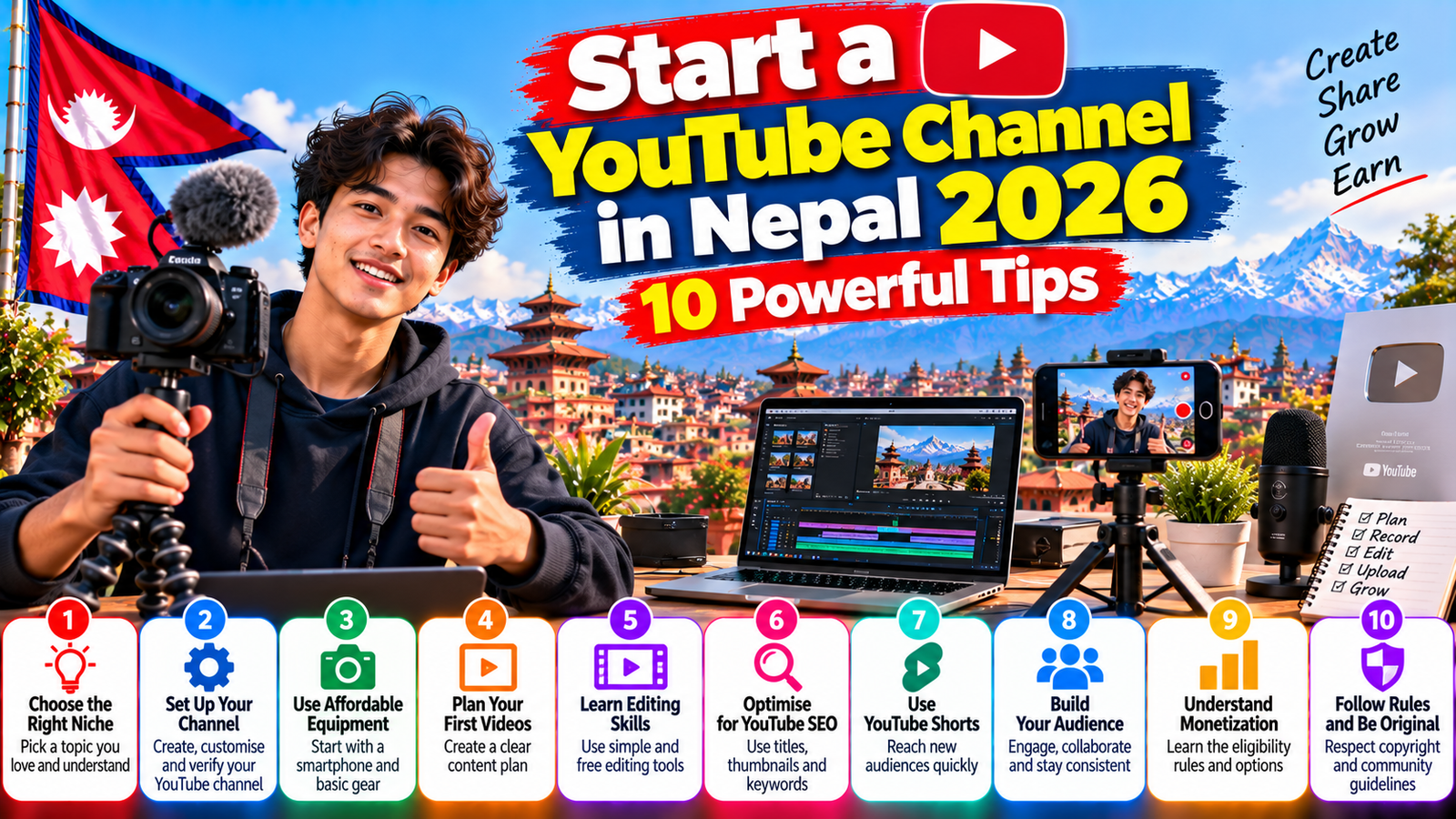
Starting a YouTube channel in Nepal can be an exciting way to share knowledge, develop creative skills, build a personal brand and potentially earn income. Whether you want to create travel videos, cooking tutorials, educational lessons, gaming content or technology reviews, YouTube provides a platform for reaching audiences in Nepal and around the world.
However, becoming a successful YouTube creator requires more than uploading videos and waiting for views.
You need to understand your audience, choose a suitable topic, produce original content, improve your editing skills and follow YouTube’s policies.
For beginners, one of the biggest challenges is knowing where to start.
Do you need an expensive camera? Can you start with a smartphone? How do you get your first subscribers? Can YouTube creators in Nepal earn advertising revenue? What are the monetization requirements in 2026?
These questions are particularly important because online advice often contains outdated information, exaggerated income claims or misleading promises about rapid growth.
Fortunately, starting a channel does not require purchasing professional equipment immediately.
A smartphone, reliable internet connection, clear content strategy and willingness to learn can provide a practical starting point.
In 2026, YouTube also offers several content formats, including traditional videos, Shorts and live streams. Each format has different strengths and production considerations.
Nepal is included in the countries where the standard YouTube Partner Program is available. However, joining the programme requires meeting eligibility conditions and passing YouTube’s review.
This guide explains 10 powerful tips for starting a YouTube channel in Nepal in 2026, including channel creation, niche selection, equipment, filming, editing, YouTube SEO, audience development, monetization and copyright protection.
You will also find a 30-day content plan, illustrative equipment budgets, practical video ideas and 25 frequently asked questions.
Important: This article provides educational guidance, not guaranteed earnings, subscriber growth or business results. Platform features and monetization policies can change, so creators should confirm current requirements through YouTube’s official Help Centre and YouTube Studio.
Why Start a YouTube Channel in Nepal in 2026?
YouTube allows individuals to publish videos without first securing a traditional television or media distribution agreement.
Creators can share educational content, demonstrate practical skills, document experiences or build communities around particular interests.
Opportunities for Nepalese Creators
Nepal offers many possible content subjects.
Its languages, food traditions, landscapes, cultural heritage and everyday experiences can provide inspiration for original videos.
For example, a creator might teach Nepali cooking techniques, explain technology in simple Nepali or document a trekking experience.
Another creator might publish educational videos for students or tutorials for small-business owners.
These are potential content directions, not verified rankings of Nepal’s most profitable YouTube niches.
Building Digital Skills
Creating videos can help develop communication, storytelling, photography, editing, research and marketing skills.
These abilities may also be useful in employment, freelancing and entrepreneurship.
Readers interested in related technology skills can explore Eleven Nepal’s AI Skills in Nepal 2026.
Potential Income Opportunities
Some creators eventually earn income through YouTube advertising, sponsorships, services or other commercial activities.
However, revenue depends on audience behaviour, eligibility, advertiser demand and individual business arrangements.
Many channels earn little or no income, especially during their early development.
A Long-Term Creative Project
A YouTube channel can also be valuable without immediate monetization.
It may serve as a portfolio, educational resource or record of personal development.
The most sustainable starting point is to create something useful for a clearly defined audience.
1. Choose the Right YouTube Niche in Nepal
A niche is the main subject or audience focus of a channel.
Choosing a niche helps viewers understand what they can expect from your videos.
Popular Types of YouTube Content to Explore
Possible channel categories include:
- Education and examination preparation.
- Cooking and food tutorials.
- Travel and tourism.
- Technology and smartphone guides.
- Gaming and entertainment.
- Fitness and lifestyle.
- Agriculture and rural life.
- Business and personal finance.
- Language learning.
- Documentary and cultural storytelling.
These categories are examples, not a verified popularity ranking.
Match the Niche to Your Skills
Consider what you know, enjoy and can explain accurately.
A culinary student might create cooking demonstrations.
A technology enthusiast might explain mobile applications or computer troubleshooting.
Someone with experience in agriculture could document farming practices.
Identify Your Target Audience
A channel aimed at SEE students requires a different approach from one targeting professional chefs.
Define the viewers you want to reach.
Consider their interests, language preferences, problems and expectations.
Research Existing Videos
Search YouTube for topics related to your niche.
Observe common questions, video formats and gaps in available explanations.
Avoid copying another creator’s content.
Create a Clear Channel Promise
A channel promise explains what viewers gain by subscribing.
For example:
“Simple cooking tutorials using ingredients available in Nepal.”
This is more specific than saying, “I upload different videos.”
Avoid Choosing Only Based on Earnings
A niche with high advertising value may still be unsuitable if you lack interest or expertise.
Choose a subject you can develop over time.
Key lesson: A focused channel with useful content is easier to understand than a channel without a clear purpose.
2. Create and Set Up Your YouTube Channel Properly
YouTube’s official Help Centre explains how to create a personal channel or a channel associated with a Brand Account.
Step 1: Sign In to YouTube
Visit https://www.youtube.com/ and sign in using your Google Account.
Step 2: Create a Channel
Open your account settings and locate the option to add or manage channels.
Follow the prompts to create a new channel.
The interface may change over time.
Step 3: Choose a Channel Name
Select a name that reflects your content.
A good name should be understandable, memorable and appropriate for your audience.
Check whether a similar name is already associated with another creator or business.
Step 4: Choose a Handle
A YouTube handle is a unique identifier associated with your channel.
Choose one that is easy to recognise and share.
Step 5: Add a Profile Picture
Use a clear personal photograph, original logo or suitable brand image.
Avoid using another organisation’s protected branding without permission.
Step 6: Create a Channel Banner
Your banner should communicate the channel’s theme.
Keep important text visible across different screen sizes.
Step 7: Write a Channel Description
Explain what viewers can expect.
For example:
“Welcome to our channel, where we share practical cooking tutorials, affordable recipes and useful kitchen techniques for home cooks in Nepal.”
Step 8: Customise Your Channel
Open YouTube Studio and explore the Customization section.
You can manage your channel’s branding, description, featured content and layout.
Step 9: Enable Account Security
Use a strong password and enable two-step verification.
Avoid sharing account credentials with editors or collaborators.
Step 10: Verify Your Phone Number
YouTube’s feature-access guidance explains that phone verification unlocks certain features, including custom thumbnails and longer video uploads, subject to account eligibility.
Official setup guide:
Key lesson: Professional channel presentation begins with accurate information, consistent branding and account security.
3. Start With Affordable YouTube Equipment
One of the biggest misconceptions about starting a YouTube channel in Nepal is that expensive equipment is necessary.
Professional cameras and lighting systems can improve production flexibility, but beginners should first focus on clear communication and useful content.
Can You Start With a Smartphone?
Yes.
Many modern smartphones can record suitable video for online publishing.
The result depends on lighting, audio quality, camera settings and recording technique.
Prioritise Audio
Viewers may tolerate modest video quality, but unclear speech can make a tutorial difficult to follow.
Record in a quiet environment.
Position the microphone appropriately.
Use Natural Lighting
A window can provide useful light for indoor recording.
Avoid placing a bright window directly behind the subject unless the exposure is carefully managed.
Stabilise the Camera
A tripod or stable surface can reduce distracting movement.
Basic Beginner Equipment
A simple setup may include:
| Equipment | Purpose |
|---|---|
| Existing smartphone | Video recording |
| Basic tripod or stable stand | Camera stability |
| Suitable microphone | Clearer speech |
| Window light or available lighting | Subject visibility |
| Headphones | Audio monitoring |
| Editing application | Video production |
Illustrative Equipment Budget
The following figures are entirely hypothetical and are not verified Nepalese retail prices.
| Item | Illustrative allowance |
|---|---|
| Existing smartphone | NPR 0 additional purchase |
| Tripod | NPR 1,500 |
| Microphone | NPR 2,500 |
| Basic lighting | NPR 3,000 |
| Accessories | NPR 1,000 |
| Illustrative total | NPR 8,000 |
Actual equipment prices depend on the product, seller and market conditions.
When Should You Upgrade?
Upgrade equipment when a specific limitation affects your videos.
For example, a better microphone may be worthwhile if outdoor noise repeatedly makes dialogue difficult to understand.
Avoid borrowing heavily to purchase equipment before testing your content idea.
Key lesson: Start with the equipment you already have and improve your production process before investing in expensive gear.
4. Plan Your First 10 YouTube Videos
Many beginners create a channel but struggle to decide what to publish.
Planning a small group of videos can make the process more manageable.
Understand Audience Problems
Useful videos often answer questions or demonstrate skills.
For example, a technology channel might explain how to improve smartphone storage management.
A cooking channel might demonstrate a traditional recipe step by step.
Create Content Categories
Organise your niche into several related subjects.
A Nepalese cooking channel could cover traditional recipes, kitchen techniques and ingredient guides.
Example: First 10 Videos for a Cooking Channel
- How to Make Authentic Nepali Momo at Home.
- Easy Tomato and Sesame Momo Achar.
- Five Common Mistakes When Making Momo Dough.
- How to Prepare a Simple Nepali Breakfast.
- Beginner Knife Skills for Home Cooking.
- How to Store Vegetables Safely.
- Easy Dal Bhat Cooking Tutorial.
- How to Make Soft Roti.
- Basic Food Hygiene Tips for Home Kitchens.
- A Beginner’s Guide to Planning Weekly Meals.
These are editorial video ideas, not evidence of search demand.
Develop a Simple Video Outline
Before filming, write down the introduction, main teaching points, demonstration and conclusion.
Focus on Viewer Value
Ask what the viewer will learn or experience by the end of the video.
Avoid Unnecessary Introductions
A long introduction can delay the information viewers came to find.
Explain the topic clearly and begin delivering value.
Create a Repeatable Workflow
Use a planning template for each video.
Record the topic, audience, key message, filming requirements and publication status.
Key lesson: A small, realistic content plan is more useful than a long list of ideas you never produce.
5. Learn Basic Filming and Video Editing
Video editing helps organise footage into a clear story.
However, complicated effects are not necessary for every type of content.
Learn Basic Camera Framing
Position the subject clearly.
Check that important objects remain visible.
Record Clean Audio
Reduce background noise where possible.
Monitor recordings before completing the entire filming session.
Capture Supporting Footage
Supporting footage, often called B-roll, helps illustrate explanations.
A cooking video might include close-ups of ingredients, preparation and the finished dish.
Choose Suitable Editing Software
Beginners can explore editing applications that work with their devices.
Examples include DaVinci Resolve, CapCut and other established video editors.
Free versions may offer sufficient functionality for basic production.
Check current licensing and feature availability before choosing a programme.
Learn Essential Editing Skills
Start with trimming clips, arranging scenes, adjusting audio levels, adding captions and exporting videos.
Avoid Excessive Effects
Transitions and animations should support the content rather than distract from it.
Add Captions Where Appropriate
Captions can improve accessibility and help viewers understand speech in difficult listening environments.
Review automatically generated captions for errors.
Export in a Suitable Format
Choose settings supported by YouTube and appropriate for your source footage.
Do not assume that exporting low-resolution footage at a higher resolution automatically improves image quality.
Develop Your Own Style
Consistent editing, pacing and visual presentation can help establish a recognisable channel identity.
Key lesson: Clear storytelling and understandable audio are more important than unnecessary visual complexity.
6. Optimise Videos With YouTube SEO
YouTube SEO involves helping the platform and potential viewers understand what a video is about.
It does not guarantee higher rankings.
Research Search Intent
Think about what viewers are trying to find.
Someone searching for “momo dough recipe” probably wants practical measurements and preparation instructions.
Write Clear Titles
A title should accurately describe the video.
For example:
“How to Make Nepali Momo Dough | Beginner Recipe”
Avoid promising results that the video does not deliver.
Create Useful Thumbnails
A thumbnail should communicate the topic quickly.
Use clear images and readable text.
Avoid misleading expressions, unrelated photographs or exaggerated claims.
Write Informative Descriptions
Explain what the video covers.
Include relevant information, useful links and appropriate disclosures.
Use Chapters Where Helpful
Chapters can make longer tutorials easier to navigate.
Add Accurate Captions
Captions may help viewers and improve accessibility.
Organise Videos Into Playlists
Playlists can group related videos.
A cooking channel might create playlists for breakfast, traditional food and kitchen skills.
Avoid Keyword Stuffing
Repeating the same phrase excessively does not make content more useful.
Use YouTube Analytics
Review the search terms and traffic sources available in YouTube Studio.
These can help you understand how viewers discover your content.
Match the Video to the Title
A well-optimised title cannot compensate for a video that fails to answer the viewer’s question.
Key lesson: YouTube SEO works best when accurate titles, useful content and audience satisfaction support one another.
7. Use YouTube Shorts to Reach New Viewers
YouTube Shorts provide a format for publishing shorter vertical or square videos.
They can be useful for demonstrations, highlights and concise explanations.
What Changed With Shorts?
YouTube introduced support for Shorts of up to three minutes for eligible square or vertical uploads from 15 October 2024.
The current classification and monetization rules depend on YouTube’s official requirements.
Ideas for Nepalese Creators
A food creator might demonstrate a quick kitchen technique.
A technology creator could explain one smartphone feature.
An education channel could answer a common examination question.
Capture Attention Early
Start with the subject rather than a lengthy introduction.
Keep the Message Focused
One Short should usually communicate one clear idea.
Use Readable Captions
Text should remain visible on mobile screens.
Encourage Further Learning
A Short can introduce a subject that is explained in greater depth in a longer video.
Understand Shorts Watch Hours
Watch hours generated through the Shorts Feed do not count towards the standard 4,000 valid public watch-hour requirement for long-form advertising eligibility.
YouTube provides a separate eligible Shorts-view pathway.
Avoid Reposting Without Permission
Copying clips from other creators can create copyright and monetization problems.
Key lesson: Shorts can complement longer videos, but neither format guarantees subscribers or revenue.
8. Build a Loyal YouTube Audience
Audience growth is not simply about reaching the highest possible view count.
A sustainable channel should give viewers reasons to return.
Publish Consistently
Choose a schedule you can maintain.
A beginner may prefer one carefully produced video each week rather than an unrealistic daily schedule.
Respond to Genuine Questions
Comments can reveal what viewers want to learn.
Ask for Useful Feedback
Instead of repeatedly requesting subscriptions, ask whether the explanation was clear or what topic viewers would like covered next.
Create Related Videos
A series can help viewers explore a subject in greater depth.
Maintain Content Quality
Consistency should not mean publishing unfinished or misleading content.
Collaborate Carefully
Collaborations may introduce your work to another audience.
Choose partners whose content and values are compatible with yours.
Avoid Buying Subscribers
Purchased subscribers and artificial engagement can violate platform rules and provide misleading performance data.
Respect Your Audience
Avoid misleading thumbnails, false claims and unnecessary controversy.
Build Trust Over Time
Viewers may return when they find your explanations useful, accurate and enjoyable.
Key lesson: Genuine engagement and useful content are more valuable than artificially inflated metrics.
9. Understand YouTube Monetization in Nepal in 2026
One of the most common questions is whether creators can earn money from a YouTube channel in Nepal.
The answer is yes, subject to YouTube’s programme rules and eligibility conditions.
Is Nepal Eligible for the YouTube Partner Program?
Yes.
Nepal appears on YouTube’s official list of countries where the standard YouTube Partner Program is available.
Standard Advertising-Revenue Thresholds
Under YouTube’s published October 2026 requirements, creators can become eligible to apply through either of these pathways:
| Requirement | Long-form pathway | Shorts pathway |
|---|---|---|
| Subscribers | 1,000 | 1,000 |
| Performance threshold | 4,000 valid public watch hours in the previous 12 months | 10 million valid public Shorts views in the previous 90 days |
Meeting a numerical threshold does not guarantee acceptance.
YouTube reviews the channel and requires compliance with its policies.
Other Programme Requirements
YouTube also identifies requirements involving account security, channel standing, advanced features and an appropriate AdSense for YouTube account.
What About 500 Subscribers?
Some online tutorials explain an expanded YouTube Partner Program pathway beginning at 500 subscribers.
However, YouTube’s official list of countries where that expanded programme is available does not currently include Nepal.
Nepalese creators should therefore not assume that the 500-subscriber pathway is available to them.
How to Check Eligibility
Open YouTube Studio and select the Earn section.
Review the eligibility information shown for your channel.
How Do Creators Receive Payments?
Approved creators follow the relevant YouTube and AdSense for YouTube payment procedures.
Payment arrangements and verification requirements depend on the account and applicable rules.
How Much Does YouTube Pay in Nepal?
There is no fixed amount paid for every 1,000 views.
Earnings depend on factors including audience location, advertising demand, content category, monetized playback and platform revenue arrangements.
Do not rely on universal earnings claims without context.
Illustrative Revenue Calculation
Suppose a fictional channel receives 100,000 video views.
Assume, solely for demonstration, an effective creator revenue of NPR 80 per 1,000 views.
The hypothetical calculation would be:
100,000 ÷ 1,000 × NPR 80 = NPR 8,000.
This is not a verified Nepalese RPM, an actual YouTube rate or a forecast.
The real amount could be lower, higher or zero.
Other Potential Income Sources
Creators may also explore brand partnerships, freelance services, educational products or other legitimate commercial arrangements.
Availability and obligations depend on the activity.
Taxes and Business Responsibilities
Income from content creation may create tax or reporting obligations.
The applicable treatment depends on the creator’s circumstances and current rules.
Consult the relevant Nepalese authorities or a qualified professional instead of assuming that online income is automatically tax-free.
For related entrepreneurship guidance, read Eleven Nepal’s How to Register a Business in Nepal.
Key lesson: Treat monetization as a possible long-term outcome, not an immediate or guaranteed source of income.
10. Follow Copyright, Community and AI Content Rules
Creators are responsible for the content they publish.
Understanding YouTube’s policies can help protect both viewers and channel owners.
Use Original Content
Create your own videos, commentary, demonstrations and educational material wherever possible.
Understand Copyright
Music, film clips, photographs and other creative works may be protected.
Finding material online does not automatically grant permission to reuse it.
Do Not Assume Giving Credit Is Enough
Attribution does not necessarily replace the need for permission or another lawful basis for use.
Understand Reused Content
YouTube’s monetization policies distinguish original, transformative content from material that merely republishes another source.
A video may raise monetization concerns even where copyright issues are different.
Important 2025 Policy Clarification
On 15 July 2025, YouTube clarified that its policy concerning repetitive content includes mass-produced or inauthentic material.
It renamed the relevant policy category “inauthentic content.”
This does not mean that all AI-assisted content is automatically prohibited.
AI-Generated Content in 2026
YouTube requires disclosure when creators use AI to meaningfully generate or alter realistic content in specified circumstances.
For example, a realistic fabricated scene or altered depiction of a real event may require disclosure.
May 2026 Disclosure Update
YouTube announced more prominent placement of generative-AI disclosures beginning in May 2026.
The platform also explained that appropriate disclosure alone does not automatically remove monetization eligibility.
AI Assistance Versus Misleading Content
Using AI to brainstorm a script or improve an outline is different from presenting a fabricated event as real.
Creators should review all AI-generated information.
Protect Privacy
Avoid exposing private addresses, identification documents or personal information without an appropriate basis.
Respect Community Guidelines
Follow YouTube’s rules concerning harmful content, harassment, spam and other prohibited activities.
Key lesson: Originality, accuracy and responsible publishing support a more sustainable channel.
How Much Does It Cost to Start a YouTube Channel in Nepal?
Creating a YouTube channel does not itself require purchasing an expensive production package.
Costs depend on the equipment you already own and the type of content you intend to create.
Illustrative Beginner Scenarios
The following amounts are hypothetical budgeting examples, not verified market prices.
| Budget scenario | Illustrative spending | Suitable approach |
|---|---|---|
| Existing-device setup | NPR 0 additional equipment | Use a phone and available lighting |
| Basic creator setup | NPR 8,000 | Add simple audio, lighting and support equipment |
| Expanded beginner setup | NPR 25,000 | Consider additional production equipment after testing the concept |
Other Possible Costs
Creators may incur internet, electricity, travel, storage, editing or location-related expenses.
Some software offers free features, while other services require subscriptions.
Do Not Overspend Before Publishing
Create several videos before making major equipment purchases.
This helps identify which upgrades would genuinely improve your work.
30-Day YouTube Channel Launch Plan
A simple launch plan can help beginners move from an idea to published content.
The following schedule is an editorial example, not a guarantee of audience growth.
Week 1: Research and Setup
Day 1: Choose your niche and intended audience.
Day 2: Research common viewer questions.
Day 3: Choose a channel name and handle.
Day 4: Create the channel and update its profile.
Day 5: Prepare a banner and channel description.
Day 6: Plan your first five video topics.
Day 7: Write an outline for your first video.
Week 2: Learn Production
Day 8: Test smartphone camera settings.
Day 9: Test microphone placement and audio.
Day 10: Practise filming in available light.
Day 11: Record your first video.
Day 12: Learn basic editing.
Day 13: Edit the first video.
Day 14: Review the finished video and correct problems.
Week 3: Publish and Learn
Day 15: Create an accurate title and thumbnail.
Day 16: Upload and publish your first video.
Day 17: Review the upload and viewer experience.
Day 18: Plan a related Short.
Day 19: Record and edit the Short.
Day 20: Publish the Short.
Day 21: Review comments and available analytics.
Week 4: Improve the Workflow
Day 22: Plan your second long-form video.
Day 23: Write the script or outline.
Day 24: Record the second video.
Day 25: Edit the footage.
Day 26: Prepare the title and thumbnail.
Day 27: Publish the second video.
Day 28: Review audience feedback.
Day 29: Identify one production skill to improve.
Day 30: Plan the next month of content.
What Should You Expect After 30 Days?
The main objective is to develop a repeatable publishing process.
Subscriber and view counts may vary widely.
A small audience does not necessarily mean that the project has failed.
How to Read YouTube Analytics as a Beginner
YouTube Studio provides information about how viewers interact with published content.
Impressions
Impressions can help show how often eligible thumbnail displays occur on YouTube.
Click-Through Rate
Click-through rate provides information about how frequently viewers select a video after an eligible impression.
Interpret it alongside traffic sources and other context.
Audience Retention
Audience-retention information can help identify where viewers continue watching or leave.
Watch Time
Watch time measures how much time viewers spend watching content.
Returning Viewers
Returning-viewer information can help creators understand whether audiences come back.
Avoid Obsessing Over One Metric
A video with a high click-through rate may still disappoint viewers if its content is misleading.
Consider several measures together.
Improve One Element at a Time
For example, experiment with clearer introductions before changing every aspect of your content strategy.
Best YouTube Channel Ideas for Nepalese Beginners
Here are ten possible concepts.
1. Nepali Cooking Tutorials
Explain recipes and kitchen techniques using accessible ingredients.
2. Educational Lessons
Teach subjects you understand accurately.
3. Technology Tutorials
Demonstrate useful software and smartphone features.
4. Travel and Cultural Videos
Document places and experiences responsibly.
5. Agriculture Education
Share practical knowledge and authentic experiences.
6. Fitness Education
Demonstrate general fitness concepts within your competence.
Avoid unsupported medical claims.
7. Language Learning
Create lessons in Nepali, English or other languages.
8. Personal Finance Education
Explain budgeting and financial concepts without promising investment returns.
9. Small-Business Learning
Discuss customer service, business planning and entrepreneurship.
10. Career and Digital Skills
Help students understand skills, CVs and professional development.
These are ideas for exploration rather than guaranteed profitable niches.
Common Mistakes New Nepalese YouTubers Should Avoid
Buying Expensive Equipment Immediately
Equipment cannot replace useful content.
Copying Successful Channels
Imitation without original value can create creative and policy problems.
Publishing Misleading Thumbnails
A misleading title may attract clicks but damage trust.
Ignoring Audio Quality
Poor audio can make otherwise useful videos difficult to follow.
Changing Topics Constantly
A channel without a clear focus may confuse viewers.
Purchasing Fake Engagement
Artificial subscribers and views are not a sustainable audience strategy.
Expecting Immediate Monetization
Building a channel takes time, and monetization is not guaranteed.
Ignoring Copyright
Unauthorised content use can create serious problems.
Using AI Without Verification
AI-generated claims, images or scripts may be inaccurate or misleading.
Giving Up Without Reviewing Feedback
Creators should assess what they can improve rather than judging success from a single upload.
Frequently Asked Questions About Starting a YouTube Channel in Nepal
1. Can I start a YouTube channel in Nepal?
Yes. People in Nepal can create YouTube channels subject to YouTube’s applicable account and platform requirements.
2. Is creating a YouTube channel free?
YouTube does not require a channel-creation purchase, although equipment, internet and production activities may involve expenses.
3. Can I start with only a smartphone?
Yes. A suitable smartphone can be used to record and edit beginner videos.
4. Which YouTube niche is best in Nepal?
The best choice depends on your knowledge, interests, intended audience and ability to create useful content.
5. Can Nepali YouTubers earn money?
Yes, subject to applicable monetization eligibility, platform policies and other relevant requirements.
6. Is Nepal eligible for the YouTube Partner Program?
Yes. Nepal is listed as an available country for the standard YouTube Partner Program.
7. How many subscribers are needed for YouTube advertising revenue?
YouTube’s published standard advertising-revenue threshold includes 1,000 subscribers together with an eligible watch-time or Shorts-view requirement.
8. Are 500 subscribers enough for monetization in Nepal?
The expanded 500-subscriber Partner Program is not currently listed as available in Nepal. Creators should check YouTube Studio for their account’s eligibility.
9. How many watch hours are needed?
The standard long-form pathway requires 4,000 valid public watch hours within the preceding 12 months, together with the other eligibility conditions.
10. How many Shorts views are needed?
The standard Shorts pathway requires 10 million valid public Shorts views within 90 days, together with the subscriber and other eligibility conditions.
11. Do Shorts Feed watch hours count towards 4,000 hours?
No. YouTube excludes watch hours generated through the Shorts Feed from that particular requirement.
12. How much does YouTube pay per 1,000 views in Nepal?
There is no universal fixed amount. Actual revenue depends on monetization and audience-related factors.
13. Can I make YouTube videos without showing my face?
Yes. Educational demonstrations, screen recordings and other original formats may not require appearing on camera.
14. Can AI-generated videos be monetized?
AI assistance is not automatically disqualifying, but content must meet YouTube’s originality, authenticity and other monetization policies.
15. Do I need to disclose AI-generated content?
YouTube requires disclosure for specified realistic AI-generated or meaningfully altered content.
16. Can I use copyrighted music?
You need an appropriate right or permission to use protected material unless another lawful basis applies.
17. How often should I upload videos?
Choose a realistic schedule that supports consistent quality. There is no universal upload frequency that guarantees growth.
18. Are YouTube Shorts useful for beginners?
Shorts can help creators experiment with concise formats and reach viewers, but results vary.
19. How long can a YouTube Short be?
YouTube supports eligible Shorts of up to three minutes, subject to its format and classification rules.
20. Which editing software should beginners use?
Choose software compatible with your device, skills and production requirements.
21. Do I need a professional camera?
No. Beginners can start with an existing smartphone and upgrade later if needed.
22. How can I get my first subscribers?
Publish useful original videos, communicate topics clearly and develop a consistent audience focus.
23. Can I create videos in Nepali?
Yes. Creators can publish videos in Nepali or other languages, subject to platform rules.
24. Do I need to register a business before creating a channel?
Creating a channel and operating a commercial business are different activities. Any registration or tax obligations depend on the circumstances and applicable rules.
25. How long does it take to become successful on YouTube?
There is no guaranteed timeline. Outcomes depend on content, audience response, consistency, competition and other factors.
Conclusion: Start Your YouTube Channel in Nepal With a Clear Strategy
Starting a YouTube channel in Nepal in 2026 can be a valuable opportunity to develop creative skills, share knowledge and connect with viewers.
However, long-term progress requires patience, originality and realistic expectations.
Begin by selecting a subject you understand and enjoy.
Create a channel with clear branding.
Use available equipment to produce your first videos.
Learn basic filming, editing and YouTube SEO.
Experiment with longer videos and Shorts where appropriate.
Review your analytics and improve based on genuine audience feedback.
As your channel develops, learn about monetization eligibility, copyright and platform policies.
Nepal’s inclusion in the standard YouTube Partner Program means eligible creators can apply for monetization, but reaching the numerical thresholds does not guarantee acceptance or income.
The most important early goal should not be earning money immediately.
Instead, focus on building useful content, improving your skills and developing a sustainable publishing routine.
You do not need the most expensive camera or the biggest budget to begin. You need a clear idea, a willingness to learn and the discipline to keep improving.
Eleven Nepal — Empowering Youth Through Knowledge, Skills and Opportunities.
References and Verified Sources
1. YouTube Help (accessed 20 October 2026). Create a YouTube Channel.
2. YouTube Help (accessed 20 October 2026). Channel Customization.
3. YouTube Help (accessed 20 October 2026). See and Unlock Features With Phone Verification.
4. YouTube Help (accessed 20 October 2026). Add Custom Thumbnails on YouTube.
5. YouTube Help (accessed 20 October 2026). Understand Three-Minute YouTube Shorts.
6. YouTube Help (accessed 20 October 2026). YouTube Partner Program Availability.
7. YouTube Help (accessed 20 October 2026). YouTube Partner Program Overview and Eligibility.
8. YouTube Help (accessed 20 October 2026). Overview of the Expanded YouTube Partner Program.
9. YouTube Help (updated 15 July 2025). YouTube Channel Monetization Policies.
10. YouTube (May 2026). Updates to AI Content Disclosure and Labels.
11. YouTube Help (accessed 20 October 2026). Disclosing Use of Generative AI Content.
12. YouTube Help (accessed 20 October 2026). How to Earn Money on YouTube.
13. Eleven Nepal (14 October 2026). AI Skills in Nepal 2026: 7 Essential Skills for Students and Jobseekers.
14. Eleven Nepal (October 2026). How to Register a Business in Nepal.
Editorial note: This article reflects publicly available YouTube guidance reviewed on 20 October 2026. Platform features, eligibility conditions and monetization policies may change. All NPR equipment budgets and revenue calculations are illustrative, not verified market quotations, official revenue rates or earnings forecasts. No subscriber, view, monetization or financial result is guaranteed.

