

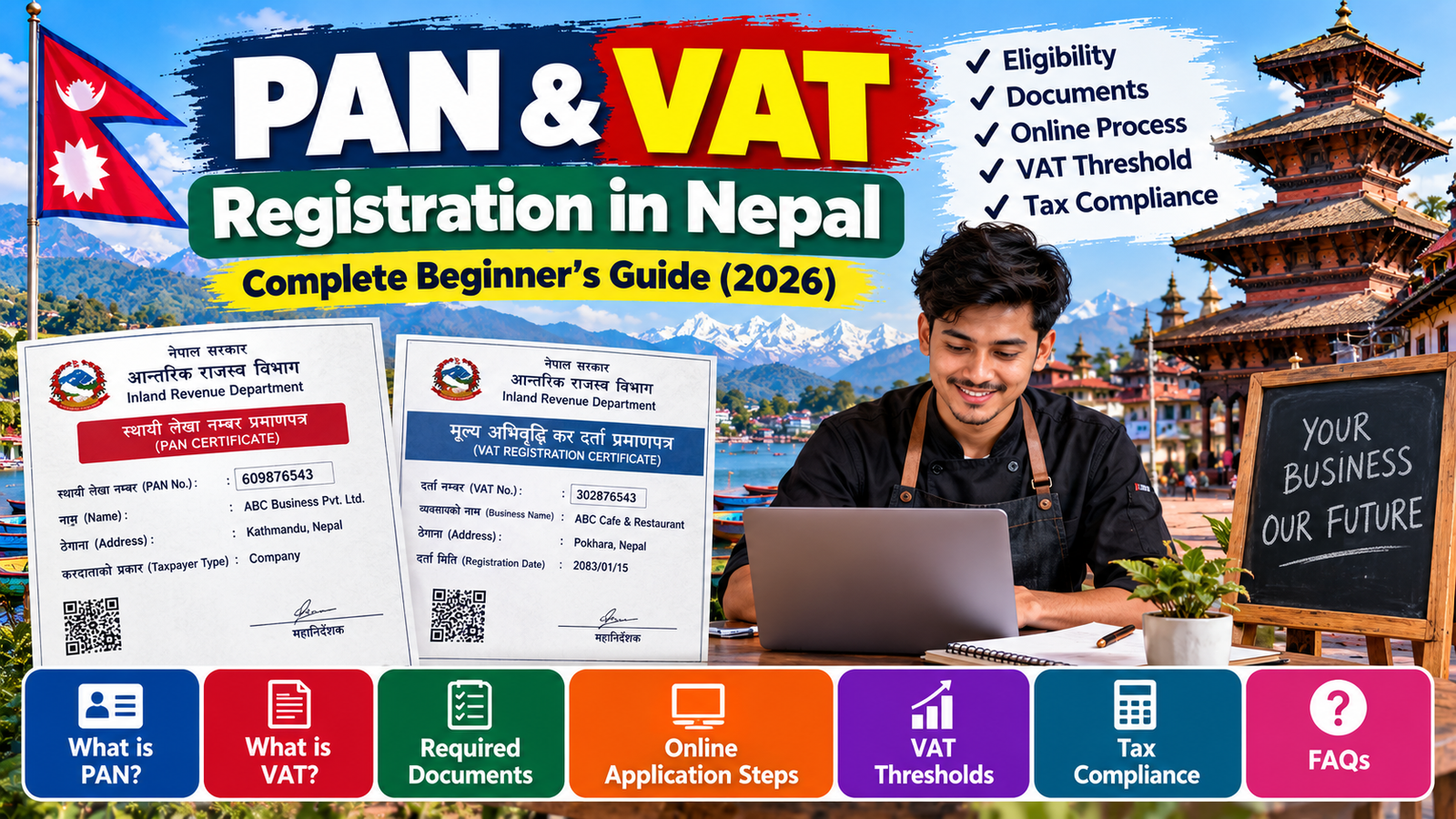
Introduction
PAN and VAT registration in Nepal is an important part of starting and operating a legally compliant business. Whether you are opening a café in Pokhara, establishing a retail shop in Kathmandu, starting a freelance business, or registering a private limited company, understanding Nepal’s tax registration system can help you avoid unnecessary problems.
The Inland Revenue Department (IRD) administers Permanent Account Numbers (PAN), Value Added Tax (VAT), and other major national taxes.
However, PAN and VAT are not the same. Many entrepreneurs confuse business registration with tax registration or assume every business must register for VAT.
This guide explains PAN and VAT registration in Nepal in 2026, including eligibility, required documents, online application procedures, VAT obligations, and practical examples.
1. What Is PAN in Nepal?
PAN stands for Permanent Account Number, known in Nepali as Sthayi Lekha Number (स्थायी लेखा नम्बर).
It is a unique tax identification number issued by the Inland Revenue Department.
PAN helps the government identify taxpayers and administer their tax obligations.
Main Types of PAN
Personal PAN (PPAN)
Personal PAN is used by individuals, including employees and people earning certain types of personal income.
Business PAN
Business PAN is used by registered business entities and firms, including sole proprietorships, partnerships, and companies.
Why Is PAN Important?
PAN supports:
- Tax registration and administration
- Business accounting and recordkeeping
- Tax return filing
- Identification on relevant invoices and tax documents
- Tax compliance and financial transactions
Entrepreneurs should arrange the appropriate tax registration before commencing taxable business activities.
2. What Is VAT in Nepal?
VAT stands for Value Added Tax, or Mulya Abhibriddhi Kar (मूल्य अभिवृद्धि कर).
VAT is an indirect tax applied to taxable supplies of goods and services under Nepal’s VAT legislation.
Nepal’s standard VAT rate is 13%.
VAT-registered businesses generally charge VAT on taxable sales and may be entitled to credit for qualifying VAT paid on business purchases.
Simple VAT Example
Imagine a VAT-registered business sells taxable goods worth NPR 1,000 before VAT.
| Description | Amount |
|---|---|
| Selling price before VAT | NPR 1,000 |
| VAT at 13% | NPR 130 |
| Total invoice | NPR 1,130 |
The NPR 130 is output VAT, not additional profit.
The amount ultimately payable to the government depends on the business’s applicable input tax credits and other adjustments.
3. PAN vs VAT Registration in Nepal: Key Differences
Understanding the difference between PAN and VAT registration in Nepal helps business owners meet the correct obligations.
| Feature | PAN | VAT |
|---|---|---|
| Full form | Permanent Account Number | Value Added Tax |
| Main purpose | Taxpayer identification | Tax registration and collection |
| Issuing authority | Inland Revenue Department | Inland Revenue Department |
| Applicable to | Individuals and businesses as required | Businesses meeting applicable VAT requirements |
| Standard rate | Not a tax rate | 13% on standard-rated supplies |
| Filing requirements | Depend on tax status | VAT returns according to applicable rules |
| Automatically required together? | No | No |
A business that already has PAN does not normally obtain a completely separate PAN number for VAT. Instead, it completes the relevant VAT registration using its taxpayer identity.
4. Who Needs PAN Registration in Nepal?
PAN registration requirements depend on the taxpayer’s activities and legal status.
Examples include:
Salaried Employees
Employees may need Personal PAN for income tax administration.
Sole Proprietors
An individual running a registered business generally needs Business PAN.
Partnership Firms
A partnership operating a business should obtain the relevant tax registration.
Private Limited Companies
Companies registered with the Office of the Company Registrar must comply with their applicable tax registration obligations.
Freelancers and Online Entrepreneurs
Freelancers, content creators, consultants, and online service providers should determine whether their activities constitute taxable business or professional income and which PAN category applies.
Receiving money online does not automatically mean the person must register for VAT.
5. Documents Required for PAN Registration in Nepal
The required documents depend on the applicant and registration category.
Personal PAN Documents
Common requirements include:
- Citizenship certificate or other accepted identification
- Passport-size photograph
- Personal and contact information
- Employment or professional details where applicable
Business PAN Documents
Depending on the business structure and circumstances, applicants may need:
- Business registration certificate
- Owner’s or authorised representative’s identification
- Partnership deed or company documents
- Business address details
- Rental agreement or premises documentation
- Authorisation documents where relevant
- Photographs and additional supporting documents
Applicants should confirm the current document checklist with their Inland Revenue Office or Taxpayer Service Office.
Why PAN and VAT Registration in Nepal Matters
PAN and VAT registration in Nepal helps entrepreneurs understand their tax responsibilities before starting business operations. Correct registration also supports proper invoicing, financial recordkeeping and compliance with Inland Revenue Department requirements.
PAN and VAT Registration in Nepal for Small Businesses
Small-business owners should understand that PAN and VAT registration in Nepal involves different obligations. While PAN identifies a taxpayer, VAT registration depends on applicable legal requirements, taxable activities and registration thresholds.
PAN and VAT Registration in Nepal for Freelancers
Freelancers and online entrepreneurs should review their tax obligations before applying for PAN and VAT registration in Nepal. The correct registration depends on the nature of their income, business activities and applicable tax rules.
Common Questions About PAN and VAT Registration in Nepal
Before completing PAN and VAT registration in Nepal, business owners should confirm the required documents, relevant tax office and current registration procedures using official Inland Revenue Department resources.
6. How to Apply for PAN Online in Nepal
The Inland Revenue Department provides online taxpayer registration services.
Step 1: Visit the IRD Website
Open the official Inland Revenue Department website:
Step 2: Open the Taxpayer Portal
Find the Taxpayer Portal link under the online services section.
Step 3: Select Registration
Open the menu for PAN, VAT, and Excise registration.
Choose Application for Registration.
Step 4: Create Application Credentials
Enter the requested information, which may include:
- Username
- Password
- Contact number
- Email address
- Relevant tax office
Keep your application credentials secure.
Step 5: Select the Registration Category
Choose Personal PAN or Business PAN, depending on the applicant.
Step 6: Enter Applicant Details
Complete the required information accurately, including identification, address, business, and contact details.
Step 7: Submit the Application
Review the application and submit it through the portal.
Retain the submission number or confirmation.
Step 8: Complete Verification
Follow the verification instructions provided by the system or the relevant tax office.
Some applicants may need to provide additional documentation or attend an office, depending on their circumstances and the current process.
Step 9: Obtain Your PAN
Once approved, obtain or download the PAN certificate through the available official process.
The IRD’s online workflow and verification arrangements may change, so always follow the current instructions displayed in the portal.
7. Who Needs VAT Registration in Nepal in 2026?
Not every PAN holder must register for VAT.
VAT registration depends on the nature of the goods or services, turnover, statutory thresholds, and any activities subject to mandatory registration rules.
Understanding VAT Thresholds
A VAT threshold is a turnover limit used to determine when qualifying businesses must register.
Important: Nepal’s VAT thresholds have changed over time, and different rules may apply to goods, services, mixed activities, and specially regulated transactions.
Some older IRD guidance refers to annual thresholds of NPR 50 lakh for goods and NPR 20 lakh for services. These figures should not be treated as verified current 2026 thresholds without checking the latest VAT Act amendments, Finance Act, and IRD notices.
Before deciding whether your business must register for VAT, verify:
- The current threshold applicable to your activity.
- Whether your supplies are taxable or exempt.
- Whether any mandatory-registration rule applies independently of turnover.
- Whether voluntary VAT registration is permitted and appropriate.
Official information: https://ird.gov.np/
8. How to Register for VAT in Nepal
Businesses that must register for VAT should complete the appropriate IRD procedure.
Step 1: Confirm VAT Eligibility
Review your business activity, taxable turnover, and applicable legal requirements.
Step 2: Prepare Business Documents
Gather your PAN details, business registration documents, identification, and other documents requested by IRD.
Step 3: Access the Taxpayer Portal
Visit the official IRD website and open the registration services.
Step 4: Complete the Relevant VAT Registration Application
Provide the business and tax details requested by the system or the tax office.
Step 5: Submit Supporting Documents
Supply the documents required for your business category.
Step 6: Complete Verification
The relevant Inland Revenue Office or Taxpayer Service Office may verify the application and supporting information.
Step 7: Obtain VAT Registration Confirmation
After approval, retain the relevant registration certificate or confirmation.
Step 8: Follow VAT Compliance Requirements
Once VAT-registered, a business must comply with applicable invoicing, accounting, return filing, and payment requirements.
Do not begin charging VAT merely because you submitted an application. Confirm your effective VAT registration status first.
9. Practical Example: PAN and VAT for a Café in Pokhara
Imagine an entrepreneur opening a small café in Pokhara.
The café serves tea, coffee, breakfast, lunch, and snacks.
Stage 1: Business Registration
The entrepreneur selects an appropriate business structure and completes the applicable firm or company registration.
Stage 2: Business PAN
The café obtains the relevant Business PAN through the Inland Revenue Department.
Stage 3: Determine VAT Requirements
The owner reviews the café’s taxable activities, expected and actual turnover, and any specific VAT registration obligations.
The owner should not assume that a café is automatically exempt from VAT merely because it is small.
Stage 4: Accounting and Billing
The café establishes a system to record:
- Daily sales
- Purchases
- Supplier invoices
- Payroll
- Operating expenses
- Tax liabilities
- Cash and bank transactions
Illustrative Monthly Sales
Suppose the café serves 35 customers daily.
Average customer spending: NPR 350
Operating days: 26 per month
Monthly sales = 35 × NPR 350 × 26 = NPR 318,500
Estimated annual sales at the same level:
NPR 318,500 × 12 = NPR 3,822,000
This example is illustrative. It does not establish whether the café must register for VAT.
The business must assess the current legal requirements applicable to its activity.
10. VAT Calculation for Small Businesses
Understanding VAT calculation is important for businesses that are registered for VAT.
Example: Output VAT
A VAT-registered business sells standard-rated products for NPR 100,000 before VAT.
Output VAT at 13%:
NPR 100,000 × 13% = NPR 13,000
Example: Input VAT
Suppose the business has NPR 6,500 in valid, creditable input VAT on qualifying purchases.
| Description | Amount |
|---|---|
| Output VAT | NPR 13,000 |
| Eligible input VAT credit | NPR 6,500 |
| Illustrative net VAT payable | NPR 6,500 |
The actual VAT payable depends on valid tax invoices, eligibility for input credits, adjustments, and other legal requirements.
Businesses should maintain proper accounting records and consult a qualified tax professional when needed.
11. VAT Invoices and Recordkeeping
VAT-registered businesses generally have additional invoicing and accounting obligations.
Relevant records may include:
- Sales invoices
- Purchase invoices
- Credit and debit notes
- VAT records
- Inventory records
- Supporting accounting documents
An ordinary receipt and a legally compliant VAT tax invoice are not necessarily the same.
Businesses should use the invoice format required by the applicable IRD rules.
12. Tax Filing After PAN and VAT Registration
Registration is the beginning of tax compliance, not the end.
Income Tax Returns
Taxpayers may need to submit income tax returns according to their legal category and applicable rules.
VAT Returns
VAT-registered businesses must file returns according to the reporting period and legal requirements applicable to them.
Tax Payments
Applicable taxes must be paid by their statutory deadlines.
Changes in Business Details
Changes to business ownership, address, operations, or registration information may require notification to IRD.
Business Closure
Closing a business does not automatically cancel its tax registration or outstanding obligations.
Taxpayers should follow the official procedures for cancellation, deregistration, and settlement of liabilities.
13. Common Mistakes in PAN and VAT Registration in Nepal
Mistake 1: Confusing PAN with VAT
Having PAN does not automatically make a business VAT-registered.
Mistake 2: Using Outdated VAT Thresholds
Entrepreneurs sometimes rely on old articles without checking current legislation.
Mistake 3: Charging VAT Without Registration
Businesses should confirm their VAT registration status before issuing VAT invoices.
Mistake 4: Ignoring Tax Returns
Tax registration may create ongoing filing and reporting obligations.
Mistake 5: Keeping Incomplete Records
Missing invoices and accounting records can create difficulties during tax filing or verification.
Mistake 6: Confusing Business Registration with Tax Registration
A business registration certificate does not replace PAN or VAT registration.
Mistake 7: Forgetting Other Legal Requirements
Tax registration does not replace municipal business registration, food-safety compliance, or sector-specific licences.
14. Benefits of Proper PAN and VAT Registration
Correct tax registration helps entrepreneurs:
- Establish a clear taxpayer identity
- Meet applicable legal obligations
- Maintain organised financial records
- Issue appropriate business documents
- Work with suppliers and customers who require formal documentation
- Prepare for business growth
- Reduce avoidable compliance problems
VAT registration should be based on legal requirements and business circumstances, not simply on the assumption that VAT registration always makes a business more credible.
15. Frequently Asked Questions
Is PAN compulsory for freelancers in Nepal?
Freelancers earning business or professional income should assess their tax registration obligations. The appropriate registration depends on their activities and tax status.
Can I register for PAN online in Nepal?
Yes. IRD provides online PAN application services through its taxpayer portal.
Is PAN the same as VAT?
No. PAN identifies taxpayers, while VAT registration establishes obligations under the VAT system.
What is the VAT rate in Nepal?
The standard VAT rate is 13%.
Does every small business need VAT registration?
No. Requirements depend on taxable activities, applicable thresholds, and other mandatory-registration provisions.
Can a sole proprietor register for VAT?
Yes, where the legal requirements for VAT registration are met.
Do I need a new PAN when registering for VAT?
Generally, VAT registration uses the taxpayer’s existing PAN rather than issuing a separate PAN number.
Is PAN registration the same as company registration?
No. Company registration and tax registration are separate legal processes.
Can I charge VAT before receiving VAT registration?
Businesses should not charge VAT as a registered taxpayer before their registration becomes effective.
Where can I check my PAN?
Use the official PAN search service provided by the Inland Revenue Department.
16. Official Government Resources
For the latest information about PAN and VAT registration in Nepal, consult the following sources:
Inland Revenue Department (IRD)
https://ird.gov.np/
Official tax administration, PAN, VAT, taxpayer services, and notices.
IRD Taxpayer Registration Guidance
https://ird.gov.np/content/13668/taxpayer-service-and-registration/
Overview of PAN registration categories and online services.
IRD Frequently Asked Questions
https://ird.gov.np/faq/
Guidance on PAN applications, VAT registration, tax filing, and other taxpayer questions.
IRD PAN Search
https://ird.gov.np/pan-search/
Official PAN lookup service.
Nepal Law Commission
https://lawcommission.gov.np/
Legal texts, including tax legislation and amendments.
Related Business Guides on Eleven Nepal
PAN and VAT registration in Nepal is one part of establishing a legally compliant business.
Before applying for tax registration, read our How to Register a Business in Nepal in 2026 guide to understand business registration procedures, ownership structures and government documentation.
You can also explore our Types of Business in Nepal: Sole Proprietorship vs Partnership vs Private Limited Company article to compare different legal business structures.
If you are planning to enter the hospitality industry, our How to Open a Cafe in Pokhara in 2026 case study explains illustrative startup costs, financial planning and operational requirements.
Conclusion
Understanding PAN and VAT registration in Nepal is essential for entrepreneurs who want to operate legally and maintain proper financial records.
PAN is a taxpayer identification number, while VAT registration creates additional obligations for businesses that fall within the applicable VAT system.
Whether you are a freelancer, café owner, retailer, or company director, the correct registration depends on your business structure, income, activities, and current tax laws.
Before submitting an application, check the latest guidance from the Inland Revenue Department, prepare the required documents, and understand your ongoing filing responsibilities.
Accurate registration and good recordkeeping are important foundations for a sustainable business in Nepal.
Disclaimer: This article provides general educational information as of October 2026 and is not individual tax or legal advice. Nepal’s tax rules and thresholds may change through legislation and official notices. Confirm the requirements applicable to your business with IRD or a qualified Nepalese tax adviser.


[…] PAN and VAT Registration in Nepal: Easy Step-by-Step Guide (2026) […]
[…] PAN and VAT Registration in Nepal: Easy Step-by-Step Guide (2026) […]