

Introduction
Are you planning to start a business in Nepal but unsure whether to register a sole proprietorship, partnership, or private limited company?
Choosing the right business structure is one of the most important decisions for a new entrepreneur. It affects ownership, legal liability, management, registration requirements, taxation, and opportunities for future investment.
Understanding the types of business in Nepal is particularly useful for entrepreneurs planning to open cafés, restaurants, retail shops, online businesses, consultancy firms, or technology startups.
Under Nepalese law, there are several ways to organise a business. However, not all businesses are legally classified as companies.
This guide explains five important business structures, their advantages and disadvantages, registration requirements, and practical examples.
Understanding the different types of business in Nepal helps entrepreneurs compare ownership, legal responsibilities, investment requirements and registration procedures.
1. What Are the Main Types of Business in Nepal?
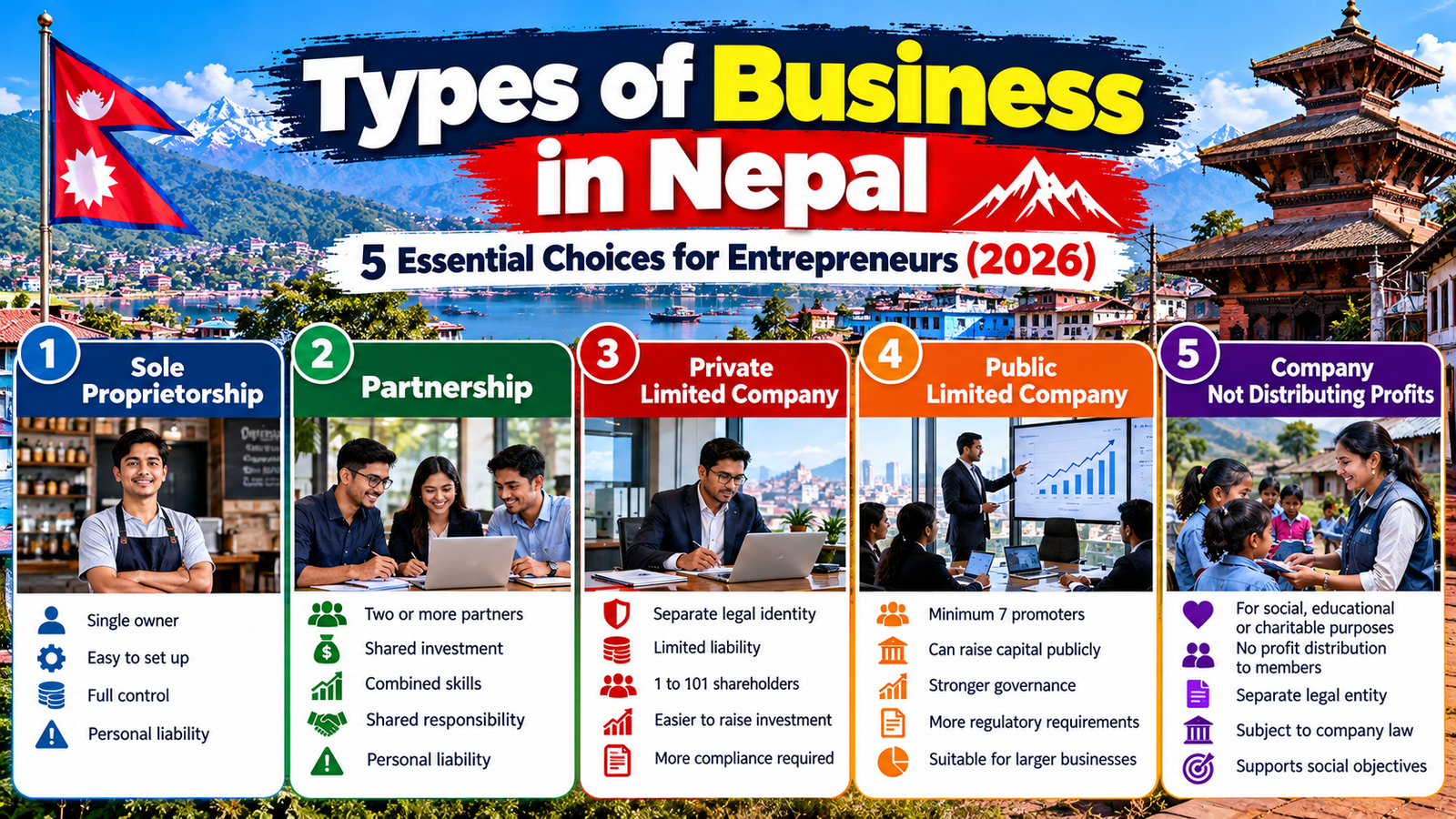
The five structures covered in this guide are:
- Sole proprietorship
- Partnership firm
- Private limited company
- Public limited company
- Company not distributing profits
The first two are firm-based business structures. The last three are company categories recognised under the Companies Act, 2063.
Other legal arrangements, including cooperatives and specialised organisations, also exist in Nepal. They are governed by their respective laws and are outside the scope of this introductory comparison.
2. Sole Proprietorship in Nepal
A sole proprietorship, commonly called Ekalauti Byabasaya (एकलौटी व्यवसाय), is a business owned and operated by one individual.
The Private Firm Registration Act, 2014 (1958), as amended, provides a legal framework for private firm registration.
Examples
- Grocery shop
- Small café
- Tailoring business
- Mobile accessories shop
- Small trading business
Advantages of Sole Proprietorship
Simple ownership: One individual controls the business.
Direct decision-making: The owner does not need approval from business partners for ordinary decisions.
Straightforward profit entitlement: Business profits belong to the owner, subject to taxes and obligations.
Suitable for smaller operations: It can be practical for businesses that do not require several equity owners.
Disadvantages of Sole Proprietorship
Personal liability: The owner generally bears personal responsibility for business debts and obligations.
Limited equity investment: Bringing in additional owners generally requires restructuring the business.
Dependence on the owner: Operations may be affected if the owner becomes unavailable.
How to Register a Sole Proprietorship
- Identify the appropriate firm registration authority.
- Select a suitable business name.
- Prepare identity and business documents.
- Submit the registration application.
- Pay the applicable official fee.
- Obtain the registration certificate.
- Complete applicable PAN, local, and sector-specific requirements.
Provincial legislation and administrative arrangements can affect registration procedures.
Best suited for: An entrepreneur starting a relatively small business independently, after considering personal liability and operational risk.
Among the common types of business in Nepal, sole proprietorship is a straightforward ownership structure for individuals who want to manage a business independently.
3. Partnership Business in Nepal
A partnership is a business relationship involving two or more people who agree to operate a business together.
The Partnership Act, 2020 (1964), as amended, provides an important legal framework for partnership firms.
Examples
- Two friends opening a restaurant
- Three entrepreneurs starting a trading business
- Professionals operating a consultancy
- Partners establishing a small hospitality business
Important Features
Partners may contribute different amounts of money, property, skills, or labour.
They should agree on how profits, losses, decisions, and responsibilities will be shared.
A partnership agreement helps reduce future disputes.
Advantages of Partnership
Shared investment: Partners can combine resources.
Combined skills: One partner may manage finance while another handles operations.
Shared workload: Responsibilities can be divided among partners.
Flexible arrangements: Partners can agree on many aspects of business management within the law.
Disadvantages of Partnership
Personal liability: In an ordinary partnership, partners may be personally liable for partnership obligations.
Disagreements: Partners may disagree about spending, profits, or management.
Potential instability: Withdrawal, death, or disputes involving a partner may affect the business.
What Should a Partnership Agreement Include?
A well-prepared agreement should address:
- Names and addresses of partners
- Business name and objectives
- Capital contributions
- Profit and loss distribution
- Management responsibilities
- Banking and spending authority
- Admission of new partners
- Withdrawal and retirement
- Dispute resolution
- Dissolution procedures
Partnership Registration Process
- Agree on the business structure.
- Prepare the partnership deed.
- Identify the relevant registration authority.
- Submit the application and documents.
- Pay the applicable fee.
- Obtain the registration certificate.
- Complete tax and other applicable registrations.
The Partnership Act also recognises provincial legal arrangements for registration and renewal. Always check the rules applicable to the location of the business.
Best suited for: Two or more entrepreneurs who want to operate a business together and understand the liability and governance implications.
4. Private Limited Company in Nepal
A private limited company is a company incorporated under Nepal’s Companies Act, 2063 (2006).
Unlike an ordinary sole proprietorship or partnership, a company has a separate legal identity from its shareholders.
According to the Office of the Company Registrar, a private company may have a single shareholder and ordinarily cannot exceed 101 shareholders.
Examples
- Software development company
- Restaurant company
- Digital marketing agency
- Manufacturing company
- Online service business
Advantages of a Private Limited Company
Separate legal identity: The company can own property and enter contracts in its own name.
Limited shareholder liability: Shareholders generally benefit from limited liability, subject to legal exceptions and any personal guarantees.
Structured ownership: Ownership can be represented through shares.
Investment opportunities: The structure may accommodate additional shareholders and formal investment arrangements, subject to legal requirements.
Business continuity: The company can continue despite changes in its shareholders.
Disadvantages of a Private Limited Company
More compliance: Companies have statutory recordkeeping and filing responsibilities.
Administrative expenses: Accounting, auditing, legal documentation, and compliance may involve additional costs.
Formal governance: Shareholder and director decisions must comply with applicable law and company documents.
How to Register a Private Limited Company
The Office of the Company Registrar (OCR) is responsible for company incorporation.
The general procedure is:
- Access the official OCR registration system.
- Apply for company name approval.
- Prepare the Memorandum of Association (MOA).
- Prepare the Articles of Association (AOA), where required.
- Provide promoter and shareholder information.
- Submit the incorporation documents.
- Complete applicable verification and payment.
- Obtain the company registration certificate.
- Register for tax and complete any required industry or sector-specific approvals.
Official website: https://ocr.gov.np/
Best suited for: Businesses that want a formal ownership structure, anticipate additional shareholders, or need a separate corporate legal identity.
A private limited company is not automatically cheaper or more tax-efficient than a sole proprietorship. That depends on the circumstances.When comparing the types of business in Nepal, partnerships are worth considering for entrepreneurs who want to combine financial resources and management skills.
5. Public Limited Company in Nepal
A public limited company is another form of company recognised under the Companies Act, 2063.
Under OCR’s published guidance, a public company generally requires at least seven promoters, subject to applicable exceptions, and has additional capital and governance requirements.
Characteristics
- Separate corporate legal identity
- Formal management and governance
- More extensive reporting obligations
- Potential to raise capital through securities, subject to applicable regulation
Advantages
Public companies may be suitable for businesses with larger capital requirements and broader ownership arrangements.
Disadvantages
They involve more extensive regulatory, governance, and disclosure obligations.
Public company status does not automatically mean the company is listed on the Nepal Stock Exchange. Listing and public securities offerings are separate regulated processes.
Best suited for: Businesses whose scale, ownership objectives, and financing requirements justify a public company structure.
6. Company Not Distributing Profits
The Companies Act, 2063 also recognises companies that do not distribute profits to their members.
These organisations may pursue permitted social, educational, professional, charitable, or other qualifying objectives.
Important Features
- Established under company law
- Operates for permitted objectives
- Cannot distribute profits to members as ordinary shareholder dividends
- Subject to specific governance and legal requirements
This structure should not be confused with a regular profit-making private limited company.
It is also not automatically equivalent to every type of NGO or charitable organisation in Nepal.
Best suited for: Eligible organisations whose purpose is not to distribute profits among their members.
7. Comparison of the Main Types of Business in Nepal
| Feature | Sole Proprietorship | Partnership | Private Limited Company |
|---|---|---|---|
| Owners | One | Two or more | One or more shareholders |
| Legal identity | Generally tied to owner | Generally tied to partners | Separate corporate entity |
| Liability | Generally personal | Generally personal | Generally limited for shareholders |
| Management | Owner | Partners or appointed managers | Directors and authorised management |
| Ownership transfer | Less flexible | Subject to agreement and law | Share transfers subject to law and company documents |
| Formal compliance | Depends on activity and registration | Firm and partnership obligations | Company-law filings and governance |
| Typical example | Small shop | Two-partner restaurant | Growing hospitality or IT company |
These are general characteristics. Actual obligations depend on the business, relevant laws, contracts, and registration details.
8. Practical Example: Opening a Café in Pokhara
Imagine three entrepreneurs planning to establish a café in Pokhara.
Their initial capital contributions are:
| Partner | Contribution |
|---|---|
| Partner A | NPR 200,000 |
| Partner B | NPR 120,000 |
| Partner C | NPR 120,000 |
| Total | NPR 440,000 |
The entrepreneurs are considering whether to register a partnership or private limited company.
Option A: Partnership Firm
The three partners could agree on their contributions, management responsibilities, and profit-sharing arrangements through a partnership deed.
If ownership were based strictly on contributed capital, their respective proportions would be approximately:
- Partner A: 45.45%
- Partner B: 27.27%
- Partner C: 27.27%
However, the partners may agree on different profit-sharing arrangements where legally permissible.
They must also understand their personal liability for partnership obligations.
Option B: Private Limited Company
The entrepreneurs could establish a company and allocate shares according to their agreed ownership arrangement.
Share ownership does not necessarily have to match the initial cash contribution if the arrangement is properly structured, documented, and legally compliant.
For example, the founders might negotiate different ownership proportions to recognise capital, expertise, management responsibilities, or other agreed contributions.
Such arrangements should be documented carefully, including any outstanding capital commitments. Private limited companies are among the types of business in Nepal that offer a separate legal identity and a formal shareholding structure.
Which Structure Is Better?
A partnership may suit entrepreneurs seeking a relatively straightforward jointly operated business.
A private limited company may be more suitable if they expect substantial investment, complex ownership arrangements, or a need for separate corporate identity.
Neither structure eliminates the need for food-related permissions, municipal requirements, tax registration, and other applicable approvals.
9. Understanding the Companies Act, 2063
The Companies Act, 2063 (2006), as amended, is Nepal’s principal company law.
It addresses matters such as:
- Company incorporation
- Company legal identity
- Share capital
- Shareholders
- Directors and governance
- Company meetings
- Accounts and auditing
- Reporting and recordkeeping
- Changes in company structure
- Winding up and related legal procedures
Memorandum of Association (MOA)
The MOA is a foundational company document that records matters such as the company’s name, objectives, and capital arrangements.
Articles of Association (AOA)
The AOA governs aspects of the company’s internal administration, management, and procedures, subject to applicable law.
Directors and Shareholders
Shareholders own shares in the company.
Directors are responsible for company governance and decision-making within their legal authority.
A person can be both a shareholder and director, but the roles are legally distinct.
Limited Liability Does Not Mean No Responsibility
Shareholders generally benefit from limited liability, but directors and individuals may still face personal consequences for unlawful conduct, fraud, personal guarantees, or other legally recognised grounds.
Always consult the current amended Act rather than relying only on its original 2006 text.
10. Business Registration vs PAN vs VAT
These terms are often confused.
Business Registration
Creates or registers the relevant business entity or firm under applicable law.
PAN Registration
Provides the taxpayer identification used for tax administration.
VAT Registration
Applies when a business meets the relevant VAT registration requirements.
A company registration certificate is not a substitute for PAN, and obtaining PAN does not automatically satisfy every business licensing requirement.
The Inland Revenue Department is the primary authority for PAN and VAT administration.
Official website: https://ird.gov.np/
11. How to Choose the Right Business Structure
Before selecting a business structure, answer these questions:
How many owners will the business have?
A single owner may consider a sole proprietorship or a single-shareholder private company.
How much financial risk is involved?
Consider potential debts, leases, staff obligations, and customer claims.
Will the business seek investors?
Formal share ownership may be useful when bringing additional investors into a company.
How will decisions be made?
Partnership agreements and company governance documents should establish decision-making authority.
What are the ongoing compliance costs?
Registration is only one expense. Accounting, reporting, taxation, renewals, and professional services may create recurring costs.
Does the business need a special licence?
Food services, tourism, financial activities, manufacturing, and other regulated sectors may have additional requirements.
The best structure is the one that suits the business’s real ownership, operational risks, and long-term plans.
12. Common Mistakes When Choosing a Business Structure
Choosing a Company Only for Prestige
A private limited company may provide benefits, but it also creates formal obligations.
Starting a Partnership Without an Agreement
Disagreements over profit sharing and management can become serious.
Ignoring Personal Liability
Entrepreneurs should understand when their personal assets may be exposed to business debts.
Confusing Registration with Licensing
A registered company may still need approvals before undertaking regulated activities.
Neglecting Accounting and Tax Records
Proper financial records are essential regardless of business structure.
Relying on Outdated Laws or Fee Schedules
Business laws, fees, and administrative procedures may change.
Verify the latest requirements through official government sources.
13. Official Government Sources
For further information, consult:
Office of the Company Registrar
https://ocr.gov.np/
Company registration, Companies Act, incorporation documents, and company compliance.
Nepal Law Commission
https://lawcommission.gov.np/
Official legislation, including the Private Firm Registration Act and Partnership Act.
Inland Revenue Department
https://ird.gov.np/
PAN, VAT, tax registration, and taxpayer guidance.
Department of Industry
https://doind.gov.np/
Industry registration and related regulatory services.
Entrepreneurs should also consult their relevant provincial authority and municipality.
14. Frequently Asked Questions
What are the main types of business in Nepal?
Common structures include sole proprietorships, partnership firms, private limited companies, public limited companies, and companies not distributing profits.
Which business structure is best for a small shop?
A sole proprietorship may be suitable for an independently operated small shop, but the owner should consider personal liability, financing needs, and applicable requirements.
Can one person open a private limited company in Nepal?
Yes. Nepal’s company law permits a single-shareholder private company.
Can three friends register a business together?
Yes. They may consider a partnership or an appropriate company structure.
Is a private limited company safer than a partnership?
A company generally offers separate legal identity and limited shareholder liability. However, it does not remove all personal, managerial, or contractual responsibilities.
Can a partnership later become a private limited company?
Entrepreneurs may be able to restructure their operations through appropriate legal procedures. It should not be assumed that a partnership automatically converts into a company without new registrations, transfers, or approvals.
Is PAN compulsory for businesses?
Businesses must comply with the tax registration requirements applicable to their legal structure and activity. Consult IRD for the appropriate procedure.
Do all businesses need VAT registration?
No. VAT registration depends on the current law and the nature and scale of the business.
What is the difference between a private and public company?
They differ in ownership rules, governance requirements, capital-related requirements, and securities-related restrictions.
Does registering a company allow every business activity?
No. Activities requiring separate approvals or licences must comply with those requirements.
Understanding the types of business in Nepal is only the first step towards starting a successful enterprise.
If you’re planning to establish a new business, read our How to Register a Business in Nepal in 2026 guide for information about registration procedures, government documents, PAN and applicable licences.
If you’re interested in the hospitality industry, explore our How to Open a Cafe in Pokhara in 2026 case study, which includes an illustrative startup budget, registration checklist and break-even analysis.
Conclusion
Understanding the types of business in Nepal helps entrepreneurs choose an appropriate legal structure before investing their money.
A sole proprietorship may suit an individual running a smaller operation. A partnership can allow several entrepreneurs to combine their resources, while a private limited company offers a separate corporate identity and a formal shareholding structure.
Public companies and companies not distributing profits serve different purposes under the Companies Act, 2063.
Before registering a business, consider the number of owners, liability, investment plans, governance, tax obligations, and applicable licensing requirements.
Choosing the right structure from the beginning can help entrepreneurs establish clearer ownership arrangements, manage risks, and plan for future growth.
Disclaimer: This article provides general educational information reviewed in October 2026. It is not individual legal, tax, or financial advice. Check current legislation and administrative requirements with the responsible government authorities before making business decisions.Choosing between the types of business in Nepal requires careful consideration of liability, investment, management responsibilities and long-term business goals.

