

Published: 20 October 2026 | Eleven Nepal | Business & Entrepreneurship

Starting an import export business in Nepal can create opportunities for entrepreneurs interested in international trade, wholesale distribution, manufacturing and Nepalese products.
An importer purchases goods from foreign suppliers and brings them into Nepal for permitted business purposes. An exporter sells eligible goods to buyers in other countries.
Both activities can connect Nepalese businesses with larger markets. However, international trade also involves customs procedures, banking requirements, transport arrangements, product regulations and financial risks.
A profitable-looking product can become unviable once freight, insurance, customs duties, taxes, storage and distribution costs are included.
Similarly, an exporter may secure a foreign buyer but struggle with product quality, packaging, certification or international payment arrangements.
Understanding these responsibilities before investing is essential.
Nepal’s international trade market is substantial. According to Department of Customs figures reported in August 2026, merchandise imports reached approximately NPR 2,096.37 billion during fiscal year 2025/26, while exports totalled NPR 315.29 billion.
The difference produced a merchandise trade deficit of approximately NPR 1,781.08 billion.
These figures demonstrate the scale of Nepal’s trade activity. They do not mean that starting an import-export business automatically generates profit.
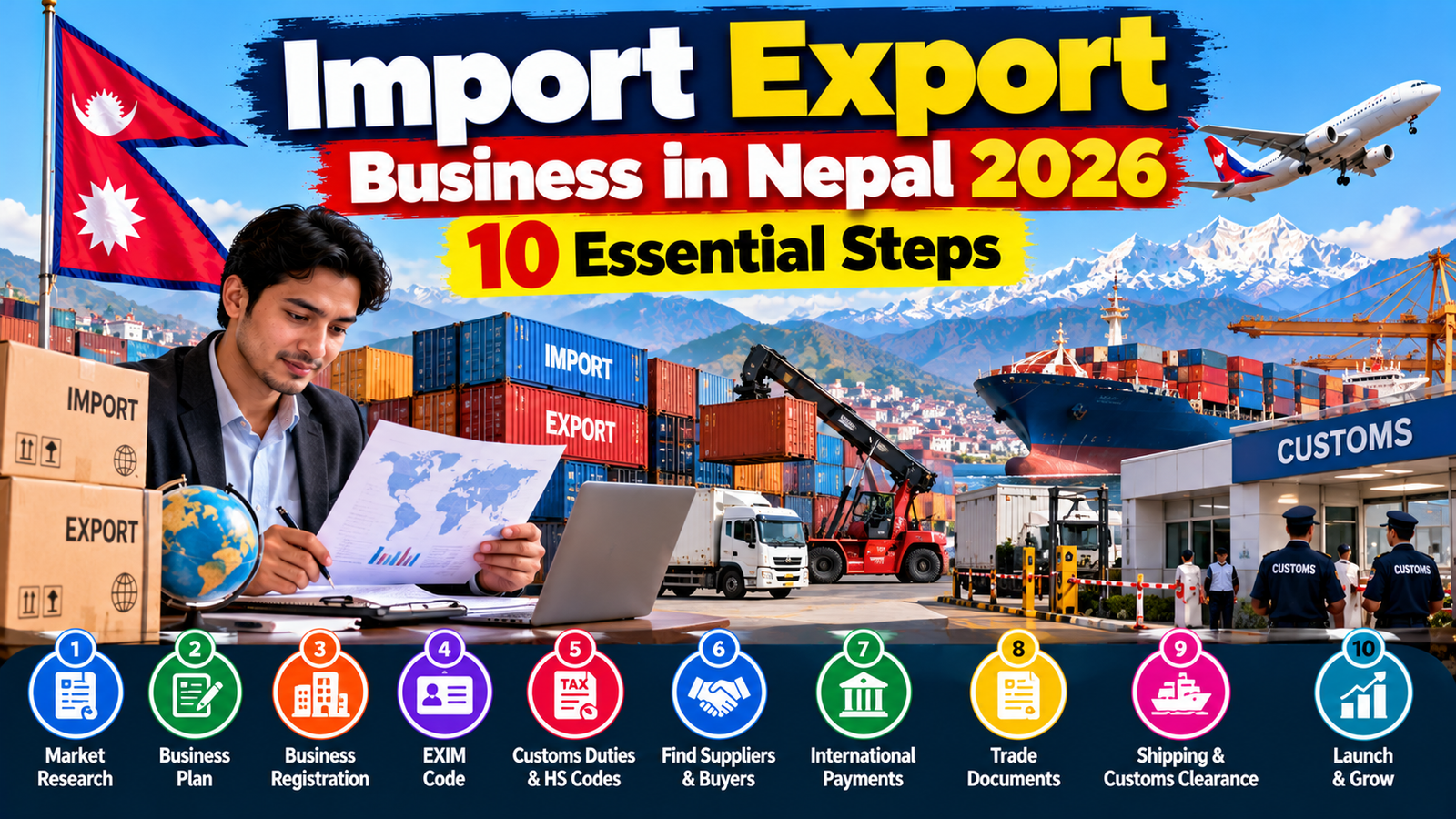
This guide explains how to start an import export business in Nepal in 2026, including business registration, EXIM codes, customs duties, supplier research, shipping documents, international payments and realistic financial planning.
It also includes clearly labelled hypothetical examples and links to official government resources.
Understanding the Import Export Business in Nepal
International trade involves buying and selling goods across national borders.
Although importing and exporting share some procedures, their commercial risks and regulatory requirements can differ.
What Is an Import Business?
An import business purchases goods from a supplier outside Nepal and arranges their lawful entry into the country.
The importer may sell products to retailers, wholesalers, businesses or final customers.
Potential product categories include machinery, manufacturing inputs, household goods and other permitted products.
Importing is not simply ordering goods from an overseas website.
Commercial shipments may involve customs classification, import documentation, tax assessment, foreign-exchange arrangements and product-specific approvals.
What Is an Export Business?
An export business supplies goods from Nepal to buyers abroad.
Potential categories for research include tea, coffee, carpets, textiles, handicrafts and certain processed products.
The actual eligibility of a product depends on Nepalese rules and the destination country’s requirements.
Exporters may need to demonstrate product origin, meet quality standards and arrange international delivery.
Importing Versus Exporting
| Factor | Import business | Export business |
|---|---|---|
| Main activity | Bringing goods into Nepal | Sending goods from Nepal abroad |
| Customers | Nepalese buyers | Overseas buyers |
| Supplier location | Usually outside Nepal | Usually Nepal |
| Key commercial concern | Landed cost and domestic demand | Buyer demand and export compliance |
| Logistics | International delivery into Nepal | International delivery to destination |
| Payment risk | Paying foreign suppliers | Receiving payment from foreign buyers |
Some businesses engage in both activities.
For beginners, focusing on one product category and one trade direction can simplify research and financial planning.
Nepal’s Import and Export Market in 2026
Nepal’s merchandise trade remains heavily weighted toward imports.
Department of Customs figures for fiscal year 2025/26 showed:
- Merchandise imports of approximately NPR 2,096.37 billion.
- Merchandise exports of approximately NPR 315.29 billion.
- Total merchandise trade of approximately NPR 2,411.66 billion.
- A merchandise trade deficit of approximately NPR 1,781.08 billion.
Imports were reported to have increased by approximately 16.20% from the preceding fiscal year, while exports increased by approximately 13.81%.
These are national trade figures, not measures of individual business profitability.
What Does the Trade Deficit Mean?
A merchandise trade deficit occurs when the value of imported goods exceeds the value of exported goods.
It does not mean that every importer earns money or that every exporter loses money.
Individual business performance depends on costs, selling prices, customer demand and operational efficiency.
Why Export Development Matters
Exports can create opportunities for Nepalese producers to reach customers beyond the domestic market.
However, exporting also requires competitiveness.
Products must satisfy buyer expectations concerning quality, delivery, pricing and documentation.
Why Import Businesses Still Matter
Imports can provide machinery, raw materials and products that support domestic production and consumption.
The economic value of an import business depends partly on what it supplies and how efficiently it operates.
Entrepreneurs should avoid assuming that every imported product has strong demand.
Step 1: Research the Market and Choose the Right Product
The first step in starting an import export business in Nepal is identifying a commercially viable product.
Choosing a product solely because it is popular can lead to expensive mistakes.
How to Research Import Opportunities
An importer should investigate what Nepalese customers need and whether existing suppliers already satisfy that demand.
Important questions include:
- Who will purchase the product?
- What alternatives are available?
- What quality standards do buyers expect?
- How frequently will customers reorder?
- How much inventory must the business hold?
- What is the total landed cost?
- Is the product legally importable?
A product with a high selling price may still offer poor margins after transport, customs and distribution costs.
How to Research Export Opportunities
An exporter should identify foreign buyers and assess whether Nepalese producers can meet their requirements.
Research should cover product specifications, packaging, delivery schedules, certification and destination-country rules.
For example, a tea exporter may need to investigate the importing country’s food safety and labelling requirements.
Use Official Trade Information
The Trade and Export Promotion Centre provides resources about Nepalese trade and export procedures.
The Department of Customs publishes trade statistics and tariff information.
These resources can support initial market research.
Test Demand Before Ordering Large Quantities
Where lawful and practical, entrepreneurs can begin with a limited trial order or sample evaluation.
A small test may reveal quality problems or weak customer demand before substantial capital is committed.
Practical advice: Select products based on verified demand and achievable margins, not simply on trends.
Step 2: Prepare a Business Plan and Financial Budget
International trade requires a realistic financial plan.
Unlike some service businesses, importers and exporters may need substantial working capital before receiving customer payments.
Essential Parts of a Trade Business Plan
A basic plan should explain the product, target customers, suppliers, sales channels, logistics, expected costs and financial risks.
It should also identify the business’s legal structure and relevant regulatory requirements.
Estimate Startup Capital
Potential expenses include business registration, equipment, samples, inventory, freight, insurance, customs charges, warehousing, marketing and professional services.
The amount varies by product, shipment size and operating model.
There is no single verified minimum investment that applies to every import-export business in Nepal.
Illustrative Import Business Startup Budget
Consider a hypothetical entrepreneur planning a small commercial import operation.
| Expense | Illustrative amount |
|---|---|
| Initial product purchases | NPR 400,000 |
| Freight and insurance allowance | NPR 70,000 |
| Customs and tax cash reserve | NPR 120,000 |
| Storage and handling | NPR 30,000 |
| Marketing and distribution | NPR 40,000 |
| Professional and administrative allowance | NPR 20,000 |
| Additional working capital | NPR 120,000 |
| Total planned funding | NPR 800,000 |
Important: Every figure in this table is a hypothetical budgeting assumption, not a verified market quotation, statutory charge or guaranteed minimum investment.
Actual customs taxes must be calculated using the correct product classification and current rules.
Why Working Capital Is Important
Importers may pay suppliers before selling inventory.
Exporters may incur production and shipping costs before receiving final payment.
A business can therefore experience cash-flow pressure even when a transaction is expected to be profitable.
Build a Financial Reserve
Entrepreneurs should consider possible delays, damaged goods, unexpected transport expenses and slow customer payments.
The appropriate reserve depends on the business’s risk profile.
Step 3: Register Your Import Export Business in Nepal
Business registration is an essential part of establishing a formal commercial operation.
The correct registration process depends on the chosen legal structure and business activity.
Choose a Business Structure
Possible structures include a sole proprietorship, partnership or company, subject to applicable Nepalese laws.
These structures differ in ownership, liability, management and administrative responsibilities.
For a detailed comparison, read Eleven Nepal’s Types of Business in Nepal: 5 Essential Choices for Entrepreneurs.
Company Registration
Businesses choosing a company structure can consult the Office of the Company Registrar.
The OCR provides information about incorporation and company administration.
However, incorporating a company does not automatically provide permission to import or export every product.
PAN and Tax Registration
The Inland Revenue Department administers taxpayer registration.
Businesses should determine which PAN and VAT obligations apply to their activities.
Do not assume that every business must register for VAT in identical circumstances.
Other Registrations and Approvals
Some activities may require registration or authorisation from additional authorities.
Product-specific rules can also apply.
A company planning to import regulated goods must investigate those requirements before placing orders.
Practical Registration Guidance
Eleven Nepal has a separate article explaining the broader process:
How to Register a Business in Nepal: Essential Steps (2026).
This guide can help entrepreneurs understand the difference between choosing a business structure and completing relevant administrative procedures.
Official resources:
Office of the Company Registrar: https://ocr.gov.np/
Inland Revenue Department: https://ird.gov.np/
Step 4: Understand and Apply for an EXIM Code
The Export Import Code, commonly called an EXIM code, is an important part of Nepal’s commercial trading system.
According to the Nepal National Single Window’s official FAQ, an EXIM code is an identification number issued by the Department of Customs to traders involved in importing or exporting goods.
What Is an EXIM Code Used For?
The code helps customs authorities identify and administer registered traders.
It forms part of the trade compliance process.
However, holding an EXIM code does not automatically authorise restricted goods or replace other required permits.
Where Can Businesses Apply?
The Department of Customs operates an online EXIM system.
Official EXIM portal:
Nepal National Single Window:
General EXIM Application Process
The Nepal National Single Window FAQ describes an application process involving business PAN information, personal PAN information and email verification.
Applicants then complete business, tax and banking-related sections and upload supporting documents.
The application is forwarded to the relevant customs office.
Applicants should follow the current official instructions because required fields, supporting documents and procedures can change.
Is a Bank Guarantee Required?
The official EXIM application workflow includes a bank guarantee section.
However, this article does not claim that every trader must provide the same guarantee amount or satisfy identical conditions.
The applicable requirement should be checked directly with the Department of Customs and the trader’s bank.
EXIM Renewal
The official system also provides an EXIM renewal service.
Traders should check whether renewal is required for their registration and ensure their information remains current.
Practical advice: Complete the relevant customs registration process before committing to shipments that depend on it.
Step 5: Understand Customs Duties, HS Codes and Taxes
Customs classification is one of the most important technical aspects of international trade.
The applicable tax treatment can significantly affect the final cost of imported goods.
What Is an HS Code?
The Harmonized System is an international product classification framework used in customs administration.
Products are classified according to their characteristics and the applicable tariff rules.
A correct classification helps determine which duties and other requirements apply.
Why Classification Matters
Two products that appear similar may fall under different tariff classifications.
An incorrect classification can lead to inaccurate cost estimates and customs complications.
Entrepreneurs should not select an HS code solely because it produces a lower duty.
Nepal’s Customs Tariff 2026/27
The Department of Customs publishes the Customs Tariff 2026/27 for fiscal year 2083/84.
This is the appropriate official starting point for checking current tariff schedules.
Official tariff information:
Understanding Landed Cost
Landed cost refers to the cost of bringing goods to the relevant destination and making them available for business use or sale.
Depending on the transaction, it can include:
- Purchase price.
- International freight.
- Insurance.
- Customs duties.
- Applicable import taxes.
- Clearance and handling expenses.
- Inland transport.
- Storage and other relevant costs.
The precise tax calculation depends on customs valuation, product classification and applicable law.
Illustrative Landed-Cost Calculation
Consider a hypothetical shipment with these assumptions:
| Cost component | Illustrative NPR |
|---|---|
| Product purchase | 500,000 |
| International freight | 50,000 |
| Insurance | 10,000 |
| Assumed customs valuation | 560,000 |
| Hypothetical customs duty at 10% | 56,000 |
| Hypothetical other import taxes | 80,000 |
| Clearance and inland transport | 24,000 |
| Illustrative total cost | 720,000 |
The 10% duty is an invented assumption for demonstrating arithmetic. It is not a verified rate for any particular product.
The NPR 80,000 tax allowance is also hypothetical and is not a statutory calculation.
Actual duties and taxes must be determined using the relevant HS code, customs valuation rules and current legislation.
Check Tax Treatment Before Setting Prices
A business that prices goods using only the overseas supplier’s invoice may underestimate its costs.
Entrepreneurs should obtain a reliable product-specific estimate before purchasing.
The Nepal National Single Window provides a tariff search and related trade tools.
Step 6: Find Reliable International Suppliers and Buyers
Supplier and buyer selection can determine whether an international transaction succeeds.
A low purchase price is not enough if the supplier delivers poor-quality goods or fails to fulfil the contract.
Finding Import Suppliers
Potential suppliers can be identified through trade fairs, industry associations, referrals and business-to-business platforms.
However, an online listing is not proof that a company is reliable.
Verify Supplier Information
Entrepreneurs should examine the supplier’s legal identity, product specifications, trading history and payment instructions.
Where appropriate, independent inspection or professional verification may be useful.
Request Product Samples
Samples can help assess materials, construction, packaging and consistency.
However, a good sample does not guarantee that a later bulk shipment will match.
Contracts should define acceptable quality and inspection arrangements.
Finding Export Buyers
Nepalese exporters can investigate distributors, retailers, importers and business associations in target markets.
Before accepting an order, exporters should assess the buyer’s credibility and ability to pay.
Use Written Contracts
A commercial agreement should clearly identify the product, quantity, quality standards, price, delivery terms, payment arrangements and dispute-resolution procedures.
Avoid Common Trade Scams
Warning signs may include requests for payments to unrelated accounts, unexplained changes to bank details and pressure to transfer money without adequate documentation.
Independent verification is particularly important before large international payments.
Practical advice: A reliable trading relationship is often more valuable than the cheapest initial quotation.
Step 7: Understand International Payments and Banking Rules
International trade payments involve commercial risk and foreign-exchange regulation.
Nepal Rastra Bank is the central bank responsible for relevant foreign-exchange policies and oversight.
Common International Payment Methods
Depending on the transaction and applicable rules, arrangements may include letters of credit, advance payments and documentary collection methods.
Each arrangement has different costs and risks.
Letter of Credit
A letter of credit, or L/C, is a bank undertaking subject to specified terms and documentation.
It can provide a structured payment arrangement, but it does not eliminate all commercial risk.
The buyer, seller and participating banks must understand the conditions.
Advance Payment
Advance payment involves transferring money before goods are delivered.
This may expose the buyer to non-delivery or quality risks.
The applicable foreign-exchange and banking requirements must be checked.
Documentary Payment Arrangements
Document against Payment (DAP) and Document against Acceptance (DAA) are forms of documentary collection.
These should not be confused with similarly abbreviated shipping terminology.
The exact risks depend on the contractual arrangement and banking procedures.
Relevant 2026 Banking Updates
Nepal Rastra Bank’s Monetary Policy for 2025/26 announced changes to certain import payment facilities, including increases in stated limits for specified documentary collection and draft/telegraphic transfer arrangements.
The central bank subsequently published additional foreign-exchange circular updates during 2026, including on 5 October 2026.
Therefore, businesses should not assume that an older monetary policy statement alone establishes the current limit applicable to their transaction.
Exchange-Rate Risk
If a supplier invoices in foreign currency, the Nepalese rupee value of the payment can change.
This may increase or reduce the final cost.
Illustrative Currency Example
Suppose a foreign supplier invoices a shipment at USD 5,000.
At an assumed exchange rate of NPR 140 per US dollar, the invoice equals NPR 700,000.
At an assumed rate of NPR 145 per US dollar, the same invoice equals NPR 725,000.
The difference is NPR 25,000.
These exchange rates are hypothetical, not current quotations.
Use Authorised Banking Channels
Entrepreneurs should discuss payment options with an authorised bank.
The bank can explain documentation, applicable limits, fees and current foreign-exchange rules.
Official resource:
Step 8: Prepare Import and Export Documents
International trade involves documentation that helps identify the goods, parties, transaction value and transport arrangements.
The exact documents depend on the product, shipment method, payment arrangement and applicable rules.
Common Import Documents
Documents may include a commercial invoice, packing list, transport document, customs declaration and relevant certificates.
Additional documents may be required for specific goods or banking arrangements.
Commercial Invoice
The commercial invoice identifies the goods, seller, buyer, quantity and transaction price.
It should accurately reflect the commercial transaction.
Packing List
A packing list describes the shipment’s contents and packaging.
It helps logistics providers and customs authorities identify goods.
Bill of Lading and Air Waybill
A bill of lading is commonly associated with sea freight.
An air waybill is associated with air transport.
Their legal and operational functions differ, so traders should not treat them as interchangeable.
Certificate of Origin
A certificate of origin provides information about the origin of goods.
It may be relevant to trade preferences and customs requirements.
The Nepal National Single Window identifies recognised issuing bodies for relevant Nepalese export certificates of origin.
Product-Specific Documents
Certain products may require health, plant, quality, technical or other certificates.
For example, agricultural products may face plant-health requirements.
The destination country may impose its own import conditions.
Why Accurate Documents Matter
Errors in product descriptions, quantities or values can delay clearance.
They may also create banking and contractual problems.
The Trade and Export Promotion Centre publishes procedural guidance explaining documentation commonly associated with import and export shipments.
Official resource:
Practical advice: Confirm the exact documentation checklist with the relevant customs authority, bank and logistics provider before shipping.
Step 9: Arrange Shipping, Customs Clearance and Delivery
Transport arrangements affect both cost and customer satisfaction.
Nepal’s geography means international shipments may involve multiple transport stages.
Common Transport Methods
Goods may move through road transport, air freight or combinations involving international sea freight and inland transit.
The appropriate method depends on product characteristics, urgency, shipment volume and available routes.
Freight Forwarders
Freight forwarders can help organise international transportation.
Their services may include booking transport, coordinating documentation and arranging logistics.
The specific responsibilities depend on the service agreement.
Customs Agents
A customs agent may assist with declarations and clearance procedures.
However, using an agent does not remove the trader’s responsibility to provide accurate information and comply with applicable rules.
Understanding Incoterms
Incoterms are internationally recognised commercial delivery terms published by the International Chamber of Commerce.
They help allocate certain responsibilities, costs and risks between buyers and sellers.
Examples include EXW, FOB, CIF and DDP.
However, the correct term depends on the transport arrangement.
For example, FOB and CIF are intended for sea and inland waterway transport, while other terms can be more suitable for multimodal shipments.
Do Not Confuse Shipping Cost With Total Cost
A low freight quotation may exclude insurance, clearance, storage or inland delivery.
Always request a clear breakdown of included and excluded services.
Plan for Delays
Transport disruptions, documentation problems and inspections may affect delivery schedules.
Entrepreneurs should avoid promising customers unrealistic delivery dates.
Practical advice: Compare logistics providers using total cost, reliability and contractual responsibilities rather than freight price alone.
Step 10: Launch, Market and Grow Your Import Export Business
After completing the relevant preparations, the next stage is to begin commercial operations on a manageable scale.
Start With a Pilot Transaction
A limited first shipment can help test supplier performance, documentation, clearance and customer demand.
However, the pilot must still comply with applicable rules.
Choose a Sales Channel
Importers may sell through wholesale relationships, retail stores, direct business contracts or suitable online channels.
Exporters may work with distributors, overseas retailers or direct commercial buyers.
Develop a Professional Business Presence
A clear website can help potential customers understand the products, company background and contact details.
Accurate descriptions and professional communication support credibility.
Monitor Every Shipment
Maintain records of purchase orders, invoices, shipping documents, taxes, payments and customer sales.
Review the actual profit or loss from each transaction.
Track Performance
Useful measures include:
- Gross margin.
- Contribution margin.
- Inventory turnover.
- Customer payment delays.
- Supplier reliability.
- Shipping delays.
- Cash-flow requirements.
- Repeat customer orders.
Expand Carefully
A successful first shipment does not guarantee that larger shipments will be profitable.
Expansion should be supported by customer demand, sufficient capital and reliable operations.
Entrepreneurs exploring other business models can also read Eleven Nepal’s Business Ideas for Returnees in Nepal.
How Much Profit Can an Import Export Business Make in Nepal?
There is no universal profit margin for international trading businesses.
Profit depends on product selection, shipment size, customs treatment, selling prices, transport costs and operational efficiency.
Illustrative Import Profit Example
Suppose a trader imports 500 units of a product.
Assume the total relevant inventory cost, including applicable non-recoverable import charges and allocated logistics expenses, is NPR 750,000.
The cost per unit is:
NPR 750,000 ÷ 500 = NPR 1,500.
Suppose the business sells all 500 units for NPR 2,000 each.
Total sales revenue would be NPR 1,000,000.
The difference between sales revenue and the assumed inventory cost would be NPR 250,000.
Now assume additional selling and operating expenses of NPR 150,000.
The illustrative operating surplus would be NPR 100,000 before tax, financing costs and any other excluded expenses.
These figures are not predictions or verified market prices.
Illustrative Export Profit Example
Consider a Nepalese producer exporting 1,000 units of a permitted product.
Assume:
| Item | Illustrative NPR |
|---|---|
| Total export sales | 1,200,000 |
| Production and packaging | 650,000 |
| Freight and insurance borne by exporter | 160,000 |
| Documentation and handling | 40,000 |
| Other operating expenses | 150,000 |
| Illustrative operating surplus | 200,000 |
The resulting surplus represents 16.67% of the assumed sales value.
It excludes any additional costs not specified.
No particular export product is claimed to achieve this margin.
What Can Reduce Profit?
Profit may fall because of exchange-rate changes, damaged goods, unsold inventory, customer returns, shipping delays or unexpected expenses.
Traders should also consider financing costs and the timing of cash receipts.
Common Mistakes to Avoid in International Trade
Understanding common mistakes can help beginners protect their investment.
1. Importing Without Confirmed Demand
Ordering large quantities before identifying customers creates inventory risk.
2. Using Incorrect HS Codes
Incorrect classification can produce unreliable tax estimates and customs problems.
3. Ignoring Product Restrictions
Some goods require approvals or may be prohibited.
An EXIM code does not override product-specific restrictions.
4. Trusting Unverified Suppliers
Supplier fraud and inconsistent quality can cause financial losses.
5. Underestimating Logistics Costs
Freight quotations may exclude important charges.
6. Making Unsafe Payment Arrangements
Poorly structured international payments can expose traders to non-delivery or non-payment.
7. Using Incomplete Documents
Documentation errors can delay shipments and create additional costs.
8. Ignoring Exchange-Rate Risk
Currency movements can change the cost of purchases or the value of sales.
9. Borrowing Without Cash-Flow Planning
Debt repayments may become difficult if inventory sells slowly.
10. Expanding Too Quickly
Larger shipments increase financial exposure.
For more financial planning advice, read Eleven Nepal’s How to Register a Business in Nepal and its other entrepreneurship resources.
A Practical 90-Day Import Export Business Preparation Plan
The following schedule is an illustrative planning framework.
It is not a promise that registration, permits, banking arrangements or customs approvals can be completed within 90 days.
Days 1–15: Research
Choose a product category.
Investigate customer demand and competitors.
Identify potential suppliers or buyers.
Check whether the product is permitted and whether additional approvals apply.
Days 16–30: Financial Planning
Prepare a startup budget.
Estimate product costs, freight, customs charges and working capital.
Calculate break-even sales.
Evaluate financing needs.
Days 31–45: Business Registration
Choose an appropriate business structure.
Complete relevant registration and taxpayer processes.
Review the official EXIM application requirements.
Days 46–60: Supplier and Buyer Verification
Request quotations and samples.
Review quality specifications.
Verify trading partners.
Draft suitable commercial agreements.
Days 61–75: Banking and Logistics
Discuss payment arrangements with an authorised bank.
Obtain freight quotations.
Confirm the product’s tariff classification and relevant approvals.
Prepare shipment documentation.
Days 76–90: Pilot Preparation
Review all compliance requirements.
Confirm customers and payment terms.
Arrange a limited first transaction if the business is ready and legally authorised.
Record actual costs and results before considering expansion.
Frequently Asked Questions About Import Export Business in Nepal
1. How can I start an import export business in Nepal?
Begin with product and market research, choose a suitable business structure, complete applicable registration and tax processes, check EXIM requirements, arrange banking facilities and confirm customs and product-specific rules.
2. Is an import export business profitable in Nepal?
It can be profitable, but there is no guaranteed return. Profitability depends on demand, margins, logistics, taxes, financing and operational efficiency.
3. What is an EXIM code in Nepal?
An EXIM code is an exporter-importer identification code issued through the Department of Customs system for relevant traders.
4. How do I apply for an EXIM code?
Use the official EXIM portal or Nepal National Single Window and follow the current application instructions.
5. Does an EXIM code allow every product to be imported?
No. Product-specific restrictions, permits and other legal requirements may still apply.
6. How much money is needed to start?
There is no single verified minimum investment for all import-export businesses. Capital requirements depend on the product, shipment size, registration obligations and working capital.
7. What products can Nepal export?
Potential categories include eligible agricultural products, textiles, carpets, handicrafts and processed goods. The specific product must satisfy applicable Nepalese and destination-country requirements.
8. Can I import products from China to Nepal?
Commercial importing may be possible for permitted products, subject to customs, banking, transport and other applicable requirements.
9. Can I import goods from India?
Trade with India is an important part of Nepal’s international commerce. However, applicable rules depend on the goods, origin, transaction and current trade arrangements.
10. Do I need a registered company?
The appropriate business structure and registration requirements depend on the activity. Not every trading business necessarily uses the same legal form.
11. Is PAN registration necessary?
Relevant taxpayer registration obligations apply according to the business and current tax rules. Consult the Inland Revenue Department.
12. Is VAT charged on all imports?
VAT treatment depends on the product and applicable legislation. Exemptions and special rules may apply. Do not assume identical treatment for every shipment.
13. How can I calculate customs duty?
Identify the correct HS classification, consult the current official customs tariff and determine the applicable valuation and tax rules.
14. What is a certificate of origin?
It is a document used to establish or certify the origin of goods for relevant trade and customs purposes.
15. What is a letter of credit?
A letter of credit is a bank payment undertaking governed by specified terms and documentary conditions.
16. Can I pay foreign suppliers directly?
Permitted payment arrangements depend on Nepal Rastra Bank rules, authorised banking procedures and the transaction.
17. What is the safest international payment method?
No payment method eliminates all risks. The appropriate arrangement depends on the parties, transaction and bank requirements.
18. Do exporters need product certification?
Some products and destination markets require particular certificates, inspections or standards compliance.
19. What is the difference between FOB and CIF?
Under Incoterms rules, FOB and CIF allocate certain costs and risks differently for eligible sea and inland waterway shipments. The precise contractual meaning should be understood before use.
20. Can students start an import export business?
A student may explore entrepreneurship, but applicable legal capacity, registration, financing and other requirements must be satisfied.
21. Can an online store import products for resale?
Potentially, yes. However, online selling does not remove applicable customs, tax, product safety or e-commerce obligations.
22. How long does customs clearance take?
There is no universal clearance time. Duration depends on the shipment, documents, inspections, applicable approvals and operating conditions.
23. What happens if imported goods are damaged?
Responsibility depends on the contract, transport arrangements, insurance coverage and circumstances of the damage.
24. Can Nepalese exporters sell directly to international customers?
They may be able to do so, subject to relevant trade, banking, customs and destination-country requirements.
25. What is the most important advice for beginners?
Verify product legality, calculate the full transaction cost, research customers and suppliers, and confirm banking and customs requirements before committing substantial money.
Conclusion: Is an Import Export Business in Nepal Worth Starting in 2026?
Starting an import export business in Nepal can offer opportunities for entrepreneurs interested in international markets.
Nepal’s merchandise trade figures show substantial commercial activity, but they also highlight the importance of understanding competition, financing and trade imbalances.
A successful trading business requires more than identifying a low-cost overseas supplier or a promising export product.
Entrepreneurs need reliable customers, appropriate registration, customs compliance, accurate financial calculations and secure payment arrangements.
The ten essential steps in this guide provide a practical starting framework.
Market research helps identify demand.
Business planning helps determine financial viability.
Registration and EXIM procedures support formal operations.
Customs classification, documentation and logistics planning help reduce avoidable complications.
Banking arrangements and supplier verification help manage international payment and delivery risks.
For beginners, starting with a manageable product range and carefully evaluating the results of an initial transaction may be more sensible than immediately placing a large order.
Most importantly, entrepreneurs should confirm the current rules with official authorities before making financial commitments.
International trade can create business opportunities, but long-term success depends on compliance, reliable relationships and disciplined financial management.
References and Official Sources
1. Department of Customs, Government of Nepal (2026). Customs Tariff 2026/27.
2. Nepal National Single Window (accessed October 2026). Official Trade Portal and EXIM Services.
3. Nepal National Single Window (accessed October 2026). Frequently Asked Questions: EXIM Code, Registration and LPCO.
4. Department of Customs (accessed October 2026). Importer Exporter System.
5. Nepal Rastra Bank (2026). Foreign Exchange Management Department and Circulars.
6. Nepal Rastra Bank (2025). Monetary Policy for 2025/26.
https://www.nrb.org.np/contents/uploads/2025/08/Monetary-policy-in-English-2025_26.pdf
7. Trade and Export Promotion Centre. Import and Export Procedures by Air.
8. Trade and Export Promotion Centre. Exports Transit Procedure.
9. International Trade Administration, U.S. Department of Commerce (15 June 2026). Nepal: Import Requirements and Documentation.
10. HimalPress (August 2026). Foreign Trade Expands 15.88% to Reach Rs 2,411.66 Billion, reporting Department of Customs figures.
11. Office of the Company Registrar. Official Business and Company Registration Information.
12. Inland Revenue Department. Official Tax Information.
Editorial note: This article was prepared using sources available as of 20 October 2026. All startup budgets, exchange rates, financial projections and example duty calculations are illustrative. They are not official quotations or legal determinations. Customs duties, payment conditions and regulatory requirements should be verified for each transaction using current official information.

