Home Blog Page 3

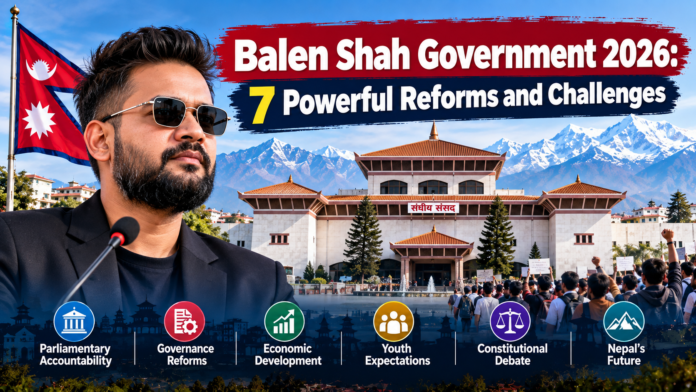
Balen Shah Government 2026: 7 Major Developments, Reforms and Challenges in Nepal

0
Balen Shah government 2026 Nepal political reforms and parliamentary accountability

Kathmandu, 16 October 2026 | Eleven Nepal | Politics
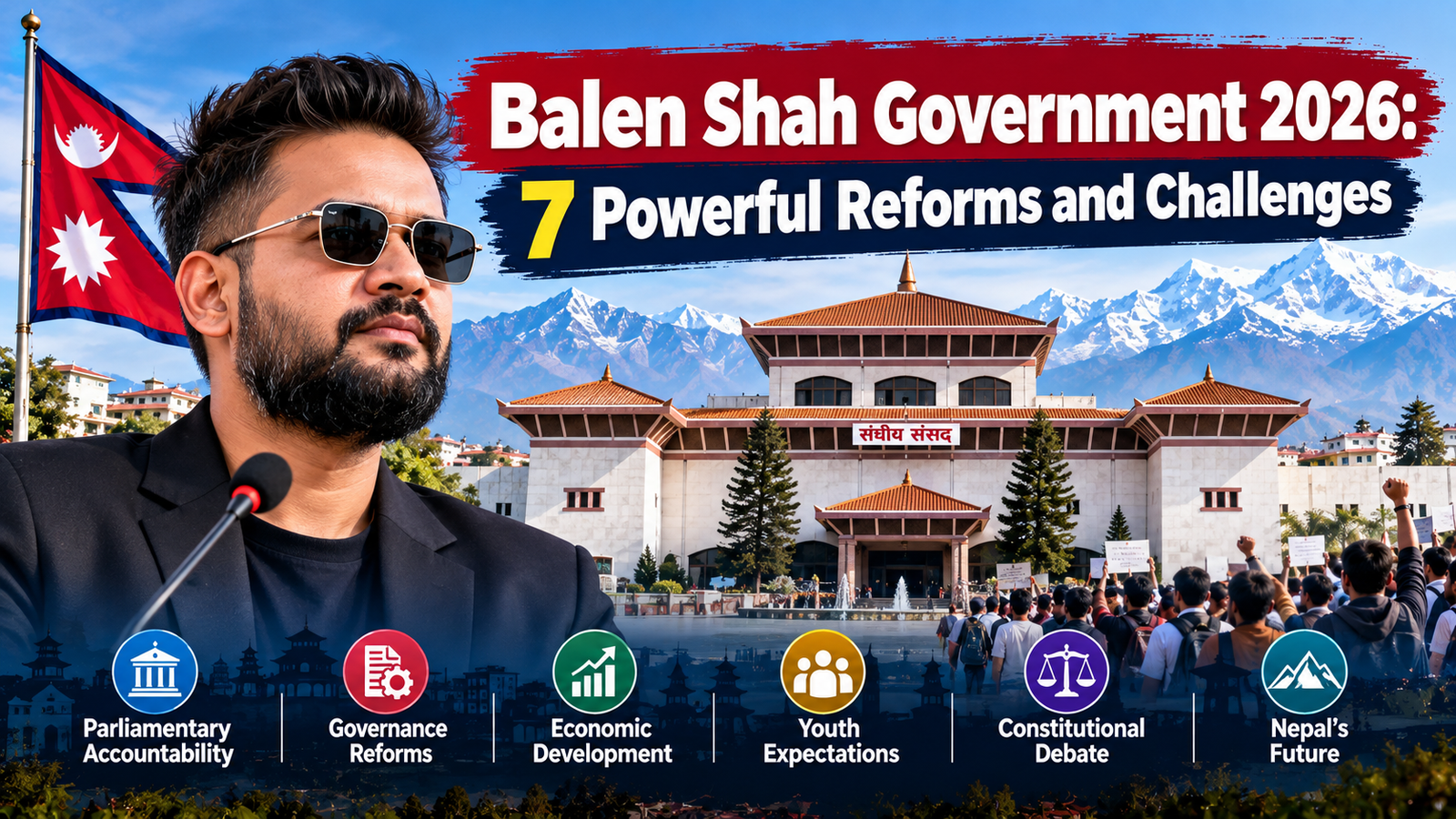
Balen Shah government 2026 Nepal political reforms and parliamentary accountability

The Balen Shah government 2026 has become one of the most closely watched political administrations in Nepal’s recent history. Nearly seven months after Balendra Shah became prime minister, public discussion is increasingly focused on whether the government can translate its ambitious reform commitments into measurable improvements in governance, employment, public services and democratic accountability.

Shah took office on 27 March 2026 following the Rastriya Swatantra Party’s (RSP) decisive victory in the parliamentary election held on 5 March. The party secured 182 seats in the 275-member House of Representatives, giving the new administration a substantial majority and an opportunity to advance its legislative programme.

His rise followed the youth-led protests of September 2025, which exposed widespread frustration with corruption, political instability and government performance. Many citizens consequently viewed the election as an opportunity to change how Nepal is governed.

The government announced a 100-point reform agenda, emphasising administrative efficiency, digital services, transparency and economic development. Yet its first several months have also brought criticism concerning parliamentary attendance, legislative delays, constitutional procedures and the implementation of promised changes.

This article examines seven major developments surrounding the Balen Shah government in 2026, the different perspectives on its performance, and the questions that remain unanswered.

The Balen Shah government 2026 entered office following a major shift in Nepal’s political landscape. Its parliamentary majority and reform commitments have attracted public attention, while questions about implementation and democratic accountability continue to shape political debate.

1. Balen Shah’s Rise to Prime Minister Changed Nepal’s Political Landscape

Balendra Shah, popularly known as Balen, entered national politics with an unusual background compared with many of Nepal’s established political leaders.

Before becoming prime minister, he was widely known as a rapper, structural engineer and mayor of Kathmandu Metropolitan City. His public profile developed through music, social media and local government leadership rather than a long career in the traditional parliamentary parties.

His transition from municipal leadership to the country’s highest executive office represented an important political development.

The March 2026 General Election

Nepal held its parliamentary election on 5 March 2026 following the political upheaval of the previous year.

The Rastriya Swatantra Party won 182 seats in the 275-member House of Representatives, according to Reuters. This result gave the party a near two-thirds majority and placed Shah in a strong parliamentary position when he assumed office on 27 March.

A large majority can make it easier for a government to pass legislation, approve budgets and maintain political continuity. However, parliamentary numbers do not automatically guarantee successful implementation of government programmes.

Policies must still pass through legal, financial and administrative processes.

The size of the RSP majority also creates an important accountability question: how can Parliament maintain effective scrutiny when one party controls such a large share of seats?

The Influence of the Gen Z Movement

The September 2025 protests formed an important part of the political environment preceding the election.

Demonstrations began amid controversy over restrictions on social media platforms and broader dissatisfaction with corruption and governance.

The protests escalated into serious violence. A subsequent investigative commission recommended action against several former senior officials in connection with the crackdown.

The former prime minister, K. P. Sharma Oli, rejected the commission’s findings as politically motivated, according to Reuters.

It is important to distinguish the commission’s recommendations from a criminal conviction. Recommendations for investigation or prosecution do not establish legal guilt.

The events nevertheless intensified public discussion about accountability, institutional reform and the role of younger citizens in national politics.

What the Election Result Means

The March election changed the distribution of parliamentary power and brought a relatively new political organisation into government.

For supporters, the result created an opportunity to pursue reforms that had faced resistance or delay under previous administrations.

For opposition parties and constitutional observers, the large majority made it especially important to preserve parliamentary scrutiny, judicial independence and transparent decision-making.

Both perspectives point toward the same practical issue: government authority must be exercised through Nepal’s constitutional institutions.

2. The Government Introduced an Ambitious 100-Point Reform Agenda

One of the first major actions of the Balen Shah government in 2026 was the approval of a 100-point governance reform programme.

The Cabinet adopted the agenda shortly after Shah assumed office, setting out commitments involving public administration, service delivery, digital government, legal reform and economic management.

The programme was presented as a results-oriented approach to governance, with targets extending from immediate measures to longer-term actions.

Major Areas of Reform

The agenda addressed several interconnected priorities.

Administrative efficiency: The government sought to improve how public institutions operate, reduce unnecessary procedures and strengthen responsibility for service delivery.

Digital governance: Greater use of technology was intended to make government services more accessible and reduce delays.

Anti-corruption measures: The administration identified transparency and stronger institutional accountability as important objectives.

Public-service improvements: Government offices were expected to improve the delivery of essential administrative services.

Legal and institutional reform: Proposed changes included legislation affecting the civil service and other areas of government administration.

Economic development: The government also linked governance reform with investment, employment and wider economic opportunities.

These priorities are significant because administrative weaknesses can affect citizens, businesses and public institutions simultaneously.

For example, delays in obtaining documents may increase the cost of starting a business, while inconsistent procedures can discourage investment.

However, the announcement of a policy is only the first stage of reform.

Conflicting Assessments of Implementation

The government’s progress has been the subject of different assessments.

In July, government spokesperson Sasmit Pokharel reported 87.2 percent progress on the 100-point agenda. According to the government’s account reported by Ratopati, 70 points had been implemented, while others remained at varying stages of progress.

However, an analysis published by The Kathmandu Post on 4 July reached a different conclusion. Drawing on government data, Cabinet decisions and implementation evidence, the newspaper assessed that only 38 of the 100 commitments had been implemented.

These figures should not be treated as directly interchangeable.

The government’s assessment and the newspaper’s review appear to have used different criteria for defining implementation and measuring progress.

For example, a ministry may consider a directive issued or a policy approved to be progress, while an independent review may require evidence that the measure is operating in practice.

Why Measuring Outcomes Matters

A credible assessment of government reform should examine more than the number of announced or completed activities.

It should ask whether citizens experience measurable changes.

If a digital service is introduced, the relevant questions include whether people can access it, whether it works reliably and whether processing times have decreased.

If an anti-corruption initiative is announced, observers should examine institutional procedures, published decisions and independently verifiable outcomes.

Similarly, administrative restructuring should be evaluated against service quality, public expenditure and accountability.

The central challenge is therefore not simply how many reform commitments have been marked complete, but whether those commitments have produced meaningful results.

3. Parliamentary Attendance and Accountability Became Major Political Issues

Parliamentary accountability has emerged as one of the most prominent controversies surrounding Prime Minister Shah.

Nepal’s parliamentary system requires the executive government to remain answerable to elected representatives.

Lawmakers can question ministers, examine legislation, review expenditure and raise concerns affecting their constituencies.

Direct participation by the prime minister is particularly important when issues concern national policy or major executive decisions.

Reports of Limited Parliamentary Attendance

On 3 October 2026, The Kathmandu Post reported that Shah had been largely absent from parliamentary proceedings during the recently concluded session.

The report stated that he attended six sittings of the House of Representatives during its second session and appeared once in the National Assembly.

It also reported that he had addressed the House from the rostrum on two occasions, on 31 May and 2 September.

Opposition lawmakers raised concerns about the limited opportunities to question the prime minister directly.

Questions had been raised on matters including floods, landslides, informal settlements, government decisions and tensions in different parts of the country.

Although ministers can respond on behalf of the administration, opposition representatives argued that certain issues required an explanation from the prime minister himself.

The Speaker’s Intervention

The issue had already attracted formal parliamentary attention in August.

On 18 August, Speaker D. P. Aryal instructed the prime minister to attend Parliament and answer lawmakers’ questions.

According to The Kathmandu Post, the direction followed repeated demands for Shah to participate in the question-and-answer process provided for under parliamentary rules.

The House of Representatives regulations require a regular opportunity for lawmakers to question the prime minister.

This mechanism is designed to help Parliament obtain explanations directly from the head of government.

Government and Opposition Perspectives

Critics argue that direct parliamentary engagement is an essential responsibility of the prime minister, regardless of how much support the government enjoys.

They maintain that a large electoral mandate does not reduce the obligation to explain executive decisions.

Ruling-party representatives have emphasised the government’s mandate for reform and its responsibility to deliver results.

These positions are not necessarily mutually exclusive.

An administration can pursue an ambitious policy programme while also participating regularly in parliamentary scrutiny.

The relevant question is whether executive work and legislative accountability are being balanced effectively.

Why Parliamentary Scrutiny Matters

Parliamentary questioning serves several functions.

It allows representatives to raise local and national concerns, requires the government to explain decisions and creates a public record of executive responses.

It also helps citizens understand how elected officials are exercising their responsibilities.

A government with a strong majority can generally advance its legislative programme more easily, but that majority does not replace the need for debate and oversight.

For Nepal, this issue has become an important test of how the new administration interacts with established democratic institutions.

4. Legislative Progress Has Faced Delays and Institutional Challenges

The Balen Shah government’s reform programme includes measures that require new legislation or amendments to existing laws.

This creates a distinction between actions that can be taken through administrative decisions and changes that must pass through Parliament.

Some reforms can begin through ministerial instructions or improvements to existing procedures.

Others require detailed bills, committee examination, parliamentary debate and formal approval.

The Challenge of Turning Promises into Laws

One frequently discussed area is federal civil service legislation.

Civil service reform is significant because government employees are responsible for implementing many public policies.

Questions about recruitment, transfers, accountability, institutional responsibilities and relations between different levels of government can affect the quality of public administration.

However, these issues are also legally and politically complex.

Reform may require consultation with civil servants, provincial authorities, local governments and other stakeholders.

An announcement of a legislative deadline does not ensure that a bill will be ready or approved within that period.

Parliamentary Attendance Beyond the Prime Minister

Concerns about parliamentary participation have not been limited to Shah.

On 13 August, The Kathmandu Post reported that the House failed to advance a government bill because insufficient lawmakers were present for a vote.

Article 94 of Nepal’s Constitution requires at least one-fourth of the total membership of the relevant parliamentary chamber to be present before a motion or proposal can be decided.

For the 275-member House of Representatives, this means at least 69 members are required.

The reported quorum failure illustrated how legislative work can be delayed even when the governing party holds a substantial majority.

Parliamentary scrutiny remains an important part of Nepal’s democratic system. Questions about the Balen Shah government 2026 include the prime minister’s participation in parliamentary proceedings, the progress of legislation and the government’s responses to elected representatives.

Why Legislative Discipline Is Important

Passing laws requires more than political agreement among party leaders.

Members must attend sessions, participate in committees, consider proposed amendments and remain present for votes.

Parliamentary committees also have a role in examining technical details and potential consequences.

When participation is inconsistent, legislative deadlines may become harder to meet.

For citizens, these delays matter because important laws can affect public employment, business regulation, infrastructure and access to government services.

Judicial Review and Reform

The government has also faced legal challenges to some decisions.

Judicial review is an established constitutional mechanism through which courts can examine whether government actions comply with applicable law.

Court intervention does not automatically establish that an entire reform agenda is invalid.

Instead, each case must be understood according to the decision challenged, the legal arguments presented and the court’s ruling.

The relationship between reform and due process is therefore an important part of Nepal’s political debate.

5. Economic Growth, Jobs and Investment Remain Major Public Expectations

Beyond parliamentary disputes, economic opportunity remains central to public expectations of the government.

Nepal faces longstanding challenges involving employment, productivity, investment and dependence on income earned abroad.

Many families rely on remittances from relatives working overseas.

For young people considering their future, questions about jobs, wages, education and entrepreneurship are often as important as national political debates.

Employment, entrepreneurship, investment and public-service improvements are important areas for evaluating the Balen Shah government 2026. Progress should be measured through economic indicators, official implementation reports and the experiences of citizens and businesses.

Employment Opportunities for Young Nepalese

The government’s reform agenda has emphasised economic development and better public administration.

However, job creation depends on several factors beyond government announcements.

Private businesses need access to finance, reliable infrastructure, skilled workers and predictable regulations.

Investment decisions also depend on market demand and confidence in the wider economy.

Government policy can influence these conditions, but changes in employment usually take time to become visible.

The number of new jobs, their quality and their geographic distribution are important indicators to monitor.

Engagement With Business Leaders

In July, Shah held discussions with business leaders, professionals and other stakeholders.

The Kathmandu Post reported on 23 July that participants welcomed the opportunity to raise their concerns directly with the prime minister.

At the same time, some observers questioned the limited participation of relevant line ministers in those discussions.

This distinction matters because a meeting with the prime minister can identify problems, but implementation usually depends on ministries, regulatory bodies and other agencies.

For example, resolving an industrial licensing problem may require changes in administrative procedures.

Improving electricity reliability or transport infrastructure may involve several public institutions and significant expenditure.

What Businesses Need From Government

Small and medium-sized businesses are particularly affected by the everyday operation of public institutions.

Entrepreneurs may need company registration, tax registration, municipal permissions, access to banking and compliance with sector-specific requirements.

A government seeking to encourage entrepreneurship can support businesses by making these processes clearer and more predictable.

However, faster procedures must still maintain appropriate safeguards involving consumer protection, workers’ rights and public finances.

The effectiveness of economic reform should therefore be assessed through outcomes such as investment activity, business formation, employment and improvements in service delivery.

The Importance of Regional Development

Economic opportunities are not distributed evenly across Nepal.

Kathmandu and other urban centres may offer different employment and investment conditions from rural districts.

Tourism, agriculture, manufacturing, digital services and small enterprises also face different challenges.

A national development strategy must consider local infrastructure, access to markets, skills and regional needs.

For returning migrant workers, these questions are especially relevant.

Experience gained overseas can support entrepreneurship, but successful businesses still require realistic budgets, market research and reliable local operating conditions.

6. Youth Expectations and the Legacy of the Gen Z Movement Continue to Shape Politics

The Balen Shah government entered office in a political environment strongly influenced by youth participation.

The 2025 protests had brought national attention to dissatisfaction with established political practices.

However, young citizens do not share a single political viewpoint.

Their concerns include employment, education, corruption, public services, freedom of expression and opportunities to participate in decision-making.

Different groups may also disagree about the pace and direction of reform.

Shah’s Meeting With Young Lawmakers

On 18 September 2026, The Kathmandu Post reported that Shah met younger RSP lawmakers and encouraged them to contribute practical proposals to parliamentary discussions.

According to lawmakers who attended, the prime minister suggested that representatives should offer solutions alongside criticism.

Topics discussed reportedly included employment, technology, entrepreneurship, sports and cultural sectors.

The meeting drew attention to the role younger parliamentarians can play in developing public policy.

Questioning Government Is Also a Parliamentary Responsibility

Constructive proposals can improve political debate.

Lawmakers may contribute ideas, identify gaps in legislation and recommend changes to public programmes.

However, questioning the government is also an essential part of parliamentary democracy.

Representatives do not need to produce a complete alternative policy before asking the executive to explain a decision.

Effective parliamentary participation can include both scrutiny and practical problem-solving.

These functions reinforce one another when they are supported by evidence and open debate.

What Young Citizens May Look For

Public expectations should not be reduced to political personalities or social media popularity.

Young citizens can assess government performance through concrete questions.

Are education and training programmes relevant to employment opportunities?

Are public-sector recruitment processes transparent?

Can young entrepreneurs register and operate businesses without unnecessary administrative obstacles?

Are digital government services accessible outside major urban centres?

Do institutions respond appropriately when citizens raise complaints?

Answers to these questions require evidence from government records, independent research and lived experiences across different communities.

Accountability for the 2025 Protest Violence

The aftermath of the September 2025 protests remains another important issue.

In March 2026, Reuters reported that an investigative commission had recommended prosecution of former senior officials in connection with the violence.

The recommendations prompted debate about accountability, legal procedure and political responsibility.

Any criminal proceedings must follow applicable legal standards, including the presumption of innocence.

For affected families, accountability may also involve access to information, medical support, compensation mechanisms and transparent investigations.

These issues should be reported carefully, with a clear distinction between allegations, investigative findings and judicial decisions.

7. The Government’s Relationship With Democratic Institutions Remains Under Scrutiny

Nepal’s political system distributes authority among the executive, legislature and judiciary.

The prime minister leads the government, but executive authority operates within a constitutional framework.

Parliament makes laws and scrutinises the government, while the courts interpret and apply the law.

Independent institutions and public bodies also perform oversight and administrative functions.

A Strong Mandate and Constitutional Limits

The RSP’s parliamentary majority gives the government substantial political influence.

However, electoral support does not eliminate constitutional limits.

Major policy changes may still require legislative approval, public consultation or judicial examination.

Some constitutional amendments are subject to special procedures and voting requirements.

The relevant procedures depend on the nature of the proposed change.

This means that a large majority creates opportunities for reform while also placing responsibility on the governing party to respect established institutions.

Political Debate Over the Government’s Approach

Opposition lawmakers have criticised aspects of the prime minister’s engagement with Parliament and other political institutions.

On 1 October, OnlineKhabar reported an exchange in which a CPN-UML lawmaker questioned the government’s political approach.

An RSP lawmaker responded by emphasising the electoral mandate and the government’s stated commitment to reducing corruption.

These statements illustrate contrasting political interpretations.

The opposition’s criticism should be understood as an attributed political position, not as an established legal finding.

Similarly, statements by ruling-party representatives about the government’s intentions should not be treated as proof that particular reforms have succeeded.

Why Institutional Relationships Matter

Public administration depends on coordination among multiple bodies.

A ministry may develop a policy, Parliament may approve the relevant law, local governments may implement parts of it and courts may resolve disputes over legality.

If these institutions communicate effectively, reforms may be easier to implement.

If responsibilities are unclear or procedures are contested, implementation can become more difficult.

For Nepal, the challenge is to pursue change while maintaining predictable constitutional processes.

What Has the Balen Shah Government Achieved So Far?

The government’s first several months have produced a mixture of policy announcements, administrative measures, reported improvements and unresolved challenges.

A balanced assessment should distinguish these categories.

Policy commitments: The administration approved a 100-point governance agenda and announced priorities involving public administration, technology, anti-corruption measures and economic development.

Reported administrative progress: A July editorial in The Kathmandu Post described improvements in driving licence printing and accounts of faster service delivery at some government offices.

Government-reported implementation: Officials reported substantial progress on the 100-point agenda, although independent assessments have applied different standards and reached lower completion figures.

Parliamentary concerns: Opposition lawmakers and parliamentary reporting documented continuing questions about the prime minister’s attendance and direct responses to lawmakers.

Legislative challenges: Quorum problems and delays involving some proposals showed that a strong majority does not automatically ensure smooth parliamentary work.

These observations should not be combined into a single numerical rating of the government.

They concern different activities, use different evidence and cover different time periods.

A fuller evaluation will require updated implementation records, financial information and independent evidence about outcomes.

What Should Nepal Watch During the Coming Months?

Several developments will help clarify how the administration’s reform agenda is progressing.

Progress on the 100-Point Agenda

Updated government reporting should identify which commitments have been completed, which remain under implementation and which have missed their deadlines.

Independent assessment can help determine whether claimed progress corresponds to changes experienced by citizens.

Parliamentary Engagement

Future parliamentary sessions will provide opportunities to examine whether regular questioning, ministerial responses and legislative scrutiny are functioning effectively.

Attendance records and parliamentary proceedings offer a more reliable basis for evaluation than speculation about political motives.

Economic Indicators

Employment, investment, business activity and public expenditure will be important areas to monitor.

Changes in these indicators should be considered alongside wider economic conditions, rather than automatically attributed to one government decision.

Public-Service Performance

Administrative reforms can be evaluated through service-processing times, accessibility, complaint resolution and documented improvements.

National averages should also be examined carefully because service quality may differ across districts and population groups.

Legal and Constitutional Developments

Court decisions, legislative proposals and official institutional responses will help establish how contested reforms are being handled.

These records are particularly important when political debate involves allegations of improper government conduct.

Why This Political Debate Matters to Ordinary Nepalese Citizens

National politics can sometimes appear distant from everyday concerns.

However, decisions made by the federal government can influence employment policy, public investment, taxation, education, healthcare and administrative services.

For students, government policy may affect the quality of education and opportunities available after graduation.

For business owners, regulatory clarity and infrastructure can influence operating costs.

For farmers, access to markets, transport and agricultural services may be important.

For families relying on foreign employment, domestic job creation and economic stability can shape future choices.

For citizens living outside major urban centres, the effectiveness of federal, provincial and local coordination can affect access to public services.

These concerns demonstrate why political accountability matters beyond party competition.

A government should be assessed through its decisions, their legal basis and their effects on the people it serves.

At the same time, citizens benefit from distinguishing documented facts from political allegations, campaign promises and unverified online claims.

The next stages of the government’s reform programme will provide further opportunities to assess its implementation. Legislative developments, official progress reports and public-service outcomes will help establish how the Balen Shah government 2026 is performing.

Frequently Asked Questions About the Balen Shah Government 2026

Who is the prime minister of Nepal in October 2026?

Balendra Shah, popularly known as Balen Shah, is Nepal’s prime minister. He assumed office on 27 March 2026 following the parliamentary election earlier that month.

Which party leads the Nepal government in 2026?

The Rastriya Swatantra Party leads the government. Reuters reported that the party secured 182 of the 275 seats in the House of Representatives.

What is the Balen Shah government’s 100-point agenda?

It is a governance reform programme covering administrative efficiency, public services, digital government, legal reform, anti-corruption measures and economic development.

Has the government completed its reform agenda?

Different assessments have reported different levels of progress. In July, government officials reported substantial implementation, while an independent review by The Kathmandu Post assessed fewer commitments as completed. The difference reflects the importance of examining how implementation is defined and verified.

Why has Balen Shah’s parliamentary attendance attracted criticism?

Opposition lawmakers have raised concerns about the prime minister’s limited attendance and the lack of regular opportunities to question him directly. Parliamentary reports in August and October documented the dispute.

What are the main economic challenges facing the government?

Important challenges include creating employment opportunities, encouraging investment, improving public services and supporting economic activity across different regions of Nepal.

What role does the Gen Z movement play in Nepal’s politics?

The September 2025 protests helped shape the political environment preceding the 2026 election. Questions about accountability, corruption, youth representation and institutional reform remain part of the national discussion.

How can citizens assess government performance?

Citizens can consult parliamentary records, official policy documents, public budgets, independent reporting and measurable indicators such as employment, service delivery and implementation of legislation.

Related Articles on Eleven Nepal

Nepal’s political developments are closely connected with employment, economic opportunities and entrepreneurship.

Readers interested in the country’s economic future can explore our article on Nepal’s Youth Employment Challenges, which discusses issues affecting young people.

For more information about starting a business, read How to Register a Business in Nepal in 2026.

You can also explore Business Ideas for Returnees in Nepal, which examines opportunities and financial considerations for Nepalese workers returning from overseas.

Conclusion

The Balen Shah government 2026 represents an important period in Nepal’s political development.

The administration entered office with a substantial parliamentary majority, an ambitious reform programme and considerable public attention following the political upheaval of 2025.

Its early months have included reported improvements in some administrative services, the introduction of a wide-ranging reform agenda and efforts to engage with economic stakeholders.

At the same time, parliamentary attendance, legislative delays, judicial scrutiny and disagreements over implementation have become significant parts of the public debate.

The government’s long-term record will depend on evidence of how policies are implemented, whether constitutional processes are respected and what changes citizens experience in their daily lives.

For Nepal, the central questions extend beyond any individual leader: how can democratic institutions deliver effective public services, expand economic opportunity and remain accountable to the people?

Those questions will continue to shape the country’s political discussion.


References and Further Reading

  1. Reuters (27 March 2026). Ex-rapper Shah sworn in as Nepal prime minister after sweeping election win.
  2. Reuters (26 March 2026). Panel wants prosecution of ousted Nepal PM over violence in Gen Z protests.
  3. The Kathmandu Post (4 July 2026). In 100 days, RSP government delivers just a third of planned actions.
  4. Ratopati (5 July 2026). Government reports progress on 100-point agenda.
  5. The Kathmandu Post (18 August 2026). Speaker instructs PM Shah to attend parliament, answer lawmakers.
  6. The Kathmandu Post (3 October 2026). Prime Minister Balendra Shah largely absent as Parliament wraps up session.
  7. The Kathmandu Post (13 August 2026). Lawmakers absent as Parliament’s work loses momentum.
  8. The Kathmandu Post (18 September 2026). Shah tells Gen Z lawmakers to offer solutions, not just question government.
  9. The Kathmandu Post (23 July 2026). Stakeholders welcome PM’s outreach, but experts question absence of line ministers.
  10. OnlineKhabar (1 October 2026). UML lawmaker questions nature of Balen-led government; RSP lawmaker responds.
  11. UK House of Commons Library (2 June 2026). Nepal: 2026 legislative election and future prospects.

Editorial disclosure: This is a factual political explainer prepared using reporting and publicly available information through 16 October 2026. Statements about government performance are attributed where contested. Official progress claims are distinguished from independent assessments.

Business Ideas for Returnees in Nepal: 10 Smart Choices (2026)

0
Business ideas for returnees in Nepal including café farming tourism gym and online services

Introduction

Business ideas for returnees in Nepal are becoming an important consideration for Nepalese workers and professionals who want to return home after spending years overseas.

Many Nepalese people working in countries such as Japan, South Korea, Australia, the United Kingdom, Qatar, the UAE and Saudi Arabia gain valuable experience, professional skills and savings. However, returning home and starting a successful business requires more than investment capital.

The right business depends on market demand, location, experience, available savings, competition and operational costs.

Nepal has also recognised the importance of returnee entrepreneurship. The government’s Returnee Migrant Workers Reintegration Directives, 2079, provide a framework for using the skills, capital and experience acquired through foreign employment to support entrepreneurship and economic reintegration.

This article explores ten practical business ideas for returnees in Nepal in 2026, including illustrative investment budgets, possible revenue, financial risks and essential startup steps.

Why Returning Migrants Should Consider Entrepreneurship in Nepal

Working abroad can provide valuable professional and personal experience. Returnees may have developed skills in hospitality, construction, agriculture, customer service, logistics, technology and management.

These skills can become useful business assets.

For example, someone who has worked in a restaurant in the UK may understand food hygiene, stock management, kitchen operations and customer service. A worker returning from South Korea may have experience in manufacturing, equipment maintenance or industrial processes.

However, international experience does not automatically guarantee success in Nepal.

Entrepreneurs must adapt their skills to local customer expectations, purchasing power, supply chains and competition.

The International Labour Organization has supported initiatives focused on skills development and employment opportunities for returning migrants in Nepal.

1. Café and Restaurant Business in Nepal

Estimated initial investment: NPR 8–25 lakh

A café or restaurant is a possible business for returnees with hospitality experience.

Cities such as Kathmandu, Pokhara, Butwal, Chitwan and Dharan offer different customer markets, including students, office workers, local residents and visitors.

Business Opportunities

  • Coffee shop and bakery
  • Breakfast and brunch café
  • Momo and fast-food restaurant
  • Nepali and international fusion restaurant
  • Takeaway and delivery-focused kitchen

Illustrative Monthly Financial Example

DescriptionNPR
Monthly sales500,000
Food and beverage costs175,000
Staff salaries120,000
Rent45,000
Utilities and other operating costs55,000
Operating surplus105,000

This NPR 105,000 is an illustrative operating surplus before taxes, financing costs, depreciation and any unaccounted owner remuneration. It is not a guaranteed monthly profit.

Main Risks

High rent, food waste, low customer traffic, inconsistent quality and poor cost control can reduce profitability.

How to Start

Begin with local competitor research, a menu costing exercise and a realistic cash-flow forecast. Test customer demand before committing to expensive premises.

Best suited for: Returnees with professional cooking, café management or hospitality experience.

2. Commercial Agriculture and Farming

Estimated initial investment: NPR 3–15 lakh

Agriculture can be an option for returnees with access to suitable land, water and reliable buyers.

Potential Businesses

  • Commercial vegetable farming
  • Mushroom cultivation
  • Greenhouse production
  • Poultry farming
  • Beekeeping
  • Fruit cultivation

Example: Small Vegetable Farming Project

An entrepreneur could allocate NPR 600,000 to a small farming project.

Illustrative allocation:

ExpenseNPR
Land preparation and infrastructure120,000
Irrigation100,000
Seeds and growing materials60,000
Tools and equipment70,000
Labour and operating reserve150,000
Contingency100,000
Total600,000

Actual costs depend heavily on land, crop, infrastructure and season.

Main Risks

Weather conditions, pests, crop diseases, market-price fluctuations and transport costs.

How to Start

Identify buyers before planting, research crop suitability, and prepare a seasonal production budget.

Best suited for: Returnees with agricultural experience, access to land or reliable local farming partnerships.

3. Grocery Store or Mini-Mart

Estimated initial investment: NPR 5–18 lakh

A grocery shop can serve repeat customers and meet everyday household needs.

Potential locations include residential neighbourhoods, growing towns and areas near schools or apartment buildings.

Products to Consider

  • Rice, flour and pulses
  • Cooking oil and packaged foods
  • Dairy products
  • Household cleaning products
  • Personal care products
  • Snacks and beverages

Financial Example

Assume monthly sales of NPR 600,000 and a gross margin of 18%.

Gross profit = NPR 108,000.

If monthly operating expenses are NPR 75,000, the illustrative operating surplus is NPR 33,000 before taxes and other excluded costs.

A grocery business can generate substantial sales while earning relatively modest margins.

Main Risks

Expired stock, theft, credit sales, price competition and poor inventory control.

How to Start

Choose a location with sufficient residential demand and compare supplier prices before purchasing inventory.

Best suited for: Returnees seeking a retail business they can manage directly.

4. Tourism and Homestay Business

Estimated initial investment: NPR 5–30 lakh

Nepal’s tourism-related opportunities include accommodation, local experiences and hospitality services.

The suitability of this business depends on location, infrastructure and visitor demand.

Possible Business Models

  • Village homestay
  • Guesthouse
  • Local food experiences
  • Cultural workshops
  • Guided experiences through appropriately licensed operators
  • Trekking-related support services

Illustrative Homestay Revenue

Suppose a homestay has four guest rooms.

Average room price: NPR 2,000 per night.

Average occupancy: 40%.

Monthly room revenue:

4 × NPR 2,000 × 30 × 40% = NPR 96,000.

This excludes food and activity income, but it also excludes operating expenses.

Main Risks

Seasonal demand, inconsistent bookings, maintenance expenses and competition.

How to Start

Research visitor patterns, accommodation regulations, accessibility and online booking channels.

Best suited for: Returnees with suitable property, tourism experience or strong local community connections.

5. Food Processing and Packaging

Estimated initial investment: NPR 4–20 lakh

Food processing can create opportunities to add value to locally available agricultural products.

Potential Products

  • Traditional Nepali achar
  • Packaged spices
  • Roasted snacks
  • Dried fruits
  • Millet-based products
  • Packaged bakery products

Example: Nepali Achar Brand

A returnee could develop a small packaged achar business using locally sourced ingredients.

Initial expenses may include food preparation equipment, packaging materials, ingredients, labels, storage and working capital.

Main Risks

Food contamination, inconsistent shelf life, packaging failures and weak distribution.

How to Start

Develop standard recipes, test shelf life, calculate unit costs and confirm applicable food registration, labelling and hygiene requirements.

Food manufacturing and packaging may involve additional regulatory requirements beyond ordinary business registration.

Best suited for: Returnees with culinary, food production or manufacturing experience.

6. Digital Marketing Agency

Estimated initial investment: NPR 1–5 lakh

Digital marketing is a lower-capital business idea for returnees who already have relevant skills.

Services to Offer

  • Social media management
  • Content writing
  • Search engine optimisation
  • Website maintenance
  • Graphic design
  • Online advertising management

Illustrative Monthly Revenue

Suppose an agency manages five clients paying NPR 15,000 each per month.

Monthly revenue = NPR 75,000.

If software, communications, subcontracting and other operating expenses total NPR 25,000, the illustrative surplus is NPR 50,000 before taxes and owner remuneration.

Finding and retaining five paying clients is not guaranteed.

Main Risks

Client acquisition, late payments, changing digital platforms and competition.

How to Start

Build a portfolio, identify a target market and offer a clearly defined service package.

Best suited for: Returnees with marketing, design, writing or technology experience.

7. Laundry and Cleaning Services

Estimated initial investment: NPR 3–12 lakh

Laundry and cleaning services may be relevant in areas with hotels, restaurants, offices, rental accommodation and busy households.

Services

  • Laundry and ironing
  • Commercial linen washing
  • House cleaning
  • Office cleaning
  • Deep cleaning
  • Hospitality linen collection and delivery

Business Example

A small operator could target local restaurants and guesthouses that require regular linen cleaning.

Recurring business customers may provide more predictable demand than occasional household orders.

Main Risks

Equipment breakdowns, utility expenses, damaged customer property and unreliable service quality.

How to Start

Compare commercial equipment costs, estimate utility consumption and seek trial contracts before purchasing machinery.

Best suited for: Returnees with housekeeping, hotel operations or service-management experience.

8. Fitness Centre or Gym

Estimated initial investment: NPR 15–50 lakh

A fitness centre can be a business option for returnees interested in health, exercise and sports.

Possible Models

  • Neighbourhood gym
  • Personal training studio
  • Women-focused fitness studio
  • Small-group strength training
  • Functional fitness centre

Illustrative Membership Example

Suppose a gym has 150 paying members.

Monthly membership: NPR 2,500.

Monthly membership revenue = NPR 375,000.

If monthly operating costs are NPR 250,000, the illustrative operating surplus is NPR 125,000 before tax, financing, depreciation and other excluded costs.

The gym must attract and retain enough members to achieve this result.

Main Risks

Expensive equipment, maintenance, electricity, rent and member retention.

How to Start

Survey local customers, research nearby gyms and calculate the minimum membership needed to cover costs.

Best suited for: Returnees with fitness-industry experience or access to qualified trainers and sufficient capital.

9. Delivery and Logistics Services

Estimated initial investment: NPR 3–15 lakh

Delivery services can support retailers, restaurants, offices and online sellers.

Business Models

  • Local parcel delivery
  • Restaurant delivery contracts
  • Business-to-business courier services
  • Scheduled delivery routes
  • Small e-commerce fulfilment

Illustrative Monthly Revenue

Assume a business completes 50 paid deliveries per day at an average fee of NPR 100.

Operating 26 days per month:

50 × NPR 100 × 26 = NPR 130,000 monthly revenue.

Fuel, riders, vehicle maintenance, insurance and administration must be deducted before calculating profit.

Main Risks

Fuel-price fluctuations, road conditions, delivery delays and vehicle repairs.

How to Start

Identify local businesses requiring delivery services and calculate the full cost per delivery before setting prices.

Best suited for: Returnees with logistics, transport or operations experience.

10. Skills Training and Vocational Education

Estimated initial investment: NPR 2–10 lakh

Returnees with valuable professional skills may consider offering training services.

Training Opportunities

  • English communication
  • Computer skills
  • Basic accounting
  • Hospitality skills
  • Cooking and bakery
  • Graphic design
  • Practical technical skills

Illustrative Revenue Example

Suppose a training centre enrols 30 students per course cycle.

Course fee: NPR 5,000.

Revenue per cycle = NPR 150,000.

Trainer payments, premises, equipment, marketing and administration must be deducted.

Revenue also depends on how frequently courses can be delivered.

Main Risks

Insufficient enrolment, trainer quality, reputation and regulatory requirements.

How to Start

Choose a specific skill, validate demand and confirm whether the intended training programme requires approval or accreditation.

Best suited for: Returnees with demonstrable expertise, teaching ability and relevant qualifications.

11. Comparison of Business Ideas for Returnees in Nepal

BusinessIllustrative InvestmentKey Challenge
Café or restaurantNPR 8–25 lakhFood costs and customer traffic
Commercial farmingNPR 3–15 lakhWeather and market prices
Grocery storeNPR 5–18 lakhLow margins and stock control
Tourism or homestayNPR 5–30 lakhSeasonality
Food processingNPR 4–20 lakhFood safety and distribution
Digital marketingNPR 1–5 lakhFinding clients
Laundry servicesNPR 3–12 lakhEquipment and utilities
Fitness centreNPR 15–50 lakhMembership retention
Delivery servicesNPR 3–15 lakhOperating cost per delivery
Skills trainingNPR 2–10 lakhStudent enrolment

These ranges are examples for early financial planning, not market-verified quotations.

12. How Much Money Should Returnees Invest?

One of the biggest mistakes new entrepreneurs can make is investing their entire savings immediately.

Imagine a returnee has saved NPR 20 lakh.

An illustrative capital allocation could be:

PurposeAmount
Initial business setupNPR 10 lakh
Business working capitalNPR 4 lakh
Personal emergency savingsNPR 4 lakh
Business contingency reserveNPR 2 lakh
TotalNPR 20 lakh

This is not a universal recommendation. A suitable allocation depends on household expenses, debt, business risk and access to other income.

The central principle is to maintain sufficient liquidity rather than tying all available savings into equipment, decoration or inventory.

13. How to Choose the Best Business Idea After Returning to Nepal

Before investing, consider five questions.

What Skills Did You Gain Abroad?

Choose a business that benefits from your experience.

Is There Real Local Demand?

Interview potential customers, visit competitors and test pricing.

Can You Afford the Startup Costs?

Include working capital, not only initial equipment and renovation.

How Long Can You Operate Without Profit?

Prepare a cash-flow forecast for at least six months and consider a longer reserve for capital-intensive businesses.

Can You Start Small?

A pilot operation can help test demand before making a large investment.

14. How to Register a Business in Nepal

Business registration depends on the ownership structure and business activity.

The general process includes:

  1. Select a business idea and legal structure.
  2. Decide whether to operate as a sole proprietor, partnership or company.
  3. Register through the relevant authority.
  4. Obtain the applicable Business PAN.
  5. Determine whether VAT registration is required.
  6. Complete municipal registration and applicable permits.
  7. Arrange accounting, banking and recordkeeping.
  8. Confirm industry-specific licences before starting regulated activities.

The Office of the Company Registrar handles company incorporation, while the Inland Revenue Department administers PAN and VAT.

Different industries may have additional legal requirements.

15. Are Government Support Programmes Available for Returnees?

Nepal has established policies and projects intended to support returning migrants and entrepreneurship.

The Returnee Migrant Workers Reintegration Directives, 2079, provide a policy framework for economic and social reintegration.

Past initiatives, including the Rural Enterprises and Remittances Project (SAMRIDDHI), have supported entrepreneurship and skills development among returning migrants.

However, a policy framework or historical project does not guarantee that grants, subsidised loans or training places are currently available.

Returnees should contact their municipality, relevant employment service centre or responsible government authority to check current programme eligibility and application arrangements.

Avoid relying on unofficial agents who promise guaranteed government funding.

16. Common Mistakes Returnees Should Avoid

Investing All Savings at Once

Retain emergency and operating reserves.

Copying Businesses Without Research

A successful café or shop in one location may not succeed elsewhere.

Trusting Verbal Partnerships

Prepare written agreements defining capital contributions, profit sharing, management authority and exit procedures.

Ignoring Monthly Operating Expenses

Rent, salaries, utilities, stock and loan repayments can create cash-flow pressure.

Assuming Revenue Equals Profit

High sales do not necessarily produce strong earnings.

Failing to Monitor Performance

Track daily sales, gross margins, operating costs, cash flow and customer feedback.

Expanding Too Quickly

Establish consistent demand and reliable systems before opening additional locations.

17. Frequently Asked Questions

What are the best business ideas for returnees in Nepal?

Suitable options may include hospitality, farming, grocery retail, digital services, food processing, logistics and vocational training. The best choice depends on experience, available capital and local demand.

Can I start a business in Nepal with NPR 5 lakh?

Some small service businesses, training activities and limited-scale trading or agricultural projects may be possible within this budget. Actual feasibility depends on location and setup requirements.

Is opening a café profitable in Nepal?

A café can generate an operating surplus if sales are sufficient to cover food costs, wages, rent and other expenses. Profitability is not guaranteed.

Which business is suitable for returnees from Japan or South Korea?

Returnees with relevant experience may consider manufacturing-related services, technical training, equipment maintenance, agriculture or other businesses aligned with their skills.

Can returning migrants get government business loans?

Eligibility and availability depend on current government and financial institution programmes. Check official announcements rather than assuming funding is available.

Should I register a company or partnership?

The appropriate structure depends on ownership, liability, investment and governance needs. Seek professional advice for significant investments.

How can I reduce startup risk?

Start with market research, test demand, control fixed costs, retain cash reserves and avoid unnecessary borrowing.

Is an online business better than a physical shop?

An online service business may require less capital, while a physical shop may offer different customer opportunities. Both involve risks and require a viable business model.

18. Official Resources and Further Reading

For reliable information, consult:

Foreign Employment Board
https://feb.gov.np/
Information relating to foreign employment welfare and returnee reintegration.

Office of the Company Registrar
https://ocr.gov.np/
Company incorporation and corporate requirements.

Inland Revenue Department
https://ird.gov.np/
PAN, VAT and taxpayer services.

Department of Industry
https://doind.gov.np/
Industry registration and relevant industrial services.

International Labour Organization
https://www.ilo.org/
Research and programmes concerning skills, labour markets and entrepreneurship.

United Nations in Nepal
https://nepal.un.org/
Development projects and returnee entrepreneurship experiences.

Related Business Guides on Eleven Nepal

Starting a business after returning to Nepal requires proper planning, legal registration and financial management.

If you are preparing to launch your first business, read our How to Register a Business in Nepal in 2026 guide to understand the registration process, required documents and legal requirements.

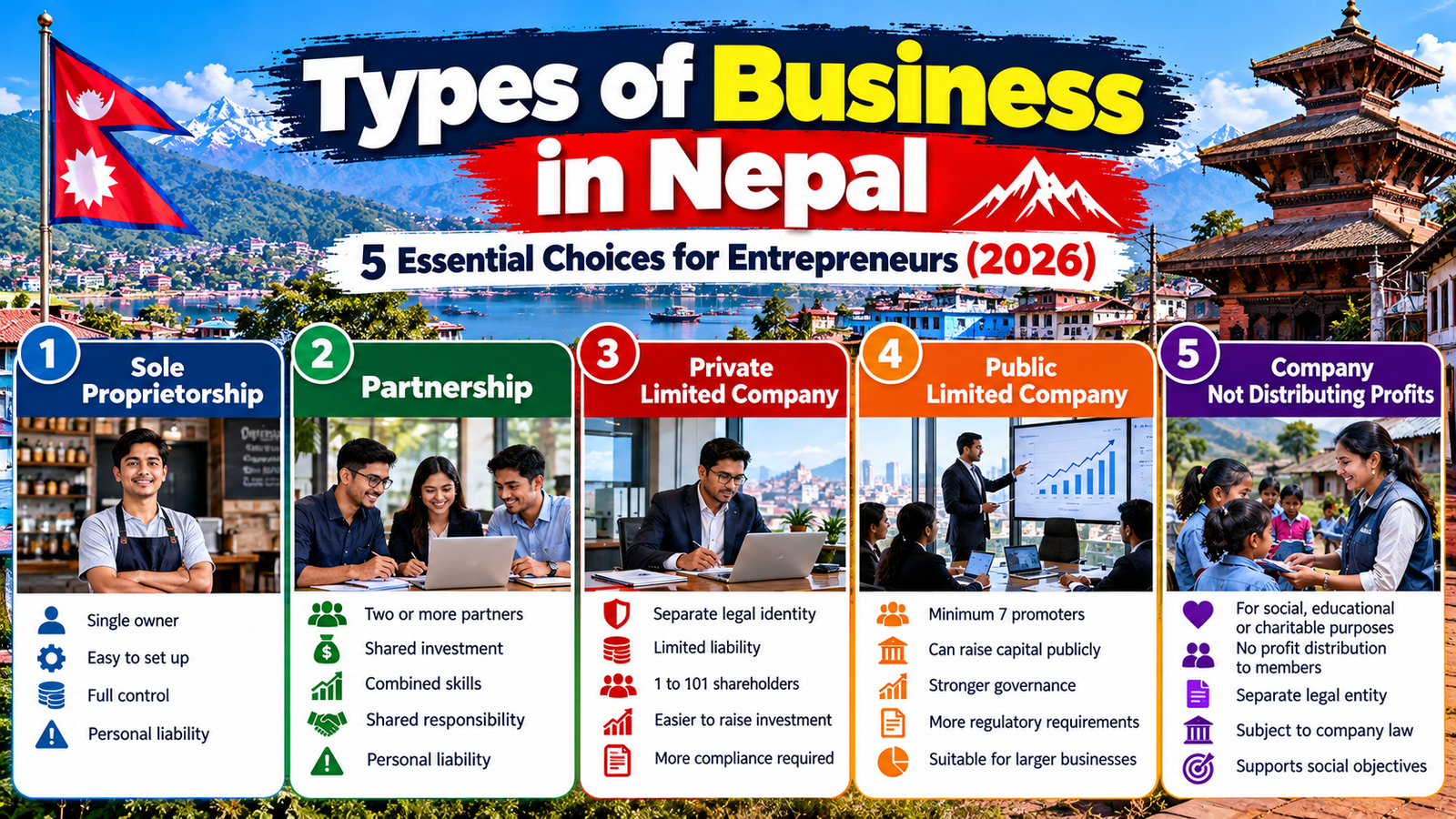
Before choosing an ownership structure, explore our Types of Business in Nepal article, which compares sole proprietorships, partnerships and private limited companies.

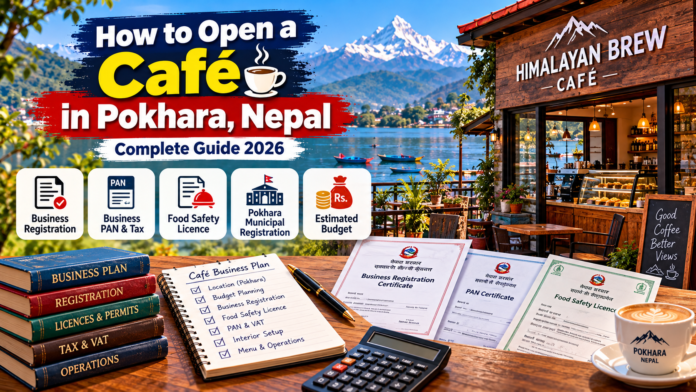
Entrepreneurs planning to open a café or restaurant can read our How to Open a Cafe in Pokhara in 2026 case study for estimated startup costs, operational expenses and financial planning.

You can also learn about PAN and VAT Registration in Nepal to understand taxpayer registration and applicable tax obligations.

Conclusion

Exploring business ideas for returnees in Nepal is an important step for people who want to use their international experience and savings to build a future at home.

Cafés, farming, retail shops, tourism services, food processing, digital agencies, gyms, logistics and skills training all offer different opportunities.

However, no business is automatically profitable.

Successful entrepreneurship requires market research, realistic financial planning, appropriate registration, customer demand and careful daily management.

For returning migrants, the most valuable starting point may not be the amount of money saved abroad, but the combination of skills, knowledge, relationships and financial discipline they bring home.

Start with a business you understand, test the market, protect your savings and expand only when the numbers support growth.

Disclaimer: Published for educational purposes in October 2026. All financial figures are illustrative estimates rather than verified supplier quotations, industry averages or promised returns. Confirm current legal, tax and programme requirements with the relevant Nepalese authorities.

PAN and VAT Registration in Nepal: Easy Step-by-Step Guide (2026)

2
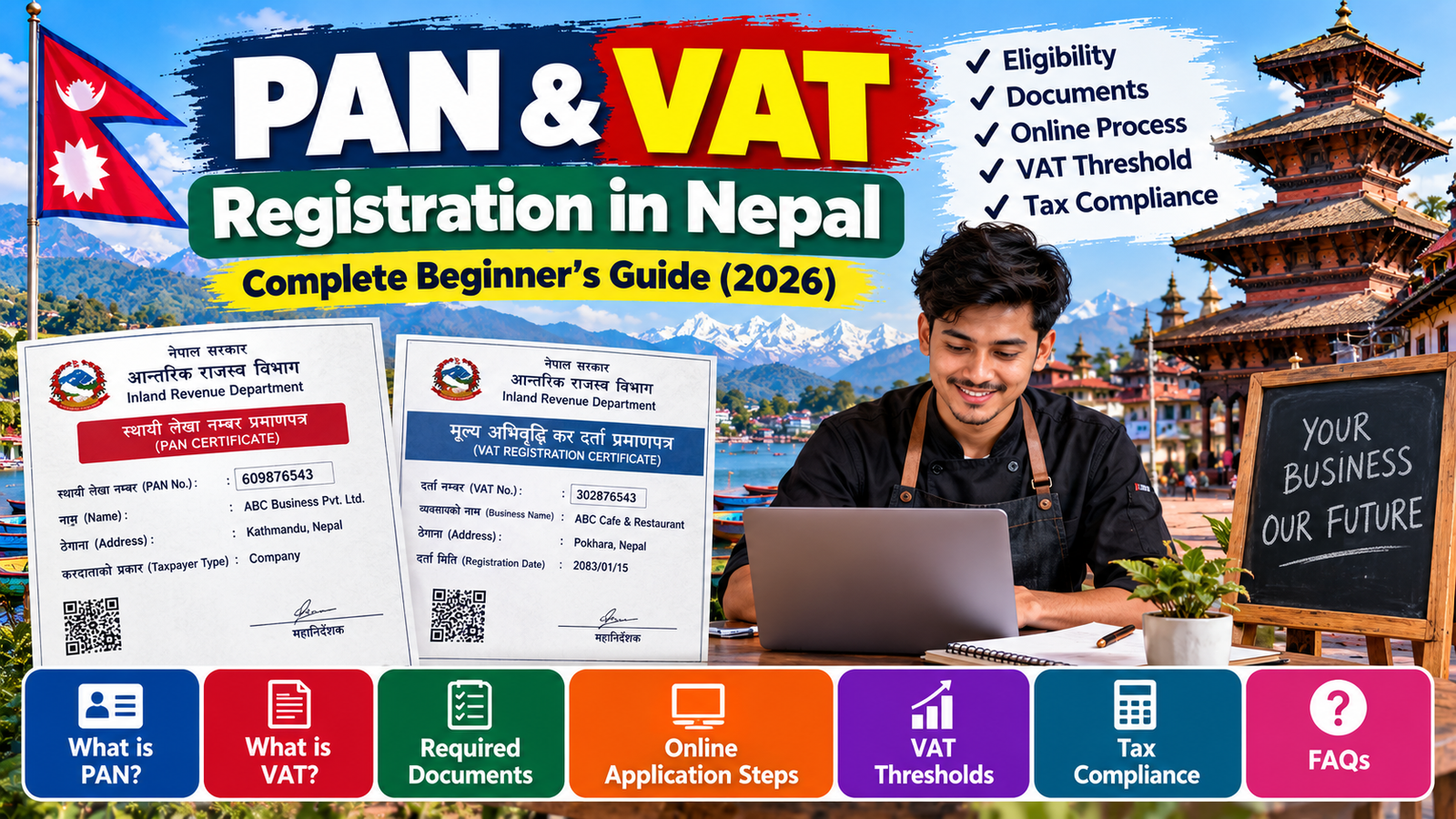
PAN and VAT registration in Nepal for businesses and freelancers in 2026

Introduction

PAN and VAT registration in Nepal is an important part of starting and operating a legally compliant business. Whether you are opening a café in Pokhara, establishing a retail shop in Kathmandu, starting a freelance business, or registering a private limited company, understanding Nepal’s tax registration system can help you avoid unnecessary problems.

The Inland Revenue Department (IRD) administers Permanent Account Numbers (PAN), Value Added Tax (VAT), and other major national taxes.

However, PAN and VAT are not the same. Many entrepreneurs confuse business registration with tax registration or assume every business must register for VAT.

This guide explains PAN and VAT registration in Nepal in 2026, including eligibility, required documents, online application procedures, VAT obligations, and practical examples.

1. What Is PAN in Nepal?

PAN stands for Permanent Account Number, known in Nepali as Sthayi Lekha Number (स्थायी लेखा नम्बर).

It is a unique tax identification number issued by the Inland Revenue Department.

PAN helps the government identify taxpayers and administer their tax obligations.

Main Types of PAN

Personal PAN (PPAN)

Personal PAN is used by individuals, including employees and people earning certain types of personal income.

Business PAN

Business PAN is used by registered business entities and firms, including sole proprietorships, partnerships, and companies.

Why Is PAN Important?

PAN supports:

  • Tax registration and administration
  • Business accounting and recordkeeping
  • Tax return filing
  • Identification on relevant invoices and tax documents
  • Tax compliance and financial transactions

Entrepreneurs should arrange the appropriate tax registration before commencing taxable business activities.

2. What Is VAT in Nepal?

VAT stands for Value Added Tax, or Mulya Abhibriddhi Kar (मूल्य अभिवृद्धि कर).

VAT is an indirect tax applied to taxable supplies of goods and services under Nepal’s VAT legislation.

Nepal’s standard VAT rate is 13%.

VAT-registered businesses generally charge VAT on taxable sales and may be entitled to credit for qualifying VAT paid on business purchases.

Simple VAT Example

Imagine a VAT-registered business sells taxable goods worth NPR 1,000 before VAT.

DescriptionAmount
Selling price before VATNPR 1,000
VAT at 13%NPR 130
Total invoiceNPR 1,130

The NPR 130 is output VAT, not additional profit.

The amount ultimately payable to the government depends on the business’s applicable input tax credits and other adjustments.

3. PAN vs VAT Registration in Nepal: Key Differences

Understanding the difference between PAN and VAT registration in Nepal helps business owners meet the correct obligations.

FeaturePANVAT
Full formPermanent Account NumberValue Added Tax
Main purposeTaxpayer identificationTax registration and collection
Issuing authorityInland Revenue DepartmentInland Revenue Department
Applicable toIndividuals and businesses as requiredBusinesses meeting applicable VAT requirements
Standard rateNot a tax rate13% on standard-rated supplies
Filing requirementsDepend on tax statusVAT returns according to applicable rules
Automatically required together?NoNo

A business that already has PAN does not normally obtain a completely separate PAN number for VAT. Instead, it completes the relevant VAT registration using its taxpayer identity.

4. Who Needs PAN Registration in Nepal?

PAN registration requirements depend on the taxpayer’s activities and legal status.

Examples include:

Salaried Employees

Employees may need Personal PAN for income tax administration.

Sole Proprietors

An individual running a registered business generally needs Business PAN.

Partnership Firms

A partnership operating a business should obtain the relevant tax registration.

Private Limited Companies

Companies registered with the Office of the Company Registrar must comply with their applicable tax registration obligations.

Freelancers and Online Entrepreneurs

Freelancers, content creators, consultants, and online service providers should determine whether their activities constitute taxable business or professional income and which PAN category applies.

Receiving money online does not automatically mean the person must register for VAT.

5. Documents Required for PAN Registration in Nepal

The required documents depend on the applicant and registration category.

Personal PAN Documents

Common requirements include:

  • Citizenship certificate or other accepted identification
  • Passport-size photograph
  • Personal and contact information
  • Employment or professional details where applicable

Business PAN Documents

Depending on the business structure and circumstances, applicants may need:

  • Business registration certificate
  • Owner’s or authorised representative’s identification
  • Partnership deed or company documents
  • Business address details
  • Rental agreement or premises documentation
  • Authorisation documents where relevant
  • Photographs and additional supporting documents

Applicants should confirm the current document checklist with their Inland Revenue Office or Taxpayer Service Office.

Why PAN and VAT Registration in Nepal Matters

PAN and VAT registration in Nepal helps entrepreneurs understand their tax responsibilities before starting business operations. Correct registration also supports proper invoicing, financial recordkeeping and compliance with Inland Revenue Department requirements.

PAN and VAT Registration in Nepal for Small Businesses

Small-business owners should understand that PAN and VAT registration in Nepal involves different obligations. While PAN identifies a taxpayer, VAT registration depends on applicable legal requirements, taxable activities and registration thresholds.

PAN and VAT Registration in Nepal for Freelancers

Freelancers and online entrepreneurs should review their tax obligations before applying for PAN and VAT registration in Nepal. The correct registration depends on the nature of their income, business activities and applicable tax rules.

Common Questions About PAN and VAT Registration in Nepal

Before completing PAN and VAT registration in Nepal, business owners should confirm the required documents, relevant tax office and current registration procedures using official Inland Revenue Department resources.

6. How to Apply for PAN Online in Nepal

The Inland Revenue Department provides online taxpayer registration services.

Step 1: Visit the IRD Website

Open the official Inland Revenue Department website:

https://ird.gov.np

Step 2: Open the Taxpayer Portal

Find the Taxpayer Portal link under the online services section.

Step 3: Select Registration

Open the menu for PAN, VAT, and Excise registration.

Choose Application for Registration.

Step 4: Create Application Credentials

Enter the requested information, which may include:

  • Username
  • Password
  • Contact number
  • Email address
  • Relevant tax office

Keep your application credentials secure.

Step 5: Select the Registration Category

Choose Personal PAN or Business PAN, depending on the applicant.

Step 6: Enter Applicant Details

Complete the required information accurately, including identification, address, business, and contact details.

Step 7: Submit the Application

Review the application and submit it through the portal.

Retain the submission number or confirmation.

Step 8: Complete Verification

Follow the verification instructions provided by the system or the relevant tax office.

Some applicants may need to provide additional documentation or attend an office, depending on their circumstances and the current process.

Step 9: Obtain Your PAN

Once approved, obtain or download the PAN certificate through the available official process.

The IRD’s online workflow and verification arrangements may change, so always follow the current instructions displayed in the portal.

7. Who Needs VAT Registration in Nepal in 2026?

Not every PAN holder must register for VAT.

VAT registration depends on the nature of the goods or services, turnover, statutory thresholds, and any activities subject to mandatory registration rules.

Understanding VAT Thresholds

A VAT threshold is a turnover limit used to determine when qualifying businesses must register.

Important: Nepal’s VAT thresholds have changed over time, and different rules may apply to goods, services, mixed activities, and specially regulated transactions.

Some older IRD guidance refers to annual thresholds of NPR 50 lakh for goods and NPR 20 lakh for services. These figures should not be treated as verified current 2026 thresholds without checking the latest VAT Act amendments, Finance Act, and IRD notices.

Before deciding whether your business must register for VAT, verify:

  1. The current threshold applicable to your activity.
  2. Whether your supplies are taxable or exempt.
  3. Whether any mandatory-registration rule applies independently of turnover.
  4. Whether voluntary VAT registration is permitted and appropriate.

Official information: https://ird.gov.np/

8. How to Register for VAT in Nepal

Businesses that must register for VAT should complete the appropriate IRD procedure.

Step 1: Confirm VAT Eligibility

Review your business activity, taxable turnover, and applicable legal requirements.

Step 2: Prepare Business Documents

Gather your PAN details, business registration documents, identification, and other documents requested by IRD.

Step 3: Access the Taxpayer Portal

Visit the official IRD website and open the registration services.

Step 4: Complete the Relevant VAT Registration Application

Provide the business and tax details requested by the system or the tax office.

Step 5: Submit Supporting Documents

Supply the documents required for your business category.

Step 6: Complete Verification

The relevant Inland Revenue Office or Taxpayer Service Office may verify the application and supporting information.

Step 7: Obtain VAT Registration Confirmation

After approval, retain the relevant registration certificate or confirmation.

Step 8: Follow VAT Compliance Requirements

Once VAT-registered, a business must comply with applicable invoicing, accounting, return filing, and payment requirements.

Do not begin charging VAT merely because you submitted an application. Confirm your effective VAT registration status first.

9. Practical Example: PAN and VAT for a Café in Pokhara

Imagine an entrepreneur opening a small café in Pokhara.

The café serves tea, coffee, breakfast, lunch, and snacks.

Stage 1: Business Registration

The entrepreneur selects an appropriate business structure and completes the applicable firm or company registration.

Stage 2: Business PAN

The café obtains the relevant Business PAN through the Inland Revenue Department.

Stage 3: Determine VAT Requirements

The owner reviews the café’s taxable activities, expected and actual turnover, and any specific VAT registration obligations.

The owner should not assume that a café is automatically exempt from VAT merely because it is small.

Stage 4: Accounting and Billing

The café establishes a system to record:

  • Daily sales
  • Purchases
  • Supplier invoices
  • Payroll
  • Operating expenses
  • Tax liabilities
  • Cash and bank transactions

Illustrative Monthly Sales

Suppose the café serves 35 customers daily.

Average customer spending: NPR 350

Operating days: 26 per month

Monthly sales = 35 × NPR 350 × 26 = NPR 318,500

Estimated annual sales at the same level:

NPR 318,500 × 12 = NPR 3,822,000

This example is illustrative. It does not establish whether the café must register for VAT.

The business must assess the current legal requirements applicable to its activity.

10. VAT Calculation for Small Businesses

Understanding VAT calculation is important for businesses that are registered for VAT.

Example: Output VAT

A VAT-registered business sells standard-rated products for NPR 100,000 before VAT.

Output VAT at 13%:

NPR 100,000 × 13% = NPR 13,000

Example: Input VAT

Suppose the business has NPR 6,500 in valid, creditable input VAT on qualifying purchases.

DescriptionAmount
Output VATNPR 13,000
Eligible input VAT creditNPR 6,500
Illustrative net VAT payableNPR 6,500

The actual VAT payable depends on valid tax invoices, eligibility for input credits, adjustments, and other legal requirements.

Businesses should maintain proper accounting records and consult a qualified tax professional when needed.

11. VAT Invoices and Recordkeeping

VAT-registered businesses generally have additional invoicing and accounting obligations.

Relevant records may include:

  • Sales invoices
  • Purchase invoices
  • Credit and debit notes
  • VAT records
  • Inventory records
  • Supporting accounting documents

An ordinary receipt and a legally compliant VAT tax invoice are not necessarily the same.

Businesses should use the invoice format required by the applicable IRD rules.

12. Tax Filing After PAN and VAT Registration

Registration is the beginning of tax compliance, not the end.

Income Tax Returns

Taxpayers may need to submit income tax returns according to their legal category and applicable rules.

VAT Returns

VAT-registered businesses must file returns according to the reporting period and legal requirements applicable to them.

Tax Payments

Applicable taxes must be paid by their statutory deadlines.

Changes in Business Details

Changes to business ownership, address, operations, or registration information may require notification to IRD.

Business Closure

Closing a business does not automatically cancel its tax registration or outstanding obligations.

Taxpayers should follow the official procedures for cancellation, deregistration, and settlement of liabilities.

13. Common Mistakes in PAN and VAT Registration in Nepal

Mistake 1: Confusing PAN with VAT

Having PAN does not automatically make a business VAT-registered.

Mistake 2: Using Outdated VAT Thresholds

Entrepreneurs sometimes rely on old articles without checking current legislation.

Mistake 3: Charging VAT Without Registration

Businesses should confirm their VAT registration status before issuing VAT invoices.

Mistake 4: Ignoring Tax Returns

Tax registration may create ongoing filing and reporting obligations.

Mistake 5: Keeping Incomplete Records

Missing invoices and accounting records can create difficulties during tax filing or verification.

Mistake 6: Confusing Business Registration with Tax Registration

A business registration certificate does not replace PAN or VAT registration.

Mistake 7: Forgetting Other Legal Requirements

Tax registration does not replace municipal business registration, food-safety compliance, or sector-specific licences.

14. Benefits of Proper PAN and VAT Registration

Correct tax registration helps entrepreneurs:

  • Establish a clear taxpayer identity
  • Meet applicable legal obligations
  • Maintain organised financial records
  • Issue appropriate business documents
  • Work with suppliers and customers who require formal documentation
  • Prepare for business growth
  • Reduce avoidable compliance problems

VAT registration should be based on legal requirements and business circumstances, not simply on the assumption that VAT registration always makes a business more credible.

15. Frequently Asked Questions

Is PAN compulsory for freelancers in Nepal?

Freelancers earning business or professional income should assess their tax registration obligations. The appropriate registration depends on their activities and tax status.

Can I register for PAN online in Nepal?

Yes. IRD provides online PAN application services through its taxpayer portal.

Is PAN the same as VAT?

No. PAN identifies taxpayers, while VAT registration establishes obligations under the VAT system.

What is the VAT rate in Nepal?

The standard VAT rate is 13%.

Does every small business need VAT registration?

No. Requirements depend on taxable activities, applicable thresholds, and other mandatory-registration provisions.

Can a sole proprietor register for VAT?

Yes, where the legal requirements for VAT registration are met.

Do I need a new PAN when registering for VAT?

Generally, VAT registration uses the taxpayer’s existing PAN rather than issuing a separate PAN number.

Is PAN registration the same as company registration?

No. Company registration and tax registration are separate legal processes.

Can I charge VAT before receiving VAT registration?

Businesses should not charge VAT as a registered taxpayer before their registration becomes effective.

Where can I check my PAN?

Use the official PAN search service provided by the Inland Revenue Department.

16. Official Government Resources

For the latest information about PAN and VAT registration in Nepal, consult the following sources:

Inland Revenue Department (IRD)
https://ird.gov.np/
Official tax administration, PAN, VAT, taxpayer services, and notices.

IRD Taxpayer Registration Guidance
https://ird.gov.np/content/13668/taxpayer-service-and-registration/
Overview of PAN registration categories and online services.

IRD Frequently Asked Questions
https://ird.gov.np/faq/
Guidance on PAN applications, VAT registration, tax filing, and other taxpayer questions.

IRD PAN Search
https://ird.gov.np/pan-search/
Official PAN lookup service.

Nepal Law Commission
https://lawcommission.gov.np/
Legal texts, including tax legislation and amendments.

Related Business Guides on Eleven Nepal

PAN and VAT registration in Nepal is one part of establishing a legally compliant business.

Before applying for tax registration, read our How to Register a Business in Nepal in 2026 guide to understand business registration procedures, ownership structures and government documentation.

You can also explore our Types of Business in Nepal: Sole Proprietorship vs Partnership vs Private Limited Company article to compare different legal business structures.

If you are planning to enter the hospitality industry, our How to Open a Cafe in Pokhara in 2026 case study explains illustrative startup costs, financial planning and operational requirements.

Conclusion

Understanding PAN and VAT registration in Nepal is essential for entrepreneurs who want to operate legally and maintain proper financial records.

PAN is a taxpayer identification number, while VAT registration creates additional obligations for businesses that fall within the applicable VAT system.

Whether you are a freelancer, café owner, retailer, or company director, the correct registration depends on your business structure, income, activities, and current tax laws.

Before submitting an application, check the latest guidance from the Inland Revenue Department, prepare the required documents, and understand your ongoing filing responsibilities.

Accurate registration and good recordkeeping are important foundations for a sustainable business in Nepal.

Disclaimer: This article provides general educational information as of October 2026 and is not individual tax or legal advice. Nepal’s tax rules and thresholds may change through legislation and official notices. Confirm the requirements applicable to your business with IRD or a qualified Nepalese tax adviser.

Types of Business in Nepal: 5 Essential Choices for Entrepreneurs in 2026

0
Types of business in Nepal – sole proprietorship, partnership and private limited company comparison

Introduction

Are you planning to start a business in Nepal but unsure whether to register a sole proprietorship, partnership, or private limited company?

Choosing the right business structure is one of the most important decisions for a new entrepreneur. It affects ownership, legal liability, management, registration requirements, taxation, and opportunities for future investment.

Understanding the types of business in Nepal is particularly useful for entrepreneurs planning to open cafés, restaurants, retail shops, online businesses, consultancy firms, or technology startups.

Under Nepalese law, there are several ways to organise a business. However, not all businesses are legally classified as companies.

This guide explains five important business structures, their advantages and disadvantages, registration requirements, and practical examples.

Understanding the different types of business in Nepal helps entrepreneurs compare ownership, legal responsibilities, investment requirements and registration procedures.

1. What Are the Main Types of Business in Nepal?

The five structures covered in this guide are:

  1. Sole proprietorship
  2. Partnership firm
  3. Private limited company
  4. Public limited company
  5. Company not distributing profits

The first two are firm-based business structures. The last three are company categories recognised under the Companies Act, 2063.

Other legal arrangements, including cooperatives and specialised organisations, also exist in Nepal. They are governed by their respective laws and are outside the scope of this introductory comparison.

2. Sole Proprietorship in Nepal

A sole proprietorship, commonly called Ekalauti Byabasaya (एकलौटी व्यवसाय), is a business owned and operated by one individual.

The Private Firm Registration Act, 2014 (1958), as amended, provides a legal framework for private firm registration.

Examples

  • Grocery shop
  • Small café
  • Tailoring business
  • Mobile accessories shop
  • Small trading business

Advantages of Sole Proprietorship

Simple ownership: One individual controls the business.

Direct decision-making: The owner does not need approval from business partners for ordinary decisions.

Straightforward profit entitlement: Business profits belong to the owner, subject to taxes and obligations.

Suitable for smaller operations: It can be practical for businesses that do not require several equity owners.

Disadvantages of Sole Proprietorship

Personal liability: The owner generally bears personal responsibility for business debts and obligations.

Limited equity investment: Bringing in additional owners generally requires restructuring the business.

Dependence on the owner: Operations may be affected if the owner becomes unavailable.

How to Register a Sole Proprietorship

  1. Identify the appropriate firm registration authority.
  2. Select a suitable business name.
  3. Prepare identity and business documents.
  4. Submit the registration application.
  5. Pay the applicable official fee.
  6. Obtain the registration certificate.
  7. Complete applicable PAN, local, and sector-specific requirements.

Provincial legislation and administrative arrangements can affect registration procedures.

Best suited for: An entrepreneur starting a relatively small business independently, after considering personal liability and operational risk.

Among the common types of business in Nepal, sole proprietorship is a straightforward ownership structure for individuals who want to manage a business independently.

3. Partnership Business in Nepal

A partnership is a business relationship involving two or more people who agree to operate a business together.

The Partnership Act, 2020 (1964), as amended, provides an important legal framework for partnership firms.

Examples

  • Two friends opening a restaurant
  • Three entrepreneurs starting a trading business
  • Professionals operating a consultancy
  • Partners establishing a small hospitality business

Important Features

Partners may contribute different amounts of money, property, skills, or labour.

They should agree on how profits, losses, decisions, and responsibilities will be shared.

A partnership agreement helps reduce future disputes.

Advantages of Partnership

Shared investment: Partners can combine resources.

Combined skills: One partner may manage finance while another handles operations.

Shared workload: Responsibilities can be divided among partners.

Flexible arrangements: Partners can agree on many aspects of business management within the law.

Disadvantages of Partnership

Personal liability: In an ordinary partnership, partners may be personally liable for partnership obligations.

Disagreements: Partners may disagree about spending, profits, or management.

Potential instability: Withdrawal, death, or disputes involving a partner may affect the business.

What Should a Partnership Agreement Include?

A well-prepared agreement should address:

  • Names and addresses of partners
  • Business name and objectives
  • Capital contributions
  • Profit and loss distribution
  • Management responsibilities
  • Banking and spending authority
  • Admission of new partners
  • Withdrawal and retirement
  • Dispute resolution
  • Dissolution procedures

Partnership Registration Process

  1. Agree on the business structure.
  2. Prepare the partnership deed.
  3. Identify the relevant registration authority.
  4. Submit the application and documents.
  5. Pay the applicable fee.
  6. Obtain the registration certificate.
  7. Complete tax and other applicable registrations.

The Partnership Act also recognises provincial legal arrangements for registration and renewal. Always check the rules applicable to the location of the business.

Best suited for: Two or more entrepreneurs who want to operate a business together and understand the liability and governance implications.

4. Private Limited Company in Nepal

A private limited company is a company incorporated under Nepal’s Companies Act, 2063 (2006).

Unlike an ordinary sole proprietorship or partnership, a company has a separate legal identity from its shareholders.

According to the Office of the Company Registrar, a private company may have a single shareholder and ordinarily cannot exceed 101 shareholders.

Examples

  • Software development company
  • Restaurant company
  • Digital marketing agency
  • Manufacturing company
  • Online service business

Advantages of a Private Limited Company

Separate legal identity: The company can own property and enter contracts in its own name.

Limited shareholder liability: Shareholders generally benefit from limited liability, subject to legal exceptions and any personal guarantees.

Structured ownership: Ownership can be represented through shares.

Investment opportunities: The structure may accommodate additional shareholders and formal investment arrangements, subject to legal requirements.

Business continuity: The company can continue despite changes in its shareholders.

Disadvantages of a Private Limited Company

More compliance: Companies have statutory recordkeeping and filing responsibilities.

Administrative expenses: Accounting, auditing, legal documentation, and compliance may involve additional costs.

Formal governance: Shareholder and director decisions must comply with applicable law and company documents.

How to Register a Private Limited Company

The Office of the Company Registrar (OCR) is responsible for company incorporation.

The general procedure is:

  1. Access the official OCR registration system.
  2. Apply for company name approval.
  3. Prepare the Memorandum of Association (MOA).
  4. Prepare the Articles of Association (AOA), where required.
  5. Provide promoter and shareholder information.
  6. Submit the incorporation documents.
  7. Complete applicable verification and payment.
  8. Obtain the company registration certificate.
  9. Register for tax and complete any required industry or sector-specific approvals.

Official website: https://ocr.gov.np/

Best suited for: Businesses that want a formal ownership structure, anticipate additional shareholders, or need a separate corporate legal identity.

A private limited company is not automatically cheaper or more tax-efficient than a sole proprietorship. That depends on the circumstances.When comparing the types of business in Nepal, partnerships are worth considering for entrepreneurs who want to combine financial resources and management skills.

5. Public Limited Company in Nepal

A public limited company is another form of company recognised under the Companies Act, 2063.

Under OCR’s published guidance, a public company generally requires at least seven promoters, subject to applicable exceptions, and has additional capital and governance requirements.

Characteristics

  • Separate corporate legal identity
  • Formal management and governance
  • More extensive reporting obligations
  • Potential to raise capital through securities, subject to applicable regulation

Advantages

Public companies may be suitable for businesses with larger capital requirements and broader ownership arrangements.

Disadvantages

They involve more extensive regulatory, governance, and disclosure obligations.

Public company status does not automatically mean the company is listed on the Nepal Stock Exchange. Listing and public securities offerings are separate regulated processes.

Best suited for: Businesses whose scale, ownership objectives, and financing requirements justify a public company structure.

6. Company Not Distributing Profits

The Companies Act, 2063 also recognises companies that do not distribute profits to their members.

These organisations may pursue permitted social, educational, professional, charitable, or other qualifying objectives.

Important Features

  • Established under company law
  • Operates for permitted objectives
  • Cannot distribute profits to members as ordinary shareholder dividends
  • Subject to specific governance and legal requirements

This structure should not be confused with a regular profit-making private limited company.

It is also not automatically equivalent to every type of NGO or charitable organisation in Nepal.

Best suited for: Eligible organisations whose purpose is not to distribute profits among their members.

7. Comparison of the Main Types of Business in Nepal

FeatureSole ProprietorshipPartnershipPrivate Limited Company
OwnersOneTwo or moreOne or more shareholders
Legal identityGenerally tied to ownerGenerally tied to partnersSeparate corporate entity
LiabilityGenerally personalGenerally personalGenerally limited for shareholders
ManagementOwnerPartners or appointed managersDirectors and authorised management
Ownership transferLess flexibleSubject to agreement and lawShare transfers subject to law and company documents
Formal complianceDepends on activity and registrationFirm and partnership obligationsCompany-law filings and governance
Typical exampleSmall shopTwo-partner restaurantGrowing hospitality or IT company

These are general characteristics. Actual obligations depend on the business, relevant laws, contracts, and registration details.

8. Practical Example: Opening a Café in Pokhara

Imagine three entrepreneurs planning to establish a café in Pokhara.

Their initial capital contributions are:

PartnerContribution
Partner ANPR 200,000
Partner BNPR 120,000
Partner CNPR 120,000
TotalNPR 440,000

The entrepreneurs are considering whether to register a partnership or private limited company.

Option A: Partnership Firm

The three partners could agree on their contributions, management responsibilities, and profit-sharing arrangements through a partnership deed.

If ownership were based strictly on contributed capital, their respective proportions would be approximately:

  • Partner A: 45.45%
  • Partner B: 27.27%
  • Partner C: 27.27%

However, the partners may agree on different profit-sharing arrangements where legally permissible.

They must also understand their personal liability for partnership obligations.

Option B: Private Limited Company

The entrepreneurs could establish a company and allocate shares according to their agreed ownership arrangement.

Share ownership does not necessarily have to match the initial cash contribution if the arrangement is properly structured, documented, and legally compliant.

For example, the founders might negotiate different ownership proportions to recognise capital, expertise, management responsibilities, or other agreed contributions.

Such arrangements should be documented carefully, including any outstanding capital commitments. Private limited companies are among the types of business in Nepal that offer a separate legal identity and a formal shareholding structure.

Which Structure Is Better?

A partnership may suit entrepreneurs seeking a relatively straightforward jointly operated business.

A private limited company may be more suitable if they expect substantial investment, complex ownership arrangements, or a need for separate corporate identity.

Neither structure eliminates the need for food-related permissions, municipal requirements, tax registration, and other applicable approvals.

9. Understanding the Companies Act, 2063

The Companies Act, 2063 (2006), as amended, is Nepal’s principal company law.

It addresses matters such as:

  • Company incorporation
  • Company legal identity
  • Share capital
  • Shareholders
  • Directors and governance
  • Company meetings
  • Accounts and auditing
  • Reporting and recordkeeping
  • Changes in company structure
  • Winding up and related legal procedures

Memorandum of Association (MOA)

The MOA is a foundational company document that records matters such as the company’s name, objectives, and capital arrangements.

Articles of Association (AOA)

The AOA governs aspects of the company’s internal administration, management, and procedures, subject to applicable law.

Directors and Shareholders

Shareholders own shares in the company.

Directors are responsible for company governance and decision-making within their legal authority.

A person can be both a shareholder and director, but the roles are legally distinct.

Limited Liability Does Not Mean No Responsibility

Shareholders generally benefit from limited liability, but directors and individuals may still face personal consequences for unlawful conduct, fraud, personal guarantees, or other legally recognised grounds.

Always consult the current amended Act rather than relying only on its original 2006 text.

10. Business Registration vs PAN vs VAT

These terms are often confused.

Business Registration

Creates or registers the relevant business entity or firm under applicable law.

PAN Registration

Provides the taxpayer identification used for tax administration.

VAT Registration

Applies when a business meets the relevant VAT registration requirements.

A company registration certificate is not a substitute for PAN, and obtaining PAN does not automatically satisfy every business licensing requirement.

The Inland Revenue Department is the primary authority for PAN and VAT administration.

Official website: https://ird.gov.np/

11. How to Choose the Right Business Structure

Before selecting a business structure, answer these questions:

How many owners will the business have?

A single owner may consider a sole proprietorship or a single-shareholder private company.

How much financial risk is involved?

Consider potential debts, leases, staff obligations, and customer claims.

Will the business seek investors?

Formal share ownership may be useful when bringing additional investors into a company.

How will decisions be made?

Partnership agreements and company governance documents should establish decision-making authority.

What are the ongoing compliance costs?

Registration is only one expense. Accounting, reporting, taxation, renewals, and professional services may create recurring costs.

Does the business need a special licence?

Food services, tourism, financial activities, manufacturing, and other regulated sectors may have additional requirements.

The best structure is the one that suits the business’s real ownership, operational risks, and long-term plans.

12. Common Mistakes When Choosing a Business Structure

Choosing a Company Only for Prestige

A private limited company may provide benefits, but it also creates formal obligations.

Starting a Partnership Without an Agreement

Disagreements over profit sharing and management can become serious.

Ignoring Personal Liability

Entrepreneurs should understand when their personal assets may be exposed to business debts.

Confusing Registration with Licensing

A registered company may still need approvals before undertaking regulated activities.

Neglecting Accounting and Tax Records

Proper financial records are essential regardless of business structure.

Relying on Outdated Laws or Fee Schedules

Business laws, fees, and administrative procedures may change.

Verify the latest requirements through official government sources.

13. Official Government Sources

For further information, consult:

Office of the Company Registrar
https://ocr.gov.np/
Company registration, Companies Act, incorporation documents, and company compliance.

Nepal Law Commission
https://lawcommission.gov.np/
Official legislation, including the Private Firm Registration Act and Partnership Act.

Inland Revenue Department
https://ird.gov.np/
PAN, VAT, tax registration, and taxpayer guidance.

Department of Industry
https://doind.gov.np/
Industry registration and related regulatory services.

Entrepreneurs should also consult their relevant provincial authority and municipality.

14. Frequently Asked Questions

What are the main types of business in Nepal?

Common structures include sole proprietorships, partnership firms, private limited companies, public limited companies, and companies not distributing profits.

Which business structure is best for a small shop?

A sole proprietorship may be suitable for an independently operated small shop, but the owner should consider personal liability, financing needs, and applicable requirements.

Can one person open a private limited company in Nepal?

Yes. Nepal’s company law permits a single-shareholder private company.

Can three friends register a business together?

Yes. They may consider a partnership or an appropriate company structure.

Is a private limited company safer than a partnership?

A company generally offers separate legal identity and limited shareholder liability. However, it does not remove all personal, managerial, or contractual responsibilities.

Can a partnership later become a private limited company?

Entrepreneurs may be able to restructure their operations through appropriate legal procedures. It should not be assumed that a partnership automatically converts into a company without new registrations, transfers, or approvals.

Is PAN compulsory for businesses?

Businesses must comply with the tax registration requirements applicable to their legal structure and activity. Consult IRD for the appropriate procedure.

Do all businesses need VAT registration?

No. VAT registration depends on the current law and the nature and scale of the business.

What is the difference between a private and public company?

They differ in ownership rules, governance requirements, capital-related requirements, and securities-related restrictions.

Does registering a company allow every business activity?

No. Activities requiring separate approvals or licences must comply with those requirements.

Understanding the types of business in Nepal is only the first step towards starting a successful enterprise.

If you’re planning to establish a new business, read our How to Register a Business in Nepal in 2026 guide for information about registration procedures, government documents, PAN and applicable licences.

If you’re interested in the hospitality industry, explore our How to Open a Cafe in Pokhara in 2026 case study, which includes an illustrative startup budget, registration checklist and break-even analysis.

Conclusion

Understanding the types of business in Nepal helps entrepreneurs choose an appropriate legal structure before investing their money.

A sole proprietorship may suit an individual running a smaller operation. A partnership can allow several entrepreneurs to combine their resources, while a private limited company offers a separate corporate identity and a formal shareholding structure.

Public companies and companies not distributing profits serve different purposes under the Companies Act, 2063.

Before registering a business, consider the number of owners, liability, investment plans, governance, tax obligations, and applicable licensing requirements.

Choosing the right structure from the beginning can help entrepreneurs establish clearer ownership arrangements, manage risks, and plan for future growth.

Disclaimer: This article provides general educational information reviewed in October 2026. It is not individual legal, tax, or financial advice. Check current legislation and administrative requirements with the responsible government authorities before making business decisions.Choosing between the types of business in Nepal requires careful consideration of liability, investment, management responsibilities and long-term business goals.

Practical Case Study: How to Open a Café in Pokhara, Nepal in 2026

0
How to open a cafe in Pokhara – business registration, budget and licences

How to Open a Cafe in Pokhara: Complete Business Guide 2026

How to open a cafe in Pokhara is a common question for aspiring entrepreneurs who want to enter Nepal’s hospitality industry.

Pokhara attracts local residents, students, domestic travellers and international tourists, making it a location worth considering for a café business.

However, opening a café requires careful financial planning, choosing a suitable location, business registration, government documentation, food-safety compliance and ongoing management.

This guide explains how to open a cafe in Pokhara step by step, including an illustrative startup budget of NPR 8.05–15.60 lakh for a small 20-seat café, potential monthly expenses, applicable registration requirements and a break-even example.

Opening a café in Pokhara can be an attractive business opportunity for entrepreneurs interested in hospitality, tourism, and food service. However, a successful café requires more than a good menu and attractive interior.

Before opening, the owner needs to consider location, rent, startup capital, business registration, food hygiene, taxation, staffing, and operating costs.

This example explains how a Nepali entrepreneur could plan a small café in Pokhara with approximately 20 seats.

1. Café Business Concept

Business name: Himalayan Brew Café (fictional example)

Location: Pokhara, Kaski, Nepal

Business type: Small independent café

Seating capacity: 20 customers

Ownership: One Nepali entrepreneur

Menu: Coffee, milk tea, cold drinks, breakfast, sandwiches, pastries, and light snacks

Target customers: Local residents, students, domestic tourists, and international visitors

Business structure: Sole proprietorship for this example, subject to confirmation of the appropriate registration route.

The owner plans to rent a commercial space and operate six or seven days per week.

2. Estimated Budget to Open a Small Café in Pokhara

The following figures are illustrative planning estimates for a modest café, not confirmed 2026 supplier quotations.

Startup expenseEstimated budget (NPR)
Rental deposit and advance rent90,000–180,000
Interior decoration and renovation150,000–300,000
Coffee machine and grinder120,000–250,000
Refrigerator and kitchen equipment100,000–180,000
Tables, chairs, and furniture80,000–150,000
Crockery, utensils, and small equipment30,000–60,000
Initial ingredients and packaging30,000–60,000
Signboard, branding, and marketing20,000–50,000
Registration, licensing, and documentation allowance15,000–40,000
POS system and miscellaneous setup20,000–40,000
Working capital reserve150,000–250,000
Estimated total investment805,000–1,560,000

Estimated startup investment: NPR 8.05 lakh to NPR 15.60 lakh.

The registration and licensing allowance is a budget reserve, not an official government fee quotation. Actual fees depend on the registration authority, business classification, capital, and applicable licences.

Costs can be higher for a prime Lakeside location, premium espresso equipment, extensive kitchen facilities, or major renovation.

3. Government Registration and Licences Required for a Café

A café owner should verify the following requirements before starting operations.

A. Firm or Company Registration

The owner must select the appropriate legal structure and complete the corresponding registration process.

A sole proprietor should confirm the applicable firm registration procedure with the relevant provincial or district authority. A private limited company is incorporated through the Office of the Company Registrar.

B. Pokhara Metropolitan City Business Registration

Pokhara Metropolitan City provides a new-business registration service through ward offices.

The municipality’s published requirements include an application, identity documents, photographs, rental agreement, and additional property or prior-registration documents depending on the situation.

C. Business PAN

The café must complete the applicable Business PAN registration with the Inland Revenue Department before commencing taxable business operations.

D. VAT Registration, If Applicable

The owner must assess whether VAT registration is required under current law. VAT registration is not automatically compulsory for every café simply because it opens.

E. Food Hygiene and Food-Service Permissions

A café preparing and serving food must comply with applicable food safety and hygiene requirements.

The owner should confirm with Pokhara Metropolitan City and the relevant food regulatory authority which food-business registration, inspection, approval, or licence applies to an ordinary café.

A café that manufactures packaged food for distribution may have different regulatory requirements from a café serving freshly prepared food on its premises.

F. Additional Permissions, Where Applicable

Depending on the business model, further requirements may include:

  • Signboard or advertisement permission and applicable local tax.
  • Building-use, fire-safety, and sanitation compliance.
  • Employment and labour-law compliance.
  • Liquor licensing if alcoholic beverages will be sold.
  • Tourism-related registration if the business falls within a regulated tourism category.

Not every café needs every licence listed above. The owner should confirm the applicable requirements with the responsible authority.

4. Government Documents Checklist for a Pokhara Café

Before applying, prepare the following documents as relevant.

DocumentPurpose
Nepali citizenship certificateOwner identification
Passport-size photographsRegistration applications
Proposed café nameBusiness identification
Completed application formRegistration
Rental agreementEvidence of rented premises
Land ownership documents, where applicablePremises verification
Property or land-tax payment receipt, where applicableMunicipal documentation
Ward recommendation or inspection record, if requiredLocal or other registration
Firm or company registration certificateLegal business registration
Business PAN certificateTax identification
Partnership deed, if applicablePartnership registration
MOA and AOA, if applicableCompany incorporation
Food-related application and supporting documentsApplicable food regulatory approval
Sector-specific approvals, if applicableRegulated activities

Pokhara Metropolitan City’s published checklist includes citizenship, two photographs, a rental agreement, and applicable property-tax or registration documents. Requirements may differ by case.

5. Step-by-Step Registration Process for the Café

Step 1: Finalise the location and business model

Identify suitable premises in Pokhara and estimate rent, customer demand, kitchen requirements, and seating capacity.

Step 2: Confirm the legal structure

Choose a sole proprietorship, partnership, or company based on the actual ownership and business plans.

Step 3: Confirm the correct firm registration authority

For a sole proprietorship, verify the current registration process with the competent authority in Gandaki Province or Kaski.

Step 4: Prepare the rental agreement

Make sure the premises can lawfully be used for the intended café operation. Clarify who is responsible for structural alterations, utilities, taxes, and repairs.

Step 5: Register the business or company

Submit the required documents to the competent registration authority and obtain the certificate.

Step 6: Register the café with Pokhara Metropolitan City

Visit the ward office responsible for the café’s location. Submit the applicable municipal documents and complete any required inspection or verification.

Step 7: Obtain Business PAN

Apply through the Inland Revenue Department’s taxpayer registration process.

Step 8: Confirm food safety and other licences

Contact the municipality and appropriate food regulatory office to establish the requirements for the planned menu and operation.

Step 9: Complete the café setup

Install equipment, establish food-storage and cleaning procedures, recruit staff, and prepare the menu.

Step 10: Open only after required approvals are in place

Keep registration certificates, tax documents, licences, and inspection records available for future reference.

6. Estimated Monthly Operating Expenses

The following figures are planning assumptions for a 20-seat café, not verified local market rates.

Monthly expenseEstimated NPR
Shop rent25,000–50,000
Staff salaries45,000–80,000
Electricity, water, internet, and gas10,000–20,000
Marketing and miscellaneous expenses5,000–15,000
Cleaning, maintenance, and administration5,000–10,000
Fixed and semi-fixed operating costs90,000–175,000

Food ingredients, beverages, packaging, and payment-processing costs are additional variable expenses.

The business owner should also account for taxes, equipment replacement, financing costs, and a reasonable allowance for their own labour.

7. Café Sales and Break-Even Example

Assume the café has:

  • Average customer spending: NPR 350.
  • Average customers per day: 35.
  • Trading days per month: 26.

Estimated monthly sales:

35 × NPR 350 × 26 = NPR 318,500

Assume ingredients and other variable costs equal 35% of sales.

Estimated contribution after variable costs:

NPR 318,500 × 65% = NPR 207,025

If monthly fixed operating costs are NPR 130,000:

Illustrative operating surplus: NPR 77,025 per month.

This is not guaranteed profit. It is before applicable taxes, financing costs, depreciation, and any owner salary not already included in operating costs.

Using these assumptions, the approximate monthly break-even sales level is:

NPR 130,000 ÷ 65% = NPR 200,000

At an average customer spend of NPR 350 over 26 trading days, this is approximately 22 customers per day.

Actual results will depend on customer demand, seasonality, pricing, waste, staffing, and location.

8. Practical Tips for Opening a Café in Pokhara

Choose the location carefully. Compare rent, footfall, competition, visibility, and accessibility rather than choosing a location based only on popularity.

Start with a manageable menu. A small selection of well-executed drinks and dishes can reduce waste and simplify kitchen operations.

Keep a working capital reserve. New cafés may need time to build regular customers.

Control food costs. Standard recipes, portion control, stock records, and regular purchasing reviews can help maintain margins.

Prioritise hygiene. Train staff in safe food handling, temperature control, cleaning, and allergen awareness.

Build a digital presence. A simple website, accurate business listing, and active social media channels can help customers discover the café.

Useful Government Resources for Opening a Café in Pokhara

Before opening your café, verify the latest registration procedures, fees and licensing requirements through official government websites.

Build an Online Presence for Your Café

After registering your café, you can create a professional website to display your menu, location, opening hours and contact details.

Read our WordPress website setup tutorials on Eleven Nepal to learn how to create a website for your business.

Conclusion: Is Opening a Café in Pokhara Worth Considering?

A small café in Pokhara may be a viable business opportunity, but profitability depends on the location, customer demand, management, food quality, and financial discipline.

For the fictional 20-seat café in this case study, the estimated startup budget is NPR 8.05–15.60 lakh.

Before spending money on renovation or equipment, the entrepreneur should verify the required business registration, municipal registration, tax obligations, food-safety approvals, and other permissions.

The most important first step is to prepare a realistic business plan and confirm the applicable legal requirements with the relevant government offices.

How to Register a Business in Nepal: 10 Easy & Essential Steps (2026)

0

Introduction

Are you planning to start a business in Nepal but confused about the registration process, government offices, documents, and legal requirements?

Whether you want to open a grocery shop, café, restaurant, online store, consultancy, or technology company, understanding business registration is an important first step.

Many beginners assume that registering a business simply means obtaining a PAN number or visiting the Office of the Company Registrar. However, business registration in Nepal involves different procedures depending on the business structure, location, and activity.

A sole proprietorship, partnership firm, and private limited company are not registered in exactly the same way.

In this comprehensive guide, you will learn how to register a business in Nepal in 2026, including the available business structures, government registration procedures, necessary documents, Business PAN, VAT, industry registration, local permits, and responsibilities after registration.

This article is based on official information from Nepal’s Office of the Company Registrar (OCR), Inland Revenue Department (IRD), Department of Industry, and Nepal Law Commission.

1. Understanding Business Registration in Nepal

Business registration is the legal process of formally recording a business with the relevant government authority.

The applicable process depends on whether you are establishing a company, an individually owned firm, a partnership, or another type of organisation.

A business may need several separate registrations or approvals.

These can include:

  • Registration of the legal business entity or firm.
  • Industry registration, where applicable.
  • Business PAN registration with the Inland Revenue Department.
  • VAT registration, when legally required.
  • Registration or licensing with the relevant municipality or local authority.
  • Additional permits for regulated activities.

For example, registering a private limited company with OCR does not automatically complete every tax, industry, or local licensing requirement.

Important: Company registration, tax registration, and permission to conduct a regulated business are different legal matters.

2. Types of Business in Nepal

Before learning how to register a business in Nepal, you must choose an appropriate legal structure.

A. Sole Proprietorship (एकलौटी व्यवसाय)

A sole proprietorship is a business owned by one individual.

It may be suitable for smaller businesses operated by a single owner.

Examples include:

  • A small grocery shop.
  • A tailoring business.
  • A local stationery shop.
  • An independently operated trading business.

Under the Private Firm Registration Act, 2014 (1958), private firms are subject to registration requirements.

Depending on the business and applicable provincial or local arrangements, the relevant registration office may differ.

Advantages:

  • One owner controls business decisions.
  • Ownership arrangements are relatively straightforward.
  • It may suit smaller operations.

Limitations:

  • The owner generally bears personal responsibility for business liabilities.
  • Raising capital from multiple owners is less straightforward.
  • Registration, renewal, and tax obligations still apply.

A sole proprietorship is not the same as a private limited company.

B. Partnership Firm (साझेदारी फर्म)

A partnership is a business arrangement involving two or more partners.

Partners generally agree on their contributions, responsibilities, profit sharing, and management arrangements.

Examples include:

  • Two friends opening a restaurant.
  • Several professionals establishing a consultancy.
  • Business partners operating a trading firm.

The Partnership Act, 2020 (1964) provides a legal framework for partnerships, alongside applicable subsequent laws and registration arrangements.

A written partnership agreement is important because it can clarify:

  • Partners’ names and details.
  • Capital contributions.
  • Profit and loss sharing.
  • Management responsibilities.
  • Admission or withdrawal of partners.
  • Dispute resolution.
  • Business dissolution.

In an ordinary partnership, partners may face personal liability for partnership obligations.

C. Private Limited Company (प्राइभेट लिमिटेड कम्पनी)

A private limited company is incorporated under the Companies Act, 2063 (2006).

It is a separate legal entity from its shareholders.

A private company can be formed by a single shareholder, subject to the applicable legal requirements.

Examples include:

  • A software development company.
  • A restaurant operating through a company.
  • A digital marketing agency.
  • A manufacturing business.

Advantages:

  • Separate corporate legal identity.
  • Limited shareholder liability, subject to applicable law and exceptions.
  • A formal ownership structure.
  • Potential suitability for multiple investors.

Limitations:

  • More formal governance requirements.
  • Corporate recordkeeping and reporting.
  • Tax and accounting responsibilities.
  • Additional costs associated with administration and compliance.

A private limited company is not automatically the best choice for every small business.

D. Public Limited Company

A public limited company is another company structure recognised under the Companies Act, 2063.

It is generally associated with businesses requiring a more extensive ownership and governance structure.

The Act ordinarily requires at least seven promoters for the incorporation of a public company, subject to statutory exceptions.

Public companies are subject to additional legal requirements, and offering securities to the public involves further regulation.

E. Company Not Distributing Profits

Nepal’s Companies Act also recognises companies that do not distribute profits to members.

These organisations are established for permitted objectives rather than distributing dividends to their members.

They should not be confused with ordinary profit-making private limited companies.

3. Which Business Structure Should You Choose?

The appropriate structure depends on the number of owners, financial risk, investment requirements, and long-term business plans.

Business structureTypical ownershipRegistration route
Sole proprietorshipOne individualRelevant firm registration authority
PartnershipTwo or more partnersRelevant partnership registration authority
Private limited companyOne or more shareholdersOffice of the Company Registrar
Public limited companyPromoters meeting statutory requirementsOffice of the Company Registrar
Company not distributing profitsFounders meeting statutory requirementsOffice of the Company Registrar

Example 1: Small grocery shop

A person planning to operate a small grocery shop independently may consider a sole proprietorship, depending on their circumstances.

Example 2: Restaurant owned by two friends

Two people planning to operate a restaurant together may consider a partnership or private limited company.

Their choice should account for liability, ownership arrangements, funding, and administrative responsibilities.

Example 3: Technology startup

A technology startup expecting several shareholders or outside investment may consider a private limited company.

These are illustrative examples, not legal recommendations for every business.

4. How to Register a Business in Nepal: 10 Essential Steps

The following steps provide an overall framework. Not every step is completed at the same office, and the order may vary depending on the business.

Step 1: Decide Your Business Activity

Start by identifying exactly what your business will do.

For example:

  • Retail trading.
  • Food and beverage services.
  • Software development.
  • Tourism services.
  • Manufacturing.
  • Online sales.
  • Professional consultancy.

Your business activity can determine whether you need industry registration, a sector-specific licence, environmental approval, or other permissions.

Some activities are regulated and cannot legally begin simply because a company or firm has been registered.

Step 2: Choose Your Business Structure

Decide whether to operate as:

  • A sole proprietorship.
  • A partnership.
  • A private limited company.
  • Another legally recognised structure.

Consider:

  • Number of owners.
  • Personal liability.
  • Funding needs.
  • Management arrangements.
  • Tax and reporting responsibilities.
  • Future expansion plans.

For businesses involving substantial financial risk, multiple investors, or complicated ownership arrangements, professional legal and accounting advice may be valuable.

Step 3: Select a Suitable Business Name

Choose a name that is appropriate for your business and does not conflict with applicable naming restrictions.

For a company, name approval is handled through OCR’s registration process.

The OCR procedure involves submitting a proposed company name and objectives for approval before completing incorporation.

For a sole proprietorship or partnership, check the name requirements with the relevant firm registration authority.

Avoid using another business’s protected name or trademark without permission.

Step 4: Prepare the Required Documents

Documents vary depending on the legal structure, ownership, and business activity.

For a Sole Proprietorship

Commonly requested documents may include:

  • Owner’s citizenship or accepted identity documents.
  • Proposed business name.
  • Business address.
  • Description of business activities.
  • Application form.
  • Supporting address or premises documents, where required.
  • Other documents required by the relevant authority.

For a Partnership

Commonly requested documents may include:

  • Partners’ identity documents.
  • Proposed firm name and address.
  • Partnership agreement or deed.
  • Details of business activities.
  • Capital and ownership arrangements.
  • Registration application.
  • Other documents required by the registration authority.

For a Private Limited Company

OCR’s published registration guidance identifies documents including:

  • Company registration application.
  • Memorandum of Association (MOA).
  • Articles of Association (AOA), subject to applicable exceptions.
  • Citizenship documents of Nepali promoters/shareholders.
  • Relevant agreements, where applicable.
  • Prior approval from another authority if required for the proposed activity.
  • Additional documents when a corporate or foreign investor is involved.

Foreign investment cases require additional documentation and applicable investment approvals.

Always follow the latest document checklist provided by the responsible government office.

Step 5: Register Your Business with the Correct Authority

This is where the procedures differ most significantly.

Route A: Registering a Sole Proprietorship

  1. Identify the competent firm registration authority for your activity and location.
  2. Check the current application procedure.
  3. Prepare the owner’s identity and business details.
  4. Submit the prescribed application and supporting documents.
  5. Pay the officially assessed registration fee.
  6. Respond to any requests for clarification.
  7. Obtain the firm registration certificate after approval.

Provincial laws and administrative arrangements can affect the registration process.

Do not assume that every sole proprietorship is registered through OCR.

Route B: Registering a Partnership

  1. Identify the relevant partnership registration authority.
  2. Agree on the partners’ rights and responsibilities.
  3. Prepare a suitable partnership agreement.
  4. Complete the prescribed registration application.
  5. Submit partners’ identity and supporting documents.
  6. Pay the applicable official fee.
  7. Obtain the partnership registration certificate when approved.

Partners should understand their potential liability before signing agreements or accepting business obligations.

Route C: Registering a Private Limited Company

Private limited companies are registered through Nepal’s Office of the Company Registrar.

OCR provides online company administration services through its CAMIS system.

The general incorporation process is explained in the next section.

Step 6: Complete Company Registration Through OCR, If Applicable

This step applies when you have chosen a company structure.

How to Register a Private Limited Company Online

1. Open the OCR website

Visit:

https://ocr.gov.np

Locate the company’s online registration service.

2. Access the CAMIS system

The official CAMIS account registration page is:

https://camis.ocr.gov.np/register

Create or access the appropriate user account.

3. Request company name approval

Submit your proposed company name and business objectives using the available online process.

Wait for the name to be approved or follow any correction instructions.

4. Prepare the incorporation documents

Prepare the MOA, AOA where required, promoter identification documents, and any other applicable approvals.

The documents must reflect the company’s actual ownership, objectives, and proposed structure.

5. Complete the company registration application

Enter the required details, which may include:

  • Approved company name.
  • Registered office address.
  • Company objectives.
  • Share capital information.
  • Promoters and shareholders.
  • Proposed management information.
  • Supporting documents.

6. Upload the required documents

Upload the documents in the format requested by the current system.

Review every detail before submission.

7. Submit the application

Submit the application through the official process and monitor its status.

OCR may request corrections or additional documents.

8. Pay the assessed government charges

Follow the payment instructions provided for your application.

9. Complete any required verification

OCR may require identity verification or other formalities under its current procedures.

10. Obtain the registration certificate

After approval, obtain and securely retain the company’s registration certificate and approved incorporation documents.

Important: OCR has introduced CAMIS and published system updates. Screens, document-upload steps, and verification arrangements may change. Follow the live official portal rather than relying on outdated screenshots.

Step 7: Complete Industry Registration or Obtain Required Licences

Company incorporation alone does not necessarily authorise every commercial or industrial activity.

Depending on your business, you may need registration with a relevant industry authority.

For certain industries, the Department of Industry identifies documents such as:

  • Industry registration application.
  • Project report.
  • Company registration certificate and incorporation documents, where applicable.
  • Partnership deed, where applicable.
  • Promoters’ identity documents.
  • Environmental approval, where required.

Other sectors may require approvals from their respective regulators.

For example, food businesses, tourism operations, educational institutions, financial services, and certain manufacturing activities may be subject to additional requirements.

Check the responsible authority before starting operations.

Step 8: Register for Business PAN

Business PAN is a tax identification requirement administered by Nepal’s Inland Revenue Department.

A company registration certificate is not the same as a PAN certificate.

The IRD provides Business PAN registration procedures for sole proprietorships, partnerships, and companies.

How to Apply for Business PAN

  1. Visit https://ird.gov.np/.
  2. Open the Taxpayer Portal.
  3. Find the registration application section.
  4. Select the appropriate taxpayer category.
  5. Enter the business and applicant details.
  6. Select the relevant tax office.
  7. Provide the requested supporting documents.
  8. Submit the application.
  9. Keep the submission number or application receipt.
  10. Complete the verification process required by the relevant Inland Revenue Office or Taxpayer Service Office.

Depending on the applicant, supporting documents may include:

  • Business registration certificate.
  • Owner or authorised representative’s identity documents.
  • Business address information.
  • Premises ownership or rental documents.
  • Other applicable documents.

The IRD explains that an existing Personal PAN may be updated for an individual operating a registered sole proprietorship through the relevant tax office.

Do not assume that Personal PAN alone replaces Business PAN requirements.

Step 9: Determine Whether VAT Registration Is Required

VAT stands for Value Added Tax.

Not every business is automatically required to register for VAT immediately.

VAT registration depends on the applicable legislation, turnover thresholds, nature of supplies, and other statutory requirements.

Some activities may trigger compulsory registration even where a business is relatively small.

How to Check Your VAT Obligations

  1. Identify whether your goods or services are taxable, exempt, or subject to special rules.
  2. Check the current VAT registration provisions.
  3. Review your expected and actual turnover.
  4. Contact the IRD or a qualified tax professional if your situation is unclear.
  5. Complete VAT registration when legally required.

Businesses registered for VAT must comply with the applicable invoicing, recordkeeping, return-filing, and payment requirements.

Avoid relying on old articles quoting VAT thresholds without checking the current law.

Step 10: Complete Local Registration and Begin Ongoing Compliance

Depending on the municipality and business activity, local registration, business tax, or operating permissions may also apply.

Contact the relevant ward office or municipality to confirm the current requirements.

Once the business is registered, maintain proper records and comply with applicable laws.

Responsibilities may include:

  • Maintaining accurate accounting records.
  • Issuing appropriate invoices.
  • Filing required tax returns.
  • Paying applicable taxes.
  • Renewing registrations and licences where required.
  • Maintaining company records.
  • Completing statutory reporting.
  • Updating registration details when changes occur.
  • Following labour, consumer, environmental, and sector-specific rules.

Registration is the beginning of business compliance, not the end.

5. Business Registration in Nepal: Documents Checklist

Use this checklist as a starting point.

DocumentWhen it may be needed
Citizenship or accepted identity documentsOwner, partners or promoters
Proposed business nameFirm or company registration
Business addressMost registrations
Application formRelevant registering authority
Partnership agreementPartnership registration
MOACompany incorporation
AOACompany incorporation, subject to exceptions
Registration certificateSubsequent tax or licensing processes
Rental agreement or premises documentsWhen requested
Project reportCertain industry registrations
Sector-specific approvalRegulated activities
PAN documentationTax registration

The final document list must be confirmed with the authority handling the application.

6. How Much Does Business Registration Cost in Nepal in 2026?

Business registration costs are not identical for every applicant.

The total may depend on:

  • Business structure.
  • Applicable capital-related company registration rules.
  • Registration authority.
  • Province or municipality.
  • Business activity.
  • Required licences.
  • Document preparation.
  • Professional service fees.
  • Renewal and ongoing compliance costs.

For companies, OCR provides official information about registration charges. However, applicants should verify the currently applicable fee schedule and any concessions or amendments before paying.

Sole proprietorship and partnership fees can depend on the relevant laws and administrative authority.

Do not confuse authorised share capital with the government registration fee. They represent different concepts.

This guide does not provide a universal registration price because doing so could mislead readers whose circumstances differ.

7. How Long Does Business Registration Take?

The time required varies by business structure, document completeness, government processing, and additional approvals.

Company registration may involve name approval, document review, corrections, payment, and verification.

Firm registration can involve different provincial or local procedures.

Additional industry or sectoral licences may take longer than the basic registration itself.

Applicants should avoid assuming that every business can be fully registered and legally operational within a fixed number of days.

8. Practical Example: Registering a Small Café in Nepal

Imagine that Sita wants to open a café in Pokhara.

She plans to operate the business independently.

Step 1: Choose the Business Structure

Sita considers whether a sole proprietorship or private limited company is appropriate.

She reviews ownership, liability, investment, and administration requirements.

Step 2: Identify the Correct Registration Authority

If she chooses a sole proprietorship, she confirms the relevant firm registration procedure for her location and activity.

If she chooses a private limited company, she follows OCR’s company incorporation process.

Step 3: Prepare the Documents

She gathers her identity documents, proposed business name, premises information, and any other required documents.

Step 4: Complete Registration

She submits the appropriate application and obtains the relevant registration certificate after approval.

Step 5: Apply for Business PAN

She completes the applicable IRD registration procedure.

Step 6: Check Food Business and Local Requirements

Before opening, she checks the municipality’s requirements and applicable food hygiene, licensing, and regulatory obligations.

Step 7: Maintain Records

Once operational, she keeps sales records, purchase invoices, staff records where applicable, and tax documents.

This example shows why registering a business name is not necessarily enough to begin operating a café legally.

9. Practical Example: Registering an IT Company in Kathmandu

Suppose three friends want to establish a software development company.

They decide that a private limited company may suit their intended ownership arrangement.

Their process may include:

  1. Agreeing on ownership and share allocation.
  2. Choosing a suitable company name.
  3. Preparing the MOA and AOA.
  4. Creating an OCR online account.
  5. Obtaining name approval.
  6. Submitting the incorporation application.
  7. Completing applicable payment and verification steps.
  8. Obtaining the company registration certificate.
  9. Completing any additional industry or business registration requirements.
  10. Obtaining the company’s PAN and meeting applicable tax obligations.

If they later seek foreign investment, additional legal requirements may apply.

They should obtain appropriate professional advice before accepting investment or entering complicated shareholder agreements.

10. Common Mistakes to Avoid During Business Registration

Registering with the Wrong Authority

Not every business must be incorporated through OCR.

Confirm whether you need firm registration, partnership registration, or company incorporation.

Assuming PAN Is a Business Registration Certificate

PAN identifies a taxpayer. It does not automatically replace registration under other applicable laws.

Ignoring Sector-Specific Licences

Certain businesses require additional approval before operating.

Using Incorrect Ownership Details

Company shareholders, partnership arrangements, and beneficial ownership information should be accurate.

Copying Legal Documents Without Reviewing Them

MOA, AOA, and partnership agreements should reflect the real business.

Ignoring Annual Compliance

Some registrations, licences, filings, and tax obligations continue after the business begins operating.

Relying on Outdated Registration Fees

Fees and administrative requirements may change.

Always confirm current charges through the responsible government authority.

11. Official Government Websites for Business Registration in Nepal

The following official resources are useful:

Office of the Company Registrar (OCR)
https://ocr.gov.np/
For company incorporation, company administration, and Companies Act information.

OCR CAMIS Online Registration
https://camis.ocr.gov.np/register
For accessing the official online company registration system.

Inland Revenue Department (IRD)
https://ird.gov.np/
For PAN, VAT, tax registration, and taxpayer services.

Department of Industry
https://doind.gov.np/
For applicable industry registration and licensing information.

Nepal Law Commission
https://lawcommission.gov.np/
For access to Nepalese legislation.

Important Laws to Understand

  • Companies Act, 2063 (2006), as amended.
  • Private Firm Registration Act, 2014 (1958), as amended.
  • Partnership Act, 2020 (1964), alongside applicable later legislation.
  • Industrial Enterprises Act, 2076 (2020), and applicable rules.
  • Income Tax Act, 2058 (2002), as amended.
  • Value Added Tax Act, 2052 (1996), as amended.
  • Applicable provincial and local laws.

The exact laws relevant to a business depend on its structure and activities.

Build an Online Presence for Your Business in Nepal

After registering your business in Nepal, creating a professional website can help customers learn about your products, services, business location, and contact details.

If you are starting a café, restaurant, retail shop, or consultancy, a website can support your online presence and marketing activities.

Read our How to Create a WordPress Website: Complete Beginner’s Guide to learn how to build a business website step by step.

Entrepreneurs who want to offer services online can also explore our How to Get Your First Client on Fiverr guide.

12. Frequently Asked Questions (FAQs)

1. How can I register a small business in Nepal?

First, identify whether you want to operate as a sole proprietorship, partnership, or company. Then register through the appropriate authority, obtain the necessary tax registration, and complete any additional local or sector-specific requirements.

2. Can one person register a private limited company in Nepal?

Yes. The Companies Act, 2063 allows a private company to be established by a single shareholder, subject to applicable requirements.

3. Is PAN registration enough to start a business?

Not necessarily. PAN is a tax registration. Separate firm, company, industry, local, or sector-specific registration may also be required.

4. Where do I register a private limited company in Nepal?

Private limited companies are incorporated through the Office of the Company Registrar (OCR), using its applicable registration procedures.

5. Do I need to visit a government office for company registration?

OCR provides online services, but some verification or other formalities may require additional action. Follow the current instructions issued for your application.

6. Is VAT compulsory for every business?

No. VAT registration depends on the applicable legal requirements, including the nature of the business and relevant thresholds or compulsory-registration provisions.

7. Can two friends register a business together?

Yes. They may consider a partnership or an appropriate company structure, depending on their circumstances and applicable law.

8. How much does it cost to register a business in Nepal?

Costs vary by structure, authority, location, and applicable requirements. Check the current official fee schedule rather than relying on a universal estimate.

9. Can foreigners register a company in Nepal?

Foreign participation may be possible, but foreign investment approvals, restrictions, and additional documentation can apply. The procedure is not identical to registering a company owned entirely by Nepali citizens.

10. Is company registration the same as industry registration?

No. Incorporation creates a company under company law. Applicable industry registration is a separate regulatory process.

11. Can I register an online business in Nepal?

An online business may be registered using an appropriate legal structure, but its activity may also be subject to applicable e-commerce, consumer protection, tax, and other requirements.

12. Do I need an accountant or lawyer to register a business?

Not every straightforward registration necessarily requires professional assistance. However, legal or accounting advice can be valuable when dealing with multiple owners, foreign investment, regulated activities, or complex tax matters.

Conclusion

Understanding how to register a business in Nepal is essential for anyone planning to establish a shop, restaurant, consultancy, startup, or other commercial venture.

The most important decision is choosing the correct business structure.

A sole proprietorship, partnership, and private limited company have different legal requirements, registration authorities, and responsibilities.

After registering the business or company, owners must also consider Business PAN, VAT where applicable, industry registration, local permissions, and ongoing compliance.

Rather than following a single registration checklist for every business, identify the requirements that apply to your specific activity and location.

Start with the correct legal structure, verify requirements through official government sources, and maintain accurate records from the beginning.

Disclaimer: This article provides general educational information based on official sources reviewed in October 2026. It is not a substitute for legal or tax advice. Laws, fees, procedures, and administrative arrangements may change. Verify current requirements with the responsible authority before submitting an application.

WordPress वेबसाइट कसरी बनाउने? २०२६ का १५ सजिला र उत्कृष्ट चरणहरू

0
WordPress वेबसाइट कसरी बनाउने भन्ने नेपाली चरणबद्ध गाइड

परिचय

WordPress वेबसाइट कसरी बनाउने भन्ने नेपाली चरणबद्ध गाइड

के तपाईं आफ्नै वेबसाइट बनाउन चाहनुहुन्छ तर कहाँबाट सुरु गर्ने भन्ने थाहा छैन?

नेपालका विद्यार्थी, ब्लगर, व्यवसायी तथा डिजिटल क्षेत्रमा करियर बनाउन चाहने व्यक्तिहरूका लागि WordPress उपयोगी विकल्प हुन सक्छ।

WordPress वेबसाइट कसरी बनाउने भन्ने सिक्न प्रोग्रामिङको ज्ञान अनिवार्य छैन। सही डोमेन, वेब होस्टिङ, थिम र आवश्यक सेटिङको सहयोगमा तपाईंले आफ्नो वेबसाइट बनाउन सक्नुहुन्छ।

तर वेबसाइट बनाउनु भनेको WordPress इन्स्टल गर्नु मात्र होइन। वेबसाइट सुरक्षित राख्ने, उपयोगी सामग्री प्रकाशित गर्ने, Google मा देखिने बनाउने र नियमित मर्मत गर्ने काम पनि उत्तिकै महत्त्वपूर्ण हुन्छ।

यस लेखमा हामी डोमेन खरिददेखि वेबसाइट प्रकाशित गर्ने, SEO मिलाउने र Google AdSense का लागि तयारी गर्नेसम्मका १५ महत्त्वपूर्ण चरण सिक्नेछौँ।


WordPress भनेको के हो?

WordPress एउटा निःशुल्क तथा खुला स्रोतको Content Management System (CMS) हो।

यसको प्रयोग गरेर तपाईंले:

  • व्यक्तिगत ब्लग
  • समाचार वेबसाइट
  • व्यवसायिक वेबसाइट
  • पोर्टफोलियो
  • शैक्षिक वेबसाइट
  • अनलाइन पसल

बनाउन सक्नुहुन्छ।

WordPress का दुई प्रमुख विकल्प छन्।

WordPress.org: आफ्नै होस्टिङमा इन्स्टल गरेर चलाइने WordPress सफ्टवेयर। यसमा वेबसाइटमाथि बढी नियन्त्रण हुन्छ।

WordPress.com: विभिन्न योजना र सुविधासहित उपलब्ध होस्ट गरिएको वेबसाइट सेवा।

यो गाइड मुख्यतः WordPress.org प्रयोग गरेर वेबसाइट बनाउने प्रक्रियामा केन्द्रित छ।

आधिकारिक वेबसाइट: WordPress.org

वेबसाइट बनाउन के–के चाहिन्छ?

सुरु गर्नुअघि यी कुराहरू बुझ्नुहोस्।

आवश्यक सामग्रीप्रयोग
Domain Nameवेबसाइटको इन्टरनेट ठेगाना
Web Hostingवेबसाइटका फाइल र डाटाबेस राख्ने ठाउँ
WordPressवेबसाइट व्यवस्थापन गर्ने सफ्टवेयर
SSL CertificateHTTPS मार्फत सुरक्षित जडान
Themeवेबसाइटको डिजाइन
Pluginsआवश्यक थप सुविधा
Logoवेबसाइटको पहिचान
Contentपाठकलाई उपयोगी जानकारी

डोमेन र होस्टिङमा खर्च लाग्न सक्छ। तर WordPress सफ्टवेयर आफैँ निःशुल्क छ।


चरण १: वेबसाइटको उद्देश्य निर्धारण गर्नुहोस्

WordPress वेबसाइट कसरी बनाउने भन्ने सिक्नुअघि तपाईंले वेबसाइट किन बनाउँदै हुनुहुन्छ भन्ने स्पष्ट हुनुपर्छ।

आफूलाई यी प्रश्न सोध्नुहोस्:

  • वेबसाइट कसका लागि हो?
  • कुन विषयमा सामग्री प्रकाशित गर्ने?
  • ब्लग, समाचार, व्यवसाय वा पोर्टफोलियोमध्ये कुन प्रकारको वेबसाइट बनाउने?
  • पाठकले वेबसाइटमा आएपछि के गर्न सक्नेछन्?

उदाहरणका लागि, समाचार वेबसाइटमा समाचारका श्रेणी, लेखकको जानकारी र लेख खोज्ने सुविधा उपयोगी हुन्छ।

व्यवसायिक वेबसाइटमा सेवा, सम्पर्क विवरण र व्यवसायबारे जानकारी बढी महत्त्वपूर्ण हुन सक्छ।

अनिवार्य: वेबसाइटको उद्देश्य र लक्षित पाठक निर्धारण गर्नुहोस्।

वैकल्पिक: वेबसाइटको प्रारम्भिक डिजाइन र सामग्री प्रकाशन योजना बनाउनुहोस्।

चरण २: डोमेन नाम छान्नुहोस्

Domain Name भनेको तपाईंको वेबसाइटको ठेगाना हो।

उदाहरण:

example.com

राम्रो डोमेन नाम:

  • छोटो र सम्झन सजिलो हुनुपर्छ।
  • लेख्न सजिलो हुनुपर्छ।
  • वेबसाइटको विषय वा ब्रान्डसँग मिल्नुपर्छ।
  • अरूको ट्रेडमार्कसँग भ्रम सिर्जना गर्नु हुँदैन।

डोमेन कसरी दर्ता गर्ने?

  1. विश्वासिलो डोमेन रजिस्ट्रारको वेबसाइट खोल्नुहोस्।
  2. आफूले चाहेको नाम खोज्नुहोस्।
  3. उपलब्ध छ कि छैन जाँच गर्नुहोस्।
  4. पहिलो वर्ष र नवीकरणको शुल्क तुलना गर्नुहोस्।
  5. आफ्नो सही विवरण प्रयोग गरेर दर्ता गर्नुहोस्।
  6. खाताको सुरक्षा बलियो बनाउनुहोस्।

नेपालका लागि .com.np डोमेन पनि एउटा विकल्प हो। यसको दर्ता प्रक्रिया र योग्यतासम्बन्धी नियम आधिकारिक रजिस्ट्रीबाट जाँच गर्नुहोस्।

चरण ३: वेब होस्टिङ खरिद गर्नुहोस्

Web Hosting भनेको तपाईंको वेबसाइटका फाइल, तस्बिर र डाटाबेस राखिने सर्भर सेवा हो।

वेबसाइटको गति, उपलब्धता र व्यवस्थापनमा होस्टिङको महत्त्वपूर्ण भूमिका हुन्छ।

होस्टिङ छान्दा के हेर्ने?

  • WordPress सपोर्ट
  • पर्याप्त स्टोरेज
  • SSL सुविधा
  • ब्याकअप
  • ग्राहक सहायता
  • सर्भरको विश्वसनीयता
  • नवीकरण शुल्क
  • वेबसाइट सार्ने सुविधा

होस्टिङका प्रकार

Shared Hosting: धेरै वेबसाइटले एउटै सर्भरका स्रोतहरू साझा गर्छन्। सामान्य सुरुवाती वेबसाइटका लागि उपयुक्त हुन सक्छ।

Managed WordPress Hosting: सेवा प्रदायकले केही WordPress सम्बन्धी प्राविधिक काम व्यवस्थापन गर्छ।

VPS Hosting: बढी नियन्त्रण चाहिने र प्राविधिक अनुभव भएका प्रयोगकर्ताका लागि उपयोगी हुन सक्छ।

सुरुवाती प्रयोगकर्ताले आफ्नो बजेट र आवश्यकताअनुसार Shared वा Managed WordPress Hosting रोज्न सक्छन्।

चरण ४: डोमेनलाई होस्टिङसँग जोड्नुहोस्

डोमेन र होस्टिङ फरक कम्पनीबाट खरिद गर्नुभएको छ भने तिनलाई जोड्नुपर्ने हुन सक्छ।

कसरी जोड्ने?

  1. होस्टिङ खातामा लगइन गर्नुहोस्।
  2. डोमेन जडानसम्बन्धी निर्देशन खोज्नुहोस्।
  3. दिइएका Nameserver वा DNS विवरण हेर्नुहोस्।
  4. डोमेन रजिस्ट्रारको DNS सेटिङ खोल्नुहोस्।
  5. आवश्यक विवरण परिवर्तन गर्नुहोस्।
  6. Save गर्नुहोस्।
  7. DNS परिवर्तन लागू हुन केही समय पर्खनुहोस्।

डोमेन र होस्टिङ एउटै प्रदायकबाट लिएको अवस्थामा यो प्रक्रिया स्वतः पूरा भएको हुन सक्छ।

चरण ५: WordPress इन्स्टल गर्नुहोस्

धेरै होस्टिङ प्रदायकले WordPress इन्स्टल गर्ने सुविधा दिन्छन्।

WordPress इन्स्टल गर्ने प्रक्रिया

  1. होस्टिङको कन्ट्रोल प्यानल खोल्नुहोस्।
  2. Website वा WordPress सम्बन्धी विकल्पमा जानुहोस्।
  3. WordPress Installation छान्नुहोस्।
  4. आफ्नो डोमेन चयन गर्नुहोस्।
  5. वेबसाइटको नाम राख्नुहोस्।
  6. Administrator Username बनाउनुहोस्।
  7. बलियो पासवर्ड राख्नुहोस्।
  8. आफ्नो इमेल ठेगाना प्रविष्ट गर्नुहोस्।
  9. Installation पूरा गर्नुहोस्।

इन्स्टल भएपछि सामान्यतया यो ठेगानाबाट Dashboard खोल्न सकिन्छ:

https://yourdomain.com/wp-admin

अब आफ्नो Username र Password प्रयोग गरेर लगइन गर्नुहोस्।

सुरक्षा सुझाव: सजिलै अनुमान गर्न सकिने पासवर्ड प्रयोग नगर्नुहोस्।

चरण ६: WordPress का आधारभूत सेटिङ मिलाउनुहोस्

WordPress इन्स्टल भएपछि वेबसाइटका महत्त्वपूर्ण सेटिङ जाँच गर्नुहोस्।

General Settings

Dashboard बाट:

Settings → General

यहाँ निम्न विवरण मिलाउनुहोस्:

  • Site Title
  • Tagline
  • Administration Email
  • Site Language
  • Timezone
  • Date Format
  • Time Format

नेपालबाट सञ्चालन हुने वेबसाइटका लागि आवश्यकताअनुसार Kathmandu टाइमजोन प्रयोग गर्न सकिन्छ।

Permalink Settings

जानुहोस्:

Settings → Permalinks

धेरै ब्लगका लागि Post name उपयोगी विकल्प हो।

उदाहरण:

example.com/wordpress-guide/

यसले URL पढ्न र बुझ्न सजिलो बनाउँछ।

तर पुरानो प्रकाशित वेबसाइटमा URL संरचना परिवर्तन गर्दा पुराना लिंक बिग्रन सक्छन्। त्यसैले आवश्यक Redirect योजना बनाउनुहोस्।

Reading Settings

जानुहोस्:

Settings → Reading

यहाँ Homepage मा:

  • Latest Posts
  • Static Page

मध्ये उपयुक्त विकल्प छान्न सक्नुहुन्छ।

वेबसाइट सार्वजनिक रूपमा Google मा देखाउन तयार भएपछि Search Engine Visibility सेटिङ पनि जाँच गर्नुहोस्।

चरण ७: SSL र HTTPS सक्रिय गर्नुहोस्

HTTPS ले वेबसाइट र प्रयोगकर्ताबीचको जडानलाई सुरक्षित बनाउन मद्दत गर्छ।

वेबसाइटको ठेगाना यसरी देखिनुपर्छ:

https://example.com

HTTPS कसरी जाँच गर्ने?

  1. वेबसाइट खोल्नुहोस्।
  2. URL मा https:// छ कि छैन हेर्नुहोस्।
  3. ब्राउजरमा सुरक्षा चेतावनी देखिन्छ कि जाँच गर्नुहोस्।
  4. SSL सक्रिय नभए होस्टिङ प्यानलमा जानुहोस्।
  5. आवश्यक SSL सेटअप पूरा गर्नुहोस्।

सार्वजनिक वेबसाइटका लागि HTTPS महत्त्वपूर्ण छ।

चरण ८: WordPress Theme इन्स्टल गर्नुहोस्

Theme ले वेबसाइटको डिजाइन र देखावट नियन्त्रण गर्छ।

Theme कसरी इन्स्टल गर्ने?

  1. Dashboard खोल्नुहोस्।
  2. Appearance → Themes मा जानुहोस्।
  3. Add New Theme छान्नुहोस्।
  4. मन परेको Theme खोज्नुहोस्।
  5. Preview गर्नुहोस्।
  6. Install गर्नुहोस्।
  7. Activate गर्नुहोस्।

उदाहरणका लागि Astra, GeneratePress वा WordPress का आधिकारिक Block Themes प्रयोग गर्न सकिन्छ।

Theme छान्दा ध्यान दिनुपर्ने कुरा

  • मोबाइलमा राम्रो देखिने
  • पढ्न सजिलो
  • छिटो लोड हुने
  • नियमित अपडेट हुने
  • आवश्यक सुविधासँग मिल्ने
  • भरपर्दो सपोर्ट भएको

Theme मा के–के मिलाउने?

  • Logo
  • Header
  • Navigation Menu
  • Homepage
  • Footer
  • Colour
  • Font
  • Mobile Menu

सबै वेबसाइटलाई Premium Theme आवश्यक पर्दैन। धेरै वेबसाइट निःशुल्क Theme बाट पनि सुरु गर्न सकिन्छ।

चरण ९: आवश्यक WordPress Plugins इन्स्टल गर्नुहोस्

Plugin ले वेबसाइटमा थप सुविधा दिन्छ।

Plugin कसरी इन्स्टल गर्ने?

  1. Plugins → Add New Plugin मा जानुहोस्।
  2. Plugin खोज्नुहोस्।
  3. Compatibility र Review जाँच गर्नुहोस्।
  4. Install Now क्लिक गर्नुहोस्।
  5. Activate गर्नुहोस्।
  6. आवश्यक सेटिङ पूरा गर्नुहोस्।

उपयोगी Plugin का उदाहरण

कामPlugin उदाहरण
SEORank Math वा Yoast SEO
BackupUpdraftPlus
SecurityWordfence
CachingLiteSpeed Cache, समर्थित होस्टिङमा
Contact FormWPForms Lite
Google IntegrationSite Kit by Google
Online StoreWooCommerce

सबै Plugin इन्स्टल गर्न आवश्यक छैन।

उदाहरणका लागि, दुईवटा SEO Plugin एकैपटक चलाउँदा सेटिङ दोहोरिने वा समस्या आउने सम्भावना हुन्छ।

आफ्नो वेबसाइटलाई आवश्यक पर्ने Plugin मात्र प्रयोग गर्नुहोस्।

चरण १०: वेबसाइटका महत्त्वपूर्ण पेज बनाउनुहोस्

व्यावसायिक र विश्वासिलो वेबसाइट बनाउन उपयोगी जानकारी भएका पेज आवश्यक हुन्छन्।

जानुहोस्:

Pages → Add New Page

Homepage

वेबसाइटको मुख्य पेज हो। यसमा वेबसाइटले के प्रदान गर्छ भन्ने स्पष्ट हुनुपर्छ।

About Us

वेबसाइटको उद्देश्य, जिम्मेवार व्यक्ति वा टोली र पाठकका लागि प्रदान गरिने सामग्रीबारे जानकारी दिनुहोस्।

Contact Us

पाठकले सम्पर्क गर्न सक्ने वास्तविक इमेल वा Contact Form राख्नुहोस्।

Privacy Policy

वेबसाइटले व्यक्तिगत जानकारी, Cookies, Analytics वा अन्य सेवाहरू कसरी प्रयोग गर्छ भन्ने सही विवरण दिनुहोस्।

अन्य उपयोगी पेज

  • Terms and Conditions
  • Editorial Policy
  • Corrections Policy
  • Affiliate Disclosure
  • Services
  • Portfolio

यी सबै पेज प्रत्येक वेबसाइटका लागि अनिवार्य हुँदैनन्। वेबसाइटको प्रकार र लागू हुने कानुनी आवश्यकताअनुसार निर्णय गर्नुहोस्।

चरण ११: Category बनाएर पहिलो लेख प्रकाशित गर्नुहोस्

ब्लग वा समाचार वेबसाइटमा Category ले सामग्री व्यवस्थित गर्न मद्दत गर्छ।

जानुहोस्:

Posts → Categories

उदाहरण:

  • Technology
  • Education
  • Career
  • Freelancing
  • Business

पहिलो लेख कसरी प्रकाशित गर्ने?

  1. Posts → Add New Post खोल्नुहोस्।
  2. आकर्षक र स्पष्ट शीर्षक लेख्नुहोस्।
  3. उपयोगी परिचय लेख्नुहोस्।
  4. H2 र H3 Heading प्रयोग गर्नुहोस्।
  5. तथ्य जाँचेर सामग्री तयार गर्नुहोस्।
  6. आवश्यक तस्बिर थप्नुहोस्।
  7. Category छान्नुहोस्।
  8. Featured Image राख्नुहोस्।
  9. Preview गर्नुहोस्।
  10. Publish गर्नुहोस्।

Google मा राम्रो प्रदर्शन गर्न लेखको लम्बाइ मात्र पर्याप्त हुँदैन।

पाठकलाई उपयोगी, मौलिक र विश्वसनीय जानकारी दिनु बढी महत्त्वपूर्ण हुन्छ।

चरण १२: WordPress SEO सेटअप गर्नुहोस्

SEO अर्थात् Search Engine Optimisation ले वेबसाइटको सामग्री खोज इन्जिनलाई बुझ्न सजिलो बनाउन मद्दत गर्छ।

WordPress वेबसाइट कसरी बनाउने भन्ने प्रक्रियामा SEO सेटअप पनि महत्त्वपूर्ण चरण हो।

Rank Math SEO सेटअप

  1. Rank Math इन्स्टल गर्नुहोस्।
  2. Setup Wizard चलाउनुहोस्।
  3. Website Type छान्नुहोस्।
  4. Website Title र Description मिलाउनुहोस्।
  5. XML Sitemap जाँच गर्नुहोस्।
  6. आवश्यक Indexing Settings मिलाउनुहोस्।
  7. प्रत्येक लेखमा उपयुक्त SEO Title राख्नुहोस्।
  8. Meta Description लेख्नुहोस्।
  9. उपयोगी Internal Links थप्नुहोस्।
  10. तस्बिरमा अर्थपूर्ण Alt Text राख्नुहोस्।

लेख लेख्दा ध्यान दिनुपर्ने SEO कुराहरू

  • मुख्य विषयसँग मिल्ने शीर्षक
  • पढ्न सजिलो URL
  • स्पष्ट Heading
  • वास्तविक जानकारी
  • सम्बन्धित Internal Links
  • भरपर्दा External Sources
  • मोबाइलमैत्री डिजाइन

Keyword धेरैपटक दोहोर्‍याएर मात्र Google मा राम्रो स्थान प्राप्त हुँदैन।

पाठकको प्रश्नको स्पष्ट र उपयोगी उत्तर दिनु महत्त्वपूर्ण हुन्छ।

चरण १३: Google Search Console जोड्नुहोस्

Google Search Console ले तपाईंको वेबसाइट Google Search मा कसरी देखिइरहेको छ भन्ने जानकारी दिन्छ।

कसरी जोड्ने?

  1. Google Search Console खोल्नुहोस्।
  2. Google खाताबाट लगइन गर्नुहोस्।
  3. Add Property छान्नुहोस्।
  4. Domain वा URL Prefix विकल्प छान्नुहोस्।
  5. वेबसाइटको स्वामित्व Verify गर्नुहोस्।
  6. Verification पूरा भएपछि Dashboard खोल्नुहोस्।

Sitemap कसरी Submit गर्ने?

तपाईंको वेबसाइटमा Sitemap यस प्रकारको हुन सक्छ:

https://example.com/sitemap_index.xml

वा

https://example.com/wp-sitemap.xml

वास्तविक Sitemap URL प्रयोग गर्नुहोस्।

त्यसपछि:

  1. Search Console मा Sitemaps खोल्नुहोस्।
  2. Sitemap URL प्रविष्ट गर्नुहोस्।
  3. Submit गर्नुहोस्।
  4. नतिजा जाँच गर्नुहोस्।

Sitemap Submit गरेपछि सबै पेज Google मा अनिवार्य रूपमा Index हुन्छन् भन्ने हुँदैन।

चरण १४: वेबसाइटको Speed, Security र Backup मिलाउनुहोस्

वेबसाइट राम्रोसँग सञ्चालन गर्न नियमित मर्मत आवश्यक हुन्छ।

Website Speed सुधार गर्ने तरिका

  • तस्बिरको आकार मिलाउनुहोस्।
  • अनावश्यक Plugin हटाउनुहोस्।
  • उपयुक्त Caching प्रयोग गर्नुहोस्।
  • मोबाइलमा वेबसाइट जाँच गर्नुहोस्।
  • धेरै भारी Animation प्रयोग नगर्नुहोस्।
  • राम्रो होस्टिङ छान्नुहोस्।

वेबसाइटको गति जाँच गर्न Google PageSpeed Insights प्रयोग गर्न सक्नुहुन्छ।

Website Security

  • बलियो Password प्रयोग गर्नुहोस्।
  • Two-Factor Authentication सक्रिय गर्नुहोस्।
  • WordPress नियमित Update गर्नुहोस्।
  • Theme र Plugin Update राख्नुहोस्।
  • विश्वासिलो Plugin मात्र प्रयोग गर्नुहोस्।
  • अनावश्यक Administrator Account हटाउनुहोस्।

Website Backup

Backup मा वेबसाइटका फाइल र डाटाबेस दुवै समावेश हुनुपर्छ।

सम्भव भएसम्म एउटा Backup वेबसाइटको मुख्य होस्टिङभन्दा अलग सुरक्षित स्थानमा राख्नुहोस्।

समय–समयमा Backup Restore गर्न सकिन्छ कि छैन जाँच गर्नुहोस्।

चरण १५: Google AdSense का लागि वेबसाइट तयार गर्नुहोस्

वेबसाइट तयार भएपछि तपाईं Google AdSense मार्फत विज्ञापन प्रदर्शन गर्ने सम्भावना पनि खोज्न सक्नुहुन्छ।

तर AdSense स्वीकृति स्वतः प्राप्त हुँदैन।

AdSense आवेदनअघि के जाँच गर्ने?

  • वेबसाइटमा मौलिक र उपयोगी सामग्री छ।
  • Navigation स्पष्ट छ।
  • मोबाइलमा वेबसाइट राम्रोसँग खुल्छ।
  • अधुरा Demo Page छैनन्।
  • Privacy Policy वेबसाइटको वास्तविक अभ्याससँग मेल खान्छ।
  • वेबसाइट Google AdSense का नीतिअनुसार छ।
  • पाठकलाई वेबसाइटको उद्देश्य स्पष्ट छ।

AdSense का लागि आवेदन कसरी दिने?

  1. Google AdSense खोल्नुहोस्।
  2. Google खाताबाट Sign In गर्नुहोस्।
  3. वेबसाइटको विवरण भर्नुहोस्।
  4. आवश्यक खाता र भुक्तानीसम्बन्धी विवरण पूरा गर्नुहोस्।
  5. वेबसाइटलाई AdSense सँग Connect गर्नुहोस्।
  6. Site Review अनुरोध गर्नुहोस्।
  7. आवेदनको स्थिति जाँच गर्नुहोस्।

WordPress मा AdSense को आवश्यक Code थप्न समर्थित Plugin वा उपयुक्त Theme Integration प्रयोग गर्न सकिन्छ।

AdSense का लागि कति लेख चाहिन्छ?

Google ले सबै वेबसाइटका लागि निश्चित संख्यामा लेख हुनैपर्छ भन्ने सार्वभौमिक नियम प्रकाशित गरेको छैन।

त्यसैले १०, २० वा ३० लेख प्रकाशित गरेकै आधारमा स्वीकृति निश्चित हुँदैन।

सामग्रीको गुणस्तर, मौलिकता, वेबसाइटको उपयोगिता र नीति पालना महत्त्वपूर्ण हुन्छ।


WordPress वेबसाइट बनाउँदा अनिवार्य र वैकल्पिक कुरा

सुविधाप्राथमिकता
Domain र Hostingअनिवार्य
WordPress Installationअनिवार्य
सुरक्षित Loginअनिवार्य
HTTPSसार्वजनिक वेबसाइटका लागि आवश्यक
Theme र Navigationअनिवार्य
उपयोगी सामग्रीअनिवार्य
Backup र Updateअनिवार्य
SEO Pluginसिफारिस गरिएको
Google Search Consoleसिफारिस गरिएको
Contact Pageसिफारिस गरिएको
Premium Themeवैकल्पिक
Google Analyticsवैकल्पिक
Newsletterवैकल्पिक
Google AdSenseवैकल्पिक

वेबसाइट बनाएपछि अनलाइन आम्दानी कसरी सुरु गर्ने?

WordPress वेबसाइट तयार भएपछि तपाईं ब्लगिङ, कन्टेन्ट राइटिङ र डिजिटल सीपमार्फत अनलाइन अवसरहरू खोज्न सक्नुहुन्छ।

यस विषयमा थप जान्न Eleven Nepal को नेपालमा अनलाइन पैसा कमाउने तरिकाहरू सम्बन्धी सामग्री पढ्नुहोस्।

यदि तपाईं Freelancing सुरु गर्न चाहनुहुन्छ भने हाम्रो Fiverr मा पहिलो Client कसरी प्राप्त गर्ने? गाइड पनि उपयोगी हुन सक्छ।

WordPress वेबसाइट बनाउँदा हुने सामान्य गल्तीहरू

१. धेरै Plugin इन्स्टल गर्नु

आवश्यकताभन्दा धेरै Plugin प्रयोग गर्दा व्यवस्थापन र Compatibility सम्बन्धी समस्या आउन सक्छ।

२. मोबाइल डिजाइन बेवास्ता गर्नु

वेबसाइट मोबाइलमा पनि पढ्न र प्रयोग गर्न सजिलो हुनुपर्छ।

३. Backup नराख्नु

समस्या आएमा वेबसाइट पुनःस्थापना गर्न कठिन हुन सक्छ।

४. अरूको सामग्री Copy गर्नु

अनुमतिबिना सामग्री वा तस्बिर प्रयोग गर्दा प्रतिलिपि अधिकारसम्बन्धी समस्या आउन सक्छ।

५. AI ले तयार गरेको सामग्री जाँच नगरी प्रकाशित गर्नु

AI उपकरणले लेखनमा सहयोग गर्न सक्छ, तर तथ्यको शुद्धता र सामग्रीको जिम्मेवारी प्रकाशककै हुन्छ।

६. पुरानो URL बिना Redirect परिवर्तन गर्नु

यसले पुराना लिंक बिगार्न सक्छ।

७. वेबसाइट अधुरै हुँदा विज्ञापनका लागि आवेदन दिनु

पहिले वेबसाइटको सामग्री, Navigation र महत्त्वपूर्ण पेज तयार गर्नु राम्रो हुन्छ।


बारम्बार सोधिने प्रश्नहरू (FAQ)

१. के कोडिङ नजानी WordPress वेबसाइट बनाउन सकिन्छ?

हो। धेरै प्रकारका वेबसाइट Theme, Block Editor र Plugin प्रयोग गरेर कोडिङबिना बनाउन सकिन्छ।

२. WordPress निःशुल्क हो?

WordPress.org को सफ्टवेयर निःशुल्क छ। तर डोमेन, होस्टिङ र केही Premium सेवामा खर्च लाग्न सक्छ।

३. नेपालबाट WordPress वेबसाइट बनाउन मिल्छ?

हो। नेपालबाट पनि उपयुक्त डोमेन र होस्टिङ सेवा प्रयोग गरेर WordPress वेबसाइट बनाउन सकिन्छ।

४. WordPress वेबसाइट बनाउन कति समय लाग्छ?

सामान्य Installation छिट्टै पूरा हुन सक्छ। तर राम्रो डिजाइन, सामग्री, सुरक्षा र परीक्षणसहित वेबसाइट तयार गर्न थप समय लाग्छ।

५. वेबसाइटबाट पैसा कमाउन सकिन्छ?

सम्भावित माध्यमहरूमा विज्ञापन, Affiliate Marketing, सेवा बिक्री र अनलाइन व्यापार पर्छन्। तर आम्दानी निश्चित हुँदैन।

६. WordPress वेबसाइट Google मा स्वतः देखिन्छ?

WordPress प्रयोग गरेकै कारण Google मा राम्रो Ranking प्राप्त हुँदैन। वेबसाइटको सामग्री, पहुँचयोग्यता, प्राविधिक अवस्था र अन्य धेरै पक्षले असर गर्छन्।

७. Google AdSense का लागि Premium Theme चाहिन्छ?

Premium Theme अनिवार्य छैन। वेबसाइटले AdSense का सम्बन्धित नीति र योग्यताका शर्त पूरा गर्नुपर्छ।

निष्कर्ष

WordPress वेबसाइट कसरी बनाउने भन्ने सिक्दा डोमेन र होस्टिङदेखि डिजाइन, सामग्री, SEO, सुरक्षा र नियमित व्यवस्थापनसम्मका विषय बुझ्नुपर्छ।

सुरुमा सबै Premium Tool खरिद गर्नु आवश्यक छैन। पहिले एउटा सरल, सुरक्षित र प्रयोग गर्न सजिलो वेबसाइट बनाउनुहोस्।

त्यसपछि उपयोगी सामग्री प्रकाशित गर्दै Google Search Console, SEO र आवश्यक अन्य सुविधाहरू थप्न सक्नुहुन्छ।

नेपालका विद्यार्थी, नयाँ ब्लगर र साना व्यवसायीका लागि WordPress डिजिटल क्षेत्रमा नयाँ सीप सिक्ने उपयोगी माध्यम बन्न सक्छ।

सानो सुरुवात गर्नुहोस्, नियमित सिक्नुहोस् र पाठकलाई उपयोगी जानकारी दिने वेबसाइट विकास गर्नुहोस्।

How to Create a WordPress Website: 15 Easy Steps in 2026

0
How to create a WordPress website step by step for beginners

How to Create a WordPress Website: 15 Easy Steps in 2026

How to create a WordPress website step by step for beginners

Introduction

Want to create your own website but don’t know where to begin? Whether you are a student in Nepal, an aspiring blogger, a small business owner, or someone exploring digital skills, WordPress offers a flexible way to build a professional website.

Learning how to create a WordPress website is easier when you follow the process in the correct order. You don’t necessarily need programming experience, but you do need to understand domains, hosting, themes, plugins, security, and website maintenance.

This complete beginner’s guide covers 15 essential steps to create a WordPress website, from buying a domain to publishing your first article and preparing your site for Google Search.

We will also explain which features are necessary and which are optional, so you can avoid spending money on tools you don’t need.

What Is WordPress?

WordPress is an open-source content management system (CMS) used to create and manage websites.

It allows users to publish articles, create pages, upload images, customise designs, and add functionality through plugins.

There are two main WordPress options:

WordPress.org: Self-hosted WordPress software that you install on compatible web hosting. It offers extensive control over your website.

WordPress.com: A hosted website service with different plans and features.

This guide focuses on self-hosted WordPress.org, which is commonly used for independent blogs, news websites, portfolios, and business websites.

Official resource: WordPress.org.

What Do You Need Before Creating a WordPress Website?

Before starting, prepare the following:

RequirementEssential or optional?Purpose
Domain nameEssential for a conventional public websiteYour website address
Web hostingEssential for self-hosted WordPressStores website files and database
WordPress softwareEssentialManages the website
SSL/HTTPSEssential for a secure public websiteEncrypts connections
ThemeEssentialControls website appearance
PluginsOptional, depending on requirementsAdd functionality
LogoOptional initiallyEstablishes branding
Professional emailRecommendedImproves communication
Google Search ConsoleRecommendedMonitors Google Search visibility
Google AnalyticsOptionalMeasures website activity

WordPress software itself is free, but hosting, domains, premium themes, and some services can involve costs.

Step 1: Choose Your Website’s Purpose

Before purchasing anything, decide why you want a website.

Common website types include:

  • Personal blog.
  • News and information website.
  • Business website.
  • Portfolio.
  • Educational website.
  • Online store.
  • Service-booking website.

For example, a news website might require categories, article pages, author information, and search functionality.

A portfolio might need only a homepage, project gallery, About page, and contact form.

Choosing the purpose first helps you select suitable hosting, a theme, and the right features.

Essential: Identify your target audience and the main goal of your website.

Optional: Prepare a content calendar or a simple sketch of the homepage.

Before learning how to create a WordPress website, it is important to understand your website’s purpose, target audience, and the type of content you plan to publish.

Step 2: Choose and Register a Domain Name

A domain name is the address people enter into their browser to visit your website.

For example:

example.com

A good domain should be:

  • Short and memorable.
  • Easy to spell.
  • Relevant to your website or brand.
  • Distinctive enough to avoid confusion.
  • Available for registration.

How to Register a Domain

  1. Visit a reputable domain registrar.
  2. Search for your preferred domain.
  3. Check its availability.
  4. Compare registration and renewal prices.
  5. Register the domain using accurate account details.
  6. Enable account security and renewal reminders.

Common extensions include .com, .org, and .com.np.

For Nepal-focused websites, .com.np may be worth exploring, subject to the registry’s eligibility and documentation requirements.

Important: Check renewal costs, not just introductory offers. Keep your domain registered under an account you control.

Step 3: Purchase Suitable Web Hosting

Web hosting provides the server resources needed to run your website.

When choosing a hosting provider, compare:

  • WordPress compatibility.
  • Storage and resource limits.
  • Reliability and support.
  • Backup availability.
  • SSL certificate support.
  • Renewal pricing.
  • Server performance.
  • Migration options.

Types of Hosting

Shared hosting: Multiple websites share server resources. It can be suitable for small beginner websites.

Managed WordPress hosting: The provider handles some WordPress-related technical tasks, depending on the plan.

VPS hosting: Offers more control and dedicated resources but usually requires greater technical knowledge.

For most beginners, a reputable shared or managed WordPress plan is a reasonable starting point.

Essential: Select hosting that supports current WordPress requirements.

Optional: Upgrade to more advanced hosting when your traffic and technical needs justify it.

Choosing reliable hosting is an important part of understanding how to create a WordPress website that performs well and remains accessible to visitors.

Step 4: Connect Your Domain to Hosting

If your domain and hosting come from different companies, you may need to connect them.

Usually, this involves changing the domain’s nameservers or DNS records.

General Steps

  1. Sign in to your hosting account.
  2. Locate the domain connection instructions.
  3. Copy the nameservers or DNS records provided.
  4. Open your domain registrar’s DNS settings.
  5. Apply the required changes.
  6. Save and wait for DNS updates to propagate.

DNS changes can take time to become visible across different networks.

If you bought the domain and hosting together, the connection may already be configured.

Essential: Make sure the domain points to the correct website.

Optional: Configure custom email DNS records if you use a separate email provider.

Step 5: Install WordPress

Many hosting providers offer automatic WordPress installation.

The exact menu names vary between companies.

How to Install WordPress Using a Hosting Dashboard

  1. Log in to your hosting control panel.
  2. Open the website management section.
  3. Look for a WordPress installer or website setup option.
  4. Choose your domain.
  5. Enter your website title.
  6. Create an administrator username.
  7. Use a strong, unique password.
  8. Enter an email address you control.
  9. Complete the installation.

After installation, the WordPress dashboard is commonly available at:

https://yourdomain.com/wp-admin

Sign in using your administrator credentials.

Alternative: Manual WordPress Installation

Advanced users can download WordPress from WordPress.org, create a database, upload the files, configure the installation, and run the setup process.

Beginners generally do not need to install WordPress manually if their hosting provider offers a reliable installer.

Security tip: Avoid using predictable administrator passwords. Enable two-factor authentication when available.

Once the installation is complete, you have finished one of the most important stages of learning how to create a WordPress website.

Step 6: Configure Essential WordPress Settings

After installing WordPress, configure the main settings before publishing content.

A. General Settings

Go to:

Dashboard → Settings → General

Review:

  • Site Title.
  • Tagline.
  • Administration Email Address.
  • Site Language.
  • Timezone.
  • Date Format.
  • Time Format.

For a Nepal-based publication, choose the appropriate timezone, such as Kathmandu, if that matches the website’s publishing operations.

Save your changes.

B. Permalink Settings

Go to:

Dashboard → Settings → Permalinks

For many blogs, Post name is a readable permalink structure.

Example:

example.com/how-to-start-blogging/

Avoid changing permalink structures on an established website without planning redirects.

C. Reading Settings

Go to:

Dashboard → Settings → Reading

You can choose between:

  • Your latest posts.
  • A static homepage.

For a business website, a static homepage is often useful.

For a news website, the homepage may display selected articles and categories.

Also check the search engine visibility setting. When you are ready for public indexing, ensure you are not unintentionally discouraging search engines from indexing the site.

Step 7: Enable HTTPS and Check Your SSL Certificate

HTTPS encrypts information exchanged between visitors and your website.

Most reputable hosting providers offer SSL certificates, often at no additional cost.

How to Check HTTPS

  1. Open your website.
  2. Confirm that the address begins with https://.
  3. Check that the browser does not display a certificate warning.
  4. Review your hosting dashboard if SSL is not active.
  5. Confirm that HTTP addresses redirect to HTTPS.

If images or scripts still load through HTTP, you may encounter mixed-content warnings.

Essential: Use HTTPS before collecting visitor information or promoting the website.

Step 8: Install and Customise a WordPress Theme

A theme controls the visual appearance of your website.

To install a theme:

  1. Open Appearance → Themes.
  2. Select Add New Theme.
  3. Browse available themes.
  4. Preview a suitable option.
  5. Click Install.
  6. Click Activate.

Popular theme choices include Astra, GeneratePress, and WordPress’s default block themes.

News publishers may also consider specialist news themes, depending on their budget and requirements.

What to Look for in a Theme

  • Responsive mobile design.
  • Readable typography.
  • Accessible navigation.
  • Regular maintenance.
  • Compatibility with your editor.
  • Good performance.
  • Reliable documentation.

Essential Design Elements

Configure your:

  • Website logo or site title.
  • Header.
  • Main navigation.
  • Footer.
  • Homepage layout.
  • Colours and fonts.
  • Mobile navigation.

Some themes use Appearance → Editor, while others use Appearance → Customise or a dedicated theme panel.

Optional: Premium layouts, animations, advanced page builders, and specialised templates.

Avoid importing unnecessary demo content that you do not intend to replace.

When learning how to create a WordPress website, choosing a responsive theme helps ensure your pages work properly on mobile devices.

Step 9: Install Only the Plugins You Need

Plugins extend WordPress functionality.

To install one:

  1. Go to Plugins → Add New Plugin.
  2. Search for the plugin.
  3. Review its compatibility, maintenance, and reputation.
  4. Click Install Now.
  5. Click Activate.
  6. Configure its settings.

Recommended Plugin Categories

PurposeExamplePriority
SEORank Math or Yoast SEORecommended
BackupUpdraftPlus or host backupsEssential to arrange backups
SecurityWordfence or suitable host securityRecommended
CachingLiteSpeed Cache where supportedDepends on hosting
Contact formsWPForms LiteOptional
Analytics integrationSite Kit by GoogleOptional
E-commerceWooCommerceOnly for online stores

Do not install several plugins that perform the same task without a clear reason.

For example, using two SEO plugins simultaneously may create conflicting metadata.

Essential: Keep WordPress, plugins, and themes updated.

Optional: Add specialised plugins only when your website needs them.

Step 10: Create the Most Important Website Pages

A professional website needs more than a homepage.

Go to:

Dashboard → Pages → Add New

Create the pages relevant to your website.

Homepage

Explain what the website offers and help visitors find important content.

About Us

Describe the website’s purpose, audience, and who is responsible for it.

Contact Us

Provide a genuine method for visitors to contact the website owner or editorial team.

Privacy Policy

Explain relevant data collection and processing, including analytics, contact forms, cookies, and third-party services.

The content must reflect how your website actually operates.

Additional Pages

Depending on your website, consider:

  • Terms and Conditions.
  • Editorial Policy.
  • Corrections Policy.
  • Affiliate Disclosure.
  • Cookie information.
  • Services.
  • Portfolio.
  • Refund and Return Policy for applicable businesses.

Not every website needs every page. Legal obligations depend on the website’s activities and applicable laws.

After publishing, add important pages to your footer or navigation.

Step 11: Create Categories and Your First Blog Post

For a blog or news website, categories help organise articles.

Go to:

Posts → Categories

Create categories based on your content strategy.

For example, a digital information website might use:

  • Technology.
  • Education.
  • Career.
  • Freelancing.
  • Business.

Avoid creating many empty categories.

How to Publish Your First Article

  1. Open Posts → Add New Post.
  2. Enter a clear title.
  3. Write an informative introduction.
  4. Organise the article using headings.
  5. Add original explanations and examples.
  6. Include relevant images.
  7. Select a suitable category.
  8. Add a featured image.
  9. Review the article on mobile and desktop.
  10. Preview and publish.

What Makes a Good Article?

Useful content should:

  • Answer a real reader question.
  • Provide accurate and understandable information.
  • Avoid unsupported claims.
  • Use trustworthy sources where appropriate.
  • Include descriptive headings.
  • Explain technical terms.
  • Be reviewed before publication.

There is no universal minimum word count that guarantees Google rankings or AdSense approval.

A complete, helpful article is more important than an arbitrary word count.

Step 12: Set Up Basic WordPress SEO

Search engine optimisation helps search engines understand your content and website structure.

A plugin such as Rank Math can simplify some SEO tasks, but it does not guarantee rankings.

Basic SEO Setup

  1. Install one reputable SEO plugin.
  2. Run its setup wizard.
  3. Set your website type.
  4. Configure site titles and descriptions.
  5. Review indexing settings.
  6. Enable a suitable XML sitemap.
  7. Check your article titles and descriptions.
  8. Add relevant internal links.
  9. Use descriptive image alt text.
  10. Review how pages appear on mobile.

On-Page SEO Checklist

For each important article:

  • Write a clear, relevant title.
  • Use a descriptive URL.
  • Answer the main question early.
  • Organise sections logically.
  • Include useful internal links.
  • Link to authoritative external sources when relevant.
  • Describe informative images accurately.
  • Avoid unnecessary keyword repetition.

Keyword density scores are plugin recommendations, not direct Google ranking requirements.

Focus on natural writing and satisfying the reader’s search intent.

Understanding how to create a WordPress website also involves learning how search engines discover, understand, and index your content.

Step 13: Connect Google Search Console and Submit a Sitemap

Google Search Console is a free tool that helps website owners monitor their site’s presence in Google Search.

How to Set It Up

  1. Visit Google Search Console.
  2. Sign in with a Google account.
  3. Select Add property.
  4. Choose a Domain or URL-prefix property.
  5. Follow the ownership verification instructions.
  6. Confirm that the property is verified.

Domain properties generally use DNS verification.

How to Submit a Sitemap

Your sitemap location depends on your WordPress setup.

A WordPress site may use a sitemap such as:

https://example.com/wp-sitemap.xml

Some SEO plugins generate a sitemap index at:

https://example.com/sitemap_index.xml

Check which sitemap your website actually provides.

Then:

  1. Open your Search Console property.
  2. Select Sitemaps.
  3. Enter the appropriate sitemap address.
  4. Click Submit.
  5. Review the result.

Submitting a sitemap helps Google discover URLs but does not guarantee indexing.

You can also use URL Inspection to check an individual page.

Step 14: Improve Website Speed, Security, and Backups

A website should be fast enough to use comfortably, secure, and recoverable if something goes wrong.

Website Speed

Consider these improvements:

  • Use appropriately sized images.
  • Compress images without damaging readability.
  • Avoid unnecessary plugins.
  • Choose efficient hosting.
  • Enable suitable caching.
  • Reduce heavy animations.
  • Test the mobile experience.

You can check performance with Google PageSpeed Insights.

Treat performance recommendations as diagnostic information rather than a requirement to achieve a perfect score.

Website Security

Important precautions include:

  • Strong, unique passwords.
  • Two-factor authentication where supported.
  • Regular software updates.
  • Trusted themes and plugins.
  • Limited administrator access.
  • Secure hosting credentials.
  • Removal of unused plugins and themes.

Backups

A useful backup system should cover both:

  • WordPress files.
  • The website database.

Schedule backups based on how often your website changes.

Keep at least one backup copy separate from the live hosting environment and periodically test the restoration process.

Essential: Have a working recovery plan before making major website changes.

Step 15: Prepare Your Website for Google AdSense

Once your website is functional and contains useful original content, you may consider advertising monetisation.

Google AdSense allows eligible publishers to display advertisements on their websites.

Before Applying for AdSense

Check that your website:

  • Contains original, useful content.
  • Has clear navigation.
  • Works on mobile devices.
  • Does not contain unfinished demo pages.
  • Complies with AdSense programme policies.
  • Provides accurate information about its purpose.
  • Includes appropriate privacy disclosures.
  • Is accessible to visitors and Google’s review systems.

Google requires AdSense applicants to meet its eligibility conditions, including the applicable age requirement.

How to Apply

  1. Visit Google AdSense.
  2. Sign in with your Google account.
  3. Provide the requested website information.
  4. Complete the required account and payment information.
  5. Connect your website using a supported verification method.
  6. Request a site review when prompted.
  7. Monitor the application status.

On WordPress, you may be able to connect AdSense using a supported plugin or by adding the required code to your site’s head section.

The available method depends on your website configuration.

Is There a Minimum Number of Articles?

Google does not publish a universal requirement that every AdSense website must have a particular number of posts.

Quality, originality, policy compliance, and overall site readiness matter more than meeting an invented article-count target.

AdSense approval is not automatic, and applications can be declined.

Essential vs Optional WordPress Features

Here is a practical summary for beginners.

Website featurePriority
Domain and compatible hostingEssential
WordPress installationEssential
Secure administrator loginEssential
HTTPSEssential
Suitable theme and navigationEssential
Useful original contentEssential
Backups and updatesEssential
Privacy disclosures appropriate to the siteEssential where legally required
SEO pluginRecommended
Google Search ConsoleRecommended
Contact pageRecommended
Custom logoOptional initially
Premium themeOptional
Page builderOptional
Google AnalyticsOptional
Newsletter systemOptional
AdSenseOptional
E-commerce featuresOptional

A beginner website can be successful without purchasing every premium tool.

Once your WordPress website is ready, the next step is creating helpful content that attracts readers. You can explore our guide to earning money online in Nepal for ideas about developing digital skills and online opportunities.

Common WordPress Mistakes Beginners Should Avoid

1. Installing Too Many Plugins

Unnecessary plugins can increase maintenance requirements and create compatibility issues.

2. Choosing a Theme Based Only on Appearance

A visually impressive theme may still be difficult to maintain or slow on mobile devices.

3. Ignoring Backups

Without reliable backups, restoring a damaged website can be difficult.

4. Publishing Unreviewed AI-Generated Content

AI tools can support research, outlining, and editing, but publishers remain responsible for factual accuracy, originality, and usefulness.

5. Forgetting Mobile Visitors

Always check menus, text, images, and buttons on smaller screens.

6. Changing URLs Without Redirects

Changing published URLs can break existing links. Use appropriate redirects when moving content permanently.

7. Applying for AdSense Too Early

A website with placeholder pages, incomplete navigation, or low-value content may not be ready for advertising review.

This guide explains how to create a WordPress website from the beginning, including domain registration, hosting, design, essential plugins, SEO, and security.

Frequently Asked Questions

Can I create a WordPress website without coding?

Yes. Many WordPress websites can be built using themes, the block editor, and plugins without writing code.

Is WordPress free?

The self-hosted WordPress software is free and open source. Domain registration, hosting, and optional premium products may cost money.

Which hosting is best for beginners?

A reputable provider offering compatible WordPress hosting, reliable support, backups, and clear renewal pricing is a sensible choice. The best provider depends on your needs and budget.

How long does it take to build a WordPress website?

A basic installation can be completed quickly, but preparing a polished website with original content, appropriate pages, security, and testing may take considerably longer.

Can I create a WordPress website from Nepal?

Yes. Users in Nepal can create WordPress websites, subject to the availability and terms of their chosen domain, hosting, and payment providers.

Do I need a premium WordPress theme?

No. A suitable free theme can be sufficient for many blogs, portfolios, and small business websites.

Can I earn money from a WordPress website?

Potential revenue methods include advertising, affiliate marketing, selling services, and e-commerce. Income is not guaranteed, and each method has its own requirements.

Does WordPress automatically rank on Google?

No. WordPress provides tools for publishing and organising content, but search visibility depends on many factors, including content relevance, accessibility, and competition.

Conclusion

Learning how to create a WordPress website involves much more than installing software.

A reliable website starts with a clear purpose, suitable hosting, a memorable domain, secure WordPress settings, useful content, and a manageable design.

Once the essential setup is complete, you can improve SEO, connect Google Search Console, monitor performance, and explore optional features such as analytics and advertising.

For beginners in Nepal and elsewhere, the most practical approach is to build a simple, functional website first and expand it as your needs grow.

Start with the essentials, publish genuinely helpful content, and maintain your website consistently.

Nepal Politics 2026: 7 Critical Challenges Facing Balen Shah’s Government

0
Nepal politics 2026 – Balen Shah and seven critical challenges including youth employment, corruption, parliamentary accountability and economic progress
Nepal Politics 2026: An illustrated overview of seven major challenges facing Balen Shah's government, from public trust and youth employment to democratic accountability.

Nepal Politics 2026: 7 Critical Challenges Facing Balen Shah’s Government

By Eleven Nepal Editorial Team | 14 October 2026

Nepal politics 2026 – Balen Shah and seven critical challenges including youth employment, corruption, parliamentary accountability and economic progress
Nepal Politics 2026: An illustrated overview of seven major challenges facing Balen Shah’s government, from public trust and youth employment to democratic accountability.

Nepal politics 2026 reflects a significant shift in public expectations, with citizens demanding greater transparency, employment opportunities and responsible leadership.Nepal politics 2026 has entered a new phase following the historic youth-led protests of September 2025 and the parliamentary election held on 5 March 2026. The political transformation brought Balendra Shah, popularly known as Balen Shah, to the prime minister’s office and established the Rastriya Swatantra Party (RSP) as Nepal’s dominant parliamentary force.

For many Nepalese, particularly younger voters, the change represented an opportunity to challenge traditional political practices and demand more accountable leadership.

However, winning an election and delivering effective governance are different challenges.

As the government moves through its first year, questions remain about employment, corruption, parliamentary accountability, justice for protest victims and the country’s economic future.

Here are seven major challenges shaping Nepal’s political direction.

Nepal Politics 2026: A Historic Political Transition

Nepal’s political landscape changed dramatically after the September 2025 Gen Z movement.

The protests began amid anger over restrictions on social media platforms but developed into a wider movement against corruption, poor governance and limited economic opportunities.

According to a September 2026 investigation by The Kathmandu Post, 76 people were killed and 2,638 injured during the demonstrations and subsequent violence.

The upheaval led to the collapse of the previous government and the appointment of former chief justice Sushila Karki as interim prime minister.

The March 2026 parliamentary election subsequently delivered a decisive victory to the RSP, bringing Balen Shah into national leadership.

The result marked a major break from Nepal’s long-standing pattern of competition among established political parties.

Nevertheless, electoral success alone cannot resolve the structural problems that contributed to public dissatisfaction.

1. Restoring Public Trust in Government

One of the defining questions in Nepal politics 2026 is whether the new leadership can rebuild public confidence through meaningful institutional reforms.One of the biggest challenges in Nepal politics 2026 is rebuilding confidence in public institutions.

Many citizens have experienced repeated political promises without seeing comparable improvements in public services, transparency or employment opportunities.

The Gen Z movement demonstrated that frustration with established political practices could translate into significant political mobilisation.

For the new government, restoring trust requires more than presenting itself as different from previous administrations.

Citizens need accessible information about public spending, government decisions and progress towards election commitments.

Independent institutions must also be able to investigate wrongdoing without political interference.

The central challenge: Can the government establish lasting institutional reforms rather than relying primarily on the popularity of individual leaders?

2. Creating Meaningful Employment for Young People

Youth employment remains a central issue in Nepal politics 2026, particularly as young people seek better career opportunities within the country.Employment remains a major concern for Nepalese youth.

Many graduates struggle to find work matching their qualifications, while overseas employment continues to shape household decisions and economic opportunities.

In September 2026, Prime Minister Shah met younger parliamentarians and discussed employment, information technology, startups and opportunities for the next generation, according to The Kathmandu Post.

These discussions highlight the government’s awareness of the issue, but policy discussions must eventually translate into measurable outcomes.

Possible priorities include vocational education, private-sector investment, entrepreneurship support and stronger links between universities and employers.

Technology-based industries may create additional opportunities, although they cannot independently solve unemployment across the country.

The central challenge: Can the government create conditions for productive, reasonably paid employment within Nepal?

3. Tackling Corruption and Political Favouritism

Corruption and unequal access to political influence were among the grievances associated with the 2025 protests.

Addressing these concerns is essential for the credibility of any government promising political renewal.

Anti-corruption efforts should involve transparent public procurement, independent investigations, effective auditing and consistent application of the law.

Investigations must follow due process and avoid becoming instruments of political retaliation.

Institutional safeguards are particularly important because public trust depends on whether the rules apply equally to governing parties, opposition leaders and politically connected individuals.

The opposition also faces pressure to demonstrate reform.

At its October 2026 general convention, Nepali Congress acknowledged organisational failures, factionalism and practices that had weakened public confidence.

The central challenge: Can Nepal strengthen institutions that prevent corruption regardless of which party holds power?

4. Strengthening Parliament and Democratic Accountability

Nepal’s new political leadership faces scrutiny over its relationship with Parliament.The debate surrounding Nepal politics 2026 also highlights the importance of parliamentary scrutiny, constructive opposition and transparent decision-making.

In September 2026, The Kathmandu Post reported criticism of Prime Minister Shah’s limited parliamentary appearances and responses to lawmakers.

During a meeting with young RSP parliamentarians, Shah encouraged them to propose solutions rather than simply raise questions.

Both constructive policymaking and parliamentary questioning are important elements of democratic government.

Legislators have a responsibility to scrutinise executive decisions, examine budgets, question ministers and represent their constituents.

A strong parliamentary majority can help governments pass legislation, but it also makes effective oversight especially important.

Opposition parties must be able to challenge government policy without obstructing legitimate parliamentary work.

The central challenge: Can the government combine decisive leadership with openness to scrutiny and democratic debate?

5. Delivering Justice After the Gen Z Protests

The legacy of the September 2025 protests remains one of Nepal’s most sensitive political issues.

Families of people killed and individuals injured during the unrest continue to seek accountability and support.

A September 2026 report by The Kathmandu Post documented concerns among victims and their relatives about medical assistance, employment support and unfulfilled commitments.

The government faces the difficult responsibility of supporting victims while ensuring that investigations into violence are independent, evidence-based and consistent with the law.

Accountability must address alleged wrongdoing by all responsible parties, including any unlawful use of force.

Compensation and rehabilitation are also important, particularly for people facing long-term disabilities or loss of household income.

The central challenge: Can the political transformation deliver meaningful justice for those who suffered during the movement?

6. Managing Relations with Opposition Parties

The RSP’s parliamentary dominance has fundamentally changed the position of Nepal’s traditional political parties.

Nepali Congress and other opposition forces must now reconsider their organisation, policy priorities and relationship with voters.

On 5 October 2026, Congress President Gagan Kumar Thapa presented a political report calling for organisational restructuring, greater youth participation and stronger government scrutiny.

The proposals included changes to candidate selection, greater financial transparency and a commitment to avoid pre-election alliances.

These remain political proposals, not completed reforms.

A functioning democracy requires competition between credible political alternatives.

Opposition parties should scrutinise the government while presenting practical policies of their own.

The governing party, meanwhile, must respect political pluralism and the constitutional role of its critics.

The central challenge: Can Nepal develop healthier competition based on policy and performance rather than personal rivalries and factional interests?

7. Turning Political Change into Economic Progress

The final challenge is economic delivery.

Public expectations are likely to depend increasingly on everyday conditions: jobs, prices, education, healthcare, infrastructure and opportunities for small businesses.

Political stability can support investment, but sustainable growth also requires predictable regulation, effective institutions and dependable public services.

Nepal has potential in tourism, hydropower, agriculture, digital services and entrepreneurship.

However, converting potential into broad economic benefits requires long-term planning and effective coordination between federal, provincial and local authorities.

The government’s performance should therefore be evaluated through measurable indicators rather than announcements alone.

These might include employment outcomes, project completion, service delivery, investment and independently verified improvements in governance.

The central challenge: Can political change produce visible improvements in the lives of ordinary Nepalese?

What Does Nepal’s Political Future Depend On?

The future of Nepal politics 2026 will depend on how institutions respond to the demands that emerged from the Gen Z movement.

Young people are not a single political group. Their priorities differ according to education, income, geography and personal circumstances.

Nevertheless, employment, accountability and public services are recurring concerns in discussions about Nepal’s political future.

The government’s supporters may emphasise its electoral mandate and potential to introduce reforms.

Critics may question whether its approach provides sufficient transparency, parliamentary engagement and institutional accountability.

Both perspectives should ultimately be assessed against verified government actions and measurable results.

Frequently Asked Questions

Who is Nepal’s prime minister in October 2026?

Balendra Shah, widely known as Balen Shah, became prime minister following the March 2026 parliamentary election.

Which party leads Nepal’s government in 2026?

The Rastriya Swatantra Party (RSP) leads the government following its decisive electoral victory.

What caused Nepal’s Gen Z protests?

The September 2025 protests began amid restrictions on social media platforms and broader frustration over corruption, governance and economic opportunities.

What are the biggest challenges facing Nepal’s government?

Major challenges include employment, corruption, democratic accountability, justice for protest victims, economic development and restoring trust in institutions.

What role does Nepali Congress play in 2026?

Nepali Congress is an opposition party. Its leadership has proposed organisational reforms and stronger scrutiny of the government.

Conclusion

Nepal politics 2026 represents an important test of whether electoral transformation can produce lasting institutional and economic improvements.Ultimately, the success of Nepal politics 2026 will be judged by improvements in governance, economic opportunities and the everyday lives of Nepalese citizens.

Balen Shah’s government entered office with a strong parliamentary mandate and substantial expectations from younger voters.

However, its long-term legacy will depend on how effectively it addresses employment, corruption, accountability, justice and economic development.

For Nepal’s democracy, the most meaningful measure of success will not be the popularity of political leaders but whether public institutions become more effective, transparent and responsive to citizens.

read Nepal’s Youth Employment Challenges Explained, Nepal Tech Revolution 2026 and AI Skills in Nepal 2026.https://elevennepal.com/nepal-tech-revolution-2026/

Eleven Nepal — Independent Information, Youth Perspectives and Public Awareness.

AI Skills in Nepal 2026: 7 Essential Skills for Students and Jobseekers

0
AI skills in Nepal 2026 – seven essential skills for students and jobseekers, including prompt writing, data analysis, programming and digital marketing
Discover seven essential AI skills in Nepal for 2026, from prompt writing and data analysis to programming, automation and digital career development.

नेपालमा एआई सीप २०२६: विद्यार्थी र रोजगारी खोज्ने युवाका लागि ७ आवश्यक सीप

By Eleven Nepal Editorial Team | 14 October 2026

Developing AI skills in Nepal can help young people prepare for new opportunities in digital employment, entrepreneurship and professional development.

Artificial intelligence is changing how people study, work and build businesses. For young Nepalese preparing for employment, understanding AI skills in Nepal could become an increasingly valuable career advantage.

From writing professional documents to analysing business data, AI tools can support tasks across education, technology, tourism, marketing and entrepreneurship. However, using an AI chatbot is not the same as developing professional AI skills.

According to the World Economic Forum’s Future of Jobs Report 2025, AI and big data are among the fastest-growing skill areas expected through 2030. This is a global forecast, not a specific prediction of job vacancies in Nepal.

So, which skills should Nepalese students and jobseekers learn first?

Why AI Skills in Nepal Matter in 2026

Nepalese professionals increasingly have opportunities to work with digital tools, serve international clients and develop technology-based businesses.

AI knowledge can complement existing abilities in writing, design, programming, customer service and business management.

However, technology also creates challenges. AI-generated information can be inaccurate, private information can be exposed, and some routine tasks may become automated.

UNESCO’s 2024 AI Competency Framework for Students emphasises technical knowledge alongside ethical judgement, responsible use and human-centred decision-making.

For young people, the goal should be to develop skills that remain useful even as individual AI tools change.

1. AI Prompt Writing and Communication

One of the easiest ways to begin learning AI skills in Nepal is to practise writing clear instructions for AI-powered tools.

Prompt writing means giving an AI system clear instructions to produce a useful response.

A well-structured prompt explains the task, context, intended audience and desired format.

For example, a student could ask an AI assistant to explain a difficult topic using simple language and practical examples.

A small-business owner might use AI to prepare a first draft of a customer email or organise product descriptions.

However, AI-generated answers must be reviewed for accuracy, tone and relevance.

How to practise: Write three versions of the same prompt, compare the responses and identify which instructions produce the most useful result.

2. Data Analysis and Spreadsheet Skills

As businesses adopt digital technologies, AI skills in Nepal may become increasingly useful for analysing information and improving everyday operations.

Data analysis is another important area of AI skills in Nepal.

Businesses use data to understand sales, customer preferences, operating costs and performance.

Students can begin by learning Microsoft Excel or Google Sheets before exploring AI-assisted analysis.

Useful foundations include spreadsheet formulas, data cleaning, charts and basic statistics.

For example, a café owner could analyse weekly sales to identify popular menu items or periods of high demand.

AI can help explain patterns, but users must understand the underlying figures before making decisions.

How to practise: Create a sample sales spreadsheet and prepare a simple report showing revenue, costs and trends.

3. AI-Assisted Content Creation and Digital Marketing

Digital marketing combines communication, creativity and business knowledge.

AI tools can help generate ideas, outline articles, suggest advertising concepts and organise marketing campaigns.

These abilities may be useful to small businesses, tourism operators, online retailers and freelance professionals.

However, publishing unverified AI-generated articles can damage credibility.

Search engine optimisation also requires original, helpful information rather than repeated keywords or automatically generated content without editorial review.

How to practise: Develop a sample digital marketing campaign for a local Nepalese business, including a target audience, content calendar and performance measures.

4. Programming and AI Application Development

Students interested in advanced AI skills in Nepal can begin with Python programming, basic data science and small application development projects.

Programming is especially valuable for students interested in technical AI careers.

Python is commonly used for data analysis, automation and machine learning.

Other useful foundations include JavaScript, databases, application programming interfaces and version control.

Beginners do not need to develop complex AI systems immediately.

They can start by building simple applications, such as a study planner, inventory tracker or automated report generator.

Microsoft provides a Generative AI for Beginners learning programme with lessons and practical examples for aspiring developers.

How to practise: Learn basic Python, complete small coding exercises and publish an original project portfolio.

5. Workflow Automation and Business Productivity

Automation involves using software to complete repetitive tasks with limited manual intervention.

For example, a business might automate appointment confirmations, organise customer enquiries or generate routine reports.

AI can extend automation by helping classify information, summarise documents or draft responses.

This creates potential applications in hospitality, administration, retail and professional services.

However, automated processes require human supervision, especially when they affect customers, payments or personal information.

How to practise: Map a repetitive task, identify the steps involved and design a simple workflow that saves time without compromising accuracy.

6. AI Ethics, Privacy and Critical Thinking

Responsible AI use is among the most important AI skills in Nepal.

AI systems can produce misleading information, reflect biases or generate content that appears convincing despite being incorrect.

Students should avoid entering confidential personal details, financial information or private business documents into tools without appropriate safeguards.

Academic institutions may also restrict how AI can be used in assessed coursework.

UNESCO identifies ethics, human responsibility and critical judgement as central components of AI education.

How to practise: Verify AI-generated claims against trustworthy sources and clearly distinguish original work from AI-assisted material.

7. AI Portfolio Building and Problem-Solving

Learning a tool is only the beginning. Employers and clients often need evidence that a person can apply skills to real problems.

A portfolio can demonstrate practical abilities through completed projects.

Examples include a business dashboard, a simple chatbot prototype, a marketing analysis or a website with useful automated features.

Students should explain the problem, their methods, the tools used and the results.

They should also disclose AI assistance where relevant and avoid presenting generated work as entirely their own.

How to practise: Complete two or three small projects and prepare clear descriptions of what you contributed.

Where Can Students Learn AI Skills?

Several established organisations provide educational resources.

Google AI Essentials introduces AI concepts, prompt writing, productivity and responsible use. Course pricing and availability may vary.

Microsoft Generative AI for Beginners provides technical lessons and coding examples for people interested in developing AI applications.

UNESCO’s AI Competency Framework for Students offers a broader understanding of responsible AI education.

Students should compare course requirements before paying for certificates.

A certificate may demonstrate completion of training, but practical competence and project experience remain important.

Can AI Skills Help Young Nepalese Find Employment?

The future of AI skills in Nepal depends on accessible education, responsible technology use and opportunities to apply knowledge in real workplaces. AI knowledge may support careers in software development, data analysis, marketing, administration and other digitally enabled roles.

The World Economic Forum projects rising global demand for AI, big data and cybersecurity skills. However, its findings do not establish how many AI jobs will be created in Nepal.

Employment prospects depend on factors such as technical ability, communication, experience, employer demand and access to reliable infrastructure.

AI should therefore be treated as a skill that complements professional expertise rather than a guarantee of employment.

Nepal’s digital economy is developing alongside growing interest in technology-based employment. Explore our article, Nepal Tech Revolution 2026: 5 Powerful Opportunities for Youth, to learn about emerging opportunities in freelancing, startups and cybersecurity.

Frequently Asked Questions

Which AI skill is best for beginners in Nepal?

Prompt writing, digital literacy and responsible AI use provide accessible starting points. Students interested in technical careers can progress to programming and data analysis.

Can I learn AI without coding?

Yes. Many AI productivity and content tools can be used without programming knowledge. Building advanced AI applications generally requires additional technical skills.

Are AI courses free?

Some introductory resources are free, while other courses charge for access or certification. Always check the provider’s current terms.

Can AI help students earn money online?

AI skills may support legitimate freelance services, but earnings are not guaranteed. Clients generally pay for useful, reliable results rather than simply for access to an AI tool.

Is AI safe for university assignments?

Acceptable use depends on university rules and assessment requirements. Students should follow institutional guidance, verify information and acknowledge AI assistance when required.

Conclusion

Developing AI skills in Nepal can help students and jobseekers prepare for changing workplace expectations.

The seven essential areas are prompt writing, data analysis, digital marketing, programming, automation, responsible AI use and portfolio development.

The strongest approach combines technology knowledge with communication, creativity, critical thinking and practical experience.

For Nepalese youth, learning AI should not simply mean following the latest trend. It should mean developing abilities that solve real problems and create lasting professional value.

Eleven Nepal — Empowering Youth Through Knowledge, Skills and Opportunities.