Home Blog Page 2

Import Export Business in Nepal 2026: 10 Essential Steps

0
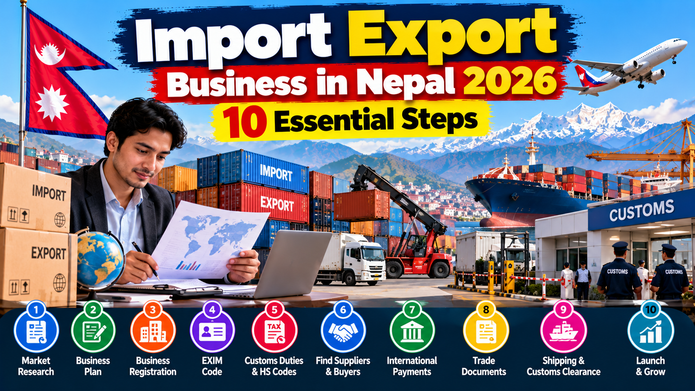
Import export business in Nepal showing international shipping, customs clearance, cargo containers and Nepalese entrepreneurs

Published: 20 October 2026 | Eleven Nepal | Business & Entrepreneurship

Starting an import export business in Nepal can create opportunities for entrepreneurs interested in international trade, wholesale distribution, manufacturing and Nepalese products.

An importer purchases goods from foreign suppliers and brings them into Nepal for permitted business purposes. An exporter sells eligible goods to buyers in other countries.

Both activities can connect Nepalese businesses with larger markets. However, international trade also involves customs procedures, banking requirements, transport arrangements, product regulations and financial risks.

A profitable-looking product can become unviable once freight, insurance, customs duties, taxes, storage and distribution costs are included.

Similarly, an exporter may secure a foreign buyer but struggle with product quality, packaging, certification or international payment arrangements.

Understanding these responsibilities before investing is essential.

Nepal’s international trade market is substantial. According to Department of Customs figures reported in August 2026, merchandise imports reached approximately NPR 2,096.37 billion during fiscal year 2025/26, while exports totalled NPR 315.29 billion.

The difference produced a merchandise trade deficit of approximately NPR 1,781.08 billion.

These figures demonstrate the scale of Nepal’s trade activity. They do not mean that starting an import-export business automatically generates profit.

This guide explains how to start an import export business in Nepal in 2026, including business registration, EXIM codes, customs duties, supplier research, shipping documents, international payments and realistic financial planning.

It also includes clearly labelled hypothetical examples and links to official government resources.

Understanding the Import Export Business in Nepal

International trade involves buying and selling goods across national borders.

Although importing and exporting share some procedures, their commercial risks and regulatory requirements can differ.

What Is an Import Business?

An import business purchases goods from a supplier outside Nepal and arranges their lawful entry into the country.

The importer may sell products to retailers, wholesalers, businesses or final customers.

Potential product categories include machinery, manufacturing inputs, household goods and other permitted products.

Importing is not simply ordering goods from an overseas website.

Commercial shipments may involve customs classification, import documentation, tax assessment, foreign-exchange arrangements and product-specific approvals.

What Is an Export Business?

An export business supplies goods from Nepal to buyers abroad.

Potential categories for research include tea, coffee, carpets, textiles, handicrafts and certain processed products.

The actual eligibility of a product depends on Nepalese rules and the destination country’s requirements.

Exporters may need to demonstrate product origin, meet quality standards and arrange international delivery.

Importing Versus Exporting

FactorImport businessExport business
Main activityBringing goods into NepalSending goods from Nepal abroad
CustomersNepalese buyersOverseas buyers
Supplier locationUsually outside NepalUsually Nepal
Key commercial concernLanded cost and domestic demandBuyer demand and export compliance
LogisticsInternational delivery into NepalInternational delivery to destination
Payment riskPaying foreign suppliersReceiving payment from foreign buyers

Some businesses engage in both activities.

For beginners, focusing on one product category and one trade direction can simplify research and financial planning.

Nepal’s Import and Export Market in 2026

Nepal’s merchandise trade remains heavily weighted toward imports.

Department of Customs figures for fiscal year 2025/26 showed:

  • Merchandise imports of approximately NPR 2,096.37 billion.
  • Merchandise exports of approximately NPR 315.29 billion.
  • Total merchandise trade of approximately NPR 2,411.66 billion.
  • A merchandise trade deficit of approximately NPR 1,781.08 billion.

Imports were reported to have increased by approximately 16.20% from the preceding fiscal year, while exports increased by approximately 13.81%.

These are national trade figures, not measures of individual business profitability.

What Does the Trade Deficit Mean?

A merchandise trade deficit occurs when the value of imported goods exceeds the value of exported goods.

It does not mean that every importer earns money or that every exporter loses money.

Individual business performance depends on costs, selling prices, customer demand and operational efficiency.

Why Export Development Matters

Exports can create opportunities for Nepalese producers to reach customers beyond the domestic market.

However, exporting also requires competitiveness.

Products must satisfy buyer expectations concerning quality, delivery, pricing and documentation.

Why Import Businesses Still Matter

Imports can provide machinery, raw materials and products that support domestic production and consumption.

The economic value of an import business depends partly on what it supplies and how efficiently it operates.

Entrepreneurs should avoid assuming that every imported product has strong demand.

Step 1: Research the Market and Choose the Right Product

The first step in starting an import export business in Nepal is identifying a commercially viable product.

Choosing a product solely because it is popular can lead to expensive mistakes.

How to Research Import Opportunities

An importer should investigate what Nepalese customers need and whether existing suppliers already satisfy that demand.

Important questions include:

  • Who will purchase the product?
  • What alternatives are available?
  • What quality standards do buyers expect?
  • How frequently will customers reorder?
  • How much inventory must the business hold?
  • What is the total landed cost?
  • Is the product legally importable?

A product with a high selling price may still offer poor margins after transport, customs and distribution costs.

How to Research Export Opportunities

An exporter should identify foreign buyers and assess whether Nepalese producers can meet their requirements.

Research should cover product specifications, packaging, delivery schedules, certification and destination-country rules.

For example, a tea exporter may need to investigate the importing country’s food safety and labelling requirements.

Use Official Trade Information

The Trade and Export Promotion Centre provides resources about Nepalese trade and export procedures.

The Department of Customs publishes trade statistics and tariff information.

These resources can support initial market research.

Test Demand Before Ordering Large Quantities

Where lawful and practical, entrepreneurs can begin with a limited trial order or sample evaluation.

A small test may reveal quality problems or weak customer demand before substantial capital is committed.

Practical advice: Select products based on verified demand and achievable margins, not simply on trends.

Step 2: Prepare a Business Plan and Financial Budget

International trade requires a realistic financial plan.

Unlike some service businesses, importers and exporters may need substantial working capital before receiving customer payments.

Essential Parts of a Trade Business Plan

A basic plan should explain the product, target customers, suppliers, sales channels, logistics, expected costs and financial risks.

It should also identify the business’s legal structure and relevant regulatory requirements.

Estimate Startup Capital

Potential expenses include business registration, equipment, samples, inventory, freight, insurance, customs charges, warehousing, marketing and professional services.

The amount varies by product, shipment size and operating model.

There is no single verified minimum investment that applies to every import-export business in Nepal.

Illustrative Import Business Startup Budget

Consider a hypothetical entrepreneur planning a small commercial import operation.

ExpenseIllustrative amount
Initial product purchasesNPR 400,000
Freight and insurance allowanceNPR 70,000
Customs and tax cash reserveNPR 120,000
Storage and handlingNPR 30,000
Marketing and distributionNPR 40,000
Professional and administrative allowanceNPR 20,000
Additional working capitalNPR 120,000
Total planned fundingNPR 800,000

Important: Every figure in this table is a hypothetical budgeting assumption, not a verified market quotation, statutory charge or guaranteed minimum investment.

Actual customs taxes must be calculated using the correct product classification and current rules.

Why Working Capital Is Important

Importers may pay suppliers before selling inventory.

Exporters may incur production and shipping costs before receiving final payment.

A business can therefore experience cash-flow pressure even when a transaction is expected to be profitable.

Build a Financial Reserve

Entrepreneurs should consider possible delays, damaged goods, unexpected transport expenses and slow customer payments.

The appropriate reserve depends on the business’s risk profile.

Step 3: Register Your Import Export Business in Nepal

Business registration is an essential part of establishing a formal commercial operation.

The correct registration process depends on the chosen legal structure and business activity.

Choose a Business Structure

Possible structures include a sole proprietorship, partnership or company, subject to applicable Nepalese laws.

These structures differ in ownership, liability, management and administrative responsibilities.

For a detailed comparison, read Eleven Nepal’s Types of Business in Nepal: 5 Essential Choices for Entrepreneurs.

Company Registration

Businesses choosing a company structure can consult the Office of the Company Registrar.

The OCR provides information about incorporation and company administration.

However, incorporating a company does not automatically provide permission to import or export every product.

PAN and Tax Registration

The Inland Revenue Department administers taxpayer registration.

Businesses should determine which PAN and VAT obligations apply to their activities.

Do not assume that every business must register for VAT in identical circumstances.

Other Registrations and Approvals

Some activities may require registration or authorisation from additional authorities.

Product-specific rules can also apply.

A company planning to import regulated goods must investigate those requirements before placing orders.

Practical Registration Guidance

Eleven Nepal has a separate article explaining the broader process:

How to Register a Business in Nepal: Essential Steps (2026).

This guide can help entrepreneurs understand the difference between choosing a business structure and completing relevant administrative procedures.

Official resources:

Office of the Company Registrar: https://ocr.gov.np/

Inland Revenue Department: https://ird.gov.np/

Step 4: Understand and Apply for an EXIM Code

The Export Import Code, commonly called an EXIM code, is an important part of Nepal’s commercial trading system.

According to the Nepal National Single Window’s official FAQ, an EXIM code is an identification number issued by the Department of Customs to traders involved in importing or exporting goods.

What Is an EXIM Code Used For?

The code helps customs authorities identify and administer registered traders.

It forms part of the trade compliance process.

However, holding an EXIM code does not automatically authorise restricted goods or replace other required permits.

Where Can Businesses Apply?

The Department of Customs operates an online EXIM system.

Official EXIM portal:

https://exim.customs.gov.np

Nepal National Single Window:

https://nnsw.gov.np/trade

General EXIM Application Process

The Nepal National Single Window FAQ describes an application process involving business PAN information, personal PAN information and email verification.

Applicants then complete business, tax and banking-related sections and upload supporting documents.

The application is forwarded to the relevant customs office.

Applicants should follow the current official instructions because required fields, supporting documents and procedures can change.

Is a Bank Guarantee Required?

The official EXIM application workflow includes a bank guarantee section.

However, this article does not claim that every trader must provide the same guarantee amount or satisfy identical conditions.

The applicable requirement should be checked directly with the Department of Customs and the trader’s bank.

EXIM Renewal

The official system also provides an EXIM renewal service.

Traders should check whether renewal is required for their registration and ensure their information remains current.

Practical advice: Complete the relevant customs registration process before committing to shipments that depend on it.

Step 5: Understand Customs Duties, HS Codes and Taxes

Customs classification is one of the most important technical aspects of international trade.

The applicable tax treatment can significantly affect the final cost of imported goods.

What Is an HS Code?

The Harmonized System is an international product classification framework used in customs administration.

Products are classified according to their characteristics and the applicable tariff rules.

A correct classification helps determine which duties and other requirements apply.

Why Classification Matters

Two products that appear similar may fall under different tariff classifications.

An incorrect classification can lead to inaccurate cost estimates and customs complications.

Entrepreneurs should not select an HS code solely because it produces a lower duty.

Nepal’s Customs Tariff 2026/27

The Department of Customs publishes the Customs Tariff 2026/27 for fiscal year 2083/84.

This is the appropriate official starting point for checking current tariff schedules.

Official tariff information:

https://customs.gov.np/content/50/custom-tariff-rate

Understanding Landed Cost

Landed cost refers to the cost of bringing goods to the relevant destination and making them available for business use or sale.

Depending on the transaction, it can include:

  • Purchase price.
  • International freight.
  • Insurance.
  • Customs duties.
  • Applicable import taxes.
  • Clearance and handling expenses.
  • Inland transport.
  • Storage and other relevant costs.

The precise tax calculation depends on customs valuation, product classification and applicable law.

Illustrative Landed-Cost Calculation

Consider a hypothetical shipment with these assumptions:

Cost componentIllustrative NPR
Product purchase500,000
International freight50,000
Insurance10,000
Assumed customs valuation560,000
Hypothetical customs duty at 10%56,000
Hypothetical other import taxes80,000
Clearance and inland transport24,000
Illustrative total cost720,000

The 10% duty is an invented assumption for demonstrating arithmetic. It is not a verified rate for any particular product.

The NPR 80,000 tax allowance is also hypothetical and is not a statutory calculation.

Actual duties and taxes must be determined using the relevant HS code, customs valuation rules and current legislation.

Check Tax Treatment Before Setting Prices

A business that prices goods using only the overseas supplier’s invoice may underestimate its costs.

Entrepreneurs should obtain a reliable product-specific estimate before purchasing.

The Nepal National Single Window provides a tariff search and related trade tools.

https://nnsw.gov.np/trade/customs/tariff/search?lang=en

Step 6: Find Reliable International Suppliers and Buyers

Supplier and buyer selection can determine whether an international transaction succeeds.

A low purchase price is not enough if the supplier delivers poor-quality goods or fails to fulfil the contract.

Finding Import Suppliers

Potential suppliers can be identified through trade fairs, industry associations, referrals and business-to-business platforms.

However, an online listing is not proof that a company is reliable.

Verify Supplier Information

Entrepreneurs should examine the supplier’s legal identity, product specifications, trading history and payment instructions.

Where appropriate, independent inspection or professional verification may be useful.

Request Product Samples

Samples can help assess materials, construction, packaging and consistency.

However, a good sample does not guarantee that a later bulk shipment will match.

Contracts should define acceptable quality and inspection arrangements.

Finding Export Buyers

Nepalese exporters can investigate distributors, retailers, importers and business associations in target markets.

Before accepting an order, exporters should assess the buyer’s credibility and ability to pay.

Use Written Contracts

A commercial agreement should clearly identify the product, quantity, quality standards, price, delivery terms, payment arrangements and dispute-resolution procedures.

Avoid Common Trade Scams

Warning signs may include requests for payments to unrelated accounts, unexplained changes to bank details and pressure to transfer money without adequate documentation.

Independent verification is particularly important before large international payments.

Practical advice: A reliable trading relationship is often more valuable than the cheapest initial quotation.

Step 7: Understand International Payments and Banking Rules

International trade payments involve commercial risk and foreign-exchange regulation.

Nepal Rastra Bank is the central bank responsible for relevant foreign-exchange policies and oversight.

Common International Payment Methods

Depending on the transaction and applicable rules, arrangements may include letters of credit, advance payments and documentary collection methods.

Each arrangement has different costs and risks.

Letter of Credit

A letter of credit, or L/C, is a bank undertaking subject to specified terms and documentation.

It can provide a structured payment arrangement, but it does not eliminate all commercial risk.

The buyer, seller and participating banks must understand the conditions.

Advance Payment

Advance payment involves transferring money before goods are delivered.

This may expose the buyer to non-delivery or quality risks.

The applicable foreign-exchange and banking requirements must be checked.

Documentary Payment Arrangements

Document against Payment (DAP) and Document against Acceptance (DAA) are forms of documentary collection.

These should not be confused with similarly abbreviated shipping terminology.

The exact risks depend on the contractual arrangement and banking procedures.

Relevant 2026 Banking Updates

Nepal Rastra Bank’s Monetary Policy for 2025/26 announced changes to certain import payment facilities, including increases in stated limits for specified documentary collection and draft/telegraphic transfer arrangements.

The central bank subsequently published additional foreign-exchange circular updates during 2026, including on 5 October 2026.

Therefore, businesses should not assume that an older monetary policy statement alone establishes the current limit applicable to their transaction.

Exchange-Rate Risk

If a supplier invoices in foreign currency, the Nepalese rupee value of the payment can change.

This may increase or reduce the final cost.

Illustrative Currency Example

Suppose a foreign supplier invoices a shipment at USD 5,000.

At an assumed exchange rate of NPR 140 per US dollar, the invoice equals NPR 700,000.

At an assumed rate of NPR 145 per US dollar, the same invoice equals NPR 725,000.

The difference is NPR 25,000.

These exchange rates are hypothetical, not current quotations.

Use Authorised Banking Channels

Entrepreneurs should discuss payment options with an authorised bank.

The bank can explain documentation, applicable limits, fees and current foreign-exchange rules.

Official resource:

Step 8: Prepare Import and Export Documents

International trade involves documentation that helps identify the goods, parties, transaction value and transport arrangements.

The exact documents depend on the product, shipment method, payment arrangement and applicable rules.

Common Import Documents

Documents may include a commercial invoice, packing list, transport document, customs declaration and relevant certificates.

Additional documents may be required for specific goods or banking arrangements.

Commercial Invoice

The commercial invoice identifies the goods, seller, buyer, quantity and transaction price.

It should accurately reflect the commercial transaction.

Packing List

A packing list describes the shipment’s contents and packaging.

It helps logistics providers and customs authorities identify goods.

Bill of Lading and Air Waybill

A bill of lading is commonly associated with sea freight.

An air waybill is associated with air transport.

Their legal and operational functions differ, so traders should not treat them as interchangeable.

Certificate of Origin

A certificate of origin provides information about the origin of goods.

It may be relevant to trade preferences and customs requirements.

The Nepal National Single Window identifies recognised issuing bodies for relevant Nepalese export certificates of origin.

Product-Specific Documents

Certain products may require health, plant, quality, technical or other certificates.

For example, agricultural products may face plant-health requirements.

The destination country may impose its own import conditions.

Why Accurate Documents Matter

Errors in product descriptions, quantities or values can delay clearance.

They may also create banking and contractual problems.

The Trade and Export Promotion Centre publishes procedural guidance explaining documentation commonly associated with import and export shipments.

Official resource:

https://tepc.gov.np/pages/import-and-export-by-air

Practical advice: Confirm the exact documentation checklist with the relevant customs authority, bank and logistics provider before shipping.

Step 9: Arrange Shipping, Customs Clearance and Delivery

Transport arrangements affect both cost and customer satisfaction.

Nepal’s geography means international shipments may involve multiple transport stages.

Common Transport Methods

Goods may move through road transport, air freight or combinations involving international sea freight and inland transit.

The appropriate method depends on product characteristics, urgency, shipment volume and available routes.

Freight Forwarders

Freight forwarders can help organise international transportation.

Their services may include booking transport, coordinating documentation and arranging logistics.

The specific responsibilities depend on the service agreement.

Customs Agents

A customs agent may assist with declarations and clearance procedures.

However, using an agent does not remove the trader’s responsibility to provide accurate information and comply with applicable rules.

Understanding Incoterms

Incoterms are internationally recognised commercial delivery terms published by the International Chamber of Commerce.

They help allocate certain responsibilities, costs and risks between buyers and sellers.

Examples include EXW, FOB, CIF and DDP.

However, the correct term depends on the transport arrangement.

For example, FOB and CIF are intended for sea and inland waterway transport, while other terms can be more suitable for multimodal shipments.

Do Not Confuse Shipping Cost With Total Cost

A low freight quotation may exclude insurance, clearance, storage or inland delivery.

Always request a clear breakdown of included and excluded services.

Plan for Delays

Transport disruptions, documentation problems and inspections may affect delivery schedules.

Entrepreneurs should avoid promising customers unrealistic delivery dates.

Practical advice: Compare logistics providers using total cost, reliability and contractual responsibilities rather than freight price alone.

Step 10: Launch, Market and Grow Your Import Export Business

After completing the relevant preparations, the next stage is to begin commercial operations on a manageable scale.

Start With a Pilot Transaction

A limited first shipment can help test supplier performance, documentation, clearance and customer demand.

However, the pilot must still comply with applicable rules.

Choose a Sales Channel

Importers may sell through wholesale relationships, retail stores, direct business contracts or suitable online channels.

Exporters may work with distributors, overseas retailers or direct commercial buyers.

Develop a Professional Business Presence

A clear website can help potential customers understand the products, company background and contact details.

Accurate descriptions and professional communication support credibility.

Monitor Every Shipment

Maintain records of purchase orders, invoices, shipping documents, taxes, payments and customer sales.

Review the actual profit or loss from each transaction.

Track Performance

Useful measures include:

  • Gross margin.
  • Contribution margin.
  • Inventory turnover.
  • Customer payment delays.
  • Supplier reliability.
  • Shipping delays.
  • Cash-flow requirements.
  • Repeat customer orders.

Expand Carefully

A successful first shipment does not guarantee that larger shipments will be profitable.

Expansion should be supported by customer demand, sufficient capital and reliable operations.

Entrepreneurs exploring other business models can also read Eleven Nepal’s Business Ideas for Returnees in Nepal.

How Much Profit Can an Import Export Business Make in Nepal?

There is no universal profit margin for international trading businesses.

Profit depends on product selection, shipment size, customs treatment, selling prices, transport costs and operational efficiency.

Illustrative Import Profit Example

Suppose a trader imports 500 units of a product.

Assume the total relevant inventory cost, including applicable non-recoverable import charges and allocated logistics expenses, is NPR 750,000.

The cost per unit is:

NPR 750,000 ÷ 500 = NPR 1,500.

Suppose the business sells all 500 units for NPR 2,000 each.

Total sales revenue would be NPR 1,000,000.

The difference between sales revenue and the assumed inventory cost would be NPR 250,000.

Now assume additional selling and operating expenses of NPR 150,000.

The illustrative operating surplus would be NPR 100,000 before tax, financing costs and any other excluded expenses.

These figures are not predictions or verified market prices.

Illustrative Export Profit Example

Consider a Nepalese producer exporting 1,000 units of a permitted product.

Assume:

ItemIllustrative NPR
Total export sales1,200,000
Production and packaging650,000
Freight and insurance borne by exporter160,000
Documentation and handling40,000
Other operating expenses150,000
Illustrative operating surplus200,000

The resulting surplus represents 16.67% of the assumed sales value.

It excludes any additional costs not specified.

No particular export product is claimed to achieve this margin.

What Can Reduce Profit?

Profit may fall because of exchange-rate changes, damaged goods, unsold inventory, customer returns, shipping delays or unexpected expenses.

Traders should also consider financing costs and the timing of cash receipts.

Common Mistakes to Avoid in International Trade

Understanding common mistakes can help beginners protect their investment.

1. Importing Without Confirmed Demand

Ordering large quantities before identifying customers creates inventory risk.

2. Using Incorrect HS Codes

Incorrect classification can produce unreliable tax estimates and customs problems.

3. Ignoring Product Restrictions

Some goods require approvals or may be prohibited.

An EXIM code does not override product-specific restrictions.

4. Trusting Unverified Suppliers

Supplier fraud and inconsistent quality can cause financial losses.

5. Underestimating Logistics Costs

Freight quotations may exclude important charges.

6. Making Unsafe Payment Arrangements

Poorly structured international payments can expose traders to non-delivery or non-payment.

7. Using Incomplete Documents

Documentation errors can delay shipments and create additional costs.

8. Ignoring Exchange-Rate Risk

Currency movements can change the cost of purchases or the value of sales.

9. Borrowing Without Cash-Flow Planning

Debt repayments may become difficult if inventory sells slowly.

10. Expanding Too Quickly

Larger shipments increase financial exposure.

For more financial planning advice, read Eleven Nepal’s How to Register a Business in Nepal and its other entrepreneurship resources.

A Practical 90-Day Import Export Business Preparation Plan

The following schedule is an illustrative planning framework.

It is not a promise that registration, permits, banking arrangements or customs approvals can be completed within 90 days.

Days 1–15: Research

Choose a product category.

Investigate customer demand and competitors.

Identify potential suppliers or buyers.

Check whether the product is permitted and whether additional approvals apply.

Days 16–30: Financial Planning

Prepare a startup budget.

Estimate product costs, freight, customs charges and working capital.

Calculate break-even sales.

Evaluate financing needs.

Days 31–45: Business Registration

Choose an appropriate business structure.

Complete relevant registration and taxpayer processes.

Review the official EXIM application requirements.

Days 46–60: Supplier and Buyer Verification

Request quotations and samples.

Review quality specifications.

Verify trading partners.

Draft suitable commercial agreements.

Days 61–75: Banking and Logistics

Discuss payment arrangements with an authorised bank.

Obtain freight quotations.

Confirm the product’s tariff classification and relevant approvals.

Prepare shipment documentation.

Days 76–90: Pilot Preparation

Review all compliance requirements.

Confirm customers and payment terms.

Arrange a limited first transaction if the business is ready and legally authorised.

Record actual costs and results before considering expansion.

Frequently Asked Questions About Import Export Business in Nepal

1. How can I start an import export business in Nepal?

Begin with product and market research, choose a suitable business structure, complete applicable registration and tax processes, check EXIM requirements, arrange banking facilities and confirm customs and product-specific rules.

2. Is an import export business profitable in Nepal?

It can be profitable, but there is no guaranteed return. Profitability depends on demand, margins, logistics, taxes, financing and operational efficiency.

3. What is an EXIM code in Nepal?

An EXIM code is an exporter-importer identification code issued through the Department of Customs system for relevant traders.

4. How do I apply for an EXIM code?

Use the official EXIM portal or Nepal National Single Window and follow the current application instructions.

5. Does an EXIM code allow every product to be imported?

No. Product-specific restrictions, permits and other legal requirements may still apply.

6. How much money is needed to start?

There is no single verified minimum investment for all import-export businesses. Capital requirements depend on the product, shipment size, registration obligations and working capital.

7. What products can Nepal export?

Potential categories include eligible agricultural products, textiles, carpets, handicrafts and processed goods. The specific product must satisfy applicable Nepalese and destination-country requirements.

8. Can I import products from China to Nepal?

Commercial importing may be possible for permitted products, subject to customs, banking, transport and other applicable requirements.

9. Can I import goods from India?

Trade with India is an important part of Nepal’s international commerce. However, applicable rules depend on the goods, origin, transaction and current trade arrangements.

10. Do I need a registered company?

The appropriate business structure and registration requirements depend on the activity. Not every trading business necessarily uses the same legal form.

11. Is PAN registration necessary?

Relevant taxpayer registration obligations apply according to the business and current tax rules. Consult the Inland Revenue Department.

12. Is VAT charged on all imports?

VAT treatment depends on the product and applicable legislation. Exemptions and special rules may apply. Do not assume identical treatment for every shipment.

13. How can I calculate customs duty?

Identify the correct HS classification, consult the current official customs tariff and determine the applicable valuation and tax rules.

14. What is a certificate of origin?

It is a document used to establish or certify the origin of goods for relevant trade and customs purposes.

15. What is a letter of credit?

A letter of credit is a bank payment undertaking governed by specified terms and documentary conditions.

16. Can I pay foreign suppliers directly?

Permitted payment arrangements depend on Nepal Rastra Bank rules, authorised banking procedures and the transaction.

17. What is the safest international payment method?

No payment method eliminates all risks. The appropriate arrangement depends on the parties, transaction and bank requirements.

18. Do exporters need product certification?

Some products and destination markets require particular certificates, inspections or standards compliance.

19. What is the difference between FOB and CIF?

Under Incoterms rules, FOB and CIF allocate certain costs and risks differently for eligible sea and inland waterway shipments. The precise contractual meaning should be understood before use.

20. Can students start an import export business?

A student may explore entrepreneurship, but applicable legal capacity, registration, financing and other requirements must be satisfied.

21. Can an online store import products for resale?

Potentially, yes. However, online selling does not remove applicable customs, tax, product safety or e-commerce obligations.

22. How long does customs clearance take?

There is no universal clearance time. Duration depends on the shipment, documents, inspections, applicable approvals and operating conditions.

23. What happens if imported goods are damaged?

Responsibility depends on the contract, transport arrangements, insurance coverage and circumstances of the damage.

24. Can Nepalese exporters sell directly to international customers?

They may be able to do so, subject to relevant trade, banking, customs and destination-country requirements.

25. What is the most important advice for beginners?

Verify product legality, calculate the full transaction cost, research customers and suppliers, and confirm banking and customs requirements before committing substantial money.

Conclusion: Is an Import Export Business in Nepal Worth Starting in 2026?

Starting an import export business in Nepal can offer opportunities for entrepreneurs interested in international markets.

Nepal’s merchandise trade figures show substantial commercial activity, but they also highlight the importance of understanding competition, financing and trade imbalances.

A successful trading business requires more than identifying a low-cost overseas supplier or a promising export product.

Entrepreneurs need reliable customers, appropriate registration, customs compliance, accurate financial calculations and secure payment arrangements.

The ten essential steps in this guide provide a practical starting framework.

Market research helps identify demand.

Business planning helps determine financial viability.

Registration and EXIM procedures support formal operations.

Customs classification, documentation and logistics planning help reduce avoidable complications.

Banking arrangements and supplier verification help manage international payment and delivery risks.

For beginners, starting with a manageable product range and carefully evaluating the results of an initial transaction may be more sensible than immediately placing a large order.

Most importantly, entrepreneurs should confirm the current rules with official authorities before making financial commitments.

International trade can create business opportunities, but long-term success depends on compliance, reliable relationships and disciplined financial management.


References and Official Sources

1. Department of Customs, Government of Nepal (2026). Customs Tariff 2026/27.

https://customs.gov.np/content/50/custom-tariff-rate

2. Nepal National Single Window (accessed October 2026). Official Trade Portal and EXIM Services.

https://nnsw.gov.np/trade/?lang=en

3. Nepal National Single Window (accessed October 2026). Frequently Asked Questions: EXIM Code, Registration and LPCO.

https://nnsw.gov.np/trade/adminFaq/list?lang=en

4. Department of Customs (accessed October 2026). Importer Exporter System.

https://exim.customs.gov.np

5. Nepal Rastra Bank (2026). Foreign Exchange Management Department and Circulars.

6. Nepal Rastra Bank (2025). Monetary Policy for 2025/26.

https://www.nrb.org.np/contents/uploads/2025/08/Monetary-policy-in-English-2025_26.pdf

7. Trade and Export Promotion Centre. Import and Export Procedures by Air.

https://tepc.gov.np/pages/import-and-export-by-air

8. Trade and Export Promotion Centre. Exports Transit Procedure.

https://tepc.gov.np/pages/exports-transit-procedure

9. International Trade Administration, U.S. Department of Commerce (15 June 2026). Nepal: Import Requirements and Documentation.

https://www.trade.gov/country-commercial-guides/nepal-import-requirements-and-documentation

10. HimalPress (August 2026). Foreign Trade Expands 15.88% to Reach Rs 2,411.66 Billion, reporting Department of Customs figures.

11. Office of the Company Registrar. Official Business and Company Registration Information.

https://ocr.gov.np

12. Inland Revenue Department. Official Tax Information.

https://ird.gov.np

Editorial note: This article was prepared using sources available as of 20 October 2026. All startup budgets, exchange rates, financial projections and example duty calculations are illustrative. They are not official quotations or legal determinations. Customs duties, payment conditions and regulatory requirements should be verified for each transaction using current official information.
Why Small Businesses Fail in Nepal: 10 Costly Mistakes to Avoid

0
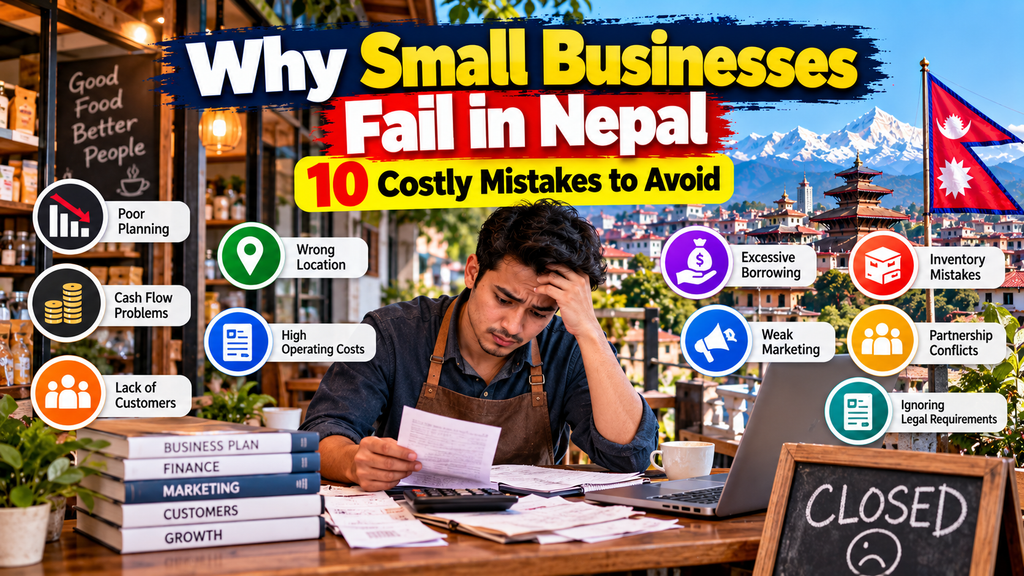
Why small businesses fail in Nepal showing financial planning, cash flow problems, poor marketing and business mistakes

Published: 20 October 2026 | Eleven Nepal | Business & Entrepreneurship

Starting a small business in Nepal can be an exciting opportunity. From opening a café in Kathmandu to launching a clothing store in Pokhara or starting an online business from home, entrepreneurship offers the possibility of financial independence, employment creation and long-term growth.

However, not every business survives.

Some businesses struggle because they cannot attract enough customers. Others generate sales but fail to manage cash flow, control expenses or repay borrowed money. Poor locations, weak partnerships, inadequate market research and inconsistent customer service can create additional problems.

Understanding why small businesses fail in Nepal is important for anyone planning to invest personal savings, borrow money or enter a business partnership.

The challenges are not purely theoretical.

In February 2026, the World Bank approved a US$95 million financing operation intended to expand access to finance for more than 100,000 small and medium enterprises in Nepal. The programme reflects the importance of addressing financing barriers and supporting business-led job creation.

Meanwhile, the World Bank’s October 2026 Nepal Development Update reported that the country’s gross non-performing loan ratio had reached 5.7% by mid-July 2026. This indicates pressure on loan repayment across the financial sector, although it does not measure the failure rate of small businesses.

Nepal’s business environment also faces challenges related to weak domestic demand, investment uncertainty, regulatory complexity and natural disasters.

Yet many business problems can be reduced through careful planning and disciplined management.

This article explains ten costly mistakes that can damage small businesses in Nepal, practical ways to avoid them and illustrative financial calculations to help entrepreneurs understand the risks.

Why Small Businesses Fail in Nepal: Understanding the Business Environment

Small businesses play an important role in Nepal’s economy.

They provide goods and services, create employment and support local communities.

Examples include grocery shops, restaurants, tailoring businesses, repair workshops, agricultural enterprises, tourism services and online retailers.

However, running a business requires more than providing a good product.

Owners must manage customers, employees, suppliers, money, regulations and competition.

What Does Business Failure Mean?

Business failure can describe several different outcomes.

A business may close because it cannot cover expenses.

It may become unable to repay debts.

The owner may decide to discontinue operations after repeated losses.

Some businesses close voluntarily for personal reasons, even when they are not insolvent.

Therefore, not every business closure represents bankruptcy or financial failure.

Is There an Official Business Failure Rate in Nepal?

A reliable national business survival rate requires data that follows businesses over time and records whether they remain active.

Nepal’s National Economic Census 2018 provides important information about establishments, but it should not be presented as a current 2026 business failure survey.

The World Bank’s Nepal Enterprise Survey 2023 provides evidence about business conditions and obstacles, but it does not establish that a particular percentage of all Nepalese startups fail.

Entrepreneurs should be cautious about unsupported claims suggesting that most businesses fail within a fixed number of years.

What Does Recent Research Show?

A World Bank report published in 2025 estimated that micro, small and medium-sized enterprises contribute approximately 22% of Nepal’s GDP and account for more than 45% of jobs.

The same report highlighted limited access to credit, business informality and regulatory difficulties.

These findings demonstrate why the operating environment matters.

Business failure is not always the result of poor decisions by an individual entrepreneur. External economic conditions and structural barriers can also influence outcomes.

Nevertheless, understanding common management mistakes can help owners make better decisions.

1. Starting a Business Without Proper Market Research

One of the most costly mistakes is investing in a business before confirming that customers want its products or services.

A business idea may sound attractive, but enthusiasm alone does not prove demand.

Why Market Research Matters

Market research helps entrepreneurs understand customer needs, purchasing behaviour, competitors and local conditions.

For example, opening a premium coffee shop near a university may appear promising.

However, students may prefer lower-priced drinks, and existing cafés may already satisfy demand.

Without research, the owner could invest in equipment, furniture and premises that do not match customer preferences.

Common Market Research Mistakes

Some entrepreneurs rely only on opinions from friends and relatives.

Others assume that a successful business in Kathmandu will perform equally well in a smaller town.

Another mistake is copying a popular business without understanding why customers choose it.

How to Avoid This Mistake

Begin by identifying a specific customer group.

Speak with potential customers and observe competing businesses.

Compare product quality, service, convenience and pricing.

Where practical, test the concept on a small scale.

A food entrepreneur might conduct a limited product trial before committing to a full restaurant.

Practical Example

Suppose an entrepreneur wants to open a takeaway food business.

Instead of immediately renting premises, the entrepreneur tests a small menu with customers through an appropriately compliant pilot operation.

The trial may reveal which products attract repeat orders and which are unpopular.

This information can support better decisions about menu design, ingredients and equipment.

Key lesson: Customer demand should be tested before making major financial commitments.

2. Poor Financial Planning and Underestimating Startup Costs

Another major reason why small businesses fail in Nepal is inadequate financial planning.

Many entrepreneurs calculate the money required to open a business but overlook the cost of keeping it operational.

Startup Costs Are Only the Beginning

Opening a business may involve premises, equipment, inventory, registration, furnishings and initial marketing.

After opening, the business may need to pay rent, wages, utilities, suppliers, maintenance and other recurring expenses.

A business can run out of money even when its initial setup was completed successfully.

Capital Expenditure and Operating Expenditure

Capital expenditure generally relates to acquiring or improving longer-term assets.

Operating expenditure relates to ongoing business activities.

For a café, coffee machines and kitchen equipment may be capital expenditure.

Ingredients, wages and rent are operating expenses.

Entrepreneurs should distinguish these categories when preparing budgets.

Illustrative Startup Budget

Consider a hypothetical small café.

ExpenseIllustrative amount
EquipmentNPR 500,000
Furniture and interior setupNPR 250,000
Initial inventoryNPR 80,000
Premises deposit and initial rentNPR 200,000
Marketing and launchNPR 40,000
Professional and administrative allowanceNPR 30,000
Working capital reserveNPR 300,000
Total planned fundingNPR 1,400,000

Important: These are invented planning assumptions for educational calculations, not verified market prices, legal fees or minimum startup requirements in Nepal.

The actual amount could be significantly different depending on the location, premises and business model.

Why Working Capital Matters

Working capital helps a business meet short-term obligations.

A business may purchase inventory today but receive customer payments later.

Without sufficient liquidity, it may struggle to pay suppliers and employees.

How to Avoid This Mistake

Prepare a startup budget and a separate monthly operating budget.

Include a reserve for unexpected expenses.

Estimate realistic sales rather than assuming immediate success.

Update financial forecasts as actual information becomes available.

Key lesson: A business needs enough money to operate, not merely enough money to open.

3. Failing to Manage Cash Flow

Cash-flow problems can threaten businesses even when their sales appear strong.

This is because sales revenue, accounting profit and cash available in the bank are different measures.

What Is Cash Flow?

Cash flow records money entering and leaving a business.

Cash inflows may include customer payments and financing.

Cash outflows may include supplier payments, wages, rent, loan repayments and taxes.

A profitable business can still experience a cash shortage if payments arrive too late.

Illustrative Cash-Flow Example

Assume a business records NPR 400,000 in monthly sales.

However, only NPR 260,000 is received during the month because some customers purchase on credit.

Suppose the business must make NPR 310,000 in cash payments during the same period.

Its net cash movement from these assumed transactions is:

NPR 260,000 − NPR 310,000 = negative NPR 50,000.

The business has a cash shortfall even though recorded sales are higher than the month’s cash payments.

This example is hypothetical.

Why Small Businesses Struggle With Cash Flow

Some owners allow customers to delay payments without setting clear terms.

Others purchase excessive inventory or withdraw money for personal expenses.

Businesses may also face seasonal demand.

For example, tourism-related businesses can experience uneven income throughout the year.

How to Improve Cash Flow

Maintain a cash-flow forecast covering upcoming receipts and payments.

Review outstanding customer invoices.

Negotiate reasonable supplier terms where appropriate.

Avoid unnecessary inventory purchases.

Keep a financial reserve where possible.

Separate Business and Personal Money

Mixing household spending with business cash makes it difficult to understand profitability.

Use appropriate separate accounts and maintain clear records.

Owners should document withdrawals and capital contributions.

Key lesson: Cash availability is essential for survival, even when sales appear healthy.

4. Choosing the Wrong Business Location

Location can strongly influence the performance of businesses that depend on physical customers.

A good product may struggle if customers cannot easily find or access the premises.

Why Location Matters in Nepal

Business locations differ in customer traffic, accessibility, competition and operating expenses.

A restaurant near offices may attract lunch customers.

A grocery shop in a residential neighbourhood may depend on local repeat purchases.

A tourism business may rely on visitors and seasonal demand.

The Danger of High Rent

Entrepreneurs sometimes choose expensive premises because the location appears prestigious.

However, higher rent creates greater pressure to generate sales.

A business must earn enough contribution from customers to cover rent and other fixed expenses.

Illustrative Location Comparison

Consider two hypothetical shop locations.

ItemLocation ALocation B
Monthly rentNPR 80,000NPR 35,000
Monthly salesNPR 450,000NPR 320,000
Contribution margin40%40%
Contribution before rentNPR 180,000NPR 128,000
Contribution after rentNPR 100,000NPR 93,000

The more expensive location generates higher sales, but its additional rent reduces the advantage.

Other operating expenses still need to be deducted.

These figures are illustrative and do not represent actual rental markets.

How to Choose a Better Location

Study customer traffic at different times.

Assess visibility, accessibility and nearby competition.

Understand lease conditions and total occupancy costs.

Consider whether the business depends on walk-in customers or deliveries.

Online Businesses Also Need Location Planning

An online retailer may not need a premium storefront.

However, storage, supplier access and delivery logistics still matter.

Key lesson: The best location is the one that supports the business model at a sustainable total cost.

5. Incorrect Pricing and Poor Profit Margins

Many businesses focus on sales volume without understanding how much money they earn from each sale.

This can lead to prices that do not cover costs.

Understanding Cost-Based Pricing

A selling price should be informed by direct costs, operating expenses, market conditions and the value customers receive.

Simply copying a competitor’s price may be dangerous because the competitor may have different costs.

Food Business Example

Suppose a restaurant sells a meal for NPR 500.

Its assumed variable costs are:

Cost componentIllustrative amount
IngredientsNPR 170
PackagingNPR 20
Payment and delivery-related costsNPR 30
Other variable costsNPR 10
Total variable costNPR 230

The contribution per meal is:

NPR 500 − NPR 230 = NPR 270.

The contribution margin is 54%.

This is not the restaurant’s final net profit.

Rent, salaries, utilities, depreciation, financing and other costs may still need to be covered.

The Danger of Excessive Discounts

Discounts can attract customers, but they also reduce revenue per sale.

A discount should be evaluated against the contribution remaining after variable costs.

How to Improve Pricing

Calculate the full cost structure.

Monitor gross profit and contribution margins.

Review prices when supplier costs change.

Evaluate whether customers perceive sufficient value.

Avoid competing only by offering the lowest price.

Key lesson: Higher sales do not guarantee higher profits.

6. Borrowing Too Much Money Without a Repayment Plan

Debt can help finance equipment, inventory and business expansion.

However, excessive borrowing can create serious financial pressure.

Why Debt Becomes Risky

Loan repayments may continue even when sales decline.

A business that depends on optimistic revenue forecasts may struggle during a weak trading period.

Interest rates, collateral requirements and repayment schedules also affect risk.

Nepal’s Business Financing Challenges

The World Bank’s February 2026 financing announcement highlighted inadequate collateral and limited credit histories as constraints affecting small and medium enterprises.

The World Bank approved US$95 million in support intended to improve financing access for more than 100,000 SMEs.

This programme is not evidence that every entrepreneur is eligible for a loan or guaranteed approval.

In September 2026, the International Finance Corporation also announced a risk-sharing facility intended to encourage lending to micro, small and medium enterprises.

These initiatives show that access to suitable financing remains an important policy issue.

Illustrative Loan Repayment Scenario

Suppose a business borrows NPR 500,000.

Assume a hypothetical annual interest rate of 12%, a fixed monthly repayment schedule and a three-year repayment period.

Under a standard amortising-loan calculation, the monthly payment would be approximately NPR 16,607.

This is an illustration, not a current bank quotation.

Actual loans may have different interest rates, fees, repayment structures and conditions.

Why Repayment Capacity Matters

Before borrowing, a business should estimate whether operating cash flow can cover loan payments.

It should also consider what happens if sales fall below expectations.

Borrowers must understand the full financing agreement, including collateral and consequences of default.

How to Avoid Excessive Debt

Borrow only for a justified business purpose.

Compare financing options.

Calculate repayments before signing agreements.

Prepare conservative cash-flow forecasts.

Do not rely on future sales growth that has not been demonstrated.

Key lesson: Borrowing should support a viable business, not conceal an unsustainable one.

7. Poor Inventory Management and Uncontrolled Waste

Inventory includes goods and materials held for production or sale.

Poor inventory management can create unnecessary costs and reduce available cash.

Excessive Stock

Buying too much inventory ties up money.

Products may become outdated, damaged or unsellable.

This is particularly important for fashion, electronics and perishable food businesses.

Insufficient Stock

Holding too little inventory can also create problems.

Customers may leave when products are unavailable.

Repeated stock shortages can damage trust.

Food Waste in Restaurants

Restaurants need to monitor ingredient purchases, storage, preparation and leftovers.

Poor portion control and inadequate forecasting can increase waste.

Food safety procedures must remain a priority.

Businesses should never attempt to reduce waste by using unsafe ingredients.

Basic Inventory Controls

Record purchases and stock movements.

Use suitable stock rotation methods, including first-in, first-out where appropriate.

For perishable food, expiry-based controls may be more suitable.

Conduct regular stock counts.

Investigate unusual losses.

Illustrative Inventory Example

Suppose a retailer purchases NPR 100,000 of goods.

At the end of a trading period, NPR 15,000 of those goods becomes unsellable.

The business has experienced a hypothetical inventory loss of NPR 15,000 before considering any recoverable value.

Such losses reduce the financial return from inventory investment.

How to Reduce Waste

Use sales records to forecast demand.

Order quantities based on realistic turnover.

Train staff in handling and storage.

Monitor expiry dates and product condition.

Key lesson: Inventory should support sales without unnecessarily consuming cash.

8. Weak Marketing and Failure to Understand Customers

A business cannot survive indefinitely without sufficient customers.

However, some owners assume that customers will arrive simply because a shop has opened.

Why Marketing Matters

Marketing communicates what a business offers, who it serves and why customers might choose it.

Effective marketing begins with understanding customer needs.

Common Marketing Mistakes

Businesses may target everyone rather than a specific audience.

They may spend money on advertising without measuring results.

Others focus on social media likes without tracking enquiries or purchases.

Customer Experience

Customer service influences repeat purchases and recommendations.

A restaurant may attract first-time visitors through advertising, but poor service can discourage them from returning.

Digital Marketing Opportunities

Websites, search engines and digital channels can help businesses communicate with customers.

However, the appropriate channels depend on the audience and the business model.

Entrepreneurs interested in online selling can read Eleven Nepal’s Online Business in Nepal 2026 guide to explore relevant business models.

This link opens the website’s search results rather than assuming an unverified article permalink.

Measuring Marketing Results

Track meaningful indicators such as customer enquiries, completed purchases, repeat customers and acquisition costs.

Do not assume that advertising exposure automatically produces profit.

How to Improve Customer Retention

Respond professionally to complaints.

Maintain consistent quality.

Provide accurate information about prices and products.

Use customer feedback to identify problems.

Key lesson: Sustainable demand requires both customer acquisition and customer satisfaction.

9. Poor Business Partnerships and Unclear Ownership

Partnerships can provide capital, skills and shared responsibilities.

However, disagreements may damage a business when ownership and decision-making arrangements are unclear.

Why Partnership Conflicts Occur

Partners may contribute different amounts of money or labour.

One partner may manage daily operations while another provides funding.

Problems can arise if partners have different expectations about profit sharing, salaries and decision-making.

Capital Contributions and Ownership

Capital contributions do not automatically determine ownership percentages in every possible arrangement.

Ownership should be established through an appropriate legal structure and properly documented agreements.

Important Partnership Questions

Before starting, partners should agree on:

  • Each person’s capital contribution.
  • Ownership percentages.
  • Management responsibilities.
  • Whether working partners receive salaries.
  • Profit distribution and treatment of losses.
  • Authority to approve spending and borrowing.
  • Procedures for admitting or removing partners.
  • Exit arrangements and dispute resolution.

Illustrative Partnership Example

Suppose three people contribute the following capital:

PartnerIllustrative contribution
Partner ANPR 300,000
Partner BNPR 200,000
Partner CNPR 100,000
TotalNPR 600,000

Their contributions represent 50%, 33.33% and 16.67% of total capital respectively.

However, the partners may agree on a different lawful ownership arrangement based on responsibilities, intellectual property or other negotiated factors.

The agreement should clearly explain any difference between capital contributions and ownership.

How to Avoid Partnership Problems

Use a written agreement prepared or reviewed by an appropriately qualified professional.

Keep business accounts transparent.

Document major decisions.

Establish procedures for resolving disagreements.

Key lesson: Good relationships are valuable, but clear agreements protect everyone.

10. Ignoring Legal Requirements and Failing to Adapt

The final major mistake is operating without understanding applicable legal obligations or refusing to respond to changing market conditions.

Business Registration

Nepal has different registration procedures depending on the business structure and activity.

The Office of the Company Registrar provides information about company incorporation.

Other government bodies may be relevant to sole proprietorships, partnerships and regulated activities.

PAN and VAT Compliance

The Inland Revenue Department administers tax registration.

PAN and VAT are not identical.

VAT obligations depend on applicable rules, taxable activities and relevant conditions.

Entrepreneurs should not assume that every small business must register for VAT or that small businesses are automatically exempt.

Industry-Specific Requirements

Food businesses may need to comply with applicable food safety requirements.

Tourism operators, manufacturers and other businesses may face additional rules.

The relevant requirements depend on the activity and location.

The Cost of Ignoring Compliance

Non-compliance can create financial, legal and operational risks.

The consequences depend on the relevant law and circumstances.

Businesses should obtain reliable advice rather than relying on informal assumptions.

Failure to Adapt

Consumer preferences, technology and competition change over time.

Businesses that ignore feedback may lose customers.

For example, a retailer may need to improve product selection or customer communication as demand changes.

However, adaptation should be based on evidence rather than constantly following trends.

How to Avoid This Mistake

Review applicable regulations.

Maintain accurate financial and administrative records.

Monitor customer feedback.

Assess competitors and changing market conditions.

Update business plans when necessary.

For practical guidance, read How to Register a Business in Nepal: Essential Steps.

Key lesson: Compliance and adaptability are ongoing responsibilities, not one-time tasks.

How Economic Conditions Affect Small Businesses in Nepal in 2026

Individual management decisions are important, but the wider economy also influences business performance.

Economic Growth

The World Bank’s October 2026 Nepal Development Update estimated real GDP growth of 3.9% for FY 2025/26, compared with 4.4% in FY 2024/25.

This indicates continued expansion at a slower rate.

Growth conditions can influence customer spending and investment.

Weak Domestic Demand

The World Bank reported subdued private-sector credit growth despite relatively favourable liquidity conditions.

This reflects continuing weakness in domestic demand.

Small businesses may experience lower sales when households and firms reduce discretionary spending.

Financial-Sector Conditions

The gross non-performing loan ratio reached 5.7% by mid-July 2026.

This was a financial-sector indicator, not a small-business closure rate.

Nevertheless, banking-sector conditions can influence the availability and cost of financing.

Natural Disasters

Floods, landslides and other disasters can damage premises, inventory, roads and infrastructure.

The World Bank’s October 2026 assessment discussed the economic consequences of the August 2026 Rasuwa flood.

Business owners should consider location-specific disaster risks and appropriate continuity planning.

Why Resilience Matters

A business cannot eliminate every external risk.

However, emergency planning, appropriate insurance where available and diversified supply arrangements may help reduce disruption.

How to Calculate the Break-Even Point for a Small Business

Understanding break-even is one of the most useful financial skills for entrepreneurs.

Break-even is the level of sales at which total revenue covers the relevant total costs.

Break-Even Formula

Break-even units = Fixed costs ÷ Contribution per unit

Contribution per unit = Selling price − Variable cost per unit

Illustrative Restaurant Example

Suppose a small restaurant has the following assumed financial structure:

ItemAmount
Average selling price per mealNPR 400
Variable cost per mealNPR 160
Contribution per mealNPR 240
Monthly fixed costsNPR 240,000

Break-even meals:

NPR 240,000 ÷ NPR 240 = 1,000 meals per month.

Assuming 30 operating days, this is approximately 34 meals per day.

The calculation is simplified and assumes a consistent average price, variable cost and product mix.

Actual businesses may sell different products with different margins.

What Happens Below Break-Even?

Suppose the restaurant sells only 800 meals.

Total contribution would be:

800 × NPR 240 = NPR 192,000.

After NPR 240,000 in fixed costs, the illustrative operating result would be a loss of NPR 48,000.

What Happens Above Break-Even?

At 1,200 meals, total contribution would be NPR 288,000.

After the same fixed costs, the illustrative operating surplus would be NPR 48,000 before any additional expenses not included in the assumptions.

Why Break-Even Analysis Matters

Break-even analysis helps entrepreneurs understand required sales volumes.

It can also support pricing and cost-control decisions.

However, break-even analysis does not replace cash-flow forecasting.

A Practical Small Business Survival Checklist

Before investing in a business, entrepreneurs should review several important questions.

Customer Demand

Is there evidence that customers want the product or service?

Have potential customers been consulted?

Financial Planning

Are startup and operating costs clearly identified?

Is sufficient working capital available?

Pricing

Does the selling price provide enough contribution to cover fixed costs?

Cash Flow

Can the business pay its obligations on time?

Competition

What makes the business different or more suitable for its customers?

Operations

Are suppliers, inventory controls and staffing arrangements reliable?

Legal Compliance

Have relevant registration, tax and industry requirements been checked?

Risk Management

Is there a plan for unexpected costs, weak sales or operational disruption?

Entrepreneurs who cannot answer these questions should consider conducting further research before committing substantial capital.

A 90-Day Plan to Improve a Struggling Small Business

Not every struggling business needs to close immediately.

Some problems can be addressed through structured analysis and operational changes.

However, the appropriate response depends on the business’s financial and legal position.

Days 1–30: Understand the Financial Position

Review sales, expenses, debts and available cash.

Identify products or services with weak margins.

Prepare a short-term cash-flow forecast.

Check whether important payments are overdue.

Seek professional advice promptly if insolvency or serious repayment problems may exist.

Days 31–60: Improve Operations

Review supplier arrangements.

Reduce avoidable waste.

Assess staffing and scheduling against demand.

Improve customer service.

Test changes to products or marketing.

Days 61–90: Evaluate Results

Compare actual results with the original plan.

Review whether cash flow and contribution margins have improved.

Identify which changes should continue.

Consider restructuring, professional assistance or an orderly closure if the business remains unviable.

This is a planning framework, not a guarantee that financial difficulties can be resolved in 90 days.

Frequently Asked Questions About Why Small Businesses Fail in Nepal

1. Why do small businesses fail in Nepal?

Small businesses may struggle because of inadequate market research, poor financial planning, weak cash flow, excessive borrowing, unsuitable locations, pricing mistakes and external economic conditions.

2. What is the biggest mistake new entrepreneurs make?

There is no verified national ranking identifying one universal mistake. However, starting without validating demand or understanding costs can expose a business to substantial financial risk.

3. What percentage of small businesses fail in Nepal?

The reviewed sources do not establish a reliable national 2026 business failure percentage. Claims about a fixed failure rate should be checked against an appropriate longitudinal study.

4. Can a profitable business still fail?

Yes. A business can report accounting profit but lack sufficient cash to pay its obligations when due.

5. Why is cash flow important?

Cash flow determines whether a business can pay suppliers, employees, lenders and other obligations on time.

6. How much capital is needed to start a small business in Nepal?

There is no universal amount. Required capital depends on the business model, location, equipment, inventory, compliance requirements and operating expenses.

7. Is borrowing money to start a business risky?

Borrowing creates repayment obligations. The risk depends on loan terms, expected cash flow, collateral and the viability of the business.

8. Why do restaurants struggle financially?

Possible causes include weak demand, poor menu costing, excessive rent, food waste, labour inefficiencies and inconsistent service.

9. How can small businesses improve profitability?

Businesses can review pricing, reduce avoidable costs, improve operations and focus on products or services that generate sustainable contribution margins.

10. Is a business partnership better than starting alone?

Neither structure is automatically better. Partnerships can provide resources and skills but require clear agreements and effective decision-making.

11. Does every small business need VAT registration?

VAT obligations depend on applicable tax rules and business circumstances. Entrepreneurs should consult current Inland Revenue Department guidance.

12. Can online businesses also fail?

Yes. Online businesses face risks involving demand, competition, advertising expenses, delivery, customer trust and legal compliance.

13. How can entrepreneurs reduce inventory losses?

They can monitor stock, forecast demand, use appropriate rotation methods and investigate wastage.

14. Is location important for every business?

Location is especially important for businesses that rely on physical customers. Online businesses may place greater emphasis on logistics and digital accessibility.

15. What should a business owner do when sales decline?

Review demand, pricing, customer feedback, expenses and cash flow before deciding which changes are appropriate.

16. Can marketing save a failing business?

Marketing may improve customer acquisition, but it cannot reliably solve fundamental problems involving poor products, unsustainable costs or inadequate operations.

17. Why do businesses struggle to obtain bank loans in Nepal?

The World Bank has identified collateral requirements, limited credit histories and other financing constraints affecting smaller enterprises.

18. What is the break-even point?

It is the sales level at which the contribution generated covers fixed costs under the assumptions used in the calculation.

19. Should entrepreneurs keep operating a loss-making business?

That depends on the cause of the losses, available financing, future prospects and legal obligations. Professional advice may be necessary.

20. What is the best way to prevent business failure?

There is no guaranteed method. However, careful market research, financial planning, cash-flow management, customer service and legal compliance can help reduce avoidable risks.

Conclusion: How Can Entrepreneurs Avoid Small Business Failure in Nepal?

Understanding why small businesses fail in Nepal is an important part of becoming a responsible entrepreneur.

Many business problems begin before the first customer arrives.

Entrepreneurs may invest without adequate research, underestimate operating costs or borrow money without a realistic repayment plan.

Other problems develop after opening.

Weak cash-flow management, poor inventory controls, unsuitable pricing and inadequate customer service can gradually damage financial performance.

Partnership disagreements and legal non-compliance can create further risks.

However, small-business difficulties are not always caused by individual mistakes.

Nepal’s wider economic environment, financing constraints, infrastructure limitations and natural disasters can also affect businesses.

The World Bank’s 2026 financing initiatives demonstrate the continuing importance of improving access to finance for small and medium enterprises.

For entrepreneurs, the most practical approach is to begin with evidence.

Research customers before investing.

Calculate realistic costs and required sales.

Monitor cash flow regularly.

Maintain clear records and agreements.

Review performance and adapt when conditions change.

Most importantly, avoid assuming that a popular business idea is automatically profitable.

A sustainable business requires sufficient customer demand, disciplined financial management and the ability to respond to challenges.

The goal is not simply to open a business. It is to build one that can operate responsibly, serve customers and remain financially viable over time.


References and Credible Sources

1. World Bank (3 February 2026). Nepal: World Bank Approves $95 Million to Support Sustainable and Inclusive Finance.

https://www.worldbank.org/en/news/press-release/2026/02/03/nepal-world-bank-approves-95-million-to-support-sustainable-and-inclusive-finance

2. World Bank (6 October 2026). Nepal Development Update.

https://www.worldbank.org/en/country/nepal/publication/nepaldevelopmentupdate

3. International Finance Corporation (30 September 2026). World Bank Group Backs Nepal’s Small Businesses with Risk-Sharing Facilities to Create Jobs.

https://www.ifc.org/en/pressroom/2026/world-bank-group-backs-nepal-s-small-businesses-with-risk-sharing-facilities-to-cr

4. World Bank (2025). Nepal Country Partnership Framework Supporting Analysis. Discussion of MSMEs, business conditions and access to finance.

https://documents1.worldbank.org/curated/en/099050625143524020/pdf/BOSIB-16a89439-c3ef-4002-9acb-ca6b2c267585.pdf

5. World Bank. Nepal Enterprise Survey 2023. Survey documentation and methodology.

https://microdata.worldbank.org/catalog/6457/study-description

6. National Statistics Office. National Economic Census 2018. Historical establishment data.

https://data.nsonepal.gov.np/en/dataset/nepal-economic-census-2018

7. Office of the Company Registrar. Company Registration Information.

https://ocr.gov.np/pages/registration

8. Inland Revenue Department. Taxpayer Guidance and VAT Registration FAQs.

https://ird.gov.np/faq/?gid=97

9. Eleven Nepal. How to Register a Business in Nepal: Essential Steps (2026).

Editorial note: This article reflects information available as of 20 October 2026. All financial examples are hypothetical calculations, not verified current Nepalese prices, bank offers or business earnings. Business closure rates have not been invented. Readers should verify legal and financial obligations with relevant authorities and qualified advisers.

Online Business in Nepal 2026: 10 Ultimate Smart Ideas

0
Online business in Nepal 2026 showing e-commerce, freelancing, digital marketing and young entrepreneurs

Kathmandu, 20 October 2026 | Eleven Nepal | Business & Entrepreneurship

Online business in Nepal 2026 is creating new opportunities for students, young professionals, freelancers, small business owners and entrepreneurs who want to reach customers through the internet.

From selling products online to offering digital marketing services, website development and online tutoring, the digital economy offers several ways to build a business without necessarily opening a traditional retail shop.

However, starting an online business is not the same as earning guaranteed money.

Success requires research, useful skills, reliable products or services, effective marketing, financial planning and compliance with applicable regulations.

Nepal’s expanding digital connectivity provides a foundation for online entrepreneurship.

According to DataReportal’s Digital 2026: Nepal report, the country had approximately 16.6 million internet users in October 2025, representing 56% of the population.

The same report estimated 14.8 million social media user identities and 32.4 million cellular mobile connections.

These figures show the scale of digital connectivity, but they do not mean that every internet user is a potential customer or that every social media identity represents a unique individual.

Meanwhile, Nepal’s e-commerce regulations are becoming more structured.

The Electronic Commerce Act, 2081, and subsequent implementing guidance establish requirements relevant to online sellers and platforms.

For aspiring entrepreneurs, this means online businesses need to be treated as genuine commercial activities with appropriate registration, records and customer protection.

This guide explores ten practical online business ideas in Nepal, their advantages and risks, illustrative financial models, and the steps beginners can take to launch responsibly.

Why Online Business in Nepal Is Growing in 2026

Online entrepreneurship is attracting attention because digital tools allow businesses to communicate with customers, promote products and deliver certain services without relying entirely on physical locations.

A traditional retail business often needs a shop, inventory, employees and other fixed resources.

Some online service businesses can begin with a computer, internet access and professional skills.

However, online businesses still face costs.

These may include software, advertising, website hosting, equipment, delivery services, payment processing, business registration and customer support.

Internet and Social Media Opportunities

DataReportal’s Digital 2026 report estimated that 56% of Nepal’s population was using the internet in late 2025.

This suggests a substantial potential audience for digital products and services.

However, online access differs across locations and demographic groups.

Not every person who uses the internet shops online.

Entrepreneurs should therefore research their specific target market rather than treating national internet statistics as guaranteed demand.

Digital Payments and Online Transactions

Digital payment services have become an important part of Nepal’s financial ecosystem.

Nepal Rastra Bank publishes regular payment-system indicators covering digital transaction channels.

The central bank’s indicators archive includes monthly releases throughout 2026, including payment-system data for Saun 2083 published on 21 September 2026.

These reports provide a credible source for analysing digital transaction trends.

For an online business, payment convenience can improve the customer experience.

However, sellers should use authorised payment services and maintain proper transaction records.

The Importance of Trust

Customers may hesitate to buy from unfamiliar online sellers.

Concerns can include product quality, payment security, delivery reliability and refunds.

Businesses that provide accurate descriptions, transparent prices and dependable customer service may be better positioned to earn trust.

Trust is especially important for new brands without established reputations.

1. Start an Online Clothing and Fashion Business

Selling clothing and fashion accessories is one business model beginners can explore.

Products may include everyday clothing, traditional garments, bags, accessories and other fashion items.

The business can operate through a dedicated website, an online marketplace or supported social commerce channels.

How the Business Works

The seller identifies a target customer group, sources products and presents them through an online catalogue.

Customers place orders, make payments using supported methods and receive products through a delivery service.

Some sellers hold inventory, while others arrange fulfilment through suppliers.

Choosing a Target Market

Instead of attempting to sell every type of clothing, a beginner can focus on a specific segment.

Examples include affordable student fashion, traditional Nepalese clothing or specialised accessories.

A narrow product range may simplify purchasing and inventory management.

Important Costs

Possible expenses include inventory, packaging, product photography, marketing, delivery and returns.

The business may also require software or website services.

Actual costs depend on the scale and suppliers.

Illustrative Profit Calculation

Suppose a seller purchases an item for NPR 700 and sells it for NPR 1,200.

The gross difference is NPR 500.

If packaging, payment processing, delivery subsidies and marketing together cost NPR 220 per completed order, the remaining contribution is NPR 280.

This is before fixed overheads, tax, returns and other expenses.

If the business completes 100 comparable orders, the illustrative contribution would be NPR 28,000.

These are hypothetical figures, not verified wholesale prices or expected earnings.

Main Challenges

Fashion businesses can face unsold inventory, changing preferences, sizing problems and returns.

Product descriptions and accurate photographs are important.

Beginners should test demand before committing substantial money to stock.

2. Offer Freelancing Services to Local and International Clients

Freelancing involves providing services to clients without necessarily working as a permanent employee.

Common service categories include writing, graphic design, video editing, website development, translation and administrative support.

Why Freelancing Can Suit Beginners

Some freelance services require relatively little physical inventory.

A person who already has a suitable computer and the necessary skills may be able to begin by developing a portfolio.

However, finding paying clients can be difficult.

Competition is often strong, and new freelancers may need time to establish credibility.

Choosing a Freelance Skill

Beginners should select services based on genuine abilities and market demand.

Examples include:

  • Graphic design for small businesses.
  • Video editing for content creators.
  • Website development.
  • Blog and website content writing.
  • Translation and proofreading.
  • Social media content creation.
  • Spreadsheet and administrative support.

Offering a specialised service may make it easier to explain the value provided.

Building a Portfolio

A portfolio demonstrates skills through completed work.

Beginners can create original sample projects or use work they have permission to share.

A graphic designer might develop sample branding concepts.

A video editor could produce a short demonstration video.

A website developer might create a sample business website.

Finding Clients

Potential channels include professional networks, referrals, freelance platforms and direct outreach.

Clients should receive clear information about deliverables, timelines, payment terms and revisions.

Illustrative Freelance Revenue

Suppose a freelancer completes four projects in a month and charges NPR 8,000 per project.

Gross revenue would be NPR 32,000.

If business-related expenses total NPR 5,000, the illustrative amount remaining before tax would be NPR 27,000.

This does not account for unpaid working time, cancellations or the cost of acquiring clients.

It is not an earnings prediction.

Important Risks

Freelancers may face irregular demand, delayed payments and fraudulent offers.

Never pay an unknown person simply for the promise of receiving freelance work.

For practical guidance, read Eleven Nepal’s article on how to get your first client on Fiverr.

3. Start a Digital Marketing Agency

Digital marketing businesses help other organisations promote their products and services through online channels.

Services may include content planning, search engine optimisation, advertising management and performance reporting.

Who Needs Digital Marketing?

Potential clients include restaurants, hotels, shops, educational institutions and professional service providers.

However, businesses have different marketing requirements.

A small restaurant may need local visibility, while an online retailer may focus on product sales.

Services to Offer

Beginners can start with one or two services rather than offering everything.

Possible services include social media content management, basic website optimisation, marketing graphics and campaign reporting.

Building Credibility

A digital marketing provider should demonstrate relevant skills.

This may involve a portfolio, sample campaigns or documented results from previous work.

Do not invent client testimonials or claim results that have not been achieved.

Illustrative Agency Revenue

Suppose an agency serves three clients, each paying NPR 12,000 per month.

Gross monthly revenue would be NPR 36,000.

If software, outsourcing and administrative expenses total NPR 9,000, the illustrative contribution before other overheads and tax would be NPR 27,000.

Actual client fees and expenses vary.

Main Challenges

Client retention, competition and changing platform algorithms can affect revenue.

Advertising expenditure should be clearly distinguished from the agency’s service fee.

A business should not promise guaranteed sales or rankings.

4. Create an Online Tutoring and Education Business

Online tutoring allows teachers and subject specialists to provide educational services through digital platforms.

Subjects may include mathematics, science, English, computer skills and professional training.

How Online Tutoring Works

A tutor conducts lessons through video conferencing or another suitable learning platform.

Students may book individual sessions or participate in group classes.

The tutor provides lessons, assignments and feedback.

Identifying the Target Audience

A tutor should decide which learners the service is designed for.

Possible audiences include school students, examination candidates, university students and working professionals.

Teaching materials should match learners’ abilities and educational needs.

Essential Requirements

Tutors need subject knowledge, communication skills and reliable internet access.

They should also understand appropriate safeguarding and privacy practices, particularly when teaching children.

Illustrative Tutoring Revenue

Suppose a tutor conducts 20 paid lessons per month at an assumed fee of NPR 1,000 per lesson.

Gross revenue would be NPR 20,000.

After NPR 2,000 in illustrative platform and communication expenses, the remaining amount would be NPR 18,000 before tax and other costs.

This example does not establish an actual market rate.

Opportunities for Growth

Tutors may eventually develop recorded courses, group classes or specialised learning materials.

However, selling recorded courses requires effective marketing and ongoing customer support.

Main Challenges

Student acquisition, scheduling and maintaining teaching quality can be difficult.

Educational claims should be accurate.

Tutors should not guarantee examination results.

5. Build an E-Commerce Store for Nepalese Products

An e-commerce store allows a business to sell physical products through a website or supported marketplace.

A beginner might focus on Nepalese handicrafts, home products, stationery or other legally saleable goods.

Choosing Products

Product selection should be based on customer demand, sourcing reliability and margins.

Entrepreneurs should investigate whether the products can be delivered safely and economically.

Inventory-Based Selling

In this model, the seller purchases or produces stock before customers order.

The advantage is greater control over availability and quality.

The disadvantage is the risk of unsold inventory.

Supplier-Fulfilled Selling

Some businesses arrange for suppliers to fulfil orders.

This may reduce the need to hold stock.

However, the seller must still manage customer expectations, supplier reliability and applicable legal responsibilities.

Creating an Online Store

A website may include product descriptions, photographs, prices, payment information, delivery policies and contact details.

Beginners can use suitable website platforms or professional development services.

The choice depends on technical skills, budget and business needs.

E-Commerce Compliance

Nepal’s Electronic Commerce Act, 2081, and 2026 implementing guidance are particularly relevant to this business model.

Entrepreneurs should check the current rules for business registration, platform listing, consumer information, returns and related obligations.

Selling through a social media page does not automatically remove legal responsibilities.

Main Challenges

Product quality, delivery failures, returns, stock management and customer complaints can reduce profitability.

Businesses should calculate their contribution margin after all variable costs.

6. Start a Content Creation Business

Content creation involves producing videos, articles, educational resources or other digital material for an audience.

Possible platforms include websites, video platforms and social media services.

How Content Creators Earn Revenue

Potential revenue sources include advertising, sponsorships, affiliate partnerships, paid services and digital products.

However, monetisation eligibility varies by platform, country and account.

A large audience does not automatically guarantee income.

Choosing a Content Niche

A clear niche helps creators develop a recognisable identity.

Examples include Nepalese food, travel, technology, education, careers and personal finance.

Creators should select subjects they can research and explain responsibly.

Building a Website

A website can provide a central location for articles and other resources.

Search engine optimisation may help readers discover content.

However, search rankings and traffic are never guaranteed.

Content Quality and Credibility

Creators should use reliable sources and avoid copying copyrighted material without permission.

Sponsored content should be clearly disclosed.

Information about finance, health and law requires particular care.

Financial Planning

Content creation often produces little or no revenue initially.

Expenses may include equipment, software, hosting and travel.

Beginners should avoid purchasing expensive equipment before validating their content strategy.

Main Challenges

Audience growth takes time.

Advertising rates and platform policies can change.

Creators should avoid building financial plans around uncertain future earnings.

7. Sell Graphic Design and Video Editing Services

Graphic design and video editing are digital services used by businesses, organisations and content creators.

Potential projects include social media graphics, logos, menus, promotional videos and presentations.

Why Businesses Purchase These Services

Organisations often need professional visual material but may not employ a full-time designer or editor.

Freelancers and small agencies can provide project-based support.

Required Skills

Designers should understand layout, typography, colour and visual communication.

Video editors should understand storytelling, pacing, audio and appropriate export formats.

Technical tools are useful, but the quality of the work matters more than simply owning expensive software.

Building a Service Package

A beginner might offer a defined package of social media graphics or a fixed-length promotional video.

Clear packages help clients understand what they are purchasing.

Specify the number of revisions, delivery format and deadline.

Illustrative Revenue

Suppose a designer completes eight small projects at an assumed price of NPR 3,000 each.

Gross revenue would be NPR 24,000.

If software and business expenses total NPR 4,000, the illustrative remaining amount would be NPR 20,000 before tax.

Actual prices depend on complexity, experience and client requirements.

Copyright and Licensing

Designers must use images, music, fonts and other materials with appropriate rights.

Clients should understand which intellectual property rights are transferred.

Main Challenges

Frequent revisions and unclear project requirements can reduce profitability.

Written agreements and clearly defined deliverables can help.

8. Start an Online Food Ordering or Home-Based Food Business

Food businesses can use online ordering systems to reach customers.

Possible concepts include baked goods, meal preparation, snacks and speciality food products.

This model combines digital sales with physical food production.

How the Business Works

Customers place orders through a website or other supported ordering channel.

The business prepares the food and arranges collection or delivery.

Choosing a Product Range

A beginner should focus on products that can be prepared consistently and transported safely.

Menu complexity affects ingredient purchasing, labour and waste.

Recipe Costing

Every product should have a recipe specification.

Costs may include ingredients, packaging, labour, delivery and payment processing.

Food businesses should also account for waste, equipment and utilities.

Illustrative Food Costing

Suppose a food product sells for NPR 350.

Assume the following variable costs:

ItemIllustrative cost
IngredientsNPR 120
PackagingNPR 25
Delivery subsidyNPR 35
Payment and other variable costsNPR 10
Total variable costNPR 190

The contribution per product would be NPR 160.

If 200 products were sold, total contribution would be NPR 32,000 before fixed overheads, labour not already included, tax and other costs.

These are illustrative amounts, not verified Nepalese food prices.

Food Safety Requirements

Food production involves additional responsibilities.

Businesses must check applicable food safety, business registration, local authority and other regulatory requirements.

They should not assume that preparing food at home exempts them from compliance.

Main Challenges

Food safety, spoilage, delivery delays and inconsistent demand can affect operations.

A small pilot can help assess whether the concept is commercially viable.

9. Develop and Sell Digital Products

Digital products are items delivered electronically rather than physically.

Examples include original templates, study materials, digital planners, design assets and software tools.

Why Digital Products Are Attractive

Once developed, some digital products can be sold repeatedly without manufacturing a physical item for every order.

However, development, marketing, support and platform expenses still exist.

Choosing a Digital Product

The product should solve a specific problem.

For example, a business spreadsheet could help entrepreneurs track expenses.

A study planner might help students organise revision schedules.

Product Development

Begin by researching the intended customer.

Create a prototype and ask potential users for feedback.

Test whether the product is understandable and useful.

Illustrative Revenue

Suppose a digital template sells for NPR 500.

If 40 customers purchase it, gross revenue would be NPR 20,000.

If transaction, platform and marketing expenses total NPR 6,000, the illustrative remaining contribution would be NPR 14,000 before development costs, other overheads and tax.

There is no guarantee that 40 customers will purchase the product.

Intellectual Property

Creators should own or have permission to use all included material.

Copying another person’s templates, photographs or course materials without appropriate rights can create legal problems.

Main Challenges

Digital products may face copying, weak demand and high marketing costs.

A good product does not automatically generate sales.

10. Offer Website Development and Business Automation Services

Website development and digital automation can help organisations improve their online operations.

Services may include creating websites, maintaining online stores, developing booking forms and connecting approved business software.

Potential Customers

Small businesses may need websites to present products, receive enquiries or manage customer information.

Restaurants may need online menus and booking systems.

Professional service providers may need appointment forms or informational websites.

Starting With Simple Services

Beginners should avoid promising complex systems beyond their technical abilities.

A practical starting point may be basic business websites, maintenance and content updates.

Building Technical Skills

Relevant skills include website design, accessibility, security, search optimisation and data protection.

Automation work may require knowledge of software integrations and secure data handling.

Illustrative Revenue

Suppose a developer completes two website projects at an assumed fee of NPR 20,000 each.

Gross project revenue would be NPR 40,000.

If direct project expenses total NPR 8,000, the illustrative contribution would be NPR 32,000 before other overheads and tax.

Actual project prices depend on scope and requirements.

Recurring Services

Website maintenance may create recurring revenue.

However, ongoing service agreements should clearly define support hours, updates, hosting responsibilities and response times.

Main Challenges

Security vulnerabilities, technical failures and unclear project requirements can create significant risks.

Client data should be handled responsibly.

Developers should use appropriate security practices and avoid promising absolute protection against cyberattacks.

Comparison: Which Online Business Is Best for Beginners in Nepal?

The most suitable business depends on skills, resources, interests and market demand.

Business ideaInventory needed?Important skillsMajor risk
Online fashion storeUsuallyProduct sourcing, salesUnsold stock
FreelancingUsually noSpecialist service skillIrregular clients
Digital marketing agencyNo physical stockMarketing, analyticsClient retention
Online tutoringNo physical stockTeaching, subject expertiseFinding students
E-commerce storeDepends on modelOperations, customer serviceReturns and delivery
Content creationUsually noResearch, productionUncertain monetisation
Design and video editingNo physical stockCreative and technical skillsRevisions and competition
Online food businessIngredients and suppliesFood production, safetySpoilage and compliance
Digital productsNo physical stockProduct design, marketingWeak demand
Website developmentNo physical stockTechnical skillsProject and security risks

No business in this table is guaranteed to be profitable.

Beginners should choose based on evidence rather than popularity alone.

How Much Money Do You Need to Start an Online Business in Nepal?

Startup capital varies widely.

Some service businesses can begin using equipment the entrepreneur already owns.

Physical product businesses may require inventory, packaging and delivery arrangements.

The correct startup budget depends on the business model.

Main Startup Expense Categories

Possible expenses include business registration, equipment, software, internet, marketing, inventory and professional advice.

Businesses should also consider working capital.

Working capital helps cover expenses before customer payments are received.

Illustrative Startup Budget for a Freelance Service

CategoryHypothetical budget
Equipment improvementsNPR 15,000
Software and digital toolsNPR 5,000
Portfolio and websiteNPR 5,000
Marketing and outreachNPR 5,000
Reserve for other expensesNPR 10,000
TotalNPR 40,000

This is an illustrative planning exercise, not a verified minimum startup cost.

It excludes any applicable registration, tax or professional compliance costs that must be determined for the specific business.

A person who already owns suitable equipment may require less.

Another business may require substantially more.

Understanding Profit

Revenue is not the same as profit.

A business may receive substantial customer payments but retain little after expenses.

Entrepreneurs should calculate gross profit, contribution margin, operating profit and cash flow where relevant.

Example Break-Even Calculation

Suppose an online service business has fixed monthly costs of NPR 12,000.

Each completed project contributes NPR 3,000 after direct variable costs.

Break-even project volume is:

NPR 12,000 ÷ NPR 3,000 = 4 projects.

The business would need four comparable completed projects to cover the assumed fixed costs.

This calculation excludes any additional requirements not included in the assumptions.

How to Register an Online Business in Nepal in 2026

Online business registration depends on the business’s legal structure, activities and applicable regulations.

Entrepreneurs should distinguish ordinary business registration from requirements specifically applicable to electronic commerce.

Step 1: Choose the Business Activity

Identify exactly what the business will sell or provide.

For example, selling physical products may involve different obligations from providing freelance design services.

Step 2: Choose an Appropriate Legal Structure

Possible business structures include sole proprietorships, partnerships and companies.

Each structure has different legal and administrative implications.

Entrepreneurs should review the applicable rules before deciding.

Step 3: Complete Relevant Business Registration

The Office of the Company Registrar provides online services for company incorporation.

Other registration processes may apply to different business structures.

Not every online business needs to incorporate a company, but operating online does not automatically remove registration obligations.

Step 4: Check PAN and VAT Requirements

The Inland Revenue Department administers tax registration.

Businesses should determine which PAN and VAT requirements apply to their activities.

VAT registration should not be assumed to be mandatory or unnecessary without checking current rules.

Step 5: Check E-Commerce Requirements

Nepal’s Electronic Commerce Act, 2081, establishes a legal framework for electronic commerce.

The implementing guidelines issued in 2026 provide additional requirements concerning online business platforms.

According to The Kathmandu Post’s 10 January 2026 reporting, these include platform listing and technical standards for relevant operators.

The exact obligations depend on the business model and applicable rules.

Step 6: Prepare Customer Policies

Businesses should provide appropriate information about products, prices, delivery, refunds, privacy and customer support.

Policy requirements should be checked against current legislation.

Step 7: Maintain Financial Records

Keep records of income, expenses, invoices and customer transactions.

Good recordkeeping supports financial planning and tax compliance.

Official Government Resources

Office of the Company Registrar: https://ocr.gov.np/

Inland Revenue Department: https://ird.gov.np/

Department of Commerce, Supplies and Consumer Protection: https://doc.gov.np/

Ministry of Industry, Commerce and Supplies: https://moics.gov.np/

For a more detailed overview, read Eleven Nepal’s guide: How to Register a Business in Nepal.

Legal information note: Requirements may differ according to business type, location and regulatory updates. Consult the relevant government authority or a qualified professional before starting operations.

Digital Payments for Online Businesses in Nepal

Reliable payment arrangements are essential for many online businesses.

Customers need convenient and secure ways to pay.

Payment Options

Depending on the business and provider, possible options include bank transfers, authorised digital wallets, QR payments and supported payment gateways.

Not every provider supports every business type.

Payment Security

Businesses should use authorised services and protect account credentials.

They should verify transactions before fulfilling orders.

Sensitive customer information should not be collected unnecessarily.

Cross-Border Payments

Receiving money from international clients can involve additional banking, foreign exchange and platform requirements.

Payment availability differs between services and jurisdictions.

Entrepreneurs should verify whether their chosen platform legally supports receiving funds in Nepal.

Do not assume that a foreign payment platform works simply because its website is accessible.

Keeping Payment Records

Every completed transaction should be recorded.

Businesses should reconcile payment confirmations with invoices and orders.

This helps identify missing payments, refunds and accounting errors.

How to Market an Online Business in Nepal

A useful product or service needs an effective way to reach customers.

Marketing should begin with understanding the intended audience.

Search Engine Optimisation

SEO involves improving a website’s structure and content so search engines can understand it.

Useful content, clear page titles and relevant internal links can support discoverability.

However, no SEO method guarantees a particular ranking.

Social Media Marketing

Social platforms may help businesses present products, answer questions and build communities.

Marketing should be consistent with applicable platform rules and Nepalese regulations.

Content Marketing

Educational articles, videos and useful guides can demonstrate expertise.

For example, a website developer might publish a guide explaining common website mistakes.

Customer Reviews

Authentic customer reviews can help potential buyers evaluate a business.

Businesses should not fabricate testimonials.

Paid Advertising

Advertising can increase exposure, but it involves financial risk.

Beginners should test campaigns with budgets they can afford to lose.

Track enquiries, sales and customer acquisition costs rather than relying only on views or likes.

A Practical 30-Day Online Business Launch Plan

The following plan is a suggested workflow, not a guarantee that a business can legally or commercially launch within 30 days.

Week 1: Research and Validation

Choose one business idea.

Identify a specific customer group and the problem the business intends to solve.

Study competing offerings and speak with potential customers.

Estimate the resources needed.

Week 2: Business Planning and Compliance

Develop a simple business plan.

Estimate startup expenses and monthly costs.

Check registration, tax and e-commerce obligations.

Create a pricing model based on realistic costs.

Week 3: Build and Test

Prepare a basic website, portfolio or sales channel.

Create product descriptions or service packages.

Test customer enquiries, payment processes and delivery arrangements.

Seek feedback from a small group of potential users.

Week 4: Pilot Launch

Begin with a manageable number of customers where all necessary requirements have been met.

Record sales, expenses and feedback.

Identify operational problems.

Adjust the offer before expanding.

Common Mistakes Beginners Should Avoid

Starting an online business can be exciting, but several mistakes can create financial problems.

Starting Without Market Research

An idea may appear attractive without sufficient customer demand.

Research helps reduce uncertainty.

Spending Too Much Too Early

Expensive websites, equipment or advertising do not guarantee customers.

Beginners should validate demand before making large commitments.

Ignoring Legal Requirements

Selling online does not automatically exempt a business from registration, tax or consumer protection rules.

Confusing Sales With Profit

Revenue must be compared with the full cost of operations.

Depending on One Platform

A business that relies entirely on a single platform may be affected by policy or algorithm changes.

Weak Customer Service

Late responses, unclear policies and unreliable delivery can damage trust.

Falling for Online Scams

Be cautious of schemes promising guaranteed income or requiring large advance payments for supposed opportunities.

Legitimate businesses still involve uncertainty and risk.

Why Online Business in Nepal 2026 Is an Opportunity for Beginners

Starting an online business in Nepal 2026 can allow entrepreneurs to reach customers through websites, digital platforms and online services. However, beginners should understand their target audience, calculate operating costs and follow applicable business regulations before launching.

Choosing the Right Online Business in Nepal 2026

The best online business in Nepal 2026 depends on an individual’s skills, available capital and customer demand. Freelancing and online tutoring may suit people with professional skills, while e-commerce and online food businesses require additional planning for products, payments and delivery.

Understanding the Costs of Online Business in Nepal 2026

Before starting an online business in Nepal 2026, entrepreneurs should prepare a realistic financial plan covering equipment, marketing, software, payment fees and other relevant expenses. Understanding contribution margins and cash flow can help businesses make more informed decisions.

Marketing an Online Business in Nepal 2026

Marketing an online business in Nepal 2026 requires more than publishing social media posts. Entrepreneurs should focus on useful content, clear product information, customer service and appropriate search engine optimisation strategies.

Building a Sustainable Online Business in Nepal 2026

A sustainable online business in Nepal 2026 should focus on genuine customer needs, transparent pricing, reliable service and responsible financial management. Long-term success depends on adapting to customer feedback and changing market conditions.

Frequently Asked Questions About Online Business in Nepal 2026

1. What is the best online business in Nepal in 2026?

There is no single best option for everyone. Freelancing, tutoring, e-commerce and digital services may suit different people depending on their skills, capital and customer demand.

2. Can students start an online business in Nepal?

Students may be able to start suitable businesses, subject to applicable age, registration and other requirements. They should consider their available time, skills and financial risks.

3. Can I start an online business without money?

Some service businesses may require little additional capital if suitable equipment is already available. However, internet access, time, software and compliance can still create costs.

4. Is online business legal in Nepal?

Yes, online commerce is recognised within Nepal’s legal framework. Businesses must comply with applicable registration, tax, e-commerce and other requirements.

5. Do I need to register an online shop in Nepal?

Relevant registration and e-commerce requirements may apply. The exact process depends on the business model and legal structure. Check current official guidance.

6. Do online businesses need PAN registration?

Tax registration requirements depend on the business and applicable rules. The Inland Revenue Department provides official guidance.

7. Is VAT compulsory for every online business?

Do not assume VAT is compulsory for every business. Applicability depends on current law, business activity and relevant thresholds or conditions.

8. Can I sell products through social media?

Social platforms may provide sales channels, but sellers must still consider applicable legal and platform requirements.

9. Is freelancing profitable in Nepal?

Freelancing can generate income, but profitability depends on client demand, fees, skills, expenses and the time required to obtain projects.

10. How can I receive international freelance payments?

Use payment channels legally available to Nepalese residents and compatible with the platform and transaction type. Verify requirements with the provider and relevant financial institutions.

11. What online business is suitable for beginners with technical skills?

Website development, graphic design, video editing and other digital services may be suitable when the person can deliver professional-quality work.

12. Can I run an online business from home?

Some businesses can operate from home, but premises, registration, food safety or other rules may apply depending on the activity.

13. How much can an online business earn per month?

There is no reliable universal income figure. Earnings depend on sales, prices, expenses and market demand. Some businesses lose money.

14. Is dropshipping suitable for Nepal?

Supplier-fulfilled selling may be possible, but delivery, returns, payment processing and legal responsibilities must be evaluated carefully.

15. How can I attract my first customers?

Identify a specific target market, present a clear offer, develop a credible portfolio and test appropriate marketing channels.

16. Do I need a website to start an online business?

Not every online business needs a standalone website immediately. However, the chosen sales channel must support the business’s operational and compliance needs.

17. Are digital products a good business idea?

Digital products may offer scalable distribution, but demand, intellectual property rights, marketing and customer support remain important.

18. What are the biggest risks of online business?

Major risks include weak demand, competition, scams, delivery problems, legal non-compliance and poor cash-flow management.

19. How long does it take to become profitable?

There is no guaranteed timeline. Some businesses take months or years, while others never become profitable.

20. What should beginners do first?

Begin with customer research and a realistic assessment of skills, capital and legal requirements before spending heavily.

Conclusion: Is Online Business in Nepal Worth Starting in 2026?

Online business in Nepal 2026 offers opportunities for entrepreneurs who want to provide products and services through digital channels.

Nepal’s growing internet connectivity and established digital payment infrastructure create a foundation for online commercial activity.

However, the opportunity is not limited to e-commerce stores.

Freelancing, digital marketing, tutoring, content creation, design, website development and digital products offer different paths into entrepreneurship.

Each business model has its own costs, risks and skill requirements.

Beginners should avoid choosing a business solely because someone claims it is highly profitable.

Instead, they should identify a genuine customer need, evaluate competition and develop a realistic financial plan.

Legal compliance is also essential.

Nepal’s e-commerce framework and implementing guidelines mean entrepreneurs must take registration, consumer protection and digital operations seriously.

A successful online business is built through consistent service, transparent communication, responsible financial management and customer trust.

For students and young entrepreneurs, starting small and learning from real customer feedback may be more sensible than making large investments before demand is established.

The best opportunity is not necessarily the most fashionable business idea.

It is the one that matches the entrepreneur’s abilities, resources and market needs while offering a realistic path to sustainable operations.


References and Credible Sources

1. DataReportal (Digital 2026 edition, published late 2025). Digital 2026: Nepal. Internet users, mobile connections and social media identities.

https://datareportal.com/reports/digital-2026-nepal

2. Nepal Rastra Bank (2026). Payment Systems Indicators Archive. Official payment-system statistics, including monthly releases during 2026.

https://www.nrb.org.np/category/indicators

3. Department of Commerce, Supplies and Consumer Protection. Electronic Commerce Act, 2081. Official legislative publication.

https://doc.gov.np/content/324/electronic-business–e-commerce–act–2081

4. Ministry of Industry, Commerce and Supplies. Electronic Commerce Guidelines, 2082. Official implementing guidance.

https://moics.gov.np/content/13547/electronic-business–e-commerce–directory–2082

5. The Kathmandu Post (10 January 2026). Online Business Platforms Come Under Information and Communication Technology Minimum Standards.

https://kathmandupost.com/money/2026/01/10/online-business-platforms-come-under-ict-minimum-standards

6. Office of the Company Registrar. Official Company Registration and Administration Services.

https://ocr.gov.np

7. Inland Revenue Department. Official Taxpayer Registration and Tax Information.

https://ird.gov.np

8. Nepal Law Commission. Electronic Commerce Act, 2081.

https://lawcommission.gov.np/content/13517/electricity-trade–e-workers–act–2081

Editorial note: This article reflects information available as of 20 October 2026. Digital adoption figures are estimates from late 2025 published in the Digital 2026 report. All financial examples are hypothetical and should not be interpreted as verified Nepalese market prices, expected earnings or guaranteed profits. Entrepreneurs should confirm current legal requirements with the relevant authorities.

Nepal Economy 2026: 7 Major Challenges and Growth Opportunities

0
Nepal economy 2026 showing economic growth, inflation, hydropower, tourism, remittances and business opportunities

Kathmandu, 19 October 2026 | Eleven Nepal | Economy & Business

The Nepal economy 2026 is facing a critical period as the country attempts to strengthen economic growth, create employment, attract investment and recover from major disruptions. While hydropower development, remittances and tourism offer opportunities, challenges involving inflation, weak job creation, banking-sector risks and natural disasters continue to affect Nepal’s economic outlook.

According to the World Bank’s October 2026 Nepal Development Update, Nepal’s economy grew by an estimated 3.9% in fiscal year 2025/26, compared with 4.4% in the previous fiscal year.

The slowdown was partly associated with weaker agricultural production. Industrial growth, however, accelerated as electricity generation expanded.

Looking ahead, the World Bank projects economic growth of 3.7% in fiscal year 2026/27, reflecting the economic damage caused by the August 2026 Rasuwa flood and its effects on electricity, transport and business activity.

At the same time, Nepal Rastra Bank’s latest figures show consumer price inflation reaching 6.34% in mid-September 2026.

Despite these challenges, Nepal has several important economic strengths. Remittance inflows remain substantial, hydropower offers opportunities for electricity exports, and tourism continues to provide a foundation for employment and business development.

The central question is whether Nepal can transform these economic resources into productive investment, better employment and sustainable long-term growth.

This article examines seven major challenges and growth opportunities shaping Nepal’s economy in 2026, supported by official statistics and assessments from Nepal Rastra Bank, the World Bank, the International Monetary Fund and the Asian Development Bank.

Nepal Economy 2026: Current Economic Situation

Nepal is a developing economy where agriculture, services, industry, overseas employment and international trade all contribute to economic activity.

The country’s economic performance is influenced by domestic conditions and international developments.

Agricultural output depends heavily on weather and farming conditions. Tourism responds to international travel demand and infrastructure quality. Remittances depend partly on employment opportunities abroad.

Meanwhile, industrial activity is affected by electricity availability, investment, financing and transportation networks.

Nepal GDP Growth in 2026

Gross domestic product, or GDP, measures the value of goods and services produced within an economy.

Real GDP growth measures changes in economic output after adjusting for inflation.

The World Bank’s October 2026 assessment reported:

Economic indicatorFY 2024/25FY 2025/26
Real GDP growth4.4%3.9%
Agricultural sector growth3.0%1.6%
Industrial sector growth3.3%5.7%

Source: World Bank, Nepal Development Update, October 2026.

The figures show that Nepal’s economy continued expanding, but at a slower pace.

Agriculture weakened while industry performed more strongly.

This distinction is important because different economic sectors do not always grow at the same rate.

Economic Growth Forecast for 2027

The World Bank’s 6 October 2026 forecast projected growth of 3.7% for FY 2026/27.

It also projected a recovery to 5.2% in FY 2027/28, supported partly by reconstruction and rehabilitation.

However, economic forecasts are uncertain.

Actual growth will depend on the pace of recovery, investment, weather conditions, international economic developments and policy implementation.

Earlier forecasts from the IMF and ADB differed because they were prepared before some later developments.

Readers should therefore distinguish forecasts by publication date.

Why Economic Growth Matters

Economic growth can support higher incomes, business expansion and government revenue.

However, GDP growth alone does not guarantee improved living standards.

An economy may expand without creating enough suitable jobs.

Benefits may also be unevenly distributed across regions and income groups.

For economic growth to improve everyday life, it needs to translate into productive employment, accessible services and greater household financial security.

1. Challenge: Slow Economic Growth and Weak Job Creation

One of Nepal’s most important economic challenges is creating sufficient productive employment.

Although the economy continues to expand, the pace and structure of growth may not generate the opportunities that workers need.

Why Job Creation Remains Difficult

Employment growth depends on investment, business expansion, skills and demand for goods and services.

Nepal faces constraints involving infrastructure, access to finance, productivity and the business environment.

The IMF’s August 2026 assessment identified stronger private investment and job creation as continuing priorities.

These challenges affect young people entering the labour market and workers seeking better-paying employment.

Youth Employment Challenges

Many young Nepalese pursue education and professional training with the expectation of securing stable careers.

However, qualifications do not automatically translate into suitable employment.

Some industries require specialised skills, while other sectors may offer limited opportunities for advancement.

The gap between education and labour-market requirements can contribute to frustration among jobseekers.

Overseas Employment and Migration

Overseas employment has become an important economic option for many Nepalese workers.

Employment abroad can provide higher earnings and opportunities to support families through remittances.

However, migration can also involve recruitment costs, workplace risks and family separation.

The existence of substantial remittance inflows should not be interpreted as evidence that overseas employment is always financially beneficial for every worker.

How Nepal Can Create More Jobs

Long-term employment growth requires investment in productive sectors.

Potential priorities include manufacturing, tourism, agriculture, food processing, renewable energy and digital services.

Vocational education and technical training can help workers develop skills needed by employers.

However, training programmes should be connected to real labour-market demand.

Opportunity: Supporting Small and Medium Businesses

Small and medium-sized enterprises can contribute to employment and local economic activity.

Restaurants, agricultural enterprises, repair services, manufacturing workshops and technology businesses may create jobs.

But entrepreneurship involves risk.

Businesses need reliable demand, appropriate financing, skilled workers and manageable operating costs.

Government policy can support business development through transparent regulations, efficient public services and dependable infrastructure.

2. Challenge: Inflation and Rising Household Expenses

Inflation is another major issue affecting the Nepal economy in 2026.

When consumer prices rise faster than household incomes, purchasing power declines.

This can make it more difficult for families to afford essential goods and services.

Latest Inflation Rate in Nepal

According to Nepal Rastra Bank’s report released on 15 October 2026, year-on-year consumer inflation reached 6.34% in mid-September.

The same report recorded:

CategoryYear-on-year inflation
Overall consumer prices6.34%
Food and beverages7.54%
Non-food goods and services5.69%

These are changes in consumer price indices, not the prices of individual products.

For example, 7.54% food inflation does not mean every food item increased by that amount.

Why Inflation Affects Families Differently

Households spend money on different combinations of goods and services.

Families with children may devote a substantial share of income to food, education and housing.

People who travel frequently may be more affected by transportation costs.

Households with fixed incomes can face particular pressure when expenses rise.

Inflation and Consumer Spending

When essential expenses increase, households may reduce discretionary spending.

This can affect restaurants, retail businesses, entertainment services and other industries.

Businesses may experience lower demand even while their own operating costs increase.

Inflation therefore affects both consumers and enterprises.

What Causes Inflation?

Consumer prices are influenced by domestic and international factors.

These include agricultural production, transportation, imported energy prices, exchange rates and demand.

Supply disruptions can also affect prices.

However, different products respond to different influences.

It would be inaccurate to attribute every price increase to a single cause.

Opportunity: Improving Domestic Production

Greater agricultural productivity and more reliable supply chains may help reduce some supply-related pressures.

Investment in irrigation, storage, roads and food processing can support production and distribution.

However, these measures require effective implementation and do not guarantee immediate price reductions.

Protecting Household Purchasing Power

Families can manage some financial pressure through budgeting and careful spending decisions.

But household budgeting cannot replace the need for productive employment, stable markets and effective economic policy.

The long-term solution to affordability requires both income growth and a stable economic environment.

3. Challenge: Heavy Dependence on Remittances and Overseas Employment

Remittances are one of Nepal’s most important sources of foreign exchange.

They represent money transferred by Nepalese workers and other individuals living abroad.

These funds can support household consumption, education, healthcare, housing and savings.

Latest Remittance Figures

Nepal Rastra Bank’s October 2026 reporting showed remittance inflows of approximately NPR 436 billion during the first two months of FY 2026/27.

The central bank also reported workers’ remittances equivalent to 35.8% of GDP for FY 2025/26.

These figures use different reporting periods and measures.

The NPR 436 billion figure is a two-month flow, while 35.8% is a full-fiscal-year ratio.

They should not be directly compared as though they measure the same thing.

Why Remittances Are Important

Remittances provide foreign currency and support domestic spending.

They may help households pay for education, healthcare and housing.

At the national level, foreign exchange inflows can contribute to external financial stability.

The IMF’s August 2026 assessment highlighted stronger international reserves as one of Nepal’s important macroeconomic achievements.

Risks of Remittance Dependence

Dependence on overseas earnings creates exposure to economic conditions in destination countries.

Changes in foreign labour demand, migration policies or international conflicts can affect workers and remittance flows.

A slowdown in major destination economies could reduce income opportunities.

Remittance dependence can also reflect the limited availability of suitable employment at home.

Do Remittances Create Economic Growth?

Remittances can support economic activity through consumption, savings and investment.

However, their long-term impact depends on how funds are used and the wider investment environment.

Spending on imported goods may have different effects from investment in productive domestic enterprises.

Neither use should be judged without considering household needs and circumstances.

Opportunity: Productive Investment

Nepal has an opportunity to encourage voluntary investment of savings into viable businesses.

Potential areas include agriculture, tourism, renewable energy, manufacturing and local services.

However, families should not be pressured into risky investments.

Financial literacy, investor protection and transparent business information are essential.

Supporting Returning Migrants

Returning workers may bring professional skills, experience and savings.

Business support programmes and recognition of acquired skills could help some returnees establish enterprises or find employment.

But successful reintegration requires realistic opportunities, not simply encouraging everyone to start a business.

4. Challenge: Weak Agricultural Productivity and Climate Risks

Agriculture remains important to Nepal’s economy and rural livelihoods.

However, agricultural production is vulnerable to weather conditions, infrastructure limitations and productivity challenges.

Agricultural Growth Slowed in 2026

The World Bank’s October 2026 report estimated agricultural growth of 1.6% in FY 2025/26, compared with 3.0% in FY 2024/25.

The slowdown was partly associated with weaker paddy production.

The World Bank reported a 4.2% contraction in paddy output.

It linked the decline to adverse weather, including drought during the transplantation period in Madhesh and excessive rainfall during the October 2025 harvest.

Why Agriculture Matters

Agriculture provides food, livelihoods and inputs for other industries.

Weak production can affect farm income, food supply and related economic activity.

Rural households may be particularly vulnerable when crops fail or market access is disrupted.

Climate Change and Agricultural Risk

Agriculture depends on temperature, rainfall and water availability.

Changing weather patterns can increase uncertainty.

Floods, droughts and landslides may damage crops, roads and irrigation infrastructure.

Climate resilience is therefore an economic priority, not only an environmental issue.

Opportunity: Modern Farming

Modern agricultural methods may help improve productivity where suitable.

Examples include improved irrigation, protected cultivation, better storage and appropriate mechanisation.

Digital market information can also help some farmers make informed decisions.

However, new technology is not automatically profitable.

Farmers need access to training, financing, maintenance and markets.

Agricultural Processing

Food processing can create additional value from agricultural products.

Potential activities include dairy processing, fruit preservation, grain milling and packaged foods.

These businesses may generate employment and reduce certain post-harvest losses.

But they require food safety controls, reliable supplies and sufficient customer demand.

Improving Market Access

Farmers need dependable routes to markets.

Road maintenance, storage facilities and transparent trading arrangements can improve distribution.

Reducing avoidable losses may benefit both producers and consumers.

However, infrastructure investment should be based on local conditions and economic feasibility.

5. Challenge: Banking-Sector Risks and Limited Productive Investment

A healthy financial system is important for economic development.

Banks and other financial institutions help channel savings into loans and investment.

However, financial-sector weaknesses can restrict lending and reduce confidence.

Rising Non-Performing Loans

The World Bank’s October 2026 report stated that Nepal’s gross non-performing loan ratio reached 5.7% by mid-July 2026.

A non-performing loan is generally a loan where repayment has become seriously overdue under the applicable classification rules.

A higher NPL ratio indicates deterioration in loan quality.

This can require banks to increase provisions for potential losses.

Why Non-Performing Loans Matter

When borrowers struggle to repay loans, banks may become more cautious about new lending.

This can affect businesses seeking financing for expansion.

Financial institutions may also face lower profitability.

However, a higher NPL ratio does not automatically mean that every bank is unsafe.

Financial resilience depends on capital, liquidity, governance and other indicators.

Banking Capital Buffers

The World Bank reported an aggregate capital adequacy ratio of 12.8% at the end of FY 2025/26.

This was above the 11% regulatory minimum cited in the report.

The figure suggests that the banking system retained capital buffers despite worsening loan quality.

Nevertheless, financial-sector risks require continued supervision.

Private Investment Challenges

Businesses may hesitate to invest when economic conditions are uncertain.

Concerns about demand, financing, regulations and infrastructure can affect decisions.

The IMF has identified stronger private investment as an important priority for Nepal.

Opportunity: Better Access to Finance

Productive businesses need suitable financial services.

Potential improvements include transparent lending procedures, better credit assessment and stronger borrower protections.

However, easier access to credit should not mean encouraging unsustainable borrowing.

Financing should support economically viable activities.

Financial Regulation and Confidence

Strong banking supervision can help maintain confidence in the financial system.

The IMF’s August 2026 assessment noted progress in financial oversight while identifying continuing vulnerabilities, including in savings and credit cooperatives.

Improved governance and risk management remain important for long-term stability.

6. Opportunity: Hydropower, Electricity Exports and Industrial Growth

Hydropower is one of Nepal’s most important potential sources of long-term economic development.

The country’s rivers provide opportunities to generate electricity for domestic consumption and export.

However, hydropower also faces environmental, financial and infrastructure challenges.

Industrial Growth in 2026

The World Bank reported that Nepal’s industrial sector grew by 5.7% in FY 2025/26.

This compared with 3.3% in the previous fiscal year.

The report identified a 21% expansion in electricity generation and higher hydropower capacity as important contributors.

This demonstrates the potential relationship between energy infrastructure and industrial development.

Why Electricity Matters for Businesses

Reliable electricity supports manufacturing, hospitality, communications and other services.

Businesses need dependable power for machinery, refrigeration, lighting and digital equipment.

An improved electricity supply can reduce disruptions and support productivity.

However, the benefits depend on transmission infrastructure, pricing and reliability.

Electricity Export Opportunities

Nepal has opportunities to sell electricity to neighbouring markets.

Cross-border electricity trade can create revenue and strengthen regional energy cooperation.

However, exports depend on transmission capacity, regulatory agreements and demand.

Hydropower projects also require substantial capital investment.

The Impact of the August 2026 Flood

The World Bank’s 6 October 2026 assessment highlighted extensive damage caused by the August 26 Rasuwa flood.

The disaster affected hydropower, solar energy, electricity transmission and transport infrastructure.

These disruptions contributed to the downward revision of the FY 2026/27 growth forecast.

This illustrates an important challenge: energy infrastructure can support economic growth while remaining exposed to natural hazards.

Opportunity: Climate-Resilient Energy Investment

Future hydropower development needs careful environmental assessment and disaster-risk planning.

Project design should consider floods, landslides and changing river conditions.

Reliable transmission networks and appropriate maintenance are also essential.

Electric Vehicles and Domestic Electricity

Electric vehicles create an additional opportunity to use electricity in transportation.

Greater electric mobility could reduce some demand for imported petroleum products.

However, EV adoption requires charging infrastructure, affordable vehicles and responsible battery management.

The economic benefits depend on the full cost of transportation and the reliability of electricity supply.

Industrial Development

Greater electricity availability may support food processing, manufacturing and other industries.

But electricity alone cannot guarantee industrial growth.

Businesses also need transport networks, skilled workers, finance and access to markets.

Hydropower should therefore be considered one part of a wider development strategy.

7. Opportunity: Tourism, Digital Services and Entrepreneurship

Tourism, digital services and entrepreneurship offer additional opportunities for Nepal’s economy.

These sectors can create employment, support small businesses and diversify sources of income.

Tourism’s Economic Role

Nepal attracts visitors interested in mountains, trekking, cultural heritage, wildlife and other experiences.

Tourism supports accommodation providers, restaurants, transport businesses, guides and related services.

International visitors can also generate foreign exchange earnings.

However, tourism demand depends on international travel conditions, safety, accessibility and infrastructure.

Tourism Challenges in 2026

The World Bank’s October 2026 outlook identified disruptions to tourism and transport following the Rasuwa flood.

International economic uncertainty can also affect travel decisions.

Tourism businesses therefore face risks that are not entirely within their control.

Opportunity: Sustainable Tourism

Nepal can strengthen tourism by improving service quality, environmental management and infrastructure.

Community-based tourism may help distribute some economic benefits beyond major destinations.

However, tourism development should consider environmental pressures and local community interests.

Digital Services and Remote Work

Digital technology can create opportunities in software development, design, digital marketing and other services.

Some Nepalese professionals may be able to serve international clients remotely.

However, income opportunities depend on skills, client demand, internet access and payment arrangements.

Online work should not be presented as guaranteed income.

Digital Payments

Digital payment systems can make some transactions more convenient for consumers and businesses.

They may also support recordkeeping and formal financial services.

However, digital financial services require cybersecurity awareness and consumer protection.

Entrepreneurship and Startups

Entrepreneurship can help develop new products and services.

Potential sectors include technology, food services, tourism, education and agriculture.

Successful businesses require more than an attractive idea.

Entrepreneurs need market research, financial planning, regulatory compliance and effective management.

Challenges Facing Startups

New businesses may face limited financing, uncertain demand and strong competition.

Some entrepreneurs may also struggle with administrative requirements or access to suitable premises.

Business development programmes should address these practical obstacles.

Opportunity: Building Local Value

Nepal can strengthen its economy by developing businesses that create value domestically.

Examples include food processing, specialised services, local manufacturing and technology solutions.

However, the commercial viability of each opportunity must be assessed individually.

Nepal’s Economic Outlook for 2027 and Beyond

The economic outlook remains uncertain.

Different institutions have published forecasts based on the information available at different times.

Comparing Major Forecasts

InstitutionForecast or estimatePublication
World BankFY 2025/26 growth: 3.9%October 2026
World BankFY 2026/27 growth: 3.7%6 October 2026
World BankFY 2027/28 growth: 5.2%6 October 2026
Asian Development BankFY 2026/27 growth: 4.5%July 2026
IMFFY 2026/27 growth: 5.3%June 2026

The forecasts differ because they were published at different times and reflect different assumptions.

The World Bank’s October forecast incorporates the effects of the August 2026 flood.

The earlier IMF and ADB projections should not be treated as equally current assessments of those later disruptions.

What Could Support Economic Recovery?

Reconstruction activity may support economic demand.

Improved agricultural production could contribute to growth.

Hydropower development, tourism and private investment may also create opportunities.

However, progress depends on implementation and economic conditions.

Major Risks

Future growth could be affected by natural disasters, international energy prices, financial-sector weaknesses and policy uncertainty.

Weak capital expenditure implementation may also limit the effectiveness of public investment.

These risks reinforce the importance of economic resilience.

Government Spending and Public Investment Challenges

Government investment can support roads, schools, hospitals, energy infrastructure and other public services.

However, the economic benefits depend on how projects are selected and implemented.

Capital Expenditure Performance

The World Bank’s October 2026 report stated that Nepal’s capital expenditure execution fell to 46.8% in FY 2025/26.

This was described as a record low.

The figure indicates substantial difficulty implementing planned capital spending.

Why Low Capital Spending Matters

Delayed public investment can postpone infrastructure improvements.

Construction businesses and suppliers may also be affected.

When planned projects are not completed on time, expected economic benefits may arrive later than anticipated.

Improving Project Implementation

Possible priorities include stronger project preparation, realistic budgets, transparent procurement and effective monitoring.

However, increasing spending alone does not guarantee better results.

Public investment should deliver useful services and infrastructure at reasonable cost.

Public Debt

The World Bank reported that public debt increased from 43.0% of GDP in FY 2024/25 to 45.1% in FY 2025/26.

It nevertheless assessed Nepal as remaining at low risk of debt distress.

This distinction matters.

A rising debt ratio is not automatically evidence of an immediate debt crisis.

Debt sustainability depends on financing terms, economic growth, government revenue and other factors.

What Does Nepal’s Economy Mean for Ordinary Families?

National economic statistics matter because they influence employment, incomes, prices and public services.

However, changes in GDP do not affect every household equally.

Employment and Income

Economic growth may create opportunities when businesses expand and hire workers.

But some sectors can grow without employing large numbers of people.

Cost of Living

Inflation affects purchasing power.

Families need to compare income growth with changes in essential expenses.

Savings and Borrowing

Interest rates and financial conditions can affect borrowers and savers.

Households should assess loan affordability carefully.

Business Opportunities

Economic development may create opportunities for entrepreneurs.

However, business decisions should be based on local demand, costs and financial capacity.

Education and Skills

Economic change can increase demand for particular skills.

Students should investigate actual employment requirements rather than assuming every popular course leads to a job.

Five Priorities for Stronger Economic Development

Nepal’s long-term economic performance depends on multiple policy areas.

1. Create Productive Employment

Encourage viable private investment and improve links between education and labour-market demand.

2. Improve Infrastructure

Prioritise reliable roads, electricity, digital connectivity and climate-resilient public assets.

3. Strengthen Financial Stability

Address loan-quality problems, improve supervision and support responsible lending.

4. Increase Agricultural Productivity

Support appropriate irrigation, storage, technology and market access.

5. Improve Public Investment Management

Select realistic projects, strengthen procurement and monitor implementation.

These priorities are interconnected.

For example, a manufacturing business may need reliable electricity, trained workers, transport access and financing at the same time.

Addressing only one constraint may not be sufficient.

Frequently Asked Questions About Nepal Economy 2026

1. What is Nepal’s GDP growth rate in 2026?

The World Bank’s October 2026 report estimated real GDP growth of 3.9% for fiscal year 2025/26.

2. What is Nepal’s economic growth forecast for 2027?

The World Bank projected 3.7% growth for fiscal year 2026/27 in its October 2026 update. This is a forecast, not an achieved result.

3. What is Nepal’s inflation rate in October 2026?

The latest NRB report available as of 19 October recorded year-on-year inflation of 6.34% in mid-September 2026.

4. What are the biggest challenges facing Nepal’s economy?

Major challenges include weak job creation, inflation, agricultural vulnerability, financial-sector risks, limited productive investment and exposure to natural disasters.

5. How important are remittances to Nepal?

Remittances are a major source of foreign exchange and household income. NRB reported approximately NPR 436 billion in remittance inflows during the first two months of FY 2026/27.

6. Is Nepal’s economy growing or shrinking?

The World Bank estimated positive GDP growth of 3.9% for FY 2025/26. This means the economy expanded overall, although growth slowed compared with the previous year.

7. Why is Nepal’s economic growth slowing?

The World Bank identified weaker agricultural performance in FY 2025/26 and later flood-related disruptions affecting the FY 2026/27 outlook.

8. What is the role of hydropower in Nepal’s economy?

Hydropower supports electricity generation, industrial activity and potential exports. However, projects face financial, environmental and disaster-related risks.

9. Is tourism important for Nepal’s economy?

Yes. Tourism supports accommodation, transport, hospitality and other services. However, it is vulnerable to disruptions and changes in international demand.

10. Why do many Nepalese workers go abroad?

Reasons vary but may include employment opportunities, income expectations, career development and personal circumstances.

11. What is the condition of Nepal’s banking sector?

The World Bank reported a gross non-performing loan ratio of 5.7% by mid-July 2026, while aggregate capital adequacy remained above the cited regulatory minimum.

12. Can startups help Nepal’s economy?

Viable startups can contribute to employment, innovation and services. However, outcomes depend on market demand, financing and management.

13. What happened to agriculture in 2026?

The World Bank estimated agricultural growth of 1.6% in FY 2025/26, down from 3.0% in the previous year, partly because of weaker paddy production.

14. Is Nepal facing a debt crisis?

The World Bank’s October 2026 assessment stated that Nepal remained at low risk of debt distress, despite an increase in public debt.

15. What are Nepal’s biggest future economic opportunities?

Potential opportunities include hydropower, tourism, productive agriculture, manufacturing, digital services and entrepreneurship.

16. What can improve Nepal’s economy?

Stronger employment creation, productive investment, infrastructure, financial supervision, agricultural resilience and effective public spending can support long-term development.

Conclusion: Can Nepal Build a Stronger Economy?

The Nepal economy 2026 presents a combination of serious challenges and important opportunities.

Economic growth remains positive, but the World Bank’s latest assessment shows that the pace of expansion has slowed.

Agricultural weakness, inflation, financial-sector risks and the economic damage caused by natural disasters are creating pressure.

At the same time, Nepal has strengths that could support future development.

Remittances provide substantial foreign exchange inflows.

Hydropower development has contributed to industrial growth.

Tourism, digital services and entrepreneurship offer opportunities to diversify economic activity.

However, these opportunities will not automatically produce widespread prosperity.

Nepal needs stronger productive investment, more suitable employment, reliable infrastructure and effective public institutions.

The country’s long-term success should be measured not only by GDP growth but also by improvements in incomes, job quality, public services and household financial security.

The most important challenge is turning economic potential into practical improvements in people’s lives.

With effective policies, responsible investment and stronger resilience to future shocks, Nepal has opportunities to build a more diversified and sustainable economy.

Related Economic Developments in Nepal

Nepal’s economic future is closely connected to several important sectors. The rising cost of living in Nepal affects household purchasing power, while hydropower development creates opportunities for renewable electricity and industrial growth.

The expansion of electric vehicles in Nepal could help reduce dependence on imported petroleum, while tourism continues to support employment and local businesses.

Young Nepalese interested in developing additional income sources can also explore how to get their first client on Fiverr and other digital career opportunities.


References and Official Sources

1. World Bank (6 October 2026). Nepal’s Growth Projected to Slow Following Devastating Rasuwa Flood.

https://www.worldbank.org/en/news/press-release/2026/10/06/nepal-s-growth-projected-to-slow-following-devastating-rasuwa-flood

2. World Bank (October 2026). Nepal Development Update: Building Back Differently for the Future.

https://www.worldbank.org/en/country/nepal/publication/nepaldevelopmentupdate

3. Nepal Rastra Bank (15 October 2026). Current Macroeconomic and Financial Situation of Nepal, Based on Two Months’ Data of 2026/27.

4. International Monetary Fund (19 August 2026). Nepal Stabilizes Its Economy—and Sets Its Sights Higher.

https://www.imf.org/en/news/articles/2026/08/19/cf-nepal-stabilizes-its-economy-and-sets-its-sights-higher

5. International Monetary Fund (8 June 2026). 2026 Article IV Consultation and Seventh Review Under the Extended Credit Facility.

https://www.imf.org/en/news/articles/2026/06/08/pr26188-nepal-imf-exec-board-concludes-2026-article-iv-consult-completes-seventh-review-ecf

6. Asian Development Bank (July 2026). Asian Development Outlook, July 2026.

https://www.adb.org/outlook/editions/july-2026

7. National Statistics Office, Nepal. National Accounts and Economic Statistics.

https://nsonepal.gov.np

Editorial note: This article reflects information available as of 19 October 2026. GDP estimates, forecasts, inflation rates and remittance figures refer to different reporting periods. Projections may change as new information becomes available. The article does not present illustrative opportunities as guaranteed economic outcomes.

Cost of Living in Nepal 2026: 7 Shocking Expenses Affecting Families

0
Cost of living in Nepal 2026 showing rising grocery expenses, housing costs, transportation, education and family budgets

Kathmandu, 19 October 2026 | Eleven Nepal | Economy & Lifestyle

Cost of living in Nepal 2026 has become an increasingly important concern for families as rising food prices, transportation expenses, housing costs and other essential bills place pressure on household budgets.

Whether a family lives in Kathmandu, Pokhara, Bharatpur, Biratnagar or a rural community, managing everyday expenses requires careful planning. The amount needed to maintain a reasonable standard of living varies depending on location, family size, income, housing arrangements and personal circumstances.

Recent economic data illustrate why affordability deserves attention.

According to Nepal Rastra Bank (NRB), Nepal’s year-on-year consumer price inflation reached 6.34% in mid-September 2026, compared with 1.87% during the same period a year earlier.

Food and beverage inflation reached 7.54%, while inflation for non-food goods and services stood at 5.69%.

The increase in food prices is particularly important because food accounts for a substantial share of household consumption.

The National Statistics Office’s Nepal Living Standards Survey IV found that average annual nominal household consumption was NPR 523,413 in 2022/23, with approximately 52% spent on food.

That survey provides valuable information about household spending patterns, although its figures should not be presented as current 2026 expenditure.

Inflation also affects families differently. A household that owns its home faces different financial pressures from one paying rent. A family with school-age children may spend more on education, while households supporting older relatives may face substantial healthcare expenses.

This article examines seven major household expenses affecting the cost of living in Nepal in 2026, explains the latest official inflation figures and provides practical budgeting strategies.

Cost of Living in Nepal 2026: Latest Inflation Statistics

Inflation measures changes in the general price level of goods and services over time.

When inflation is positive, the overall cost of a representative basket of consumer goods and services increases.

However, inflation does not mean that every product becomes more expensive at the same rate.

Some prices may increase rapidly, while others remain stable or decline.

Nepal’s Inflation Rate in September 2026

Nepal Rastra Bank published its report on the country’s current macroeconomic and financial situation for the first two months of fiscal year 2026/27 on 15 October 2026.

The report recorded the following year-on-year inflation rates for mid-September 2026:

CategoryAnnual inflation
Overall consumer prices6.34%
Food and beverages7.54%
Non-food goods and services5.69%
Transportation12.77%
Ghee and edible oils16.68%
Fruits15.99%
Sugar and sugar products12.14%
Fish and meat7.34%
Vegetables7.07%
Clothing and footwear7.06%

Source: Nepal Rastra Bank, Current Macroeconomic and Financial Situation of Nepal, two-month data for fiscal year 2026/27, released 15 October 2026.

These are changes in price indices compared with the corresponding period a year earlier. They are not individual product prices.

For example, a 7.07% increase in the vegetables price index does not mean that every vegetable increased by exactly 7.07%.

Why Inflation Matters for Families

Consider a hypothetical household spending NPR 50,000 per month.

If every item in its budget increased by 6.34%, the household would need approximately NPR 53,170 to purchase the same quantities.

That represents an additional NPR 3,170 per month.

However, this is only a mathematical illustration.

Actual household expenses may increase more or less because families purchase different combinations of goods and services.

Households that spend a larger proportion of their income on food may experience stronger pressure when food inflation exceeds overall inflation.

Rural and Urban Differences

NRB’s September 2026 data showed rural inflation at 6.78% and urban inflation at 6.19%.

This demonstrates that price pressures are not identical across Nepal.

Regional differences may reflect transportation costs, local supply conditions, consumer spending patterns and other factors.

For families, understanding their own expenses is more useful than assuming the national inflation rate applies equally to every purchase.

1. Food and Grocery Expenses: The Biggest Everyday Pressure

Food is one of the most important components of household expenditure.

Families regularly purchase rice, lentils, vegetables, cooking oil, milk, eggs, fruit and other essential ingredients.

Because food purchases are frequent, price changes can become noticeable quickly.

What the Official Data Show

NRB reported food and beverage inflation of 7.54% in mid-September 2026.

Several food categories experienced substantially higher increases.

Ghee and edible oils recorded a 16.68% year-on-year increase.

Fruit prices rose by 15.99%, while sugar and sugar products increased by 12.14%.

Fish and meat prices increased by 7.34%, and vegetables rose by 7.07%.

These figures suggest that families purchasing these items regularly may face significant pressure.

However, the price of an individual product can vary by season, location, quality and retailer.

Why Food Prices Change

Food prices are influenced by several factors.

Agricultural production depends on weather, irrigation, labour availability and farming inputs.

Floods, landslides and damaged roads can disrupt transportation.

Imported food products may be affected by international prices and exchange rates.

Seasonal demand also influences certain products.

For example, some vegetables may become more expensive when local supplies are limited.

These factors interact differently across products and regions.

Food Spending in Nepalese Households

The National Statistics Office’s Nepal Living Standards Survey IV estimated that food represented approximately 52% of average household consumption in 2022/23.

The survey also found that lower-consumption households generally devoted a larger share of their spending to food than wealthier households.

This matters because families with limited financial resources have less flexibility when essential food prices increase.

Reducing food spending may be difficult without affecting dietary quality.

How Families Can Manage Grocery Expenses

One useful approach is to plan meals before shopping.

Families can prepare a weekly menu based on ingredients they already have.

Buying seasonal vegetables may be more economical than purchasing expensive out-of-season produce.

Comparing prices between local markets and retailers can also help.

However, bulk purchases are not always cheaper if food spoils before it is used.

Proper storage, portion planning and reducing food waste can make a meaningful difference.

Families should also avoid reducing essential nutrition simply to meet a budget.

A balanced diet remains important for children, adults and older people.

Practical Food Budgeting

A household can begin by recording its food expenditure for one month.

Separate essential groceries from restaurant meals, snacks and discretionary purchases.

This helps identify where spending is concentrated.

The goal should be to maintain adequate nutrition while reducing avoidable expenses.

2. Housing and Rent: A Major Expense for Urban Families

Housing is another important component of the cost of living in Nepal 2026.

Families who rent accommodation must allocate part of their income to monthly rent.

Homeowners may face mortgage payments, repairs, property-related charges and maintenance costs.

Housing expenses vary considerably across Nepal.

Kathmandu Versus Smaller Cities

Housing costs in Kathmandu may differ significantly from those in smaller towns or rural communities.

Within Kathmandu itself, rents can vary depending on neighbourhood, property size, building condition and access to facilities.

A property close to major employment centres may have a different rental price from one farther away.

However, reliable nationwide monthly rental averages for October 2026 are not available from the official sources reviewed for this article.

Therefore, presenting a single rent figure as representative of all Nepalese households would be misleading.

Hidden Housing Expenses

Rent is only one part of accommodation costs.

Tenants may also need to budget for electricity, water, internet, cooking gas, maintenance contributions and moving expenses.

Some rental agreements require advance payments or security deposits.

These requirements can create financial pressure when a family moves.

Homeowners may face unexpected repairs involving roofs, plumbing, electrical systems or other building components.

How to Reduce Housing Costs

Families should compare total housing expenses rather than focusing only on rent.

A cheaper property located far from work may increase transportation costs.

Likewise, accommodation with unreliable utilities may create additional expenses.

Before signing a rental agreement, tenants should clarify payment terms, maintenance responsibilities and deposit arrangements.

A written agreement can help reduce misunderstandings.

Housing Affordability

A household’s ability to afford rent depends on income and other essential expenses.

Financial guidance sometimes suggests spending a limited percentage of income on housing, but there is no universal percentage suitable for every Nepalese household.

Families should calculate what remains after paying for food, transport, education, healthcare and other necessary costs.

Housing decisions should be based on the full household budget.

3. Transportation Costs: Rising Pressure on Commuters

Transportation is another major expense affecting Nepalese families.

People travel for employment, education, healthcare, shopping and other essential activities.

Depending on location, households may use buses, motorcycles, scooters, taxis, private cars or other transport services.

Transportation Inflation in 2026

According to NRB’s mid-September 2026 data, the transportation consumer price index increased by 12.77% year on year.

This was significantly higher than overall consumer inflation of 6.34%.

The transportation index covers a category of goods and services rather than a single bus fare or fuel price.

It should not be interpreted as evidence that every public transport fare increased by 12.77%.

Why Transportation Expenses Matter

Daily commuting creates repeated costs.

Even a relatively small increase in the cost of each journey can affect monthly spending.

Families with multiple members travelling to work or school may experience additional pressure.

For households living far from employment centres, transport can become an important consideration when choosing accommodation.

Private Vehicle Expenses

Owning a motorcycle or car involves more than the purchase price.

Regular expenses may include fuel or electricity, maintenance, insurance, taxes and repairs.

Unexpected mechanical problems can create additional costs.

Vehicle financing may also increase monthly obligations.

Electric Vehicles and Running Costs

Electric vehicles may offer lower energy costs per kilometre than comparable petrol vehicles under suitable conditions.

However, their purchase prices, charging requirements, insurance and depreciation must also be considered.

An electric vehicle is not automatically the most affordable choice for every family.

The decision should depend on driving patterns, charging access and total ownership cost.

Ways to Manage Transportation Spending

Families can compare available transport options.

Combining necessary journeys may reduce travel expenses.

Walking short distances where safe and practical can also help.

For people using private vehicles, regular maintenance may prevent some expensive repairs.

However, reducing transport spending should not come at the expense of safety or access to essential services.

4. Education Expenses: A Long-Term Commitment for Families

Education is an important investment in children’s development and future opportunities.

However, it can also represent a substantial financial commitment.

Households may need to pay for school fees, uniforms, books, stationery, transportation, examinations and extracurricular activities.

Expenses vary depending on the institution and level of education.

Public and Private Education

Nepal has both public and private educational institutions.

Costs can differ considerably between them.

Some families choose private schools because of location, teaching preferences or perceived educational quality.

Others rely on public schools to reduce direct education expenses.

However, even when tuition is limited or subsidised, households may still incur costs for materials, transport and other needs.

Education and Inflation

NRB’s mid-January 2026 report recorded year-on-year education inflation of 7.56%.

This is a historical figure for January 2026, not the education inflation rate for October 2026.

It demonstrates that education-related prices have been an important component of household inflation.

Families should consult the latest available category-specific data before making claims about current education inflation.

Hidden Education Costs

School expenses may include more than tuition.

Uniforms, shoes, books, stationery and transport can add to the annual total.

Some students may require additional learning materials or digital devices.

For families with several children, these costs can accumulate.

Higher Education

University and college students may face tuition fees, accommodation costs, transport expenses and spending on educational materials.

Students studying away from home may need a separate living budget.

Those considering education abroad should also account for application fees, travel, insurance and living expenses.

However, overseas education costs vary widely and should not be estimated without specifying the country and institution.

Managing Education Expenses

Families can plan for annual school expenses instead of treating them as unexpected costs.

Setting aside money each month may help cover uniforms, books and examination fees.

Students should investigate scholarships and financial assistance where available.

Families should also compare educational options based on quality, affordability and suitability.

The cheapest institution is not necessarily the best choice, but higher fees do not automatically guarantee better outcomes.

5. Healthcare Expenses: Financial Pressure From Unexpected Illness

Healthcare is another important component of household living costs.

Families may need to pay for consultations, medicines, diagnostic tests, transport and other medical services.

Some expenses are predictable, while others arise unexpectedly.

Why Healthcare Costs Are Difficult to Predict

A household may spend relatively little on healthcare during one month and face substantial expenses during another.

Unexpected illness or injury can require urgent treatment.

Families supporting older adults or people with ongoing medical needs may face regular expenses.

This makes healthcare budgeting particularly challenging.

Public and Private Healthcare

Nepal has public and private healthcare facilities.

Services, availability and costs vary by location and provider.

Public facilities may offer certain services at subsidised rates, but eligibility and availability depend on the programme and facility.

Private services may involve different charges.

Families should confirm actual costs directly with the relevant healthcare provider.

Health Insurance

Nepal operates a government health insurance programme through the Health Insurance Board.

However, coverage, contribution requirements and service arrangements depend on current programme rules.

Insurance should not be assumed to cover every treatment or expense.

Families considering enrolment should review official eligibility requirements, participating facilities and exclusions.

Emergency Savings

Healthcare expenses demonstrate why emergency savings are important.

A family with some financial reserves may be better prepared for unexpected treatment costs.

However, many households cannot immediately save several months of expenses.

Starting with a small, regular contribution may be more realistic.

Avoiding Unnecessary Healthcare Spending

Preventive healthcare, appropriate medical advice and following prescribed treatment may help avoid some complications.

However, families should not delay necessary treatment solely to reduce expenses.

Health decisions should be guided by qualified healthcare professionals.

6. Electricity, Cooking Fuel, Water and Internet Bills

Utility expenses are another regular part of household spending.

Families may pay for electricity, cooking fuel, water, internet and mobile communications.

These services are important for everyday activities.

Electricity Costs

Electricity expenses depend on consumption, tariff categories and household appliances.

Families using refrigerators, electric cooking equipment, water heaters or air conditioning may have different electricity requirements.

Nepal Electricity Authority publishes electricity tariff information.

However, households should use their actual bills and current tariff schedules rather than relying on generic estimates.

Cooking Fuel

Cooking energy is an important household expense.

Families may use LPG, electricity, firewood or other sources depending on location and availability.

The cost of cooking depends on the energy source, equipment efficiency and frequency of use.

Electric cooking may be economical in some circumstances, but households need reliable electricity and suitable appliances.

Water Expenses

Water costs vary depending on the source and local service arrangements.

Some households receive piped water, while others may rely on alternative arrangements.

Water shortages can create additional costs.

Families should include water-related expenses when comparing accommodation options.

Internet and Mobile Communications

Internet access is increasingly important for education, employment, banking and communication.

However, internet subscriptions and mobile data can add to monthly expenses.

Households should compare packages based on actual usage.

An expensive plan may not be necessary if a lower-cost package meets the family’s needs.

Reducing Utility Expenses

Families can monitor electricity consumption and avoid unnecessary use.

Energy-efficient appliances may reduce electricity demand, although their purchase prices must be considered.

Repairing water leaks and reviewing unused subscriptions can also help.

The most useful approach is to examine actual bills and identify avoidable spending.

7. Clothing, Household Goods and Unexpected Expenses

The final major category includes clothing, footwear, household equipment, personal care and other purchases.

These expenses may be less frequent than groceries but can still affect financial stability.

Clothing and Footwear Inflation

NRB’s September 2026 data recorded year-on-year inflation of 7.06% for clothing and footwear.

This indicates an increase in the category’s consumer price index.

However, prices vary by product, quality and retailer.

Household Equipment

Families occasionally need to replace appliances, furniture or other household items.

These purchases can be expensive because they often require a large payment at once.

NRB reported inflation of 6.01% for furnishings and household equipment in mid-September 2026.

This category includes a range of household-related goods.

Festivals and Social Spending

Festivals and family events can create additional expenses.

Households may spend money on travel, clothing, food, gifts and celebrations.

These expenses are important to many families, but they should be planned where possible.

Borrowing heavily for discretionary celebrations can create longer-term financial pressure.

Unexpected Repairs

Household equipment may fail without warning.

A refrigerator, phone or motorcycle repair can disrupt a monthly budget.

Setting aside a small amount for repairs can reduce dependence on emergency borrowing.

Managing Irregular Expenses

One useful approach is to create a separate savings category for occasional purchases.

Instead of treating annual expenses as surprises, families can estimate their likely cost and save gradually.

For example, school uniforms, festival spending and routine vehicle maintenance can be included in an annual budget.

This approach does not eliminate expenses, but it makes them easier to anticipate.

How Much Does a Family Need to Live in Nepal in 2026?

There is no single verified monthly amount that accurately represents the living costs of every family in Nepal.

Expenses depend on household size, location, housing arrangements, income and lifestyle.

A family that owns its home in a rural community may have very different expenses from a family renting accommodation in Kathmandu.

What the National Living Standards Survey Shows

The Nepal Living Standards Survey IV estimated average annual nominal household consumption of NPR 523,413 in 2022/23.

Dividing this figure by 12 gives approximately NPR 43,618 per month.

However, this is a historical national survey average.

It is not a verified estimate of what a family needs in October 2026.

The survey includes different types of households and consumption arrangements.

It should not be interpreted as a recommended salary, minimum living wage or current household budget.

Example of a Monthly Family Budget

The following table demonstrates how a household might organise its spending.

It uses hypothetical allocations rather than verified market prices.

Illustrative monthly budget: NPR 60,000

Expense categoryExample monthly allocation
Food and groceriesNPR 20,000
Housing and rentNPR 15,000
TransportationNPR 5,000
EducationNPR 6,000
Healthcare provisionNPR 3,000
Utilities and communicationNPR 4,000
Other household expensesNPR 4,000
Emergency savingsNPR 3,000
TotalNPR 60,000

These amounts are examples for budgeting purposes only.

They are not actual average prices or an official cost-of-living estimate.

A household should replace every figure with its own bills, receipts and expected expenses.

How to Create a Realistic Household Budget

Start by recording all income sources.

Then identify essential expenses.

These may include housing, food, transport, healthcare and education.

Next, calculate irregular expenses such as repairs, festivals and annual fees.

Finally, review how much money remains for savings and discretionary spending.

A budget should reflect actual circumstances rather than an arbitrary national average.

Kathmandu vs Pokhara vs Rural Nepal: Why Costs Differ

The cost of living varies across Nepal.

Differences may arise from housing demand, transportation, market access and available services.

Kathmandu

Kathmandu offers access to employment, education, healthcare and other services.

However, families may face substantial housing and commuting expenses depending on location.

Actual costs vary widely between neighbourhoods and housing types.

Pokhara

Pokhara has a different economic and housing environment.

Tourism-related activity may influence prices in some locations.

However, it would be misleading to claim that Pokhara is always cheaper than Kathmandu without comparable, current data.

Rural Communities

Some rural households may spend less on rented accommodation.

Others may produce part of their own food.

However, remote communities can face higher transport costs and limited access to certain services.

Lower cash spending does not necessarily mean a higher standard of living.

Understanding Regional Inflation

NRB reported the following year-on-year inflation rates in mid-September 2026:

AreaInflation
Kathmandu Valley5.28%
Tarai6.89%
Hills6.41%
Mountains5.69%

These rates describe price changes, not the absolute cost of living.

A location with lower inflation may still have higher overall prices.

For example, housing in one city could be more expensive even if its annual inflation rate is lower.

How Inflation Affects Low-Income and Middle-Income Families

Inflation can affect households differently depending on income and spending patterns.

Low-Income Families

Lower-income households often spend a larger proportion of their resources on essential goods.

When food prices rise, they may have fewer opportunities to reduce discretionary spending.

The Nepal Living Standards Survey IV supports this general pattern.

Its consumption analysis found that poorer households devoted a larger share of expenditure to food than wealthier households.

Middle-Income Families

Middle-income households may face pressure from rent, school fees, transport and loan repayments.

Even when income remains stable, increasing expenses can reduce the amount available for savings.

Families Receiving Remittances

Some Nepalese households receive financial support from relatives working abroad.

Remittances can help cover everyday expenses, education and other needs.

However, the amount available to a household depends on transfer costs, exchange rates and the sender’s circumstances.

Receiving remittances does not automatically protect a family from inflation.

Retired and Older People

People relying on fixed incomes may find it difficult to adjust when prices rise.

Healthcare and medicine expenses can create additional pressure.

Financial planning should therefore consider both routine and unexpected costs.

Cost of Living in Nepal 2026: Practical Ways to Save Money

Households cannot control national inflation, but they can take steps to manage their own expenses.

1. Track Spending for One Month

Record purchases, bills and transfers.

This helps identify the categories consuming the largest share of income.

2. Prepare a Grocery Plan

Plan meals and create a shopping list.

Use existing ingredients before buying more.

3. Compare Essential Prices

Compare prices for groceries, internet packages and other regular purchases.

Consider quality and convenience as well as price.

4. Reduce Avoidable Food Waste

Store ingredients properly and use leftovers safely.

Avoid buying more perishable food than the household can consume.

5. Review Transportation Choices

Compare the costs of public transport, private vehicles and alternative commuting arrangements.

6. Plan Annual Expenses

Include school materials, festivals, insurance and maintenance in the budget.

7. Build Emergency Savings

Save a manageable amount regularly where possible.

Even a small reserve can help with unexpected expenses.

8. Avoid Unnecessary Debt

Borrowing for routine consumption can create additional interest costs.

Before taking a loan, consider whether repayments are affordable.

9. Review Subscriptions

Check whether unused digital services or expensive packages can be cancelled or reduced.

10. Explore Additional Income Carefully

Freelancing, part-time work and small businesses may provide opportunities for additional income.

However, earnings are uncertain and some activities require initial investment.

Families should avoid schemes promising guaranteed high returns.

Cost of Living and Employment Opportunities in Nepal

Household affordability is closely connected to employment and wages.

When expenses rise faster than income, families may find it difficult to maintain their purchasing power.

Why Stable Employment Matters

Regular income helps households plan spending and meet financial obligations.

However, job availability, wages and working conditions vary across industries and locations.

Skills and Career Development

Education and practical skills can improve access to some employment opportunities.

Digital skills, technical training and professional qualifications may be useful depending on market demand.

However, qualifications alone do not guarantee employment.

Entrepreneurship

Small businesses can create income opportunities.

Potential activities include food services, retail, agricultural production and digital services.

However, entrepreneurship involves financial risks.

A business plan should include realistic estimates of startup costs, sales, expenses and cash flow.

Youth Migration

Living costs, employment opportunities and income expectations can influence decisions about working or studying abroad.

However, migration decisions are complex.

Education, family circumstances, career development and personal preferences may also play important roles.

It would be inaccurate to attribute all youth migration to inflation alone.

What Can Policymakers Do About Household Affordability?

The cost of living is influenced by factors beyond individual household decisions.

Public policy can affect infrastructure, markets and access to essential services.

Improve Agricultural Supply Chains

Reliable roads, storage facilities and distribution systems can help reduce avoidable losses and disruptions.

However, infrastructure investment requires financing and effective implementation.

Support Reliable Transportation

Efficient public transportation can improve mobility and reduce some household transport burdens.

Strengthen Public Services

Accessible education and healthcare can reduce certain direct household expenses.

The effectiveness of public services depends on quality, funding and implementation.

Improve Market Information

Transparent information about prices can help consumers compare options.

It can also support monitoring of unusual market developments.

Encourage Productive Employment

Sustainable employment and income growth can improve household purchasing power.

However, job creation requires broader economic development and private-sector investment.

Maintain Reliable Economic Reporting

Timely inflation statistics and household surveys help policymakers and citizens understand economic conditions.

The NRB’s monthly inflation reports and the National Statistics Office’s household surveys are important sources of evidence.

Frequently Asked Questions About the Cost of Living in Nepal 2026

1. What is the inflation rate in Nepal in 2026?

According to Nepal Rastra Bank, year-on-year consumer price inflation reached 6.34% in mid-September 2026. The data were released on 15 October 2026.

2. Is food becoming more expensive in Nepal?

NRB reported food and beverage inflation of 7.54% in mid-September 2026. Some categories, including edible oils, fruits and sugar products, recorded larger increases.

3. How much money does a family need per month in Nepal?

There is no single verified amount suitable for every family. The required budget depends on household size, location, housing arrangements and spending needs.

4. What is the average household spending in Nepal?

The National Statistics Office’s 2022/23 Living Standards Survey estimated average annual nominal household consumption at NPR 523,413. This is historical survey data, not a current 2026 monthly cost estimate.

5. Is Kathmandu more expensive than rural Nepal?

Costs differ by expense category. Kathmandu households may face higher housing expenses, while rural households may face different transport and service-access costs. A reliable comparison requires current, comparable data.

6. What are the biggest household expenses in Nepal?

Major categories include food, housing, transportation, education, healthcare, utilities and other household goods. Their relative importance varies by family.

7. Why are food prices increasing in Nepal?

Food prices can be affected by agricultural production, weather, transport disruptions, imported costs and seasonal demand. The importance of each factor varies by product.

8. How can families reduce grocery expenses?

Meal planning, price comparison, buying suitable seasonal produce and reducing food waste can help manage spending without unnecessarily compromising nutrition.

9. Does inflation affect everyone equally?

No. Households purchase different goods and services. Families spending a larger share of income on rapidly increasing essentials may face greater pressure.

10. What is the difference between inflation and the cost of living?

Inflation measures changes in prices over time. The cost of living refers to the expenses required to maintain a particular standard of living.

11. Are transportation costs rising in Nepal?

NRB reported year-on-year transportation inflation of 12.77% in mid-September 2026. This is a category-level index change, not a uniform increase in every fare.

12. How can students manage living expenses?

Students can prepare monthly budgets, compare accommodation and transport options, track spending and investigate scholarships or financial assistance where available.

13. Can remittances help families manage inflation?

Remittances may provide important financial support, but their impact depends on the amount received and the household’s expenses.

14. Should families borrow money to cover rising expenses?

Borrowing can create additional repayment obligations. Families should assess affordability carefully and avoid relying on expensive debt for recurring consumption where alternatives are available.

15. Will the cost of living decrease in Nepal?

Future prices depend on economic conditions, supply, demand and policy developments. A lower inflation rate would mean prices are rising more slowly, not necessarily that prices are falling.

Conclusion: Managing the Cost of Living in Nepal in 2026

The cost of living in Nepal 2026 remains an important challenge for families managing food, housing, transportation, education, healthcare and other essential expenses.

The latest NRB figures show that consumer price inflation reached 6.34% in mid-September 2026, with food and beverage inflation at 7.54%.

Transportation, edible oils, fruits and several other categories experienced particularly significant price increases.

These developments can place pressure on households, especially those with limited incomes or substantial essential expenses.

However, the financial impact varies.

A family that owns its home may face different challenges from one paying rent.

A household with several children may prioritise education costs, while another may spend more on healthcare.

There is no single monthly budget that accurately represents every Nepalese family.

The most useful approach is to combine reliable national statistics with actual household spending records.

Families can improve financial planning by tracking expenses, reducing avoidable waste, preparing for irregular costs and building savings where possible.

At the same time, long-term improvements in affordability depend on wider economic conditions, employment opportunities, infrastructure and access to essential services.

For Nepal, addressing household affordability requires both practical financial planning and policies that support sustainable economic development.

Understanding the cost of living is the first step toward making better financial decisions and building greater household financial security.

Related Economic Challenges and Opportunities in Nepal

The rising cost of living is closely connected to employment, energy and economic opportunities. Many young people are exploring freelancing opportunities in Nepal to develop additional income sources and improve their financial independence.

Nepal’s growing hydropower industry may also create economic opportunities, while electric vehicles could help some households reduce transportation energy costs. Digital payment services can make it easier for families to track spending and manage their finances.


References and Credible Sources

1. Nepal Rastra Bank (15 October 2026). Current Macroeconomic and Financial Situation of Nepal, Based on Two Months’ Data of 2026/27. Official inflation figures for mid-September 2026.

2. OnlineKhabar (15 October 2026). Annual Inflation Rises to 6.34%. Reporting on NRB’s latest consumer price inflation statistics.

3. National Statistics Office (2022/23 survey). Nepal Living Standards Survey IV. Household consumption, expenditure and living standards.

https://microdata.nsonepal.gov.np/index.php/catalog/149/related-materials

4. National Statistics Office. Nepal Living Standards Survey IV – Statistical Report.

https://data.nsonepal.gov.np/dataset/b6c3c19b-4b15-44bf-8653-1571e76dad14/resource/e2d52301-1c25-498b-8732-4326c62a2372/download/nlss-iv.pdf

5. Nepal Rastra Bank (February 2026). Current Macroeconomic and Financial Situation, Based on Six Months’ Data of 2025/26.

https://www.nrb.org.np/contents/uploads/2026/02/Current-Macroeconomic-and-Financial-Situation-English-Based-on-Six-Month-data-of-2025.26-1.pdf

6. Nepal Rastra Bank. Monthly Statistics Archive. Official monthly economic data.

https://www.nrb.org.np/category/monthly-statistics

7. Nepal Electricity Authority. Official Electricity Information and Tariffs.

https://www.nea.org.np

8. Health Insurance Board, Nepal. Official Health Insurance Information.

https://hib.gov.np

Editorial note: This article reflects information available as of 19 October 2026. Official inflation figures describe changes in price indices, not fixed prices for individual goods. Historical household survey averages and illustrative budgets should not be interpreted as verified current market prices.

Electric Vehicles in Nepal 2026: 7 Major Benefits and Challenges

0
Electric vehicles in Nepal 2026 featuring electric cars, EV charging stations, Kathmandu roads and clean transportation benefits

Kathmandu, 19 October 2026 | Eleven Nepal | Technology & Economy

Electric vehicles in Nepal 2026 are transforming the country’s transportation sector as more drivers consider electric cars, scooters, buses and other battery-powered vehicles. Rising interest in cleaner transport, the expansion of charging infrastructure and Nepal’s domestic hydropower resources have created new opportunities for electric mobility.

Electric vehicles, commonly known as EVs, are increasingly visible on roads in Kathmandu, Pokhara, Bharatpur and other urban centres. Consumers are exploring alternatives to petrol and diesel vehicles, while businesses are considering electric transportation for deliveries, passenger services and commercial operations.

According to Department of Customs figures reported by New Business Age in August 2026, Nepal imported 31,532 electric vehicles during fiscal year 2025/26, compared with 30,083 in the previous fiscal year. This represents an increase of approximately 4.8% within the reported vehicle categories.

China remained the largest supplier, accounting for 26,032 imported EVs, or approximately 82.6% of the reported total.

These figures demonstrate the importance of electric mobility in Nepal’s vehicle import market. However, they do not mean that 31,532 electric passenger cars were sold to individual customers. The reported total includes different vehicle categories.

At the same time, Nepal’s EV sector faces important challenges. Charging stations remain unevenly distributed, vehicle prices can be high, battery replacement is expensive, and changes in government taxation have created uncertainty for buyers and importers.

The 2026/27 national budget introduced a revised taxation structure that could significantly affect the prices of some imported electric vehicles.

Understanding these developments is important for consumers, entrepreneurs, transport operators and policymakers.

This article examines seven major benefits and challenges of electric vehicles in Nepal, using available 2026 evidence and explaining what buyers should consider before investing in electric transportation.

Electric Vehicles in Nepal 2026: Current Market Overview

Nepal’s electric vehicle market has developed rapidly in recent years.

The country imports electric cars, scooters, three-wheelers, buses and other vehicles from international manufacturers.

Chinese manufacturers play a particularly important role in the market, alongside suppliers from India and other countries.

Latest Electric Vehicle Import Statistics

According to Department of Customs data reported by New Business Age in August 2026:

  • Nepal imported 31,532 electric vehicles during fiscal year 2025/26.
  • The comparable reported total for fiscal year 2024/25 was 30,083 vehicles.
  • Imports increased by approximately 4.8%.
  • China supplied 26,032 vehicles.
  • India supplied 4,640 vehicles.
  • Thailand supplied 824 vehicles.

China accounted for approximately 82.6% of imports within this dataset, while India represented around 14.7%.

Thailand emerged as an additional supplier, particularly in the electric passenger vehicle segment.

These figures are useful for understanding the geographical sources of Nepal’s EV imports.

However, import data should not be confused with vehicle registrations, sales to final consumers or the total number of EVs operating on Nepalese roads.

Different reports may also cover different categories of electric vehicles.

For accurate comparisons, readers should use datasets with consistent definitions and reporting periods.

Source: New Business Age, August 2026, citing Nepal’s Department of Customs.

Why Are Electric Vehicles Becoming Popular?

Several factors help explain growing interest in electric mobility.

Electric vehicles use electricity instead of petrol or diesel for propulsion.

Nepal produces substantial quantities of electricity through hydropower, creating an opportunity to connect domestic energy production with transportation.

Consumers may also be attracted by lower energy costs per kilometre, quieter operation and reduced routine maintenance requirements.

However, the overall cost of owning an EV depends on the purchase price, electricity tariff, driving distance, battery condition, insurance and other expenses.

Not every electric vehicle is cheaper than every petrol vehicle.

Common Types of Electric Vehicles in Nepal

Nepal’s electric mobility market includes several categories.

Electric cars: Passenger vehicles powered by rechargeable batteries.

Electric scooters and motorcycles: Two-wheelers used for commuting and short-distance transportation.

Electric three-wheelers: Vehicles used for passenger transport and certain commercial purposes.

Electric buses: Larger vehicles designed for public transportation.

Electric commercial vehicles: Vehicles intended for deliveries, cargo movement and business operations.

Each category has different requirements for charging, range, maintenance and infrastructure.

1. Benefit: Lower Running Costs Compared With Petrol Vehicles

One of the main reasons people consider electric vehicles in Nepal 2026 is the possibility of reducing daily transportation costs.

Electric vehicles consume electricity rather than petrol or diesel.

When electricity is relatively affordable, the energy cost of driving an EV can be lower than that of a comparable conventional vehicle.

How Much Does It Cost to Charge an Electric Car?

The cost of charging depends on the electricity tariff and the amount of energy consumed.

Consider a hypothetical electric car that consumes 15 kilowatt-hours (kWh) of electricity per 100 kilometres.

If electricity costs NPR 12 per kWh, the energy cost would be:

15 kWh × NPR 12 = NPR 180 per 100 kilometres.

This equals approximately NPR 1.80 per kilometre.

Now consider a hypothetical petrol car consuming 6 litres per 100 kilometres.

If petrol costs NPR 170 per litre, the fuel cost would be:

6 litres × NPR 170 = NPR 1,020 per 100 kilometres.

This equals approximately NPR 10.20 per kilometre.

Illustrative Energy Cost Comparison

ItemElectric carPetrol car
Energy consumption15 kWh/100 km6 L/100 km
Assumed energy priceNPR 12/kWhNPR 170/L
Cost per 100 kmNPR 180NPR 1,020
Cost per 1,000 kmNPR 1,800NPR 10,200
Cost per 10,000 kmNPR 18,000NPR 102,000

Under these assumptions, the electric car’s energy expenditure would be NPR 84,000 lower over 10,000 kilometres.

Important: These are illustrative calculations, not verified October 2026 electricity or petrol prices. They exclude charging losses, charging service fees, maintenance, insurance, financing and depreciation.

Real costs vary significantly.

Why Driving Conditions Matter

Electricity consumption depends on vehicle weight, speed, terrain, temperature and driving behaviour.

Nepal’s steep roads can increase energy consumption when climbing.

Regenerative braking may recover some energy during downhill driving, but it does not eliminate the energy required for climbing.

Air conditioning, heating and vehicle load can also affect range.

Therefore, buyers should consider their actual driving conditions rather than relying only on manufacturer estimates.

Long-Term Savings

Lower energy expenditure may produce meaningful savings for people who drive frequently.

Taxi operators, delivery businesses and commuters covering substantial distances may have particular interest in EV operating costs.

However, a higher purchase price can offset some of these savings.

A proper ownership-cost comparison should include the entire period of vehicle use.

2. Benefit: Reduced Tailpipe Pollution and Cleaner Urban Transport

Air pollution is a major concern in many urban areas.

Conventional petrol and diesel vehicles produce exhaust emissions during operation.

Battery-electric vehicles do not produce exhaust emissions from a tailpipe.

This can help reduce local transport-related pollution when electric vehicles replace combustion-engine vehicles.

Why Zero Tailpipe Emissions Matter

Petrol and diesel vehicles emit pollutants during fuel combustion.

These include nitrogen oxides and particulate pollution, depending on vehicle technology and operating conditions.

Electric vehicles avoid these direct exhaust emissions.

This is particularly relevant in areas with heavy traffic.

However, EVs are not completely pollution-free.

Tyres, brakes and road wear can still contribute particulate pollution.

Vehicle manufacturing and battery production also have environmental impacts.

Are Electric Vehicles Completely Environmentally Friendly?

No.

The environmental performance of an EV depends on its entire lifecycle.

Important factors include:

  • Raw materials used in battery manufacturing.
  • Electricity generation sources.
  • Vehicle manufacturing emissions.
  • Total distance driven.
  • Battery durability.
  • Recycling and disposal practices.

An EV charged using low-carbon electricity can offer substantial climate advantages compared with a similar petrol vehicle.

However, environmental benefits should be assessed over the vehicle’s lifecycle rather than only during driving.

Nepal’s Hydropower Advantage

Nepal generates most of its domestic electricity from hydropower.

This creates an opportunity for electric vehicles to operate using a relatively low-carbon domestic electricity source.

The World Bank’s October 2026 Nepal Development Update reported that electricity generation expanded by approximately 21% during fiscal year 2025/26.

The report identified increased hydropower capacity as an important contributor to industrial growth.

However, Nepal’s electricity system also experiences seasonal generation differences and electricity imports.

The environmental benefits of EV charging therefore depend partly on the electricity supplied at the time.

Cleaner Public Transportation

Electric buses and other electric public transport vehicles could reduce tailpipe emissions in busy urban corridors.

However, public transport electrification requires more than purchasing vehicles.

Operators also need reliable charging facilities, maintenance services, financing and appropriate route planning.

Electric buses may be particularly suitable for routes with predictable schedules and access to dedicated charging facilities.

3. Benefit: Reduced Dependence on Imported Petroleum

Another major advantage of electric vehicles in Nepal 2026 is the possibility of reducing demand for imported petroleum products.

Nepal imports petrol and diesel because it does not produce sufficient domestic petroleum fuel for its transportation needs.

This creates exposure to international energy prices and supply conditions.

Why Petroleum Imports Matter

Imported fuel requires foreign currency.

Changes in international prices can affect transportation costs and the wider economy.

Electric vehicles provide an alternative source of transport energy.

Instead of using imported petrol or diesel, EVs consume electricity that may be generated domestically.

This creates an opportunity to use Nepal’s hydropower resources more effectively.

Connecting Hydropower and Electric Mobility

Nepal’s electricity sector has expanded through public and private hydropower investment.

As more electricity becomes available, domestic consumption can help create demand for generating capacity.

Electric transportation is one possible source of this demand.

For example, electric buses, taxis and commercial vehicles can consume electricity that might otherwise be exported or remain unused during certain periods.

However, electricity availability varies by season and location.

EV adoption should therefore be coordinated with electricity system planning.

Energy Security Benefits

Reducing petroleum consumption may improve energy security over time.

However, electric vehicles also depend on imported batteries, electronic components and vehicles.

Consequently, EV adoption changes the structure of import dependence rather than eliminating it entirely.

Nepal may reduce some fuel imports while continuing to import EV technology and replacement parts.

Supporting Domestic Electricity Consumption

The Ministry of Energy, Water Resources and Irrigation has identified the expansion of electric transport and charging infrastructure as part of its broader energy-consumption strategy.

According to Radio Nepal’s report of 7 June 2026, government planning includes expanding charging facilities and encouraging electric buses.

This suggests that transportation electrification is becoming increasingly connected to Nepal’s energy policy.

4. Benefit: Lower Routine Maintenance Requirements

Electric vehicles generally have fewer moving parts in their propulsion systems than conventional petrol or diesel vehicles.

Battery-electric vehicles do not require engine oil changes associated with internal combustion engines.

They also do not have conventional engine components such as spark plugs or exhaust systems.

These differences can reduce some routine maintenance requirements.

Common EV Maintenance Tasks

Electric vehicles still require regular inspection and servicing.

Important maintenance items may include tyres, brakes, suspension, steering, air-conditioning systems and battery cooling equipment.

Electrical systems and charging components also need appropriate checks.

Vehicle owners should follow manufacturer maintenance schedules.

Regenerative Braking

Many EVs use regenerative braking.

This technology converts some of the vehicle’s kinetic energy into electricity during deceleration.

The recovered electricity is stored in the battery.

Regenerative braking may reduce the use of conventional friction brakes under suitable driving conditions.

However, brake components still require inspection and maintenance.

Battery Health

The traction battery is one of the most important and expensive EV components.

Battery performance changes over time because of age, usage, charging patterns and temperature exposure.

Manufacturers may provide battery warranties, but coverage varies.

Some warranties specify limits based on time, distance or minimum battery capacity.

Buyers should read the exact warranty conditions.

Availability of Skilled Technicians

A major challenge in Nepal is the availability of technicians trained to service high-voltage electric vehicle systems.

Electric vehicle repairs may require specialist equipment and safety procedures.

Owners should use qualified service providers, particularly for battery and high-voltage components.

Unauthorised repairs can create safety risks and may affect warranty coverage.

5. Benefit: New Business and Employment Opportunities

The expansion of electric vehicles in Nepal creates opportunities beyond vehicle sales.

The EV industry requires charging infrastructure, maintenance services, spare parts, technical training and related business support.

These activities can create new employment and entrepreneurship opportunities.

EV Charging Station Businesses

Charging facilities are becoming an important part of the electric mobility ecosystem.

Potential operators include service stations, hotels, restaurants, shopping centres and dedicated charging businesses.

A charging facility may attract customers who need to stop during longer journeys.

However, profitability depends on utilisation, electricity costs, equipment investment, maintenance and applicable charging fees.

A charging station in a location with limited EV traffic may struggle to recover its investment.

Opportunities for Hotels and Restaurants

Hospitality businesses located along major roads may benefit from offering charging facilities.

Customers waiting for their vehicles to charge may purchase meals, drinks or other services.

This creates a possible connection between electric transportation and hospitality.

However, businesses should conduct a feasibility study before investing.

Important considerations include local electricity capacity, equipment costs, parking space and expected demand.

Vehicle Maintenance and Repair

Electric vehicles require trained technicians.

This creates opportunities for automotive education, diagnostic services and specialist workshops.

Training may cover electrical safety, battery management, charging systems and vehicle electronics.

Battery Recycling and Waste Management

Battery management is another potential area of business development.

However, battery recycling requires appropriate technology, environmental safeguards and regulatory compliance.

It should not be treated as a simple small-business opportunity.

Lithium-ion batteries can create fire, chemical and electrical hazards if handled incorrectly.

Employment for Young Nepalese

The electric mobility sector may create roles for engineers, electricians, mechanics, sales professionals and charging infrastructure technicians.

Digital skills may also be relevant to vehicle diagnostics and charging-network management.

However, employment growth depends on actual investment and market demand.

Training providers and students should assess recognised qualifications and employer requirements.

6. Challenge: Charging Infrastructure and Driving Range

One of the most important challenges facing electric vehicles in Nepal 2026 is charging accessibility.

Although charging infrastructure has expanded, facilities are not equally distributed across the country.

Urban areas generally have more charging options than remote communities.

How Many EV Charging Stations Are in Nepal?

A government task force report discussed by Radio Nepal on 7 June 2026 estimated that approximately 1,000 charging stations were operating nationwide at that time.

The report stated that most facilities were concentrated in major urban areas, including Kathmandu, Pokhara and Bharatpur.

It also noted that NEA operated 62 fast chargers.

However, charging station counts vary according to the definition used.

Some reports count charging sites, while others count individual charging connectors or charging guns.

A single location may have multiple connectors.

Therefore, figures from different sources should not automatically be compared.

Government Charging Infrastructure Recommendation

The government task force recommended developing at least 10,000 charging stations by 2030.

This was a recommendation for future infrastructure expansion, not the number of stations already available.

Achieving such a target would require investment, suitable locations, electricity connections and operational planning.

Charging Problems Outside Major Cities

Drivers travelling to rural areas may find fewer charging facilities.

Long-distance journeys can therefore require more planning than urban commuting.

Charging availability is especially important on routes with steep terrain, limited services or unpredictable road conditions.

Range Anxiety

Range anxiety refers to concern that a vehicle may run out of battery power before reaching a charging facility.

The concern can be greater when drivers are unfamiliar with a route.

Vehicle range depends on battery capacity, driving conditions and energy consumption.

A manufacturer’s advertised range may differ from real-world performance.

How to Plan an EV Journey in Nepal

Drivers should check available charging locations before travelling.

They should also consider road gradients, weather, passenger load and possible traffic delays.

A sensible journey plan includes an alternative charging option where available.

Charging station availability should be confirmed through the relevant operator because stations may be temporarily unavailable.

Charging Time

Charging duration depends on battery capacity, charger power, vehicle charging capability and battery condition.

A high-power charger does not guarantee that every vehicle will charge at its maximum advertised output.

Charging can slow as the battery approaches a high state of charge.

For this reason, drivers should understand their vehicle’s charging characteristics before undertaking long journeys.

7. Challenge: EV Prices, Battery Costs and Changing Government Taxes

The purchase price remains a major consideration for electric vehicle buyers.

Although EVs may offer lower running costs, some models require a substantial initial investment.

Battery replacement costs and uncertainty about resale value can also influence purchasing decisions.

Nepal’s 2026 EV Tax Changes

Nepal’s fiscal year 2026/27 budget introduced significant changes to the taxation of imported electric vehicles.

According to reporting by The Kathmandu Post on 1 and 5 June 2026, the government replaced the previous EV excise-duty structure with a Clean Infrastructure Investment Fee, commonly abbreviated as CIIF.

The reported framework introduced a uniform 20% customs duty and additional CIIF rates based on the vehicle’s customs value.

The reported CIIF structure was:

Customs value of EVReported CIIF rate
Up to NPR 2 million2.5%
Above NPR 2 million to NPR 3 million20%
Above NPR 3 million to NPR 4 million35%
Above NPR 4 million to NPR 5 million90%
Above NPR 5 million130%

The reporting also described applicable VAT and road-related levies.

These rates refer to the reported budget framework, not the complete final tax payable on a particular vehicle.

The actual landed cost depends on customs valuation, applicable legislation, other charges and the way different taxes are calculated.

Why Tax Changes Matter

Import duties and related taxes can substantially influence retail prices.

When the tax structure changes, dealers may need to adjust pricing.

Some vehicle categories may be affected more heavily than others.

Buyers should therefore avoid relying on older price lists.

Policy Uncertainty

In August 2026, automobile industry representatives raised concerns about changing tax policies and inadequate infrastructure.

The Kathmandu Post reported that importers considered policy stability important for long-term business planning.

Frequent tax changes can make it difficult for consumers and businesses to predict future vehicle prices.

However, industry statements should be recognised as stakeholder perspectives rather than independent proof of every claimed market effect.

Battery Replacement Costs

EV batteries are expensive components.

Replacement costs depend on the vehicle model, battery chemistry, capacity, manufacturer and availability of parts.

There is no single reliable battery replacement price applicable to all EVs in Nepal.

Buyers should obtain model-specific information from authorised dealers.

Resale Value

Resale value depends on brand reputation, vehicle condition, battery health, warranty coverage and market demand.

Nepal’s used-EV market is still evolving.

Consequently, long-term resale values can be difficult to predict.

Consumers should avoid assuming that every EV will retain value better or worse than a petrol vehicle.

EV Charging Infrastructure in Nepal: What Needs to Improve?

Charging infrastructure is central to the long-term success of electric mobility.

Nepal needs more than a large number of chargers.

It needs reliable, accessible and appropriately located facilities.

Highway Charging Networks

Major highways are important because drivers need dependable charging during intercity journeys.

Facilities should be located according to traffic demand, travel distances and electricity availability.

Urban Charging

Urban drivers may charge at home, workplaces or public facilities.

However, people living in rented accommodation or apartments may not have access to private charging.

Public charging infrastructure is therefore important for broader adoption.

Reliable Electricity Supply

Charging stations depend on functioning electricity infrastructure.

Power interruptions can affect charging availability.

Grid upgrades may be necessary where multiple high-power chargers operate at the same location.

Transparent Charging Prices

Drivers need clear information about charging fees.

Pricing may be based on electricity consumption, charging time or other service arrangements.

Consumers should review the operator’s terms before charging.

Charger Compatibility

Not every charging connector is compatible with every vehicle.

Drivers should confirm that a charging station supports their vehicle’s charging standard.

Adapters and charging accessories should only be used according to manufacturer guidance.

Electric Cars vs Petrol Cars in Nepal: Which Is Better?

Choosing between an electric vehicle and a petrol vehicle depends on personal circumstances.

There is no single answer suitable for every driver.

Comparison of Electric and Petrol Vehicles

FactorElectric vehiclePetrol vehicle
Energy sourceElectricityPetrol
Tailpipe emissionsNone during operationProduces exhaust emissions
Energy costOften lower per kilometreDepends on fuel prices
Routine maintenanceFewer engine-related tasksRequires engine servicing
Refuelling or chargingCharging may take longerRefuelling usually faster
Long-distance convenienceDepends on charger availabilityDepends on fuel station access
Purchase priceVaries by model and taxesVaries by model and taxes
Battery replacementPotentially expensiveNo EV traction battery
Resale valueModel and battery dependentModel and condition dependent

Who Might Benefit Most From an EV?

Drivers with predictable daily routes and convenient charging access may find EV ownership particularly suitable.

For example, someone who travels between home and work every day may be able to charge overnight.

Businesses operating vehicles on fixed routes may also be able to plan charging schedules.

Who Should Be More Cautious?

Drivers who frequently travel through remote areas without dependable charging may need to evaluate their options carefully.

People without access to home or workplace charging should also consider public charging availability.

A lower operating cost is less useful if charging creates significant inconvenience or business disruption.

How to Calculate the Total Cost of Owning an EV in Nepal

Consumers should compare the total cost of ownership rather than only the purchase price.

Total ownership cost includes the expenses associated with buying, operating, maintaining and eventually selling a vehicle.

Purchase Price

Start with the actual dealer quotation.

Check whether the price includes applicable taxes, registration and other charges.

Financing

If the vehicle is purchased through a loan, consider the interest rate, repayment period and additional fees.

Financing can substantially increase the total amount paid.

Electricity Costs

Estimate annual kilometres driven.

Multiply the vehicle’s expected energy consumption by the relevant electricity tariff.

Include charging losses and public charging fees where appropriate.

Maintenance

Ask the dealer for the recommended service schedule and expected servicing costs.

Insurance

Obtain an insurance quotation for the specific model.

Insurance costs vary according to vehicle value, coverage and insurer requirements.

Battery Warranty

Check the warranty period, mileage limit and capacity-retention conditions.

Depreciation

Estimate the likely resale value cautiously.

Do not rely on optimistic resale assumptions without evidence.

Illustrative Ownership Calculation

Suppose an EV costs NPR 4 million and a comparable petrol vehicle costs NPR 3.5 million.

The EV initially costs NPR 500,000 more.

If the EV saves NPR 84,000 annually in energy costs under the earlier illustrative assumptions, it would take approximately six years of those savings to offset the initial price difference.

However, this simplified comparison excludes financing, maintenance, insurance, charging equipment, depreciation and battery-related costs.

It is therefore not a complete break-even calculation.

The actual result could be better or worse.

Electric Vehicles and Nepal’s Hydropower Industry

Electric mobility and hydropower are closely connected.

Nepal’s rivers provide opportunities for renewable electricity generation.

Electric vehicles create additional domestic demand for that electricity.

This relationship could support the country’s energy transition.

Using Domestic Electricity

When EVs are charged using domestically generated electricity, they can reduce some dependence on imported transport fuels.

However, electricity imports during dry periods and other grid conditions must also be considered.

Opportunities for Charging Businesses

Charging infrastructure can create additional electricity demand and commercial opportunities.

Businesses may develop charging facilities in suitable locations.

However, financial viability depends on actual utilisation.

Supporting a Cleaner Transport System

Electric vehicles can contribute to reducing direct vehicle exhaust emissions.

Hydropower can support the electricity supply needed for this transition.

Nevertheless, both sectors require careful environmental management.

Hydropower development can affect river ecosystems, while EV battery production and disposal create separate environmental challenges.

A sustainable transport strategy must consider both.

Environmental Challenges: What Happens to Old EV Batteries?

Battery waste management is an emerging concern in Nepal.

As electric vehicle ownership expands, more batteries will eventually reach the end of their useful life.

These batteries require appropriate collection, handling and recycling or disposal.

Why Battery Waste Matters

Lithium-ion batteries contain materials that require careful management.

Damaged batteries can present fire and electrical hazards.

Improper disposal can create environmental risks.

Recycling Challenges

A July 2026 Nepal News investigation highlighted concerns about the country’s readiness to manage growing quantities of EV battery waste.

The report discussed gaps in recycling infrastructure and regulatory arrangements.

This is an important reminder that cleaner transport requires responsible management throughout the vehicle lifecycle.

Battery Reuse

Some batteries may be suitable for secondary applications after they are no longer appropriate for vehicle use.

However, reuse requires technical testing, safety assessment and appropriate system design.

Not every used EV battery is suitable for reuse.

What Nepal Needs

A stronger battery management system may require collection arrangements, technical standards, trained workers and environmental safeguards.

Clear responsibilities for manufacturers, importers, dealers and waste-management organisations are also important.

Consumers should seek guidance from authorised service providers rather than attempting to dismantle high-voltage batteries themselves.

Government Policies and the Future of Electric Vehicles in Nepal

Government policy strongly influences the development of electric mobility.

Taxes, charging infrastructure, electricity tariffs and vehicle standards can all affect adoption.

Stable Tax Policies

Predictable taxation can help consumers and businesses make long-term decisions.

However, governments must also consider revenue requirements and wider transport policy objectives.

Charging Infrastructure Investment

Public and private investment will be necessary to improve charging access.

Government planning should consider both major cities and underserved routes.

Public Transportation Electrification

Electric buses and other public transport vehicles may provide substantial benefits where routes and charging infrastructure are suitable.

However, fleet operators must evaluate costs, reliability and operational requirements.

Technical Training

EV expansion requires skilled technicians.

Training institutions may need to develop programmes covering electrical safety, batteries, charging systems and vehicle diagnostics.

Consumer Protection

Consumers need clear information about vehicle warranties, battery performance and service availability.

Transparent advertising and reliable after-sales support can help build confidence.

What Should You Check Before Buying an Electric Vehicle in Nepal?

Buying an EV is a major financial decision.

Before purchasing, consumers should evaluate the vehicle and the supporting infrastructure.

Check the Real-World Range

Ask how the vehicle performs under conditions similar to your normal journeys.

Consider hills, traffic, weather and passenger load.

Check Charging Access

Identify reliable charging options near home, work and frequently travelled routes.

Compare Total Ownership Costs

Include purchase price, financing, electricity, maintenance, insurance and depreciation.

Review Battery Warranty

Understand the exact warranty terms and exclusions.

Check Service Availability

Confirm that qualified technicians and spare parts are available.

Verify Current Prices

Ask for a written quotation that reflects applicable taxes and charges.

Test Drive the Vehicle

A test drive can help assess comfort, handling and suitability for Nepal’s roads.

Research the Dealer

Choose a reputable seller with clear after-sales support.

Understand Charging Compatibility

Confirm which public chargers can be used with the vehicle.

Avoid Unrealistic Claims

Be cautious of advertisements promising guaranteed savings, unlimited battery life or unrealistic driving range.

Frequently Asked Questions About Electric Vehicles in Nepal 2026

1. Are electric vehicles popular in Nepal in 2026?

Electric vehicles have become increasingly important in Nepal’s vehicle market. Department of Customs figures reported in August 2026 show 31,532 EV imports during fiscal year 2025/26 within the reported categories.

2. Are electric cars cheaper to operate than petrol cars?

They can have lower energy costs per kilometre, depending on electricity tariffs, petrol prices and vehicle efficiency. Total ownership costs also depend on purchase price, maintenance, insurance and depreciation.

3. How many EV charging stations are there in Nepal?

A government study discussed in June 2026 estimated approximately 1,000 charging stations nationwide at that time. Counts vary depending on whether sources measure locations, chargers or individual connectors.

4. What is Nepal’s EV charging station target?

A government task force recommended developing at least 10,000 charging stations by 2030. This is a future recommendation, not an achieved figure.

5. Are electric vehicles environmentally friendly?

EVs produce no tailpipe exhaust emissions during operation. However, battery manufacturing, electricity generation, vehicle production and end-of-life disposal all affect their environmental footprint.

6. Which country supplies the most EVs to Nepal?

China was the largest supplier in fiscal year 2025/26, accounting for approximately 82.6% of the 31,532 EV imports reported in the cited dataset.

7. Did EV taxes change in Nepal in 2026?

Yes. The fiscal year 2026/27 budget introduced a revised EV tax structure involving customs duty and a Clean Infrastructure Investment Fee. Buyers should verify current legally applicable rates before purchasing.

8. Can electric vehicles travel long distances in Nepal?

Yes, but suitability depends on battery range, terrain, weather and charging infrastructure. Drivers should plan charging stops and confirm station availability.

9. How long does an EV battery last?

Battery lifespan varies by model, chemistry, usage and operating conditions. Consumers should review the manufacturer’s warranty and battery-health information rather than assuming a universal lifespan.

10. Are EV batteries expensive to replace?

Replacement can be expensive, but costs vary considerably. Buyers should request model-specific information from authorised dealers.

11. Can I charge an electric car at home in Nepal?

Home charging may be possible where suitable electrical infrastructure and manufacturer-approved equipment are available. Installation should be assessed by a qualified electrician.

12. Are electric scooters a good option for students?

Electric scooters may suit students with predictable daily journeys and convenient charging access. Buyers should compare range, safety, purchase cost, warranty and service availability.

13. Can electric vehicles reduce Nepal’s petroleum imports?

Greater EV adoption can reduce demand for petrol and diesel when electric vehicles replace conventional vehicles. However, EVs and their components are generally imported, so overall trade effects are more complex.

14. What are the biggest problems with EVs in Nepal?

Major challenges include charging availability, purchase costs, battery replacement, uneven infrastructure, after-sales service and changing government policies.

15. What is the future of electric vehicles in Nepal?

Nepal has opportunities to expand electric mobility through domestic electricity generation, charging infrastructure and cleaner transportation. Future growth will depend on affordability, reliable services, policy stability and consumer confidence.

Conclusion: Are Electric Vehicles the Future of Nepal?

Electric vehicles in Nepal 2026 represent an important change in the country’s transportation sector.

Growing imports, expanding charging infrastructure and interest in domestic electricity consumption demonstrate the increasing role of electric mobility.

Electric vehicles offer several potential advantages, including lower energy costs, reduced tailpipe emissions, fewer routine engine-related maintenance requirements and reduced dependence on imported petroleum.

The industry may also create opportunities for charging businesses, technicians, transport operators and entrepreneurs.

However, the transition is not without challenges.

Charging infrastructure remains unevenly distributed, battery replacement can be expensive, and changes in taxation can affect vehicle affordability.

Environmental issues related to battery production and disposal also require attention.

The most successful transition will depend on reliable charging networks, transparent consumer information, skilled workers and stable long-term planning.

For individual buyers, an electric vehicle can be a practical choice when its range, charging requirements and total ownership cost match their needs.

For businesses, electric transportation may offer operational benefits when supported by suitable infrastructure.

For Nepal, the opportunity is to connect cleaner transportation with domestic renewable electricity while managing the financial, environmental and technical challenges responsibly.

Electric vehicles are likely to remain an important part of Nepal’s transportation future, but their long-term success will depend on more than the number of cars imported.

It will depend on whether electric mobility becomes affordable, reliable and accessible for people across the country.

How Electric Vehicles Support Nepal’s Digital Economy

The growth of electric vehicles in Nepal 2026 is closely connected to the country’s wider economic development. Expanding hydropower in Nepal can provide renewable electricity for charging infrastructure, while improvements in digital payments in Nepal can make charging transactions more convenient.

Electric mobility may also support tourism in Nepal, particularly as hotels and restaurants introduce charging facilities for travellers. Entrepreneurs interested in charging stations, vehicle maintenance and other services can explore opportunities for starting a business in Nepal.


References and Credible Sources

1. New Business Age (August 2026). China Extends Dominance in Nepal’s EV Market as Thailand Emerges as New Contender. Based on Department of Customs figures for fiscal year 2025/26.

https://www.newbusinessage.com/news/49595/china-extends-dominance-in-nepals-ev-market-as-thailand-emerges-as-new-contender

2. The Kathmandu Post (1 June 2026). Revised Tax Slabs Threaten EV Boom in Nepal. Reporting on the fiscal year 2026/27 budget’s EV tax changes.

https://kathmandupost.com/money/2026/06/01/revised-tax-slabs-threaten-ev-boom-in-nepal

3. The Kathmandu Post (5 June 2026). Probe Launched into 776 EVs Imported in Run-Up to Budget. Includes details of the revised tax framework.

https://kathmandupost.com/money/2026/06/05/probe-launched-into-776-evs-imported-in-run-up-to-budget

4. Radio Nepal (7 June 2026). At Least 10,000 EV Charging Stations Needed Across the Country. Reporting on a government task force study and charging infrastructure recommendations.

5. The Kathmandu Post (10 August 2026). Traders Complain of Policy Uncertainty, Poor Infrastructure in EV Market.

https://kathmandupost.com/money/2026/08/10/traders-complain-of-policy-uncertainty-poor-infrastructure-in-ev-market

6. World Bank (October 2026). Nepal Development Update. Economic growth, electricity generation and hydropower developments.

https://www.worldbank.org/en/country/nepal/publication/nepaldevelopmentupdate

7. Ministry of Finance, Government of Nepal (2026). Budget Speech and Finance Documents for Fiscal Year 2083/84.

https://mof.gov.np/category/73

8. Nepal News (July 2026). Nepal’s EV Boom Is Fueling an E-Waste Crisis the Government Isn’t Ready For.

https://english.nepalnews.com/s/feature/nepals-ev-boom-is-fueling-an-e-waste-crisis-the-government-isnt-ready-for

9. Nepal Electricity Authority. Official Electricity and Charging Infrastructure Information.

https://www.nea.org.np

10. Department of Customs, Government of Nepal. Official Trade and Import Statistics.

https://customs.gov.np

Editorial note: This article reflects information available as of 19 October 2026. EV prices, taxes, charging station availability and market conditions can change. Import totals may vary between publications because of differences in vehicle categories and reporting methods. Illustrative running-cost calculations are examples, not current market quotations.

Hydropower in Nepal 2026: 7 Powerful Opportunities and Challenges

0
Hydropower in Nepal 2026 showing a hydroelectric dam, Himalayan rivers, electricity transmission lines and renewable energy opportunities

Kathmandu, 19 October 2026 | Eleven Nepal | Economy & Energy

Hydropower in Nepal 2026 represents one of the country’s most important opportunities for economic development, renewable electricity generation, employment and regional energy cooperation. With powerful Himalayan rivers and significant water resources, Nepal has the potential to expand electricity production and strengthen its position in South Asia’s energy market.

Over the past decade, Nepal has made considerable progress in developing hydropower projects, expanding electricity connections and trading power with neighbouring countries.

According to the Nepal Electricity Authority (NEA), the country’s total installed electricity generation capacity reached approximately 4,120 megawatts (MW) by the end of fiscal year 2025/26. Electricity export revenue also increased, reaching approximately NPR 29.32 billion during the financial year.

However, hydropower development is not without difficulties.

The August 2026 floods caused serious damage to electricity infrastructure, highlighting the vulnerability of power plants and transmission systems in Nepal’s mountainous geography.

Other challenges include seasonal electricity shortages, expensive construction, environmental impacts, financing difficulties and the need for reliable transmission infrastructure.

Understanding these opportunities and challenges is essential because electricity development affects households, businesses, government finances and Nepal’s wider economy.

This article examines seven major opportunities associated with hydropower in Nepal, the challenges facing the industry in 2026 and the measures that could support more reliable and sustainable development.

Hydropower in Nepal 2026: Current Situation and Latest Statistics

Nepal has long been recognised for its considerable hydropower potential.

The country’s rivers originate from the Himalayas and flow through steep valleys, creating geographical conditions suitable for hydroelectric generation.

According to the United States International Trade Administration’s June 2026 country guide, Nepal has an estimated technical hydropower potential of approximately 83,000 MW, of which more than 40,000 MW is considered commercially viable under the assessment it cites.

These are estimates of potential, not existing generating capacity.

The amount that can ultimately be developed depends on economic feasibility, environmental conditions, technology, infrastructure, regulation and other factors.

Nepal’s Installed Electricity Capacity

The NEA’s annual report for fiscal year 2025/26 records total installed electricity generation capacity of approximately 4,120 MW.

This figure includes the national electricity generation portfolio, rather than hydropower alone.

Hydropower remains the dominant source of domestic electricity generation.

The country’s installed capacity has expanded through projects developed by NEA, its subsidiaries and independent power producers.

One notable development during fiscal year 2025/26 was the commencement of commercial electricity production at the 102 MW Madhya Bhotekoshi Hydropower Project.

The 40 MW Rahughat project was also reported to be undergoing testing during the period covered by the annual report.

These developments demonstrate progress in increasing electricity supply, although project commissioning schedules can change.

Electricity Exports and Revenue

NEA reported approximately NPR 29.32 billion in electricity export revenue during fiscal year 2025/26.

This represents an important source of income for Nepal’s electricity sector.

However, electricity export revenue should not be confused with net profit.

The utility also incurs costs associated with electricity purchases, transmission, infrastructure, financing and other operations.

Exchange-rate movements can also influence financial performance.

Why Nepal Still Imports Electricity

Despite growing generating capacity, Nepal continues to face seasonal imbalances.

Many hydropower projects depend on the natural flow of rivers.

Electricity production is generally stronger during periods of high river flow and weaker during dry months.

Consequently, Nepal may export surplus electricity during favourable conditions while importing electricity when domestic generation is insufficient.

This seasonal pattern is one of the central challenges facing the country’s electricity system.

1. Opportunity: Expanding Renewable Electricity Generation

One of the most significant opportunities for hydropower in Nepal 2026 is the expansion of renewable electricity production.

Hydroelectric plants convert the energy of moving or falling water into electricity.

Unlike fossil-fuel power stations, they do not need to burn coal, oil or natural gas during normal electricity generation.

This makes hydropower an important part of Nepal’s renewable energy system.

How Hydropower Works

A hydropower plant uses flowing water to rotate a turbine.

The turbine drives a generator that produces electricity.

The electricity is then transmitted through power lines to consumers.

The amount generated depends on several factors, including water flow, the available height difference and equipment efficiency.

Different hydropower technologies offer different advantages.

Run-of-River Hydropower

Many Nepalese hydropower projects operate as run-of-river facilities.

These projects use river flows with limited water storage.

They can be suitable for Nepal’s mountainous terrain and may require less extensive reservoirs than large storage projects.

However, their output changes significantly with seasonal water availability.

During the monsoon, rivers may provide enough water for substantial electricity generation.

During dry months, generation may decline.

Storage Hydropower

Storage projects use reservoirs to retain water for later electricity generation.

They can provide greater flexibility by releasing water when electricity demand is high or natural river flows are low.

However, reservoirs may require larger investments and create more complex environmental and social impacts.

The Asian Development Bank identifies storage hydropower as important for improving Nepal’s energy security and balancing seasonal electricity supply.

Why Renewable Electricity Matters

Greater access to reliable electricity can support households, schools, hospitals and businesses.

It can also help Nepal reduce dependence on imported fossil fuels when electricity replaces suitable petroleum-based energy uses.

However, hydropower is not environmentally impact-free.

Construction, river diversion and reservoir development can affect ecosystems and communities.

Renewable energy development therefore requires careful environmental planning.

2. Opportunity: Electricity Exports to India and Bangladesh

Cross-border electricity trade is another major opportunity for Nepal.

As domestic generating capacity expands, Nepal can sell surplus electricity to neighbouring markets when transmission capacity, regulatory approvals and commercial arrangements permit.

India is Nepal’s principal electricity trading partner.

Bangladesh has also become an important regional market through a cross-border arrangement involving India.

Nepal–India Electricity Trade

Nepal and India have developed electricity trading arrangements over several years.

The Dhalkebar–Muzaffarpur 400 kV transmission line is an important connection between the two countries.

Electricity exports take place through approved trading mechanisms and cross-border infrastructure.

According to NEA’s fiscal year 2024/25 annual report, Nepal exported approximately 2,380 gigawatt-hours (GWh) of electricity to India during that year.

NEA reported electricity export revenue to India of approximately NPR 17.47 billion.

The utility also imported electricity during the year.

These figures illustrate the two-way nature of Nepal’s electricity trade.

Nepal’s Electricity Exports to Bangladesh

Nepal began exporting 40 MW of electricity to Bangladesh through India on 15 June 2025 under a seasonal arrangement.

The agreement followed cooperation between Nepal, India and Bangladesh.

This development created an additional export destination for Nepalese electricity.

However, the 40 MW figure represents the agreed export capacity, not continuous year-round generation.

The arrangement is seasonal and depends on applicable agreements and operational conditions.

Why Regional Trade Matters

Electricity exports can create revenue for the power sector and support regional energy cooperation.

They may also improve the commercial viability of some generating projects.

For importing countries, electricity trade can diversify available energy sources.

However, export growth requires more than building hydropower plants.

Nepal also needs sufficient transmission capacity, reliable generation and access to approved markets.

Future Export Ambitions

Nepal and India have discussed substantial expansion of electricity trade over the coming decade.

The NEA’s 2024/25 annual report refers to an ambition to export 15,000 MW by 2035 and India’s commitment to purchase up to 10,000 MW over a ten-year period.

These are policy and development ambitions, not electricity export levels already achieved.

Their implementation depends on new projects, transmission infrastructure, financing and regulatory cooperation.

3. Opportunity: Employment and Skilled Workforce Development

Hydropower development can create employment opportunities across engineering, construction, maintenance, administration and environmental management.

The industry requires workers with different qualifications and experience levels.

Large projects may employ engineers, surveyors, technicians, electricians, construction workers, drivers, safety officers and project managers.

After construction, operational facilities continue to require maintenance and technical staff.

Construction-Stage Employment

Building a hydropower plant can involve roads, tunnels, powerhouses, transmission lines and supporting infrastructure.

These activities create demand for construction-related services.

Local businesses may also supply food, accommodation, transport and materials.

However, construction employment is often temporary.

Jobs associated with a particular project may decline when construction ends.

This distinction is important when assessing the long-term employment benefits of hydropower development.

Technical and Professional Careers

Hydropower creates opportunities for people trained in electrical, civil and mechanical engineering.

Additional roles may involve geology, hydrology, environmental science and occupational safety.

Technicians are needed to inspect and maintain turbines, generators, control systems and transmission equipment.

Digital monitoring and automation can also create demand for information technology and data-related skills.

Opportunities for Young Nepalese

Young people interested in the energy sector can explore technical education, apprenticeships and professional training.

Relevant skills may include electrical installation, mechanical maintenance, project management and environmental monitoring.

However, employment opportunities depend on actual vacancies and project requirements.

Students should research recognised qualifications and employer expectations before selecting training programmes.

Supporting Local Communities

Hydropower developers may create opportunities for local suppliers and workers.

However, these benefits are not automatically distributed equally.

Local hiring policies, training and transparent procurement can help communities participate in project-related economic activity.

The quality and duration of employment are as important as the number of jobs created.

4. Opportunity: Investment and Private-Sector Development

Hydropower is one of Nepal’s major infrastructure investment sectors.

Projects may involve public institutions, private developers, banks and international financing organisations.

The country’s large estimated hydropower potential has attracted interest from domestic and international investors.

The Role of Independent Power Producers

Independent power producers, commonly called IPPs, develop electricity generation projects outside direct NEA ownership.

Many sell electricity through power purchase agreements.

A power purchase agreement, or PPA, establishes commercial terms for the sale of electricity between a generator and a buyer.

These agreements can help developers demonstrate expected revenue when seeking project financing.

However, a signed PPA does not guarantee that a project will be completed.

Developers must still obtain financing, meet regulatory requirements and manage construction risks.

Hydropower Project Development

The NEA’s 2024/25 annual report recorded 142 IPP projects with a combined capacity of approximately 4,303 MW under construction after achieving financial closure.

It also identified additional projects at different stages of development.

These figures describe the project pipeline at that reporting date.

They should not be interpreted as capacity already generating electricity.

Opportunities for Supporting Businesses

Hydropower investment can create demand for equipment suppliers, engineering consultants, transport operators and construction contractors.

Other businesses may provide accommodation, catering, logistics and maintenance services.

This creates opportunities beyond direct electricity generation.

However, entrepreneurs need to assess procurement requirements, project schedules and payment risks.

A business should not invest heavily in equipment or facilities without understanding the likely demand.

Financial Challenges

Hydropower projects generally require substantial initial investment.

Costs may include feasibility studies, land access, construction, equipment, transmission connections, environmental safeguards and financing.

Mountainous terrain can increase engineering complexity.

Delays caused by landslides, weather or unexpected geological conditions can raise costs.

Developers also face interest-rate, currency and market risks.

Investment decisions therefore require careful technical and financial assessment.

5. Opportunity: Supporting Industry and Economic Growth

Reliable electricity is important for industrial development.

Manufacturing businesses, hotels, hospitals, digital services and other organisations depend on electricity for their operations.

Greater electricity availability can help businesses operate machinery, maintain refrigeration, use digital systems and provide services.

Electricity and Manufacturing

Factories require dependable power for production equipment.

Unexpected interruptions can reduce productivity and increase operating costs.

Reliable electricity may therefore support industrial investment.

However, electricity availability alone does not guarantee manufacturing growth.

Businesses also need transport infrastructure, skilled workers, finance and access to markets.

Hydropower and Tourism

Tourism businesses depend on electricity for lighting, food storage, communications and hospitality services.

Reliable supply can improve operations in hotels, restaurants and other facilities.

Hydropower development may also improve local roads or other infrastructure.

However, tourism benefits must be weighed against potential environmental impacts.

Poorly planned infrastructure can damage landscapes and affect destinations that depend on natural beauty.

Electricity and Digital Businesses

Digital businesses require reliable power for computers, communications and supporting equipment.

Electricity is also important for telecommunications networks and data infrastructure.

Expanding reliable electricity access can therefore support Nepal’s broader digital economy.

Economic Growth in 2026

The World Bank’s October 2026 Nepal Development Update reports that Nepal’s industrial sector grew by approximately 5.7% during fiscal year 2025/26.

It identifies a 21% expansion in electricity generation and increased hydropower capacity as important contributors to industrial growth.

This illustrates the sector’s significance within Nepal’s economy.

However, growth in electricity generation does not automatically translate into equal improvements across every industry or household.

The wider benefits depend on infrastructure, affordability and economic conditions.

6. Opportunity: Improving Domestic Energy Security

Energy security means having reliable access to sufficient energy at an affordable cost.

For Nepal, hydropower development offers opportunities to strengthen domestic electricity supply.

However, relying heavily on river-based electricity also creates vulnerabilities.

The Problem of Seasonal Generation

Many Nepalese hydropower plants generate more electricity during the wet season.

During dry months, river flows decline.

This can reduce domestic generation even when installed capacity remains unchanged.

Nepal may therefore need electricity imports to meet demand.

The Asian Development Bank highlights this seasonal imbalance as a major reason to develop storage hydropower and improve power-system flexibility.

Why Storage Projects Matter

Storage hydropower can help manage electricity supply across different periods.

Water can be retained and released when needed, subject to reservoir operating conditions.

This can support electricity availability during periods of lower river flow.

However, storage projects are technically complex and expensive.

They also require detailed assessments of environmental and social impacts.

Combining Different Energy Sources

Hydropower can operate alongside other renewable technologies.

Solar electricity, for example, may complement hydropower under certain conditions.

Energy diversification can reduce dependence on one source of generation.

However, integrating different technologies requires appropriate grid infrastructure and system planning.

Electricity Transmission and Distribution

Generating electricity is only one part of energy security.

Power must also reach households and businesses through reliable transmission and distribution networks.

NEA’s 2025/26 annual review reported progress on several major transmission lines, including the Khimti–Barhabise 400 kV and Marsyangdi–Bharatpur 220 kV connections.

These investments can strengthen the electricity network.

However, maintaining and expanding transmission infrastructure remains an ongoing challenge.

7. Opportunity: Sustainable Development and Regional Cooperation

Hydropower development can contribute to broader sustainability goals when projects are carefully planned and managed.

Renewable electricity can support the transition away from fossil-fuel-based energy uses.

Regional electricity cooperation may also help neighbouring countries share energy resources.

However, sustainable development requires attention to environmental protection, community rights and climate resilience.

Environmental Planning

Hydropower projects can alter river flows and affect aquatic ecosystems.

Construction may disturb forests, agricultural land and wildlife habitats.

Large reservoirs can also change land use and affect settlements.

Environmental impact assessments are therefore essential.

Developers need to identify potential effects and implement appropriate mitigation measures.

Community Participation

Communities living near hydropower projects may experience both benefits and disruptions.

Potential benefits include employment, infrastructure improvements and business opportunities.

Potential costs may include changes in land access, environmental conditions and local livelihoods.

Meaningful consultation helps identify concerns before construction begins.

Compensation and benefit-sharing arrangements should be transparent and consistent with applicable law.

Regional Electricity Cooperation

Nepal’s electricity relationships with India and Bangladesh demonstrate opportunities for regional cooperation.

Cross-border electricity trade requires coordination on infrastructure, regulation and commercial arrangements.

Successful cooperation can improve market access and support regional energy planning.

However, Nepal must also consider domestic electricity needs and the financial sustainability of its projects.

Climate-Resilient Development

Climate resilience is increasingly important for hydropower infrastructure.

Projects must be designed with consideration for floods, landslides, sediment and changing river conditions.

Historical weather records alone may not fully capture future risks.

Long-term planning therefore requires updated hazard assessments and monitoring.

Major Challenges Facing Hydropower in Nepal 2026

Despite the opportunities, several challenges remain.

1. Floods, Landslides and Extreme Weather

Nepal’s mountainous geography creates substantial natural hazards.

Hydropower plants, roads and transmission lines can be exposed to floods, landslides and debris flows.

The August 2026 floods demonstrated the seriousness of these risks.

The World Bank’s October 2026 Nepal Development Update reports that the disaster affected 12 hydropower projects.

These included seven operational projects with a combined capacity of 256.1 MW and five projects under construction with a combined capacity of 395.02 MW.

The flood also affected a 25 MW solar facility.

Damage to transmission infrastructure disrupted an additional 149.6 MW.

The World Bank calculated approximately 430.7 MW of affected generation and transmission capacity, equivalent to around 10.6% of Nepal’s fiscal year 2025/26 installed hydropower and solar capacity.

These figures describe affected capacity, not a permanent loss of all those generating assets.

The impact depends on the extent of damage and the time required for repairs.

2. Seasonal Electricity Shortages

Run-of-river projects depend heavily on seasonal water availability.

This creates differences between wet-season and dry-season electricity generation.

Without sufficient storage and complementary energy sources, Nepal may continue importing electricity during periods of low river flow.

3. High Construction Costs

Hydropower plants require significant investment before electricity generation begins.

Remote locations, difficult terrain and complex engineering can increase costs.

Unexpected geological conditions may also delay projects.

These risks can affect both public and private developers.

4. Environmental and Social Impacts

Hydropower development may affect rivers, forests, agricultural land and local communities.

Large projects can create disputes over land acquisition, compensation and environmental management.

Effective consultation and monitoring are necessary throughout project development.

5. Transmission Infrastructure Constraints

New generating capacity is useful only when electricity can reach consumers or export markets.

Transmission lines require investment, land access and regulatory approvals.

Delays in transmission construction can reduce the commercial value of completed generating projects.

6. Financing and Investment Risks

Hydropower projects often depend on long-term financing.

Developers may face interest-rate changes, cost overruns and delays in expected revenue.

International projects can also involve currency and political risks.

Strong project preparation and transparent contractual arrangements are important.

7. Dependence on External Electricity Markets

Electricity exports offer revenue opportunities, but market access depends on international agreements and regulatory conditions.

Changes in demand, prices or trading rules may affect export earnings.

Nepal therefore needs to balance export ambitions with domestic demand and system reliability.

How the August 2026 Floods Changed Nepal’s Hydropower Outlook

The August 2026 disaster represents a major recent test of Nepal’s electricity infrastructure.

According to the World Bank, an extreme flash flood and debris flow began in the Rasuwagadhi border region on 26 August 2026.

The event affected the Bhote Koshi and Trishuli river systems, causing destruction across parts of Rasuwa, Nuwakot and Dhading.

Hydropower infrastructure was among the most seriously affected sectors.

Damage to Electricity Generation

Floodwaters, debris and sediment damaged power infrastructure.

Some facilities experienced direct physical damage, while others were affected by disruptions to transmission connections.

The World Bank identified energy as the most important channel through which the disaster could affect Nepal’s economy.

Impact on Electricity Exports

Damage to generating facilities and transmission infrastructure reduced the availability of electricity for domestic use and export.

The World Bank estimated that approximately 60 MW of export-oriented hydropower capacity was affected.

This could weigh on electricity export earnings during fiscal year 2026/27.

However, the eventual financial impact depends on repairs, restoration schedules and market conditions.

Lessons for Future Projects

The floods demonstrate the importance of considering extreme weather and geological hazards during project planning.

Future development may require improved site selection, stronger engineering standards and more comprehensive emergency procedures.

Early-warning systems and regular monitoring can also support risk management.

Projects already operating may need updated assessments of their exposure to changing environmental conditions.

Rebuilding With Resilience

Restoring damaged infrastructure is important, but rebuilding also presents an opportunity to improve resilience.

Where technically and financially feasible, repairs can incorporate lessons from the disaster.

The priority should be reliable electricity supply, worker safety and long-term infrastructure protection.

Important Hydropower Projects and Infrastructure in Nepal

Nepal’s electricity sector includes a combination of operating projects, facilities under construction and proposed developments.

Their status should be assessed using official project updates.

Upper Tamakoshi Hydropower Project

Upper Tamakoshi is one of Nepal’s major hydropower facilities.

Its installed capacity is 456 MW.

The project illustrates the scale of hydropower development achieved within Nepal.

However, installed capacity does not mean the plant generates 456 MW continuously throughout the year.

Output depends on water availability and operational conditions.

Madhya Bhotekoshi Hydropower Project

The 102 MW Madhya Bhotekoshi project commenced commercial electricity production during fiscal year 2025/26, according to NEA’s annual review.

It represents an addition to Nepal’s electricity generation portfolio.

Rahughat Hydropower Project

The 40 MW Rahughat project was reported to be in testing during the period covered by NEA’s fiscal year 2025/26 annual report.

Testing should not be described as full commercial operation without a subsequent verified announcement.

Dudh Koshi Hydropower Development

The Asian Development Bank identifies the Dudh Koshi project as an important proposed storage hydropower investment.

Storage development could help address Nepal’s seasonal electricity imbalance.

However, project financing, construction and environmental safeguards remain important considerations.

Cross-Border Transmission Lines

Cross-border transmission infrastructure is essential for electricity trade.

The Dhalkebar–Muzaffarpur line is an established connection.

Additional proposed connections could expand future trading capacity, subject to completion and operational approvals.

Hydropower in Nepal 2026 and the Role of Government

Government institutions play an important role in planning, regulating and overseeing electricity development.

The Ministry of Energy, Water Resources and Irrigation is responsible for major energy policy functions.

The Nepal Electricity Authority operates important parts of the electricity system.

Other regulatory and technical institutions are involved in licensing, electricity regulation and project development.

Improving Project Approval

Hydropower developers must comply with applicable licensing and environmental requirements.

Efficient administration can help reduce unnecessary delays.

However, faster approvals should not come at the expense of environmental assessment or community consultation.

Strengthening Regulation

Electricity regulation affects tariffs, investment and the operation of power markets.

Clear and predictable rules can support investor confidence.

Regulation must also protect consumers and maintain the reliability of the electricity system.

Improving Transparency

Public access to reliable project information can help citizens understand costs, progress and expected benefits.

Transparent reporting is particularly important for large infrastructure projects involving public funds or public guarantees.

Can Hydropower Make Nepal Economically Stronger?

Hydropower has the potential to contribute to Nepal’s economy through electricity supply, exports, investment and employment.

However, the economic outcome depends on how projects are financed, built and operated.

Electricity export revenue is not equivalent to national profit.

Likewise, a large installed capacity does not automatically guarantee uninterrupted domestic electricity supply.

To generate broader economic benefits, Nepal needs reliable infrastructure, competitive industries and responsible financial management.

Supporting Domestic Businesses

Affordable and reliable electricity can improve conditions for manufacturing, hospitality and other industries.

However, businesses also need transport, finance, skilled workers and market access.

Hydropower development should therefore be connected to broader economic planning.

Supporting Public Finances

Electricity sector revenue may support investment and public institutions.

However, large infrastructure projects can also create financial obligations.

Debt servicing, maintenance and operational costs must be considered.

Supporting Regional Development

Projects can create local economic activity, but benefits depend on employment arrangements, procurement and community participation.

Infrastructure improvements should be designed to support residents as well as project operations.

What Should Nepal Prioritise for Sustainable Hydropower Development?

Several priorities emerge from the evidence available in 2026.

Improve Disaster Risk Assessment

Project planning should use updated information about floods, landslides and changing river conditions.

Expand Reliable Transmission Networks

Electricity generation must be matched with sufficient transmission and distribution capacity.

Develop a Balanced Electricity Mix

Storage hydropower and complementary renewable technologies can help manage seasonal supply risks.

Strengthen Environmental Protection

Projects should minimise avoidable damage and comply with environmental safeguards.

Support Local Employment

Training and fair recruitment can help Nepalese workers benefit from infrastructure investment.

Improve Financial Planning

Project developers should use realistic construction schedules and account for financing and operational risks.

Maintain Regional Cooperation

Electricity trade agreements can support market access, but domestic energy security must remain a priority.

Hydropower development is closely connected to Nepal’s economy, employment opportunities and infrastructure.

Reliable electricity can support Nepal’s tourism industry by helping hotels, restaurants and other hospitality businesses operate more efficiently.

Hydropower investment may also create skilled employment opportunities and help address some of the employment challenges facing young Nepalese.

Entrepreneurs interested in supplying services to energy projects can explore our guide to starting a business in Nepal.

The expansion of reliable electricity can also support the growth of digital payments in Nepal and other technology-based services.

Frequently Asked Questions About Hydropower in Nepal 2026

1. What is the current hydropower capacity of Nepal in 2026?

NEA’s fiscal year 2025/26 annual report records approximately 4,120 MW of total installed national electricity generation capacity. This includes the broader electricity portfolio and should not be described as hydropower capacity alone.

2. How much hydropower potential does Nepal have?

A June 2026 United States International Trade Administration guide cites approximately 83,000 MW of technical potential and more than 40,000 MW considered commercially viable. These are estimates, not operating capacity.

3. Does Nepal export electricity to India?

Yes. Nepal exports electricity to India through approved cross-border trading arrangements and transmission infrastructure.

4. Does Nepal export electricity to Bangladesh?

Yes. A seasonal arrangement for exporting 40 MW of electricity to Bangladesh through India began in June 2025.

5. Why does Nepal import electricity despite having hydropower?

Many plants depend on seasonal river flows. Generation can decline during dry months, requiring electricity imports when domestic production is insufficient.

6. What are the main benefits of hydropower in Nepal?

Potential benefits include renewable electricity, export revenue, employment, investment, improved energy security and support for domestic industries.

7. What are the main challenges facing Nepal’s hydropower industry?

Challenges include natural disasters, seasonal generation, high construction costs, financing, environmental impacts and transmission constraints.

8. How did the August 2026 floods affect hydropower?

The World Bank reports that the disaster affected multiple hydropower projects and transmission infrastructure, with approximately 430.7 MW of generation and transmission capacity affected.

9. Is hydropower environmentally friendly?

Hydropower generates renewable electricity without burning fossil fuels during normal operation. However, projects can affect rivers, ecosystems, land use and communities.

10. What is the difference between run-of-river and storage hydropower?

Run-of-river projects depend mainly on natural river flow. Storage projects retain water in reservoirs and can provide greater flexibility in electricity generation.

11. Can young Nepalese find jobs in hydropower?

The sector requires engineers, technicians, construction workers, environmental specialists and other professionals. Employment depends on qualifications, experience and available vacancies.

12. Can hydropower reduce Nepal’s dependence on imported fuel?

Greater electricity availability can support the use of electric technologies in suitable sectors. However, the extent of fuel substitution depends on infrastructure, costs and adoption.

13. What is Nepal’s electricity export target?

NEA’s 2024/25 annual report refers to an ambition of exporting 15,000 MW by 2035. This is a target, not an achieved level of exports.

14. Why are transmission lines important?

Transmission lines transport electricity from generating stations to consumers and export connections. Without adequate transmission infrastructure, available electricity may not reach the intended market.

15. What is the future of hydropower in Nepal?

Nepal has substantial development opportunities, but outcomes depend on project financing, environmental safeguards, transmission infrastructure, regional trade and disaster resilience.

Conclusion: Hydropower’s Opportunities and Challenges in 2026

Hydropower in Nepal 2026 is an important part of the country’s economic and energy development.

Nepal has expanded electricity generation capacity, increased electricity exports and strengthened regional energy cooperation.

The NEA’s reported 4,120 MW of installed national electricity capacity and NPR 29.32 billion in export revenue during fiscal year 2025/26 demonstrate the scale of the sector’s recent development.

However, these achievements must be considered alongside the industry’s vulnerabilities.

The August 2026 floods damaged hydropower and transmission infrastructure, disrupted electricity supply and highlighted the risks of developing energy projects in environmentally sensitive mountain regions.

Seasonal water availability, financing difficulties and transmission constraints also remain significant challenges.

Nepal’s long-term opportunity is not simply to construct more power plants.

It is to develop an electricity system that is reliable, financially sustainable, environmentally responsible and resilient to natural disasters.

Hydropower can support employment, industrial development and regional electricity trade.

Whether those benefits are fully realised will depend on careful planning, transparent institutions, responsible investment and the protection of affected communities.

For Nepal, the future of hydropower should be measured not only in megawatts, but also in the reliability of electricity supply and the benefits delivered to people across the country.


References and Credible Sources

1. Nepal Electricity Authority (2026). Annual Report 2025/2026. Published August 2026.
https://www.nea.org.np/en/detail/annual-report-20252026

2. Nepal Electricity Authority (2025). Annual Report 2024/2025.
https://pmitd.nea.org.np/uploads/shares/annual_report/89899842.pdf

3. World Bank (October 2026). Nepal Development Update. Includes analysis of the August 2026 floods and electricity-sector impacts.
https://www.worldbank.org/en/country/nepal/publication/nepaldevelopmentupdate

4. United States International Trade Administration (15 June 2026). Nepal – Hydropower, Water Resources, and Renewable Energy.
https://www.trade.gov/country-commercial-guides/nepal-hydropower-water-resources-and-renewable-energy

5. Asian Development Bank. Dudh Koshi Hydropower Project. Project information and analysis of Nepal’s storage hydropower needs.
https://www.adb.org/projects/50049-002/main

6. Nepal Electricity Authority. Annual Reports and Official Publications.
https://nea.org.np/en/category/annual-reports

7. Ministry of Energy, Water Resources and Irrigation, Government of Nepal. Official Energy Policy and Sector Information.
https://moewri.gov.np/

8. Department of Electricity Development, Government of Nepal. Hydropower Licensing and Project Information.
https://www.doed.gov.np/

9. Electricity Regulatory Commission, Nepal. Regulatory Information and Directives.
https://erc.gov.np/

10. Reuters (1 September 2026). Deadly Floods Test Nepal’s Hydropower Ambitions.
https://www.reuters.com/business/energy/deadly-floods-test-nepals-hydropower-ambitions-2026-09-01/

Editorial note: This article uses information available through 19 October 2026. Installed capacity, generation, electricity exports, revenue and proposed project capacity are different measurements. Flood damage assessments and project statuses may change as repairs and official reporting continue.

Digital Payments in Nepal 2026: 8 Major Changes Transforming Everyday Life

0
Digital payments in Nepal 2026 showing QR code transactions, mobile banking, eSewa, Khalti and cashless shopping

Kathmandu, 19 October 2026 | Eleven Nepal | Technology & Economy

Digital payments in Nepal are transforming how people shop, transfer money, pay bills and manage their finances in 2026. From small tea shops accepting QR codes to families sending money through mobile banking, electronic payments are becoming an increasingly familiar part of everyday life.

Only a few years ago, many routine transactions required physical cash, visits to bank branches or manual payment procedures. Today, customers can use smartphones to pay merchants, transfer money between accounts, recharge mobile phones and complete certain government payments.

The transformation is supported by Nepal Rastra Bank (NRB), banks, licensed payment service providers and payment infrastructure operators such as Nepal Clearing House Limited (NCHL).

However, the growth of digital finance also raises important questions. Are digital transactions secure? Can people in rural communities access the same services? How do different payment systems work together? What happens when a customer sends money to the wrong account?

These questions matter because a modern payment system must be more than convenient. It must also be reliable, affordable, accessible and secure.

According to NCHL, its Retail Payment Switch processed approximately NPR 9.3 trillion in transactions during fiscal year 2025/26. This reflects the growing importance of electronic payment infrastructure, although the figure represents activity through that particular system rather than the total value of every digital transaction in Nepal.

Meanwhile, the Asian Development Bank’s July 2026 report identifies interoperability, digital infrastructure, cybersecurity and regulatory coordination as important priorities for the country’s payment ecosystem.

This article explores eight major changes shaping digital payments in Nepal in 2026, their benefits for consumers and businesses, and the challenges that still need attention.

Digital Payments in Nepal 2026: What Has Changed?

Nepal’s financial services have evolved as banks, mobile applications and payment providers have expanded electronic transaction options.

Consumers can now access several types of digital payment services.

These include mobile banking, internet banking, digital wallets, QR code payments, card transactions, account-to-account transfers and online payment gateways.

Each service works differently.

Mobile banking typically allows customers to access services linked to their bank accounts.

Digital wallets provide payment functions through licensed payment service providers.

QR payments allow customers to scan a merchant’s payment code.

Payment gateways enable customers to complete transactions on websites and digital platforms.

Systems such as connectIPS support transfers and payments connected to bank accounts.

The development of these services is not simply a technological trend. It is also changing how businesses operate and how households manage everyday expenses.

What Do the Official Statistics Show?

Nepal Rastra Bank publishes monthly Payment Systems Indicators covering access to payment services and their usage.

These indicators include information about mobile banking, digital wallets, QR payments, cards and other electronic transaction channels.

The NRB Payment Systems Department published its Saun 2083 indicators on 21 September 2026.

For a broader picture of the payment system, NCHL reported that its Retail Payment Switch processed more than NPR 1.2 trillion in transactions during Ashadh 2083, corresponding approximately to mid-June through mid-July 2026.

The organisation also reported NPR 9.3 trillion in Retail Payment Switch transaction value across fiscal year 2025/26.

These figures demonstrate substantial payment activity through NCHL’s infrastructure.

However, it would be inaccurate to treat the entire amount as QR payments or to assume it represents the value of all digital transactions in Nepal.

The Retail Payment Switch supports multiple transaction types, including account transfers, merchant payments and other payment services.

Official sources:

1. QR Code Payments Are Changing Everyday Shopping

One of the most visible developments in digital payments in Nepal is the widespread availability of QR code payment options.

Customers increasingly encounter QR codes at shops, restaurants, cafés and other businesses.

Instead of paying with cash, a customer can open a supported mobile banking or wallet application, scan the merchant’s QR code and authorise the payment.

How QR Code Payments Work

A QR code contains information that helps a payment application identify the intended recipient or payment request.

The customer generally follows these steps:

  1. Opens a supported banking or payment application.
  2. Selects the QR payment function.
  3. Scans the merchant’s code.
  4. Checks the merchant’s name and payment amount.
  5. Authorises the transaction.
  6. Waits for confirmation.

Some merchants use static QR codes that remain the same for multiple transactions.

Others use dynamic QR codes generated for individual bills.

Fonepay explains that a static QR code remains associated with a merchant, while a dynamic code is created for a particular payment.

Benefits for Small Businesses

QR payments can reduce the need to handle physical cash.

A small café may find it easier to receive payments without maintaining large amounts of change.

A retail shop can provide customers with an additional payment option.

Digital transaction records may also support bookkeeping and reconciliation.

However, businesses should still verify that payments have been completed.

A screenshot shown by a customer is not always reliable proof of settlement.

Merchants should confirm the transaction through their official banking or payment application.

Are QR Payments Free?

Fonepay’s published merchant FAQ states that its QR acceptance service does not charge merchants for accepting payments.

However, this statement should not be interpreted as a guarantee that every QR payment product, banking arrangement or additional service in Nepal is free.

Fees and conditions can vary by provider and transaction type.

Businesses should check the terms of their specific payment service.

Challenges of QR Payments

QR payments depend on functioning payment applications, network connections and payment infrastructure.

Technical interruptions can delay transactions.

Incorrect payment details or fraudulent QR codes can also create risks.

For these reasons, customers should verify the recipient’s name before confirming payment.

Source: Fonepay – Frequently Asked Questions

2. Mobile Banking Is Becoming a Daily Financial Tool

Mobile banking has changed how people interact with their banks.

Instead of visiting a branch for every routine transaction, customers can perform many activities through their smartphones.

Available functions vary by bank but may include checking balances, transferring money, paying bills and reviewing transaction histories.

Why Mobile Banking Matters

Mobile banking can save time and reduce the need for travel.

For people who work long hours, attending a bank branch during normal opening times may be inconvenient.

A mobile application can provide access to supported services outside branch opening hours.

This convenience is especially valuable for routine transactions.

For example, a student may transfer money to a landlord.

A worker may send funds to family members.

A business owner may check whether a customer payment has arrived.

These activities can be completed digitally when the relevant service is available and functioning.

Growth in Mobile Banking Access

Nepal Rastra Bank’s monthly payment indicators show that mobile banking has become an important part of the country’s payment infrastructure.

The central bank’s mid-May 2025 indicators recorded approximately 27.26 million mobile banking registrations.

This was a historical registration count, not a verified count of unique people actively using mobile banking.

An individual may hold accounts or registrations with more than one institution.

Consequently, registration figures should not be described as the number of Nepalese citizens who use mobile banking every day.

For current reporting, readers should consult NRB’s latest monthly indicators rather than relying on older figures.

What Users Should Consider

Mobile banking applications can provide convenience, but customers should understand their bank’s transaction limits and security requirements.

They should also check whether transfers are immediate, whether fees apply and how failed transactions are handled.

Users should avoid installing banking applications from unofficial sources.

Official banking websites and recognised app stores are safer starting points.

3. Digital Wallets Are Expanding Payment Choices

Digital wallets have become another familiar feature of Nepal’s financial landscape.

Services such as eSewa and Khalti have helped introduce consumers to electronic payments for everyday transactions.

Wallet features can include mobile top-ups, bill payments, merchant purchases and transfers, depending on the provider’s approved services.

How Digital Wallets Differ From Mobile Banking

Mobile banking is generally connected directly to services provided by a bank.

A digital wallet is typically operated by a licensed payment service provider.

The distinction matters because providers may have different regulatory requirements, account features, fees and transaction limits.

Customers should understand which organisation holds or processes their funds and how they can obtain support.

Benefits for Consumers

Digital wallets can make certain small and frequent transactions more convenient.

Users may be able to pay utility bills, recharge phones or purchase eligible services without handling cash.

Some providers also offer merchant payments and promotional programmes.

However, discounts and cashback offers can change frequently.

Consumers should not choose a financial service solely because of temporary promotions.

Security, reliability and customer support are more important long-term considerations.

Benefits for Businesses

Wallet acceptance may help businesses serve customers who prefer electronic payments.

Digital records can make it easier to review transaction histories.

For online businesses, supported wallet payment options can reduce dependence on cash collection.

Nevertheless, merchants need to understand settlement arrangements, refunds, service fees and dispute procedures.

Regulation and Licensing

Nepal Rastra Bank regulates payment service providers and payment system operators under Nepal’s payment and settlement framework.

The central bank publishes lists of licensed institutions.

Consumers and businesses should verify a provider’s current status before using an unfamiliar service.

Source: Nepal Rastra Bank – Licensed Payment Institutions

4. Nepal’s Payment Systems Are Becoming More Connected

A major development in digital payments in Nepal 2026 is the expansion of interoperable payment infrastructure.

Interoperability means that different participating financial institutions or payment applications can exchange payment instructions through compatible systems.

Without interoperability, customers may need to use the same provider as the person or business receiving the money.

Connected systems can reduce these barriers.

What Is the National Payment Switch?

Nepal Clearing House Limited operates components of the National Payment Switch under NRB oversight.

Its Retail Payment Switch supports a range of electronic payment services.

According to NCHL, these include account-to-account transfers, merchant payments, bill payments and other interoperable services.

The system also supports payment products associated with the NEPALPAY ecosystem.

Why Interoperability Matters

Imagine a customer who uses one bank and a merchant who uses another payment provider.

Interoperable infrastructure can allow participating institutions to process the payment without requiring both parties to use the same application.

This can improve convenience and potentially reduce fragmentation.

For businesses, interoperability may expand the range of customers who can pay electronically.

For consumers, it may reduce the need to maintain multiple payment accounts.

However, interoperability is not universal.

Not every institution, application or payment method necessarily supports every transaction.

Customers must check compatibility with their own provider.

What the Asian Development Bank Says

In July 2026, the Asian Development Bank published Advancing Digital Payments in Nepal: Infrastructure Upgrades and Policy Development for Enhanced Trade Facilitation.

The report examines infrastructure development, regulatory alignment and cross-border payment opportunities.

It identifies technical integration, merchant adoption and skills shortages as important challenges.

The report also discusses the role of digital identification and interoperable payment systems.

These findings suggest that further progress depends on both technology and effective implementation.

Source: Asian Development Bank – Advancing Digital Payments in Nepal, July 2026

5. Cross-Border Digital Payments Are Improving Nepal–India Connectivity

Cross-border payments represent one of the most significant developments in Nepal’s financial technology sector.

Nepal and India share extensive economic, social and family connections.

People travel between the two countries for tourism, education, employment and business.

Convenient and secure payment systems can support these activities.

UPI Merchant Payments in Nepal

India’s Unified Payments Interface, commonly known as UPI, supports electronic payments through participating applications and institutions.

In February 2024, Nepal introduced live merchant QR payment acceptance through the collaboration between Fonepay and NPCI International Payments Limited.

This allowed eligible Indian users to make supported merchant QR payments in Nepal.

The arrangement is particularly relevant to tourism and retail businesses serving Indian visitors.

However, support depends on participating applications, merchants and applicable rules.

A Major Development in June 2026

On 11 June 2026, India’s Press Information Bureau announced that a Nepal–India person-to-person cross-border remittance mechanism had officially launched on 6 June 2026.

The mechanism connects India’s UPI infrastructure with Nepal’s National Payments Interface.

According to the announcement, the integration supports instant cross-border transfers through participating mobile banking applications and digital wallets.

This is distinct from merchant QR acceptance.

Merchant payments involve paying a business, while person-to-person transfers involve sending money to another individual.

Why Cross-Border Payments Matter

Cross-border payment improvements may benefit families, workers, travellers and businesses.

They can reduce friction in transferring money between participating institutions.

However, the practical benefits depend on eligibility, transaction limits, fees, exchange rates and the availability of supported applications.

Users should not assume that every wallet or bank can send money internationally.

They should confirm the specific service and permitted transaction types with their financial institution.

Future Regional Opportunities

The ADB’s July 2026 report identifies cross-border payment development as an area with potential to support trade and regional economic activity.

However, expansion requires regulatory cooperation, technical integration and reliable safeguards.

Source: Government of India – Nepal–India Cross-Border Remittance Launch, 11 June 2026

6. Government Payments Are Moving Toward Digital Services

Government payment systems are another area of financial transformation.

Citizens and businesses may need to pay taxes, fees or other government charges.

Traditionally, some of these transactions required physical visits and manual procedures.

Digital payment integration can make eligible services easier to access.

Government Payments Through connectIPS

Nepal Clearing House Limited explains that its connectIPS infrastructure supports electronic government revenue payments.

Users can initiate eligible payments through supported government portals and payment channels.

The process may involve generating an electronic payment reference or voucher.

Customers can then complete the transaction using the supported payment method.

NEPALPAY QR functionality has also been introduced for certain government payment processes.

Benefits for Citizens

Digital government payments can reduce travel and waiting time when services are available online.

Electronic receipts and transaction records may also make it easier to retain proof of payment.

For businesses, digital payments can support more organised recordkeeping.

However, users should verify that the relevant government portal is authentic before entering financial information.

Benefits for Public Administration

Digital transactions can support more structured payment records and reconciliation.

They may also reduce dependence on manual cash handling.

Nevertheless, digital systems still require oversight, accurate records and accessible support for users experiencing problems.

Are All Government Payments Digital?

No.

The availability of electronic payments varies by government service, department and platform.

Some processes may still require physical verification or additional documentation.

Users should consult the relevant official government website before assuming a payment can be completed entirely online.

Source: connectIPS – Government Payments

7. Digital Payments Are Creating Opportunities for Small Businesses

The expansion of digital payments in Nepal is particularly relevant to small and medium-sized enterprises.

Businesses need reliable ways to receive money, pay suppliers and maintain financial records.

Electronic payment services can support these activities.

Opportunities for Retail Shops

Small retailers can offer customers additional payment choices.

A shop accepting QR payments may serve customers who do not carry sufficient cash.

Digital receipts and transaction records can also support reconciliation.

However, business owners must monitor transactions carefully.

They should not rely on customer screenshots alone when confirming payment.

Opportunities for Cafés and Restaurants

Restaurants and cafés can use digital payment options alongside cash.

Customers may prefer to pay through banking applications or supported wallets.

Businesses can also use digital transaction records to support daily sales reconciliation.

For example, a café manager can compare electronic payment confirmations with point-of-sale records.

This helps identify discrepancies between recorded sales and actual receipts.

However, the payment system should not replace proper accounting procedures.

Opportunities for Online Businesses

Online sellers can benefit from supported electronic payment options.

Digital payments may reduce the need to arrange cash collection for every order.

This can be useful for businesses selling clothing, handmade products, food items or digital services.

However, online merchants must consider refunds, customer complaints, delivery failures and payment disputes.

A reliable payment method is only one part of a successful online business.

Better Financial Records

Digital payment histories can help businesses track money received and transferred.

These records may support bookkeeping, budgeting and financial analysis.

However, a payment history is not a complete accounting system.

Businesses still need to record expenses, sales, liabilities and applicable taxes correctly.

Can Digital Payments Improve Access to Finance?

Consistent financial records may help some businesses demonstrate transaction activity.

However, payment history alone does not guarantee access to bank loans.

Lenders consider multiple factors, including repayment capacity, financial statements and their own eligibility requirements.

Business owners should avoid assuming that accepting QR payments automatically makes them eligible for financing.

8. Cybersecurity and Consumer Protection Are Becoming More Important

As electronic payments become more common, security becomes increasingly important.

Digital payment systems can reduce certain risks associated with carrying cash, but they also introduce different threats.

These may include phishing, fraudulent links, impersonation, account takeover and social engineering.

Common Digital Payment Scams

Fraudsters may pretend to represent a bank, wallet provider or customer support team.

They may ask users to share passwords, one-time passwords or other confidential information.

Some scams involve fake payment confirmations or fraudulent QR codes.

Others encourage users to install unfamiliar applications or visit misleading websites.

Customers should remain cautious whenever someone requests confidential financial information.

How to Protect Your Digital Wallet

Users should follow basic security practices:

  1. Download financial applications only from trusted official sources.
  2. Use strong passwords or PINs.
  3. Enable available biometric or multi-factor authentication.
  4. Never share one-time passwords.
  5. Verify the recipient before sending money.
  6. Avoid opening suspicious payment links.
  7. Review transaction notifications regularly.
  8. Report unauthorised activity promptly.

These steps can reduce risk, although no payment method is completely immune to fraud.

What Should You Do After Sending Money to the Wrong Account?

A mistaken transfer should be reported to the payment provider as quickly as possible.

Customers should retain the transaction reference, amount, date and recipient information.

They should use official customer-support channels.

However, recovery is not guaranteed.

The outcome may depend on the transaction type, provider rules, recipient cooperation and applicable procedures.

Why Regulation Matters

Payment services depend on public confidence.

Customers need clear information about fees, transaction limits, complaint procedures and the protection of their financial information.

NRB’s oversight role is therefore important.

The ADB’s July 2026 report also emphasises the need for secure, resilient and inclusive payment infrastructure.

As digital finance expands, consumer education and reliable complaint handling will remain essential.

Benefits of Digital Payments in Nepal

The development of digital payments offers several potential benefits.

Greater Convenience

Consumers can complete many transactions without visiting a physical branch.

This can save time and reduce unnecessary travel.

More Payment Choices

Businesses can accept different forms of payment depending on customer preferences.

This may improve the shopping experience.

Better Transaction Records

Electronic payment histories can make it easier to review past transactions.

For businesses, these records may support financial administration.

Support for Digital Commerce

Electronic payment services enable many types of online transactions.

This can support businesses operating through websites and digital platforms.

Improved Financial Connectivity

Interoperable systems can help participating institutions exchange payments more efficiently.

Cross-border developments may also improve access to supported international transfer services.

However, the benefits are not automatic.

They depend on affordability, service reliability, digital skills and the availability of suitable infrastructure.

Major Challenges Facing Digital Payments in Nepal

Despite progress, several problems remain.

1. Unequal Internet and Smartphone Access

Not everyone has reliable access to smartphones, mobile data or broadband.

Some users may find digital payments difficult because of device costs or limited connectivity.

2. Digital Literacy

People need to understand how payment applications work.

This includes recognising scams, checking transaction details and protecting personal information.

Training and accessible instructions can help reduce mistakes.

3. Technical Interruptions

Payment services may experience connectivity problems, maintenance periods or temporary disruptions.

Businesses should prepare alternative payment options where practical.

4. Fraud and Cybersecurity Risks

Greater adoption creates more opportunities for criminals to target users.

Consumer awareness, secure infrastructure and effective fraud reporting are essential.

5. Merchant Adoption

Some small businesses may hesitate to adopt digital payments because of technical difficulties, unfamiliar procedures or concerns about settlement.

Training and clear provider support can help.

6. Interoperability Gaps

Not all financial institutions and payment applications support every payment service.

Further integration may improve convenience, but compatibility should always be verified.

7. Consumer Complaints and Disputes

Failed transactions, mistaken transfers and delayed refunds can undermine confidence.

Providers need clear and accessible complaint procedures.

8. Financial Inclusion

Digital finance should serve people with different levels of income, education and technological experience.

Services that are difficult to understand or expensive to access may exclude vulnerable groups.

The Asian Development Bank identifies infrastructure, technical integration and skills development as important areas for further improvement.

Digital Payments in Nepal and Financial Inclusion

Financial inclusion means enabling people and businesses to access appropriate and affordable financial services.

Digital payment systems can support this goal by making some transactions easier to complete.

However, access to a payment application is not the same as full financial inclusion.

A person may have a wallet but still lack affordable credit, insurance or suitable savings products.

Similarly, someone may have a bank account but face difficulties using digital services.

Financial inclusion therefore requires attention to affordability, consumer protection and practical usability.

Rural Communities

Digital payments may help people in rural areas avoid some journeys to financial institutions.

However, reliable internet, electricity and accessible customer support remain important.

A digital service cannot fully replace physical access where connectivity is poor.

Older Users

Some older adults may prefer cash or need assistance with payment applications.

Services should provide understandable instructions and accessible support.

Family members helping with digital payments should protect the user’s privacy and avoid sharing confidential credentials.

Women and Small Entrepreneurs

Accessible payment services may help women entrepreneurs and small business owners manage transactions.

However, outcomes depend on broader conditions such as access to devices, financial knowledge and business opportunities.

Digital technology should be viewed as one tool for improving financial participation rather than a complete solution.

Digital Payments Versus Cash: Which Is Better?

Cash and electronic payments have different advantages.

Cash does not require a smartphone or internet connection for an ordinary face-to-face transaction.

It can be useful during technical outages and for people who prefer physical money.

Digital payments can provide convenience, transaction records and remote transfer capabilities.

However, they depend on functioning systems and appropriate security.

For many households and businesses, using both payment methods may be practical.

A café, for example, might accept QR payments while retaining a suitable cash-handling process.

The most appropriate choice depends on the transaction, the people involved and the available infrastructure.

How Small Businesses Can Start Accepting Digital Payments

Business owners interested in electronic payments should begin by choosing a suitable provider.

Step 1: Identify Customer Needs

Consider which payment methods customers already use.

A business serving local residents may have different needs from one serving international tourists.

Step 2: Choose a Licensed Provider

Check whether the bank or payment service provider is appropriately authorised.

Review the available services and support arrangements.

Step 3: Understand Fees and Settlement

Ask about transaction charges, settlement timing, limits and refund procedures.

Do not assume that every provider offers identical conditions.

Step 4: Complete Merchant Registration

Follow the provider’s requirements.

These may involve business details, identification documents or bank account information.

Step 5: Train Staff

Employees should understand how to verify completed payments.

They should also know what to do when a transaction fails.

Step 6: Maintain Financial Records

Record digital and cash sales accurately.

Reconcile payments against sales records regularly.

Step 7: Review Security

Use secure devices and official applications.

Restrict access to sensitive financial information.

Step 8: Monitor Customer Experience

Ask customers whether the payment process is convenient.

Review recurring problems and improve procedures where necessary.

What Is the Future of Digital Payments in Nepal?

Nepal’s payment infrastructure has expanded significantly, but further development will depend on technology, regulation and consumer confidence.

Interoperability is likely to remain an important area of industry development.

Cross-border services may also become more relevant as Nepal strengthens regional financial connectivity.

Digital government payments and online commerce provide additional opportunities.

However, future growth should not be treated as guaranteed.

Economic conditions, cybersecurity risks, infrastructure investment and regulatory decisions can influence adoption.

The ADB’s July 2026 report highlights the importance of coordinated infrastructure upgrades and policy development.

For Nepal, the long-term goal is not simply to increase the number of transactions.

It is to create payment services that are dependable, inclusive and useful to households and businesses.

Why Digital Payments in Nepal Are Becoming More Important

The expansion of digital payments in Nepal is changing how consumers and businesses manage everyday transactions. Electronic payment services offer convenient alternatives to cash, particularly for shopping, bill payments and transfers between participating financial institutions.

Digital Payments in Nepal and Small Business Growth

For small businesses, digital payments in Nepal can simplify customer transactions and support better financial recordkeeping. Retail shops, restaurants and online sellers can benefit from providing secure payment options that match customer preferences.

Digital Payments in Nepal and Financial Inclusion

The development of digital payments in Nepal could improve access to financial services for people who face difficulties visiting physical bank branches. However, reliable internet access, affordable devices and digital literacy remain important requirements.

Digital Payments in Nepal and Cybersecurity

As digital payments in Nepal become more common, protecting customers from fraud is increasingly important. Users should verify payment details, protect confidential information and report suspicious transactions through official channels.

The Future of Digital Payments in Nepal

The future of digital payments in Nepal will depend on reliable infrastructure, interoperable systems and consumer trust. Continued improvements in security, accessibility and financial education could help more individuals and businesses use electronic payment services confidently.

Frequently Asked Questions About Digital Payments in Nepal

1. What are digital payments in Nepal?

Digital payments are electronic methods of transferring money or paying for goods and services. Examples include mobile banking, digital wallets, QR payments, card transactions and online bank transfers.

2. Which digital payment methods are popular in Nepal?

Common options include mobile banking, digital wallets, QR code payments and bank-linked transfer services such as connectIPS. Availability depends on the provider and transaction type.

3. Are QR payments safe in Nepal?

QR payments can be convenient and secure when users follow appropriate precautions. Customers should verify merchant details, use official applications and protect confidential information.

4. What is the difference between eSewa and mobile banking?

eSewa is a digital wallet service, while mobile banking refers to services offered through a bank’s application. Features, limits and regulatory arrangements may differ.

5. Can Indian tourists make UPI payments in Nepal?

Eligible Indian users can make supported merchant QR payments through participating arrangements. Availability depends on the payment application and merchant acceptance network.

6. Can people transfer money digitally between Nepal and India?

A Nepal–India person-to-person cross-border remittance mechanism was officially launched in June 2026. Users should confirm participating institutions, eligibility, limits and fees before attempting a transfer.

7. What is connectIPS?

connectIPS is a bank-linked electronic payment service operated within Nepal Clearing House Limited’s payment infrastructure. It supports eligible transfers and other payment services.

8. Are all digital payments free in Nepal?

No. Fees depend on the payment method, provider and transaction. Users should review current charges before making payments.

9. How can businesses accept QR payments?

Businesses can contact a participating bank or authorised payment provider, complete the relevant merchant registration and follow the provider’s setup instructions.

10. What should I do if a digital payment fails?

Check the official transaction status and contact the relevant provider. Keep the transaction reference and avoid repeating a payment until you understand whether the first attempt succeeded.

11. Can digital payments help small businesses?

Yes. They may improve customer convenience, reduce some cash-handling requirements and provide useful transaction records. Businesses still need proper accounting and security procedures.

12. What are the main challenges for digital payments in Nepal?

Important challenges include internet access, digital literacy, cybersecurity, interoperability, merchant adoption and consumer protection.

Related Articles on Eleven Nepal

Digital payment technology is closely connected to entrepreneurship, online work and financial development.

If you’re planning to start a business, read our guide to How to Register a Business in Nepal in 2026: 10 Essential Steps for Beginners.

Students interested in online earning opportunities can explore How to Get Your First Client on Fiverr.

For entrepreneurs considering different business structures, see Types of Business in Nepal: 5 Essential Choices for Entrepreneurs (2026).

You can also explore Top 10 Skills to Learn in 2026 for Students to understand the digital skills that can support modern careers.

Conclusion: Digital Payments Are Reshaping Nepal’s Economy

Digital payments in Nepal have become an important part of everyday financial activity in 2026.

QR code payments, mobile banking, digital wallets and interoperable payment infrastructure are changing how individuals and businesses exchange money.

The development of cross-border payment links with India and the expansion of government payment services demonstrate that Nepal’s financial technology ecosystem is becoming more connected.

NCHL’s reported NPR 9.3 trillion in Retail Payment Switch transactions during fiscal year 2025/26 highlights the scale of activity through one important component of this infrastructure.

However, digital transformation also brings responsibilities.

Financial institutions must protect customers, businesses must verify transactions and users need reliable information about security.

Access must also extend beyond people who already have smartphones, internet connectivity and financial knowledge.

The future of digital payments in Nepal will depend on balancing innovation with safety, reliability and inclusion.

For consumers, the most important benefit is the ability to complete financial transactions conveniently and securely.

For businesses, the opportunity is to provide better payment experiences while maintaining accurate records.

For Nepal’s wider economy, digital payments offer another foundation for developing modern financial services and supporting digital commerce.


References and Credible Sources

  1. Nepal Rastra Bank (2026). Payment Systems Indicators, Saun 2083. Published 21 September 2026.
    https://www.nrb.org.np/departments/psd/
  2. Nepal Rastra Bank (2026). Payment Systems Oversight Report 2081/82. Published 4 August 2026.
    https://www.nrb.org.np/departments/psd/
  3. Nepal Clearing House Limited (2026). Nepal’s Retail Payment Switch Surpasses NPR 1.2 Trillion in Monthly Transactions. Published 4 August 2026.
    https://nchl.com.np/nepals-retail-payment-switch-surpasses-monthly-transaction-of-npr-1-2-trillion-marking-a-new-milestone-in-the-nepals-digital-payment-journey/
  4. Asian Development Bank (2026). Advancing Digital Payments in Nepal: Infrastructure Upgrades and Policy Development for Enhanced Trade Facilitation. Published July 2026.
    https://www.adb.org/publications/advancing-digital-payments-nepal
  5. Government of India, Press Information Bureau (2026). India–Nepal Cross-Border P2P Remittance Mechanism. Published 11 June 2026.
    https://www.pib.gov.in/PressReleasePage.aspx?PRID=2271613
  6. Fonepay. Frequently Asked Questions: QR Payments and Merchant Services.
    https://fonepay.com/public/faqs
  7. Nepal Clearing House Limited. connectIPS Government Payments.
    https://connectips.com/index.php/0429/26-govt-pay
  8. Nepal Rastra Bank. Payment Systems Department and Licensed Institutions.
    https://www.nrb.org.np/departments/psd/

Editorial note: This article reflects information available as of 19 October 2026. Payment service availability, fees, transaction limits, participating institutions and regulations may change. Readers should verify current conditions with their financial institution or the relevant regulator.

Tourism in Nepal 2026: 7 Powerful Opportunities and Challenges

0
Tourism in Nepal 2026 featuring Himalayan trekking, cultural heritage, tourism opportunities and challenges

Kathmandu, 19 October 2026 | Eleven Nepal | Tourism & Economy

Tourism in Nepal 2026 presents significant opportunities for economic growth, employment, entrepreneurship and cultural exchange. With the world’s highest mountains, historic temples, diverse landscapes and distinctive traditions, Nepal remains an attractive destination for international travellers.

However, the tourism industry also faces serious challenges. Inadequate infrastructure, natural disasters, seasonal demand, environmental pressures and international travel disruptions can affect businesses and local communities.

Nepal’s tourism sector is therefore at an important stage. The country has opportunities to attract visitors beyond its traditional trekking destinations, create jobs for young people and develop sustainable businesses. Realising those opportunities requires investment, effective planning and stronger cooperation between government, businesses and communities.

According to the World Bank’s 2025 Nepal Country Economic Memorandum, tourism remains underdeveloped relative to Nepal’s natural and cultural potential. The organisation identifies better infrastructure, private investment and improved services as important priorities for expanding tourism-related economic activity.

Meanwhile, the Nepal Tourism Board has continued promoting adventure, cultural, spiritual and community-based tourism throughout 2026.

This article explores seven major opportunities, the challenges facing tourism in Nepal, current industry developments and practical strategies for building a more sustainable tourism economy.

Tourism in Nepal 2026: Current Situation and Visitor Trends

Nepal’s tourism industry has continued its recovery from the severe disruption caused by the COVID-19 pandemic.

The Nepal Tourism Board publishes monthly international visitor arrival reports, providing an official basis for monitoring travel trends.

As of 19 October 2026, the board’s public statistics collection includes monthly tourism insights through September 2026.

These reports help identify changes in arrivals, source markets and seasonal patterns. However, figures for the first nine months of the year should not be presented as the total for 2026.

What Do the Latest Tourism Statistics Show?

The Government of Nepal’s Nepal Tourism Statistics 2025 provides an official account of the preceding year’s tourism activity.

The report records approximately 1.16 million international tourist arrivals during 2025, demonstrating the substantial scale of the country’s international visitor market.

It also identifies India, China, the United Kingdom and Bangladesh among important source markets.

Tourism activity is not distributed equally across the country. Established destinations such as Kathmandu, Pokhara, Chitwan and major trekking regions continue to play important roles.

At the same time, destinations with cultural, spiritual and nature-based attractions offer opportunities to broaden Nepal’s tourism economy.

The Nepal Tourism Board’s January 2026 announcement of Nepal–ASEAN Tourism Year 2026 reflects an effort to strengthen tourism relationships with Southeast Asian markets.

The initiative highlights spiritual tourism, adventure travel, wellness, cultural experiences and community-based tourism.

Why Tourism Matters to Nepal

Tourism creates demand for services across multiple industries.

A visitor arriving in Nepal may spend money on accommodation, food, transport, guiding, trekking equipment, local products and cultural activities.

These expenditures can support hotels, restaurants, travel agencies, transport providers, farmers, artisans and other businesses.

Tourism can also provide employment opportunities for people with different educational backgrounds and skill levels.

For example, a destination may require trained chefs, receptionists, drivers, trekking guides, digital marketers, cleaners, maintenance workers and local suppliers.

However, the economic benefits depend on where tourists spend their money, how businesses source their products and whether local workers receive fair opportunities.

Increasing visitor numbers alone does not guarantee inclusive development.

1. Adventure Tourism and Himalayan Trekking

Adventure tourism remains one of Nepal’s strongest international attractions.

The country is home to Mount Everest, Annapurna, Manaslu, Langtang and numerous other mountain destinations.

Travellers visit Nepal for trekking, mountaineering, rafting, mountain biking and other outdoor activities.

The Nepal Tourism Board identifies the Everest, Annapurna and Langtang regions as established trekking destinations, while also promoting areas such as Kanchenjunga and Dolpo.

Opportunities for Trekking Businesses

Adventure tourism creates opportunities for local entrepreneurs and workers.

These include trekking agencies, licensed guides, accommodation providers, equipment shops, restaurants, transport services and specialist training businesses.

A trekking route can generate economic activity across several communities.

For example, visitors may purchase meals, accommodation and supplies in villages along a trail.

Local farmers can benefit when lodges buy vegetables, dairy products and other ingredients from nearby producers.

Craft producers may also sell traditional goods to visitors.

However, businesses should avoid assuming that every new trekking route will attract enough customers to become profitable.

Demand depends on accessibility, safety, accommodation standards, environmental conditions and marketing.

Opportunities Beyond Famous Routes

Nepal has potential to develop tourism in destinations that receive fewer international visitors.

Community-based walking routes, cultural trails and carefully managed nature experiences could help distribute tourism income more widely.

This approach may reduce pressure on heavily visited destinations while introducing travellers to different regions.

However, developing new destinations requires consultation with residents and environmental assessment.

Tourism should not damage fragile landscapes or exclude local communities from decision-making.

Safety and Trekking Regulations

Adventure tourism also involves significant risks.

Altitude sickness, unpredictable weather, landslides and difficult terrain can threaten visitors and workers.

The Nepal Tourism Board states that licensed guides and agency-issued TIMS cards are required on specified trekking routes under its revised trekking provisions.

Certain restricted areas also require special permits.

Travellers should verify requirements for their exact itinerary because rules differ by route and protected area.

Official source: Nepal Tourism Board – TIMS Card and Trekking Guidance

2. Cultural, Religious and Heritage Tourism

Nepal’s cultural diversity provides opportunities beyond mountain tourism.

Historic cities, temples, monasteries, traditional architecture, festivals and religious sites attract domestic and international visitors.

Kathmandu Valley, Lumbini and other heritage destinations offer experiences that combine history, spirituality and local culture.

Kathmandu Valley’s Cultural Attractions

Kathmandu, Patan and Bhaktapur contain important architectural and cultural sites.

Visitors can explore historic squares, temples, courtyards, traditional crafts and local food.

These experiences create opportunities for guides, restaurants, guesthouses, craft producers and cultural organisations.

Heritage tourism can also encourage investment in conservation and traditional skills.

However, tourism development must respect the religious and social significance of these places.

Historic sites are not simply commercial attractions. Many remain active places of worship and community life.

Lumbini and Spiritual Tourism

Lumbini, recognised as the birthplace of the Buddha, has considerable importance for Buddhist pilgrims and cultural travellers.

The World Bank identifies Lumbini and the wider Gandaki region as areas with tourism potential that could benefit from improved connectivity and investment.

Spiritual tourism may support accommodation, transport, local food businesses and guided cultural experiences.

There are also opportunities for educational tours and carefully designed wellness activities.

However, development should protect the authenticity of religious sites and avoid inappropriate commercialisation.

Festivals and Local Experiences

Nepal’s festivals, music, traditional clothing and regional cuisines can provide distinctive tourism experiences.

Visitors may be interested in learning about Newar culture, Tharu traditions, Himalayan communities and other aspects of Nepal’s diverse heritage.

Community-led cultural experiences can generate income while helping preserve local knowledge.

Such activities should be organised with the consent and participation of the communities involved.

Respectful tourism requires accurate interpretation, fair compensation and appropriate behaviour at cultural and religious sites.

3. Eco-Tourism and Sustainable Travel

Sustainable tourism is increasingly important as destinations respond to environmental pressures and changing visitor expectations.

Nepal’s national parks, forests, wetlands, mountains and wildlife habitats provide opportunities for nature-based travel.

Chitwan National Park and Bardia National Park are among the country’s well-known wildlife destinations.

Visitors may participate in guided nature walks, birdwatching and other activities operated under relevant conservation rules.

Opportunities for Eco-Friendly Businesses

Tourism businesses can differentiate themselves through responsible environmental practices.

Examples include reducing unnecessary plastic packaging, improving waste management, using energy-efficient equipment and sourcing suitable products locally.

Accommodation providers can also communicate environmental practices clearly to guests.

However, sustainability claims should be supported by genuine actions rather than marketing language alone.

A hotel should not describe itself as environmentally friendly simply because it asks guests to reuse towels.

Meaningful improvements may involve water management, energy consumption, purchasing practices and waste disposal.

Community-Based Tourism

Community-based tourism aims to involve local residents in planning and benefiting from tourism activities.

Examples may include homestays, guided village walks, agricultural experiences and locally operated cultural programmes.

This model can create opportunities for households that do not have the capital to establish large hotels.

It can also encourage tourists to spend money directly within communities.

Nevertheless, community-based tourism is not automatically sustainable.

Poor management, unequal distribution of income and environmental damage can undermine its benefits.

Transparent financial arrangements and local participation are therefore essential.

Protecting Natural Resources

Environmental conservation is particularly important in mountain destinations.

Unmanaged waste, pressure on water resources and damage to trails can affect both ecosystems and visitor experiences.

Businesses, local governments and tourism organisations can cooperate on waste collection, sanitation and visitor education.

Long-term tourism development depends on maintaining the natural assets that attract visitors in the first place.

4. Hospitality, Restaurants and Local Food Tourism

The hospitality industry provides opportunities for Nepalese workers and entrepreneurs.

Hotels, restaurants, cafés, guesthouses and catering businesses are important parts of the tourism supply chain.

Food tourism is especially relevant because visitors increasingly look for experiences that reflect local culture.

Nepal offers a diverse range of regional dishes, cooking techniques and food traditions.

Opportunities for Nepalese Restaurants

Restaurants can introduce visitors to traditional dishes such as momo, dal bhat, thakali meals, sel roti, yomari and regional specialities.

A strong food concept can combine authentic flavours with reliable hygiene, clear menus and professional service.

For entrepreneurs, tourism-related food businesses may include cafés, casual restaurants, cooking classes, food tours and speciality products.

However, opening a restaurant requires careful financial planning.

Owners must consider rent, equipment, ingredients, labour, licensing, utilities and seasonal demand.

A busy tourist location does not automatically guarantee profitability.

Employment and Skills Development

Hospitality businesses need workers with practical and professional skills.

These include food preparation, customer service, housekeeping, front-office operations, food safety, purchasing and management.

Training can improve service quality and create clearer career pathways.

English communication and additional foreign-language skills may be useful for customer-facing positions.

Digital skills are also important because travellers frequently research, compare and book services online.

Supporting Local Producers

Hotels and restaurants can strengthen local supply chains by purchasing ingredients from nearby farmers and producers where quality, safety and availability permit.

This can help spread tourism expenditure beyond businesses that directly serve visitors.

For example, a restaurant may create demand for locally grown vegetables, dairy products, herbs and traditional food products.

Strong supplier relationships can also improve menu identity and reduce dependence on distant sources.

5. Digital Tourism and Online Business Opportunities

Digital technology offers another important opportunity for tourism in Nepal 2026.

Travellers commonly use websites, search engines, maps, online reviews and social media to research destinations.

A business with a clear digital presence can communicate its services to potential customers before they arrive.

The Nepal Tourism Board’s September 2026 World Tourism Day programme emphasised digital transformation, artificial intelligence and tourism resilience.

This reflects growing interest in the role of technology within Nepal’s tourism industry.

Digital Marketing for Tourism Businesses

Small hotels, restaurants and travel agencies can benefit from accurate websites and online listings.

Useful information includes contact details, location, photographs, services, booking conditions and cancellation policies.

Search engine optimisation can help relevant pages become easier to discover.

For example, a trekking agency may publish detailed route information, safety guidance and preparation advice.

A hotel may provide clear information about rooms, facilities and transport.

A restaurant can publish an updated menu and opening hours.

However, online visibility depends on competition, content quality, technical performance and other factors.

Digital marketing does not guarantee bookings.

Opportunities for Young Entrepreneurs

Tourism-related digital services may include website development, photography, video production, social media management and booking support.

Young professionals with these skills can offer services to local tourism businesses.

Some may work independently, while others may establish agencies.

These opportunities are particularly relevant in destinations where businesses lack in-house digital expertise.

Entrepreneurs should still conduct market research and confirm that customers are willing to pay for their services.

Artificial Intelligence in Tourism

AI tools can assist with content preparation, translation, customer-service workflows and data analysis.

For example, a business might use software to organise common customer questions or draft multilingual information.

However, AI-generated travel information must be checked carefully.

Incorrect details about trekking permits, road conditions or safety requirements could create serious problems.

Human oversight remains essential, particularly for information affecting visitor safety.

6. Rural Tourism and Regional Economic Development

Tourism activity in Nepal is concentrated in certain destinations.

Expanding appropriate tourism opportunities beyond established centres could help create economic activity in additional regions.

Rural destinations may offer landscapes, agricultural traditions, cultural heritage and local hospitality experiences.

Opportunities for Rural Communities

Potential tourism enterprises include homestays, guided walking experiences, local restaurants, handicraft workshops and agricultural tourism.

These businesses may provide supplementary income to households that already depend on farming or other activities.

Tourism can also create demand for transport, construction, maintenance and local supplies.

However, the scale of these opportunities depends on actual visitor demand.

A village may have attractive scenery but still struggle to attract tourists if roads, sanitation or reliable accommodation are unavailable.

The Importance of Infrastructure

The World Bank identifies weak infrastructure and regional connectivity as major constraints on Nepal’s tourism development.

Road conditions, transport reliability, electricity, communications and sanitation influence both business operations and visitor satisfaction.

Investment in these services can benefit residents as well as tourists.

For example, a reliable road can improve access to healthcare and markets while also supporting tourism.

Development plans should therefore consider broader community needs.

Avoiding Unequal Development

Tourism investment can create tensions when benefits are concentrated among a small number of operators.

Landowners and larger businesses may be better positioned to benefit than workers or low-income households.

Inclusive planning should consider employment conditions, access to training, opportunities for women and participation by local entrepreneurs.

Community consultation is especially important when tourism development affects land use or shared natural resources.

7. Investment, Employment and Tourism Entrepreneurship

Tourism offers opportunities for private investment and business development.

Potential areas include accommodation, transport, adventure activities, food services, cultural experiences and technology.

The World Bank’s 2025 analysis describes tourism as a promising source of private-sector-led growth and employment.

However, it also identifies regulatory and infrastructure constraints that limit the industry’s potential.

Opportunities for Small Businesses

Tourism entrepreneurship does not always require a large hotel or resort.

Depending on location, regulations and demand, smaller businesses may provide services such as local food, guiding, laundry, transport coordination or equipment rental.

A business can also serve existing hotels and tour operators rather than selling directly to visitors.

For example, a laundry provider might serve guesthouses, while a food producer could supply restaurants.

These business-to-business opportunities are sometimes overlooked in discussions about tourism.

Opportunities for Returning Migrants

Nepalese workers returning from overseas may have experience in hospitality, food production, customer service, transport or management.

Some may be interested in applying these skills to businesses in Nepal.

International experience can provide useful knowledge of operating standards and customer expectations.

However, a successful overseas career does not automatically translate into a profitable business.

Returning migrants need to assess local demand, financing, competition and operating costs.

What Investors Should Consider

Before investing, entrepreneurs should investigate customer demand, seasonal fluctuations, legal requirements and the availability of trained workers.

They should also prepare realistic financial forecasts.

Important costs may include property, equipment, maintenance, utilities, insurance, marketing and working capital.

Businesses in remote locations should consider transport disruptions and emergency planning.

Financial decisions should be based on verified local quotations rather than broad national estimates.

Major Challenges Facing Tourism in Nepal 2026

Although Nepal has considerable tourism potential, several challenges could limit growth.

1. Transport and Infrastructure Problems

Difficult road conditions, limited connectivity and unreliable transport can affect visitor experiences.

These issues can also increase operating costs for tourism businesses.

Remote destinations may face particular difficulties during adverse weather.

Improving infrastructure requires coordinated planning, maintenance and investment.

2. Floods, Landslides and Climate-Related Risks

Natural disasters are a major concern for Nepal’s tourism industry.

The World Bank’s October 2026 Nepal Development Update describes significant disruption from the August 2026 floods.

According to the report, more than 200 hotels and restaurants were damaged across affected districts.

The report also identifies disruption to access routes serving destinations including Langtang, Gosaikunda and the Kailash Mansarovar corridor.

These events occurred ahead of Nepal’s important autumn tourism season.

The consequences extend beyond damaged buildings.

Road closures, cancelled trips, reduced bookings and concerns about safety can affect businesses and workers.

Recovery therefore requires both infrastructure repairs and reliable communication with travellers.

3. Seasonal Demand

Tourism activity changes throughout the year.

Weather conditions, holidays and trekking seasons influence demand.

Businesses that depend heavily on a short peak season may struggle with cash flow during quieter months.

Diversifying services and targeting suitable visitor groups may help reduce this dependence.

However, not every tourism product is suitable for year-round operation.

4. Environmental Pressure

Increased visitor activity can create pressure on waste management, water supplies, trails and natural habitats.

Poorly managed tourism may reduce the environmental quality of destinations.

Sustainable development requires investment in sanitation, conservation and responsible visitor behaviour.

5. Workforce Skills and Working Conditions

Tourism businesses require trained employees.

Skill gaps can affect customer service, safety and operational efficiency.

Employers may also face challenges retaining experienced workers.

Improved training, fair working conditions and career progression can help develop a more capable workforce.

6. International Travel Disruptions

Nepal depends partly on international aviation networks.

Changes in flight availability, airfares and geopolitical conditions can influence visitor arrivals.

In April 2026, the Nepal Tourism Board held discussions about the potential effects of the Middle East crisis on Nepal’s tourism industry.

The board highlighted the importance of Middle Eastern aviation hubs for travellers connecting from Europe and North America.

These developments demonstrate that Nepal’s tourism industry can be affected by events outside the country.

7. Competition and Destination Management

Nepal competes with other destinations for international visitors.

Travellers consider safety, cost, accessibility, service quality and available experiences.

Effective destination management therefore involves more than advertising.

Businesses and public institutions need to provide accurate information, maintain visitor facilities and protect natural and cultural attractions.

How the August 2026 Floods Affected Tourism

The August 2026 floods represent one of the most important recent challenges for tourism in Nepal.

The World Bank reports extensive damage to transport infrastructure and tourism businesses.

Affected roads and bridges disrupted access to several destinations, while the timing created additional concerns ahead of the autumn travel season.

The report also notes that several countries updated their travel advisories following the disaster.

However, this does not mean every destination in Nepal was inaccessible or unsafe.

Conditions can vary significantly between regions.

Visitors should check current information for their specific route rather than relying on general statements about the entire country.

What Tourism Businesses Can Learn

The floods highlight the importance of emergency planning.

Businesses should understand evacuation procedures, communication systems, insurance arrangements and alternative transport options.

Accommodation providers and tour operators should also communicate clearly about cancellations and changes to itineraries.

Reliable information can help visitors make informed decisions.

Building a More Resilient Industry

Tourism resilience involves the ability to prepare for, respond to and recover from disruptions.

This may require stronger infrastructure standards, better weather information and coordination between tourism operators and local authorities.

Recovery planning should also consider workers and small businesses that may lack substantial financial reserves.

Tourism in Nepal 2026: What Should Improve?

Nepal’s tourism development requires cooperation between government, private businesses and local communities.

Several practical priorities emerge from the available research.

Improve Regional Connectivity

Reliable transport and essential infrastructure can make destinations more accessible.

Investment decisions should consider maintenance, environmental risks and community benefits.

Develop a Skilled Tourism Workforce

Hospitality education, guide training, language skills and digital literacy can support service quality.

Training should connect with realistic employment opportunities.

Promote Responsible Tourism

Businesses can improve waste management, reduce environmental impacts and involve local communities.

Conservation should be treated as a long-term economic priority.

Strengthen Digital Information

Accurate websites, updated route information and clear visitor guidance can improve planning and confidence.

Digital tools should support, rather than replace, reliable human expertise.

Support Small Enterprises

Access to training, business information and appropriate finance can help small businesses participate in tourism.

Support programmes should be evaluated for measurable results.

Improve Disaster Preparedness

Tourism operators and public authorities need practical systems for responding to floods, landslides and other emergencies.

Visitor safety and local community protection should remain central priorities.

Is Tourism a Good Career in Nepal in 2026?

Tourism can offer careers in hospitality, guiding, travel operations, food services, transport, marketing and business management.

It may appeal to people interested in communication, cultural exchange, customer service and entrepreneurship.

However, job availability and salaries vary by employer, location, experience and season.

Young people considering tourism careers should research actual vacancies and training requirements.

Professional experience, communication skills and practical qualifications can help applicants compete for suitable roles.

For entrepreneurs, tourism may provide opportunities, but business success depends on customer demand, cost control and service quality.

A realistic business plan is essential.

Tourism in Nepal 2026 and Economic Development

The growth of tourism in Nepal 2026 presents opportunities for hotels, restaurants, transport providers and small businesses. Expanding tourism activity beyond established destinations could help distribute economic benefits to additional communities, provided development is carefully managed.

Tourism in Nepal 2026 and Youth Employment

One important aspect of tourism in Nepal 2026 is its potential to create employment for young people. Hospitality, food services, guiding, digital marketing and travel operations offer different career pathways, although job availability and working conditions vary by location and employer.

Tourism in Nepal 2026 and Sustainable Development

Protecting natural resources is essential for the long-term development of tourism in Nepal 2026. Responsible waste management, conservation measures and community participation can help destinations balance economic activity with environmental protection.

Tourism in Nepal 2026 and Digital Innovation

Digital technology can support tourism in Nepal 2026 by helping businesses provide accurate information, communicate with customers and manage bookings. Websites, digital marketing and carefully supervised AI tools may help smaller tourism enterprises reach new markets.

Challenges Facing Tourism in Nepal 2026

The future of tourism in Nepal 2026 depends partly on how effectively the industry responds to infrastructure problems, seasonal demand, natural disasters and environmental pressures. Stronger planning and cooperation between public authorities and businesses could improve resilience.

Related Articles on Eleven Nepal

Tourism development is closely connected to employment, entrepreneurship and digital skills in Nepal.

Readers interested in tourism entrepreneurship can explore our article How to Open a Cafe in Pokhara: 10 Easy Steps (2026).

For information about setting up a tourism-related company, read How to Register a Business in Nepal in 2026: 10 Essential Steps for Beginners.

Young people interested in careers within tourism and hospitality can also read Why Are Young Nepalese Leaving Nepal in 2026? 7 Major Reasons.

For returning migrants considering investment in tourism, our guide Business Ideas for Returnees in Nepal: 10 Smart Choices (2026) discusses several possible business opportunities.

Frequently Asked Questions About Tourism in Nepal 2026

1. How is tourism in Nepal performing in 2026?

Nepal Tourism Board has published monthly visitor-arrival information through September 2026. The sector continues to attract international travellers, although infrastructure problems, global travel disruptions and the August floods have created challenges. A full-year 2026 total is not yet available as of 19 October.

2. How many tourists visited Nepal in 2025?

The Government of Nepal’s Nepal Tourism Statistics 2025 reports approximately 1.16 million international tourist arrivals. Readers should consult the official publication for exact figures and statistical definitions.

3. What are the main tourism opportunities in Nepal?

Important opportunities include adventure tourism, cultural heritage, eco-tourism, hospitality, digital tourism, rural tourism and tourism-related entrepreneurship.

4. What are the biggest challenges for Nepal’s tourism industry?

Major challenges include transport infrastructure, natural disasters, seasonal demand, environmental pressures, workforce development and international travel disruptions.

5. Is trekking safe in Nepal in 2026?

Safety depends on the route, weather, altitude, individual preparation and current conditions. Travellers should check official advisories, obtain required permits and use licensed guides where regulations require them.

6. Can young Nepalese start tourism businesses?

Yes. Potential businesses include accommodation, food services, local experiences, guiding support and digital marketing. Entrepreneurs should verify licensing requirements, customer demand and startup costs before investing.

7. How can tourism support rural communities?

Tourism can create demand for accommodation, food, transport, local products and cultural experiences. The benefits depend on community participation, infrastructure and responsible business practices.

8. What is sustainable tourism in Nepal?

Sustainable tourism aims to balance visitor experiences, environmental protection, cultural preservation and economic benefits for communities.

9. How did the August 2026 floods affect tourism?

The World Bank reports damage to more than 200 hotels and restaurants across affected districts and disruption to transport routes serving several tourism destinations. Conditions vary by region, and travellers should check current local information.

10. What is the future of tourism in Nepal?

Nepal has opportunities to expand tourism through better infrastructure, skilled workers, diversified destinations and sustainable investment. Future outcomes remain uncertain and will depend on implementation, environmental conditions and domestic and international economic developments.

Conclusion: Building a Sustainable Future for Nepal’s Tourism Industry

Tourism in Nepal 2026 demonstrates both the country’s remarkable potential and the challenges involved in developing a competitive, sustainable industry.

Nepal’s mountains, heritage sites, wildlife, local cuisines and cultural traditions provide opportunities for visitors and businesses.

Adventure tourism, hospitality, digital services, rural tourism and entrepreneurship could contribute to employment and regional development.

However, tourism growth cannot be measured only by the number of visitors.

Infrastructure quality, environmental protection, working conditions, community participation and disaster preparedness are equally important.

The August 2026 floods underline the vulnerability of tourism businesses and the need for resilient infrastructure and effective emergency planning.

Nepal’s long-term opportunity is to build a tourism industry that benefits visitors while supporting local communities and protecting the country’s natural and cultural heritage.

With coordinated investment, responsible business practices and reliable public services, tourism can remain an important part of Nepal’s economic development.

The central challenge is turning the country’s tourism potential into sustainable opportunities for people across Nepal.


References and Credible Sources

1. Nepal Tourism Board (2026). Nepal Tourism Insights: Monthly Reports, January–September 2026.
https://trade.ntb.gov.np/downloads-cat/nepal-tourism-statistics

2. Government of Nepal (2026). Nepal Tourism Statistics 2025.
https://giwmscdnone.gov.np/media/pdf_upload/Nepal%20tourism%20statistics%202025_ibddtm6.pdf

3. World Bank (2025). Unlocking Nepal’s Growth Potential: Nepal Country Economic Memorandum.
https://www.worldbank.org/en/country/nepal/publication/unlocking-nepal-s-growth-potential

4. World Bank (October 2026). Nepal Development Update.
https://www.worldbank.org/en/country/nepal/publication/nepaldevelopmentupdate

5. Nepal Tourism Board (2026). Nepal–ASEAN Tourism Year 2026 Announcement.
https://trade.ntb.gov.np/27th-anniversary-of-nepal-tourism-board-announcement-of-nepal-asean-tourism-year-2026

6. Nepal Tourism Board (2026). Nepal Celebrates World Tourism Day: Digital Transformation and Tourism Resilience.
https://trade.ntb.gov.np/nepal-celebrates-47th-world-tourism-day-highlighting-digital-transformation-and-tourism-resilience/

7. Nepal Tourism Board. TIMS Card and Trekking Regulations.
https://ntb.gov.np/plan-your-trip/before-you-come/tims-card

8. Nepal Tourism Board. Restricted Area Trekking Permits.
https://ntb.gov.np/en/plan-your-trip/before-you-come/trekking-permit

9. Nepal Tourism Board (2026). Nepal Plans Strategic Measures Amid Middle East Crisis.
https://trade.ntb.gov.np/nepal-plans-strategic-measures-amidst-middle-east-crisis/

Editorial note: Information is current to 19 October 2026. Tourism statistics, regulations, travel advisories and destination accessibility can change. Visitors should consult official sources before travelling.

Why Are Young Nepalese Leaving Nepal in 2026? 7 Major Reasons

0
Why young Nepalese leave Nepal in 2026 for foreign employment, better education, higher salaries and career opportunities

Kathmandu, 19 October 2026 | Eleven Nepal | Youth & Employment

Why young Nepalese leave Nepal has become an important question in 2026 as thousands of students, graduates and skilled workers continue to explore opportunities overseas. Limited employment opportunities, low salaries, higher education, career development and family responsibilities are among the factors influencing migration decisions.

For many young Nepalese, leaving their home country is not simply about earning more money. It can also mean gaining international experience, developing professional skills and creating financial security for their families.

However, migration also brings challenges, including high living costs, family separation, recruitment expenses and uncertainty about long-term employment. This article explores seven major reasons behind youth migration and examines what Nepal could do to create more opportunities at home.

The answer is more complicated than unemployment alone.

Low wages, limited career progression, gaps in higher education, family responsibilities and concerns about governance all influence migration decisions. At the same time, many young people choose to travel because they want international experience, specialised education or opportunities that match their personal ambitions.

Migration can improve household incomes, develop professional skills and connect Nepal with international markets. However, large-scale outward migration also raises questions about Nepal’s ability to create attractive opportunities for its growing workforce.

This article explores seven major reasons behind youth migration, the latest available evidence from 2026, the benefits and challenges of working abroad, and what Nepal could do to create more opportunities at home.

Nepal’s Youth Migration Situation in 2026

Foreign employment has been a major feature of Nepal’s economy for decades.

According to Department of Foreign Employment data reported by The Kathmandu Post in August 2026, Nepal issued approximately 792,187 labour approvals, including renewals, during fiscal year 2025/26.

Of these, approximately 406,404 were new labour approvals, according to the newspaper’s account. Nepal Rastra Bank’s financial reporting gives a slightly different new-approval figure because of reporting categories and data compilation.

These figures show the scale of Nepal’s foreign employment system, but they should not be interpreted as 792,187 different people permanently leaving Nepal.

Renewals can involve workers who were already employed abroad. Labour approvals also do not measure international student departures or every other form of migration.

Nevertheless, the numbers demonstrate the continuing importance of overseas employment.

The financial impact is equally significant.

Nepal Rastra Bank reported remittance inflows of approximately NPR 2.36 trillion during fiscal year 2025/26, representing a substantial source of household income and foreign exchange.

These transfers support families with food, housing, education, healthcare, debt repayment and savings.

However, the continued importance of remittances also raises a question: why does Nepal depend so heavily on income earned outside its borders?

The seven reasons below help explain the pressures and opportunities shaping migration decisions.

One reason why young Nepalese leave Nepal is the difficulty of finding jobs that offer suitable salaries, stable contracts and opportunities for career advancement. Overseas employment can provide alternatives, although earnings and working conditions vary significantly by destination and employer.

1. Limited Employment Opportunities in Nepal

One of the main explanations for why young Nepalese leave Nepal is the difficulty of finding suitable employment.

Nepal has expanded access to education over recent decades, but the number and quality of available jobs have not always kept pace with the expectations of graduates and other young workers.

The World Bank’s August 2026 analysis estimates that approximately 500,000 young people enter Nepal’s workforce annually.

Creating productive employment for such a large number of new workers requires substantial private investment, business expansion, skills development and economic growth.

The Difference Between Having a Job and Having a Good Job

Unemployment is not the only challenge.

Some people work in positions that offer insufficient hours, unstable income or limited opportunities for professional development.

Others may be employed in activities that do not fully use their qualifications.

This situation is often described as underemployment.

For example, a university graduate may accept work unrelated to their degree because suitable positions are unavailable.

A skilled worker may earn income through temporary jobs without a stable employment contract.

A young entrepreneur may want to establish a business but lack access to affordable financing or reliable markets.

These circumstances can encourage people to consider overseas employment.

What the Research Shows

In its 2025 Country Economic Memorandum, the World Bank identified slow job creation outside agriculture, low productivity and structural economic weaknesses as major constraints on Nepal’s development.

The report highlighted opportunities in tourism, hydropower, digital services and private-sector development, while also identifying infrastructure and regulatory barriers.

These findings suggest that improving employment opportunities requires more than creating vacancies.

Nepal also needs businesses capable of offering productive, sustainable work.

Why Overseas Employment Can Appear Attractive

Foreign employment may offer access to industries that are smaller or less developed in Nepal.

Workers can seek opportunities in construction, hospitality, manufacturing, healthcare, logistics and other sectors.

However, the availability and quality of those jobs vary significantly by country, employer and occupation.

A foreign job should not automatically be assumed to provide better conditions.

Workers need to examine contracts, accommodation, insurance, recruitment costs and applicable labour protections before making decisions.

2. Low Salaries and the Challenge of Financial Independence

Another important reason young Nepalese leave Nepal is the difference between expected earnings at home and abroad.

A person may find employment in Nepal but still struggle to save money after paying for accommodation, transport, food and family expenses.

For workers supporting parents, siblings or children, financial pressure can become particularly important.

Salary Versus Cost of Living

The value of a salary depends on more than the amount shown on a payslip.

Someone earning a higher salary overseas may also face substantial expenses for rent, transport, taxes and everyday necessities.

Likewise, a lower salary in Nepal may be more manageable for someone who lives with family and has fewer housing expenses.

The most useful comparison is therefore net savings after all necessary costs, rather than salary alone.

Consider a purely illustrative example.

A worker earning NPR 30,000 per month in Nepal who spends NPR 22,000 may save NPR 8,000.

Another worker earning the equivalent of NPR 100,000 overseas but spending NPR 65,000 on living costs and other obligations may save NPR 35,000.

The second worker has greater potential savings in this example, but the comparison excludes recruitment debt, travel expenses, exchange-rate movements and unexpected costs.

These are hypothetical figures, not verified average salaries for Nepal or any destination country.

Financial Responsibilities Influence Migration

For some families, overseas employment is a strategy for meeting immediate financial needs.

Money earned abroad may be used to repay loans, pay school fees, finance medical treatment or improve housing.

Other migrants aim to accumulate capital before returning to Nepal to open a business.

The importance of these goals helps explain why migration can remain attractive even when people would prefer to live near their families.

Higher Earnings Are Not Guaranteed

Migration also carries financial risks.

Some workers borrow money to pay recruitment expenses, while others encounter misleading job advertisements or unexpected deductions.

Currency fluctuations and changes in employment conditions can affect actual savings.

Before accepting a foreign job, workers should calculate expected income, mandatory deductions, living expenses, recruitment costs and the time required to repay any debt.

3. Better Education and International Career Opportunities

Education is another major factor behind Nepalese migration.

Students travel overseas to pursue undergraduate degrees, postgraduate qualifications, professional training and research opportunities.

Popular destinations can include Australia, Japan, the United Kingdom, the United States and other countries, depending on programmes, admission requirements, costs and immigration policies.

Why Students Consider Foreign Universities

Students may be attracted by specialised courses, research facilities, international qualifications, industry connections or opportunities to gain practical experience.

Some programmes may not be widely available in Nepal.

Others may offer facilities or professional networks that students believe will support their career goals.

International study can also provide exposure to different cultures, languages and working environments.

However, studying abroad is not necessarily the right option for everyone.

Tuition fees, living expenses, visa restrictions and uncertain employment prospects can create considerable financial pressure.

The Education-to-Employment Gap

The World Bank reported in August 2026 that Nepal had more than 1,400 higher education institutions and approximately 633,000 enrolled students in 2025.

Despite this expansion, the organisation identified a gap between educational qualifications and labour-market needs.

The issue is not simply whether young people attend university.

It is whether their education equips them with the skills employers require.

Practical training, communication, digital literacy, teamwork and problem-solving can be important alongside academic knowledge.

Nepalese Students and No Objection Certificates

Nepal’s Ministry of Education, Science and Technology operates a No Objection Certificate system for students seeking to study overseas.

The official portal explains the certificate’s purpose and application requirements.

However, a No Objection Certificate is not the same as proof that a student has departed Nepal or completed a degree overseas.

Statistics about certificates issued should therefore not be described as exact student migration totals.

Can Nepal Improve Higher Education?

Potential improvements include stronger industry partnerships, more internships, practical training, research opportunities and clearer career guidance.

Nepalese universities can also support entrepreneurship by helping students develop ideas into viable businesses.

The World Bank’s Nepal Higher Education Project has supported student entrepreneurship initiatives, including training and seed-financing opportunities for selected ventures.

These examples demonstrate how education can connect more directly with employment and enterprise development.

Another explanation for why young Nepalese leave Nepal is access to specialised university programmes, research facilities and international qualifications. Students may also value practical experience and professional networks that support their long-term career goals.

4. Limited Career Growth and Professional Development

Finding a first job is important, but young professionals also consider what their careers might look like five or ten years later.

They may want promotions, specialised training, leadership responsibilities, higher salaries or opportunities to work with modern technology.

When those opportunities appear limited, overseas employment can become attractive.

The Importance of Career Progression

A graduate may begin in an entry-level position and hope to develop into a manager, engineer, researcher or business owner.

Career development often requires mentoring, structured training, professional networks and organisations that are growing.

Some Nepalese businesses provide these opportunities, particularly in expanding industries.

However, smaller organisations may have fewer specialist positions or formal promotion pathways.

This does not mean all Nepalese employers lack professional opportunities.

Rather, access to career development differs across sectors, locations and employers.

International Experience as an Investment

Some young people migrate because they believe overseas experience will strengthen their future career prospects.

A chef might want experience in an international hotel.

A nurse may seek specialist clinical training.

An engineer might pursue work involving advanced equipment or large infrastructure projects.

A technology graduate may want to develop expertise in cybersecurity, cloud computing or artificial intelligence.

In these situations, migration may be part of a longer professional plan rather than a permanent decision to leave Nepal.

The Challenge of Returning Home

Returning professionals may face difficulties finding jobs that match their international experience.

Salary expectations, professional recognition and limited specialist positions can complicate reintegration.

Nepal could benefit from stronger connections between returning migrants and domestic employers.

Skills recognition, entrepreneurship support and professional networking may help returnees apply their experience productively.

5. Governance Concerns and Uncertainty About the Future

Economic opportunity is not the only consideration influencing migration.

Trust in public institutions, confidence in government services and perceptions of fairness can also shape people’s expectations about the future.

The International Monetary Fund’s April 2026 analysis examined the relationship between governance weaknesses, limited economic opportunities and outward migration in Nepal.

It identified high perceived corruption, political volatility and institutional capacity constraints as factors affecting social trust and economic prospects.

Why Governance Matters to Young People

Young citizens may evaluate public institutions through their everyday experiences.

They may consider whether recruitment processes are transparent, whether public services are accessible and whether rules are applied consistently.

Business owners may focus on administrative procedures, regulatory predictability and opportunities to invest.

Students may consider the fairness of educational and employment opportunities.

These experiences can influence whether people believe they can build stable careers in Nepal.

Political Reform and Public Expectations

Nepal’s political changes in 2025 and 2026 increased public attention to government accountability, youth representation and institutional reform.

Different political parties and groups have proposed different approaches to these challenges.

Assessing those proposals requires attention to legislation, budgets, implementation records and measurable outcomes rather than political slogans alone.

Young Nepalese also hold diverse political views.

It would be inaccurate to assume that every person leaving Nepal does so because of dissatisfaction with a particular government or political party.

What Could Improve Confidence?

Transparent recruitment, predictable regulations, reliable public services and effective anti-corruption safeguards could strengthen confidence in domestic opportunities.

However, the effects of governance reforms take time to evaluate.

Citizens need access to reliable information about what has been promised, what has been implemented and what outcomes have been achieved.

6. Family Responsibilities, Social Networks and Migration Expectations

Migration decisions are often influenced by family circumstances and social connections.

In communities where many households have relatives working overseas, young people may already know someone who can explain a destination country’s job market, living conditions or application process.

These networks can reduce uncertainty, but they can also create expectations that working abroad is the normal next step after education.

The Influence of Friends and Relatives

A young person may hear about a friend who found employment overseas, saved money or supported their family.

Such experiences can encourage others to explore similar opportunities.

Social media also makes international lifestyles and career achievements highly visible.

However, online posts rarely provide a complete picture of someone’s finances, working hours, stress or personal circumstances.

Comparing one’s own life with selected images of success can create unrealistic expectations.

Migration as a Household Decision

For some families, migration is not an individual financial choice.

Parents may contribute money for education abroad.

Relatives may help finance travel or recruitment expenses.

A household may expect future remittances to support younger siblings or repay existing debt.

These arrangements can create opportunities, but they can also place pressure on migrants.

Workers may feel obligated to continue overseas employment even when conditions are difficult.

The Emotional Cost of Migration

Living abroad can involve loneliness, cultural adjustment, language barriers and separation from family.

Migrants may miss important family events or experience difficulties balancing work with personal relationships.

Those who remain in Nepal may also face emotional and practical challenges.

Children, older parents and partners can be affected by prolonged separation.

These experiences deserve attention alongside economic indicators.

Migration should not be presented only as a financial success story or only as a national problem.

It involves individual aspirations, family responsibilities and sometimes difficult trade-offs.

7. Better Living Conditions, Security and Long-Term Stability

A final major reason young Nepalese consider leaving is the search for long-term stability.

For some, this involves access to reliable public services, healthcare, transport, housing or professional protections.

For others, it means building savings, gaining international experience or pursuing a particular lifestyle.

What Does a Better Future Mean?

The meaning of a better future differs between individuals.

A student may prioritise research facilities and academic opportunities.

A worker may focus on reliable wages and safe employment.

A parent may consider schooling and healthcare.

An entrepreneur may look for access to finance, infrastructure and predictable regulations.

These priorities cannot be reduced to a single measure of national development.

Comparing Nepal With Overseas Destinations

Countries differ in wages, taxation, healthcare systems, housing costs, labour rights and immigration rules.

An attractive salary may be offset by expensive accommodation or limited access to services.

Temporary migrant workers may not receive the same benefits as permanent residents or citizens.

International students may face restrictions on working hours and uncertain post-study employment opportunities.

Consequently, choosing to migrate requires careful research into the specific destination and immigration category.

The Importance of Realistic Expectations

Young people considering migration should examine the full financial and personal implications.

This includes tuition fees or recruitment expenses, accommodation, healthcare, insurance, transport, working conditions and the possibility of returning home.

They should also consider how their qualifications and experience might be recognised in Nepal if they return.

Migration can create valuable opportunities, but it does not guarantee financial security or permanent settlement.

Where Are Nepalese Workers Going in 2026?

Nepalese workers continue to seek employment in the Gulf countries, Malaysia and a growing range of European destinations.

According to The Kathmandu Post, 53,951 Nepalese workers received new labour approvals for 24 European countries during the first 11 months of fiscal year 2025/26.

The report identified Romania as an important European destination.

Traditional destinations such as the United Arab Emirates, Qatar, Saudi Arabia and Malaysia nevertheless remained significant.

Migration patterns can change because of employer demand, recruitment policies, diplomatic agreements, regional conflicts and economic conditions.

It is therefore important to distinguish long-term migration trends from short-term changes in labour approvals.

The decline in overall approvals during fiscal year 2025/26 should not automatically be interpreted as proof that domestic employment opportunities improved.

Restrictions and disruptions affecting overseas destinations can also influence the numbers.

How Does Youth Migration Affect Nepal’s Economy?

Migration has both benefits and costs.

Its effects depend on the type of migration, working conditions, remittance use and opportunities available to workers when they return.

Benefits of Remittances

Remittances help households meet everyday expenses and finance education, healthcare, housing and savings.

They also provide foreign exchange and support economic activity through household spending.

Nepal Rastra Bank’s reported NPR 2.36 trillion in remittance inflows during fiscal year 2025/26 illustrates the scale of these transfers.

The World Bank has recognised remittances as an important contributor to Nepal’s historical poverty reduction.

Potential Economic Challenges

Large-scale migration can reduce the availability of workers in some domestic sectors.

Employers may experience difficulty recruiting experienced staff, particularly when local wages and working conditions are less attractive.

The departure of skilled professionals can also affect institutions that require specialised expertise.

However, migration does not always result in a permanent loss of skills.

Workers may return with savings, international experience, technical knowledge and professional networks.

The challenge is creating conditions in which those resources can contribute to Nepal’s development.

The Role of Returning Migrants

Returning workers can establish businesses, train employees or introduce new working practices.

Examples include hospitality, agriculture, construction, digital services, retail and manufacturing.

Nevertheless, entrepreneurship involves financial risk.

Returning migrants need realistic market research, business plans, legal registration and sufficient working capital.

Savings alone do not guarantee business success.

What Can Nepal Do to Create More Opportunities for Young People?

Reducing unwanted migration requires addressing the reasons people struggle to find attractive opportunities at home.

It does not require preventing citizens from studying or working abroad.

International mobility can remain beneficial while domestic opportunities improve.

Strengthen Private-Sector Job Creation

Businesses need a supportive environment for investment and expansion.

Clear regulations, reliable infrastructure, access to finance and effective public services can help enterprises grow.

Employment strategies should consider both large employers and smaller businesses.

Connect Education With Industry

Universities, colleges and training providers can work more closely with employers.

Internships, apprenticeships, industry projects and career guidance may help students develop practical skills.

The World Bank and UNICEF have both identified the importance of improving the transition from education to employment.

Support Entrepreneurship

Young entrepreneurs may benefit from business mentoring, financial literacy, market access and appropriately designed financing.

Support programmes should be assessed through outcomes such as business survival, employment and revenue rather than only the number of participants trained.

Improve Public Administration

Transparent processes and reliable services can reduce uncertainty for businesses and workers.

Administrative improvements may also help returning migrants establish enterprises or access relevant support.

Develop Opportunities Beyond Major Cities

Regional development is important because employment opportunities differ considerably across Nepal.

Investment in transport, electricity, internet connectivity, agriculture, tourism and local industries may help expand economic activity outside major urban centres.

Protect Migrant Workers

Even with stronger domestic opportunities, many Nepalese will continue to work overseas.

Government institutions therefore need to support safe and informed migration.

This includes clear recruitment information, effective complaint mechanisms, pre-departure guidance and cooperation with destination countries.

Should Young Nepalese Stay in Nepal or Go Abroad?

There is no single answer that applies to everyone.

The decision depends on qualifications, financial circumstances, family responsibilities, career goals and the opportunities available in a particular location.

A person with a suitable job offer overseas may find migration beneficial.

Another person may have better opportunities through a local business, professional career or further education in Nepal.

The most useful approach is to compare realistic options.

Before making a decision, individuals should examine expected income, total costs, legal requirements, risks and long-term career possibilities.

They should also consider personal wellbeing and the effect of migration on family relationships.

Staying in Nepal should not automatically be viewed as a failure to pursue opportunity.

Equally, leaving Nepal should not automatically be interpreted as abandoning the country.

People can contribute to Nepal through employment, entrepreneurship, investment, remittances, knowledge sharing and community involvement, whether they live at home or overseas.People can contribute to Nepal through employment, entrepreneurship, investment, remittances, knowledge sharing and community involvement, whether they live at home or overseas.

Understanding Why Young Nepalese Leave Nepal in 2026

The discussion about why young Nepalese leave Nepal also involves governance, family expectations, living conditions and individual ambitions. These factors affect people differently, so migration should not be treated as a single problem with one explanation.

Frequently Asked Questions

Why are young Nepalese leaving Nepal in 2026?

Major factors include limited suitable jobs, salary expectations, education opportunities, career development, family responsibilities, governance concerns and long-term living conditions. The importance of each factor varies between individuals.

How many Nepalese received foreign employment approvals in 2025/26?

Department of Foreign Employment figures reported in 2026 show approximately 792,187 labour approvals, including renewals, during fiscal year 2025/26. This is not the same as the number of unique first-time migrants or confirmed departures.

What are the main destinations for Nepalese migrant workers?

Major destinations include Gulf countries and Malaysia, while European countries such as Romania have become increasingly significant in recent labour-approval data.

Why do Nepalese students choose to study abroad?

Students may seek specialised courses, international qualifications, research opportunities, professional experience and different career pathways. Financial costs and immigration restrictions also need careful consideration.

Is youth migration good or bad for Nepal?

Migration can support households through remittances and provide valuable skills and experience. It can also create challenges involving family separation, worker safety and the availability of skilled labour in Nepal.

Can Nepal create more jobs for young people?

The World Bank identifies opportunities in sectors including tourism, hydropower and digital services. Realising these opportunities depends on investment, infrastructure, workforce skills and effective institutions.

Will young Nepalese stop migrating if the economy improves?

Improved domestic opportunities may reduce migration driven by financial necessity, but people may still choose to study, work or live abroad for personal and professional reasons.

Conclusion: Building a Future With More Choices

Understanding why young Nepalese leave Nepal requires looking beyond unemployment statistics.

The decision to migrate is influenced by wages, education, professional development, family obligations, confidence in institutions and individual ambitions.

Nepal has benefited significantly from the work and financial contributions of its citizens overseas. At the same time, the scale of migration highlights the importance of creating more productive and attractive opportunities within the country.

The goal should not be to eliminate migration.

Instead, Nepal can work toward a future in which young people have genuine choices: to study and work at home, gain experience overseas, return with new skills or build businesses that create opportunities for others.

For young Nepalese in 2026, the central question is not simply whether to leave.

It is whether Nepal can provide enough opportunities for people to build the futures they want, wherever they ultimately choose to live.

Young people considering their future in Nepal can explore several related topics on Eleven Nepal.

Read our guide to Top 10 Skills to Learn in 2026 for Students to discover practical skills for career development.

If you are interested in earning money online, explore Freelancing in Nepal: 6 Essential Steps for Beginners in 2026.

You can also read Business Ideas for Returnees in Nepal: 10 Smart Choices (2026) to understand entrepreneurship opportunities for Nepalese returning from overseas.

For those interested in digital employment, our article How to Get Your First Client on Fiverr explains the process of starting a freelance career.


References and Further Reading

  1. World Bank (2026). From Education to Opportunity: Investing in Nepal’s Youth for More and Better Jobs.
  2. International Monetary Fund (2026). Nepal: Selected Issues.
  3. World Bank (2025). Unlocking Nepal’s Growth Potential.
  4. UNICEF Nepal (2026). From Learning to Earning.
  5. Nepal Rastra Bank. Official Economic and Financial Statistics.
  6. Department of Foreign Employment. Official Website and Labour Approval Information.
  7. The Kathmandu Post (6 August 2026). Foreign Employment Recruitment and Labour Permit Data.
  8. The Kathmandu Post (16 July 2026). Europe Emerges as a Major Destination for Nepali Workers.
  9. Ministry of Education, Science and Technology. Official No Objection Certificate Portal.

Editorial note: This article uses information available through 19 October 2026. Labour approvals, actual departures, student migration and remittance statistics measure different things and should not be treated as interchangeable. The seven reasons are explanatory categories, not a statistically ranked survey of migrants.