

Kathmandu, 19 October 2026 | Eleven Nepal | Economy & Business
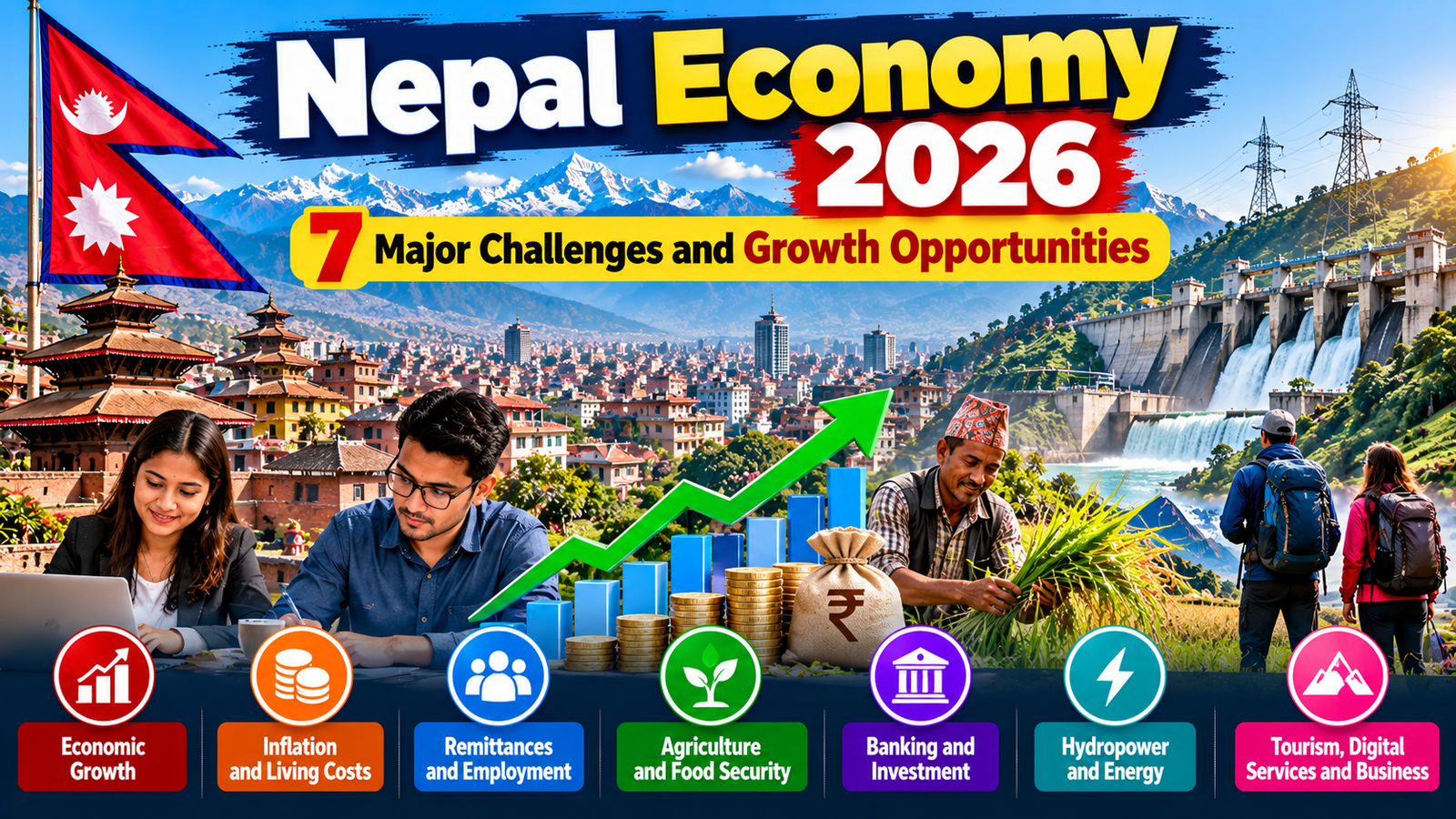
The Nepal economy 2026 is facing a critical period as the country attempts to strengthen economic growth, create employment, attract investment and recover from major disruptions. While hydropower development, remittances and tourism offer opportunities, challenges involving inflation, weak job creation, banking-sector risks and natural disasters continue to affect Nepal’s economic outlook.
According to the World Bank’s October 2026 Nepal Development Update, Nepal’s economy grew by an estimated 3.9% in fiscal year 2025/26, compared with 4.4% in the previous fiscal year.
The slowdown was partly associated with weaker agricultural production. Industrial growth, however, accelerated as electricity generation expanded.
Looking ahead, the World Bank projects economic growth of 3.7% in fiscal year 2026/27, reflecting the economic damage caused by the August 2026 Rasuwa flood and its effects on electricity, transport and business activity.
At the same time, Nepal Rastra Bank’s latest figures show consumer price inflation reaching 6.34% in mid-September 2026.
Despite these challenges, Nepal has several important economic strengths. Remittance inflows remain substantial, hydropower offers opportunities for electricity exports, and tourism continues to provide a foundation for employment and business development.
The central question is whether Nepal can transform these economic resources into productive investment, better employment and sustainable long-term growth.
This article examines seven major challenges and growth opportunities shaping Nepal’s economy in 2026, supported by official statistics and assessments from Nepal Rastra Bank, the World Bank, the International Monetary Fund and the Asian Development Bank.
Nepal Economy 2026: Current Economic Situation
Nepal is a developing economy where agriculture, services, industry, overseas employment and international trade all contribute to economic activity.
The country’s economic performance is influenced by domestic conditions and international developments.
Agricultural output depends heavily on weather and farming conditions. Tourism responds to international travel demand and infrastructure quality. Remittances depend partly on employment opportunities abroad.
Meanwhile, industrial activity is affected by electricity availability, investment, financing and transportation networks.
Nepal GDP Growth in 2026
Gross domestic product, or GDP, measures the value of goods and services produced within an economy.
Real GDP growth measures changes in economic output after adjusting for inflation.
The World Bank’s October 2026 assessment reported:
| Economic indicator | FY 2024/25 | FY 2025/26 |
|---|---|---|
| Real GDP growth | 4.4% | 3.9% |
| Agricultural sector growth | 3.0% | 1.6% |
| Industrial sector growth | 3.3% | 5.7% |
Source: World Bank, Nepal Development Update, October 2026.
The figures show that Nepal’s economy continued expanding, but at a slower pace.
Agriculture weakened while industry performed more strongly.
This distinction is important because different economic sectors do not always grow at the same rate.
Economic Growth Forecast for 2027
The World Bank’s 6 October 2026 forecast projected growth of 3.7% for FY 2026/27.
It also projected a recovery to 5.2% in FY 2027/28, supported partly by reconstruction and rehabilitation.
However, economic forecasts are uncertain.
Actual growth will depend on the pace of recovery, investment, weather conditions, international economic developments and policy implementation.
Earlier forecasts from the IMF and ADB differed because they were prepared before some later developments.
Readers should therefore distinguish forecasts by publication date.
Why Economic Growth Matters
Economic growth can support higher incomes, business expansion and government revenue.
However, GDP growth alone does not guarantee improved living standards.
An economy may expand without creating enough suitable jobs.
Benefits may also be unevenly distributed across regions and income groups.
For economic growth to improve everyday life, it needs to translate into productive employment, accessible services and greater household financial security.
1. Challenge: Slow Economic Growth and Weak Job Creation
One of Nepal’s most important economic challenges is creating sufficient productive employment.
Although the economy continues to expand, the pace and structure of growth may not generate the opportunities that workers need.
Why Job Creation Remains Difficult
Employment growth depends on investment, business expansion, skills and demand for goods and services.
Nepal faces constraints involving infrastructure, access to finance, productivity and the business environment.
The IMF’s August 2026 assessment identified stronger private investment and job creation as continuing priorities.
These challenges affect young people entering the labour market and workers seeking better-paying employment.
Youth Employment Challenges
Many young Nepalese pursue education and professional training with the expectation of securing stable careers.
However, qualifications do not automatically translate into suitable employment.
Some industries require specialised skills, while other sectors may offer limited opportunities for advancement.
The gap between education and labour-market requirements can contribute to frustration among jobseekers.
Overseas Employment and Migration
Overseas employment has become an important economic option for many Nepalese workers.
Employment abroad can provide higher earnings and opportunities to support families through remittances.
However, migration can also involve recruitment costs, workplace risks and family separation.
The existence of substantial remittance inflows should not be interpreted as evidence that overseas employment is always financially beneficial for every worker.
How Nepal Can Create More Jobs
Long-term employment growth requires investment in productive sectors.
Potential priorities include manufacturing, tourism, agriculture, food processing, renewable energy and digital services.
Vocational education and technical training can help workers develop skills needed by employers.
However, training programmes should be connected to real labour-market demand.
Opportunity: Supporting Small and Medium Businesses
Small and medium-sized enterprises can contribute to employment and local economic activity.
Restaurants, agricultural enterprises, repair services, manufacturing workshops and technology businesses may create jobs.
But entrepreneurship involves risk.
Businesses need reliable demand, appropriate financing, skilled workers and manageable operating costs.
Government policy can support business development through transparent regulations, efficient public services and dependable infrastructure.
2. Challenge: Inflation and Rising Household Expenses
Inflation is another major issue affecting the Nepal economy in 2026.
When consumer prices rise faster than household incomes, purchasing power declines.
This can make it more difficult for families to afford essential goods and services.
Latest Inflation Rate in Nepal
According to Nepal Rastra Bank’s report released on 15 October 2026, year-on-year consumer inflation reached 6.34% in mid-September.
The same report recorded:
| Category | Year-on-year inflation |
|---|---|
| Overall consumer prices | 6.34% |
| Food and beverages | 7.54% |
| Non-food goods and services | 5.69% |
These are changes in consumer price indices, not the prices of individual products.
For example, 7.54% food inflation does not mean every food item increased by that amount.
Why Inflation Affects Families Differently
Households spend money on different combinations of goods and services.
Families with children may devote a substantial share of income to food, education and housing.
People who travel frequently may be more affected by transportation costs.
Households with fixed incomes can face particular pressure when expenses rise.
Inflation and Consumer Spending
When essential expenses increase, households may reduce discretionary spending.
This can affect restaurants, retail businesses, entertainment services and other industries.
Businesses may experience lower demand even while their own operating costs increase.
Inflation therefore affects both consumers and enterprises.
What Causes Inflation?
Consumer prices are influenced by domestic and international factors.
These include agricultural production, transportation, imported energy prices, exchange rates and demand.
Supply disruptions can also affect prices.
However, different products respond to different influences.
It would be inaccurate to attribute every price increase to a single cause.
Opportunity: Improving Domestic Production
Greater agricultural productivity and more reliable supply chains may help reduce some supply-related pressures.
Investment in irrigation, storage, roads and food processing can support production and distribution.
However, these measures require effective implementation and do not guarantee immediate price reductions.
Protecting Household Purchasing Power
Families can manage some financial pressure through budgeting and careful spending decisions.
But household budgeting cannot replace the need for productive employment, stable markets and effective economic policy.
The long-term solution to affordability requires both income growth and a stable economic environment.
3. Challenge: Heavy Dependence on Remittances and Overseas Employment
Remittances are one of Nepal’s most important sources of foreign exchange.
They represent money transferred by Nepalese workers and other individuals living abroad.
These funds can support household consumption, education, healthcare, housing and savings.
Latest Remittance Figures
Nepal Rastra Bank’s October 2026 reporting showed remittance inflows of approximately NPR 436 billion during the first two months of FY 2026/27.
The central bank also reported workers’ remittances equivalent to 35.8% of GDP for FY 2025/26.
These figures use different reporting periods and measures.
The NPR 436 billion figure is a two-month flow, while 35.8% is a full-fiscal-year ratio.
They should not be directly compared as though they measure the same thing.
Why Remittances Are Important
Remittances provide foreign currency and support domestic spending.
They may help households pay for education, healthcare and housing.
At the national level, foreign exchange inflows can contribute to external financial stability.
The IMF’s August 2026 assessment highlighted stronger international reserves as one of Nepal’s important macroeconomic achievements.
Risks of Remittance Dependence
Dependence on overseas earnings creates exposure to economic conditions in destination countries.
Changes in foreign labour demand, migration policies or international conflicts can affect workers and remittance flows.
A slowdown in major destination economies could reduce income opportunities.
Remittance dependence can also reflect the limited availability of suitable employment at home.
Do Remittances Create Economic Growth?
Remittances can support economic activity through consumption, savings and investment.
However, their long-term impact depends on how funds are used and the wider investment environment.
Spending on imported goods may have different effects from investment in productive domestic enterprises.
Neither use should be judged without considering household needs and circumstances.
Opportunity: Productive Investment
Nepal has an opportunity to encourage voluntary investment of savings into viable businesses.
Potential areas include agriculture, tourism, renewable energy, manufacturing and local services.
However, families should not be pressured into risky investments.
Financial literacy, investor protection and transparent business information are essential.
Supporting Returning Migrants
Returning workers may bring professional skills, experience and savings.
Business support programmes and recognition of acquired skills could help some returnees establish enterprises or find employment.
But successful reintegration requires realistic opportunities, not simply encouraging everyone to start a business.
4. Challenge: Weak Agricultural Productivity and Climate Risks
Agriculture remains important to Nepal’s economy and rural livelihoods.
However, agricultural production is vulnerable to weather conditions, infrastructure limitations and productivity challenges.
Agricultural Growth Slowed in 2026
The World Bank’s October 2026 report estimated agricultural growth of 1.6% in FY 2025/26, compared with 3.0% in FY 2024/25.
The slowdown was partly associated with weaker paddy production.
The World Bank reported a 4.2% contraction in paddy output.
It linked the decline to adverse weather, including drought during the transplantation period in Madhesh and excessive rainfall during the October 2025 harvest.
Why Agriculture Matters
Agriculture provides food, livelihoods and inputs for other industries.
Weak production can affect farm income, food supply and related economic activity.
Rural households may be particularly vulnerable when crops fail or market access is disrupted.
Climate Change and Agricultural Risk
Agriculture depends on temperature, rainfall and water availability.
Changing weather patterns can increase uncertainty.
Floods, droughts and landslides may damage crops, roads and irrigation infrastructure.
Climate resilience is therefore an economic priority, not only an environmental issue.
Opportunity: Modern Farming
Modern agricultural methods may help improve productivity where suitable.
Examples include improved irrigation, protected cultivation, better storage and appropriate mechanisation.
Digital market information can also help some farmers make informed decisions.
However, new technology is not automatically profitable.
Farmers need access to training, financing, maintenance and markets.
Agricultural Processing
Food processing can create additional value from agricultural products.
Potential activities include dairy processing, fruit preservation, grain milling and packaged foods.
These businesses may generate employment and reduce certain post-harvest losses.
But they require food safety controls, reliable supplies and sufficient customer demand.
Improving Market Access
Farmers need dependable routes to markets.
Road maintenance, storage facilities and transparent trading arrangements can improve distribution.
Reducing avoidable losses may benefit both producers and consumers.
However, infrastructure investment should be based on local conditions and economic feasibility.
5. Challenge: Banking-Sector Risks and Limited Productive Investment
A healthy financial system is important for economic development.
Banks and other financial institutions help channel savings into loans and investment.
However, financial-sector weaknesses can restrict lending and reduce confidence.
Rising Non-Performing Loans
The World Bank’s October 2026 report stated that Nepal’s gross non-performing loan ratio reached 5.7% by mid-July 2026.
A non-performing loan is generally a loan where repayment has become seriously overdue under the applicable classification rules.
A higher NPL ratio indicates deterioration in loan quality.
This can require banks to increase provisions for potential losses.
Why Non-Performing Loans Matter
When borrowers struggle to repay loans, banks may become more cautious about new lending.
This can affect businesses seeking financing for expansion.
Financial institutions may also face lower profitability.
However, a higher NPL ratio does not automatically mean that every bank is unsafe.
Financial resilience depends on capital, liquidity, governance and other indicators.
Banking Capital Buffers
The World Bank reported an aggregate capital adequacy ratio of 12.8% at the end of FY 2025/26.
This was above the 11% regulatory minimum cited in the report.
The figure suggests that the banking system retained capital buffers despite worsening loan quality.
Nevertheless, financial-sector risks require continued supervision.
Private Investment Challenges
Businesses may hesitate to invest when economic conditions are uncertain.
Concerns about demand, financing, regulations and infrastructure can affect decisions.
The IMF has identified stronger private investment as an important priority for Nepal.
Opportunity: Better Access to Finance
Productive businesses need suitable financial services.
Potential improvements include transparent lending procedures, better credit assessment and stronger borrower protections.
However, easier access to credit should not mean encouraging unsustainable borrowing.
Financing should support economically viable activities.
Financial Regulation and Confidence
Strong banking supervision can help maintain confidence in the financial system.
The IMF’s August 2026 assessment noted progress in financial oversight while identifying continuing vulnerabilities, including in savings and credit cooperatives.
Improved governance and risk management remain important for long-term stability.
6. Opportunity: Hydropower, Electricity Exports and Industrial Growth
Hydropower is one of Nepal’s most important potential sources of long-term economic development.
The country’s rivers provide opportunities to generate electricity for domestic consumption and export.
However, hydropower also faces environmental, financial and infrastructure challenges.
Industrial Growth in 2026
The World Bank reported that Nepal’s industrial sector grew by 5.7% in FY 2025/26.
This compared with 3.3% in the previous fiscal year.
The report identified a 21% expansion in electricity generation and higher hydropower capacity as important contributors.
This demonstrates the potential relationship between energy infrastructure and industrial development.
Why Electricity Matters for Businesses
Reliable electricity supports manufacturing, hospitality, communications and other services.
Businesses need dependable power for machinery, refrigeration, lighting and digital equipment.
An improved electricity supply can reduce disruptions and support productivity.
However, the benefits depend on transmission infrastructure, pricing and reliability.
Electricity Export Opportunities
Nepal has opportunities to sell electricity to neighbouring markets.
Cross-border electricity trade can create revenue and strengthen regional energy cooperation.
However, exports depend on transmission capacity, regulatory agreements and demand.
Hydropower projects also require substantial capital investment.
The Impact of the August 2026 Flood
The World Bank’s 6 October 2026 assessment highlighted extensive damage caused by the August 26 Rasuwa flood.
The disaster affected hydropower, solar energy, electricity transmission and transport infrastructure.
These disruptions contributed to the downward revision of the FY 2026/27 growth forecast.
This illustrates an important challenge: energy infrastructure can support economic growth while remaining exposed to natural hazards.
Opportunity: Climate-Resilient Energy Investment
Future hydropower development needs careful environmental assessment and disaster-risk planning.
Project design should consider floods, landslides and changing river conditions.
Reliable transmission networks and appropriate maintenance are also essential.
Electric Vehicles and Domestic Electricity
Electric vehicles create an additional opportunity to use electricity in transportation.
Greater electric mobility could reduce some demand for imported petroleum products.
However, EV adoption requires charging infrastructure, affordable vehicles and responsible battery management.
The economic benefits depend on the full cost of transportation and the reliability of electricity supply.
Industrial Development
Greater electricity availability may support food processing, manufacturing and other industries.
But electricity alone cannot guarantee industrial growth.
Businesses also need transport networks, skilled workers, finance and access to markets.
Hydropower should therefore be considered one part of a wider development strategy.
7. Opportunity: Tourism, Digital Services and Entrepreneurship
Tourism, digital services and entrepreneurship offer additional opportunities for Nepal’s economy.
These sectors can create employment, support small businesses and diversify sources of income.
Tourism’s Economic Role
Nepal attracts visitors interested in mountains, trekking, cultural heritage, wildlife and other experiences.
Tourism supports accommodation providers, restaurants, transport businesses, guides and related services.
International visitors can also generate foreign exchange earnings.
However, tourism demand depends on international travel conditions, safety, accessibility and infrastructure.
Tourism Challenges in 2026
The World Bank’s October 2026 outlook identified disruptions to tourism and transport following the Rasuwa flood.
International economic uncertainty can also affect travel decisions.
Tourism businesses therefore face risks that are not entirely within their control.
Opportunity: Sustainable Tourism
Nepal can strengthen tourism by improving service quality, environmental management and infrastructure.
Community-based tourism may help distribute some economic benefits beyond major destinations.
However, tourism development should consider environmental pressures and local community interests.
Digital Services and Remote Work
Digital technology can create opportunities in software development, design, digital marketing and other services.
Some Nepalese professionals may be able to serve international clients remotely.
However, income opportunities depend on skills, client demand, internet access and payment arrangements.
Online work should not be presented as guaranteed income.
Digital Payments
Digital payment systems can make some transactions more convenient for consumers and businesses.
They may also support recordkeeping and formal financial services.
However, digital financial services require cybersecurity awareness and consumer protection.
Entrepreneurship and Startups
Entrepreneurship can help develop new products and services.
Potential sectors include technology, food services, tourism, education and agriculture.
Successful businesses require more than an attractive idea.
Entrepreneurs need market research, financial planning, regulatory compliance and effective management.
Challenges Facing Startups
New businesses may face limited financing, uncertain demand and strong competition.
Some entrepreneurs may also struggle with administrative requirements or access to suitable premises.
Business development programmes should address these practical obstacles.
Opportunity: Building Local Value
Nepal can strengthen its economy by developing businesses that create value domestically.
Examples include food processing, specialised services, local manufacturing and technology solutions.
However, the commercial viability of each opportunity must be assessed individually.
Nepal’s Economic Outlook for 2027 and Beyond
The economic outlook remains uncertain.
Different institutions have published forecasts based on the information available at different times.
Comparing Major Forecasts
| Institution | Forecast or estimate | Publication |
|---|---|---|
| World Bank | FY 2025/26 growth: 3.9% | October 2026 |
| World Bank | FY 2026/27 growth: 3.7% | 6 October 2026 |
| World Bank | FY 2027/28 growth: 5.2% | 6 October 2026 |
| Asian Development Bank | FY 2026/27 growth: 4.5% | July 2026 |
| IMF | FY 2026/27 growth: 5.3% | June 2026 |
The forecasts differ because they were published at different times and reflect different assumptions.
The World Bank’s October forecast incorporates the effects of the August 2026 flood.
The earlier IMF and ADB projections should not be treated as equally current assessments of those later disruptions.
What Could Support Economic Recovery?
Reconstruction activity may support economic demand.
Improved agricultural production could contribute to growth.
Hydropower development, tourism and private investment may also create opportunities.
However, progress depends on implementation and economic conditions.
Major Risks
Future growth could be affected by natural disasters, international energy prices, financial-sector weaknesses and policy uncertainty.
Weak capital expenditure implementation may also limit the effectiveness of public investment.
These risks reinforce the importance of economic resilience.
Government Spending and Public Investment Challenges
Government investment can support roads, schools, hospitals, energy infrastructure and other public services.
However, the economic benefits depend on how projects are selected and implemented.
Capital Expenditure Performance
The World Bank’s October 2026 report stated that Nepal’s capital expenditure execution fell to 46.8% in FY 2025/26.
This was described as a record low.
The figure indicates substantial difficulty implementing planned capital spending.
Why Low Capital Spending Matters
Delayed public investment can postpone infrastructure improvements.
Construction businesses and suppliers may also be affected.
When planned projects are not completed on time, expected economic benefits may arrive later than anticipated.
Improving Project Implementation
Possible priorities include stronger project preparation, realistic budgets, transparent procurement and effective monitoring.
However, increasing spending alone does not guarantee better results.
Public investment should deliver useful services and infrastructure at reasonable cost.
Public Debt
The World Bank reported that public debt increased from 43.0% of GDP in FY 2024/25 to 45.1% in FY 2025/26.
It nevertheless assessed Nepal as remaining at low risk of debt distress.
This distinction matters.
A rising debt ratio is not automatically evidence of an immediate debt crisis.
Debt sustainability depends on financing terms, economic growth, government revenue and other factors.
What Does Nepal’s Economy Mean for Ordinary Families?
National economic statistics matter because they influence employment, incomes, prices and public services.
However, changes in GDP do not affect every household equally.
Employment and Income
Economic growth may create opportunities when businesses expand and hire workers.
But some sectors can grow without employing large numbers of people.
Cost of Living
Inflation affects purchasing power.
Families need to compare income growth with changes in essential expenses.
Savings and Borrowing
Interest rates and financial conditions can affect borrowers and savers.
Households should assess loan affordability carefully.
Business Opportunities
Economic development may create opportunities for entrepreneurs.
However, business decisions should be based on local demand, costs and financial capacity.
Education and Skills
Economic change can increase demand for particular skills.
Students should investigate actual employment requirements rather than assuming every popular course leads to a job.
Five Priorities for Stronger Economic Development
Nepal’s long-term economic performance depends on multiple policy areas.
1. Create Productive Employment
Encourage viable private investment and improve links between education and labour-market demand.
2. Improve Infrastructure
Prioritise reliable roads, electricity, digital connectivity and climate-resilient public assets.
3. Strengthen Financial Stability
Address loan-quality problems, improve supervision and support responsible lending.
4. Increase Agricultural Productivity
Support appropriate irrigation, storage, technology and market access.
5. Improve Public Investment Management
Select realistic projects, strengthen procurement and monitor implementation.
These priorities are interconnected.
For example, a manufacturing business may need reliable electricity, trained workers, transport access and financing at the same time.
Addressing only one constraint may not be sufficient.
Frequently Asked Questions About Nepal Economy 2026
1. What is Nepal’s GDP growth rate in 2026?
The World Bank’s October 2026 report estimated real GDP growth of 3.9% for fiscal year 2025/26.
2. What is Nepal’s economic growth forecast for 2027?
The World Bank projected 3.7% growth for fiscal year 2026/27 in its October 2026 update. This is a forecast, not an achieved result.
3. What is Nepal’s inflation rate in October 2026?
The latest NRB report available as of 19 October recorded year-on-year inflation of 6.34% in mid-September 2026.
4. What are the biggest challenges facing Nepal’s economy?
Major challenges include weak job creation, inflation, agricultural vulnerability, financial-sector risks, limited productive investment and exposure to natural disasters.
5. How important are remittances to Nepal?
Remittances are a major source of foreign exchange and household income. NRB reported approximately NPR 436 billion in remittance inflows during the first two months of FY 2026/27.
6. Is Nepal’s economy growing or shrinking?
The World Bank estimated positive GDP growth of 3.9% for FY 2025/26. This means the economy expanded overall, although growth slowed compared with the previous year.
7. Why is Nepal’s economic growth slowing?
The World Bank identified weaker agricultural performance in FY 2025/26 and later flood-related disruptions affecting the FY 2026/27 outlook.
8. What is the role of hydropower in Nepal’s economy?
Hydropower supports electricity generation, industrial activity and potential exports. However, projects face financial, environmental and disaster-related risks.
9. Is tourism important for Nepal’s economy?
Yes. Tourism supports accommodation, transport, hospitality and other services. However, it is vulnerable to disruptions and changes in international demand.
10. Why do many Nepalese workers go abroad?
Reasons vary but may include employment opportunities, income expectations, career development and personal circumstances.
11. What is the condition of Nepal’s banking sector?
The World Bank reported a gross non-performing loan ratio of 5.7% by mid-July 2026, while aggregate capital adequacy remained above the cited regulatory minimum.
12. Can startups help Nepal’s economy?
Viable startups can contribute to employment, innovation and services. However, outcomes depend on market demand, financing and management.
13. What happened to agriculture in 2026?
The World Bank estimated agricultural growth of 1.6% in FY 2025/26, down from 3.0% in the previous year, partly because of weaker paddy production.
14. Is Nepal facing a debt crisis?
The World Bank’s October 2026 assessment stated that Nepal remained at low risk of debt distress, despite an increase in public debt.
15. What are Nepal’s biggest future economic opportunities?
Potential opportunities include hydropower, tourism, productive agriculture, manufacturing, digital services and entrepreneurship.
16. What can improve Nepal’s economy?
Stronger employment creation, productive investment, infrastructure, financial supervision, agricultural resilience and effective public spending can support long-term development.
Conclusion: Can Nepal Build a Stronger Economy?
The Nepal economy 2026 presents a combination of serious challenges and important opportunities.
Economic growth remains positive, but the World Bank’s latest assessment shows that the pace of expansion has slowed.
Agricultural weakness, inflation, financial-sector risks and the economic damage caused by natural disasters are creating pressure.
At the same time, Nepal has strengths that could support future development.
Remittances provide substantial foreign exchange inflows.
Hydropower development has contributed to industrial growth.
Tourism, digital services and entrepreneurship offer opportunities to diversify economic activity.
However, these opportunities will not automatically produce widespread prosperity.
Nepal needs stronger productive investment, more suitable employment, reliable infrastructure and effective public institutions.
The country’s long-term success should be measured not only by GDP growth but also by improvements in incomes, job quality, public services and household financial security.
The most important challenge is turning economic potential into practical improvements in people’s lives.
With effective policies, responsible investment and stronger resilience to future shocks, Nepal has opportunities to build a more diversified and sustainable economy.
Related Economic Developments in Nepal
Nepal’s economic future is closely connected to several important sectors. The rising cost of living in Nepal affects household purchasing power, while hydropower development creates opportunities for renewable electricity and industrial growth.
The expansion of electric vehicles in Nepal could help reduce dependence on imported petroleum, while tourism continues to support employment and local businesses.
Young Nepalese interested in developing additional income sources can also explore how to get their first client on Fiverr and other digital career opportunities.
References and Official Sources
1. World Bank (6 October 2026). Nepal’s Growth Projected to Slow Following Devastating Rasuwa Flood.
2. World Bank (October 2026). Nepal Development Update: Building Back Differently for the Future.
https://www.worldbank.org/en/country/nepal/publication/nepaldevelopmentupdate
3. Nepal Rastra Bank (15 October 2026). Current Macroeconomic and Financial Situation of Nepal, Based on Two Months’ Data of 2026/27.
4. International Monetary Fund (19 August 2026). Nepal Stabilizes Its Economy—and Sets Its Sights Higher.
5. International Monetary Fund (8 June 2026). 2026 Article IV Consultation and Seventh Review Under the Extended Credit Facility.
6. Asian Development Bank (July 2026). Asian Development Outlook, July 2026.
https://www.adb.org/outlook/editions/july-2026
7. National Statistics Office, Nepal. National Accounts and Economic Statistics.
Editorial note: This article reflects information available as of 19 October 2026. GDP estimates, forecasts, inflation rates and remittance figures refer to different reporting periods. Projections may change as new information becomes available. The article does not present illustrative opportunities as guaranteed economic outcomes.

