


Kathmandu, 19 October 2026 | Eleven Nepal | Technology & Economy
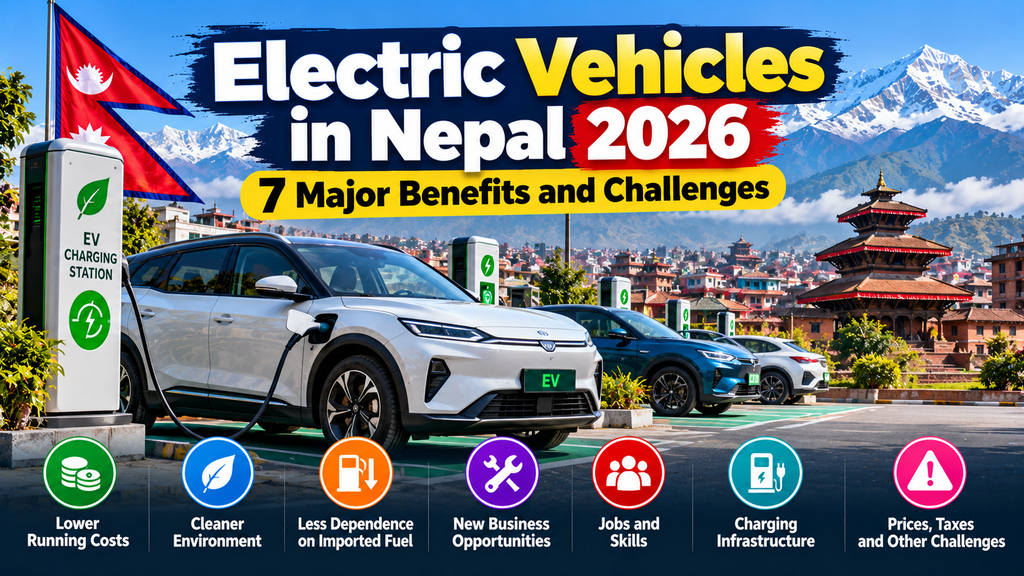
Electric vehicles in Nepal 2026 are transforming the country’s transportation sector as more drivers consider electric cars, scooters, buses and other battery-powered vehicles. Rising interest in cleaner transport, the expansion of charging infrastructure and Nepal’s domestic hydropower resources have created new opportunities for electric mobility.
Electric vehicles, commonly known as EVs, are increasingly visible on roads in Kathmandu, Pokhara, Bharatpur and other urban centres. Consumers are exploring alternatives to petrol and diesel vehicles, while businesses are considering electric transportation for deliveries, passenger services and commercial operations.
According to Department of Customs figures reported by New Business Age in August 2026, Nepal imported 31,532 electric vehicles during fiscal year 2025/26, compared with 30,083 in the previous fiscal year. This represents an increase of approximately 4.8% within the reported vehicle categories.
China remained the largest supplier, accounting for 26,032 imported EVs, or approximately 82.6% of the reported total.
These figures demonstrate the importance of electric mobility in Nepal’s vehicle import market. However, they do not mean that 31,532 electric passenger cars were sold to individual customers. The reported total includes different vehicle categories.
At the same time, Nepal’s EV sector faces important challenges. Charging stations remain unevenly distributed, vehicle prices can be high, battery replacement is expensive, and changes in government taxation have created uncertainty for buyers and importers.
The 2026/27 national budget introduced a revised taxation structure that could significantly affect the prices of some imported electric vehicles.
Understanding these developments is important for consumers, entrepreneurs, transport operators and policymakers.
This article examines seven major benefits and challenges of electric vehicles in Nepal, using available 2026 evidence and explaining what buyers should consider before investing in electric transportation.
Electric Vehicles in Nepal 2026: Current Market Overview
Nepal’s electric vehicle market has developed rapidly in recent years.
The country imports electric cars, scooters, three-wheelers, buses and other vehicles from international manufacturers.
Chinese manufacturers play a particularly important role in the market, alongside suppliers from India and other countries.
Latest Electric Vehicle Import Statistics
According to Department of Customs data reported by New Business Age in August 2026:
- Nepal imported 31,532 electric vehicles during fiscal year 2025/26.
- The comparable reported total for fiscal year 2024/25 was 30,083 vehicles.
- Imports increased by approximately 4.8%.
- China supplied 26,032 vehicles.
- India supplied 4,640 vehicles.
- Thailand supplied 824 vehicles.
China accounted for approximately 82.6% of imports within this dataset, while India represented around 14.7%.
Thailand emerged as an additional supplier, particularly in the electric passenger vehicle segment.
These figures are useful for understanding the geographical sources of Nepal’s EV imports.
However, import data should not be confused with vehicle registrations, sales to final consumers or the total number of EVs operating on Nepalese roads.
Different reports may also cover different categories of electric vehicles.
For accurate comparisons, readers should use datasets with consistent definitions and reporting periods.
Source: New Business Age, August 2026, citing Nepal’s Department of Customs.
Why Are Electric Vehicles Becoming Popular?
Several factors help explain growing interest in electric mobility.
Electric vehicles use electricity instead of petrol or diesel for propulsion.
Nepal produces substantial quantities of electricity through hydropower, creating an opportunity to connect domestic energy production with transportation.
Consumers may also be attracted by lower energy costs per kilometre, quieter operation and reduced routine maintenance requirements.
However, the overall cost of owning an EV depends on the purchase price, electricity tariff, driving distance, battery condition, insurance and other expenses.
Not every electric vehicle is cheaper than every petrol vehicle.
Common Types of Electric Vehicles in Nepal
Nepal’s electric mobility market includes several categories.
Electric cars: Passenger vehicles powered by rechargeable batteries.
Electric scooters and motorcycles: Two-wheelers used for commuting and short-distance transportation.
Electric three-wheelers: Vehicles used for passenger transport and certain commercial purposes.
Electric buses: Larger vehicles designed for public transportation.
Electric commercial vehicles: Vehicles intended for deliveries, cargo movement and business operations.
Each category has different requirements for charging, range, maintenance and infrastructure.
1. Benefit: Lower Running Costs Compared With Petrol Vehicles
One of the main reasons people consider electric vehicles in Nepal 2026 is the possibility of reducing daily transportation costs.
Electric vehicles consume electricity rather than petrol or diesel.
When electricity is relatively affordable, the energy cost of driving an EV can be lower than that of a comparable conventional vehicle.
How Much Does It Cost to Charge an Electric Car?
The cost of charging depends on the electricity tariff and the amount of energy consumed.
Consider a hypothetical electric car that consumes 15 kilowatt-hours (kWh) of electricity per 100 kilometres.
If electricity costs NPR 12 per kWh, the energy cost would be:
15 kWh × NPR 12 = NPR 180 per 100 kilometres.
This equals approximately NPR 1.80 per kilometre.
Now consider a hypothetical petrol car consuming 6 litres per 100 kilometres.
If petrol costs NPR 170 per litre, the fuel cost would be:
6 litres × NPR 170 = NPR 1,020 per 100 kilometres.
This equals approximately NPR 10.20 per kilometre.
Illustrative Energy Cost Comparison
| Item | Electric car | Petrol car |
|---|---|---|
| Energy consumption | 15 kWh/100 km | 6 L/100 km |
| Assumed energy price | NPR 12/kWh | NPR 170/L |
| Cost per 100 km | NPR 180 | NPR 1,020 |
| Cost per 1,000 km | NPR 1,800 | NPR 10,200 |
| Cost per 10,000 km | NPR 18,000 | NPR 102,000 |
Under these assumptions, the electric car’s energy expenditure would be NPR 84,000 lower over 10,000 kilometres.
Important: These are illustrative calculations, not verified October 2026 electricity or petrol prices. They exclude charging losses, charging service fees, maintenance, insurance, financing and depreciation.
Real costs vary significantly.
Why Driving Conditions Matter
Electricity consumption depends on vehicle weight, speed, terrain, temperature and driving behaviour.
Nepal’s steep roads can increase energy consumption when climbing.
Regenerative braking may recover some energy during downhill driving, but it does not eliminate the energy required for climbing.
Air conditioning, heating and vehicle load can also affect range.
Therefore, buyers should consider their actual driving conditions rather than relying only on manufacturer estimates.
Long-Term Savings
Lower energy expenditure may produce meaningful savings for people who drive frequently.
Taxi operators, delivery businesses and commuters covering substantial distances may have particular interest in EV operating costs.
However, a higher purchase price can offset some of these savings.
A proper ownership-cost comparison should include the entire period of vehicle use.
2. Benefit: Reduced Tailpipe Pollution and Cleaner Urban Transport
Air pollution is a major concern in many urban areas.
Conventional petrol and diesel vehicles produce exhaust emissions during operation.
Battery-electric vehicles do not produce exhaust emissions from a tailpipe.
This can help reduce local transport-related pollution when electric vehicles replace combustion-engine vehicles.
Why Zero Tailpipe Emissions Matter
Petrol and diesel vehicles emit pollutants during fuel combustion.
These include nitrogen oxides and particulate pollution, depending on vehicle technology and operating conditions.
Electric vehicles avoid these direct exhaust emissions.
This is particularly relevant in areas with heavy traffic.
However, EVs are not completely pollution-free.
Tyres, brakes and road wear can still contribute particulate pollution.
Vehicle manufacturing and battery production also have environmental impacts.
Are Electric Vehicles Completely Environmentally Friendly?
No.
The environmental performance of an EV depends on its entire lifecycle.
Important factors include:
- Raw materials used in battery manufacturing.
- Electricity generation sources.
- Vehicle manufacturing emissions.
- Total distance driven.
- Battery durability.
- Recycling and disposal practices.
An EV charged using low-carbon electricity can offer substantial climate advantages compared with a similar petrol vehicle.
However, environmental benefits should be assessed over the vehicle’s lifecycle rather than only during driving.
Nepal’s Hydropower Advantage
Nepal generates most of its domestic electricity from hydropower.
This creates an opportunity for electric vehicles to operate using a relatively low-carbon domestic electricity source.
The World Bank’s October 2026 Nepal Development Update reported that electricity generation expanded by approximately 21% during fiscal year 2025/26.
The report identified increased hydropower capacity as an important contributor to industrial growth.
However, Nepal’s electricity system also experiences seasonal generation differences and electricity imports.
The environmental benefits of EV charging therefore depend partly on the electricity supplied at the time.
Cleaner Public Transportation
Electric buses and other electric public transport vehicles could reduce tailpipe emissions in busy urban corridors.
However, public transport electrification requires more than purchasing vehicles.
Operators also need reliable charging facilities, maintenance services, financing and appropriate route planning.
Electric buses may be particularly suitable for routes with predictable schedules and access to dedicated charging facilities.
3. Benefit: Reduced Dependence on Imported Petroleum
Another major advantage of electric vehicles in Nepal 2026 is the possibility of reducing demand for imported petroleum products.
Nepal imports petrol and diesel because it does not produce sufficient domestic petroleum fuel for its transportation needs.
This creates exposure to international energy prices and supply conditions.
Why Petroleum Imports Matter
Imported fuel requires foreign currency.
Changes in international prices can affect transportation costs and the wider economy.
Electric vehicles provide an alternative source of transport energy.
Instead of using imported petrol or diesel, EVs consume electricity that may be generated domestically.
This creates an opportunity to use Nepal’s hydropower resources more effectively.
Connecting Hydropower and Electric Mobility
Nepal’s electricity sector has expanded through public and private hydropower investment.
As more electricity becomes available, domestic consumption can help create demand for generating capacity.
Electric transportation is one possible source of this demand.
For example, electric buses, taxis and commercial vehicles can consume electricity that might otherwise be exported or remain unused during certain periods.
However, electricity availability varies by season and location.
EV adoption should therefore be coordinated with electricity system planning.
Energy Security Benefits
Reducing petroleum consumption may improve energy security over time.
However, electric vehicles also depend on imported batteries, electronic components and vehicles.
Consequently, EV adoption changes the structure of import dependence rather than eliminating it entirely.
Nepal may reduce some fuel imports while continuing to import EV technology and replacement parts.
Supporting Domestic Electricity Consumption
The Ministry of Energy, Water Resources and Irrigation has identified the expansion of electric transport and charging infrastructure as part of its broader energy-consumption strategy.
According to Radio Nepal’s report of 7 June 2026, government planning includes expanding charging facilities and encouraging electric buses.
This suggests that transportation electrification is becoming increasingly connected to Nepal’s energy policy.
4. Benefit: Lower Routine Maintenance Requirements
Electric vehicles generally have fewer moving parts in their propulsion systems than conventional petrol or diesel vehicles.
Battery-electric vehicles do not require engine oil changes associated with internal combustion engines.
They also do not have conventional engine components such as spark plugs or exhaust systems.
These differences can reduce some routine maintenance requirements.
Common EV Maintenance Tasks
Electric vehicles still require regular inspection and servicing.
Important maintenance items may include tyres, brakes, suspension, steering, air-conditioning systems and battery cooling equipment.
Electrical systems and charging components also need appropriate checks.
Vehicle owners should follow manufacturer maintenance schedules.
Regenerative Braking
Many EVs use regenerative braking.
This technology converts some of the vehicle’s kinetic energy into electricity during deceleration.
The recovered electricity is stored in the battery.
Regenerative braking may reduce the use of conventional friction brakes under suitable driving conditions.
However, brake components still require inspection and maintenance.
Battery Health
The traction battery is one of the most important and expensive EV components.
Battery performance changes over time because of age, usage, charging patterns and temperature exposure.
Manufacturers may provide battery warranties, but coverage varies.
Some warranties specify limits based on time, distance or minimum battery capacity.
Buyers should read the exact warranty conditions.
Availability of Skilled Technicians
A major challenge in Nepal is the availability of technicians trained to service high-voltage electric vehicle systems.
Electric vehicle repairs may require specialist equipment and safety procedures.
Owners should use qualified service providers, particularly for battery and high-voltage components.
Unauthorised repairs can create safety risks and may affect warranty coverage.
5. Benefit: New Business and Employment Opportunities
The expansion of electric vehicles in Nepal creates opportunities beyond vehicle sales.
The EV industry requires charging infrastructure, maintenance services, spare parts, technical training and related business support.
These activities can create new employment and entrepreneurship opportunities.
EV Charging Station Businesses
Charging facilities are becoming an important part of the electric mobility ecosystem.
Potential operators include service stations, hotels, restaurants, shopping centres and dedicated charging businesses.
A charging facility may attract customers who need to stop during longer journeys.
However, profitability depends on utilisation, electricity costs, equipment investment, maintenance and applicable charging fees.
A charging station in a location with limited EV traffic may struggle to recover its investment.
Opportunities for Hotels and Restaurants
Hospitality businesses located along major roads may benefit from offering charging facilities.
Customers waiting for their vehicles to charge may purchase meals, drinks or other services.
This creates a possible connection between electric transportation and hospitality.
However, businesses should conduct a feasibility study before investing.
Important considerations include local electricity capacity, equipment costs, parking space and expected demand.
Vehicle Maintenance and Repair
Electric vehicles require trained technicians.
This creates opportunities for automotive education, diagnostic services and specialist workshops.
Training may cover electrical safety, battery management, charging systems and vehicle electronics.
Battery Recycling and Waste Management
Battery management is another potential area of business development.
However, battery recycling requires appropriate technology, environmental safeguards and regulatory compliance.
It should not be treated as a simple small-business opportunity.
Lithium-ion batteries can create fire, chemical and electrical hazards if handled incorrectly.
Employment for Young Nepalese
The electric mobility sector may create roles for engineers, electricians, mechanics, sales professionals and charging infrastructure technicians.
Digital skills may also be relevant to vehicle diagnostics and charging-network management.
However, employment growth depends on actual investment and market demand.
Training providers and students should assess recognised qualifications and employer requirements.
6. Challenge: Charging Infrastructure and Driving Range
One of the most important challenges facing electric vehicles in Nepal 2026 is charging accessibility.
Although charging infrastructure has expanded, facilities are not equally distributed across the country.
Urban areas generally have more charging options than remote communities.
How Many EV Charging Stations Are in Nepal?
A government task force report discussed by Radio Nepal on 7 June 2026 estimated that approximately 1,000 charging stations were operating nationwide at that time.
The report stated that most facilities were concentrated in major urban areas, including Kathmandu, Pokhara and Bharatpur.
It also noted that NEA operated 62 fast chargers.
However, charging station counts vary according to the definition used.
Some reports count charging sites, while others count individual charging connectors or charging guns.
A single location may have multiple connectors.
Therefore, figures from different sources should not automatically be compared.
Government Charging Infrastructure Recommendation
The government task force recommended developing at least 10,000 charging stations by 2030.
This was a recommendation for future infrastructure expansion, not the number of stations already available.
Achieving such a target would require investment, suitable locations, electricity connections and operational planning.
Charging Problems Outside Major Cities
Drivers travelling to rural areas may find fewer charging facilities.
Long-distance journeys can therefore require more planning than urban commuting.
Charging availability is especially important on routes with steep terrain, limited services or unpredictable road conditions.
Range Anxiety
Range anxiety refers to concern that a vehicle may run out of battery power before reaching a charging facility.
The concern can be greater when drivers are unfamiliar with a route.
Vehicle range depends on battery capacity, driving conditions and energy consumption.
A manufacturer’s advertised range may differ from real-world performance.
How to Plan an EV Journey in Nepal
Drivers should check available charging locations before travelling.
They should also consider road gradients, weather, passenger load and possible traffic delays.
A sensible journey plan includes an alternative charging option where available.
Charging station availability should be confirmed through the relevant operator because stations may be temporarily unavailable.
Charging Time
Charging duration depends on battery capacity, charger power, vehicle charging capability and battery condition.
A high-power charger does not guarantee that every vehicle will charge at its maximum advertised output.
Charging can slow as the battery approaches a high state of charge.
For this reason, drivers should understand their vehicle’s charging characteristics before undertaking long journeys.
7. Challenge: EV Prices, Battery Costs and Changing Government Taxes
The purchase price remains a major consideration for electric vehicle buyers.
Although EVs may offer lower running costs, some models require a substantial initial investment.
Battery replacement costs and uncertainty about resale value can also influence purchasing decisions.
Nepal’s 2026 EV Tax Changes
Nepal’s fiscal year 2026/27 budget introduced significant changes to the taxation of imported electric vehicles.
According to reporting by The Kathmandu Post on 1 and 5 June 2026, the government replaced the previous EV excise-duty structure with a Clean Infrastructure Investment Fee, commonly abbreviated as CIIF.
The reported framework introduced a uniform 20% customs duty and additional CIIF rates based on the vehicle’s customs value.
The reported CIIF structure was:
| Customs value of EV | Reported CIIF rate |
|---|---|
| Up to NPR 2 million | 2.5% |
| Above NPR 2 million to NPR 3 million | 20% |
| Above NPR 3 million to NPR 4 million | 35% |
| Above NPR 4 million to NPR 5 million | 90% |
| Above NPR 5 million | 130% |
The reporting also described applicable VAT and road-related levies.
These rates refer to the reported budget framework, not the complete final tax payable on a particular vehicle.
The actual landed cost depends on customs valuation, applicable legislation, other charges and the way different taxes are calculated.
Why Tax Changes Matter
Import duties and related taxes can substantially influence retail prices.
When the tax structure changes, dealers may need to adjust pricing.
Some vehicle categories may be affected more heavily than others.
Buyers should therefore avoid relying on older price lists.
Policy Uncertainty
In August 2026, automobile industry representatives raised concerns about changing tax policies and inadequate infrastructure.
The Kathmandu Post reported that importers considered policy stability important for long-term business planning.
Frequent tax changes can make it difficult for consumers and businesses to predict future vehicle prices.
However, industry statements should be recognised as stakeholder perspectives rather than independent proof of every claimed market effect.
Battery Replacement Costs
EV batteries are expensive components.
Replacement costs depend on the vehicle model, battery chemistry, capacity, manufacturer and availability of parts.
There is no single reliable battery replacement price applicable to all EVs in Nepal.
Buyers should obtain model-specific information from authorised dealers.
Resale Value
Resale value depends on brand reputation, vehicle condition, battery health, warranty coverage and market demand.
Nepal’s used-EV market is still evolving.
Consequently, long-term resale values can be difficult to predict.
Consumers should avoid assuming that every EV will retain value better or worse than a petrol vehicle.
EV Charging Infrastructure in Nepal: What Needs to Improve?
Charging infrastructure is central to the long-term success of electric mobility.
Nepal needs more than a large number of chargers.
It needs reliable, accessible and appropriately located facilities.
Highway Charging Networks
Major highways are important because drivers need dependable charging during intercity journeys.
Facilities should be located according to traffic demand, travel distances and electricity availability.
Urban Charging
Urban drivers may charge at home, workplaces or public facilities.
However, people living in rented accommodation or apartments may not have access to private charging.
Public charging infrastructure is therefore important for broader adoption.
Reliable Electricity Supply
Charging stations depend on functioning electricity infrastructure.
Power interruptions can affect charging availability.
Grid upgrades may be necessary where multiple high-power chargers operate at the same location.
Transparent Charging Prices
Drivers need clear information about charging fees.
Pricing may be based on electricity consumption, charging time or other service arrangements.
Consumers should review the operator’s terms before charging.
Charger Compatibility
Not every charging connector is compatible with every vehicle.
Drivers should confirm that a charging station supports their vehicle’s charging standard.
Adapters and charging accessories should only be used according to manufacturer guidance.
Electric Cars vs Petrol Cars in Nepal: Which Is Better?
Choosing between an electric vehicle and a petrol vehicle depends on personal circumstances.
There is no single answer suitable for every driver.
Comparison of Electric and Petrol Vehicles
| Factor | Electric vehicle | Petrol vehicle |
|---|---|---|
| Energy source | Electricity | Petrol |
| Tailpipe emissions | None during operation | Produces exhaust emissions |
| Energy cost | Often lower per kilometre | Depends on fuel prices |
| Routine maintenance | Fewer engine-related tasks | Requires engine servicing |
| Refuelling or charging | Charging may take longer | Refuelling usually faster |
| Long-distance convenience | Depends on charger availability | Depends on fuel station access |
| Purchase price | Varies by model and taxes | Varies by model and taxes |
| Battery replacement | Potentially expensive | No EV traction battery |
| Resale value | Model and battery dependent | Model and condition dependent |
Who Might Benefit Most From an EV?
Drivers with predictable daily routes and convenient charging access may find EV ownership particularly suitable.
For example, someone who travels between home and work every day may be able to charge overnight.
Businesses operating vehicles on fixed routes may also be able to plan charging schedules.
Who Should Be More Cautious?
Drivers who frequently travel through remote areas without dependable charging may need to evaluate their options carefully.
People without access to home or workplace charging should also consider public charging availability.
A lower operating cost is less useful if charging creates significant inconvenience or business disruption.
How to Calculate the Total Cost of Owning an EV in Nepal
Consumers should compare the total cost of ownership rather than only the purchase price.
Total ownership cost includes the expenses associated with buying, operating, maintaining and eventually selling a vehicle.
Purchase Price
Start with the actual dealer quotation.
Check whether the price includes applicable taxes, registration and other charges.
Financing
If the vehicle is purchased through a loan, consider the interest rate, repayment period and additional fees.
Financing can substantially increase the total amount paid.
Electricity Costs
Estimate annual kilometres driven.
Multiply the vehicle’s expected energy consumption by the relevant electricity tariff.
Include charging losses and public charging fees where appropriate.
Maintenance
Ask the dealer for the recommended service schedule and expected servicing costs.
Insurance
Obtain an insurance quotation for the specific model.
Insurance costs vary according to vehicle value, coverage and insurer requirements.
Battery Warranty
Check the warranty period, mileage limit and capacity-retention conditions.
Depreciation
Estimate the likely resale value cautiously.
Do not rely on optimistic resale assumptions without evidence.
Illustrative Ownership Calculation
Suppose an EV costs NPR 4 million and a comparable petrol vehicle costs NPR 3.5 million.
The EV initially costs NPR 500,000 more.
If the EV saves NPR 84,000 annually in energy costs under the earlier illustrative assumptions, it would take approximately six years of those savings to offset the initial price difference.
However, this simplified comparison excludes financing, maintenance, insurance, charging equipment, depreciation and battery-related costs.
It is therefore not a complete break-even calculation.
The actual result could be better or worse.
Electric Vehicles and Nepal’s Hydropower Industry
Electric mobility and hydropower are closely connected.
Nepal’s rivers provide opportunities for renewable electricity generation.
Electric vehicles create additional domestic demand for that electricity.
This relationship could support the country’s energy transition.
Using Domestic Electricity
When EVs are charged using domestically generated electricity, they can reduce some dependence on imported transport fuels.
However, electricity imports during dry periods and other grid conditions must also be considered.
Opportunities for Charging Businesses
Charging infrastructure can create additional electricity demand and commercial opportunities.
Businesses may develop charging facilities in suitable locations.
However, financial viability depends on actual utilisation.
Supporting a Cleaner Transport System
Electric vehicles can contribute to reducing direct vehicle exhaust emissions.
Hydropower can support the electricity supply needed for this transition.
Nevertheless, both sectors require careful environmental management.
Hydropower development can affect river ecosystems, while EV battery production and disposal create separate environmental challenges.
A sustainable transport strategy must consider both.
Environmental Challenges: What Happens to Old EV Batteries?
Battery waste management is an emerging concern in Nepal.
As electric vehicle ownership expands, more batteries will eventually reach the end of their useful life.
These batteries require appropriate collection, handling and recycling or disposal.
Why Battery Waste Matters
Lithium-ion batteries contain materials that require careful management.
Damaged batteries can present fire and electrical hazards.
Improper disposal can create environmental risks.
Recycling Challenges
A July 2026 Nepal News investigation highlighted concerns about the country’s readiness to manage growing quantities of EV battery waste.
The report discussed gaps in recycling infrastructure and regulatory arrangements.
This is an important reminder that cleaner transport requires responsible management throughout the vehicle lifecycle.
Battery Reuse
Some batteries may be suitable for secondary applications after they are no longer appropriate for vehicle use.
However, reuse requires technical testing, safety assessment and appropriate system design.
Not every used EV battery is suitable for reuse.
What Nepal Needs
A stronger battery management system may require collection arrangements, technical standards, trained workers and environmental safeguards.
Clear responsibilities for manufacturers, importers, dealers and waste-management organisations are also important.
Consumers should seek guidance from authorised service providers rather than attempting to dismantle high-voltage batteries themselves.
Government Policies and the Future of Electric Vehicles in Nepal
Government policy strongly influences the development of electric mobility.
Taxes, charging infrastructure, electricity tariffs and vehicle standards can all affect adoption.
Stable Tax Policies
Predictable taxation can help consumers and businesses make long-term decisions.
However, governments must also consider revenue requirements and wider transport policy objectives.
Charging Infrastructure Investment
Public and private investment will be necessary to improve charging access.
Government planning should consider both major cities and underserved routes.
Public Transportation Electrification
Electric buses and other public transport vehicles may provide substantial benefits where routes and charging infrastructure are suitable.
However, fleet operators must evaluate costs, reliability and operational requirements.
Technical Training
EV expansion requires skilled technicians.
Training institutions may need to develop programmes covering electrical safety, batteries, charging systems and vehicle diagnostics.
Consumer Protection
Consumers need clear information about vehicle warranties, battery performance and service availability.
Transparent advertising and reliable after-sales support can help build confidence.
What Should You Check Before Buying an Electric Vehicle in Nepal?
Buying an EV is a major financial decision.
Before purchasing, consumers should evaluate the vehicle and the supporting infrastructure.
Check the Real-World Range
Ask how the vehicle performs under conditions similar to your normal journeys.
Consider hills, traffic, weather and passenger load.
Check Charging Access
Identify reliable charging options near home, work and frequently travelled routes.
Compare Total Ownership Costs
Include purchase price, financing, electricity, maintenance, insurance and depreciation.
Review Battery Warranty
Understand the exact warranty terms and exclusions.
Check Service Availability
Confirm that qualified technicians and spare parts are available.
Verify Current Prices
Ask for a written quotation that reflects applicable taxes and charges.
Test Drive the Vehicle
A test drive can help assess comfort, handling and suitability for Nepal’s roads.
Research the Dealer
Choose a reputable seller with clear after-sales support.
Understand Charging Compatibility
Confirm which public chargers can be used with the vehicle.
Avoid Unrealistic Claims
Be cautious of advertisements promising guaranteed savings, unlimited battery life or unrealistic driving range.
Frequently Asked Questions About Electric Vehicles in Nepal 2026
1. Are electric vehicles popular in Nepal in 2026?
Electric vehicles have become increasingly important in Nepal’s vehicle market. Department of Customs figures reported in August 2026 show 31,532 EV imports during fiscal year 2025/26 within the reported categories.
2. Are electric cars cheaper to operate than petrol cars?
They can have lower energy costs per kilometre, depending on electricity tariffs, petrol prices and vehicle efficiency. Total ownership costs also depend on purchase price, maintenance, insurance and depreciation.
3. How many EV charging stations are there in Nepal?
A government study discussed in June 2026 estimated approximately 1,000 charging stations nationwide at that time. Counts vary depending on whether sources measure locations, chargers or individual connectors.
4. What is Nepal’s EV charging station target?
A government task force recommended developing at least 10,000 charging stations by 2030. This is a future recommendation, not an achieved figure.
5. Are electric vehicles environmentally friendly?
EVs produce no tailpipe exhaust emissions during operation. However, battery manufacturing, electricity generation, vehicle production and end-of-life disposal all affect their environmental footprint.
6. Which country supplies the most EVs to Nepal?
China was the largest supplier in fiscal year 2025/26, accounting for approximately 82.6% of the 31,532 EV imports reported in the cited dataset.
7. Did EV taxes change in Nepal in 2026?
Yes. The fiscal year 2026/27 budget introduced a revised EV tax structure involving customs duty and a Clean Infrastructure Investment Fee. Buyers should verify current legally applicable rates before purchasing.
8. Can electric vehicles travel long distances in Nepal?
Yes, but suitability depends on battery range, terrain, weather and charging infrastructure. Drivers should plan charging stops and confirm station availability.
9. How long does an EV battery last?
Battery lifespan varies by model, chemistry, usage and operating conditions. Consumers should review the manufacturer’s warranty and battery-health information rather than assuming a universal lifespan.
10. Are EV batteries expensive to replace?
Replacement can be expensive, but costs vary considerably. Buyers should request model-specific information from authorised dealers.
11. Can I charge an electric car at home in Nepal?
Home charging may be possible where suitable electrical infrastructure and manufacturer-approved equipment are available. Installation should be assessed by a qualified electrician.
12. Are electric scooters a good option for students?
Electric scooters may suit students with predictable daily journeys and convenient charging access. Buyers should compare range, safety, purchase cost, warranty and service availability.
13. Can electric vehicles reduce Nepal’s petroleum imports?
Greater EV adoption can reduce demand for petrol and diesel when electric vehicles replace conventional vehicles. However, EVs and their components are generally imported, so overall trade effects are more complex.
14. What are the biggest problems with EVs in Nepal?
Major challenges include charging availability, purchase costs, battery replacement, uneven infrastructure, after-sales service and changing government policies.
15. What is the future of electric vehicles in Nepal?
Nepal has opportunities to expand electric mobility through domestic electricity generation, charging infrastructure and cleaner transportation. Future growth will depend on affordability, reliable services, policy stability and consumer confidence.
Conclusion: Are Electric Vehicles the Future of Nepal?
Electric vehicles in Nepal 2026 represent an important change in the country’s transportation sector.
Growing imports, expanding charging infrastructure and interest in domestic electricity consumption demonstrate the increasing role of electric mobility.
Electric vehicles offer several potential advantages, including lower energy costs, reduced tailpipe emissions, fewer routine engine-related maintenance requirements and reduced dependence on imported petroleum.
The industry may also create opportunities for charging businesses, technicians, transport operators and entrepreneurs.
However, the transition is not without challenges.
Charging infrastructure remains unevenly distributed, battery replacement can be expensive, and changes in taxation can affect vehicle affordability.
Environmental issues related to battery production and disposal also require attention.
The most successful transition will depend on reliable charging networks, transparent consumer information, skilled workers and stable long-term planning.
For individual buyers, an electric vehicle can be a practical choice when its range, charging requirements and total ownership cost match their needs.
For businesses, electric transportation may offer operational benefits when supported by suitable infrastructure.
For Nepal, the opportunity is to connect cleaner transportation with domestic renewable electricity while managing the financial, environmental and technical challenges responsibly.
Electric vehicles are likely to remain an important part of Nepal’s transportation future, but their long-term success will depend on more than the number of cars imported.
It will depend on whether electric mobility becomes affordable, reliable and accessible for people across the country.
How Electric Vehicles Support Nepal’s Digital Economy
The growth of electric vehicles in Nepal 2026 is closely connected to the country’s wider economic development. Expanding hydropower in Nepal can provide renewable electricity for charging infrastructure, while improvements in digital payments in Nepal can make charging transactions more convenient.
Electric mobility may also support tourism in Nepal, particularly as hotels and restaurants introduce charging facilities for travellers. Entrepreneurs interested in charging stations, vehicle maintenance and other services can explore opportunities for starting a business in Nepal.
References and Credible Sources
1. New Business Age (August 2026). China Extends Dominance in Nepal’s EV Market as Thailand Emerges as New Contender. Based on Department of Customs figures for fiscal year 2025/26.
2. The Kathmandu Post (1 June 2026). Revised Tax Slabs Threaten EV Boom in Nepal. Reporting on the fiscal year 2026/27 budget’s EV tax changes.
https://kathmandupost.com/money/2026/06/01/revised-tax-slabs-threaten-ev-boom-in-nepal
3. The Kathmandu Post (5 June 2026). Probe Launched into 776 EVs Imported in Run-Up to Budget. Includes details of the revised tax framework.
https://kathmandupost.com/money/2026/06/05/probe-launched-into-776-evs-imported-in-run-up-to-budget
4. Radio Nepal (7 June 2026). At Least 10,000 EV Charging Stations Needed Across the Country. Reporting on a government task force study and charging infrastructure recommendations.
5. The Kathmandu Post (10 August 2026). Traders Complain of Policy Uncertainty, Poor Infrastructure in EV Market.
6. World Bank (October 2026). Nepal Development Update. Economic growth, electricity generation and hydropower developments.
7. Ministry of Finance, Government of Nepal (2026). Budget Speech and Finance Documents for Fiscal Year 2083/84.
8. Nepal News (July 2026). Nepal’s EV Boom Is Fueling an E-Waste Crisis the Government Isn’t Ready For.
9. Nepal Electricity Authority. Official Electricity and Charging Infrastructure Information.
10. Department of Customs, Government of Nepal. Official Trade and Import Statistics.
Editorial note: This article reflects information available as of 19 October 2026. EV prices, taxes, charging station availability and market conditions can change. Import totals may vary between publications because of differences in vehicle categories and reporting methods. Illustrative running-cost calculations are examples, not current market quotations.

