
Kathmandu, 19 October 2026 | Eleven Nepal | Economy & Lifestyle
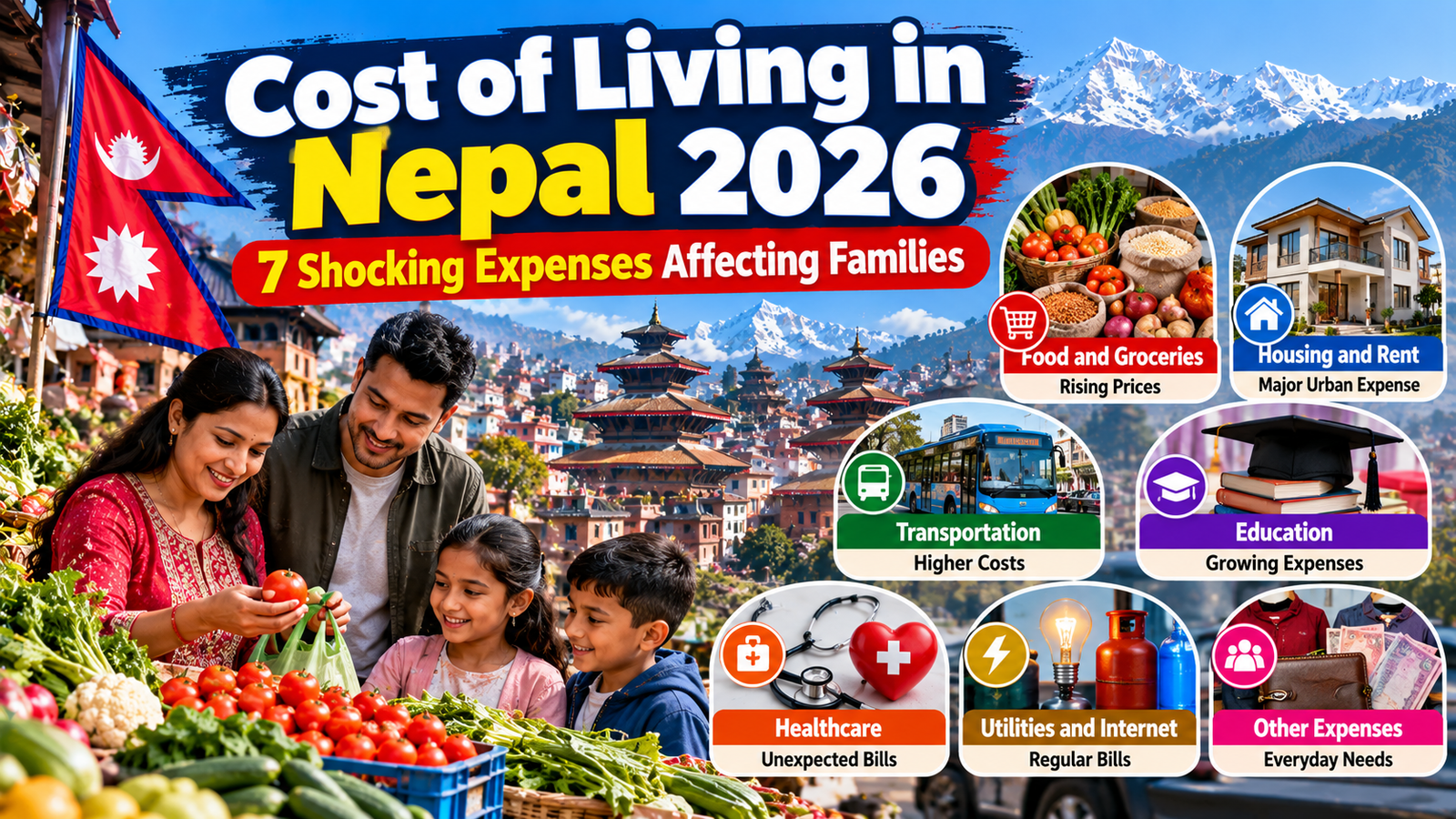
Cost of living in Nepal 2026 has become an increasingly important concern for families as rising food prices, transportation expenses, housing costs and other essential bills place pressure on household budgets.
Whether a family lives in Kathmandu, Pokhara, Bharatpur, Biratnagar or a rural community, managing everyday expenses requires careful planning. The amount needed to maintain a reasonable standard of living varies depending on location, family size, income, housing arrangements and personal circumstances.
Recent economic data illustrate why affordability deserves attention.
According to Nepal Rastra Bank (NRB), Nepal’s year-on-year consumer price inflation reached 6.34% in mid-September 2026, compared with 1.87% during the same period a year earlier.
Food and beverage inflation reached 7.54%, while inflation for non-food goods and services stood at 5.69%.
The increase in food prices is particularly important because food accounts for a substantial share of household consumption.
The National Statistics Office’s Nepal Living Standards Survey IV found that average annual nominal household consumption was NPR 523,413 in 2022/23, with approximately 52% spent on food.
That survey provides valuable information about household spending patterns, although its figures should not be presented as current 2026 expenditure.
Inflation also affects families differently. A household that owns its home faces different financial pressures from one paying rent. A family with school-age children may spend more on education, while households supporting older relatives may face substantial healthcare expenses.
This article examines seven major household expenses affecting the cost of living in Nepal in 2026, explains the latest official inflation figures and provides practical budgeting strategies.
Cost of Living in Nepal 2026: Latest Inflation Statistics
Inflation measures changes in the general price level of goods and services over time.
When inflation is positive, the overall cost of a representative basket of consumer goods and services increases.
However, inflation does not mean that every product becomes more expensive at the same rate.
Some prices may increase rapidly, while others remain stable or decline.
Nepal’s Inflation Rate in September 2026
Nepal Rastra Bank published its report on the country’s current macroeconomic and financial situation for the first two months of fiscal year 2026/27 on 15 October 2026.
The report recorded the following year-on-year inflation rates for mid-September 2026:
| Category | Annual inflation |
|---|---|
| Overall consumer prices | 6.34% |
| Food and beverages | 7.54% |
| Non-food goods and services | 5.69% |
| Transportation | 12.77% |
| Ghee and edible oils | 16.68% |
| Fruits | 15.99% |
| Sugar and sugar products | 12.14% |
| Fish and meat | 7.34% |
| Vegetables | 7.07% |
| Clothing and footwear | 7.06% |
Source: Nepal Rastra Bank, Current Macroeconomic and Financial Situation of Nepal, two-month data for fiscal year 2026/27, released 15 October 2026.
These are changes in price indices compared with the corresponding period a year earlier. They are not individual product prices.
For example, a 7.07% increase in the vegetables price index does not mean that every vegetable increased by exactly 7.07%.
Why Inflation Matters for Families
Consider a hypothetical household spending NPR 50,000 per month.
If every item in its budget increased by 6.34%, the household would need approximately NPR 53,170 to purchase the same quantities.
That represents an additional NPR 3,170 per month.
However, this is only a mathematical illustration.
Actual household expenses may increase more or less because families purchase different combinations of goods and services.
Households that spend a larger proportion of their income on food may experience stronger pressure when food inflation exceeds overall inflation.
Rural and Urban Differences
NRB’s September 2026 data showed rural inflation at 6.78% and urban inflation at 6.19%.
This demonstrates that price pressures are not identical across Nepal.
Regional differences may reflect transportation costs, local supply conditions, consumer spending patterns and other factors.
For families, understanding their own expenses is more useful than assuming the national inflation rate applies equally to every purchase.
1. Food and Grocery Expenses: The Biggest Everyday Pressure
Food is one of the most important components of household expenditure.
Families regularly purchase rice, lentils, vegetables, cooking oil, milk, eggs, fruit and other essential ingredients.
Because food purchases are frequent, price changes can become noticeable quickly.
What the Official Data Show
NRB reported food and beverage inflation of 7.54% in mid-September 2026.
Several food categories experienced substantially higher increases.
Ghee and edible oils recorded a 16.68% year-on-year increase.
Fruit prices rose by 15.99%, while sugar and sugar products increased by 12.14%.
Fish and meat prices increased by 7.34%, and vegetables rose by 7.07%.
These figures suggest that families purchasing these items regularly may face significant pressure.
However, the price of an individual product can vary by season, location, quality and retailer.
Why Food Prices Change
Food prices are influenced by several factors.
Agricultural production depends on weather, irrigation, labour availability and farming inputs.
Floods, landslides and damaged roads can disrupt transportation.
Imported food products may be affected by international prices and exchange rates.
Seasonal demand also influences certain products.
For example, some vegetables may become more expensive when local supplies are limited.
These factors interact differently across products and regions.
Food Spending in Nepalese Households
The National Statistics Office’s Nepal Living Standards Survey IV estimated that food represented approximately 52% of average household consumption in 2022/23.
The survey also found that lower-consumption households generally devoted a larger share of their spending to food than wealthier households.
This matters because families with limited financial resources have less flexibility when essential food prices increase.
Reducing food spending may be difficult without affecting dietary quality.
How Families Can Manage Grocery Expenses
One useful approach is to plan meals before shopping.
Families can prepare a weekly menu based on ingredients they already have.
Buying seasonal vegetables may be more economical than purchasing expensive out-of-season produce.
Comparing prices between local markets and retailers can also help.
However, bulk purchases are not always cheaper if food spoils before it is used.
Proper storage, portion planning and reducing food waste can make a meaningful difference.
Families should also avoid reducing essential nutrition simply to meet a budget.
A balanced diet remains important for children, adults and older people.
Practical Food Budgeting
A household can begin by recording its food expenditure for one month.
Separate essential groceries from restaurant meals, snacks and discretionary purchases.
This helps identify where spending is concentrated.
The goal should be to maintain adequate nutrition while reducing avoidable expenses.
2. Housing and Rent: A Major Expense for Urban Families
Housing is another important component of the cost of living in Nepal 2026.
Families who rent accommodation must allocate part of their income to monthly rent.
Homeowners may face mortgage payments, repairs, property-related charges and maintenance costs.
Housing expenses vary considerably across Nepal.
Kathmandu Versus Smaller Cities
Housing costs in Kathmandu may differ significantly from those in smaller towns or rural communities.
Within Kathmandu itself, rents can vary depending on neighbourhood, property size, building condition and access to facilities.
A property close to major employment centres may have a different rental price from one farther away.
However, reliable nationwide monthly rental averages for October 2026 are not available from the official sources reviewed for this article.
Therefore, presenting a single rent figure as representative of all Nepalese households would be misleading.
Hidden Housing Expenses
Rent is only one part of accommodation costs.
Tenants may also need to budget for electricity, water, internet, cooking gas, maintenance contributions and moving expenses.
Some rental agreements require advance payments or security deposits.
These requirements can create financial pressure when a family moves.
Homeowners may face unexpected repairs involving roofs, plumbing, electrical systems or other building components.
How to Reduce Housing Costs
Families should compare total housing expenses rather than focusing only on rent.
A cheaper property located far from work may increase transportation costs.
Likewise, accommodation with unreliable utilities may create additional expenses.
Before signing a rental agreement, tenants should clarify payment terms, maintenance responsibilities and deposit arrangements.
A written agreement can help reduce misunderstandings.
Housing Affordability
A household’s ability to afford rent depends on income and other essential expenses.
Financial guidance sometimes suggests spending a limited percentage of income on housing, but there is no universal percentage suitable for every Nepalese household.
Families should calculate what remains after paying for food, transport, education, healthcare and other necessary costs.
Housing decisions should be based on the full household budget.
3. Transportation Costs: Rising Pressure on Commuters
Transportation is another major expense affecting Nepalese families.
People travel for employment, education, healthcare, shopping and other essential activities.
Depending on location, households may use buses, motorcycles, scooters, taxis, private cars or other transport services.
Transportation Inflation in 2026
According to NRB’s mid-September 2026 data, the transportation consumer price index increased by 12.77% year on year.
This was significantly higher than overall consumer inflation of 6.34%.
The transportation index covers a category of goods and services rather than a single bus fare or fuel price.
It should not be interpreted as evidence that every public transport fare increased by 12.77%.
Why Transportation Expenses Matter
Daily commuting creates repeated costs.
Even a relatively small increase in the cost of each journey can affect monthly spending.
Families with multiple members travelling to work or school may experience additional pressure.
For households living far from employment centres, transport can become an important consideration when choosing accommodation.
Private Vehicle Expenses
Owning a motorcycle or car involves more than the purchase price.
Regular expenses may include fuel or electricity, maintenance, insurance, taxes and repairs.
Unexpected mechanical problems can create additional costs.
Vehicle financing may also increase monthly obligations.
Electric Vehicles and Running Costs
Electric vehicles may offer lower energy costs per kilometre than comparable petrol vehicles under suitable conditions.
However, their purchase prices, charging requirements, insurance and depreciation must also be considered.
An electric vehicle is not automatically the most affordable choice for every family.
The decision should depend on driving patterns, charging access and total ownership cost.
Ways to Manage Transportation Spending
Families can compare available transport options.
Combining necessary journeys may reduce travel expenses.
Walking short distances where safe and practical can also help.
For people using private vehicles, regular maintenance may prevent some expensive repairs.
However, reducing transport spending should not come at the expense of safety or access to essential services.
4. Education Expenses: A Long-Term Commitment for Families
Education is an important investment in children’s development and future opportunities.
However, it can also represent a substantial financial commitment.
Households may need to pay for school fees, uniforms, books, stationery, transportation, examinations and extracurricular activities.
Expenses vary depending on the institution and level of education.
Public and Private Education
Nepal has both public and private educational institutions.
Costs can differ considerably between them.
Some families choose private schools because of location, teaching preferences or perceived educational quality.
Others rely on public schools to reduce direct education expenses.
However, even when tuition is limited or subsidised, households may still incur costs for materials, transport and other needs.
Education and Inflation
NRB’s mid-January 2026 report recorded year-on-year education inflation of 7.56%.
This is a historical figure for January 2026, not the education inflation rate for October 2026.
It demonstrates that education-related prices have been an important component of household inflation.
Families should consult the latest available category-specific data before making claims about current education inflation.
Hidden Education Costs
School expenses may include more than tuition.
Uniforms, shoes, books, stationery and transport can add to the annual total.
Some students may require additional learning materials or digital devices.
For families with several children, these costs can accumulate.
Higher Education
University and college students may face tuition fees, accommodation costs, transport expenses and spending on educational materials.
Students studying away from home may need a separate living budget.
Those considering education abroad should also account for application fees, travel, insurance and living expenses.
However, overseas education costs vary widely and should not be estimated without specifying the country and institution.
Managing Education Expenses
Families can plan for annual school expenses instead of treating them as unexpected costs.
Setting aside money each month may help cover uniforms, books and examination fees.
Students should investigate scholarships and financial assistance where available.
Families should also compare educational options based on quality, affordability and suitability.
The cheapest institution is not necessarily the best choice, but higher fees do not automatically guarantee better outcomes.
5. Healthcare Expenses: Financial Pressure From Unexpected Illness
Healthcare is another important component of household living costs.
Families may need to pay for consultations, medicines, diagnostic tests, transport and other medical services.
Some expenses are predictable, while others arise unexpectedly.
Why Healthcare Costs Are Difficult to Predict
A household may spend relatively little on healthcare during one month and face substantial expenses during another.
Unexpected illness or injury can require urgent treatment.
Families supporting older adults or people with ongoing medical needs may face regular expenses.
This makes healthcare budgeting particularly challenging.
Public and Private Healthcare
Nepal has public and private healthcare facilities.
Services, availability and costs vary by location and provider.
Public facilities may offer certain services at subsidised rates, but eligibility and availability depend on the programme and facility.
Private services may involve different charges.
Families should confirm actual costs directly with the relevant healthcare provider.
Health Insurance
Nepal operates a government health insurance programme through the Health Insurance Board.
However, coverage, contribution requirements and service arrangements depend on current programme rules.
Insurance should not be assumed to cover every treatment or expense.
Families considering enrolment should review official eligibility requirements, participating facilities and exclusions.
Emergency Savings
Healthcare expenses demonstrate why emergency savings are important.
A family with some financial reserves may be better prepared for unexpected treatment costs.
However, many households cannot immediately save several months of expenses.
Starting with a small, regular contribution may be more realistic.
Avoiding Unnecessary Healthcare Spending
Preventive healthcare, appropriate medical advice and following prescribed treatment may help avoid some complications.
However, families should not delay necessary treatment solely to reduce expenses.
Health decisions should be guided by qualified healthcare professionals.
6. Electricity, Cooking Fuel, Water and Internet Bills
Utility expenses are another regular part of household spending.
Families may pay for electricity, cooking fuel, water, internet and mobile communications.
These services are important for everyday activities.
Electricity Costs
Electricity expenses depend on consumption, tariff categories and household appliances.
Families using refrigerators, electric cooking equipment, water heaters or air conditioning may have different electricity requirements.
Nepal Electricity Authority publishes electricity tariff information.
However, households should use their actual bills and current tariff schedules rather than relying on generic estimates.
Cooking Fuel
Cooking energy is an important household expense.
Families may use LPG, electricity, firewood or other sources depending on location and availability.
The cost of cooking depends on the energy source, equipment efficiency and frequency of use.
Electric cooking may be economical in some circumstances, but households need reliable electricity and suitable appliances.
Water Expenses
Water costs vary depending on the source and local service arrangements.
Some households receive piped water, while others may rely on alternative arrangements.
Water shortages can create additional costs.
Families should include water-related expenses when comparing accommodation options.
Internet and Mobile Communications
Internet access is increasingly important for education, employment, banking and communication.
However, internet subscriptions and mobile data can add to monthly expenses.
Households should compare packages based on actual usage.
An expensive plan may not be necessary if a lower-cost package meets the family’s needs.
Reducing Utility Expenses
Families can monitor electricity consumption and avoid unnecessary use.
Energy-efficient appliances may reduce electricity demand, although their purchase prices must be considered.
Repairing water leaks and reviewing unused subscriptions can also help.
The most useful approach is to examine actual bills and identify avoidable spending.
7. Clothing, Household Goods and Unexpected Expenses
The final major category includes clothing, footwear, household equipment, personal care and other purchases.
These expenses may be less frequent than groceries but can still affect financial stability.
Clothing and Footwear Inflation
NRB’s September 2026 data recorded year-on-year inflation of 7.06% for clothing and footwear.
This indicates an increase in the category’s consumer price index.
However, prices vary by product, quality and retailer.
Household Equipment
Families occasionally need to replace appliances, furniture or other household items.
These purchases can be expensive because they often require a large payment at once.
NRB reported inflation of 6.01% for furnishings and household equipment in mid-September 2026.
This category includes a range of household-related goods.
Festivals and Social Spending
Festivals and family events can create additional expenses.
Households may spend money on travel, clothing, food, gifts and celebrations.
These expenses are important to many families, but they should be planned where possible.
Borrowing heavily for discretionary celebrations can create longer-term financial pressure.
Unexpected Repairs
Household equipment may fail without warning.
A refrigerator, phone or motorcycle repair can disrupt a monthly budget.
Setting aside a small amount for repairs can reduce dependence on emergency borrowing.
Managing Irregular Expenses
One useful approach is to create a separate savings category for occasional purchases.
Instead of treating annual expenses as surprises, families can estimate their likely cost and save gradually.
For example, school uniforms, festival spending and routine vehicle maintenance can be included in an annual budget.
This approach does not eliminate expenses, but it makes them easier to anticipate.
How Much Does a Family Need to Live in Nepal in 2026?
There is no single verified monthly amount that accurately represents the living costs of every family in Nepal.
Expenses depend on household size, location, housing arrangements, income and lifestyle.
A family that owns its home in a rural community may have very different expenses from a family renting accommodation in Kathmandu.
What the National Living Standards Survey Shows
The Nepal Living Standards Survey IV estimated average annual nominal household consumption of NPR 523,413 in 2022/23.
Dividing this figure by 12 gives approximately NPR 43,618 per month.
However, this is a historical national survey average.
It is not a verified estimate of what a family needs in October 2026.
The survey includes different types of households and consumption arrangements.
It should not be interpreted as a recommended salary, minimum living wage or current household budget.
Example of a Monthly Family Budget
The following table demonstrates how a household might organise its spending.
It uses hypothetical allocations rather than verified market prices.
Illustrative monthly budget: NPR 60,000
| Expense category | Example monthly allocation |
|---|---|
| Food and groceries | NPR 20,000 |
| Housing and rent | NPR 15,000 |
| Transportation | NPR 5,000 |
| Education | NPR 6,000 |
| Healthcare provision | NPR 3,000 |
| Utilities and communication | NPR 4,000 |
| Other household expenses | NPR 4,000 |
| Emergency savings | NPR 3,000 |
| Total | NPR 60,000 |
These amounts are examples for budgeting purposes only.
They are not actual average prices or an official cost-of-living estimate.
A household should replace every figure with its own bills, receipts and expected expenses.
How to Create a Realistic Household Budget
Start by recording all income sources.
Then identify essential expenses.
These may include housing, food, transport, healthcare and education.
Next, calculate irregular expenses such as repairs, festivals and annual fees.
Finally, review how much money remains for savings and discretionary spending.
A budget should reflect actual circumstances rather than an arbitrary national average.
Kathmandu vs Pokhara vs Rural Nepal: Why Costs Differ
The cost of living varies across Nepal.
Differences may arise from housing demand, transportation, market access and available services.
Kathmandu
Kathmandu offers access to employment, education, healthcare and other services.
However, families may face substantial housing and commuting expenses depending on location.
Actual costs vary widely between neighbourhoods and housing types.
Pokhara
Pokhara has a different economic and housing environment.
Tourism-related activity may influence prices in some locations.
However, it would be misleading to claim that Pokhara is always cheaper than Kathmandu without comparable, current data.
Rural Communities
Some rural households may spend less on rented accommodation.
Others may produce part of their own food.
However, remote communities can face higher transport costs and limited access to certain services.
Lower cash spending does not necessarily mean a higher standard of living.
Understanding Regional Inflation
NRB reported the following year-on-year inflation rates in mid-September 2026:
| Area | Inflation |
|---|---|
| Kathmandu Valley | 5.28% |
| Tarai | 6.89% |
| Hills | 6.41% |
| Mountains | 5.69% |
These rates describe price changes, not the absolute cost of living.
A location with lower inflation may still have higher overall prices.
For example, housing in one city could be more expensive even if its annual inflation rate is lower.
How Inflation Affects Low-Income and Middle-Income Families
Inflation can affect households differently depending on income and spending patterns.
Low-Income Families
Lower-income households often spend a larger proportion of their resources on essential goods.
When food prices rise, they may have fewer opportunities to reduce discretionary spending.
The Nepal Living Standards Survey IV supports this general pattern.
Its consumption analysis found that poorer households devoted a larger share of expenditure to food than wealthier households.
Middle-Income Families
Middle-income households may face pressure from rent, school fees, transport and loan repayments.
Even when income remains stable, increasing expenses can reduce the amount available for savings.
Families Receiving Remittances
Some Nepalese households receive financial support from relatives working abroad.
Remittances can help cover everyday expenses, education and other needs.
However, the amount available to a household depends on transfer costs, exchange rates and the sender’s circumstances.
Receiving remittances does not automatically protect a family from inflation.
Retired and Older People
People relying on fixed incomes may find it difficult to adjust when prices rise.
Healthcare and medicine expenses can create additional pressure.
Financial planning should therefore consider both routine and unexpected costs.
Cost of Living in Nepal 2026: Practical Ways to Save Money
Households cannot control national inflation, but they can take steps to manage their own expenses.
1. Track Spending for One Month
Record purchases, bills and transfers.
This helps identify the categories consuming the largest share of income.
2. Prepare a Grocery Plan
Plan meals and create a shopping list.
Use existing ingredients before buying more.
3. Compare Essential Prices
Compare prices for groceries, internet packages and other regular purchases.
Consider quality and convenience as well as price.
4. Reduce Avoidable Food Waste
Store ingredients properly and use leftovers safely.
Avoid buying more perishable food than the household can consume.
5. Review Transportation Choices
Compare the costs of public transport, private vehicles and alternative commuting arrangements.
6. Plan Annual Expenses
Include school materials, festivals, insurance and maintenance in the budget.
7. Build Emergency Savings
Save a manageable amount regularly where possible.
Even a small reserve can help with unexpected expenses.
8. Avoid Unnecessary Debt
Borrowing for routine consumption can create additional interest costs.
Before taking a loan, consider whether repayments are affordable.
9. Review Subscriptions
Check whether unused digital services or expensive packages can be cancelled or reduced.
10. Explore Additional Income Carefully
Freelancing, part-time work and small businesses may provide opportunities for additional income.
However, earnings are uncertain and some activities require initial investment.
Families should avoid schemes promising guaranteed high returns.
Cost of Living and Employment Opportunities in Nepal
Household affordability is closely connected to employment and wages.
When expenses rise faster than income, families may find it difficult to maintain their purchasing power.
Why Stable Employment Matters
Regular income helps households plan spending and meet financial obligations.
However, job availability, wages and working conditions vary across industries and locations.
Skills and Career Development
Education and practical skills can improve access to some employment opportunities.
Digital skills, technical training and professional qualifications may be useful depending on market demand.
However, qualifications alone do not guarantee employment.
Entrepreneurship
Small businesses can create income opportunities.
Potential activities include food services, retail, agricultural production and digital services.
However, entrepreneurship involves financial risks.
A business plan should include realistic estimates of startup costs, sales, expenses and cash flow.
Youth Migration
Living costs, employment opportunities and income expectations can influence decisions about working or studying abroad.
However, migration decisions are complex.
Education, family circumstances, career development and personal preferences may also play important roles.
It would be inaccurate to attribute all youth migration to inflation alone.
What Can Policymakers Do About Household Affordability?
The cost of living is influenced by factors beyond individual household decisions.
Public policy can affect infrastructure, markets and access to essential services.
Improve Agricultural Supply Chains
Reliable roads, storage facilities and distribution systems can help reduce avoidable losses and disruptions.
However, infrastructure investment requires financing and effective implementation.
Support Reliable Transportation
Efficient public transportation can improve mobility and reduce some household transport burdens.
Strengthen Public Services
Accessible education and healthcare can reduce certain direct household expenses.
The effectiveness of public services depends on quality, funding and implementation.
Improve Market Information
Transparent information about prices can help consumers compare options.
It can also support monitoring of unusual market developments.
Encourage Productive Employment
Sustainable employment and income growth can improve household purchasing power.
However, job creation requires broader economic development and private-sector investment.
Maintain Reliable Economic Reporting
Timely inflation statistics and household surveys help policymakers and citizens understand economic conditions.
The NRB’s monthly inflation reports and the National Statistics Office’s household surveys are important sources of evidence.
Frequently Asked Questions About the Cost of Living in Nepal 2026
1. What is the inflation rate in Nepal in 2026?
According to Nepal Rastra Bank, year-on-year consumer price inflation reached 6.34% in mid-September 2026. The data were released on 15 October 2026.
2. Is food becoming more expensive in Nepal?
NRB reported food and beverage inflation of 7.54% in mid-September 2026. Some categories, including edible oils, fruits and sugar products, recorded larger increases.
3. How much money does a family need per month in Nepal?
There is no single verified amount suitable for every family. The required budget depends on household size, location, housing arrangements and spending needs.
4. What is the average household spending in Nepal?
The National Statistics Office’s 2022/23 Living Standards Survey estimated average annual nominal household consumption at NPR 523,413. This is historical survey data, not a current 2026 monthly cost estimate.
5. Is Kathmandu more expensive than rural Nepal?
Costs differ by expense category. Kathmandu households may face higher housing expenses, while rural households may face different transport and service-access costs. A reliable comparison requires current, comparable data.
6. What are the biggest household expenses in Nepal?
Major categories include food, housing, transportation, education, healthcare, utilities and other household goods. Their relative importance varies by family.
7. Why are food prices increasing in Nepal?
Food prices can be affected by agricultural production, weather, transport disruptions, imported costs and seasonal demand. The importance of each factor varies by product.
8. How can families reduce grocery expenses?
Meal planning, price comparison, buying suitable seasonal produce and reducing food waste can help manage spending without unnecessarily compromising nutrition.
9. Does inflation affect everyone equally?
No. Households purchase different goods and services. Families spending a larger share of income on rapidly increasing essentials may face greater pressure.
10. What is the difference between inflation and the cost of living?
Inflation measures changes in prices over time. The cost of living refers to the expenses required to maintain a particular standard of living.
11. Are transportation costs rising in Nepal?
NRB reported year-on-year transportation inflation of 12.77% in mid-September 2026. This is a category-level index change, not a uniform increase in every fare.
12. How can students manage living expenses?
Students can prepare monthly budgets, compare accommodation and transport options, track spending and investigate scholarships or financial assistance where available.
13. Can remittances help families manage inflation?
Remittances may provide important financial support, but their impact depends on the amount received and the household’s expenses.
14. Should families borrow money to cover rising expenses?
Borrowing can create additional repayment obligations. Families should assess affordability carefully and avoid relying on expensive debt for recurring consumption where alternatives are available.
15. Will the cost of living decrease in Nepal?
Future prices depend on economic conditions, supply, demand and policy developments. A lower inflation rate would mean prices are rising more slowly, not necessarily that prices are falling.
Conclusion: Managing the Cost of Living in Nepal in 2026
The cost of living in Nepal 2026 remains an important challenge for families managing food, housing, transportation, education, healthcare and other essential expenses.
The latest NRB figures show that consumer price inflation reached 6.34% in mid-September 2026, with food and beverage inflation at 7.54%.
Transportation, edible oils, fruits and several other categories experienced particularly significant price increases.
These developments can place pressure on households, especially those with limited incomes or substantial essential expenses.
However, the financial impact varies.
A family that owns its home may face different challenges from one paying rent.
A household with several children may prioritise education costs, while another may spend more on healthcare.
There is no single monthly budget that accurately represents every Nepalese family.
The most useful approach is to combine reliable national statistics with actual household spending records.
Families can improve financial planning by tracking expenses, reducing avoidable waste, preparing for irregular costs and building savings where possible.
At the same time, long-term improvements in affordability depend on wider economic conditions, employment opportunities, infrastructure and access to essential services.
For Nepal, addressing household affordability requires both practical financial planning and policies that support sustainable economic development.
Understanding the cost of living is the first step toward making better financial decisions and building greater household financial security.
Related Economic Challenges and Opportunities in Nepal
The rising cost of living is closely connected to employment, energy and economic opportunities. Many young people are exploring freelancing opportunities in Nepal to develop additional income sources and improve their financial independence.
Nepal’s growing hydropower industry may also create economic opportunities, while electric vehicles could help some households reduce transportation energy costs. Digital payment services can make it easier for families to track spending and manage their finances.
References and Credible Sources
1. Nepal Rastra Bank (15 October 2026). Current Macroeconomic and Financial Situation of Nepal, Based on Two Months’ Data of 2026/27. Official inflation figures for mid-September 2026.
2. OnlineKhabar (15 October 2026). Annual Inflation Rises to 6.34%. Reporting on NRB’s latest consumer price inflation statistics.
3. National Statistics Office (2022/23 survey). Nepal Living Standards Survey IV. Household consumption, expenditure and living standards.
https://microdata.nsonepal.gov.np/index.php/catalog/149/related-materials
4. National Statistics Office. Nepal Living Standards Survey IV – Statistical Report.
5. Nepal Rastra Bank (February 2026). Current Macroeconomic and Financial Situation, Based on Six Months’ Data of 2025/26.
6. Nepal Rastra Bank. Monthly Statistics Archive. Official monthly economic data.
https://www.nrb.org.np/category/monthly-statistics
7. Nepal Electricity Authority. Official Electricity Information and Tariffs.
8. Health Insurance Board, Nepal. Official Health Insurance Information.
Editorial note: This article reflects information available as of 19 October 2026. Official inflation figures describe changes in price indices, not fixed prices for individual goods. Historical household survey averages and illustrative budgets should not be interpreted as verified current market prices.

