

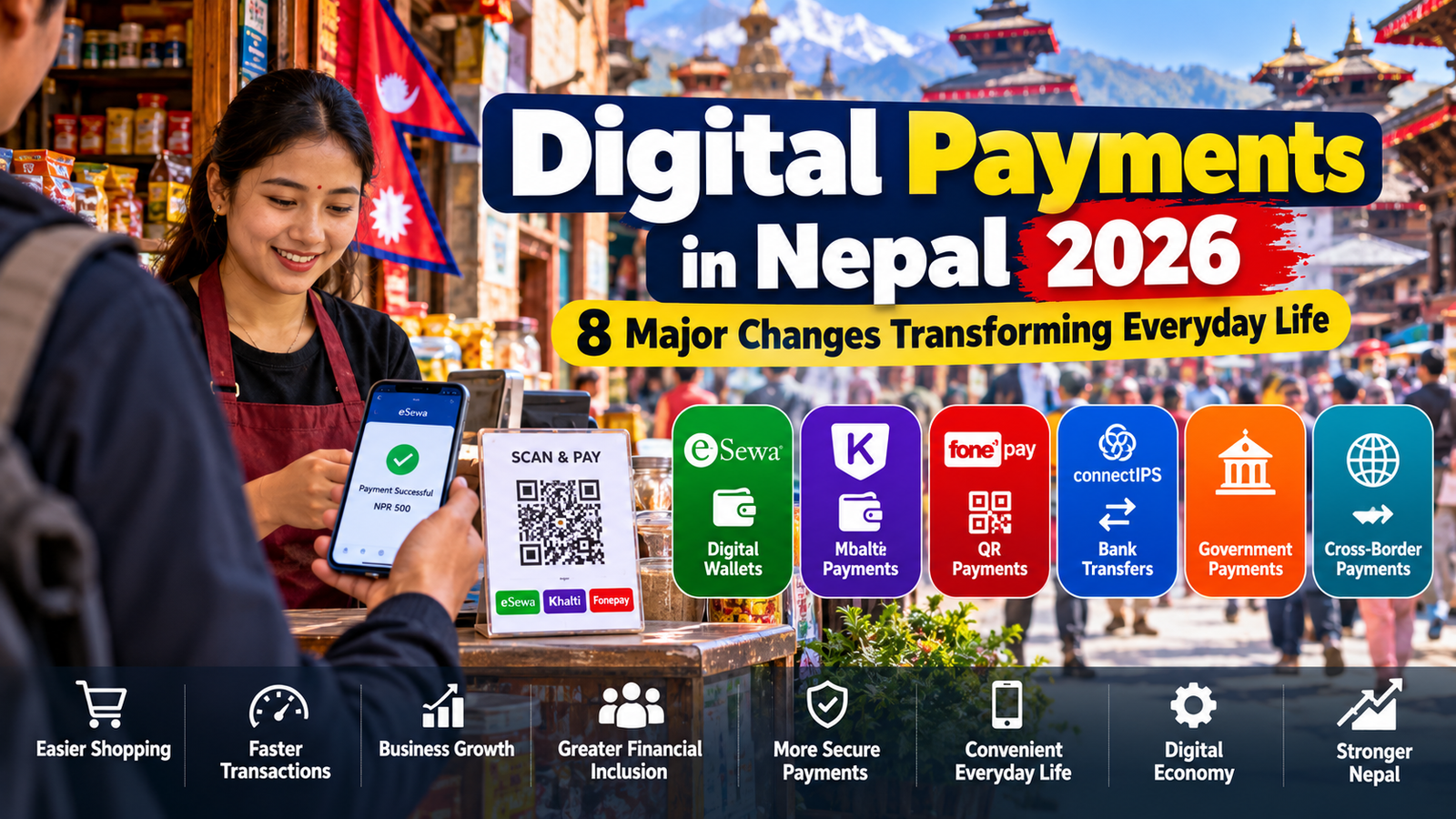
Kathmandu, 19 October 2026 | Eleven Nepal | Technology & Economy

Digital payments in Nepal are transforming how people shop, transfer money, pay bills and manage their finances in 2026. From small tea shops accepting QR codes to families sending money through mobile banking, electronic payments are becoming an increasingly familiar part of everyday life.
Only a few years ago, many routine transactions required physical cash, visits to bank branches or manual payment procedures. Today, customers can use smartphones to pay merchants, transfer money between accounts, recharge mobile phones and complete certain government payments.
The transformation is supported by Nepal Rastra Bank (NRB), banks, licensed payment service providers and payment infrastructure operators such as Nepal Clearing House Limited (NCHL).
However, the growth of digital finance also raises important questions. Are digital transactions secure? Can people in rural communities access the same services? How do different payment systems work together? What happens when a customer sends money to the wrong account?
These questions matter because a modern payment system must be more than convenient. It must also be reliable, affordable, accessible and secure.
According to NCHL, its Retail Payment Switch processed approximately NPR 9.3 trillion in transactions during fiscal year 2025/26. This reflects the growing importance of electronic payment infrastructure, although the figure represents activity through that particular system rather than the total value of every digital transaction in Nepal.
Meanwhile, the Asian Development Bank’s July 2026 report identifies interoperability, digital infrastructure, cybersecurity and regulatory coordination as important priorities for the country’s payment ecosystem.
This article explores eight major changes shaping digital payments in Nepal in 2026, their benefits for consumers and businesses, and the challenges that still need attention.
Digital Payments in Nepal 2026: What Has Changed?
Nepal’s financial services have evolved as banks, mobile applications and payment providers have expanded electronic transaction options.
Consumers can now access several types of digital payment services.
These include mobile banking, internet banking, digital wallets, QR code payments, card transactions, account-to-account transfers and online payment gateways.
Each service works differently.
Mobile banking typically allows customers to access services linked to their bank accounts.
Digital wallets provide payment functions through licensed payment service providers.
QR payments allow customers to scan a merchant’s payment code.
Payment gateways enable customers to complete transactions on websites and digital platforms.
Systems such as connectIPS support transfers and payments connected to bank accounts.
The development of these services is not simply a technological trend. It is also changing how businesses operate and how households manage everyday expenses.
What Do the Official Statistics Show?
Nepal Rastra Bank publishes monthly Payment Systems Indicators covering access to payment services and their usage.
These indicators include information about mobile banking, digital wallets, QR payments, cards and other electronic transaction channels.
The NRB Payment Systems Department published its Saun 2083 indicators on 21 September 2026.
For a broader picture of the payment system, NCHL reported that its Retail Payment Switch processed more than NPR 1.2 trillion in transactions during Ashadh 2083, corresponding approximately to mid-June through mid-July 2026.
The organisation also reported NPR 9.3 trillion in Retail Payment Switch transaction value across fiscal year 2025/26.
These figures demonstrate substantial payment activity through NCHL’s infrastructure.
However, it would be inaccurate to treat the entire amount as QR payments or to assume it represents the value of all digital transactions in Nepal.
The Retail Payment Switch supports multiple transaction types, including account transfers, merchant payments and other payment services.
Official sources:
- Nepal Rastra Bank – Payment Systems Department
- NCHL – Retail Payment Switch Announcement, 4 August 2026
1. QR Code Payments Are Changing Everyday Shopping
One of the most visible developments in digital payments in Nepal is the widespread availability of QR code payment options.
Customers increasingly encounter QR codes at shops, restaurants, cafés and other businesses.
Instead of paying with cash, a customer can open a supported mobile banking or wallet application, scan the merchant’s QR code and authorise the payment.
How QR Code Payments Work
A QR code contains information that helps a payment application identify the intended recipient or payment request.
The customer generally follows these steps:
- Opens a supported banking or payment application.
- Selects the QR payment function.
- Scans the merchant’s code.
- Checks the merchant’s name and payment amount.
- Authorises the transaction.
- Waits for confirmation.
Some merchants use static QR codes that remain the same for multiple transactions.
Others use dynamic QR codes generated for individual bills.
Fonepay explains that a static QR code remains associated with a merchant, while a dynamic code is created for a particular payment.
Benefits for Small Businesses
QR payments can reduce the need to handle physical cash.
A small café may find it easier to receive payments without maintaining large amounts of change.
A retail shop can provide customers with an additional payment option.
Digital transaction records may also support bookkeeping and reconciliation.
However, businesses should still verify that payments have been completed.
A screenshot shown by a customer is not always reliable proof of settlement.
Merchants should confirm the transaction through their official banking or payment application.
Are QR Payments Free?
Fonepay’s published merchant FAQ states that its QR acceptance service does not charge merchants for accepting payments.
However, this statement should not be interpreted as a guarantee that every QR payment product, banking arrangement or additional service in Nepal is free.
Fees and conditions can vary by provider and transaction type.
Businesses should check the terms of their specific payment service.
Challenges of QR Payments
QR payments depend on functioning payment applications, network connections and payment infrastructure.
Technical interruptions can delay transactions.
Incorrect payment details or fraudulent QR codes can also create risks.
For these reasons, customers should verify the recipient’s name before confirming payment.
Source: Fonepay – Frequently Asked Questions
2. Mobile Banking Is Becoming a Daily Financial Tool
Mobile banking has changed how people interact with their banks.
Instead of visiting a branch for every routine transaction, customers can perform many activities through their smartphones.
Available functions vary by bank but may include checking balances, transferring money, paying bills and reviewing transaction histories.
Why Mobile Banking Matters
Mobile banking can save time and reduce the need for travel.
For people who work long hours, attending a bank branch during normal opening times may be inconvenient.
A mobile application can provide access to supported services outside branch opening hours.
This convenience is especially valuable for routine transactions.
For example, a student may transfer money to a landlord.
A worker may send funds to family members.
A business owner may check whether a customer payment has arrived.
These activities can be completed digitally when the relevant service is available and functioning.
Growth in Mobile Banking Access
Nepal Rastra Bank’s monthly payment indicators show that mobile banking has become an important part of the country’s payment infrastructure.
The central bank’s mid-May 2025 indicators recorded approximately 27.26 million mobile banking registrations.
This was a historical registration count, not a verified count of unique people actively using mobile banking.
An individual may hold accounts or registrations with more than one institution.
Consequently, registration figures should not be described as the number of Nepalese citizens who use mobile banking every day.
For current reporting, readers should consult NRB’s latest monthly indicators rather than relying on older figures.
What Users Should Consider
Mobile banking applications can provide convenience, but customers should understand their bank’s transaction limits and security requirements.
They should also check whether transfers are immediate, whether fees apply and how failed transactions are handled.
Users should avoid installing banking applications from unofficial sources.
Official banking websites and recognised app stores are safer starting points.
3. Digital Wallets Are Expanding Payment Choices
Digital wallets have become another familiar feature of Nepal’s financial landscape.
Services such as eSewa and Khalti have helped introduce consumers to electronic payments for everyday transactions.
Wallet features can include mobile top-ups, bill payments, merchant purchases and transfers, depending on the provider’s approved services.
How Digital Wallets Differ From Mobile Banking
Mobile banking is generally connected directly to services provided by a bank.
A digital wallet is typically operated by a licensed payment service provider.
The distinction matters because providers may have different regulatory requirements, account features, fees and transaction limits.
Customers should understand which organisation holds or processes their funds and how they can obtain support.
Benefits for Consumers
Digital wallets can make certain small and frequent transactions more convenient.
Users may be able to pay utility bills, recharge phones or purchase eligible services without handling cash.
Some providers also offer merchant payments and promotional programmes.
However, discounts and cashback offers can change frequently.
Consumers should not choose a financial service solely because of temporary promotions.
Security, reliability and customer support are more important long-term considerations.
Benefits for Businesses
Wallet acceptance may help businesses serve customers who prefer electronic payments.
Digital records can make it easier to review transaction histories.
For online businesses, supported wallet payment options can reduce dependence on cash collection.
Nevertheless, merchants need to understand settlement arrangements, refunds, service fees and dispute procedures.
Regulation and Licensing
Nepal Rastra Bank regulates payment service providers and payment system operators under Nepal’s payment and settlement framework.
The central bank publishes lists of licensed institutions.
Consumers and businesses should verify a provider’s current status before using an unfamiliar service.
Source: Nepal Rastra Bank – Licensed Payment Institutions
4. Nepal’s Payment Systems Are Becoming More Connected
A major development in digital payments in Nepal 2026 is the expansion of interoperable payment infrastructure.
Interoperability means that different participating financial institutions or payment applications can exchange payment instructions through compatible systems.
Without interoperability, customers may need to use the same provider as the person or business receiving the money.
Connected systems can reduce these barriers.
What Is the National Payment Switch?
Nepal Clearing House Limited operates components of the National Payment Switch under NRB oversight.
Its Retail Payment Switch supports a range of electronic payment services.
According to NCHL, these include account-to-account transfers, merchant payments, bill payments and other interoperable services.
The system also supports payment products associated with the NEPALPAY ecosystem.
Why Interoperability Matters
Imagine a customer who uses one bank and a merchant who uses another payment provider.
Interoperable infrastructure can allow participating institutions to process the payment without requiring both parties to use the same application.
This can improve convenience and potentially reduce fragmentation.
For businesses, interoperability may expand the range of customers who can pay electronically.
For consumers, it may reduce the need to maintain multiple payment accounts.
However, interoperability is not universal.
Not every institution, application or payment method necessarily supports every transaction.
Customers must check compatibility with their own provider.
What the Asian Development Bank Says
In July 2026, the Asian Development Bank published Advancing Digital Payments in Nepal: Infrastructure Upgrades and Policy Development for Enhanced Trade Facilitation.
The report examines infrastructure development, regulatory alignment and cross-border payment opportunities.
It identifies technical integration, merchant adoption and skills shortages as important challenges.
The report also discusses the role of digital identification and interoperable payment systems.
These findings suggest that further progress depends on both technology and effective implementation.
Source: Asian Development Bank – Advancing Digital Payments in Nepal, July 2026
5. Cross-Border Digital Payments Are Improving Nepal–India Connectivity
Cross-border payments represent one of the most significant developments in Nepal’s financial technology sector.
Nepal and India share extensive economic, social and family connections.
People travel between the two countries for tourism, education, employment and business.
Convenient and secure payment systems can support these activities.
UPI Merchant Payments in Nepal
India’s Unified Payments Interface, commonly known as UPI, supports electronic payments through participating applications and institutions.
In February 2024, Nepal introduced live merchant QR payment acceptance through the collaboration between Fonepay and NPCI International Payments Limited.
This allowed eligible Indian users to make supported merchant QR payments in Nepal.
The arrangement is particularly relevant to tourism and retail businesses serving Indian visitors.
However, support depends on participating applications, merchants and applicable rules.
A Major Development in June 2026
On 11 June 2026, India’s Press Information Bureau announced that a Nepal–India person-to-person cross-border remittance mechanism had officially launched on 6 June 2026.
The mechanism connects India’s UPI infrastructure with Nepal’s National Payments Interface.
According to the announcement, the integration supports instant cross-border transfers through participating mobile banking applications and digital wallets.
This is distinct from merchant QR acceptance.
Merchant payments involve paying a business, while person-to-person transfers involve sending money to another individual.
Why Cross-Border Payments Matter
Cross-border payment improvements may benefit families, workers, travellers and businesses.
They can reduce friction in transferring money between participating institutions.
However, the practical benefits depend on eligibility, transaction limits, fees, exchange rates and the availability of supported applications.
Users should not assume that every wallet or bank can send money internationally.
They should confirm the specific service and permitted transaction types with their financial institution.
Future Regional Opportunities
The ADB’s July 2026 report identifies cross-border payment development as an area with potential to support trade and regional economic activity.
However, expansion requires regulatory cooperation, technical integration and reliable safeguards.
Source: Government of India – Nepal–India Cross-Border Remittance Launch, 11 June 2026
6. Government Payments Are Moving Toward Digital Services
Government payment systems are another area of financial transformation.
Citizens and businesses may need to pay taxes, fees or other government charges.
Traditionally, some of these transactions required physical visits and manual procedures.
Digital payment integration can make eligible services easier to access.
Government Payments Through connectIPS
Nepal Clearing House Limited explains that its connectIPS infrastructure supports electronic government revenue payments.
Users can initiate eligible payments through supported government portals and payment channels.
The process may involve generating an electronic payment reference or voucher.
Customers can then complete the transaction using the supported payment method.
NEPALPAY QR functionality has also been introduced for certain government payment processes.
Benefits for Citizens
Digital government payments can reduce travel and waiting time when services are available online.
Electronic receipts and transaction records may also make it easier to retain proof of payment.
For businesses, digital payments can support more organised recordkeeping.
However, users should verify that the relevant government portal is authentic before entering financial information.
Benefits for Public Administration
Digital transactions can support more structured payment records and reconciliation.
They may also reduce dependence on manual cash handling.
Nevertheless, digital systems still require oversight, accurate records and accessible support for users experiencing problems.
Are All Government Payments Digital?
No.
The availability of electronic payments varies by government service, department and platform.
Some processes may still require physical verification or additional documentation.
Users should consult the relevant official government website before assuming a payment can be completed entirely online.
Source: connectIPS – Government Payments
7. Digital Payments Are Creating Opportunities for Small Businesses
The expansion of digital payments in Nepal is particularly relevant to small and medium-sized enterprises.
Businesses need reliable ways to receive money, pay suppliers and maintain financial records.
Electronic payment services can support these activities.
Opportunities for Retail Shops
Small retailers can offer customers additional payment choices.
A shop accepting QR payments may serve customers who do not carry sufficient cash.
Digital receipts and transaction records can also support reconciliation.
However, business owners must monitor transactions carefully.
They should not rely on customer screenshots alone when confirming payment.
Opportunities for Cafés and Restaurants
Restaurants and cafés can use digital payment options alongside cash.
Customers may prefer to pay through banking applications or supported wallets.
Businesses can also use digital transaction records to support daily sales reconciliation.
For example, a café manager can compare electronic payment confirmations with point-of-sale records.
This helps identify discrepancies between recorded sales and actual receipts.
However, the payment system should not replace proper accounting procedures.
Opportunities for Online Businesses
Online sellers can benefit from supported electronic payment options.
Digital payments may reduce the need to arrange cash collection for every order.
This can be useful for businesses selling clothing, handmade products, food items or digital services.
However, online merchants must consider refunds, customer complaints, delivery failures and payment disputes.
A reliable payment method is only one part of a successful online business.
Better Financial Records
Digital payment histories can help businesses track money received and transferred.
These records may support bookkeeping, budgeting and financial analysis.
However, a payment history is not a complete accounting system.
Businesses still need to record expenses, sales, liabilities and applicable taxes correctly.
Can Digital Payments Improve Access to Finance?
Consistent financial records may help some businesses demonstrate transaction activity.
However, payment history alone does not guarantee access to bank loans.
Lenders consider multiple factors, including repayment capacity, financial statements and their own eligibility requirements.
Business owners should avoid assuming that accepting QR payments automatically makes them eligible for financing.
8. Cybersecurity and Consumer Protection Are Becoming More Important
As electronic payments become more common, security becomes increasingly important.
Digital payment systems can reduce certain risks associated with carrying cash, but they also introduce different threats.
These may include phishing, fraudulent links, impersonation, account takeover and social engineering.
Common Digital Payment Scams
Fraudsters may pretend to represent a bank, wallet provider or customer support team.
They may ask users to share passwords, one-time passwords or other confidential information.
Some scams involve fake payment confirmations or fraudulent QR codes.
Others encourage users to install unfamiliar applications or visit misleading websites.
Customers should remain cautious whenever someone requests confidential financial information.
How to Protect Your Digital Wallet
Users should follow basic security practices:
- Download financial applications only from trusted official sources.
- Use strong passwords or PINs.
- Enable available biometric or multi-factor authentication.
- Never share one-time passwords.
- Verify the recipient before sending money.
- Avoid opening suspicious payment links.
- Review transaction notifications regularly.
- Report unauthorised activity promptly.
These steps can reduce risk, although no payment method is completely immune to fraud.
What Should You Do After Sending Money to the Wrong Account?
A mistaken transfer should be reported to the payment provider as quickly as possible.
Customers should retain the transaction reference, amount, date and recipient information.
They should use official customer-support channels.
However, recovery is not guaranteed.
The outcome may depend on the transaction type, provider rules, recipient cooperation and applicable procedures.
Why Regulation Matters
Payment services depend on public confidence.
Customers need clear information about fees, transaction limits, complaint procedures and the protection of their financial information.
NRB’s oversight role is therefore important.
The ADB’s July 2026 report also emphasises the need for secure, resilient and inclusive payment infrastructure.
As digital finance expands, consumer education and reliable complaint handling will remain essential.
Benefits of Digital Payments in Nepal
The development of digital payments offers several potential benefits.
Greater Convenience
Consumers can complete many transactions without visiting a physical branch.
This can save time and reduce unnecessary travel.
More Payment Choices
Businesses can accept different forms of payment depending on customer preferences.
This may improve the shopping experience.
Better Transaction Records
Electronic payment histories can make it easier to review past transactions.
For businesses, these records may support financial administration.
Support for Digital Commerce
Electronic payment services enable many types of online transactions.
This can support businesses operating through websites and digital platforms.
Improved Financial Connectivity
Interoperable systems can help participating institutions exchange payments more efficiently.
Cross-border developments may also improve access to supported international transfer services.
However, the benefits are not automatic.
They depend on affordability, service reliability, digital skills and the availability of suitable infrastructure.
Major Challenges Facing Digital Payments in Nepal
Despite progress, several problems remain.
1. Unequal Internet and Smartphone Access
Not everyone has reliable access to smartphones, mobile data or broadband.
Some users may find digital payments difficult because of device costs or limited connectivity.
2. Digital Literacy
People need to understand how payment applications work.
This includes recognising scams, checking transaction details and protecting personal information.
Training and accessible instructions can help reduce mistakes.
3. Technical Interruptions
Payment services may experience connectivity problems, maintenance periods or temporary disruptions.
Businesses should prepare alternative payment options where practical.
4. Fraud and Cybersecurity Risks
Greater adoption creates more opportunities for criminals to target users.
Consumer awareness, secure infrastructure and effective fraud reporting are essential.
5. Merchant Adoption
Some small businesses may hesitate to adopt digital payments because of technical difficulties, unfamiliar procedures or concerns about settlement.
Training and clear provider support can help.
6. Interoperability Gaps
Not all financial institutions and payment applications support every payment service.
Further integration may improve convenience, but compatibility should always be verified.
7. Consumer Complaints and Disputes
Failed transactions, mistaken transfers and delayed refunds can undermine confidence.
Providers need clear and accessible complaint procedures.
8. Financial Inclusion
Digital finance should serve people with different levels of income, education and technological experience.
Services that are difficult to understand or expensive to access may exclude vulnerable groups.
The Asian Development Bank identifies infrastructure, technical integration and skills development as important areas for further improvement.
Digital Payments in Nepal and Financial Inclusion
Financial inclusion means enabling people and businesses to access appropriate and affordable financial services.
Digital payment systems can support this goal by making some transactions easier to complete.
However, access to a payment application is not the same as full financial inclusion.
A person may have a wallet but still lack affordable credit, insurance or suitable savings products.
Similarly, someone may have a bank account but face difficulties using digital services.
Financial inclusion therefore requires attention to affordability, consumer protection and practical usability.
Rural Communities
Digital payments may help people in rural areas avoid some journeys to financial institutions.
However, reliable internet, electricity and accessible customer support remain important.
A digital service cannot fully replace physical access where connectivity is poor.
Older Users
Some older adults may prefer cash or need assistance with payment applications.
Services should provide understandable instructions and accessible support.
Family members helping with digital payments should protect the user’s privacy and avoid sharing confidential credentials.
Women and Small Entrepreneurs
Accessible payment services may help women entrepreneurs and small business owners manage transactions.
However, outcomes depend on broader conditions such as access to devices, financial knowledge and business opportunities.
Digital technology should be viewed as one tool for improving financial participation rather than a complete solution.
Digital Payments Versus Cash: Which Is Better?
Cash and electronic payments have different advantages.
Cash does not require a smartphone or internet connection for an ordinary face-to-face transaction.
It can be useful during technical outages and for people who prefer physical money.
Digital payments can provide convenience, transaction records and remote transfer capabilities.
However, they depend on functioning systems and appropriate security.
For many households and businesses, using both payment methods may be practical.
A café, for example, might accept QR payments while retaining a suitable cash-handling process.
The most appropriate choice depends on the transaction, the people involved and the available infrastructure.
How Small Businesses Can Start Accepting Digital Payments
Business owners interested in electronic payments should begin by choosing a suitable provider.
Step 1: Identify Customer Needs
Consider which payment methods customers already use.
A business serving local residents may have different needs from one serving international tourists.
Step 2: Choose a Licensed Provider
Check whether the bank or payment service provider is appropriately authorised.
Review the available services and support arrangements.
Step 3: Understand Fees and Settlement
Ask about transaction charges, settlement timing, limits and refund procedures.
Do not assume that every provider offers identical conditions.
Step 4: Complete Merchant Registration
Follow the provider’s requirements.
These may involve business details, identification documents or bank account information.
Step 5: Train Staff
Employees should understand how to verify completed payments.
They should also know what to do when a transaction fails.
Step 6: Maintain Financial Records
Record digital and cash sales accurately.
Reconcile payments against sales records regularly.
Step 7: Review Security
Use secure devices and official applications.
Restrict access to sensitive financial information.
Step 8: Monitor Customer Experience
Ask customers whether the payment process is convenient.
Review recurring problems and improve procedures where necessary.
What Is the Future of Digital Payments in Nepal?
Nepal’s payment infrastructure has expanded significantly, but further development will depend on technology, regulation and consumer confidence.
Interoperability is likely to remain an important area of industry development.
Cross-border services may also become more relevant as Nepal strengthens regional financial connectivity.
Digital government payments and online commerce provide additional opportunities.
However, future growth should not be treated as guaranteed.
Economic conditions, cybersecurity risks, infrastructure investment and regulatory decisions can influence adoption.
The ADB’s July 2026 report highlights the importance of coordinated infrastructure upgrades and policy development.
For Nepal, the long-term goal is not simply to increase the number of transactions.
It is to create payment services that are dependable, inclusive and useful to households and businesses.
Why Digital Payments in Nepal Are Becoming More Important
The expansion of digital payments in Nepal is changing how consumers and businesses manage everyday transactions. Electronic payment services offer convenient alternatives to cash, particularly for shopping, bill payments and transfers between participating financial institutions.
Digital Payments in Nepal and Small Business Growth
For small businesses, digital payments in Nepal can simplify customer transactions and support better financial recordkeeping. Retail shops, restaurants and online sellers can benefit from providing secure payment options that match customer preferences.
Digital Payments in Nepal and Financial Inclusion
The development of digital payments in Nepal could improve access to financial services for people who face difficulties visiting physical bank branches. However, reliable internet access, affordable devices and digital literacy remain important requirements.
Digital Payments in Nepal and Cybersecurity
As digital payments in Nepal become more common, protecting customers from fraud is increasingly important. Users should verify payment details, protect confidential information and report suspicious transactions through official channels.
The Future of Digital Payments in Nepal
The future of digital payments in Nepal will depend on reliable infrastructure, interoperable systems and consumer trust. Continued improvements in security, accessibility and financial education could help more individuals and businesses use electronic payment services confidently.
Frequently Asked Questions About Digital Payments in Nepal
1. What are digital payments in Nepal?
Digital payments are electronic methods of transferring money or paying for goods and services. Examples include mobile banking, digital wallets, QR payments, card transactions and online bank transfers.
2. Which digital payment methods are popular in Nepal?
Common options include mobile banking, digital wallets, QR code payments and bank-linked transfer services such as connectIPS. Availability depends on the provider and transaction type.
3. Are QR payments safe in Nepal?
QR payments can be convenient and secure when users follow appropriate precautions. Customers should verify merchant details, use official applications and protect confidential information.
4. What is the difference between eSewa and mobile banking?
eSewa is a digital wallet service, while mobile banking refers to services offered through a bank’s application. Features, limits and regulatory arrangements may differ.
5. Can Indian tourists make UPI payments in Nepal?
Eligible Indian users can make supported merchant QR payments through participating arrangements. Availability depends on the payment application and merchant acceptance network.
6. Can people transfer money digitally between Nepal and India?
A Nepal–India person-to-person cross-border remittance mechanism was officially launched in June 2026. Users should confirm participating institutions, eligibility, limits and fees before attempting a transfer.
7. What is connectIPS?
connectIPS is a bank-linked electronic payment service operated within Nepal Clearing House Limited’s payment infrastructure. It supports eligible transfers and other payment services.
8. Are all digital payments free in Nepal?
No. Fees depend on the payment method, provider and transaction. Users should review current charges before making payments.
9. How can businesses accept QR payments?
Businesses can contact a participating bank or authorised payment provider, complete the relevant merchant registration and follow the provider’s setup instructions.
10. What should I do if a digital payment fails?
Check the official transaction status and contact the relevant provider. Keep the transaction reference and avoid repeating a payment until you understand whether the first attempt succeeded.
11. Can digital payments help small businesses?
Yes. They may improve customer convenience, reduce some cash-handling requirements and provide useful transaction records. Businesses still need proper accounting and security procedures.
12. What are the main challenges for digital payments in Nepal?
Important challenges include internet access, digital literacy, cybersecurity, interoperability, merchant adoption and consumer protection.
Related Articles on Eleven Nepal
Digital payment technology is closely connected to entrepreneurship, online work and financial development.
If you’re planning to start a business, read our guide to How to Register a Business in Nepal in 2026: 10 Essential Steps for Beginners.
Students interested in online earning opportunities can explore How to Get Your First Client on Fiverr.
For entrepreneurs considering different business structures, see Types of Business in Nepal: 5 Essential Choices for Entrepreneurs (2026).
You can also explore Top 10 Skills to Learn in 2026 for Students to understand the digital skills that can support modern careers.
Conclusion: Digital Payments Are Reshaping Nepal’s Economy
Digital payments in Nepal have become an important part of everyday financial activity in 2026.
QR code payments, mobile banking, digital wallets and interoperable payment infrastructure are changing how individuals and businesses exchange money.
The development of cross-border payment links with India and the expansion of government payment services demonstrate that Nepal’s financial technology ecosystem is becoming more connected.
NCHL’s reported NPR 9.3 trillion in Retail Payment Switch transactions during fiscal year 2025/26 highlights the scale of activity through one important component of this infrastructure.
However, digital transformation also brings responsibilities.
Financial institutions must protect customers, businesses must verify transactions and users need reliable information about security.
Access must also extend beyond people who already have smartphones, internet connectivity and financial knowledge.
The future of digital payments in Nepal will depend on balancing innovation with safety, reliability and inclusion.
For consumers, the most important benefit is the ability to complete financial transactions conveniently and securely.
For businesses, the opportunity is to provide better payment experiences while maintaining accurate records.
For Nepal’s wider economy, digital payments offer another foundation for developing modern financial services and supporting digital commerce.
References and Credible Sources
- Nepal Rastra Bank (2026). Payment Systems Indicators, Saun 2083. Published 21 September 2026.
https://www.nrb.org.np/departments/psd/ - Nepal Rastra Bank (2026). Payment Systems Oversight Report 2081/82. Published 4 August 2026.
https://www.nrb.org.np/departments/psd/ - Nepal Clearing House Limited (2026). Nepal’s Retail Payment Switch Surpasses NPR 1.2 Trillion in Monthly Transactions. Published 4 August 2026.
https://nchl.com.np/nepals-retail-payment-switch-surpasses-monthly-transaction-of-npr-1-2-trillion-marking-a-new-milestone-in-the-nepals-digital-payment-journey/ - Asian Development Bank (2026). Advancing Digital Payments in Nepal: Infrastructure Upgrades and Policy Development for Enhanced Trade Facilitation. Published July 2026.
https://www.adb.org/publications/advancing-digital-payments-nepal - Government of India, Press Information Bureau (2026). India–Nepal Cross-Border P2P Remittance Mechanism. Published 11 June 2026.
https://www.pib.gov.in/PressReleasePage.aspx?PRID=2271613 - Fonepay. Frequently Asked Questions: QR Payments and Merchant Services.
https://fonepay.com/public/faqs - Nepal Clearing House Limited. connectIPS Government Payments.
https://connectips.com/index.php/0429/26-govt-pay - Nepal Rastra Bank. Payment Systems Department and Licensed Institutions.
https://www.nrb.org.np/departments/psd/
Editorial note: This article reflects information available as of 19 October 2026. Payment service availability, fees, transaction limits, participating institutions and regulations may change. Readers should verify current conditions with their financial institution or the relevant regulator.

