

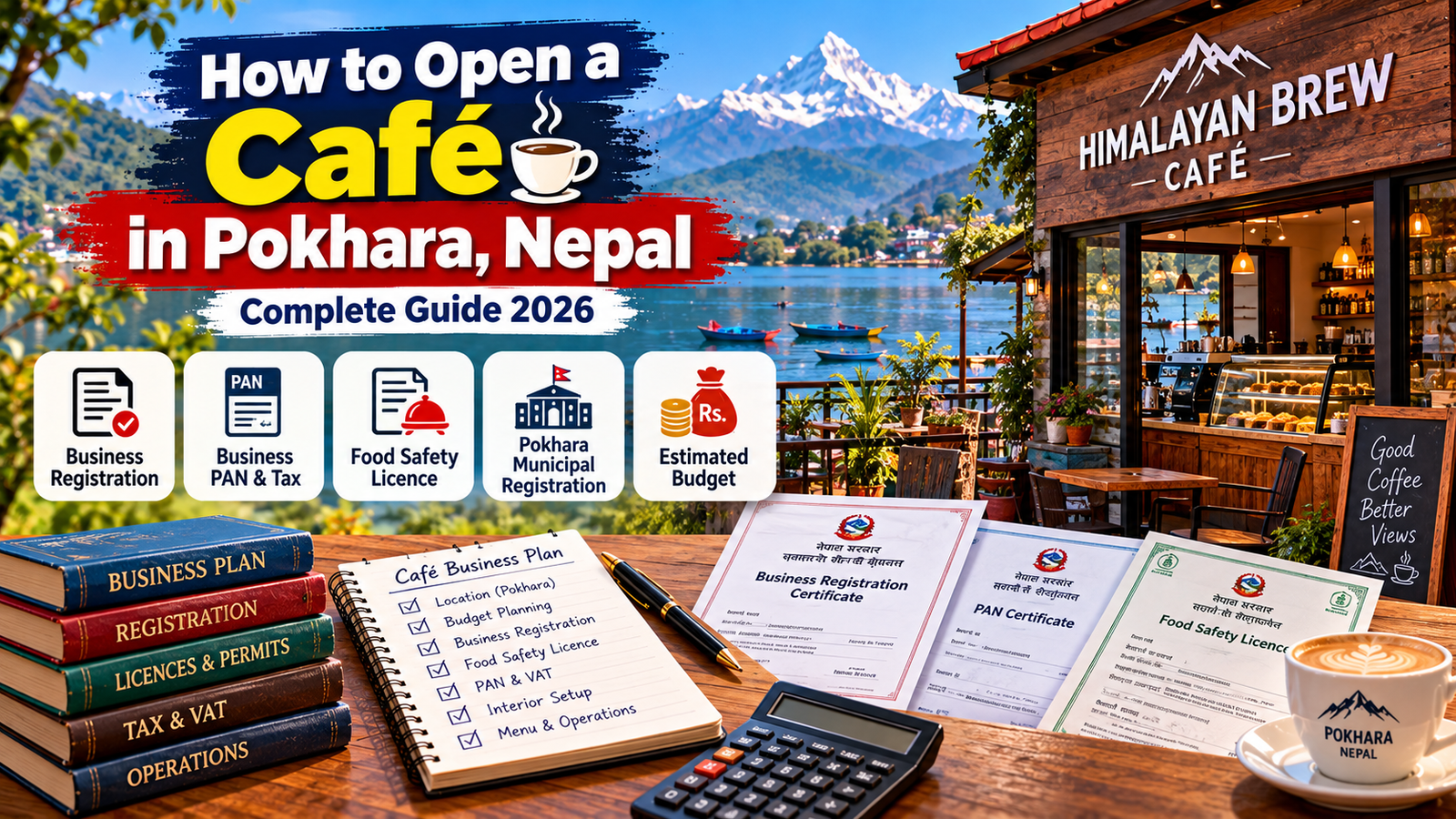
How to Open a Cafe in Pokhara: Complete Business Guide 2026
How to open a cafe in Pokhara is a common question for aspiring entrepreneurs who want to enter Nepal’s hospitality industry.
Pokhara attracts local residents, students, domestic travellers and international tourists, making it a location worth considering for a café business.
However, opening a café requires careful financial planning, choosing a suitable location, business registration, government documentation, food-safety compliance and ongoing management.
This guide explains how to open a cafe in Pokhara step by step, including an illustrative startup budget of NPR 8.05–15.60 lakh for a small 20-seat café, potential monthly expenses, applicable registration requirements and a break-even example.
Opening a café in Pokhara can be an attractive business opportunity for entrepreneurs interested in hospitality, tourism, and food service. However, a successful café requires more than a good menu and attractive interior.
Before opening, the owner needs to consider location, rent, startup capital, business registration, food hygiene, taxation, staffing, and operating costs.
This example explains how a Nepali entrepreneur could plan a small café in Pokhara with approximately 20 seats.
1. Café Business Concept
Business name: Himalayan Brew Café (fictional example)
Location: Pokhara, Kaski, Nepal
Business type: Small independent café
Seating capacity: 20 customers
Ownership: One Nepali entrepreneur
Menu: Coffee, milk tea, cold drinks, breakfast, sandwiches, pastries, and light snacks
Target customers: Local residents, students, domestic tourists, and international visitors
Business structure: Sole proprietorship for this example, subject to confirmation of the appropriate registration route.
The owner plans to rent a commercial space and operate six or seven days per week.
2. Estimated Budget to Open a Small Café in Pokhara
The following figures are illustrative planning estimates for a modest café, not confirmed 2026 supplier quotations.
| Startup expense | Estimated budget (NPR) |
|---|---|
| Rental deposit and advance rent | 90,000–180,000 |
| Interior decoration and renovation | 150,000–300,000 |
| Coffee machine and grinder | 120,000–250,000 |
| Refrigerator and kitchen equipment | 100,000–180,000 |
| Tables, chairs, and furniture | 80,000–150,000 |
| Crockery, utensils, and small equipment | 30,000–60,000 |
| Initial ingredients and packaging | 30,000–60,000 |
| Signboard, branding, and marketing | 20,000–50,000 |
| Registration, licensing, and documentation allowance | 15,000–40,000 |
| POS system and miscellaneous setup | 20,000–40,000 |
| Working capital reserve | 150,000–250,000 |
| Estimated total investment | 805,000–1,560,000 |
Estimated startup investment: NPR 8.05 lakh to NPR 15.60 lakh.
The registration and licensing allowance is a budget reserve, not an official government fee quotation. Actual fees depend on the registration authority, business classification, capital, and applicable licences.
Costs can be higher for a prime Lakeside location, premium espresso equipment, extensive kitchen facilities, or major renovation.
3. Government Registration and Licences Required for a Café
A café owner should verify the following requirements before starting operations.
A. Firm or Company Registration
The owner must select the appropriate legal structure and complete the corresponding registration process.
A sole proprietor should confirm the applicable firm registration procedure with the relevant provincial or district authority. A private limited company is incorporated through the Office of the Company Registrar.
B. Pokhara Metropolitan City Business Registration
Pokhara Metropolitan City provides a new-business registration service through ward offices.
The municipality’s published requirements include an application, identity documents, photographs, rental agreement, and additional property or prior-registration documents depending on the situation.
C. Business PAN
The café must complete the applicable Business PAN registration with the Inland Revenue Department before commencing taxable business operations.
D. VAT Registration, If Applicable
The owner must assess whether VAT registration is required under current law. VAT registration is not automatically compulsory for every café simply because it opens.
E. Food Hygiene and Food-Service Permissions
A café preparing and serving food must comply with applicable food safety and hygiene requirements.
The owner should confirm with Pokhara Metropolitan City and the relevant food regulatory authority which food-business registration, inspection, approval, or licence applies to an ordinary café.
A café that manufactures packaged food for distribution may have different regulatory requirements from a café serving freshly prepared food on its premises.
F. Additional Permissions, Where Applicable
Depending on the business model, further requirements may include:
- Signboard or advertisement permission and applicable local tax.
- Building-use, fire-safety, and sanitation compliance.
- Employment and labour-law compliance.
- Liquor licensing if alcoholic beverages will be sold.
- Tourism-related registration if the business falls within a regulated tourism category.
Not every café needs every licence listed above. The owner should confirm the applicable requirements with the responsible authority.
4. Government Documents Checklist for a Pokhara Café
Before applying, prepare the following documents as relevant.
| Document | Purpose |
|---|---|
| Nepali citizenship certificate | Owner identification |
| Passport-size photographs | Registration applications |
| Proposed café name | Business identification |
| Completed application form | Registration |
| Rental agreement | Evidence of rented premises |
| Land ownership documents, where applicable | Premises verification |
| Property or land-tax payment receipt, where applicable | Municipal documentation |
| Ward recommendation or inspection record, if required | Local or other registration |
| Firm or company registration certificate | Legal business registration |
| Business PAN certificate | Tax identification |
| Partnership deed, if applicable | Partnership registration |
| MOA and AOA, if applicable | Company incorporation |
| Food-related application and supporting documents | Applicable food regulatory approval |
| Sector-specific approvals, if applicable | Regulated activities |
Pokhara Metropolitan City’s published checklist includes citizenship, two photographs, a rental agreement, and applicable property-tax or registration documents. Requirements may differ by case.
5. Step-by-Step Registration Process for the Café
Step 1: Finalise the location and business model
Identify suitable premises in Pokhara and estimate rent, customer demand, kitchen requirements, and seating capacity.
Step 2: Confirm the legal structure
Choose a sole proprietorship, partnership, or company based on the actual ownership and business plans.
Step 3: Confirm the correct firm registration authority
For a sole proprietorship, verify the current registration process with the competent authority in Gandaki Province or Kaski.
Step 4: Prepare the rental agreement
Make sure the premises can lawfully be used for the intended café operation. Clarify who is responsible for structural alterations, utilities, taxes, and repairs.
Step 5: Register the business or company
Submit the required documents to the competent registration authority and obtain the certificate.
Step 6: Register the café with Pokhara Metropolitan City
Visit the ward office responsible for the café’s location. Submit the applicable municipal documents and complete any required inspection or verification.
Step 7: Obtain Business PAN
Apply through the Inland Revenue Department’s taxpayer registration process.
Step 8: Confirm food safety and other licences
Contact the municipality and appropriate food regulatory office to establish the requirements for the planned menu and operation.
Step 9: Complete the café setup
Install equipment, establish food-storage and cleaning procedures, recruit staff, and prepare the menu.
Step 10: Open only after required approvals are in place
Keep registration certificates, tax documents, licences, and inspection records available for future reference.
6. Estimated Monthly Operating Expenses
The following figures are planning assumptions for a 20-seat café, not verified local market rates.
| Monthly expense | Estimated NPR |
|---|---|
| Shop rent | 25,000–50,000 |
| Staff salaries | 45,000–80,000 |
| Electricity, water, internet, and gas | 10,000–20,000 |
| Marketing and miscellaneous expenses | 5,000–15,000 |
| Cleaning, maintenance, and administration | 5,000–10,000 |
| Fixed and semi-fixed operating costs | 90,000–175,000 |
Food ingredients, beverages, packaging, and payment-processing costs are additional variable expenses.
The business owner should also account for taxes, equipment replacement, financing costs, and a reasonable allowance for their own labour.
7. Café Sales and Break-Even Example
Assume the café has:
- Average customer spending: NPR 350.
- Average customers per day: 35.
- Trading days per month: 26.
Estimated monthly sales:
35 × NPR 350 × 26 = NPR 318,500
Assume ingredients and other variable costs equal 35% of sales.
Estimated contribution after variable costs:
NPR 318,500 × 65% = NPR 207,025
If monthly fixed operating costs are NPR 130,000:
Illustrative operating surplus: NPR 77,025 per month.
This is not guaranteed profit. It is before applicable taxes, financing costs, depreciation, and any owner salary not already included in operating costs.
Using these assumptions, the approximate monthly break-even sales level is:
NPR 130,000 ÷ 65% = NPR 200,000
At an average customer spend of NPR 350 over 26 trading days, this is approximately 22 customers per day.
Actual results will depend on customer demand, seasonality, pricing, waste, staffing, and location.
8. Practical Tips for Opening a Café in Pokhara
Choose the location carefully. Compare rent, footfall, competition, visibility, and accessibility rather than choosing a location based only on popularity.
Start with a manageable menu. A small selection of well-executed drinks and dishes can reduce waste and simplify kitchen operations.
Keep a working capital reserve. New cafés may need time to build regular customers.
Control food costs. Standard recipes, portion control, stock records, and regular purchasing reviews can help maintain margins.
Prioritise hygiene. Train staff in safe food handling, temperature control, cleaning, and allergen awareness.
Build a digital presence. A simple website, accurate business listing, and active social media channels can help customers discover the café.
Useful Government Resources for Opening a Café in Pokhara
Before opening your café, verify the latest registration procedures, fees and licensing requirements through official government websites.
- Pokhara Metropolitan City – Local business registration, ward services and municipal requirements.
- Office of the Company Registrar – Private limited company registration.
- Inland Revenue Department – Business PAN, VAT and tax obligations.
- Department of Food Technology and Quality Control – Applicable food-safety laws and regulatory requirements.
Build an Online Presence for Your Café
After registering your café, you can create a professional website to display your menu, location, opening hours and contact details.
Read our WordPress website setup tutorials on Eleven Nepal to learn how to create a website for your business.
Conclusion: Is Opening a Café in Pokhara Worth Considering?
A small café in Pokhara may be a viable business opportunity, but profitability depends on the location, customer demand, management, food quality, and financial discipline.
For the fictional 20-seat café in this case study, the estimated startup budget is NPR 8.05–15.60 lakh.
Before spending money on renovation or equipment, the entrepreneur should verify the required business registration, municipal registration, tax obligations, food-safety approvals, and other permissions.
The most important first step is to prepare a realistic business plan and confirm the applicable legal requirements with the relevant government offices.

