

By Eleven Nepal Editorial Team | Updated: 20 October 2026 | Category: Technology & Digital Skills
Starting a podcast in Nepal can be an exciting opportunity for students, entrepreneurs, journalists, educators and creative individuals who want to share their ideas with a wider audience.
Whether you want to discuss Nepalese culture, interview successful entrepreneurs, explain technology, share personal experiences or create educational content, podcasting offers a flexible way to communicate with listeners.
Unlike traditional broadcasting, podcasting does not necessarily require a professional studio or an expensive production team.
You can begin with a smartphone, a quiet recording space, a clear topic and suitable recording software.
However, creating a successful podcast involves more than buying a microphone and talking for an hour.
You need to identify your audience, choose relevant topics, prepare episodes, record understandable audio, edit carefully, distribute your content and develop a consistent publishing strategy.
Many beginners also have questions about podcast monetization.
Can you earn money from a podcast in Nepal? Is Spotify podcast hosting free? Should you publish on YouTube? How much equipment do you need? Are there copyright rules for using music?
These questions matter because online tutorials sometimes exaggerate earning opportunities or provide outdated information about platform eligibility.
In 2026, creators can explore audio podcasts, video podcasts and short clips that introduce longer conversations.
Services such as Spotify for Creators, Apple Podcasts and YouTube provide different publishing and discovery options, although features and eligibility vary.
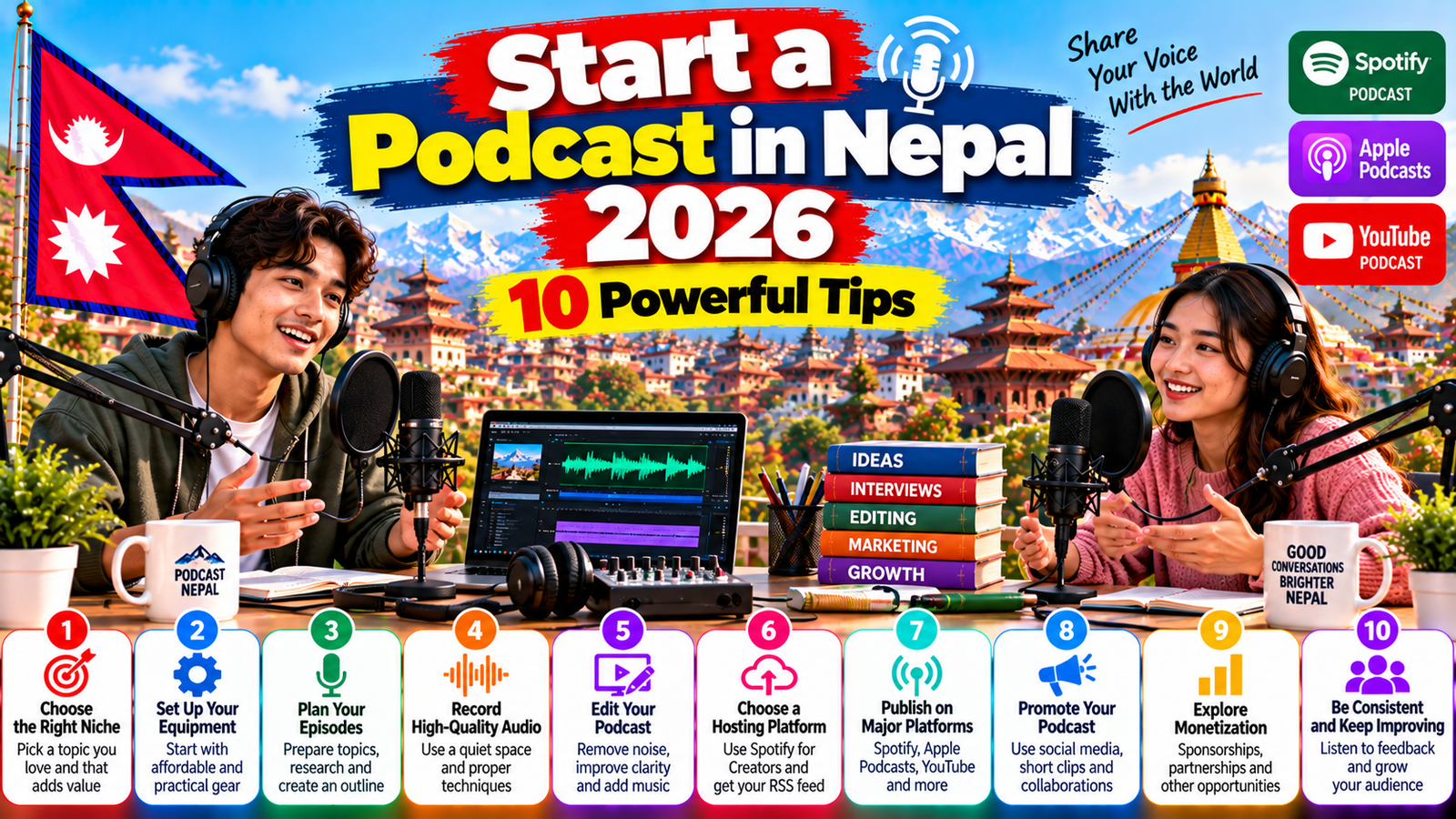
This guide explains 10 powerful tips for starting a podcast in Nepal in 2026, including equipment, recording, editing, distribution, branding, promotion and possible income opportunities.
It also includes an illustrative startup budget, a practical 30-day launch plan, beginner-friendly podcast ideas and 25 frequently asked questions.
Important: Podcasting does not guarantee listeners, sponsorships, employment or income. Platform features, costs and commercial obligations may change. Always confirm important information through official sources.
What Is a Podcast?
A podcast is a programme distributed as a series of episodes, usually centred on a particular subject or theme.
Many podcasts are audio-only, although video podcasts have become an established format.
Episodes may feature a single presenter, interviews, group discussions, storytelling or educational explanations.
Listeners can access podcasts through compatible applications, websites and media platforms.
Audio Podcasts
Audio podcasts focus on spoken content.
They can be suitable for interviews, discussions, educational lessons and storytelling.
An audio-only programme may require less filming equipment than a video podcast.
However, clear sound and thoughtful editing remain important.
Video Podcasts
Video podcasts include visual recordings of presenters or guests.
They can be published on compatible video platforms, including YouTube.
Video can make conversations more engaging for viewers who prefer to watch speakers.
However, video production may require additional lighting, storage and editing time.
Solo Podcasts
A solo podcast features one main presenter.
This format can be useful for tutorials, commentary, personal experiences and educational explanations.
Interview Podcasts
Interview podcasts feature conversations with guests.
They may provide different perspectives and specialist knowledge.
Group Discussion Podcasts
Group discussions involve multiple speakers.
These require careful microphone placement and conversation management to prevent overlapping dialogue.
Which Format Is Best?
There is no universally best format.
The right choice depends on your audience, subject, resources and communication style.
Beginners should select a format they can produce consistently.
Why Start a Podcast in Nepal in 2026?
Podcasting can provide a platform for sharing information and developing creative skills.
Nepal offers many potential subjects, including culture, entrepreneurship, education, tourism, food, technology and personal development.
Share Nepalese Stories
Podcasts can document experiences that may receive limited attention through traditional media.
For example, a creator could interview local entrepreneurs, artists or skilled workers.
Support Education
Educational podcasts can explain complex topics in accessible language.
A student-focused programme might discuss examination preparation, career planning or digital skills.
Develop Communication Skills
Preparing and presenting episodes can help improve public speaking, interviewing, research and storytelling.
Build a Personal Brand
A consistent podcast can become part of a creator’s professional portfolio.
However, publishing episodes does not automatically establish credibility.
Accuracy, experience and responsible communication remain important.
Connect With Different Audiences
Creators can publish in Nepali, English or other languages.
Language selection should reflect the intended audience.
Explore Future Commercial Opportunities
Some established podcasts may attract sponsors or support related businesses.
These opportunities depend on audience trust, commercial demand and the creator’s circumstances.
They should not be treated as guaranteed outcomes.
For broader digital career opportunities, read Eleven Nepal’s AI Skills in Nepal 2026.
1. Choose the Right Podcast Niche in Nepal
The first step in starting a podcast in Nepal is deciding what your programme will discuss.
A niche is the main subject or audience focus of your content.
Why Your Niche Matters
A clearly defined subject helps listeners understand what to expect.
It also makes episode planning easier.
For example, a podcast about Nepalese entrepreneurship might feature business owners, startup lessons and practical management discussions.
Ten Podcast Niches to Consider
1. Entrepreneurship: Interviews with business owners and discussions about business development.
2. Education: Study techniques, career planning and academic experiences.
3. Technology: Digital tools, software, cybersecurity and technology trends.
4. Nepalese Culture: Language, traditions, food and cultural history.
5. Tourism: Travel experiences, responsible tourism and destination information.
6. Personal Development: Communication, time management and learning habits.
7. Food and Hospitality: Culinary careers, restaurant operations and traditional recipes.
8. Creative Careers: Filmmaking, photography, design and music production.
9. Agriculture: Farming experiences, food systems and rural entrepreneurship.
10. Community Stories: Conversations about local experiences and social issues.
These are editorial suggestions, not a verified ranking of Nepal’s most popular or profitable podcast categories.
Identify Your Target Listener
Ask yourself who will benefit from the programme.
A podcast for university students may use different language and examples from a programme for established business owners.
Evaluate Your Knowledge
Choose a subject you can discuss responsibly.
For specialised topics such as health, finance or law, distinguish personal experience from professional advice.
Research Existing Podcasts
Listen to programmes covering similar topics.
Notice their structure, episode length, presentation and audience questions.
Do not copy their branding or original content.
Create a Clear Podcast Promise
A podcast promise explains the value offered to listeners.
For example:
“Weekly conversations with Nepalese entrepreneurs about their experiences, decisions and lessons.”
This is clearer than a description that simply says, “We talk about everything.”
Key lesson: A focused subject and identifiable audience provide a stronger starting point than choosing a niche solely because it appears profitable.
2. Create a Memorable Podcast Name and Brand
Your podcast name is an important part of its identity.
It should communicate the programme’s purpose and be easy to recognise.
Choose a Clear Name
A good name should be memorable, relevant and suitable for the intended audience.
Avoid names that are unnecessarily complicated.
Check for Existing Names
Search major podcast directories, YouTube and the web for similar names.
Also consider whether the name could conflict with an existing brand or protected trademark.
Design Podcast Cover Artwork
Cover artwork represents your show in podcast applications.
Use clear typography, a recognisable visual identity and an appropriate image.
Understand Artwork Requirements
Different platforms may specify artwork dimensions, formats and other technical requirements.
Apple Podcasts publishes official artwork guidance.
Review the current specifications before exporting your final design.
Write a Podcast Description
A useful description explains the subject, audience and type of episodes.
For example:
“Welcome to Himalayan Conversations, a podcast exploring entrepreneurship, education and creative careers in Nepal through practical discussions and guest interviews.”
This is an illustrative description for a fictional podcast.
Create Consistent Branding
Use similar visual elements across episode artwork, social profiles and promotional clips.
Choose Introductory Music Carefully
If you use music, confirm that you have the appropriate rights.
Do not assume that a song is free to use because it is available online.
Establish a Professional Contact Method
Consider creating a dedicated email address for guest enquiries and business communication.
Key lesson: Good branding should help people understand and remember your podcast without misleading them about its purpose.
3. Start With Affordable Podcast Equipment
One common misconception is that podcasting requires expensive microphones, mixers and cameras.
Professional equipment can be useful, but beginners can test their concept with a much simpler setup.
Can You Record With a Smartphone?
Yes.
A smartphone can record spoken audio using a suitable application.
The quality depends on microphone placement, room acoustics, recording settings and background noise.
Why Audio Quality Matters
Listeners need to understand the speakers.
Echo, distortion, electrical interference and excessive background noise can make a conversation difficult to follow.
Basic Podcast Equipment
| Equipment | Main purpose |
|---|---|
| Smartphone or computer | Recording and editing |
| Microphone | Capturing speech |
| Headphones | Monitoring audio |
| Microphone stand | Stable microphone positioning |
| Pop filter or windscreen | Reducing certain unwanted sounds |
| Recording software | Capturing the conversation |
| Editing software | Improving and organising audio |
USB Microphones
USB microphones can connect directly to compatible computers.
They may be convenient for beginners recording in one location.
XLR Microphones
XLR microphones generally require a suitable audio interface, mixer or recorder.
They can offer flexibility for more complex setups.
Headphones
Headphones help presenters monitor recordings and detect unwanted noise.
Closed-back headphones may be useful when monitoring speech near microphones.
Room Acoustics
A quiet room with soft furnishings may reduce some unwanted reflections.
Avoid recording near loud appliances, busy roads or open windows when possible.
Microphone Placement
Position the microphone consistently and avoid unnecessary movement.
Test the sound before recording an entire episode.
Illustrative Beginner Podcast Budget
The following amounts are hypothetical planning allowances, not verified Nepalese retail prices.
| Item | Illustrative cost |
|---|---|
| Existing smartphone or laptop | NPR 0 additional purchase |
| Basic microphone | NPR 3,000 |
| Headphones | NPR 2,000 |
| Microphone stand | NPR 1,500 |
| Pop filter or windscreen | NPR 500 |
| Miscellaneous accessories | NPR 1,000 |
| Illustrative total | NPR 8,000 |
Actual prices vary by brand, retailer, availability and product specifications.
Should You Buy a Camera?
A camera is optional for audio-only podcasts.
If you plan to produce video, test your smartphone before purchasing a dedicated camera.
Key lesson: Improve your recording environment and microphone technique before spending heavily on equipment.
4. Plan Your Podcast Episodes Before Recording
A podcast becomes easier to produce when each episode has a clear purpose.
Planning does not mean every sentence must be scripted.
It means understanding what the episode should communicate.
Define the Episode Objective
Ask what listeners should learn or understand by the end.
Create a Basic Episode Structure
An interview episode might include:
- A short introduction.
- Guest background.
- Main discussion topics.
- Practical examples.
- Key lessons.
- Closing remarks.
Prepare Research Notes
If you discuss factual subjects, review credible sources before recording.
Write Interview Questions
Prepare open-ended questions that encourage useful explanations.
For example:
“What was the biggest challenge when you opened your first business?”
This may produce a more informative response than a simple yes-or-no question.
Avoid Overloading One Episode
Trying to cover too many unrelated subjects can make a conversation difficult to follow.
Choose a Suitable Episode Length
There is no universal ideal duration.
An educational explanation might be short, while an in-depth interview may take longer.
Choose a length appropriate to the content.
Prepare Follow-Up Questions
Listen carefully to your guest and ask for clarification where needed.
Fact-Check Important Claims
Guests may express opinions or recall events inaccurately.
Consider verifying important factual claims before publication.
Plan Your First Five Episodes
For a fictional Nepalese entrepreneurship podcast, a beginner plan could include:
- Why People Start Small Businesses in Nepal.
- Lessons From a First-Time Entrepreneur.
- How Business Owners Approach Customer Service.
- Common Challenges in Managing a Small Team.
- Developing Useful Skills Before Starting a Business.
These are content ideas, not verified market-demand findings.
Key lesson: Preparation creates a more useful conversation without removing spontaneity.
5. Learn Podcast Recording and Editing
Recording and editing are essential production skills.
A well-edited podcast should remain natural while removing avoidable distractions.
Choose Recording Software
Depending on your device, you may explore tools such as Audacity, GarageBand or other established recording applications.
Check current compatibility and licensing.
Test Before Recording
Record a short sample.
Listen for background noise, echo, clipping and differences in speaker volume.
Use Separate Audio Tracks Where Possible
Recording speakers on separate tracks can make editing easier.
This may require suitable equipment or recording software.
Record Remote Interviews Carefully
Remote conversations depend on internet stability, microphone quality and the recording service.
Explain the recording arrangement to guests beforehand.
Avoid Interruptions
Silence notifications and reduce avoidable distractions.
Learn Basic Editing
Begin with trimming unwanted sections, balancing levels and removing distracting noise where appropriate.
Do Not Overprocess Audio
Excessive noise reduction or compression can make speech sound unnatural.
Review the Full Episode
Listen to the finished programme before publication.
Check for missing sections, abrupt edits and accidental disclosure of private information.
Export Suitable Audio Files
Follow your podcast hosting platform’s current supported formats and technical requirements.
Save Backups
Keep original recordings and project files in a secure location.
A second backup can help protect against accidental loss.
Key lesson: Reliable recording and careful editing are more valuable than unnecessary sound effects.
6. Choose the Right Podcast Hosting Platform
Podcast hosting is different from recording.
A hosting service stores your podcast episodes and may provide an RSS feed used by compatible podcast directories.
What Is an RSS Feed?
An RSS feed contains information about your podcast and episodes.
This may include titles, descriptions, artwork and links to audio files.
Podcast applications can use the feed to discover new episodes.
Spotify for Creators
Spotify for Creators offers free podcast hosting and publishing tools.
It also provides analytics and other creator features.
However, monetization eligibility and feature availability vary.
Does Spotify Automatically Publish Everywhere?
No.
Spotify’s official guidance explains that a podcast hosted through Spotify for Creators is automatically available on Spotify.
To distribute through other platforms, creators may need to enable their RSS feed and submit it separately.
How to Find Your Spotify RSS Feed
Spotify explains that the feed becomes available after the first episode is published.
Creators can locate RSS distribution settings through their account.
Protect Your Email Address
Spotify warns that enabling RSS distribution can make the email address associated with the feed publicly visible.
Consider using an appropriate dedicated contact address.
Other Hosting Services
Other podcast hosting providers may offer different storage limits, distribution features and pricing arrangements.
Compare their current terms before selecting one.
Questions to Ask Before Choosing a Host
Consider whether the service supports your preferred format, provides an RSS feed, allows access to analytics and offers suitable export or migration options.
Free Hosting Versus Paid Services
A free hosting service may be sufficient for a beginner.
Paid plans may offer additional tools, but purchasing a subscription does not guarantee audience growth.
Official source: https://creators.spotify.com/features/podcast
Key lesson: Choose a host based on your publishing needs and current features, not unsupported monetization promises.
7. Publish Your Podcast on Spotify, Apple Podcasts and YouTube
Distribution makes episodes accessible to listeners.
However, each platform has its own requirements.
Publishing on Spotify
Creators using Spotify for Creators can follow its official hosting and publishing workflow.
After publishing, review the show’s details and availability.
Publishing on Apple Podcasts
Apple Podcasts allows creators to submit a qualifying RSS feed through Apple Podcasts Connect.
Apple states that shows must satisfy technical requirements and undergo review.
Basic Apple Podcasts Submission Process
Create or access an Apple Podcasts Connect account.
Choose the option to add a show using an RSS feed.
Enter the feed address.
Review show details, rights declarations and availability settings.
Submit the show according to Apple’s instructions.
Apple Podcasts Technical Requirements
Apple requires appropriate RSS information, at least one episode and suitable artwork.
Feeds must pass technical validation.
Publishing on YouTube
YouTube treats a podcast as a playlist containing podcast episodes in video form.
Creators can create and manage podcasts through YouTube Studio.
Can an Audio Podcast Appear on YouTube?
Yes.
YouTube supports audio-first podcast publishing through eligible workflows.
One approach is to create a video using suitable static artwork or other visuals.
YouTube RSS Import
YouTube also supports podcast RSS-feed ingestion in selected countries and regions.
This feature is not universally available.
Creators in Nepal should check their YouTube Studio account for current access.
Do Not Assume Automatic Cross-Platform Distribution
Spotify, Apple Podcasts and YouTube operate separate publishing systems.
An upload to one service does not necessarily publish the same episode everywhere.
Check Your Published Episodes
After distribution, verify the title, artwork, description, audio playback and episode order.
Official sources:
Key lesson: Successful distribution requires correct metadata, suitable hosting and compliance with each platform’s requirements.
8. Promote Your Podcast and Build an Audience
Publishing an episode is only the beginning.
Listeners need a way to discover your programme.
Create a Simple Podcast Website
A website can provide episode descriptions, transcripts, resources and contact information.
Use Social Media Carefully
Share relevant episode highlights rather than repeatedly posting identical promotional messages.
Create Short Clips
A useful conversation segment can become a short promotional video.
Ensure the clip represents the original discussion accurately.
Write Clear Episode Titles
A title should explain the subject.
For example:
“Starting a Small Café in Nepal: Lessons From a Business Owner”
This is more informative than a vague title such as “Episode 5.”
Publish Show Notes
Show notes can summarise the episode and provide links to relevant resources.
Invite Suitable Guests
Guests may bring useful knowledge and different perspectives.
Choose them based on relevance and credibility.
Collaborate With Other Creators
Collaboration can help introduce a podcast to related audiences.
Engage With Listeners
Ask for thoughtful questions and respond respectfully where possible.
Maintain a Realistic Schedule
A predictable release schedule can help establish expectations.
However, quality and accuracy should take priority over publishing frequency.
Avoid Artificial Engagement
Buying fake followers or manipulating metrics does not build a genuine audience.
Key lesson: Sustainable audience development depends on useful episodes, clear presentation and authentic engagement.
9. Understand Podcast Monetization in Nepal
Podcasting can support commercial activity, but income is not automatic.
A programme may need time to develop an audience and demonstrate value.
Can Podcasts Earn Money in Nepal?
Creators may explore different income models depending on their audience, agreements and platform eligibility.
Sponsorships
A business may pay to sponsor an episode or series.
Commercial terms depend on the agreement.
Brand Partnerships
Creators may collaborate with relevant businesses.
Sponsored relationships should be disclosed appropriately.
Services and Consulting
A podcast may help a professional demonstrate expertise and attract legitimate enquiries.
However, professional services may require qualifications or other obligations.
Educational Products
Some creators may develop courses, workshops or learning materials related to their expertise.
Listener Support
Certain platforms provide subscription or support features in eligible locations.
Availability must be confirmed for the creator’s account and country.
Spotify Monetization
Spotify advertises monetization opportunities, including its Partner Program, but these are subject to specific eligibility and market restrictions.
Free Spotify hosting does not mean every Nepalese creator can immediately access Spotify’s monetization programmes.
YouTube Monetization
Podcast videos on YouTube may become eligible for monetization through the YouTube Partner Program.
YouTube’s standard programme is available in Nepal, subject to the relevant requirements and channel review.
Illustrative Sponsorship Calculation
Suppose a fictional podcast secures two sponsorship arrangements in one month.
Assume each hypothetical sponsor pays NPR 5,000.
The illustrative gross sponsorship revenue would be:
2 × NPR 5,000 = NPR 10,000.
This is not a verified Nepalese sponsorship rate, market average or earnings forecast.
Actual sponsorship income may be lower, higher or zero.
Understand Expenses
Commercial revenue is not the same as profit.
Recording equipment, travel, software, marketing and other expenses may reduce the amount retained.
Tax and Business Considerations
Podcast income may create tax, reporting or business obligations depending on the circumstances.
Do not assume that online earnings are automatically tax-free.
For related business guidance, see Eleven Nepal’s How to Register a Business in Nepal and PAN and VAT Registration in Nepal.
Key lesson: Build a trustworthy podcast before depending on potential sponsorship or platform income.
10. Protect Your Podcast With Copyright, Consent and Responsible Publishing
Podcast creators should understand the responsibilities involved in publishing recordings.
Respect Copyright
Music, recordings, written works and other creative materials may be protected by copyright.
Nepal has a Copyright Act, 2059 (2002), and related rules.
The Nepal Copyright Registrar’s Office provides access to relevant legislation.
Obtain Appropriate Music Rights
Do not assume that music can be used freely simply because it appears on YouTube or another website.
Understand Guest Consent
Explain to guests that the conversation will be recorded and published.
Agree on the intended format and any important conditions beforehand.
Protect Personal Information
Avoid publishing private contact details, addresses or sensitive information without an appropriate basis.
Be Careful With Allegations
Claims about individuals or organisations can create legal and reputational risks.
Verify important information and distinguish factual reporting from opinion.
Use AI Responsibly
AI tools may help with episode outlines, transcription and editing.
However, automatically generated transcripts can contain errors.
Do Not Fabricate Guest Statements
Never present an AI-generated voice or fabricated quotation as an authentic statement by a real person.
Check Platform Rules
Hosting and distribution services have their own content policies.
Keep Records
Maintain suitable records of permissions, licences and commercial agreements.
Seek Specialist Advice When Necessary
Complex legal or commercial questions should be reviewed by a qualified professional.
Official Nepalese copyright source:
Key lesson: Responsible publishing protects your guests, listeners and creative work.
How Much Does It Cost to Start a Podcast in Nepal?
Podcast startup costs vary significantly.
Some creators can begin with existing devices and free software.
Others may choose additional equipment or professional production services.
The following examples are hypothetical planning scenarios.
Illustrative Startup Budgets
| Setup | Illustrative additional budget | Description |
|---|---|---|
| Minimal audio podcast | NPR 0 | Existing phone and suitable free tools |
| Basic audio podcast | NPR 8,000 | Entry-level microphone and accessories |
| Expanded audio setup | NPR 25,000 | Additional recording and monitoring equipment |
| Video podcast setup | NPR 60,000 | Hypothetical allowance for expanded video production |
These are not verified retail quotations or typical Nepalese market prices.
Example Monthly Operating Budget
| Expense | Hypothetical monthly allowance |
|---|---|
| Internet or additional data | NPR 1,500 |
| Transport for guest interviews | NPR 2,000 |
| Miscellaneous production expenses | NPR 1,000 |
| Illustrative total | NPR 4,500 |
Actual costs may be lower or higher.
Should Beginners Rent a Studio?
Studio rental may be useful for some productions.
However, beginners should compare the benefits with the cost and frequency of recording.
Is Free Podcast Hosting Enough?
Free hosting may be suitable initially.
Evaluate current storage, distribution and account terms before committing to a platform.
Avoid Unnecessary Debt
Do not assume that expensive equipment will generate commercial returns.
Test the concept and improve your skills before making major purchases.
A Practical 30-Day Podcast Launch Plan
The following plan provides an illustrative schedule for developing and publishing a first podcast episode.
It is not a guaranteed audience-growth programme.
Week 1: Research and Branding
Day 1: Choose your podcast subject.
Day 2: Identify your intended audience.
Day 3: Research existing podcasts.
Day 4: Choose a programme name.
Day 5: Write the podcast description.
Day 6: Design cover artwork.
Day 7: Plan the first three episode topics.
Week 2: Recording Preparation
Day 8: Choose a suitable recording space.
Day 9: Test your available microphone.
Day 10: Select recording software.
Day 11: Prepare your first episode outline.
Day 12: Practise speaking and recording.
Day 13: Invite a guest if needed.
Day 14: Confirm recording arrangements and permissions.
Week 3: Production
Day 15: Record your first episode.
Day 16: Review the raw audio.
Day 17: Edit the recording.
Day 18: Check sound quality.
Day 19: Prepare episode artwork.
Day 20: Write the title and description.
Day 21: Review the complete episode.
Week 4: Distribution and Promotion
Day 22: Choose a hosting platform.
Day 23: Create your hosting account.
Day 24: Upload the first episode.
Day 25: Review RSS distribution settings.
Day 26: Submit to additional compatible platforms.
Day 27: Publish a promotional clip.
Day 28: Share the episode with relevant audiences.
Day 29: Review initial feedback and analytics.
Day 30: Plan the next episode and improve your workflow.
What Should You Expect After 30 Days?
The primary objective is to publish a complete episode and establish a repeatable production process.
There is no guaranteed listener count.
Some podcasts may take considerable time to develop an audience.
How to Create an Effective Podcast Episode Structure
A consistent structure can help listeners follow the conversation.
Introduction
Introduce the programme, episode topic and guest where relevant.
Context
Explain why the topic matters.
Main Discussion
Explore the subject through prepared questions or organised explanations.
Practical Examples
Use relevant examples to clarify complex ideas.
Key Takeaways
Summarise the most useful lessons.
Conclusion
Thank listeners and explain where they can find related information.
Example Episode Outline
For a fictional 30-minute entrepreneurship podcast:
| Segment | Illustrative duration |
|---|---|
| Introduction | 2 minutes |
| Guest background | 5 minutes |
| Main discussion | 15 minutes |
| Practical lessons | 6 minutes |
| Conclusion | 2 minutes |
| Total | 30 minutes |
This is an editorial example, not an official recommended episode length.
How to Measure Podcast Performance
Analytics can help creators understand how their episodes perform.
However, different platforms may define and report metrics differently.
Plays and Downloads
Hosting platforms may report downloads or other listening activity.
Do not assume that every download represents a complete listen.
Audience Retention
Where available, retention information may help identify how long people continue listening.
Episode Comparisons
Compare topics and formats to identify which episodes generate useful engagement.
Audience Feedback
Listener questions and comments can reveal areas for improvement.
Traffic Sources
Some platforms provide information about how audiences discover content.
Avoid Misleading Comparisons
A small podcast should not assume that the performance of an established programme represents a realistic short-term target.
Review Trends Over Time
Look for consistent patterns rather than judging a programme based on one episode.
Improve One Element at a Time
You might improve microphone placement, shorten introductions or make episode titles clearer.
Key lesson: Use analytics to improve the listener experience rather than obsess over individual numbers.
Ten Podcast Ideas for Nepalese Beginners
If you are unsure what to create, consider these concepts.
1. Nepalese Entrepreneur Stories
Interview founders and small-business owners about their experiences.
2. Student Career Conversations
Discuss academic choices, career development and professional skills.
3. Nepalese Food and Culinary Culture
Explore regional dishes, cooking techniques and hospitality careers.
4. Technology Explained in Nepali
Discuss software, digital literacy and practical technology use.
5. Travel Experiences in Nepal
Share responsible travel stories and cultural experiences.
6. Creative Careers in Nepal
Interview filmmakers, designers, photographers and other creative professionals.
7. Agriculture and Rural Entrepreneurship
Explore farming experiences, food production and rural business challenges.
8. Language Learning Conversations
Help listeners practise communication skills.
9. Books and Learning
Discuss books, educational ideas and research.
10. Community Voices
Document local experiences through responsible interviews and storytelling.
These suggestions are not ranked by verified popularity or revenue potential.
Common Mistakes New Podcasters Should Avoid
Recording Without a Clear Topic
Unstructured conversations can become difficult to follow.
Ignoring Audio Quality
Poor sound may discourage listeners even when the topic is interesting.
Buying Expensive Equipment Too Early
High-end equipment does not guarantee engaging content.
Copying Another Podcast
Imitating another creator’s identity can undermine originality.
Publishing Without Permission
Guest recordings and third-party content may raise consent or rights concerns.
Using Copyrighted Music Carelessly
A short music clip is not automatically free to use.
Expecting Immediate Sponsorship
Commercial opportunities depend on many factors and are not guaranteed.
Ignoring Episode Titles
Vague titles make it harder for potential listeners to understand the content.
Publishing Inaccurate Information
Credibility depends on careful research and responsible corrections.
Giving Up Before Improving the Process
Evaluate production challenges and feedback before deciding whether to continue.
Frequently Asked Questions About Starting a Podcast in Nepal
1. Can I start a podcast in Nepal?
Yes. Individuals in Nepal can create and publish podcasts using suitable recording and distribution services, subject to applicable rules.
2. Is starting a podcast free?
It can be possible to begin with existing equipment and free tools, although internet and other expenses may still apply.
3. Can I record a podcast with my smartphone?
Yes. A suitable smartphone and recording application can be used for basic podcast production.
4. Do I need an expensive microphone?
No. Beginners can start with available equipment and upgrade when necessary.
5. Which language should I use for my podcast?
Choose a language appropriate for your intended audience, such as Nepali, English or another language.
6. Which podcast niche is best in Nepal?
The best choice depends on your knowledge, interests and target listeners. No niche guarantees success.
7. Is Spotify podcast hosting free?
Spotify for Creators advertises free podcast hosting, subject to its current service terms.
8. Does Spotify automatically publish my podcast on Apple Podcasts?
No. Spotify’s guidance explains that creators may need to enable and submit an RSS feed separately.
9. What is a podcast RSS feed?
An RSS feed contains information about the podcast and episodes that compatible applications use for distribution.
10. Can I publish my podcast on Apple Podcasts?
Yes, subject to Apple’s submission, technical and review requirements.
11. Can I upload podcasts to YouTube?
Yes. YouTube supports podcasts through its video-based podcast features.
12. Is YouTube RSS podcast import available in Nepal?
YouTube restricts RSS ingestion to selected countries or regions. Confirm current availability through YouTube Studio.
13. Do I need a camera for podcasting?
No. Audio-only podcasts do not require video equipment.
14. Can I record a podcast without guests?
Yes. Solo podcasts are a recognised format.
15. How long should a podcast episode be?
Choose a duration appropriate to the topic and audience. There is no universally required episode length.
16. How often should I publish episodes?
Choose a realistic schedule that allows sufficient preparation and quality control.
17. Can I earn money from a podcast in Nepal?
Potential commercial opportunities exist, but they depend on audience, agreements and eligibility. Income is not guaranteed.
18. Does Spotify pay every podcast creator?
No. Spotify monetization features have eligibility and market restrictions.
19. Can a podcast attract sponsors?
Potentially, although sponsorship depends on commercial interest and negotiated arrangements.
20. Can I use popular songs in my podcast?
Only where you have the necessary rights or another lawful basis for use.
21. Do I need permission to record guests?
You should clearly explain the recording and publication arrangements and obtain appropriate consent.
22. Can AI help edit my podcast?
Yes. AI tools may assist with transcription and editing, but outputs should be reviewed for errors.
23. How can I promote a new podcast?
Use accurate episode titles, useful clips, relevant communities, collaborations and consistent publishing.
24. Do I need to register a business for a podcast?
Requirements depend on the nature of the activity and applicable rules. Creating a podcast does not by itself establish that every creator must register a company.
25. What is the most important tip for starting a podcast?
Choose a clear subject, create useful original episodes, record understandable audio and improve consistently.
Conclusion: Start Your Podcast in Nepal With a Clear Plan
Starting a podcast in Nepal in 2026 can provide an opportunity to share knowledge, document experiences and build valuable creative skills.
You do not necessarily need an expensive studio, professional camera or large production team to begin.
A suitable recording device, quiet environment, clear topic and practical publishing plan may be enough to produce your first episode.
The most important early decisions involve choosing your audience, developing original content and establishing a repeatable recording process.
As your skills improve, you can explore better equipment, guest interviews, video production and wider distribution.
Spotify for Creators offers free hosting, while Apple Podcasts and YouTube provide additional publishing options subject to their requirements.
However, distribution does not automatically produce a large audience.
Listeners are more likely to value content that is informative, engaging, accurate and consistently produced.
Creators should also understand copyright, guest consent, privacy and platform policies before publishing.
Podcast monetization may become possible through commercial partnerships or eligible platform features, but no income level or timeline is guaranteed.
The best way to begin is to choose one meaningful topic, prepare one useful episode and learn from the experience.
Your first podcast does not need to be perfect.
It should be original, understandable and worth listening to.
Eleven Nepal — Empowering Youth Through Knowledge, Skills and Opportunities.
References and Official Sources
1. Spotify for Creators (accessed 20 October 2026). Podcast Hosting, Distribution and Creator Tools.
2. Spotify Support (accessed 20 October 2026). Finding and Enabling Your RSS Feed.
3. Apple Podcasts for Creators (accessed 20 October 2026). Submit a New Show.
4. Apple Podcasts for Creators (accessed 20 October 2026). Podcast RSS Feed Requirements.
5. YouTube Help (accessed 20 October 2026). Distribute Podcasts on YouTube.
6. YouTube Help (accessed 20 October 2026). Deliver Podcasts Using an RSS Feed.
7. Nepal Copyright Registrar’s Office (accessed 20 October 2026). Copyright Legislation and Official Resources.
8. Eleven Nepal (14 October 2026). AI Skills in Nepal 2026: 7 Essential Skills for Students and Jobseekers.
9. Eleven Nepal. How to Register a Business in Nepal.
10. Eleven Nepal. PAN and VAT Registration in Nepal.
Editorial note: This article was prepared using publicly available information reviewed on 20 October 2026. Platform availability, technical requirements, pricing and monetization conditions may change. All NPR equipment costs, monthly budgets and sponsorship calculations are hypothetical examples, not verified market prices or income forecasts. The article does not provide legal, tax or financial advice.

