


By Eleven Nepal Editorial Team | Published: 20 October 2026 | Category: Education & Personal Finance
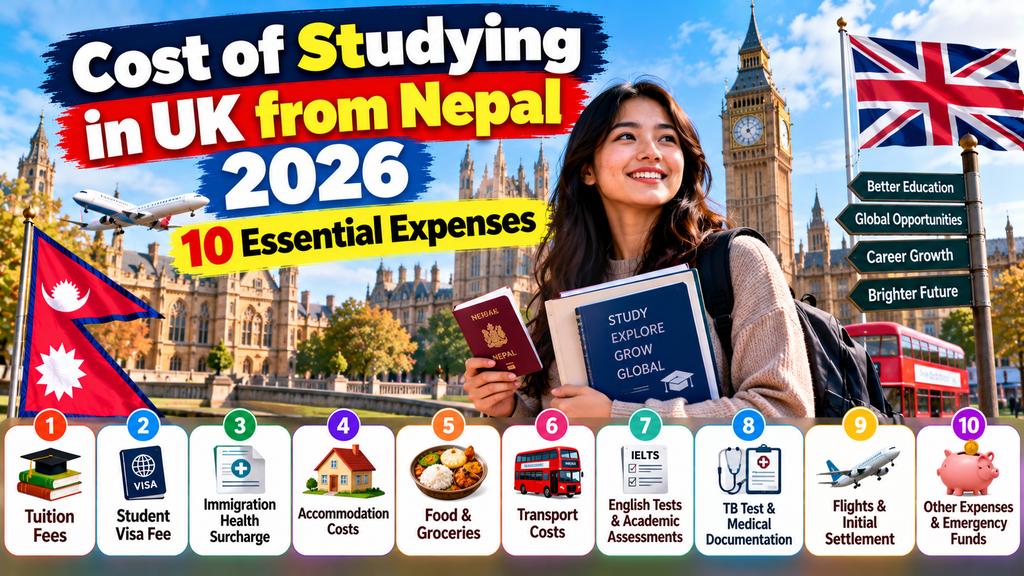
Cost of studying in UK from Nepal is one of the most important financial considerations for Nepalese students planning higher education abroad in 2026. From university tuition fees and Student visa charges to accommodation, food, transport and healthcare costs, studying in the United Kingdom requires careful financial planning.
In this comprehensive guide, Eleven Nepal explains 10 essential expenses, official UK visa financial requirements, practical budgeting strategies and illustrative examples to help Nepalese students and families prepare for studying in the UK.Studying in the United Kingdom is an important ambition for many Nepalese students. British universities offer a wide range of undergraduate and postgraduate programmes, including business management, engineering, nursing, hospitality, information technology and other specialist subjects.
However, international education requires careful financial preparation.
Tuition fees are only one part of the total expense. Students must also consider visa charges, the Immigration Health Surcharge, accommodation, food, transport, English-language assessments and other costs.
For families researching the cost of studying in UK from Nepal, understanding these expenses before applying can help prevent financial difficulties.
The amount required varies significantly depending on the university, programme, location and individual circumstances.
A student living in London may face different accommodation and transport costs from someone studying in Birmingham, Cardiff or another city.
Course duration also matters. A one-year postgraduate programme may have a different total cost from a three-year undergraduate degree.
In October 2026, the standard UK Student visa application fee is £558 for applications made outside the UK. The student Immigration Health Surcharge rate is £776 per year, although the total payment depends on visa duration.
The UK government also specifies minimum financial requirements for Student visa applications.
As of 20 October 2026, the maintenance requirement is £1,529 per month for study in London and £1,171 per month outside London, for up to nine months.
These figures are official visa financial requirements, not estimates of what every student will actually spend.
Importantly, higher maintenance requirements are scheduled to take effect on 30 November 2026.
This article explains ten essential expenses Nepalese students should consider, compares London with other UK locations, provides clearly labelled illustrative budgets and answers frequently asked questions.
Why Is Studying in the UK Expensive for Nepalese Students?
International study involves expenses in two countries.
Before departure, students may need to pay for applications, assessments, travel documents and immigration-related processes.
After arrival, they must manage tuition payments, accommodation, food and everyday living costs.
International Tuition Fees
Nepalese students ordinarily apply as international students unless they qualify for another fee status.
International tuition fees are set by the institution and can differ substantially between courses.
Students should check their exact fee classification rather than assuming all Nepalese applicants pay the same amount.
Differences Between UK Cities
Accommodation is often one of the largest ongoing expenses.
A room in central London may cost more than a comparable room in some other locations.
However, prices vary within every city.
University location alone does not determine a student’s total spending.
Exchange Rate Changes
Tuition fees and living costs are normally paid in pounds sterling.
Nepalese families often budget in Nepalese rupees.
Changes in the GBP/NPR exchange rate can therefore affect the amount required in Nepalese currency.
Course Duration
A three-year degree involves more years of tuition and living expenses than a one-year course, assuming comparable annual costs.
Students should calculate the entire programme budget rather than looking only at the first year.
1. University Tuition Fees
Tuition is usually the largest single educational expense.
The exact amount depends on the university, qualification and course.
Undergraduate Tuition Fees
Undergraduate courses may run for several academic years.
A student considering a bachelor’s degree should check the tuition payable for every year of study.
They should also ask whether fees may increase in later years.
Postgraduate Tuition Fees
Many taught master’s programmes in the UK are designed to be completed in one year.
However, some programmes are longer.
Students should confirm the official duration and any additional course requirements.
Specialist Courses
Courses involving laboratories, clinical training, specialist equipment or extensive practical facilities may have different fees from classroom-based programmes.
Illustrative Tuition Examples
The following figures are hypothetical planning scenarios, not verified 2026 university fee quotations.
| Course scenario | Illustrative tuition |
|---|---|
| One-year postgraduate programme | £15,000 |
| One-year postgraduate programme at a different institution | £20,000 |
| Undergraduate programme, annual fee | £16,000 |
| Three years at £16,000 per year | £48,000 |
Actual fees may be lower or higher.
Tuition Deposits
Some universities require a tuition deposit before issuing a Confirmation of Acceptance for Studies, commonly called a CAS.
The amount and refund conditions depend on the institution.
Students should pay only through verified university payment channels.
Scholarships and Discounts
Some universities offer international scholarships, bursaries or tuition discounts.
Eligibility, availability and amounts vary.
A scholarship should only be included in the final budget after the institution has confirmed the award and applicable conditions.
Practical advice: Obtain an official written fee quotation and understand the full payment schedule before accepting an offer.
2. UK Student Visa Application Fee
Most Nepalese students intending to study an eligible longer course in the UK will need an appropriate immigration route.
The Student visa is a common route for eligible further and higher education courses.
Official Student Visa Fee in October 2026
The Home Office fee schedule effective 8 October 2026 lists the standard Student visa application fee for an applicant outside the UK as £558.
This is an official charge, not an illustrative estimate.
Does the Fee Include Healthcare?
No.
The Immigration Health Surcharge is normally a separate payment.
Students may also have other application-related expenses depending on their circumstances.
Is the Visa Fee Refundable?
Refund eligibility depends on the stage of the application and applicable Home Office rules.
Students should review the official refund guidance rather than assume that cancelling an application guarantees repayment.
Are Faster Decisions Available?
Priority services may be offered for some applications.
Availability and fees can vary.
Students should check the official application system and avoid paying unverified agents who promise guaranteed visa approval.
How Long Does a Decision Take?
The UK government’s Student visa guidance describes a usual decision period of approximately three weeks for applications made outside the UK.
Actual processing can take longer.
Students should not book expensive non-refundable travel solely on the assumption that a decision will arrive by a particular date.
Official source: https://www.gov.uk/student-visa
3. Immigration Health Surcharge (IHS)
The Immigration Health Surcharge is an important upfront cost for many international students.
It is paid as part of the immigration application process.
Official Student IHS Rate
The UK government specifies a reduced IHS rate of £776 per year for students.
However, the total charge depends on the length of immigration permission.
Why the Total Can Be Higher Than One Year’s Rate
A student may receive additional immigration permission before or after the course.
The surcharge calculation takes the relevant visa period into account.
Home Office guidance explains that the IHS is generally calculated in six-month increments where applicable.
Illustrative IHS Calculation
Suppose a student’s immigration permission covers 18 months.
Using the verified annual student rate:
£776 × 1.5 = £1,164.
This is an illustrative calculation for an assumed 18-month chargeable period.
It does not mean every one-year master’s student pays exactly £1,164.
The actual IHS is calculated through the immigration application.
Does IHS Cover Every Medical Expense?
No.
Paying the surcharge generally provides access to relevant NHS services under applicable rules.
Certain services and charges may still apply, including some prescriptions, dental care and other treatments.
Do Students Still Need Private Insurance?
Private insurance is not automatically a substitute for the IHS.
Students should consider their individual needs, university guidance and travel insurance arrangements.
Official source: https://www.gov.uk/healthcare-immigration-application
4. Proof of Funds and UK Living-Cost Requirements
Financial evidence is one of the most important parts of Student visa preparation.
Students must distinguish between the money required to demonstrate eligibility and the money they expect to spend.
Official Requirements on 20 October 2026
The UK government currently specifies:
- London: £1,529 per month.
- Outside London: £1,171 per month.
The calculation covers the relevant course period up to a maximum of nine months.
Nine-Month Calculation
For London:
£1,529 × 9 = £13,761.
For locations outside London:
£1,171 × 9 = £10,539.
These are official maintenance calculations for a nine-month requirement under the rules applicable on 20 October 2026.
Important Change From 30 November 2026
The UK government published changes increasing the monthly figures to:
- London: £1,570.
- Outside London: £1,203.
For nine months, these would equal:
London: £1,570 × 9 = £14,130.
Outside London: £1,203 × 9 = £10,827.
Students submitting applications around the implementation date should check the applicable rules carefully.
The 28-Day Financial Evidence Rule
Where applicants must demonstrate personal funds, the required amount generally needs to be held for at least 28 consecutive days.
The end of that period must fall within 31 days of the application date.
Official student loans and financial sponsorship can be subject to different evidence arrangements.
Tuition and Maintenance Are Separate
The financial requirement normally includes outstanding tuition fees shown on the CAS and the applicable living-cost amount.
Certain qualifying tuition payments or accommodation payments may be taken into account under the rules.
Illustrative Example
Assume a student’s CAS shows £15,000 outstanding tuition.
If the nine-month outside-London maintenance requirement is £10,539:
£15,000 + £10,539 = £25,539.
This is an illustrative combination of assumed tuition and the official October 2026 maintenance figure.
It is not an additional government fee.
Why Financial Planning Must Go Beyond Nine Months
The maintenance calculation may cover up to nine months, but many students need to budget for a full twelve-month living period.
Actual expenses may also exceed the minimum immigration requirement.
Official source: https://www.gov.uk/student-visa/money
5. Accommodation and Housing Expenses
Accommodation is a major part of the cost of studying in UK from Nepal.
Students may choose university halls, private student accommodation, shared houses or other suitable housing.
University Accommodation
University-managed accommodation may offer convenient access to campus and a structured contract.
However, availability is limited at some institutions.
Private Student Accommodation
Purpose-built student accommodation may include certain utilities or shared facilities.
Students should confirm exactly what is included.
Shared Houses
A room in a shared property may be suitable for students who prefer independent living.
However, students should understand the tenancy agreement, bills and household responsibilities.
Illustrative Monthly Accommodation Budgets
These are fictional budgeting assumptions, not verified average rents.
| Location scenario | Illustrative monthly housing |
|---|---|
| Shared room or house outside London | £500 |
| Different outside-London arrangement | £650 |
| London shared accommodation | £850 |
| Higher-cost London accommodation | £1,100 |
Actual prices can vary considerably.
Deposits and Advance Rent
Students may need to pay a deposit or rent in advance.
The rules and protections applicable to deposits depend on the tenancy and jurisdiction.
England, Scotland, Wales and Northern Ireland have different housing frameworks.
Check What Bills Are Included
Ask whether the rent covers electricity, heating, water and internet.
A cheaper advertised room may be more expensive overall if essential bills are excluded.
Avoid Accommodation Scams
Verify the landlord or accommodation provider.
Review the contract before transferring money.
Do not assume that photographs or social media advertisements prove a property is genuine.
6. Food and Grocery Expenses
Food is an essential recurring expense.
Students can spend different amounts depending on dietary preferences, cooking habits and shopping choices.
Cooking at Home
Preparing meals at home may help students control portions and spending.
Shared accommodation with suitable cooking facilities can make meal preparation more convenient.
Eating Out
Restaurants, takeaways and delivery services can increase monthly expenses.
Students should include occasional social meals in their budgets rather than assuming they will never eat outside.
Nepalese Food and Ingredients
Students who prefer Nepalese meals may purchase rice, lentils, vegetables, spices and other ingredients from supermarkets or specialist shops.
Prices and availability vary.
Illustrative Food Budget
Assume a student sets aside:
- Groceries: £160 per month.
- Occasional meals outside: £40 per month.
Total: £200 per month.
Over twelve months:
£200 × 12 = £2,400.
This is a hypothetical spending plan, not a verified national student food average.
Practical Food-Saving Habits
Prepare a shopping list.
Compare unit prices.
Cook larger batches when food can be stored safely.
Avoid purchasing more perishable food than needed.
Monitor food waste.
Students should not reduce food spending to a level that compromises adequate nutrition.
7. Transport and Daily Travel
Transport costs depend on how far students live from campus and how frequently they travel.
Walking and Cycling
Living close to campus may reduce travel expenses.
However, housing near universities may be more expensive.
Local Buses
Bus fares and student discounts vary by location and operator.
Students should check current local transport arrangements.
Rail Travel
Rail journeys may be useful for visiting other cities or travelling home during holidays.
Eligible students may benefit from suitable railcards or discounted tickets.
Discounts, exclusions and eligibility conditions should be checked before purchase.
London Transport
Students in London may use buses, Underground services and other public transport.
Costs depend on travel zones, frequency and eligibility for discounts.
Illustrative Transport Budget
Assume a student spends £65 per month on local transport.
Annual cost:
£65 × 12 = £780.
A student who walks to campus may spend less.
Someone commuting longer distances may spend more.
Airport Transfers
Students should also budget for travel from the arrival airport to their accommodation.
This is separate from regular commuting.
8. English-Language Tests and Academic Assessments
English-language requirements vary by university, course and visa circumstances.
Some applicants need to provide evidence through an accepted test.
IELTS and Other Tests
Universities may accept different English-language qualifications.
The appropriate test depends on institutional requirements and the immigration route.
Students should confirm whether a particular test version is required before booking.
Do Not Assume One Fixed Test Fee
Test charges vary by provider, location and test type.
Because no current provider quotation is included in this article, no specific 2026 Nepal test fee is presented as verified.
Retaking an Examination
Students should budget for the possibility of retaking a test if they do not achieve the required score.
However, retaking is not inevitable.
Academic Technology Approval Scheme
Certain postgraduate courses and research areas may require an Academic Technology Approval Scheme certificate.
Students should check whether ATAS applies to their course.
Document Preparation
Applicants may need to obtain appropriate translations or other documentation.
Costs depend on individual requirements.
Practical Advice
Use the university’s official admissions instructions to identify acceptable evidence.
Do not book unnecessary tests simply because an education agent recommends them.
9. Tuberculosis Testing and Medical Documentation
Some applicants need tuberculosis screening before applying for a UK visa.
The requirement depends on factors including residence history and intended length of stay.
When a TB Test May Be Required
UK government guidance states that applicants generally need a TB test if they are coming for six months or more and meet the relevant residence conditions for a listed country.
Nepal is included in the relevant country guidance.
Use an Approved Clinic
The UK government states that certificates must come from approved clinics.
A certificate from an unapproved provider may not be accepted.
Verified Nepal TB Test Fees
The official Nepal clinic list, updated 2 November 2025, publishes these fees:
| Approved provider | Published adult test fee |
|---|---|
| IOM approved clinics listed in Nepal | US$60, payable in NPR at the clinic’s exchange rate |
| Norvic International Hospital, Kathmandu | NPR 7,800 |
These are published provider charges, not hypothetical examples.
The official list also provides separate charges for younger applicants and certain additional services.
Students should confirm current fees directly with the clinic before booking.
Certificate Validity
UK guidance states that a negative TB certificate is valid for six months from the date of the chest X-ray.
Other Medical Expenses
Individual applicants may incur additional expenses depending on their medical circumstances.
Do not assume that every applicant requires identical assessments.
Official source: https://www.gov.uk/government/publications/tuberculosis-test-for-a-uk-visa-clinics-in-nepal/tuberculosis-testing-in-nepal
10. Flights, Initial Settlement and Emergency Funds
Travel and arrival costs are sometimes overlooked.
Even students who have prepared for tuition and rent may need extra money during their first weeks in the UK.
Flights From Nepal to the UK
Airfares vary according to airline, route, season, booking conditions and baggage allowance.
No single flight price is reliable for every departure date.
Students should compare actual quotations before booking.
Baggage Charges
Some fares include less checked baggage than others.
Students should check baggage allowances and additional charges.
Initial Household Purchases
Students may need bedding, kitchen equipment, toiletries or other essential items.
University accommodation may include some furnishings.
Mobile Phone and Internet
Students should compare suitable mobile plans.
Do not automatically purchase an expensive long-term contract before understanding the terms.
Winter Clothing
Students arriving from Nepal may need appropriate clothing for colder weather.
The amount required depends on what they already own and where they will live.
Emergency Savings
An emergency reserve may help cover unexpected travel, equipment repairs or temporary income interruptions.
Illustrative Initial Settlement Budget
| Expense | Hypothetical amount |
|---|---|
| Flight allowance | £650 |
| Airport transfer | £50 |
| Initial household essentials | £150 |
| Winter clothing allowance | £120 |
| Emergency reserve | £500 |
| Total | £1,470 |
These are illustrative assumptions, not verified travel quotations or compulsory charges.
Total Cost of Studying in the UK from Nepal: Two Illustrative Budgets
To understand the combined impact of these expenses, consider two fictional student scenarios.
These examples assume a one-year academic programme, twelve months of living expenses and an 18-month IHS charging period.
They are planning exercises, not estimates of average costs.
Scenario A: Student Studying Outside London
| Expense | Illustrative amount |
|---|---|
| Tuition fees | £15,000 |
| Student visa fee — official October 2026 | £558 |
| IHS for assumed 18 months | £1,164 |
| Accommodation: £550 × 12 | £6,600 |
| Food: £200 × 12 | £2,400 |
| Transport: £60 × 12 | £720 |
| Phone and miscellaneous: £80 × 12 | £960 |
| English test and document allowance | £250 |
| TB test and related allowance | £70 |
| Flight and initial settlement allowance | £1,200 |
| Illustrative total | £28,922 |
The £70 TB-related allowance is hypothetical and is not presented as an official clinic fee.
The total assumes the listed tuition is the entire fee for the example course.
Scenario B: Student Studying in London
| Expense | Illustrative amount |
|---|---|
| Tuition fees | £20,000 |
| Student visa fee — official October 2026 | £558 |
| IHS for assumed 18 months | £1,164 |
| Accommodation: £950 × 12 | £11,400 |
| Food: £250 × 12 | £3,000 |
| Transport: £120 × 12 | £1,440 |
| Phone and miscellaneous: £100 × 12 | £1,200 |
| English test and document allowance | £250 |
| TB test and related allowance | £70 |
| Flight and initial settlement allowance | £1,500 |
| Illustrative total | £40,582 |
These examples show how tuition and accommodation assumptions can influence overall costs.
They should not be used as a substitute for official university quotations and a personal budget.
What About a Three-Year Degree?
Suppose an undergraduate student pays an illustrative £16,000 annually for three years.
Tuition alone would total:
£16,000 × 3 = £48,000.
Living expenses, immigration charges and other costs would be additional.
Future tuition increases and changes to living costs should also be considered.
Converting UK Study Costs Into Nepalese Rupees
Many families prefer to calculate education costs in NPR.
However, the GBP/NPR exchange rate changes.
The rate used by a bank or payment provider may also differ from an indicative market rate.
Illustrative Exchange Rate Example
Assume, purely for calculation, that:
£1 = NPR 190.
This is not a verified live exchange rate.
Using the outside-London example:
£28,922 × NPR 190 = NPR 5,495,180.
Using the London example:
£40,582 × NPR 190 = NPR 7,710,580.
These conversions are hypothetical.
Actual NPR costs depend on the rate and charges applied when money is exchanged or transferred.
Why Exchange Rate Planning Matters
A change in the exchange rate can affect the NPR amount required even when tuition in GBP stays the same.
Families should consider a reasonable contingency for currency movements.
Check Official Exchange Information
Nepal Rastra Bank publishes foreign exchange information.
Students should also confirm the actual rate and charges with the bank processing their payment.
Official source: https://www.nrb.org.np/forex/
Can Nepalese Students Work Part-Time in the UK?
Part-time employment may help with some living expenses, but it should not be treated as guaranteed income.
Work Rights Depend on Visa Conditions
Under the UK Student route, eligible students studying full-time degree-level courses with appropriate sponsors may be permitted to work up to 20 hours per week during term time.
Different limits or restrictions can apply to other courses and circumstances.
Students must check the conditions attached to their own immigration permission.
Term Time and Holidays
Some eligible students may work full-time outside term time.
However, the definition of term time depends on the course and institution.
A postgraduate dissertation period may still be treated as term time.
Do Not Assume Employment Is Guaranteed
Jobs depend on local demand, experience, availability and employer requirements.
A student may take time to find suitable employment.
Illustrative Part-Time Earnings
Assume a student is legally permitted to work 15 hours per week and receives a hypothetical hourly rate of £12.
Weekly gross earnings:
15 × £12 = £180.
Over four weeks:
£180 × 4 = £720.
This is a mathematical illustration, not a verified wage offer or guaranteed monthly income.
Actual take-home pay may differ because of taxes, working hours and other circumstances.
Avoid Funding Your Entire Plan Through Expected Wages
Tuition and essential living expenses should be planned using reliable financial resources.
Potential employment income should be treated cautiously.
For students preparing employment applications, Eleven Nepal also publishes How to Make a Professional CV in Nepal.
How to Reduce the Cost of Studying in the UK
Financial planning can help students make more sustainable choices.
Compare Universities Carefully
Do not compare universities using tuition alone.
Consider the course, location, accommodation options and total programme duration.
Investigate Scholarships
Review official university scholarship pages.
Check eligibility, award amounts and application deadlines.
Consider Location
Living outside London may reduce some costs, but the actual benefit depends on rent, transport and lifestyle.
Choose Accommodation Strategically
Compare total monthly housing expenses, including bills and commuting.
Prepare a Monthly Budget
Track recurring expenses and irregular payments.
Include annual or term-based costs that do not occur every month.
Use Student Discounts
Check verified discounts offered by transport providers, retailers and student organisations.
Cook More Frequently
Home cooking may help manage food expenses.
Students should still maintain adequate nutrition.
Avoid Unnecessary Subscriptions
Review software, entertainment and other recurring payments.
Plan Currency Transfers
Compare legitimate transfer methods and applicable fees.
Keep an Emergency Reserve
Unexpected costs can occur even with careful planning.
Common Financial Mistakes Nepalese Students Should Avoid
Several mistakes can create unnecessary pressure.
Looking Only at First-Year Tuition
A degree lasting multiple years involves additional tuition and living expenses.
Confusing Visa Maintenance With Actual Living Costs
The official maintenance requirement is an immigration calculation.
It is not a personalised cost-of-living forecast.
Ignoring the Immigration Health Surcharge
The IHS can create a substantial upfront expense.
Assuming Part-Time Work Will Cover Tuition
Employment is not guaranteed and may be restricted by visa conditions.
Paying Unverified Agents
Students should verify institutions, services and payment instructions independently.
Ignoring Exchange Rates
GBP costs may become more expensive in NPR when exchange rates move.
Underestimating Accommodation Costs
Rent, deposits and utilities should all be considered.
Forgetting Course-Related Expenses
Some courses require specialist materials, equipment or travel.
Borrowing Without a Repayment Plan
Education loans create repayment obligations regardless of employment outcomes.
Making Decisions Based on Unverified Promises
Claims about guaranteed jobs, visa approval or future earnings should be treated with caution.
Is Studying in the UK Worth the Cost for Nepalese Students?
The value of international education depends on academic, professional and financial circumstances.
Educational Benefits
Students may gain access to specialised courses, research facilities and different teaching methods.
International Experience
Living abroad can provide opportunities to develop independence, communication and cultural understanding.
Career Development
A qualification may support certain career goals.
However, graduation does not guarantee employment.
Financial Return
Students should compare total education costs with realistic career pathways.
Expected earnings depend on occupation, skills, employer demand and immigration eligibility.
Post-Study Immigration Rules
The UK Graduate route has eligibility requirements and does not automatically provide permanent residence.
The government has published a change under which eligible non-doctoral Graduate visa applications made on or before 31 December 2026 can receive two years, while applications from 1 January 2027 are subject to an 18-month period.
Doctoral graduates have different duration rules.
Students planning future work should review the current Graduate visa guidance rather than relying on older information.
Official source: https://www.gov.uk/graduate-visa
A Practical Financial Planning Timeline
Students can organise preparation around key decisions.
Six to Twelve Months Before the Course
Research universities.
Compare tuition fees.
Review scholarship options.
Estimate total programme costs.
Three to Six Months Before Departure
Confirm the course offer.
Review financial evidence requirements.
Plan for tuition deposits and applicable tests.
Before Submitting the Visa Application
Confirm the CAS details.
Check current visa fees and maintenance rules.
Prepare appropriate financial evidence.
Complete required medical checks.
After Visa Approval
Arrange suitable accommodation.
Review travel options.
Prepare an initial settlement budget.
During the First Month in the UK
Track actual spending.
Compare it with the planned budget.
Adjust nonessential expenses if necessary.
Frequently Asked Questions About the Cost of Studying in the UK from Nepal
1. How much does it cost to study in the UK from Nepal in 2026?
There is no single total. Tuition, living costs, course duration and personal circumstances vary. The illustrative one-year scenarios in this article total £28,922 outside London and £40,582 in London, but these are not market averages.
2. What is the UK Student visa fee in October 2026?
The standard fee for applying from outside the UK is £558 under the Home Office schedule effective 8 October 2026.
3. How much is the student Immigration Health Surcharge?
The official student rate is £776 per year. The actual total depends on the relevant visa duration.
4. How much money must students show for London?
As of 20 October 2026, the maintenance requirement is £1,529 per month for up to nine months, subject to applicable exemptions and adjustments.
5. How much money must students show outside London?
As of 20 October 2026, the requirement is £1,171 per month for up to nine months.
6. Will the maintenance requirements change in November 2026?
Yes. Published immigration changes provide for £1,570 per month in London and £1,203 outside London from 30 November 2026.
7. Do students need to show funds for twelve months?
The standard maintenance calculation generally covers the course period up to nine months, but actual budgeting may need to cover a full year or longer.
8. What is the 28-day bank statement rule?
Where personal funds must be evidenced, the required amount generally needs to be held for at least 28 consecutive days, with the relevant end date within 31 days of the application.
9. Can tuition already paid be deducted?
Qualifying tuition payments may be taken into account under the relevant financial rules, provided the required evidence is available.
10. Is studying outside London always cheaper?
Not necessarily. Some expenses may be lower, but actual costs depend on accommodation, transport, university fees and lifestyle.
11. Can Nepalese students work while studying?
Eligible students may be permitted to work, subject to their visa conditions and course circumstances.
12. Can students work 20 hours per week?
Some eligible full-time degree-level students can work up to 20 hours per week during term time. This does not apply universally.
13. Can part-time work cover tuition fees?
It is not reliable to assume that part-time work will cover tuition. Employment is uncertain and immigration restrictions apply.
14. Is IELTS compulsory for every student?
No single test requirement applies to every applicant. Universities and immigration rules specify acceptable evidence according to the circumstances.
15. Is a tuberculosis test required for Nepalese students?
It is required where the applicant meets the relevant UK TB screening conditions. The official rules should be checked.
16. How much does a TB test cost in Nepal?
The official UK clinic list updated in November 2025 shows US$60 at listed IOM clinics and NPR 7,800 at Norvic for applicants aged 11 or older, subject to the listed conditions.
17. Are scholarships available to Nepalese students?
Some universities and organisations offer scholarships. Eligibility, value and deadlines vary.
18. How much is accommodation in the UK?
There is no universal price. Students should compare actual housing listings and university accommodation quotations.
19. How much should students budget for food?
The required amount depends on personal circumstances. The £200 monthly food budget in this article is illustrative.
20. Should students take an education loan?
A loan may be appropriate in some circumstances, but students should evaluate interest, repayment terms, currency risk and future affordability.
21. Does the IHS cover dental treatment?
Certain NHS services and charges, including some dental services, may require additional payment.
22. Can students bring dependants?
Eligibility is restricted and depends on the course and immigration rules. Applicants should check the current Student dependant requirements.
23. Is a one-year master’s cheaper than a three-year bachelor’s degree?
A shorter course may have lower total living expenses, but tuition and other costs vary. Students should compare complete programme budgets.
24. Is the Graduate visa guaranteed after completing a degree?
No. Applicants must meet the applicable eligibility and immigration requirements.
25. What is the best way to calculate total UK study costs?
Add verified tuition and immigration charges to a realistic personal budget for accommodation, food, transport, travel, course materials and emergencies.
Conclusion: Plan the Full Cost Before Studying in the UK
Understanding the cost of studying in UK from Nepal is an essential step before accepting an international university offer.
Tuition fees may represent the largest expense, but students must also prepare for immigration charges, accommodation, food, transport, academic assessments and initial settlement costs.
In October 2026, the standard Student visa application fee is £558.
The student Immigration Health Surcharge is £776 per year, with the total determined by visa duration.
The official maintenance requirement is £1,529 per month in London and £1,171 outside London, for up to nine months.
Higher maintenance figures are scheduled to apply from 30 November 2026.
These official requirements should be distinguished from actual living expenses.
Students should obtain university fee quotations, compare accommodation options and prepare a full programme budget.
Families should also consider currency changes, emergency expenses and the possibility that part-time work may not be available immediately.
Studying abroad can provide valuable educational experiences, but it involves significant financial commitments.
The best decision is one based on verified costs, realistic financial resources, academic goals and a sustainable long-term plan.
References and Official Sources
1. UK Home Office (8 October 2026). Home Office Immigration and Nationality Fees.
2. UK Government (accessed 20 October 2026). Student Visa: Money You Need.
3. UK Home Office (3 September 2026). Statement of Changes to the Immigration Rules: HC 584.
4. UK Government. Pay for UK Healthcare as Part of Your Immigration Application.
5. UK Home Office. Immigration Health Surcharge: Caseworker Guidance.
6. UK Government. Financial Evidence for Student and Child Student Visa Applicants.
7. UK Government (updated 2 November 2025). Tuberculosis Testing in Nepal.
8. UK Government. Immigration Rules: Appendix Student.
9. UK Government. Graduate Visa.
10. Nepal Rastra Bank. Foreign Exchange Rates.
11. Eleven Nepal (October 2026). How to Make a Professional CV in Nepal.
Editorial note: This article reflects official guidance reviewed on 20 October 2026. University tuition, rent, food, travel and financial scenarios are illustrative unless specifically identified as verified government or provider charges. Immigration rules and fees may change. Readers should check the current UK government guidance and their university’s official information before applying or making payments.

