


Published: 20 October 2026 | Eleven Nepal | Business & Entrepreneurship
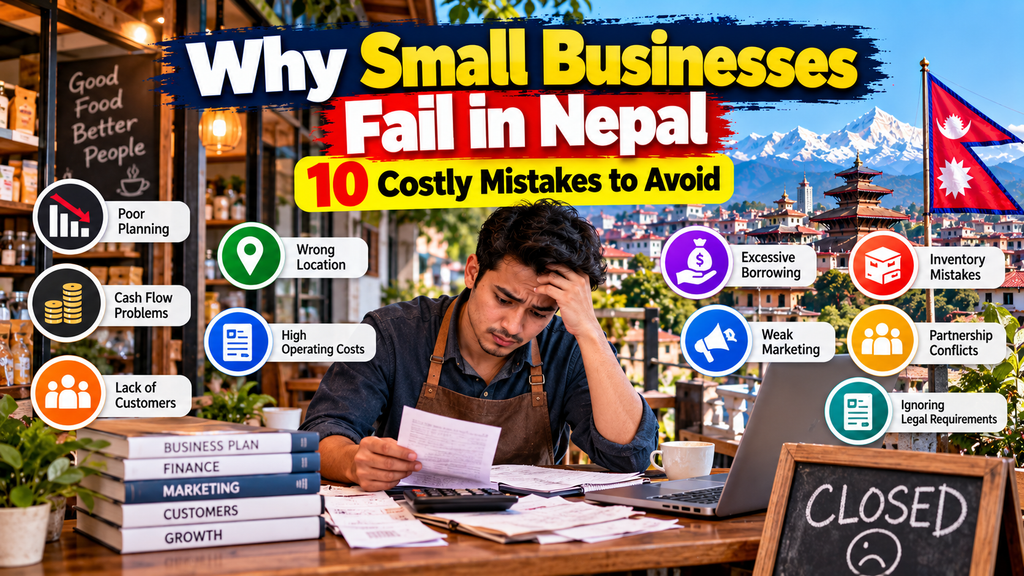
Starting a small business in Nepal can be an exciting opportunity. From opening a café in Kathmandu to launching a clothing store in Pokhara or starting an online business from home, entrepreneurship offers the possibility of financial independence, employment creation and long-term growth.
However, not every business survives.
Some businesses struggle because they cannot attract enough customers. Others generate sales but fail to manage cash flow, control expenses or repay borrowed money. Poor locations, weak partnerships, inadequate market research and inconsistent customer service can create additional problems.
Understanding why small businesses fail in Nepal is important for anyone planning to invest personal savings, borrow money or enter a business partnership.
The challenges are not purely theoretical.
In February 2026, the World Bank approved a US$95 million financing operation intended to expand access to finance for more than 100,000 small and medium enterprises in Nepal. The programme reflects the importance of addressing financing barriers and supporting business-led job creation.
Meanwhile, the World Bank’s October 2026 Nepal Development Update reported that the country’s gross non-performing loan ratio had reached 5.7% by mid-July 2026. This indicates pressure on loan repayment across the financial sector, although it does not measure the failure rate of small businesses.
Nepal’s business environment also faces challenges related to weak domestic demand, investment uncertainty, regulatory complexity and natural disasters.
Yet many business problems can be reduced through careful planning and disciplined management.
This article explains ten costly mistakes that can damage small businesses in Nepal, practical ways to avoid them and illustrative financial calculations to help entrepreneurs understand the risks.
Why Small Businesses Fail in Nepal: Understanding the Business Environment
Small businesses play an important role in Nepal’s economy.
They provide goods and services, create employment and support local communities.
Examples include grocery shops, restaurants, tailoring businesses, repair workshops, agricultural enterprises, tourism services and online retailers.
However, running a business requires more than providing a good product.
Owners must manage customers, employees, suppliers, money, regulations and competition.
What Does Business Failure Mean?
Business failure can describe several different outcomes.
A business may close because it cannot cover expenses.
It may become unable to repay debts.
The owner may decide to discontinue operations after repeated losses.
Some businesses close voluntarily for personal reasons, even when they are not insolvent.
Therefore, not every business closure represents bankruptcy or financial failure.
Is There an Official Business Failure Rate in Nepal?
A reliable national business survival rate requires data that follows businesses over time and records whether they remain active.
Nepal’s National Economic Census 2018 provides important information about establishments, but it should not be presented as a current 2026 business failure survey.
The World Bank’s Nepal Enterprise Survey 2023 provides evidence about business conditions and obstacles, but it does not establish that a particular percentage of all Nepalese startups fail.
Entrepreneurs should be cautious about unsupported claims suggesting that most businesses fail within a fixed number of years.
What Does Recent Research Show?
A World Bank report published in 2025 estimated that micro, small and medium-sized enterprises contribute approximately 22% of Nepal’s GDP and account for more than 45% of jobs.
The same report highlighted limited access to credit, business informality and regulatory difficulties.
These findings demonstrate why the operating environment matters.
Business failure is not always the result of poor decisions by an individual entrepreneur. External economic conditions and structural barriers can also influence outcomes.
Nevertheless, understanding common management mistakes can help owners make better decisions.
1. Starting a Business Without Proper Market Research
One of the most costly mistakes is investing in a business before confirming that customers want its products or services.
A business idea may sound attractive, but enthusiasm alone does not prove demand.
Why Market Research Matters
Market research helps entrepreneurs understand customer needs, purchasing behaviour, competitors and local conditions.
For example, opening a premium coffee shop near a university may appear promising.
However, students may prefer lower-priced drinks, and existing cafés may already satisfy demand.
Without research, the owner could invest in equipment, furniture and premises that do not match customer preferences.
Common Market Research Mistakes
Some entrepreneurs rely only on opinions from friends and relatives.
Others assume that a successful business in Kathmandu will perform equally well in a smaller town.
Another mistake is copying a popular business without understanding why customers choose it.
How to Avoid This Mistake
Begin by identifying a specific customer group.
Speak with potential customers and observe competing businesses.
Compare product quality, service, convenience and pricing.
Where practical, test the concept on a small scale.
A food entrepreneur might conduct a limited product trial before committing to a full restaurant.
Practical Example
Suppose an entrepreneur wants to open a takeaway food business.
Instead of immediately renting premises, the entrepreneur tests a small menu with customers through an appropriately compliant pilot operation.
The trial may reveal which products attract repeat orders and which are unpopular.
This information can support better decisions about menu design, ingredients and equipment.
Key lesson: Customer demand should be tested before making major financial commitments.
2. Poor Financial Planning and Underestimating Startup Costs
Another major reason why small businesses fail in Nepal is inadequate financial planning.
Many entrepreneurs calculate the money required to open a business but overlook the cost of keeping it operational.
Startup Costs Are Only the Beginning
Opening a business may involve premises, equipment, inventory, registration, furnishings and initial marketing.
After opening, the business may need to pay rent, wages, utilities, suppliers, maintenance and other recurring expenses.
A business can run out of money even when its initial setup was completed successfully.
Capital Expenditure and Operating Expenditure
Capital expenditure generally relates to acquiring or improving longer-term assets.
Operating expenditure relates to ongoing business activities.
For a café, coffee machines and kitchen equipment may be capital expenditure.
Ingredients, wages and rent are operating expenses.
Entrepreneurs should distinguish these categories when preparing budgets.
Illustrative Startup Budget
Consider a hypothetical small café.
| Expense | Illustrative amount |
|---|---|
| Equipment | NPR 500,000 |
| Furniture and interior setup | NPR 250,000 |
| Initial inventory | NPR 80,000 |
| Premises deposit and initial rent | NPR 200,000 |
| Marketing and launch | NPR 40,000 |
| Professional and administrative allowance | NPR 30,000 |
| Working capital reserve | NPR 300,000 |
| Total planned funding | NPR 1,400,000 |
Important: These are invented planning assumptions for educational calculations, not verified market prices, legal fees or minimum startup requirements in Nepal.
The actual amount could be significantly different depending on the location, premises and business model.
Why Working Capital Matters
Working capital helps a business meet short-term obligations.
A business may purchase inventory today but receive customer payments later.
Without sufficient liquidity, it may struggle to pay suppliers and employees.
How to Avoid This Mistake
Prepare a startup budget and a separate monthly operating budget.
Include a reserve for unexpected expenses.
Estimate realistic sales rather than assuming immediate success.
Update financial forecasts as actual information becomes available.
Key lesson: A business needs enough money to operate, not merely enough money to open.
3. Failing to Manage Cash Flow
Cash-flow problems can threaten businesses even when their sales appear strong.
This is because sales revenue, accounting profit and cash available in the bank are different measures.
What Is Cash Flow?
Cash flow records money entering and leaving a business.
Cash inflows may include customer payments and financing.
Cash outflows may include supplier payments, wages, rent, loan repayments and taxes.
A profitable business can still experience a cash shortage if payments arrive too late.
Illustrative Cash-Flow Example
Assume a business records NPR 400,000 in monthly sales.
However, only NPR 260,000 is received during the month because some customers purchase on credit.
Suppose the business must make NPR 310,000 in cash payments during the same period.
Its net cash movement from these assumed transactions is:
NPR 260,000 − NPR 310,000 = negative NPR 50,000.
The business has a cash shortfall even though recorded sales are higher than the month’s cash payments.
This example is hypothetical.
Why Small Businesses Struggle With Cash Flow
Some owners allow customers to delay payments without setting clear terms.
Others purchase excessive inventory or withdraw money for personal expenses.
Businesses may also face seasonal demand.
For example, tourism-related businesses can experience uneven income throughout the year.
How to Improve Cash Flow
Maintain a cash-flow forecast covering upcoming receipts and payments.
Review outstanding customer invoices.
Negotiate reasonable supplier terms where appropriate.
Avoid unnecessary inventory purchases.
Keep a financial reserve where possible.
Separate Business and Personal Money
Mixing household spending with business cash makes it difficult to understand profitability.
Use appropriate separate accounts and maintain clear records.
Owners should document withdrawals and capital contributions.
Key lesson: Cash availability is essential for survival, even when sales appear healthy.
4. Choosing the Wrong Business Location
Location can strongly influence the performance of businesses that depend on physical customers.
A good product may struggle if customers cannot easily find or access the premises.
Why Location Matters in Nepal
Business locations differ in customer traffic, accessibility, competition and operating expenses.
A restaurant near offices may attract lunch customers.
A grocery shop in a residential neighbourhood may depend on local repeat purchases.
A tourism business may rely on visitors and seasonal demand.
The Danger of High Rent
Entrepreneurs sometimes choose expensive premises because the location appears prestigious.
However, higher rent creates greater pressure to generate sales.
A business must earn enough contribution from customers to cover rent and other fixed expenses.
Illustrative Location Comparison
Consider two hypothetical shop locations.
| Item | Location A | Location B |
|---|---|---|
| Monthly rent | NPR 80,000 | NPR 35,000 |
| Monthly sales | NPR 450,000 | NPR 320,000 |
| Contribution margin | 40% | 40% |
| Contribution before rent | NPR 180,000 | NPR 128,000 |
| Contribution after rent | NPR 100,000 | NPR 93,000 |
The more expensive location generates higher sales, but its additional rent reduces the advantage.
Other operating expenses still need to be deducted.
These figures are illustrative and do not represent actual rental markets.
How to Choose a Better Location
Study customer traffic at different times.
Assess visibility, accessibility and nearby competition.
Understand lease conditions and total occupancy costs.
Consider whether the business depends on walk-in customers or deliveries.
Online Businesses Also Need Location Planning
An online retailer may not need a premium storefront.
However, storage, supplier access and delivery logistics still matter.
Key lesson: The best location is the one that supports the business model at a sustainable total cost.
5. Incorrect Pricing and Poor Profit Margins
Many businesses focus on sales volume without understanding how much money they earn from each sale.
This can lead to prices that do not cover costs.
Understanding Cost-Based Pricing
A selling price should be informed by direct costs, operating expenses, market conditions and the value customers receive.
Simply copying a competitor’s price may be dangerous because the competitor may have different costs.
Food Business Example
Suppose a restaurant sells a meal for NPR 500.
Its assumed variable costs are:
| Cost component | Illustrative amount |
|---|---|
| Ingredients | NPR 170 |
| Packaging | NPR 20 |
| Payment and delivery-related costs | NPR 30 |
| Other variable costs | NPR 10 |
| Total variable cost | NPR 230 |
The contribution per meal is:
NPR 500 − NPR 230 = NPR 270.
The contribution margin is 54%.
This is not the restaurant’s final net profit.
Rent, salaries, utilities, depreciation, financing and other costs may still need to be covered.
The Danger of Excessive Discounts
Discounts can attract customers, but they also reduce revenue per sale.
A discount should be evaluated against the contribution remaining after variable costs.
How to Improve Pricing
Calculate the full cost structure.
Monitor gross profit and contribution margins.
Review prices when supplier costs change.
Evaluate whether customers perceive sufficient value.
Avoid competing only by offering the lowest price.
Key lesson: Higher sales do not guarantee higher profits.
6. Borrowing Too Much Money Without a Repayment Plan
Debt can help finance equipment, inventory and business expansion.
However, excessive borrowing can create serious financial pressure.
Why Debt Becomes Risky
Loan repayments may continue even when sales decline.
A business that depends on optimistic revenue forecasts may struggle during a weak trading period.
Interest rates, collateral requirements and repayment schedules also affect risk.
Nepal’s Business Financing Challenges
The World Bank’s February 2026 financing announcement highlighted inadequate collateral and limited credit histories as constraints affecting small and medium enterprises.
The World Bank approved US$95 million in support intended to improve financing access for more than 100,000 SMEs.
This programme is not evidence that every entrepreneur is eligible for a loan or guaranteed approval.
In September 2026, the International Finance Corporation also announced a risk-sharing facility intended to encourage lending to micro, small and medium enterprises.
These initiatives show that access to suitable financing remains an important policy issue.
Illustrative Loan Repayment Scenario
Suppose a business borrows NPR 500,000.
Assume a hypothetical annual interest rate of 12%, a fixed monthly repayment schedule and a three-year repayment period.
Under a standard amortising-loan calculation, the monthly payment would be approximately NPR 16,607.
This is an illustration, not a current bank quotation.
Actual loans may have different interest rates, fees, repayment structures and conditions.
Why Repayment Capacity Matters
Before borrowing, a business should estimate whether operating cash flow can cover loan payments.
It should also consider what happens if sales fall below expectations.
Borrowers must understand the full financing agreement, including collateral and consequences of default.
How to Avoid Excessive Debt
Borrow only for a justified business purpose.
Compare financing options.
Calculate repayments before signing agreements.
Prepare conservative cash-flow forecasts.
Do not rely on future sales growth that has not been demonstrated.
Key lesson: Borrowing should support a viable business, not conceal an unsustainable one.
7. Poor Inventory Management and Uncontrolled Waste
Inventory includes goods and materials held for production or sale.
Poor inventory management can create unnecessary costs and reduce available cash.
Excessive Stock
Buying too much inventory ties up money.
Products may become outdated, damaged or unsellable.
This is particularly important for fashion, electronics and perishable food businesses.
Insufficient Stock
Holding too little inventory can also create problems.
Customers may leave when products are unavailable.
Repeated stock shortages can damage trust.
Food Waste in Restaurants
Restaurants need to monitor ingredient purchases, storage, preparation and leftovers.
Poor portion control and inadequate forecasting can increase waste.
Food safety procedures must remain a priority.
Businesses should never attempt to reduce waste by using unsafe ingredients.
Basic Inventory Controls
Record purchases and stock movements.
Use suitable stock rotation methods, including first-in, first-out where appropriate.
For perishable food, expiry-based controls may be more suitable.
Conduct regular stock counts.
Investigate unusual losses.
Illustrative Inventory Example
Suppose a retailer purchases NPR 100,000 of goods.
At the end of a trading period, NPR 15,000 of those goods becomes unsellable.
The business has experienced a hypothetical inventory loss of NPR 15,000 before considering any recoverable value.
Such losses reduce the financial return from inventory investment.
How to Reduce Waste
Use sales records to forecast demand.
Order quantities based on realistic turnover.
Train staff in handling and storage.
Monitor expiry dates and product condition.
Key lesson: Inventory should support sales without unnecessarily consuming cash.
8. Weak Marketing and Failure to Understand Customers
A business cannot survive indefinitely without sufficient customers.
However, some owners assume that customers will arrive simply because a shop has opened.
Why Marketing Matters
Marketing communicates what a business offers, who it serves and why customers might choose it.
Effective marketing begins with understanding customer needs.
Common Marketing Mistakes
Businesses may target everyone rather than a specific audience.
They may spend money on advertising without measuring results.
Others focus on social media likes without tracking enquiries or purchases.
Customer Experience
Customer service influences repeat purchases and recommendations.
A restaurant may attract first-time visitors through advertising, but poor service can discourage them from returning.
Digital Marketing Opportunities
Websites, search engines and digital channels can help businesses communicate with customers.
However, the appropriate channels depend on the audience and the business model.
Entrepreneurs interested in online selling can read Eleven Nepal’s Online Business in Nepal 2026 guide to explore relevant business models.
This link opens the website’s search results rather than assuming an unverified article permalink.
Measuring Marketing Results
Track meaningful indicators such as customer enquiries, completed purchases, repeat customers and acquisition costs.
Do not assume that advertising exposure automatically produces profit.
How to Improve Customer Retention
Respond professionally to complaints.
Maintain consistent quality.
Provide accurate information about prices and products.
Use customer feedback to identify problems.
Key lesson: Sustainable demand requires both customer acquisition and customer satisfaction.
9. Poor Business Partnerships and Unclear Ownership
Partnerships can provide capital, skills and shared responsibilities.
However, disagreements may damage a business when ownership and decision-making arrangements are unclear.
Why Partnership Conflicts Occur
Partners may contribute different amounts of money or labour.
One partner may manage daily operations while another provides funding.
Problems can arise if partners have different expectations about profit sharing, salaries and decision-making.
Capital Contributions and Ownership
Capital contributions do not automatically determine ownership percentages in every possible arrangement.
Ownership should be established through an appropriate legal structure and properly documented agreements.
Important Partnership Questions
Before starting, partners should agree on:
- Each person’s capital contribution.
- Ownership percentages.
- Management responsibilities.
- Whether working partners receive salaries.
- Profit distribution and treatment of losses.
- Authority to approve spending and borrowing.
- Procedures for admitting or removing partners.
- Exit arrangements and dispute resolution.
Illustrative Partnership Example
Suppose three people contribute the following capital:
| Partner | Illustrative contribution |
|---|---|
| Partner A | NPR 300,000 |
| Partner B | NPR 200,000 |
| Partner C | NPR 100,000 |
| Total | NPR 600,000 |
Their contributions represent 50%, 33.33% and 16.67% of total capital respectively.
However, the partners may agree on a different lawful ownership arrangement based on responsibilities, intellectual property or other negotiated factors.
The agreement should clearly explain any difference between capital contributions and ownership.
How to Avoid Partnership Problems
Use a written agreement prepared or reviewed by an appropriately qualified professional.
Keep business accounts transparent.
Document major decisions.
Establish procedures for resolving disagreements.
Key lesson: Good relationships are valuable, but clear agreements protect everyone.
10. Ignoring Legal Requirements and Failing to Adapt
The final major mistake is operating without understanding applicable legal obligations or refusing to respond to changing market conditions.
Business Registration
Nepal has different registration procedures depending on the business structure and activity.
The Office of the Company Registrar provides information about company incorporation.
Other government bodies may be relevant to sole proprietorships, partnerships and regulated activities.
PAN and VAT Compliance
The Inland Revenue Department administers tax registration.
PAN and VAT are not identical.
VAT obligations depend on applicable rules, taxable activities and relevant conditions.
Entrepreneurs should not assume that every small business must register for VAT or that small businesses are automatically exempt.
Industry-Specific Requirements
Food businesses may need to comply with applicable food safety requirements.
Tourism operators, manufacturers and other businesses may face additional rules.
The relevant requirements depend on the activity and location.
The Cost of Ignoring Compliance
Non-compliance can create financial, legal and operational risks.
The consequences depend on the relevant law and circumstances.
Businesses should obtain reliable advice rather than relying on informal assumptions.
Failure to Adapt
Consumer preferences, technology and competition change over time.
Businesses that ignore feedback may lose customers.
For example, a retailer may need to improve product selection or customer communication as demand changes.
However, adaptation should be based on evidence rather than constantly following trends.
How to Avoid This Mistake
Review applicable regulations.
Maintain accurate financial and administrative records.
Monitor customer feedback.
Assess competitors and changing market conditions.
Update business plans when necessary.
For practical guidance, read How to Register a Business in Nepal: Essential Steps.
Key lesson: Compliance and adaptability are ongoing responsibilities, not one-time tasks.
How Economic Conditions Affect Small Businesses in Nepal in 2026
Individual management decisions are important, but the wider economy also influences business performance.
Economic Growth
The World Bank’s October 2026 Nepal Development Update estimated real GDP growth of 3.9% for FY 2025/26, compared with 4.4% in FY 2024/25.
This indicates continued expansion at a slower rate.
Growth conditions can influence customer spending and investment.
Weak Domestic Demand
The World Bank reported subdued private-sector credit growth despite relatively favourable liquidity conditions.
This reflects continuing weakness in domestic demand.
Small businesses may experience lower sales when households and firms reduce discretionary spending.
Financial-Sector Conditions
The gross non-performing loan ratio reached 5.7% by mid-July 2026.
This was a financial-sector indicator, not a small-business closure rate.
Nevertheless, banking-sector conditions can influence the availability and cost of financing.
Natural Disasters
Floods, landslides and other disasters can damage premises, inventory, roads and infrastructure.
The World Bank’s October 2026 assessment discussed the economic consequences of the August 2026 Rasuwa flood.
Business owners should consider location-specific disaster risks and appropriate continuity planning.
Why Resilience Matters
A business cannot eliminate every external risk.
However, emergency planning, appropriate insurance where available and diversified supply arrangements may help reduce disruption.
How to Calculate the Break-Even Point for a Small Business
Understanding break-even is one of the most useful financial skills for entrepreneurs.
Break-even is the level of sales at which total revenue covers the relevant total costs.
Break-Even Formula
Break-even units = Fixed costs ÷ Contribution per unit
Contribution per unit = Selling price − Variable cost per unit
Illustrative Restaurant Example
Suppose a small restaurant has the following assumed financial structure:
| Item | Amount |
|---|---|
| Average selling price per meal | NPR 400 |
| Variable cost per meal | NPR 160 |
| Contribution per meal | NPR 240 |
| Monthly fixed costs | NPR 240,000 |
Break-even meals:
NPR 240,000 ÷ NPR 240 = 1,000 meals per month.
Assuming 30 operating days, this is approximately 34 meals per day.
The calculation is simplified and assumes a consistent average price, variable cost and product mix.
Actual businesses may sell different products with different margins.
What Happens Below Break-Even?
Suppose the restaurant sells only 800 meals.
Total contribution would be:
800 × NPR 240 = NPR 192,000.
After NPR 240,000 in fixed costs, the illustrative operating result would be a loss of NPR 48,000.
What Happens Above Break-Even?
At 1,200 meals, total contribution would be NPR 288,000.
After the same fixed costs, the illustrative operating surplus would be NPR 48,000 before any additional expenses not included in the assumptions.
Why Break-Even Analysis Matters
Break-even analysis helps entrepreneurs understand required sales volumes.
It can also support pricing and cost-control decisions.
However, break-even analysis does not replace cash-flow forecasting.
A Practical Small Business Survival Checklist
Before investing in a business, entrepreneurs should review several important questions.
Customer Demand
Is there evidence that customers want the product or service?
Have potential customers been consulted?
Financial Planning
Are startup and operating costs clearly identified?
Is sufficient working capital available?
Pricing
Does the selling price provide enough contribution to cover fixed costs?
Cash Flow
Can the business pay its obligations on time?
Competition
What makes the business different or more suitable for its customers?
Operations
Are suppliers, inventory controls and staffing arrangements reliable?
Legal Compliance
Have relevant registration, tax and industry requirements been checked?
Risk Management
Is there a plan for unexpected costs, weak sales or operational disruption?
Entrepreneurs who cannot answer these questions should consider conducting further research before committing substantial capital.
A 90-Day Plan to Improve a Struggling Small Business
Not every struggling business needs to close immediately.
Some problems can be addressed through structured analysis and operational changes.
However, the appropriate response depends on the business’s financial and legal position.
Days 1–30: Understand the Financial Position
Review sales, expenses, debts and available cash.
Identify products or services with weak margins.
Prepare a short-term cash-flow forecast.
Check whether important payments are overdue.
Seek professional advice promptly if insolvency or serious repayment problems may exist.
Days 31–60: Improve Operations
Review supplier arrangements.
Reduce avoidable waste.
Assess staffing and scheduling against demand.
Improve customer service.
Test changes to products or marketing.
Days 61–90: Evaluate Results
Compare actual results with the original plan.
Review whether cash flow and contribution margins have improved.
Identify which changes should continue.
Consider restructuring, professional assistance or an orderly closure if the business remains unviable.
This is a planning framework, not a guarantee that financial difficulties can be resolved in 90 days.
Frequently Asked Questions About Why Small Businesses Fail in Nepal
1. Why do small businesses fail in Nepal?
Small businesses may struggle because of inadequate market research, poor financial planning, weak cash flow, excessive borrowing, unsuitable locations, pricing mistakes and external economic conditions.
2. What is the biggest mistake new entrepreneurs make?
There is no verified national ranking identifying one universal mistake. However, starting without validating demand or understanding costs can expose a business to substantial financial risk.
3. What percentage of small businesses fail in Nepal?
The reviewed sources do not establish a reliable national 2026 business failure percentage. Claims about a fixed failure rate should be checked against an appropriate longitudinal study.
4. Can a profitable business still fail?
Yes. A business can report accounting profit but lack sufficient cash to pay its obligations when due.
5. Why is cash flow important?
Cash flow determines whether a business can pay suppliers, employees, lenders and other obligations on time.
6. How much capital is needed to start a small business in Nepal?
There is no universal amount. Required capital depends on the business model, location, equipment, inventory, compliance requirements and operating expenses.
7. Is borrowing money to start a business risky?
Borrowing creates repayment obligations. The risk depends on loan terms, expected cash flow, collateral and the viability of the business.
8. Why do restaurants struggle financially?
Possible causes include weak demand, poor menu costing, excessive rent, food waste, labour inefficiencies and inconsistent service.
9. How can small businesses improve profitability?
Businesses can review pricing, reduce avoidable costs, improve operations and focus on products or services that generate sustainable contribution margins.
10. Is a business partnership better than starting alone?
Neither structure is automatically better. Partnerships can provide resources and skills but require clear agreements and effective decision-making.
11. Does every small business need VAT registration?
VAT obligations depend on applicable tax rules and business circumstances. Entrepreneurs should consult current Inland Revenue Department guidance.
12. Can online businesses also fail?
Yes. Online businesses face risks involving demand, competition, advertising expenses, delivery, customer trust and legal compliance.
13. How can entrepreneurs reduce inventory losses?
They can monitor stock, forecast demand, use appropriate rotation methods and investigate wastage.
14. Is location important for every business?
Location is especially important for businesses that rely on physical customers. Online businesses may place greater emphasis on logistics and digital accessibility.
15. What should a business owner do when sales decline?
Review demand, pricing, customer feedback, expenses and cash flow before deciding which changes are appropriate.
16. Can marketing save a failing business?
Marketing may improve customer acquisition, but it cannot reliably solve fundamental problems involving poor products, unsustainable costs or inadequate operations.
17. Why do businesses struggle to obtain bank loans in Nepal?
The World Bank has identified collateral requirements, limited credit histories and other financing constraints affecting smaller enterprises.
18. What is the break-even point?
It is the sales level at which the contribution generated covers fixed costs under the assumptions used in the calculation.
19. Should entrepreneurs keep operating a loss-making business?
That depends on the cause of the losses, available financing, future prospects and legal obligations. Professional advice may be necessary.
20. What is the best way to prevent business failure?
There is no guaranteed method. However, careful market research, financial planning, cash-flow management, customer service and legal compliance can help reduce avoidable risks.
Conclusion: How Can Entrepreneurs Avoid Small Business Failure in Nepal?
Understanding why small businesses fail in Nepal is an important part of becoming a responsible entrepreneur.
Many business problems begin before the first customer arrives.
Entrepreneurs may invest without adequate research, underestimate operating costs or borrow money without a realistic repayment plan.
Other problems develop after opening.
Weak cash-flow management, poor inventory controls, unsuitable pricing and inadequate customer service can gradually damage financial performance.
Partnership disagreements and legal non-compliance can create further risks.
However, small-business difficulties are not always caused by individual mistakes.
Nepal’s wider economic environment, financing constraints, infrastructure limitations and natural disasters can also affect businesses.
The World Bank’s 2026 financing initiatives demonstrate the continuing importance of improving access to finance for small and medium enterprises.
For entrepreneurs, the most practical approach is to begin with evidence.
Research customers before investing.
Calculate realistic costs and required sales.
Monitor cash flow regularly.
Maintain clear records and agreements.
Review performance and adapt when conditions change.
Most importantly, avoid assuming that a popular business idea is automatically profitable.
A sustainable business requires sufficient customer demand, disciplined financial management and the ability to respond to challenges.
The goal is not simply to open a business. It is to build one that can operate responsibly, serve customers and remain financially viable over time.
References and Credible Sources
1. World Bank (3 February 2026). Nepal: World Bank Approves $95 Million to Support Sustainable and Inclusive Finance.
2. World Bank (6 October 2026). Nepal Development Update.
3. International Finance Corporation (30 September 2026). World Bank Group Backs Nepal’s Small Businesses with Risk-Sharing Facilities to Create Jobs.
4. World Bank (2025). Nepal Country Partnership Framework Supporting Analysis. Discussion of MSMEs, business conditions and access to finance.
5. World Bank. Nepal Enterprise Survey 2023. Survey documentation and methodology.
6. National Statistics Office. National Economic Census 2018. Historical establishment data.
7. Office of the Company Registrar. Company Registration Information.
8. Inland Revenue Department. Taxpayer Guidance and VAT Registration FAQs.
9. Eleven Nepal. How to Register a Business in Nepal: Essential Steps (2026).
Editorial note: This article reflects information available as of 20 October 2026. All financial examples are hypothetical calculations, not verified current Nepalese prices, bank offers or business earnings. Business closure rates have not been invented. Readers should verify legal and financial obligations with relevant authorities and qualified advisers.

