

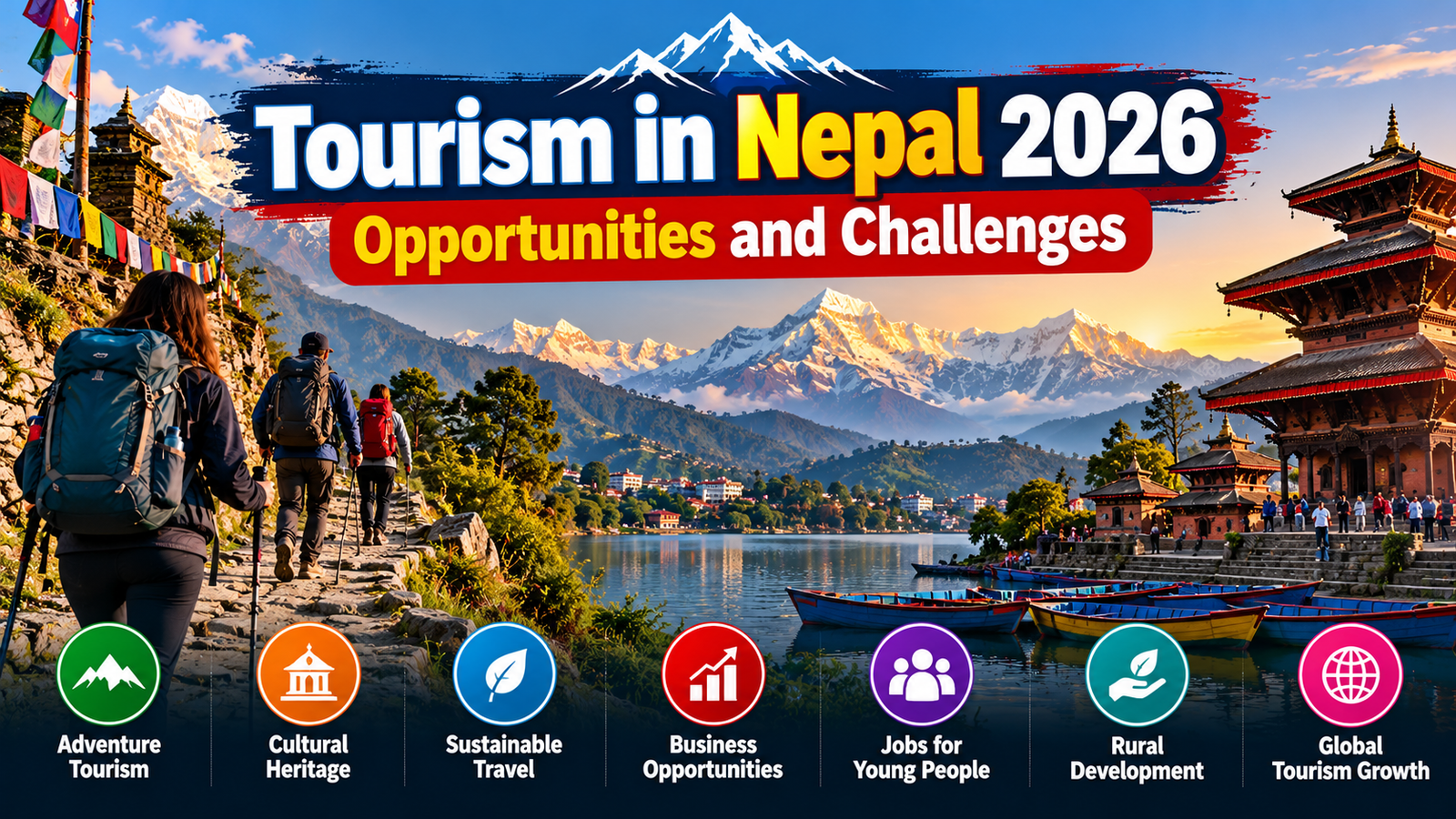
Kathmandu, 19 October 2026 | Eleven Nepal | Tourism & Economy
Tourism in Nepal 2026 presents significant opportunities for economic growth, employment, entrepreneurship and cultural exchange. With the world’s highest mountains, historic temples, diverse landscapes and distinctive traditions, Nepal remains an attractive destination for international travellers.
However, the tourism industry also faces serious challenges. Inadequate infrastructure, natural disasters, seasonal demand, environmental pressures and international travel disruptions can affect businesses and local communities.
Nepal’s tourism sector is therefore at an important stage. The country has opportunities to attract visitors beyond its traditional trekking destinations, create jobs for young people and develop sustainable businesses. Realising those opportunities requires investment, effective planning and stronger cooperation between government, businesses and communities.
According to the World Bank’s 2025 Nepal Country Economic Memorandum, tourism remains underdeveloped relative to Nepal’s natural and cultural potential. The organisation identifies better infrastructure, private investment and improved services as important priorities for expanding tourism-related economic activity.
Meanwhile, the Nepal Tourism Board has continued promoting adventure, cultural, spiritual and community-based tourism throughout 2026.
This article explores seven major opportunities, the challenges facing tourism in Nepal, current industry developments and practical strategies for building a more sustainable tourism economy.
Tourism in Nepal 2026: Current Situation and Visitor Trends
Nepal’s tourism industry has continued its recovery from the severe disruption caused by the COVID-19 pandemic.
The Nepal Tourism Board publishes monthly international visitor arrival reports, providing an official basis for monitoring travel trends.
As of 19 October 2026, the board’s public statistics collection includes monthly tourism insights through September 2026.
These reports help identify changes in arrivals, source markets and seasonal patterns. However, figures for the first nine months of the year should not be presented as the total for 2026.
What Do the Latest Tourism Statistics Show?
The Government of Nepal’s Nepal Tourism Statistics 2025 provides an official account of the preceding year’s tourism activity.
The report records approximately 1.16 million international tourist arrivals during 2025, demonstrating the substantial scale of the country’s international visitor market.
It also identifies India, China, the United Kingdom and Bangladesh among important source markets.
Tourism activity is not distributed equally across the country. Established destinations such as Kathmandu, Pokhara, Chitwan and major trekking regions continue to play important roles.
At the same time, destinations with cultural, spiritual and nature-based attractions offer opportunities to broaden Nepal’s tourism economy.
The Nepal Tourism Board’s January 2026 announcement of Nepal–ASEAN Tourism Year 2026 reflects an effort to strengthen tourism relationships with Southeast Asian markets.
The initiative highlights spiritual tourism, adventure travel, wellness, cultural experiences and community-based tourism.
Why Tourism Matters to Nepal
Tourism creates demand for services across multiple industries.
A visitor arriving in Nepal may spend money on accommodation, food, transport, guiding, trekking equipment, local products and cultural activities.
These expenditures can support hotels, restaurants, travel agencies, transport providers, farmers, artisans and other businesses.
Tourism can also provide employment opportunities for people with different educational backgrounds and skill levels.
For example, a destination may require trained chefs, receptionists, drivers, trekking guides, digital marketers, cleaners, maintenance workers and local suppliers.
However, the economic benefits depend on where tourists spend their money, how businesses source their products and whether local workers receive fair opportunities.
Increasing visitor numbers alone does not guarantee inclusive development.
1. Adventure Tourism and Himalayan Trekking
Adventure tourism remains one of Nepal’s strongest international attractions.
The country is home to Mount Everest, Annapurna, Manaslu, Langtang and numerous other mountain destinations.
Travellers visit Nepal for trekking, mountaineering, rafting, mountain biking and other outdoor activities.
The Nepal Tourism Board identifies the Everest, Annapurna and Langtang regions as established trekking destinations, while also promoting areas such as Kanchenjunga and Dolpo.
Opportunities for Trekking Businesses
Adventure tourism creates opportunities for local entrepreneurs and workers.
These include trekking agencies, licensed guides, accommodation providers, equipment shops, restaurants, transport services and specialist training businesses.
A trekking route can generate economic activity across several communities.
For example, visitors may purchase meals, accommodation and supplies in villages along a trail.
Local farmers can benefit when lodges buy vegetables, dairy products and other ingredients from nearby producers.
Craft producers may also sell traditional goods to visitors.
However, businesses should avoid assuming that every new trekking route will attract enough customers to become profitable.
Demand depends on accessibility, safety, accommodation standards, environmental conditions and marketing.
Opportunities Beyond Famous Routes
Nepal has potential to develop tourism in destinations that receive fewer international visitors.
Community-based walking routes, cultural trails and carefully managed nature experiences could help distribute tourism income more widely.
This approach may reduce pressure on heavily visited destinations while introducing travellers to different regions.
However, developing new destinations requires consultation with residents and environmental assessment.
Tourism should not damage fragile landscapes or exclude local communities from decision-making.
Safety and Trekking Regulations
Adventure tourism also involves significant risks.
Altitude sickness, unpredictable weather, landslides and difficult terrain can threaten visitors and workers.
The Nepal Tourism Board states that licensed guides and agency-issued TIMS cards are required on specified trekking routes under its revised trekking provisions.
Certain restricted areas also require special permits.
Travellers should verify requirements for their exact itinerary because rules differ by route and protected area.
Official source: Nepal Tourism Board – TIMS Card and Trekking Guidance
2. Cultural, Religious and Heritage Tourism
Nepal’s cultural diversity provides opportunities beyond mountain tourism.
Historic cities, temples, monasteries, traditional architecture, festivals and religious sites attract domestic and international visitors.
Kathmandu Valley, Lumbini and other heritage destinations offer experiences that combine history, spirituality and local culture.
Kathmandu Valley’s Cultural Attractions
Kathmandu, Patan and Bhaktapur contain important architectural and cultural sites.
Visitors can explore historic squares, temples, courtyards, traditional crafts and local food.
These experiences create opportunities for guides, restaurants, guesthouses, craft producers and cultural organisations.
Heritage tourism can also encourage investment in conservation and traditional skills.
However, tourism development must respect the religious and social significance of these places.
Historic sites are not simply commercial attractions. Many remain active places of worship and community life.
Lumbini and Spiritual Tourism
Lumbini, recognised as the birthplace of the Buddha, has considerable importance for Buddhist pilgrims and cultural travellers.
The World Bank identifies Lumbini and the wider Gandaki region as areas with tourism potential that could benefit from improved connectivity and investment.
Spiritual tourism may support accommodation, transport, local food businesses and guided cultural experiences.
There are also opportunities for educational tours and carefully designed wellness activities.
However, development should protect the authenticity of religious sites and avoid inappropriate commercialisation.
Festivals and Local Experiences
Nepal’s festivals, music, traditional clothing and regional cuisines can provide distinctive tourism experiences.
Visitors may be interested in learning about Newar culture, Tharu traditions, Himalayan communities and other aspects of Nepal’s diverse heritage.
Community-led cultural experiences can generate income while helping preserve local knowledge.
Such activities should be organised with the consent and participation of the communities involved.
Respectful tourism requires accurate interpretation, fair compensation and appropriate behaviour at cultural and religious sites.
3. Eco-Tourism and Sustainable Travel
Sustainable tourism is increasingly important as destinations respond to environmental pressures and changing visitor expectations.
Nepal’s national parks, forests, wetlands, mountains and wildlife habitats provide opportunities for nature-based travel.
Chitwan National Park and Bardia National Park are among the country’s well-known wildlife destinations.
Visitors may participate in guided nature walks, birdwatching and other activities operated under relevant conservation rules.
Opportunities for Eco-Friendly Businesses
Tourism businesses can differentiate themselves through responsible environmental practices.
Examples include reducing unnecessary plastic packaging, improving waste management, using energy-efficient equipment and sourcing suitable products locally.
Accommodation providers can also communicate environmental practices clearly to guests.
However, sustainability claims should be supported by genuine actions rather than marketing language alone.
A hotel should not describe itself as environmentally friendly simply because it asks guests to reuse towels.
Meaningful improvements may involve water management, energy consumption, purchasing practices and waste disposal.
Community-Based Tourism
Community-based tourism aims to involve local residents in planning and benefiting from tourism activities.
Examples may include homestays, guided village walks, agricultural experiences and locally operated cultural programmes.
This model can create opportunities for households that do not have the capital to establish large hotels.
It can also encourage tourists to spend money directly within communities.
Nevertheless, community-based tourism is not automatically sustainable.
Poor management, unequal distribution of income and environmental damage can undermine its benefits.
Transparent financial arrangements and local participation are therefore essential.
Protecting Natural Resources
Environmental conservation is particularly important in mountain destinations.
Unmanaged waste, pressure on water resources and damage to trails can affect both ecosystems and visitor experiences.
Businesses, local governments and tourism organisations can cooperate on waste collection, sanitation and visitor education.
Long-term tourism development depends on maintaining the natural assets that attract visitors in the first place.
4. Hospitality, Restaurants and Local Food Tourism
The hospitality industry provides opportunities for Nepalese workers and entrepreneurs.
Hotels, restaurants, cafés, guesthouses and catering businesses are important parts of the tourism supply chain.
Food tourism is especially relevant because visitors increasingly look for experiences that reflect local culture.
Nepal offers a diverse range of regional dishes, cooking techniques and food traditions.
Opportunities for Nepalese Restaurants
Restaurants can introduce visitors to traditional dishes such as momo, dal bhat, thakali meals, sel roti, yomari and regional specialities.
A strong food concept can combine authentic flavours with reliable hygiene, clear menus and professional service.
For entrepreneurs, tourism-related food businesses may include cafés, casual restaurants, cooking classes, food tours and speciality products.
However, opening a restaurant requires careful financial planning.
Owners must consider rent, equipment, ingredients, labour, licensing, utilities and seasonal demand.
A busy tourist location does not automatically guarantee profitability.
Employment and Skills Development
Hospitality businesses need workers with practical and professional skills.
These include food preparation, customer service, housekeeping, front-office operations, food safety, purchasing and management.
Training can improve service quality and create clearer career pathways.
English communication and additional foreign-language skills may be useful for customer-facing positions.
Digital skills are also important because travellers frequently research, compare and book services online.
Supporting Local Producers
Hotels and restaurants can strengthen local supply chains by purchasing ingredients from nearby farmers and producers where quality, safety and availability permit.
This can help spread tourism expenditure beyond businesses that directly serve visitors.
For example, a restaurant may create demand for locally grown vegetables, dairy products, herbs and traditional food products.
Strong supplier relationships can also improve menu identity and reduce dependence on distant sources.
5. Digital Tourism and Online Business Opportunities
Digital technology offers another important opportunity for tourism in Nepal 2026.
Travellers commonly use websites, search engines, maps, online reviews and social media to research destinations.
A business with a clear digital presence can communicate its services to potential customers before they arrive.
The Nepal Tourism Board’s September 2026 World Tourism Day programme emphasised digital transformation, artificial intelligence and tourism resilience.
This reflects growing interest in the role of technology within Nepal’s tourism industry.
Digital Marketing for Tourism Businesses
Small hotels, restaurants and travel agencies can benefit from accurate websites and online listings.
Useful information includes contact details, location, photographs, services, booking conditions and cancellation policies.
Search engine optimisation can help relevant pages become easier to discover.
For example, a trekking agency may publish detailed route information, safety guidance and preparation advice.
A hotel may provide clear information about rooms, facilities and transport.
A restaurant can publish an updated menu and opening hours.
However, online visibility depends on competition, content quality, technical performance and other factors.
Digital marketing does not guarantee bookings.
Opportunities for Young Entrepreneurs
Tourism-related digital services may include website development, photography, video production, social media management and booking support.
Young professionals with these skills can offer services to local tourism businesses.
Some may work independently, while others may establish agencies.
These opportunities are particularly relevant in destinations where businesses lack in-house digital expertise.
Entrepreneurs should still conduct market research and confirm that customers are willing to pay for their services.
Artificial Intelligence in Tourism
AI tools can assist with content preparation, translation, customer-service workflows and data analysis.
For example, a business might use software to organise common customer questions or draft multilingual information.
However, AI-generated travel information must be checked carefully.
Incorrect details about trekking permits, road conditions or safety requirements could create serious problems.
Human oversight remains essential, particularly for information affecting visitor safety.
6. Rural Tourism and Regional Economic Development
Tourism activity in Nepal is concentrated in certain destinations.
Expanding appropriate tourism opportunities beyond established centres could help create economic activity in additional regions.
Rural destinations may offer landscapes, agricultural traditions, cultural heritage and local hospitality experiences.
Opportunities for Rural Communities
Potential tourism enterprises include homestays, guided walking experiences, local restaurants, handicraft workshops and agricultural tourism.
These businesses may provide supplementary income to households that already depend on farming or other activities.
Tourism can also create demand for transport, construction, maintenance and local supplies.
However, the scale of these opportunities depends on actual visitor demand.
A village may have attractive scenery but still struggle to attract tourists if roads, sanitation or reliable accommodation are unavailable.
The Importance of Infrastructure
The World Bank identifies weak infrastructure and regional connectivity as major constraints on Nepal’s tourism development.
Road conditions, transport reliability, electricity, communications and sanitation influence both business operations and visitor satisfaction.
Investment in these services can benefit residents as well as tourists.
For example, a reliable road can improve access to healthcare and markets while also supporting tourism.
Development plans should therefore consider broader community needs.
Avoiding Unequal Development
Tourism investment can create tensions when benefits are concentrated among a small number of operators.
Landowners and larger businesses may be better positioned to benefit than workers or low-income households.
Inclusive planning should consider employment conditions, access to training, opportunities for women and participation by local entrepreneurs.
Community consultation is especially important when tourism development affects land use or shared natural resources.
7. Investment, Employment and Tourism Entrepreneurship
Tourism offers opportunities for private investment and business development.
Potential areas include accommodation, transport, adventure activities, food services, cultural experiences and technology.
The World Bank’s 2025 analysis describes tourism as a promising source of private-sector-led growth and employment.
However, it also identifies regulatory and infrastructure constraints that limit the industry’s potential.
Opportunities for Small Businesses
Tourism entrepreneurship does not always require a large hotel or resort.
Depending on location, regulations and demand, smaller businesses may provide services such as local food, guiding, laundry, transport coordination or equipment rental.
A business can also serve existing hotels and tour operators rather than selling directly to visitors.
For example, a laundry provider might serve guesthouses, while a food producer could supply restaurants.
These business-to-business opportunities are sometimes overlooked in discussions about tourism.
Opportunities for Returning Migrants
Nepalese workers returning from overseas may have experience in hospitality, food production, customer service, transport or management.
Some may be interested in applying these skills to businesses in Nepal.
International experience can provide useful knowledge of operating standards and customer expectations.
However, a successful overseas career does not automatically translate into a profitable business.
Returning migrants need to assess local demand, financing, competition and operating costs.
What Investors Should Consider
Before investing, entrepreneurs should investigate customer demand, seasonal fluctuations, legal requirements and the availability of trained workers.
They should also prepare realistic financial forecasts.
Important costs may include property, equipment, maintenance, utilities, insurance, marketing and working capital.
Businesses in remote locations should consider transport disruptions and emergency planning.
Financial decisions should be based on verified local quotations rather than broad national estimates.
Major Challenges Facing Tourism in Nepal 2026
Although Nepal has considerable tourism potential, several challenges could limit growth.
1. Transport and Infrastructure Problems
Difficult road conditions, limited connectivity and unreliable transport can affect visitor experiences.
These issues can also increase operating costs for tourism businesses.
Remote destinations may face particular difficulties during adverse weather.
Improving infrastructure requires coordinated planning, maintenance and investment.
2. Floods, Landslides and Climate-Related Risks
Natural disasters are a major concern for Nepal’s tourism industry.
The World Bank’s October 2026 Nepal Development Update describes significant disruption from the August 2026 floods.
According to the report, more than 200 hotels and restaurants were damaged across affected districts.
The report also identifies disruption to access routes serving destinations including Langtang, Gosaikunda and the Kailash Mansarovar corridor.
These events occurred ahead of Nepal’s important autumn tourism season.
The consequences extend beyond damaged buildings.
Road closures, cancelled trips, reduced bookings and concerns about safety can affect businesses and workers.
Recovery therefore requires both infrastructure repairs and reliable communication with travellers.
3. Seasonal Demand
Tourism activity changes throughout the year.
Weather conditions, holidays and trekking seasons influence demand.
Businesses that depend heavily on a short peak season may struggle with cash flow during quieter months.
Diversifying services and targeting suitable visitor groups may help reduce this dependence.
However, not every tourism product is suitable for year-round operation.
4. Environmental Pressure
Increased visitor activity can create pressure on waste management, water supplies, trails and natural habitats.
Poorly managed tourism may reduce the environmental quality of destinations.
Sustainable development requires investment in sanitation, conservation and responsible visitor behaviour.
5. Workforce Skills and Working Conditions
Tourism businesses require trained employees.
Skill gaps can affect customer service, safety and operational efficiency.
Employers may also face challenges retaining experienced workers.
Improved training, fair working conditions and career progression can help develop a more capable workforce.
6. International Travel Disruptions
Nepal depends partly on international aviation networks.
Changes in flight availability, airfares and geopolitical conditions can influence visitor arrivals.
In April 2026, the Nepal Tourism Board held discussions about the potential effects of the Middle East crisis on Nepal’s tourism industry.
The board highlighted the importance of Middle Eastern aviation hubs for travellers connecting from Europe and North America.
These developments demonstrate that Nepal’s tourism industry can be affected by events outside the country.
7. Competition and Destination Management
Nepal competes with other destinations for international visitors.
Travellers consider safety, cost, accessibility, service quality and available experiences.
Effective destination management therefore involves more than advertising.
Businesses and public institutions need to provide accurate information, maintain visitor facilities and protect natural and cultural attractions.
How the August 2026 Floods Affected Tourism
The August 2026 floods represent one of the most important recent challenges for tourism in Nepal.
The World Bank reports extensive damage to transport infrastructure and tourism businesses.
Affected roads and bridges disrupted access to several destinations, while the timing created additional concerns ahead of the autumn travel season.
The report also notes that several countries updated their travel advisories following the disaster.
However, this does not mean every destination in Nepal was inaccessible or unsafe.
Conditions can vary significantly between regions.
Visitors should check current information for their specific route rather than relying on general statements about the entire country.
What Tourism Businesses Can Learn
The floods highlight the importance of emergency planning.
Businesses should understand evacuation procedures, communication systems, insurance arrangements and alternative transport options.
Accommodation providers and tour operators should also communicate clearly about cancellations and changes to itineraries.
Reliable information can help visitors make informed decisions.
Building a More Resilient Industry
Tourism resilience involves the ability to prepare for, respond to and recover from disruptions.
This may require stronger infrastructure standards, better weather information and coordination between tourism operators and local authorities.
Recovery planning should also consider workers and small businesses that may lack substantial financial reserves.
Tourism in Nepal 2026: What Should Improve?
Nepal’s tourism development requires cooperation between government, private businesses and local communities.
Several practical priorities emerge from the available research.
Improve Regional Connectivity
Reliable transport and essential infrastructure can make destinations more accessible.
Investment decisions should consider maintenance, environmental risks and community benefits.
Develop a Skilled Tourism Workforce
Hospitality education, guide training, language skills and digital literacy can support service quality.
Training should connect with realistic employment opportunities.
Promote Responsible Tourism
Businesses can improve waste management, reduce environmental impacts and involve local communities.
Conservation should be treated as a long-term economic priority.
Strengthen Digital Information
Accurate websites, updated route information and clear visitor guidance can improve planning and confidence.
Digital tools should support, rather than replace, reliable human expertise.
Support Small Enterprises
Access to training, business information and appropriate finance can help small businesses participate in tourism.
Support programmes should be evaluated for measurable results.
Improve Disaster Preparedness
Tourism operators and public authorities need practical systems for responding to floods, landslides and other emergencies.
Visitor safety and local community protection should remain central priorities.
Is Tourism a Good Career in Nepal in 2026?
Tourism can offer careers in hospitality, guiding, travel operations, food services, transport, marketing and business management.
It may appeal to people interested in communication, cultural exchange, customer service and entrepreneurship.
However, job availability and salaries vary by employer, location, experience and season.
Young people considering tourism careers should research actual vacancies and training requirements.
Professional experience, communication skills and practical qualifications can help applicants compete for suitable roles.
For entrepreneurs, tourism may provide opportunities, but business success depends on customer demand, cost control and service quality.
A realistic business plan is essential.
Tourism in Nepal 2026 and Economic Development
The growth of tourism in Nepal 2026 presents opportunities for hotels, restaurants, transport providers and small businesses. Expanding tourism activity beyond established destinations could help distribute economic benefits to additional communities, provided development is carefully managed.
Tourism in Nepal 2026 and Youth Employment
One important aspect of tourism in Nepal 2026 is its potential to create employment for young people. Hospitality, food services, guiding, digital marketing and travel operations offer different career pathways, although job availability and working conditions vary by location and employer.
Tourism in Nepal 2026 and Sustainable Development
Protecting natural resources is essential for the long-term development of tourism in Nepal 2026. Responsible waste management, conservation measures and community participation can help destinations balance economic activity with environmental protection.
Tourism in Nepal 2026 and Digital Innovation
Digital technology can support tourism in Nepal 2026 by helping businesses provide accurate information, communicate with customers and manage bookings. Websites, digital marketing and carefully supervised AI tools may help smaller tourism enterprises reach new markets.
Challenges Facing Tourism in Nepal 2026
The future of tourism in Nepal 2026 depends partly on how effectively the industry responds to infrastructure problems, seasonal demand, natural disasters and environmental pressures. Stronger planning and cooperation between public authorities and businesses could improve resilience.
Related Articles on Eleven Nepal
Tourism development is closely connected to employment, entrepreneurship and digital skills in Nepal.
Readers interested in tourism entrepreneurship can explore our article How to Open a Cafe in Pokhara: 10 Easy Steps (2026).
For information about setting up a tourism-related company, read How to Register a Business in Nepal in 2026: 10 Essential Steps for Beginners.
Young people interested in careers within tourism and hospitality can also read Why Are Young Nepalese Leaving Nepal in 2026? 7 Major Reasons.
For returning migrants considering investment in tourism, our guide Business Ideas for Returnees in Nepal: 10 Smart Choices (2026) discusses several possible business opportunities.
Frequently Asked Questions About Tourism in Nepal 2026
1. How is tourism in Nepal performing in 2026?
Nepal Tourism Board has published monthly visitor-arrival information through September 2026. The sector continues to attract international travellers, although infrastructure problems, global travel disruptions and the August floods have created challenges. A full-year 2026 total is not yet available as of 19 October.
2. How many tourists visited Nepal in 2025?
The Government of Nepal’s Nepal Tourism Statistics 2025 reports approximately 1.16 million international tourist arrivals. Readers should consult the official publication for exact figures and statistical definitions.
3. What are the main tourism opportunities in Nepal?
Important opportunities include adventure tourism, cultural heritage, eco-tourism, hospitality, digital tourism, rural tourism and tourism-related entrepreneurship.
4. What are the biggest challenges for Nepal’s tourism industry?
Major challenges include transport infrastructure, natural disasters, seasonal demand, environmental pressures, workforce development and international travel disruptions.
5. Is trekking safe in Nepal in 2026?
Safety depends on the route, weather, altitude, individual preparation and current conditions. Travellers should check official advisories, obtain required permits and use licensed guides where regulations require them.
6. Can young Nepalese start tourism businesses?
Yes. Potential businesses include accommodation, food services, local experiences, guiding support and digital marketing. Entrepreneurs should verify licensing requirements, customer demand and startup costs before investing.
7. How can tourism support rural communities?
Tourism can create demand for accommodation, food, transport, local products and cultural experiences. The benefits depend on community participation, infrastructure and responsible business practices.
8. What is sustainable tourism in Nepal?
Sustainable tourism aims to balance visitor experiences, environmental protection, cultural preservation and economic benefits for communities.
9. How did the August 2026 floods affect tourism?
The World Bank reports damage to more than 200 hotels and restaurants across affected districts and disruption to transport routes serving several tourism destinations. Conditions vary by region, and travellers should check current local information.
10. What is the future of tourism in Nepal?
Nepal has opportunities to expand tourism through better infrastructure, skilled workers, diversified destinations and sustainable investment. Future outcomes remain uncertain and will depend on implementation, environmental conditions and domestic and international economic developments.
Conclusion: Building a Sustainable Future for Nepal’s Tourism Industry
Tourism in Nepal 2026 demonstrates both the country’s remarkable potential and the challenges involved in developing a competitive, sustainable industry.
Nepal’s mountains, heritage sites, wildlife, local cuisines and cultural traditions provide opportunities for visitors and businesses.
Adventure tourism, hospitality, digital services, rural tourism and entrepreneurship could contribute to employment and regional development.
However, tourism growth cannot be measured only by the number of visitors.
Infrastructure quality, environmental protection, working conditions, community participation and disaster preparedness are equally important.
The August 2026 floods underline the vulnerability of tourism businesses and the need for resilient infrastructure and effective emergency planning.
Nepal’s long-term opportunity is to build a tourism industry that benefits visitors while supporting local communities and protecting the country’s natural and cultural heritage.
With coordinated investment, responsible business practices and reliable public services, tourism can remain an important part of Nepal’s economic development.
The central challenge is turning the country’s tourism potential into sustainable opportunities for people across Nepal.
References and Credible Sources
1. Nepal Tourism Board (2026). Nepal Tourism Insights: Monthly Reports, January–September 2026.
https://trade.ntb.gov.np/downloads-cat/nepal-tourism-statistics
2. Government of Nepal (2026). Nepal Tourism Statistics 2025.
https://giwmscdnone.gov.np/media/pdf_upload/Nepal%20tourism%20statistics%202025_ibddtm6.pdf
3. World Bank (2025). Unlocking Nepal’s Growth Potential: Nepal Country Economic Memorandum.
https://www.worldbank.org/en/country/nepal/publication/unlocking-nepal-s-growth-potential
4. World Bank (October 2026). Nepal Development Update.
https://www.worldbank.org/en/country/nepal/publication/nepaldevelopmentupdate
5. Nepal Tourism Board (2026). Nepal–ASEAN Tourism Year 2026 Announcement.
https://trade.ntb.gov.np/27th-anniversary-of-nepal-tourism-board-announcement-of-nepal-asean-tourism-year-2026
6. Nepal Tourism Board (2026). Nepal Celebrates World Tourism Day: Digital Transformation and Tourism Resilience.
https://trade.ntb.gov.np/nepal-celebrates-47th-world-tourism-day-highlighting-digital-transformation-and-tourism-resilience/
7. Nepal Tourism Board. TIMS Card and Trekking Regulations.
https://ntb.gov.np/plan-your-trip/before-you-come/tims-card
8. Nepal Tourism Board. Restricted Area Trekking Permits.
https://ntb.gov.np/en/plan-your-trip/before-you-come/trekking-permit
9. Nepal Tourism Board (2026). Nepal Plans Strategic Measures Amid Middle East Crisis.
https://trade.ntb.gov.np/nepal-plans-strategic-measures-amidst-middle-east-crisis/
Editorial note: Information is current to 19 October 2026. Tourism statistics, regulations, travel advisories and destination accessibility can change. Visitors should consult official sources before travelling.

