

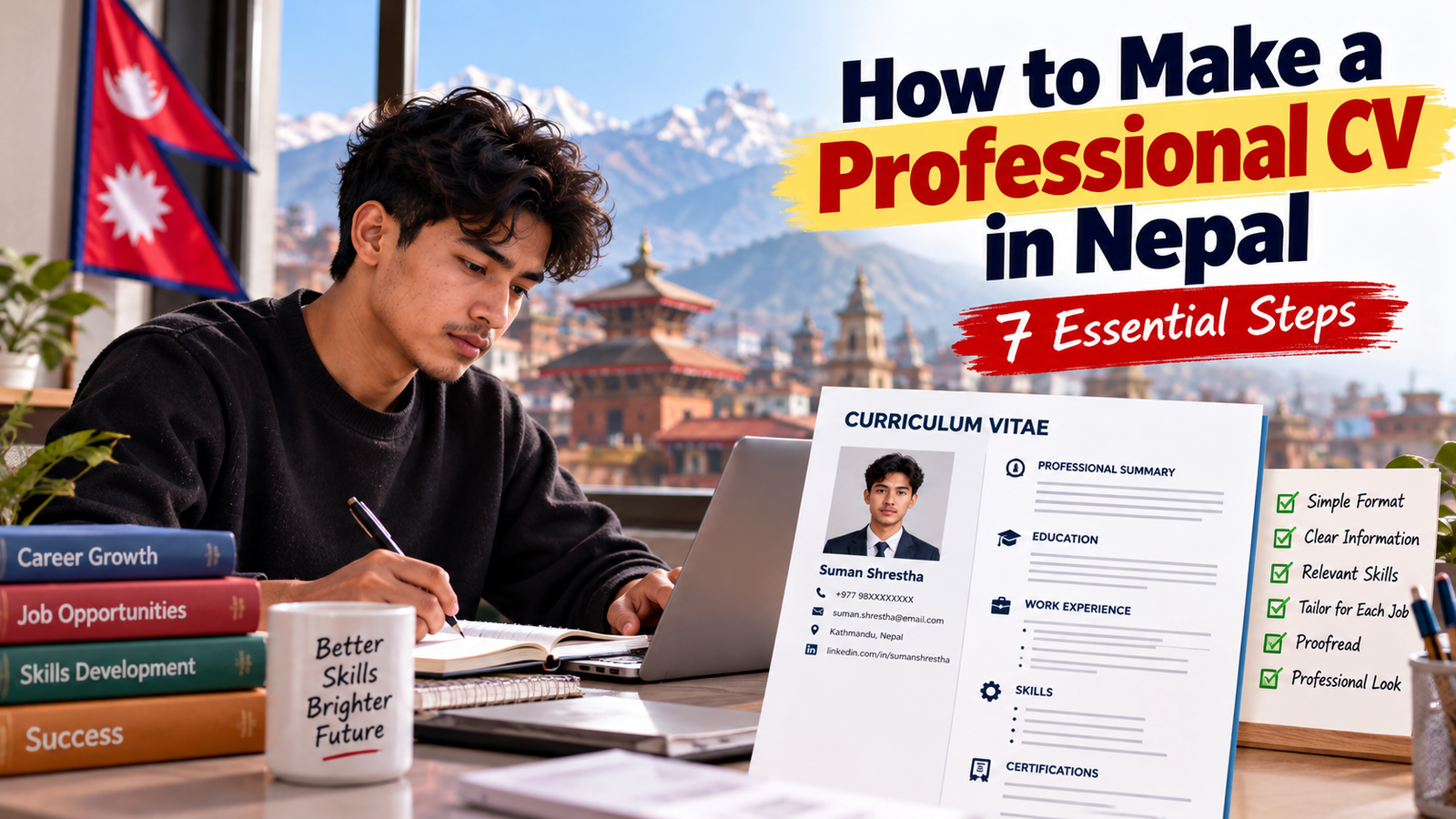

How to Make a Professional CV in Nepal: 7 Essential Steps
By Eleven Nepal Editorial Team | 14 October 2026
Learning how to make a CV in Nepal can improve the way students and fresh graduates present their qualifications to potential employers.
Young jobseekers in Nepal face challenges including limited employment opportunities, skills mismatches and competition for entry-level positions. Read our analysis of Nepal’s Youth Employment Challenges Explained to understand the wider employment situation.
Are you applying for your first job in Nepal but unsure how to prepare a professional CV? Whether you are a university student, fresh graduate or experienced employee, a well-written curriculum vitae (CV) can help you present your qualifications and make a positive first impression.
Understanding how to make a CV in Nepal is an important step towards finding employment. A professional CV should communicate your education, skills, experience and achievements clearly without unnecessary information.
This guide explains seven practical steps to creating an effective CV, including examples, formatting advice and common mistakes to avoid.
What Is a CV and Why Is It Important in Nepal?
A curriculum vitae, commonly called a CV, is a document summarising your educational qualifications, professional experience, skills and achievements.
Employers use CVs to evaluate whether applicants meet the requirements of a position before inviting suitable candidates for further assessment.
For jobseekers in Nepal, a CV may be requested when applying to banks, hotels, schools, NGOs, technology companies, government-related organisations and other employers.
However, different organisations have different application requirements. Always follow the instructions provided in the vacancy announcement.
How to Make a CV in Nepal: 7 Essential Steps
1. Start With Accurate Contact Information
The first section of your CV should contain the information an employer needs to contact you.
Include your full name, professional email address, telephone number and current city or district. You may also include a LinkedIn profile or online portfolio if relevant.
For example:
Name: Suman Sharma
Location: Pokhara, Nepal
Phone: +977-98XXXXXXXX
Email: suman.sharma@example.com
LinkedIn: linkedin.com/in/yourprofile
Avoid sharing unnecessary sensitive information such as citizenship numbers, bank details or a complete residential address unless legitimately required.
Some Nepalese employers may request photographs or additional personal details. Check the vacancy instructions rather than assuming these are mandatory for every application.
2. Write a Strong Professional Summary
When considering how to make a CV in Nepal, your professional summary should reflect the specific job you are applying for.
A professional summary introduces your qualifications, interests and career goals.
Keep it concise, ideally two to four sentences, and adapt it to the position.
Example for a fresh graduate:
“Motivated Bachelor of Business Studies graduate with knowledge of accounting, Microsoft Excel and customer service. Developed teamwork and communication skills through university projects and volunteer activities. Seeking an entry-level administrative or finance position where I can contribute and continue developing professionally.”
Avoid generic statements that do not explain what you can offer an employer.
Further Reading and CV Resources
3. Present Your Educational Qualifications
Education is particularly important when preparing a CV without previous employment experience.
List your most recent or highest relevant qualification first.
Example:
Bachelor of Business Studies (BBS)
Tribhuvan University, Nepal
2022–2026
Relevant coursework: Financial Accounting, Business Management and Marketing.
If you are still studying, indicate your expected graduation date rather than claiming to have completed the qualification.
You may also include academic projects, scholarships or relevant achievements.
4. Highlight Relevant Skills
Understanding how to make a CV in Nepal also involves selecting relevant technical and transferable skills.
When learning how to make a CV in Nepal, identifying your strongest skills is essential.
Employers may look for both technical abilities and transferable skills.
Technical skills might include:
- Microsoft Word, Excel and PowerPoint
- Accounting software
- Digital marketing
- Graphic design
- Data analysis
- Programming or website management
Transferable skills might include communication, teamwork, organisation, problem-solving and time management.
Only include skills you genuinely possess. Where possible, explain how you have used them.
For example, instead of simply writing “leadership”, mention that you coordinated a university project or organised a student event.
5. Include Work Experience, Internships and Volunteering
You do not need years of professional experience to create a useful CV.
Part-time employment, internships, volunteering, freelance projects and university activities can demonstrate practical abilities.
Example:
Marketing Intern
ABC Digital Agency, Kathmandu
June–August 2026
- Assisted with preparing social media content.
- Supported customer communication and campaign planning.
- Helped organise digital marketing reports using Microsoft Excel.
This is an illustrative example, not a real person’s employment history.
Use action verbs such as developed, organised, assisted, managed and improved.
Where possible, include measurable achievements, but never invent performance figures.
6. Choose a Simple, Professional CV Format
A professional CV should be easy to read on both mobile devices and computers.
For most students and early-career applicants, one page can be sufficient. Two pages may be appropriate when you have substantial relevant experience.
Use readable fonts such as Arial or Calibri, consistent headings and clear spacing.
A reverse-chronological format, which presents recent education and experience first, is a practical starting point for many applicants.
Avoid excessive colours, decorative graphics and complicated layouts that distract from the information.
If an employer uses an applicant tracking system (ATS), a straightforward single-column layout may also help automated software process your document.
7. Customise and Proofread Before Applying
One of the most important CV-writing practices is tailoring your document to each job.
Read the vacancy carefully and identify the employer’s essential requirements.
If a hotel is recruiting a receptionist, highlight customer service, communication, reservation systems and language skills where applicable.
For an accounting position, relevant financial knowledge, Excel skills and attention to detail may deserve greater emphasis.
Before submitting your CV, check spelling, dates, formatting and contact details.
Save your document as a PDF unless the employer requests another format.
A professional filename might be:
Suman_Sharma_CV.pdf
Professional CV Format for Freshers in Nepal
Students and fresh graduates can use the following structure:
Full Name
City, Nepal | Phone | Professional Email
Professional Summary
Two or three sentences describing your qualifications, relevant strengths and career interests.
Education
Degree or qualification, institution and dates.
Relevant Skills
Technical abilities, communication skills and other job-related competencies.
Projects and Internships
Relevant academic work, training, volunteering or practical experience.
Certifications
Completed courses and professional training, where applicable.
Languages
Languages you can communicate in confidently.
References
Provide references when requested by the employer.
This structure can be adapted for different industries and levels of experience.
Common CV Mistakes to Avoid in Nepal
Anyone learning how to make a CV in Nepal should avoid exaggerated qualifications, spelling mistakes and unnecessary personal details.
Even qualified candidates can weaken their applications through avoidable mistakes.
Common problems include spelling errors, outdated contact information, exaggerated qualifications and using the same generic CV for every position.
Other mistakes include unnecessarily long descriptions, unclear formatting and listing skills without supporting examples.
Do not copy another person’s CV word for word or claim experience you have not gained.
An accurate, targeted CV is more valuable than one filled with impressive but unsupported statements.
Free Tools to Create a Professional CV
Knowing how to make a CV in Nepal is an important career skill that can help jobseekers prepare more competitive applications.
Several digital tools can help jobseekers prepare their CVs.
Microsoft Word provides editable CV templates and formatting tools.
Google Docs allows users to create, edit and export documents online.
Canva offers visual CV templates, although applicants should avoid overly complex designs when applying through automated recruitment systems.
Choose a tool that allows you to produce a clean, readable document.
Frequently Asked Questions
How many pages should a CV be in Nepal?
One page is often suitable for students and fresh graduates. Two pages may be appropriate for experienced applicants. Follow any employer-specific instructions.
Is a photograph compulsory on a CV in Nepal?
Not universally. Some employers request photographs, while others do not. Include one only when appropriate or required.
Can I make a CV without work experience?
Yes. Focus on education, academic projects, volunteering, internships, certifications and relevant skills.
Should I write my CV in English or Nepali?
Follow the language requirements of the employer. English may be appropriate for many private-sector and international roles, while Nepali may be suitable for positions requesting applications in Nepali.
What is the best CV format for freshers?
A simple, clearly structured CV that highlights education, skills and relevant projects is usually a good starting point.
Conclusion
Learning how to make a CV in Nepal can help students, graduates and experienced workers present themselves more effectively to potential employers.
A strong CV does not require expensive software or an elaborate design. What matters most is accurate information, relevant skills, clear formatting and careful proofreading.
For Nepalese jobseekers, developing a professional CV is one practical step towards building a successful career.
Eleven Nepal encourages young people to invest in practical skills, professional development and informed career planning.

